Advance Tax and Self-Assessment Tax
Quarterly advance tax instalments and due dates, the ₹10,000 threshold and senior citizen exemption, Section 234C/234B/234A interest calculations, self-assessment tax settlement before filing, and Challan 280 payment mechanics
- Determine when advance tax is required using the ₹10,000 threshold test and identify the senior citizen exemption under Section 207(2)
- Calculate quarterly advance tax instalments with correct cumulative percentages and know the due dates for each instalment
- Estimate advance tax obligations for different income types — salary, interest, capital gains, rental, business, and dividend income
- Compute interest under Sections 234A (late filing), 234B (advance tax shortfall), and 234C (instalment shortfall) and apply the 90% threshold and tolerance rules
- Execute self-assessment tax payment through Challan 280 using the correct payment code and verify credit in Form 26AS before filing
Advance Tax and Self-Assessment Tax
Indian tax law expects you to pay tax as you earn — not in one lump sum at year-end.
The mechanism for this is advance tax: estimated quarterly payments throughout the year. When advance tax plus TDS doesn't cover your full liability, you pay the balance as self-assessment tax before filing your ITR.
Get the timing wrong, and Sections 234A, 234B, and 234C kick in with interest charges that can be substantial. A filer who simply pays everything in July when filing — without advance tax during the year — typically owes 1% per month interest on the shortfall, which adds up quickly on large amounts.
This lesson covers when advance tax is required, how to calculate the quarterly instalments, the deadlines, and the interest provisions that apply when you miss them. We also cover self-assessment tax (what you pay just before filing) and the practical mechanics of making tax payments through Challan 280.
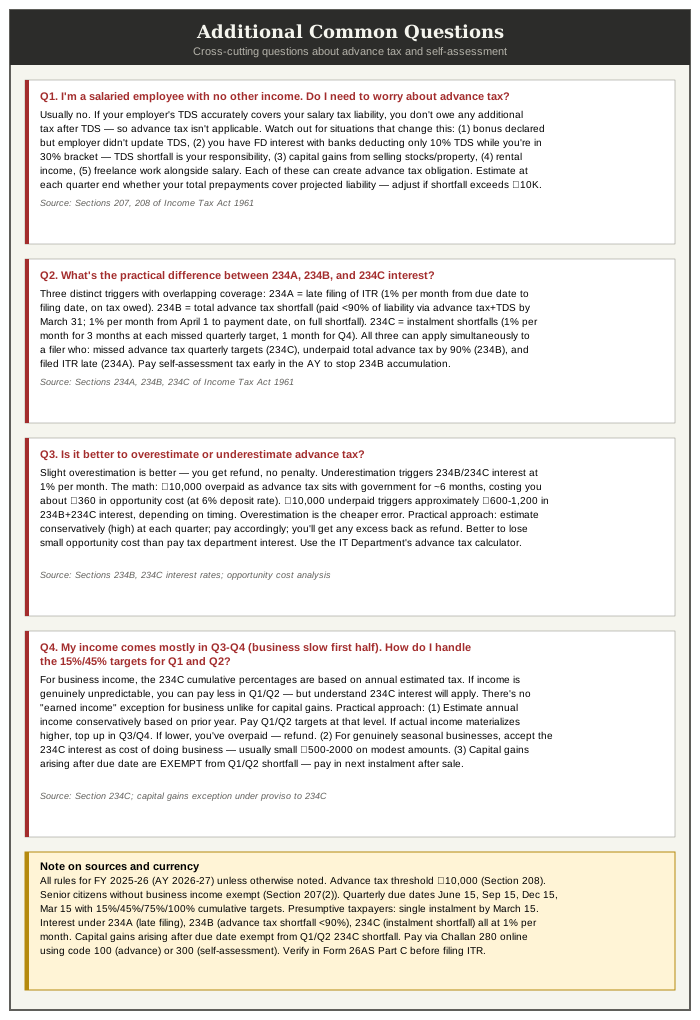
For salaried individuals with all income subject to TDS, advance tax obligations are often minimal. But the moment you add capital gains, rental income, business income, freelance work, or any income where TDS doesn't fully cover the tax, advance tax becomes essential.
A reminder on terminology: Income Tax Act 2025 (effective April 1, 2026) renumbers these sections but preserves the substantive framework. This lesson uses 1961 Act references applicable to FY 2025-26.
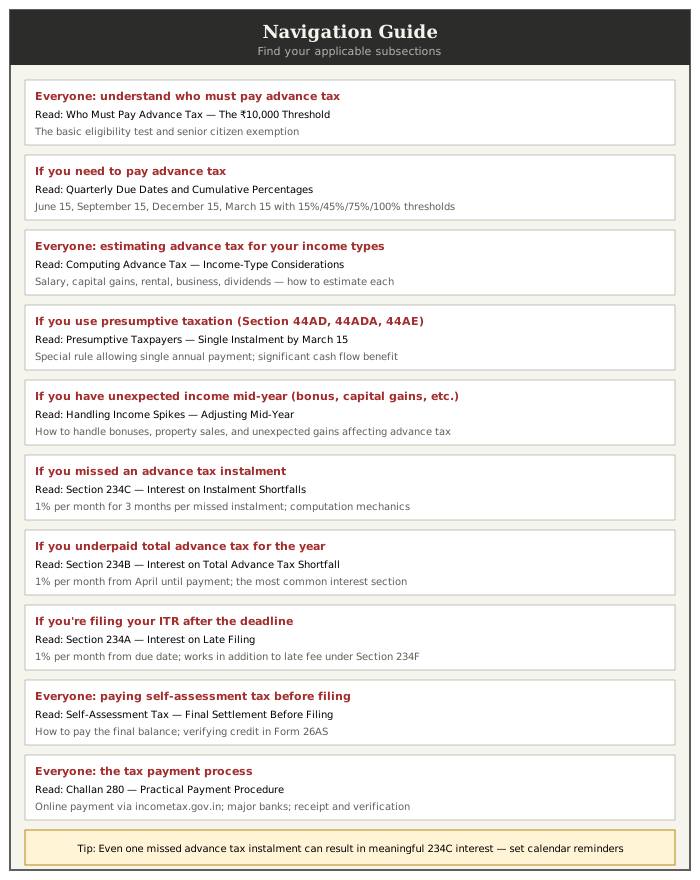
Who Must Pay Advance Tax — The ₹10,000 Threshold
Advance tax is required when your estimated tax liability for the year (after TDS, TCS, and any rebates) exceeds ₹10,000.
The threshold test.
- Compute estimated total tax liability for the year
- Subtract estimated TDS, TCS, MAT credit (if applicable), and Section 87A rebate
- If remaining amount exceeds ₹10,000 → advance tax required
Important exemption — Senior citizens without business income. Section 207(2) exempts senior citizens (60 or older) from advance tax obligation, PROVIDED they do not have income from business or profession. So a 65-year-old pensioner with interest, dividend, and rental income owes NO advance tax — they can pay everything as self-assessment tax before filing.
Who is NOT exempt.
- Anyone under 60
- Senior citizens with business or professional income
- Senior citizens running a partnership/proprietorship
- Senior citizens doing F&O trading (which is PGBP)
Why this matters. Many salaried filers with significant non-salary income (capital gains, rental, dividends, interest) face advance tax obligations they don't anticipate. The ₹10,000 threshold is reached quickly:
- Capital gains of ₹2 lakh from equity LTCG: tax ₹9,375 — under threshold
- Capital gains of ₹3 lakh from property LTCG: tax ₹37,500 — over threshold
- Rental income of ₹5 lakh net at 30% bracket: tax ₹1,50,000 — well over threshold
- Interest income of ₹5 lakh: TDS only ₹40,000 → balance ₹1,10,000+ over threshold
Practical estimation. At the start of each quarter, estimate your annual position:
- Total expected income for the year from all sources
- Total expected tax under your regime
- Total expected TDS to be deducted
- If (tax − TDS) exceeds ₹10,000 → make advance tax payments
Section 207-208 of Income Tax Act 1961; Section 207(2) senior citizen exemption.
Quarterly Due Dates and Cumulative Percentages
Advance tax is paid in four instalments throughout the year, with cumulative percentages building up to 100% by March 15.
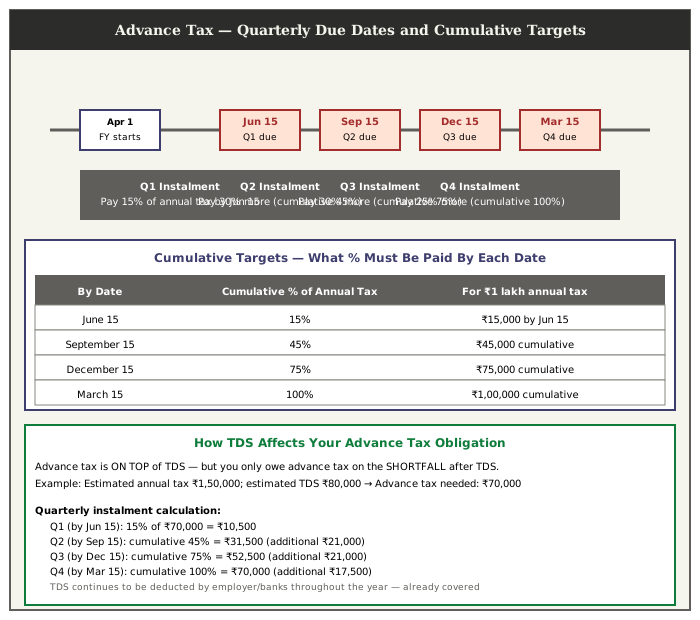
Priya has salary income with TDS that covers her salary tax. She also has: LTCG on equity sold in October 2025: ₹4 lakh (post ₹1.25L exemption = ₹2.75L taxable at 12.5% = ₹34,375 tax) Total annual tax over and above salary TDS: ₹34,375 Since this exceeds ₹10,000 threshold, advance tax applies. Quarter-by-quarter obligation: Q1 (Jun 15): Sale hadn't happened. No advance tax due yet (estimated additional liability was nil). Q2 (Sep 15): Sale hadn't happened. No advance tax due yet. Q3 (Dec 15): Sale happened in October. By Dec 15, cumulative target is 75% of ₹34,375 = ₹25,781. Q4 (Mar 15): Cumulative target 100% = ₹34,375. If Priya doesn't pay by Dec 15 and Mar 15, she'll face 234C interest on the shortfall.
Section 211 of Income Tax Act 1961; CBDT advance tax computation guidance.
Computing Advance Tax — Income-Type Considerations
Different income types have different patterns that affect advance tax estimation.
Salary income.
- Predictable monthly amount × 12
- TDS already deducted — usually covers all tax on salary
- Generally no advance tax needed for pure salary if employer TDS is accurate
- Exception: if you declared low investments to employer (high TDS) — get refund; if declared high investments but didn't make them (low TDS) — pay advance tax
Interest income.
- Bank FD interest typically annualized at FY end
- Banks deduct 10% TDS (above thresholds) on interest credited
- If you're in 20% or 30% tax bracket, TDS doesn't cover full liability — balance is advance tax
- Estimate annual interest from each FD; project total; deduct anticipated TDS
Rental income.
- Annual figure usually predictable
- 30% standard deduction + actual home loan interest reduces taxable amount
- No TDS unless tenant covered under 194I/194-IB
- Estimate net rental income; apply your marginal rate
Capital gains.
- Unpredictable — depends on when you sell
- Once sale occurs, you know the gain; can pay advance tax in subsequent quarters
- Special rule: For capital gains arising AFTER the relevant due date, you have flexibility (covered below in "Handling Income Spikes")
Business/Professional income.
- Estimate based on prior year and current performance
- Quarterly review and adjustment
- TDS by clients (Section 194J at 10%) covers part of liability — balance is advance tax
- Self-employed professionals often face significant advance tax obligations
Dividend income.
- 10% TDS deducted by company if dividend exceeds ₹5,000
- TDS at 10% doesn't cover full liability for higher bracket filers
- Annual dividends from multiple companies aggregate — track total
Section 209 (computation of advance tax) of Income Tax Act 1961.
Presumptive Taxpayers — Single Instalment by March 15
A significant simplification exists for those using presumptive taxation (Sections 44AD, 44ADA, 44AE).
The rule. Presumptive taxpayers must pay 100% of advance tax in a single instalment by March 15. No quarterly schedule.
Why this matters.
- Single deadline to remember (vs four)
- No need to estimate quarterly — pay once at year-end with full visibility of annual income
- Significant cash flow benefit — money stays with you until March
Who qualifies for this benefit.
- Section 44AD presumptive business taxpayers
- Section 44ADA presumptive professional taxpayers
- Section 44AE goods transport business taxpayers
Important condition. You must actually be using presumptive scheme for the year. If you opt out and use regular books, the quarterly schedule applies.
Freelance designer using Section 44ADA: Gross receipts: ₹40 lakh Presumed income at 50%: ₹20 lakh Tax under New Regime: approximately ₹2,40,000 This designer must pay full ₹2,40,000 by March 15 (after factoring TDS already deducted by clients).
Strategy. Set aside funds in a separate account each month to ensure cash availability on March 15. ₹2,40,000 ÷ 12 = ₹20,000 per month earmarked.
Section 211(1)(b) of Income Tax Act 1961; CBDT clarifications for presumptive taxpayers.
Handling Income Spikes — Adjusting Mid-Year
Unexpected income mid-year creates advance tax challenges. The law has specific provisions for these situations.
The capital gains exception. For capital gains income, Section 234C provides relief: if a capital gain arises AFTER the due date of an instalment, the shortfall for that instalment is not penalized as long as the tax on that capital gain is paid in subsequent instalments.
Q1 (Jun 15) and Q2 (Sep 15): No capital gains yet, no shortfall Q3 (Dec 15): Sale on Oct 15 results in ₹5 lakh LTCG Cumulative target by Dec 15 (75%) includes ₹46,875 (75% of LTCG tax) — must be paid by Dec 15 Q4 (Mar 15): Full 100% must be paid If sale happened on Dec 16 (one day after Q3 due date), the Q3 shortfall on that gain isn't penalized. By Q4 deadline (Mar 15), full tax must be paid.
Other income spike scenarios.
Year-end bonus. If you receive bonus in March exceeding what employer's TDS covered:
- Q4 deadline (March 15) requires 100% cumulative payment
- Often pushed to self-assessment tax after FY end
- 234B interest applies if not paid by March 15
Property sale. Large capital gain on property sale triggers significant tax:
- Plan advance tax instalment in the quarter following the sale
- Even better: Withhold the tax amount from sale proceeds for advance tax payment
Surprise inheritance creating taxable income. Inheritance itself is exempt, but income FROM inherited assets (rent, interest, dividends) is taxable. Adjust advance tax estimates after inheritance.
Tax on F&O profits. Trading profits can vary dramatically:
- Conservative: pay advance tax based on year-to-date profits at each instalment
- Quarterly review of position
- 234C interest may be unavoidable for inherently volatile income
Proviso to Section 234C(1)(b) of Income Tax Act 1961; CBDT capital gains and dividend instalment guidance.
Section 234C — Interest on Instalment Shortfalls
Section 234C charges interest at 1% per month for shortfalls in each advance tax instalment.
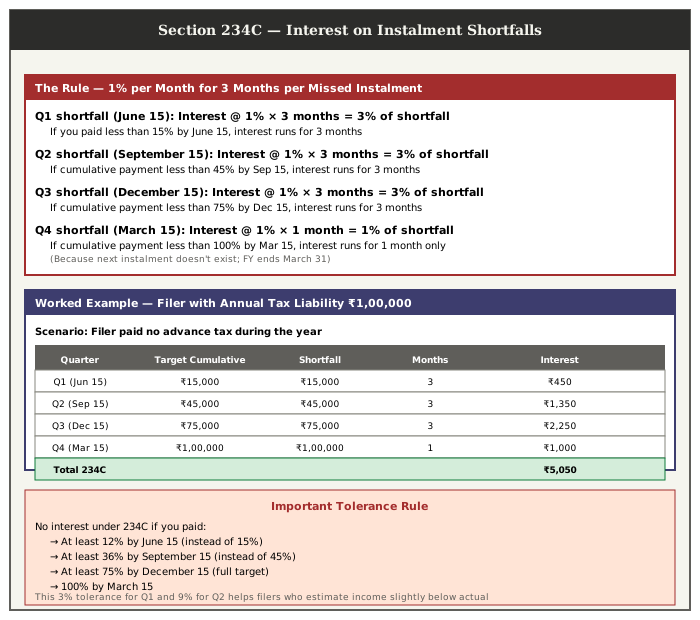
The tolerance rule. Important to remember: 234C interest doesn't apply if you paid at least 12% by Q1 (vs 15% target) and 36% by Q2 (vs 45% target). Q3 and Q4 must meet the full 75% and 100% targets respectively.
This tolerance accommodates filers who underestimate slightly. But miss by more than the tolerance, and 234C interest kicks in.
Section 234C of Income Tax Act 1961.
Section 234B — Interest on Total Advance Tax Shortfall
Section 234B charges interest at 1% per month from April 1 of the assessment year until the date of payment, on the total shortfall in advance tax for the year.
The rule. If you paid less than 90% of your total tax liability through advance tax + TDS by March 31, 234B interest applies on the shortfall.
Calculation.
- Interest = Shortfall × 1% × Number of months from April 1 to date of payment
- "Months" rounded up (any part of a month counts as full month)
- Continues to accrue until you pay (advance tax or self-assessment tax)
90% rule. Critical threshold:
- If you paid 90% or more of liability via advance tax + TDS by March 31 → no 234B
- If less than 90% → 234B applies on the entire shortfall
Total tax liability for the year: ₹1,00,000 TDS deducted: ₹40,000 Advance tax paid: ₹35,000 Total paid by March 31: ₹75,000 (75% of liability) Shortfall: ₹25,000 Since payment less than 90%, 234B applies. Interest from April 1 until self-assessment tax paid. If self-assessment tax paid on July 15 (filing day): Months: April, May, June, July = 4 months Interest = ₹25,000 × 1% × 4 = ₹1,000 If filed and paid in September: Months: April through September = 6 months Interest = ₹25,000 × 1% × 6 = ₹1,500
This compounds with 234A interest if also late filing. Filer who files in September pays both 234A (late filing interest) and 234B (advance tax shortfall) on the shortfall amount.
Strategy. If you find yourself short of advance tax target on March 15, consider making last-minute payment by March 31 to start the clock from April 1 with reduced shortfall.
Section 234B of Income Tax Act 1961.
Section 234A — Interest on Late Filing
Section 234A charges interest at 1% per month from the due date until the date of filing the return, on tax not paid by the due date.
The rule. Filing ITR after the due date (July 31 for individuals; October 31 for audit cases) triggers 234A.
Calculation.
- Interest = Tax due × 1% × Number of months from due date to filing date
- "Tax due" = tax payable after subtracting TDS, TCS, advance tax (i.e., the balance owed)
- If you owe nothing (all paid via TDS/advance tax), no 234A even if late
ITR due date: July 31, 2026 Actually filed: October 31, 2026 Tax balance owed: ₹50,000 Months late: 3 (August, September, October) 234A interest: ₹50,000 × 1% × 3 = ₹1,500
Important: 234A is in ADDITION to late filing fee under Section 234F. Both apply:
- 234A: Interest on balance tax owed
- 234F: Flat late fee (₹5,000 if income > ₹5L; ₹1,000 if ≤ ₹5L)
If you owe no tax (refund situation). 234A doesn't apply because there's no tax owed on which to charge interest. But 234F late fee still applies — pay it before filing.
No 234A if filing on time but tax not paid. Critical distinction: 234A applies only when ITR is filed LATE. If you file on time but underpaid advance tax, only 234B applies (not 234A).
Section 234A of Income Tax Act 1961.
Self-Assessment Tax — Final Settlement Before Filing
Self-assessment tax is what you pay AFTER computing final tax liability but BEFORE filing your ITR.
The mechanic.
- Step 1. Compute total tax liability for the year (all the steps from Lesson 6).
- Step 2. Subtract all prepayments: TDS (from Form 26AS Part A), TCS (from Form 26AS Part B), Advance tax paid (from Form 26AS Part C), MAT/AMT credit if applicable
- Step 3. If positive balance remains, this is self-assessment tax. Pay before filing.
- Step 4. If negative balance (overpayment), you get refund — no self-assessment tax.
When to pay. Best to pay just before filing — you'll have final numbers by then. Don't delay payment hoping to optimize timing; interest accumulates.
Payment method. Online through incometax.gov.in:
- e-Pay Tax → Challan 280
- Select "Self-Assessment Tax" (Code 300)
- Fill assessment year, PAN, contact
- Pay via net banking or card
- Save challan receipt
Verification. After payment:
- Self-assessment tax appears in Form 26AS Part C within 2-7 days
- Use the BSR code + challan number from receipt when filing ITR
- Don't file ITR until self-assessment tax is reflected (refund delays otherwise)
Some filers file ITR without paying self-assessment tax, planning to pay later. This is wrong — you must pay before/at filing. The portal allows you to enter unpaid amount, but you'll receive immediate demand notice.
Section 140A of Income Tax Act 1961.
Challan 280 — Practical Payment Procedure
The standard challan for income tax payments.
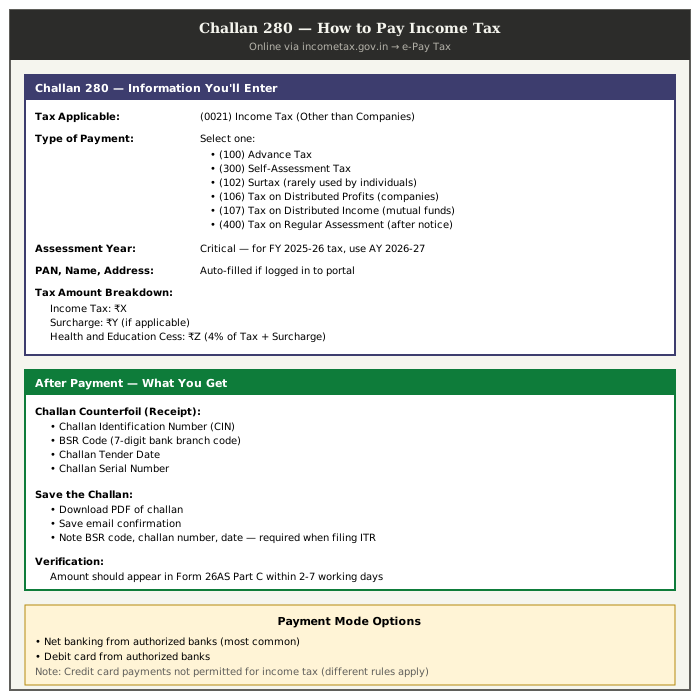
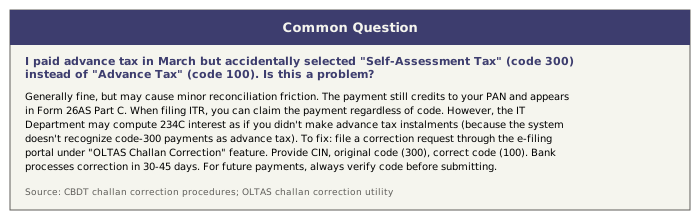
Critical: Use correct payment type code.
- Code 100 (Advance Tax): For instalments before March 31
- Code 300 (Self-Assessment Tax): For payment after March 31 to settle final liability
- Code 400 (Regular Assessment): Only after receiving tax demand notice
Using the wrong code creates reconciliation issues with Form 26AS. Code 100 used after March 31 may still post correctly but causes confusion.
CBDT Challan 280 procedures; OLTAS (Online Tax Accounting System).
End of lesson — Additional common questions
Key Takeaways
- Advance tax is required when estimated tax liability (after TDS, TCS, and rebates) exceeds ₹10,000; senior citizens aged 60 or above without business or professional income are exempt under Section 207(2) and can pay everything as self-assessment tax.
- Advance tax is due in four instalments — 15% by June 15, 45% by September 15, 75% by December 15, and 100% by March 15; presumptive taxpayers (Sections 44AD, 44ADA, 44AE) pay 100% in a single instalment by March 15.
- Section 234C charges 1% per month on instalment shortfalls, but tolerates 12% by Q1 (vs 15% target) and 36% by Q2 (vs 45% target) — Q3 and Q4 must hit 75% and 100% exactly.
- Section 234B charges 1% per month from April 1 until payment if you paid less than 90% of your total tax liability (advance tax + TDS) by March 31 — the 90% threshold is the critical cut-off.
- Section 234A charges 1% per month only when ITR is filed LATE — if you file on time but owe tax, only 234B applies; 234A is charged in addition to (not instead of) the Section 234F flat late filing fee.
- Self-assessment tax must be paid BEFORE filing ITR; use Challan 280 Code 300, not Code 100 (advance tax), and wait for the payment to appear in Form 26AS Part C before filing.
- For capital gains arising after an advance tax due date, Section 234C provides relief — the shortfall for that instalment is not penalized as long as the tax on that capital gain is paid in subsequent instalments.
Quiz — 4 Questions
Answer one at a timeDeepa is 62 years old and retired. Her income comes from FD interest (₹3 lakh), rental income (₹4 lakh), and dividend income (₹50,000). Her estimated tax liability for the year is ₹82,000. Does she have an advance tax obligation?