Income Sources: The Five Heads of Income
Indian tax law classifies all income into five distinct "heads" — categories with their own computation rules, deductions, and tax treatment. Every rupee of income must be assigned to exactly one head.
- Identify which of the five heads applies to each type of income you earn
- Trace the full computation path from each head's income to net tax payable
- Know the key deductions, exemptions, and special rates that apply to each head
- Apply intra-head and inter-head set-off rules, and understand carry-forward limits
- Reconcile AIS, Form 26AS, and TIS to catch discrepancies before filing
Lesson 3 — Income Sources: The Five Heads of Income
Indian tax law classifies all income into five distinct "heads" — categories with their own computation rules, deductions, and tax treatment. Every rupee of income must be assigned to exactly one head, and each ITR form computes income head by head before combining them into Gross Total Income.
Understanding the five heads is foundational. Different heads have different rules for:
- What qualifies as deductible expense
- What special rates apply (most income is taxed at slab rates, but capital gains have special rates)
- What set-off rules apply (which losses can offset which income)
- What forms must be filed
- What documentation must be maintained
This lesson covers each head at the conceptual level — enough to understand the framework. Deeper coverage of specific situations appears in dedicated lessons later: Lesson 10 (Salaries in depth), Lesson 12 (Business and Profession), Lesson 13 (House Property), and Lesson 20 (Capital Gains in depth).
The Income Tax Act 2025 (effective April 1, 2026) replaced the terms Previous Year and Assessment Year with the term "Tax Year". The five heads framework remains, with section numbers renumbered. This lesson uses Income Tax Act 1961 section references (which apply to FY 2025-26 income filed as AY 2026-27).
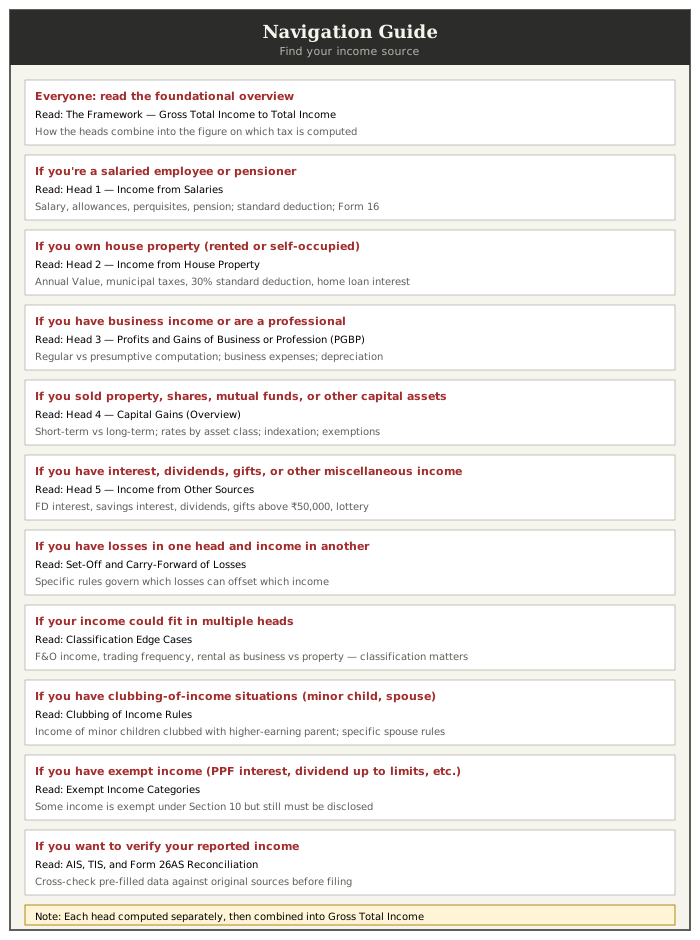
The Framework — Gross Total Income to Total Income
Before going into each head, understand how the heads combine into the tax computation framework.
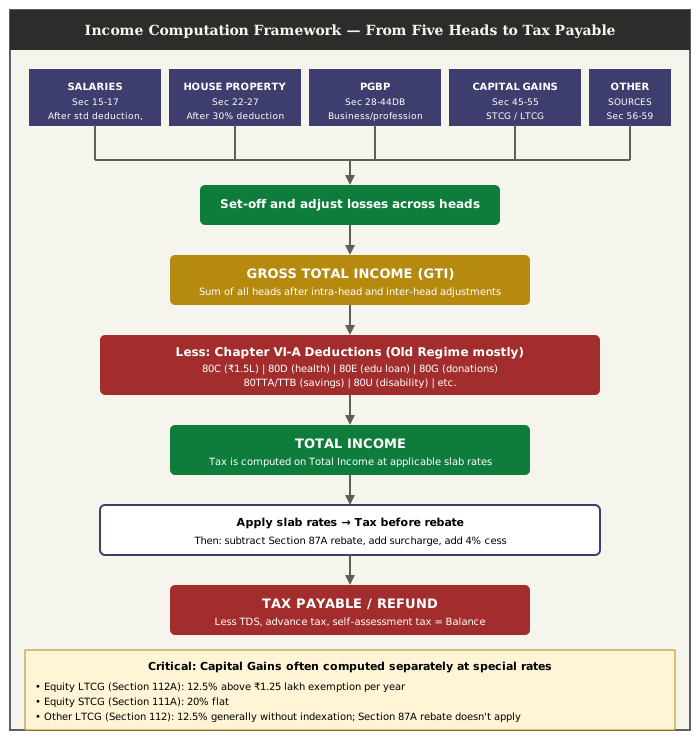
- Step 1 — Compute income under each head separately. Each head has its own computation rules. You may have income under one head (just salary), two heads (salary + interest from FDs), or all five heads (salary, rental, business, capital gains, and other sources).
- Step 2 — Apply head-level deductions. Each head allows specific deductions before arriving at the income for that head: Salaries: Standard deduction, professional tax, exempt allowances; House Property: Municipal taxes, 30% standard deduction, home loan interest; PGBP: Business expenses, depreciation; Capital Gains: Cost of acquisition, improvement costs, transfer expenses, exemptions (54, 54F, 54EC); Other Sources: Specific deductions for family pension, dividends, etc.
- Step 3 — Set off losses between heads (intra-head and inter-head). Specific rules govern which losses can offset which income. Some losses can only carry forward, not set off in the same year. Detailed in a dedicated section below.
- Step 4 — Arrive at Gross Total Income (GTI). Sum of incomes under all heads after set-off of losses.
- Step 5 — Apply Chapter VI-A deductions (Old Regime only mostly). Deductions under Sections 80C through 80U reduce GTI to Total Income. Most of these deductions are NOT available under the New Regime.
- Step 6 — Arrive at Total Income. GTI minus Chapter VI-A deductions. Tax is computed on Total Income.
- Step 7 — Apply Section 87A rebate. Reduces tax payable to zero for taxable income up to ₹12 lakh under New Regime (₹5 lakh under Old Regime).
- Step 8 — Add surcharge and cess. Surcharge for higher incomes; 4% Health and Education Cess on all (tax + surcharge).
- Step 9 — Adjust for TDS, advance tax, self-assessment tax. Final tax liability minus taxes already paid equals balance payable or refund.
Each Head Income → (head-level deductions) → Net Income under each Head → (set-off of losses) → Gross Total Income (GTI) → (Chapter VI-A deductions) → Total Income → (apply slab rates) → Tax Liability (before rebate) → (87A rebate, surcharge, cess) → Net Tax Payable → (less TDS, advance tax, etc.) → Balance Payable / Refund
Sections 14 (heads of income), 80A et seq (Chapter VI-A) of Income Tax Act 1961.
Head 1 — Income from Salaries
Income from Salaries covers all earnings from an employer-employee relationship — past, present, or future employers.
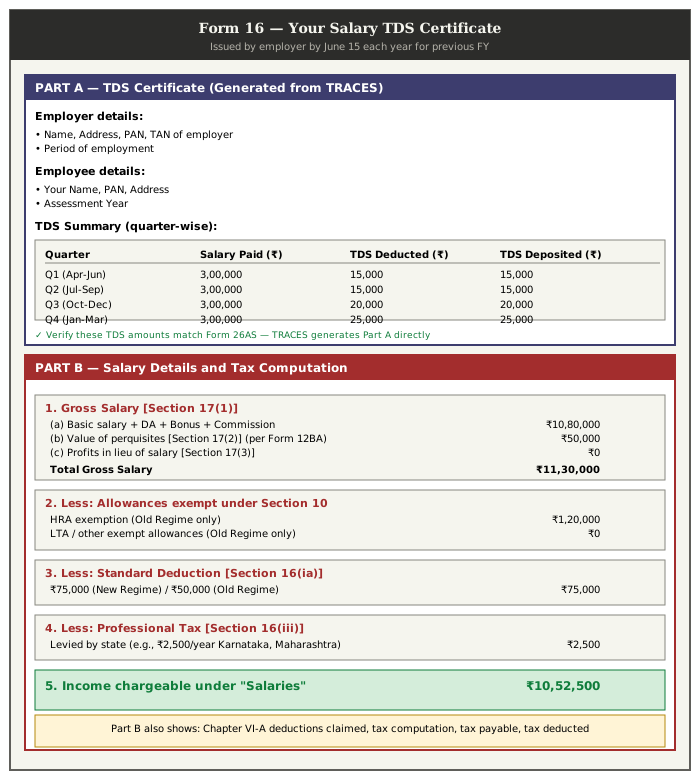
The primary document for salaried filers is Form 16. Here's its structure:
What's included as salary.
- Basic salary
- Dearness Allowance (DA)
- House Rent Allowance (HRA)
- Special allowances (conveyance, medical, etc.)
- Bonus and commission
- Leave Travel Allowance (LTA) / Leave Travel Concession (LTC)
- Perquisites (rent-free accommodation, company car, ESOPs, etc.)
- Profits in lieu of salary (compensation for loss of employment, etc.)
- Employer's contribution to recognized provident fund above limits
- Pension from former employer
- Gratuity, leave encashment (with exemptions)
Standard deduction. A flat deduction available to all salaried individuals and pensioners:
- New Regime: ₹75,000 (increased from ₹50,000 in Budget 2024, applies to FY 2025-26 onwards)
- Old Regime: ₹50,000
This applies automatically — no investment or expense proof required.
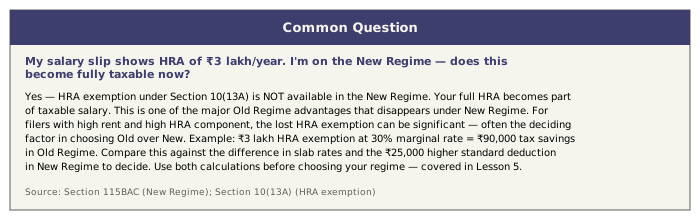
Allowance exemptions (Old Regime mostly, very limited in New Regime).
HRA (House Rent Allowance). Available only in Old Regime. Exemption is the least of:
- Actual HRA received
- 50% of basic salary (40% for non-metro cities)
- Actual rent paid minus 10% of basic salary
LTA (Leave Travel Allowance). Available only in Old Regime. Exemption for travel within India for self and family, twice in a block of 4 years. Covers only travel expense (not stay or food).
Conveyance Allowance. Specifically exempt up to limits in Old Regime; not in New Regime.
Other exempt allowances. Several specific allowances are exempt under Section 10(14) and Rule 2BB — uniform allowance, child education allowance up to ₹100/month per child (max 2 children), etc.
Perquisites. Non-cash benefits provided by employer. Some examples:
- Rent-free or concessional accommodation: Valued per specific rules
- Company-owned car for personal use: Specific valuation based on car size and usage
- Interest-free or concessional loans: Valued at SBI lending rate minus interest charged
- ESOPs: Difference between Fair Market Value at vesting and exercise price
- Medical reimbursements: Specific limits and conditions
Profits in lieu of salary. Compensation for termination, modification of employment, or similar — taxable as salary.
Pension taxation.
- Uncommuted pension (regular monthly pension): Fully taxable as salary
- Commuted pension (lump sum): Exempt for government employees; partially exempt for others (1/3 if gratuity received, 1/2 if not)
Gratuity.
- Government employees: Fully exempt
- Non-government covered by Payment of Gratuity Act: Least of actual gratuity, ₹20 lakh, or 15 days' last salary × years of service
- Non-government not covered: Different formula; subject to ₹20 lakh lifetime cap
Leave encashment on retirement.
- Government employees: Fully exempt
- Non-government: Least of actual amount, ₹25 lakh (lifetime cap increased Budget 2023), 10 months' average salary, or cash equivalent of 30 days × years of service
Form 16 — the salary document. Annual statement from employer with two parts:
- Part A: TDS details (tax deducted at source, deposited with government)
- Part B: Salary breakup, deductions, exemptions, taxable income, tax computation
Multiple employers in a year. Each employer issues a separate Form 16. Combine all for ITR filing. Each employer may have under-deducted tax (since they don't know about other employer's income); often results in self-assessment tax owed.
Sections 15-17 of Income Tax Act 1961; the "head of salary" under the Income Tax Act refers to one of the five income heads. Covered in Sections 15 to 17, this head includes all earnings from employment.
Head 2 — Income from House Property
Income from House Property covers income from owning property — whether actually let out (rented) or self-occupied. The computation has specific quirks that surprise first-time filers.
What's covered.
- Income from any building or land appurtenant thereto
- Owned by the assessee
- Not used for own business or profession
What's NOT covered.
- Property used for own business/profession (income falls under PGBP)
- Property held as stock in trade (income is business income)
- Vacant land (no building) — income falls under Other Sources
Computation framework.
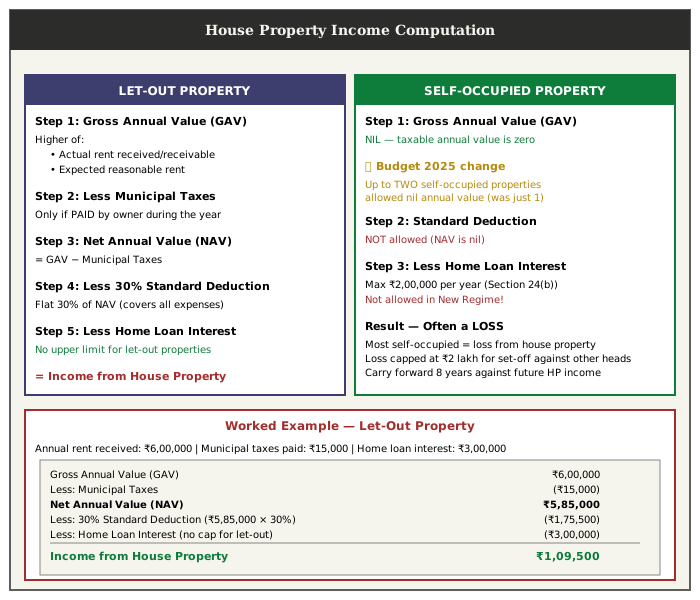
Gross Annual Value (GAV). For let-out property: Higher of actual rent received/receivable and expected reasonable rent (based on municipal valuation, fair rental, standard rent). For self-occupied property: GAV is Nil (taxable annual value treated as zero).
- Gross Annual Value (GAV)
- - Municipal Taxes paid by owner
- = Net Annual Value (NAV)
- - 30% Standard Deduction (on NAV)
- - Interest on Home Loan
- = Income from House Property
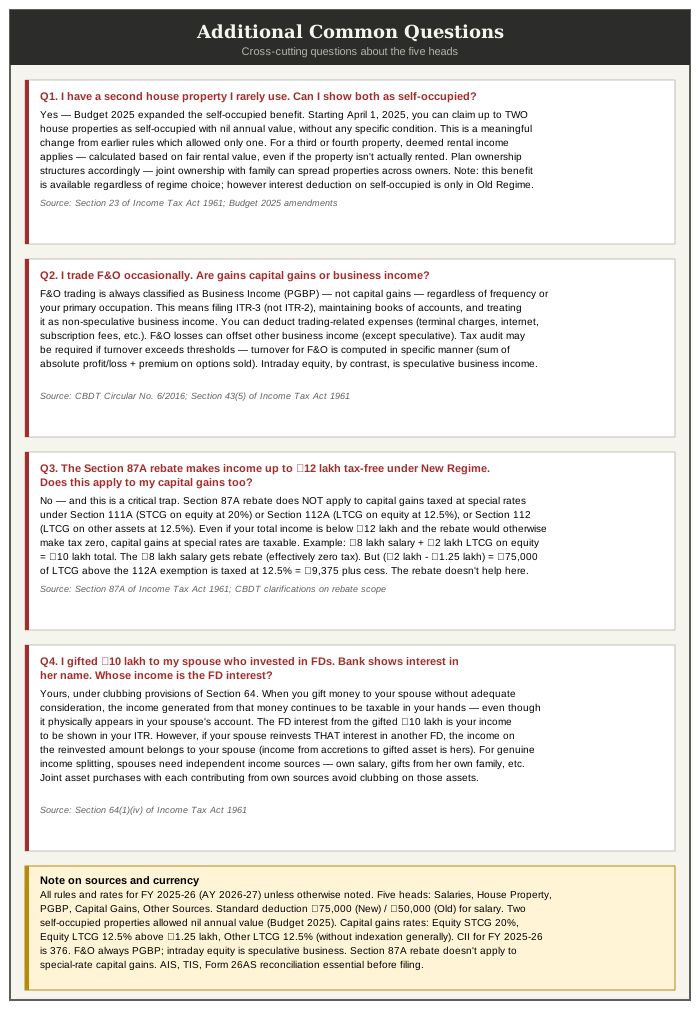
As per the Union Budget 2025, the government has changed the rules related to taxation of self-occupied house properties. Earlier, only one house could have nil annual value. But now, starting from April 1, 2025, a taxpayer can show their annual value as nil for two self-occupied properties (without meeting any specific condition). However, if someone owns more than two houses, the third and additional houses will still be taxed based on notional rent. This is a significant relaxation. Previously, only one property could be claimed as self-occupied with nil annual value; the second had deemed rent treatment. Now two properties can be treated as self-occupied; the third onwards have notional rent.
Municipal Taxes. Deductible only if actually paid by the owner during the year. If paid by tenant or unpaid, no deduction.
30% Standard Deduction. Flat 30% of Net Annual Value, available regardless of actual expenses incurred (covers repairs, maintenance, insurance, etc.). Not allowed for self-occupied property (since NAV is nil anyway).
Home Loan Interest Deduction.
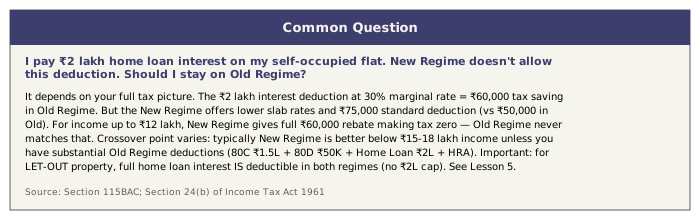
- Self-occupied property: Maximum ₹2 lakh per year (Section 24(b))
- Let-out property: No limit on interest deduction (any actual interest deductible)
- Pre-construction interest: Interest paid during construction period can be deducted in 5 equal installments starting from the year of completion (Section 24(b))
Under New Regime, interest deduction on self-occupied property is NOT allowed. Only interest on let-out property is deductible (with no limit, but loss set-off is restricted).
Loss from House Property. Common in early years of home loan when interest exceeds rent (for let-out) or when self-occupied has high interest.
- Set off against other heads of income same year: Maximum ₹2 lakh
- Excess loss can be carried forward for 8 years to set off against future house property income only
- Under New Regime, loss from house property cannot be set off against other income heads
Joint ownership. Income and deductions split based on ownership ratio per registered deed. If husband and wife are 50-50 co-owners, each reports 50% of rental income and 50% of interest deduction.
Sections 22-27 of Income Tax Act 1961; Budget 2025 amendments to Section 23.
Head 3 — Profits and Gains of Business or Profession (PGBP)
PGBP covers all income from carrying on business or professional activities — proprietary or as a partner in a firm.
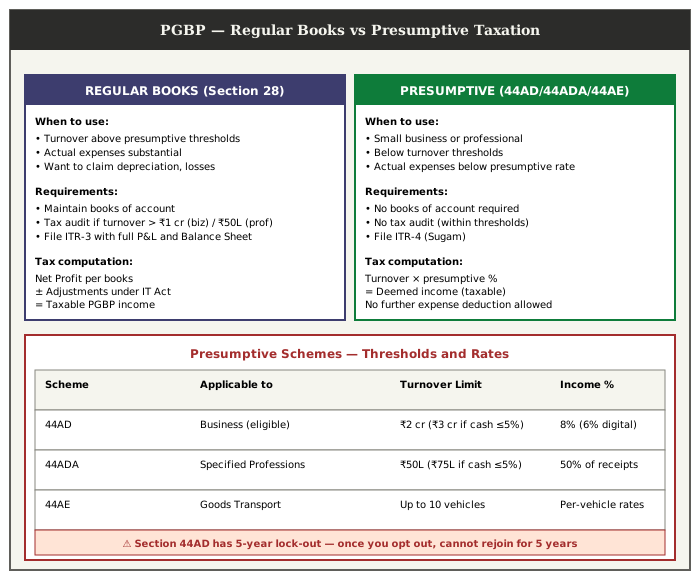
Two computation methods.
- Regular method (Section 28 et seq). Maintain books of accounts, compute actual profit after all business expenses.
- Presumptive method (Section 44AD, 44ADA, 44AE). Simplified computation for small taxpayers — presume income at specified percentage of turnover.
Regular method computation.
Common deductible expenses.
- Rent for business premises
- Salaries paid to employees
- Wages
- Repairs and maintenance
- Insurance premiums on business assets
- Interest on borrowed capital used for business
- Bad debts written off
- Professional fees (CA, lawyer, consultant)
- Office expenses, communication
- Travel for business purposes
- Depreciation on assets
Depreciation. Allowed at specified rates on tangible assets and intangible assets:
- Computers and software: 40%
- Vehicles: 15%
- Furniture: 10%
- Plant and machinery: 15%
- Buildings: 10% (residential), 10% (non-residential)
- Intangible assets (patents, copyrights): 25%
Additional depreciation of 20% available for new plant and machinery in eligible manufacturing/power generation businesses in the first year.
- Gross Receipts / Sales / Turnover
- - Direct expenses (cost of goods, materials)
- - Operating expenses (rent, salaries, utilities, etc.)
- - Depreciation
- - Other deductible expenses
- = Net Profit per Books
- ± Adjustments under Income Tax Act
- = Taxable Income under PGBP
Presumptive Taxation — Section 44AD. For small businesses with turnover up to ₹2 crore (₹3 crore if cash receipts ≤5%):
- Presumed income: 8% of turnover (6% for digital/banking transactions)
- No books of account required
- Cannot claim further expense deductions
- Cannot claim depreciation (deemed already considered)
Once opted, must continue for 5 years. Opting out makes you ineligible for 5 subsequent years. Also requires regular book-keeping and audit if turnover exceeds ₹5 crore.
Presumptive Taxation — Section 44ADA. For specified professionals with gross receipts up to ₹50 lakh (₹75 lakh if cash receipts ≤5%):
- Presumed income: 50% of gross receipts
- Eligible professions: Legal, medical, engineering, architectural, accountancy, technical consultancy, interior decoration, and notified professions
- No books of account required
- Cannot claim further expense deductions
Presumptive Taxation — Section 44AE. For transport businesses owning up to 10 goods vehicles:
- Heavy goods vehicle: ₹1,000 per ton per month per vehicle
- Other vehicles: ₹7,500 per month per vehicle
Audit Requirement (Section 44AB). Tax audit by CA required if:
- Business turnover exceeds ₹1 crore (₹10 crore if cash transactions ≤5%)
- Professional gross receipts exceed ₹50 lakh
- Presumptive scheme used but declared income is less than presumptive percentage
Speculative business and F&O.
- Intraday equity trading: Speculative business income
- F&O (Futures and Options): Non-speculative business income
- Both treated as PGBP (not capital gains)
- Specific set-off rules: Speculative losses can only be set off against speculative gains
Sections 28-44DB of Income Tax Act 1961; Sections 44AD, 44ADA, 44AE for presumptive taxation.
Head 4 — Capital Gains (Overview)
Capital Gains arise from the transfer of capital assets — property, shares, mutual funds, gold, jewellery, etc. The classification (short-term vs long-term) and the asset type determine the tax rate.
Capital Asset definition. Any property held by the assessee, whether or not connected with business or profession. Includes:
- Real estate (land, building)
- Shares, securities, mutual funds
- Gold, jewellery, precious metals
- Bonds
- Intangible assets (trademarks, patents)
NOT capital assets (excluded).
- Stock in trade (business inventory)
- Personal effects (clothing, furniture for personal use) — EXCEPT jewellery, archaeological collections, paintings, drawings, sculptures, art
- Agricultural land in rural areas (specific definition)
- Specific gold deposit bonds
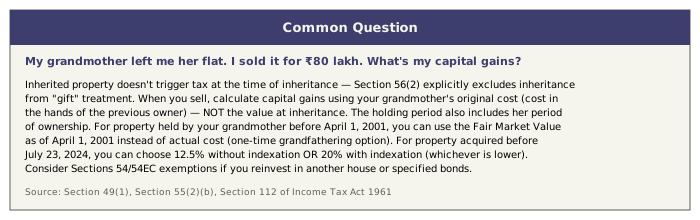
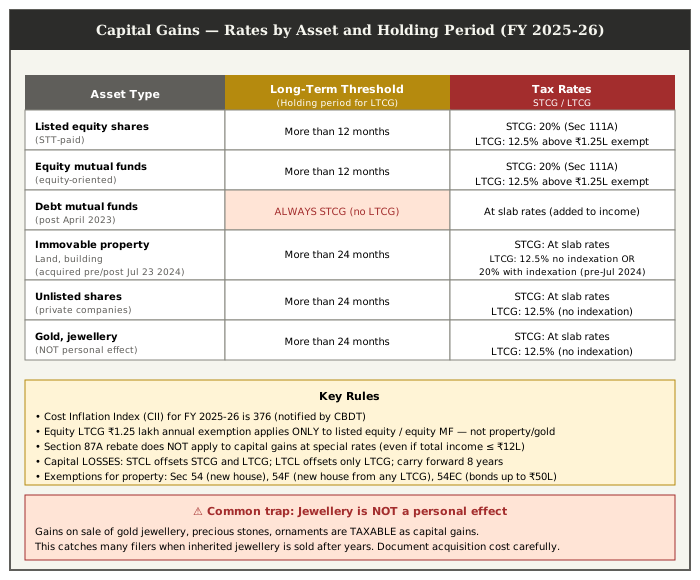
Jewellery is not a personal effect for tax purposes. Gains on the sale of gold jewellery, precious stones, or other ornaments are taxable as capital gains. This is a common oversight at the time of filing, particularly for inherited jewellery sold after many years.
Holding period classifications.
| Asset | Long-Term Holding Period |
|---|---|
| Listed equity shares | More than 12 months |
| Equity-oriented mutual funds | More than 12 months |
| Listed debentures, bonds | More than 12 months |
| Unlisted shares | More than 24 months |
| Immovable property (land, building) | More than 24 months |
| Other capital assets (gold, etc.) | More than 24 months |
| Debt-oriented mutual funds | Always treated as STCG (post April 2023) |
Capital Gains Tax Rates (FY 2025-26).
Listed equity shares and equity mutual funds (Section 112A for LTCG, Section 111A for STCG).
- STCG: 20% (increased from 15% in Budget 2024, applicable from July 23, 2024)
- LTCG: 12.5% on gains exceeding ₹1.25 lakh per year (increased from 10% in Budget 2024)
Immovable property.
- STCG: At slab rates
- LTCG: 12.5% without indexation (changed in Budget 2024); for property acquired before July 23, 2024, taxpayer can choose 12.5% without indexation OR 20% with indexation, whichever is lower
Unlisted shares.
- STCG: At slab rates
- LTCG: 12.5% (without indexation)
Other assets (gold, debt funds for old holdings, etc.).
- STCG: At slab rates
- LTCG: 12.5% (without indexation)
Cost Inflation Index (CII). Used for indexation calculations: FY 2025-26: 376 (notified by CBDT). Indexation adjusts purchase cost for inflation, reducing taxable LTCG. Available only for limited cases now (property acquired pre-July 23, 2024).
Set-Off Rules for Capital Losses.
- STCL can be set off against STCG or LTCG
- LTCL can be set off ONLY against LTCG
- Carry forward for 8 assessment years
- Cannot be set off against any other head's income
Section 87A rebate does not apply to capital gains taxed at special rates, even if total income is below ₹12 lakh under the new regime (FY 2025-26). This is a significant trap — filers may think they're tax-free under New Regime but owe tax on capital gains at special rates.
Exemptions from LTCG on Property (Sections 54, 54F, 54EC).
- Section 54: Reinvest LTCG from sale of residential house into another residential house within specified time
- Section 54F: Reinvest sale proceeds (not just gain) from sale of any LTCG asset into residential house
- Section 54EC: Invest LTCG into specified bonds (NHAI, REC) within 6 months; up to ₹50 lakh limit
Capital Gains receives full treatment in Lesson 20.
Sections 45-55 of Income Tax Act 1961; Finance Act 2024 capital gains amendments; CBDT Notification No. 70/2025 (CII).
Head 5 — Income from Other Sources
Income from Other Sources is the catch-all category for income not falling under any of the other four heads.
Common items under Other Sources.
Interest income.
- Savings bank account interest (₹10,000 exempt under Section 80TTA, Old Regime only)
- ₹50,000 exemption for senior citizens (Section 80TTB, Old Regime only)
- Fixed Deposit interest (fully taxable)
- Recurring Deposit interest (fully taxable)
- Bond interest, NCD interest
- Post Office Savings Schemes (with specific exemptions for some)
- Interest from co-operative society deposits
Dividend income.
- Fully taxable as Other Sources at slab rates (since FY 2020-21)
- 10% TDS deducted if total dividend from a company exceeds ₹5,000
- Deduction up to 20% of dividend income allowed for interest expense on borrowed capital used to acquire shares (Old Regime)
Family pension.
- Pension received by family members after employee's death
- Lower of ₹15,000 or 1/3rd of family pension is exempt (under Old Regime)
- Under New Regime, Budget 2024 introduced a deduction of ₹25,000 from family pension
Gifts.
- Gifts in cash or kind exceeding ₹50,000 in a year are fully taxable as Other Sources
- EXCEPT gifts from: Relatives (specific defined relationships — spouse, parents, siblings, lineal ascendants/descendants, etc.); On occasion of marriage; Under will or inheritance; In contemplation of death
Lottery, betting, gambling winnings.
- Taxed at flat 30% (Section 115BB) plus surcharge/cess
- No basic exemption available
- 30% TDS deducted at source if winnings exceed ₹10,000
Casual income. Lottery, crossword puzzles, horse races, card games, etc. — all at flat 30%.
Income from leasing equipment, machinery (not as business). If leasing is not your business activity, the income falls under Other Sources.
Sub-letting income. If you sub-let a property you don't own, income is Other Sources (not House Property, because you're not the owner).
Interest on income tax refund. Taxable as Other Sources at slab rates.
Specific deductions allowed against Other Sources income.
- 1/3rd of family pension or ₹15,000 (Old Regime; ₹25,000 under New Regime post-Budget 2024)
- 30% standard deduction on rent from machinery/plant if let out
- Interest on borrowed capital for purchasing securities (against dividend income)
Sections 56-59 of Income Tax Act 1961; Section 115BB (casual income rates).
Set-Off and Carry-Forward of Losses
Loss situations create the most confusion for filers. Specific rules govern which losses can offset which income.
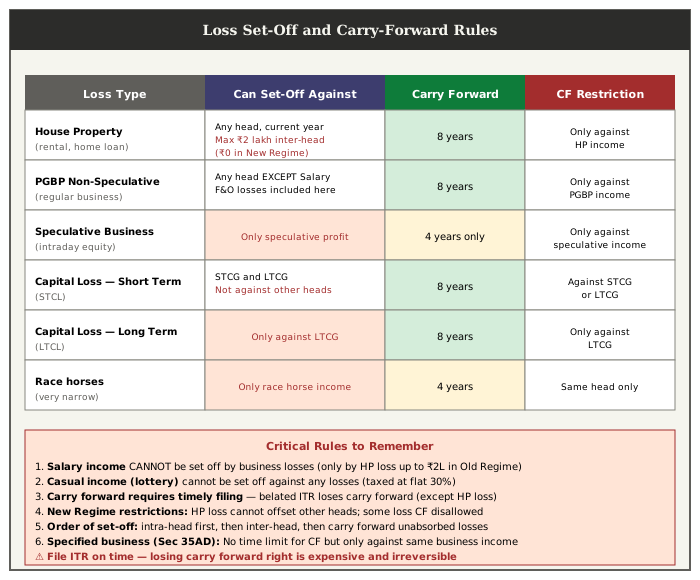
Intra-head set-off (same head). Generally, losses in one source within a head can be set off against income from another source in the same head, with exceptions:
- Speculative business loss: Only against speculative business profit
- Loss from owning/maintaining race horses: Only against income from race horses
- Long-term capital loss: Only against LTCG (not STCG)
- Loss from specified businesses under Section 35AD: Only against income of similar specified businesses
Inter-head set-off (different heads). In general, loss in one head can be set off against income in another head, but with restrictions:
- Loss under House Property: Up to ₹2 lakh against other heads same year
- Loss under PGBP: Cannot be set off against Salary income
- Speculative loss: Only against speculative income
- Capital loss: Only against capital gains
- Loss from race horses: Only against race horse income
- Casual loss (lottery): Cannot be set off
Carry-forward rules. If losses can't be fully set off in the current year, they can be carried forward to subsequent years (subject to specific limits):
| Loss Type | Carry Forward Period | Set Off Restrictions |
|---|---|---|
| House Property | 8 years | Only against House Property income |
| PGBP (Non-speculative) | 8 years | Only against PGBP income |
| Speculative business | 4 years | Only against speculative business income |
| Specified business (Section 35AD) | No time limit | Only against specified business income |
| Capital Loss - Short Term | 8 years | Against STCG and LTCG |
| Capital Loss - Long Term | 8 years | Only against LTCG |
| Loss from race horses | 4 years | Only against race horses income |
Must file ITR by the due date under Section 139(1). Belated returns (after July 31) lose the right to carry forward losses (except House Property loss, which can be carried forward even with belated return).
New Regime restrictions on losses.
- Loss from House Property cannot be set off against other heads under New Regime
- Cannot carry forward various specified losses (verify current rules)
Sections 70-80 of Income Tax Act 1961.
Classification Edge Cases
Some income types could plausibly fit under multiple heads. Correct classification matters because:
- Different heads have different rates
- Different heads have different set-off rules
- Different heads have different deductions
F&O (Futures and Options) Trading.
- Always classified as Business Income (PGBP) — not capital gains
- Treated as non-speculative business
- Can claim business expenses (terminal charges, internet, etc.)
- Losses can be set off against any business income (except speculative)
- Tax audit required if turnover exceeds prescribed limits
Intraday Equity Trading.
- Classified as Speculative Business Income
- Different from F&O (which is non-speculative)
- Losses can only offset speculative income
- More restrictive than other business income
Frequent Equity Trading. If trading is your primary occupation or you're doing it as business with high frequency, may be reclassified as business income:
- Casual investor trading: Capital Gains
- Frequent trader: Could be Business Income
- Income Tax Department considers volume, frequency, intent, time spent
- Once treated as business income, cannot switch back later
Rental Income — Property vs Business.
- Casual renting of a property you own: House Property
- Running a hotel, lodge, paying guest accommodation as commercial enterprise: Business Income
- Renting commercial property: House Property (if just owning), Business (if operating an establishment)
Salary vs Professional Fees.
- Employee with employer-employee relationship: Salary
- Independent contractor, consultant: PGBP
- "Contract employment" with no genuine employer relationship: Could be reclassified
- TDS section differs (192 for salary vs 194J for professional)
Why classification matters — example. Same ₹5 lakh income could be taxed differently:
- As Salary: Slab rates, standard deduction available
- As PGBP: Slab rates, business expenses deductible
- As LTCG on listed equity: 12.5% above ₹1.25 lakh threshold
- As Lottery winnings: Flat 30%
Tax classification is often determined by intent and substance, not just labels. Consult a CA for unclear cases. Once a classification is established in your filing pattern, switching can attract scrutiny.
Various sections of Income Tax Act 1961; CBDT Circular No. 6/2016 (equity trading classification); case law on rental income classification.
Clubbing of Income Rules
Indian tax law has specific provisions to prevent income shifting to lower-tax family members through "clubbing" — adding such income to the higher-earning family member's income.
Income of Minor Child (Section 64(1A)).
- Income of a minor child (under 18) is clubbed with the parent whose total income is higher
- Exception: Income from minor's own manual work or skill (talented child performers, etc.)
- Exception: Income from minor's own assets if minor is disabled
Income of Spouse from Spouse's Transferred Assets. If you transfer an asset to your spouse without adequate consideration (i.e., as a gift), the income from that asset continues to be your taxable income (clubbed back).
You gift ₹10 lakh to your spouse who invests it in FDs earning 7% interest. The ₹70,000 annual interest is YOUR taxable income, not your spouse's — despite being received in spouse's account.
Workarounds.
- Loan instead of gift at reasonable interest: Interest income still gets clubbed
- Spouse uses gifted money but invests in their own subsequent earnings: Original income clubbed, but earnings on earnings can be spouse's
- Each spouse earning independently from their own income: No clubbing
Income from Daughter-in-Law's Assets. Similar clubbing rule if you transfer assets to your son's wife without adequate consideration — income clubbed back to you.
Income from Hindu Undivided Family (HUF) Property. If you transfer your personal asset to HUF without adequate consideration, the income from that asset is clubbed with your individual income.
Cross-clubbing. If you transfer to spouse and spouse transfers to your minor child, clubbing rules apply at each level.
No clubbing if asset transferred for adequate consideration. If you sell at fair market value (not gift), no clubbing.
Practical implications.
- Family tax planning around income splitting requires careful structuring
- Educational fund for minor child invested by parents: Income clubbed
- Independent investments by spouse from own income (salary, gifts from her own family, etc.): No clubbing
- Joint property purchases with each spouse contributing from own resources: Income split by ownership share
Sections 60-64 of Income Tax Act 1961; CBDT guidance on clubbing.
Exempt Income Categories
Some income is exempt from tax under Section 10 but typically still must be disclosed in the ITR for transparency.
Common exempt income.
Section 10(1) — Agricultural income. Income from agriculture in India is exempt. However, if agricultural income exceeds ₹5,000 AND non-agricultural income exceeds basic exemption limit, partial integration applies (raises the effective tax rate slightly).
Section 10(10D) — Life insurance policy maturity. Maturity proceeds and death benefits from life insurance generally exempt, subject to certain conditions:
- For policies issued post-April 2023 with annual premium above ₹5 lakh, exemption is limited
- For ULIPs with annual premium above ₹2.5 lakh, exemption is limited
Section 10(11), 10(12) — Provident Fund accumulations.
- Statutory PF (government employees) and Recognized PF (private employees) accumulations exempt at retirement
- Employer's contribution above ₹7.5 lakh per year now taxable (Budget 2020+)
- Interest on PF contributions above ₹2.5 lakh per year taxable
Section 10(11A) — Sukanya Samriddhi Account. Interest and maturity proceeds for girl child savings scheme — exempt.
Section 10(14) — Specific allowances. Various small allowances exempt up to specified limits (uniform, child education, etc.). Available primarily under Old Regime.
Section 10(15) — Specific interest.
- Interest on Post Office Savings Account up to ₹3,500 (single)/₹7,000 (joint)
- Interest on tax-free bonds
- Interest on PPF (fully exempt)
Section 10(34) — Dividends. Pre-FY 2020-21 dividends were exempt up to ₹10 lakh. Post-FY 2020-21, dividends are fully taxable.
Section 10(38) — Listed equity LTCG. Pre-FY 2018-19 LTCG on STT-paid listed equity was exempt. Post-FY 2018-19, taxable under Section 112A with ₹1.25 lakh annual exemption.
Disclosure requirements. Even exempt income often must be disclosed in the ITR:
- Schedule EI (Exempt Income) for various exempt items
- Specific schedules for agricultural income
- Specific reporting for exempt long-term capital gains
Why disclose exempt income. Tax authorities verify total inflow against AIS, bank deposits, lifestyle. Unreported exempt income can trigger inquiry into source of funds.
Section 10 of Income Tax Act 1961 (various sub-sections); Schedule EI of ITR.
AIS, TIS, and Form 26AS Reconciliation
Before filing, reconcile your computed income against three official statements to catch discrepancies.
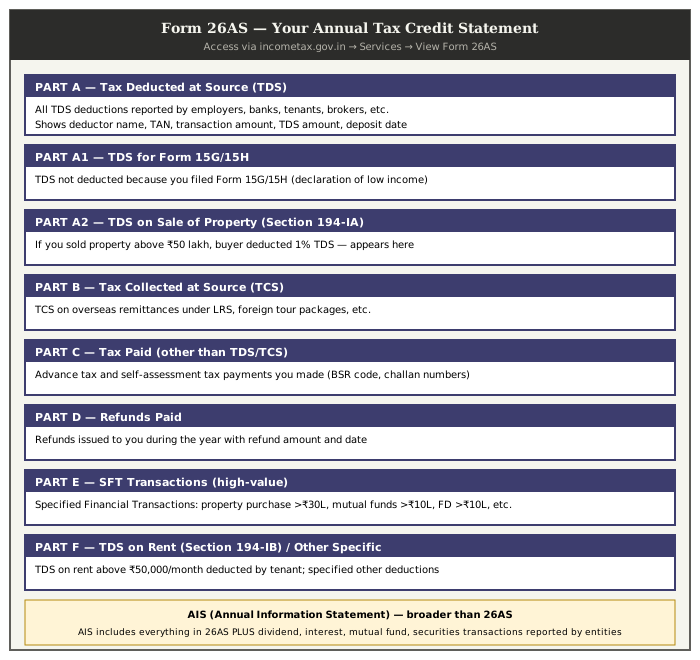
Form 26AS (Tax Credit Statement). Shows tax deducted/collected on your behalf:
- TDS by employers (salary)
- TDS by banks (FD interest)
- TDS by tenants (rent above ₹50,000/month from Section 194I-B)
- TDS on professional fees
- TDS on dividends, sales of property
- Advance tax and self-assessment tax paid
- Refunds processed
AIS (Annual Information Statement). Comprehensive view of all financial transactions reported to tax department:
- All income reported by various sources
- Major financial transactions (property purchase, mutual fund investments, etc.)
- High-value transactions reported under SFT (Statement of Financial Transactions)
- Foreign remittances received
- Credit card payments above thresholds
TIS (Taxpayer Information Summary). A simplified summary derived from AIS, organized by income category.
How to access. All three available on incometax.gov.in after login:
- AIS and TIS under "Services" → "AIS"
- Form 26AS under "Services" → "View Form 26AS"
Reconciliation process.
- Step 1. Download AIS, TIS, and Form 26AS for the relevant FY.
- Step 2. For each income source in your computation, find the corresponding entry in AIS: Salary: Match with Form 16 and AIS salary entry; Interest income: Match with bank statements and AIS interest entries; Capital gains: Match with broker statements and AIS securities entries; Dividends: Match with broker statements and AIS dividend entries; Foreign income (if applicable): Match with foreign source documents.
- Step 3. Identify discrepancies: Income reported in AIS but not in your records; income in your records but not in AIS; amount differences.
- Step 4. Submit feedback through AIS portal for any incorrect entries. Keep documentation supporting your position.
Common discrepancies.
- Bank FD interest under-reported by bank
- Dividend amounts incorrectly captured
- Capital gains shown incorrectly (especially mutual fund redemptions)
- Property transactions for joint owners not properly split
- Foreign remittances incorrectly classified
Why this matters. Discrepancies caught after filing can trigger:
- Defective return notice
- Reassessment proceedings
- Demand notices
- Penalty for under-reporting
Tax portal pre-fills many fields from AIS. Verify carefully — pre-filled data has been wrong in documented cases. Don't blindly trust pre-filling.
Section 285BA of Income Tax Act 1961 (SFT); CBDT instructions on AIS; Income Tax Department user guide for AIS.
Connection to Other Lessons
The Five Heads lesson connects to every subsequent lesson:
- Lesson 1 (Filing) — Different ITR forms are designed around heads present. ITR-1 limited to salary, one house property, other sources; ITR-3 needed for business income.
- Lesson 2 (Residential Status) — Determines whether worldwide income or only Indian-source income falls under each head.
- Lesson 4 (Deductions) — Chapter VI-A deductions reduce GTI to Total Income; mostly Old Regime.
- Lesson 5 (Regime Choice) — New vs Old Regime affects which deductions apply across heads.
- Lesson 6 (Tax Computation) — Tax computed on Total Income; capital gains have special rates outside slab rates.
- Lesson 10 (Salaries) — Deep coverage of Head 1.
- Lesson 12 (Business) — Deep coverage of Head 3.
- Lesson 13 (House Property) — Deep coverage of Head 2.
- Lesson 20 (Capital Gains) — Deep coverage of Head 4.
What to Gather for Income Computation Under Each Head
Form 16 from all employers during the year; salary slips for verification; Form 12BA for perquisites; records of LTA/HRA claims (if Old Regime); ESOP exercise documents.
Address and ownership documents; rental agreements and receipts (if let out); municipal tax payment receipts; home loan interest certificate from lender; property valuation records.
Books of account (or presumptive computation); bank statements for business account; GST returns (if registered); expense vouchers and bills; depreciation schedules; audit report (if applicable).
Sale and purchase deeds for property; broker statements with capital gains computation; mutual fund redemption statements; cost of improvement records; TDS certificates for property sale (Form 26QB/26QC); records for indexation calculations.
Bank statements showing interest received; bank FD interest certificates; dividend statements from companies and mutual funds; gift documentation (if relevant); other income source records.
Form 26AS; AIS; TIS; all TDS certificates.
Key Takeaways
- All income must be assigned to exactly one of five heads — Salaries, House Property, PGBP, Capital Gains, or Other Sources. Each head has its own computation rules, deductions, and set-off provisions.
- The computation chain is: income under each head → head-level deductions → set-off of losses → Gross Total Income → Chapter VI-A deductions → Total Income → tax at applicable rates.
- Budget 2025 changed the rules so two self-occupied properties can have nil annual value — previously only one. Third house onwards has notional rent treatment.
- F&O is non-speculative PGBP; intraday equity is speculative PGBP — both are business income, not capital gains. This affects set-off rules significantly.
- Capital gains taxed at special rates (STCG 20%, LTCG 12.5% on listed equity) are NOT covered by the Section 87A rebate, even if total income is below ₹12 lakh under New Regime.
- Loss carry-forward (except House Property) requires filing ITR by the due date — July 31. Belated return forfeits this right for most heads.
- Always reconcile AIS, Form 26AS, and TIS before filing. Pre-filled data on the tax portal has been wrong in documented cases — verify every entry.
Quiz — 5 Questions
Answer one at a timeAfter Budget 2025, how many self-occupied properties can have nil annual value?