Residential Status: Resident, RNOR, and Non-Resident
Residential status is the single most consequential classification in Indian income tax — determining whether worldwide income or only Indian-source income is taxable, which ITR form you can use, and what foreign disclosure obligations apply.
- Apply the two basic residency tests — 182-day and 60+365-day — to determine Resident or Non-Resident status
- Distinguish between ROR and RNOR using the two Ordinarily Resident tests under Section 6(6)
- Identify when the 120-day rule (Finance Act 2020) applies to high-income NRIs
- Understand when Section 6(1A) deems an Indian citizen Resident despite minimal India presence
- Determine the scope of income taxable in India for each residential status category
- Count days in India correctly and apply DTAA tie-breaker rules for dual-residency situations
Residential Status in Indian Tax Law
Residential status is the single most consequential classification in Indian income tax. It determines whether your worldwide income is taxable in India or only your Indian-source income, which ITR form you can use, what foreign asset disclosure obligations apply, and whether you can claim DTAA (Double Taxation Avoidance Agreement) benefits.
Indian tax law uses physical presence in India (measured in days) as the primary test for residential status, with several additional factors that can push someone into "deemed residency" or other special categories. This is fundamentally different from US tax law (which uses citizenship-based taxation) and different from most other countries (which typically use a single residency test).
The rules have become more complex since Finance Act 2020, which introduced the 120-day rule for high-income NRIs and the deemed residency rule for Indian citizens not taxed anywhere else. The Income Tax Act 2025 (effective April 1, 2026) largely preserves the existing framework but introduces some refinements — flagged in this lesson where relevant.
A residential status error can result in significant consequences: undisclosed foreign income, missed FA Schedule disclosures (with severe Black Money Act penalties), wrong ITR form, denied DTAA benefits, or overpayment of tax. Get this right.

The Basic Residency Tests
Residential status determination starts with two basic tests under Section 6(1) of the Income Tax Act 1961. An individual is a Resident in India for a particular financial year if EITHER test is satisfied. If neither is satisfied, the individual is a Non-Resident (NR).
Here's the decision flow:
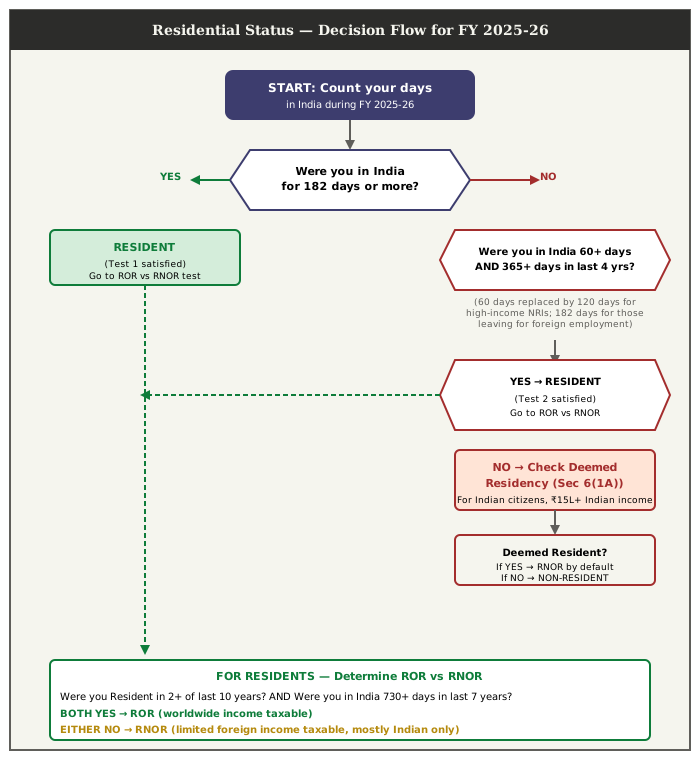
Test 1 — The 182-day rule. An individual is Resident if they were in India for 182 days or more during the relevant financial year.
This is the primary and straightforward test. The 182-day rule remains the primary criterion for residency.
Test 2 — The 60+365-day rule. An individual is Resident if they were:
- In India for at least 60 days during the relevant financial year, AND
- In India for 365 days or more during the four years immediately preceding the relevant financial year
The 60-day part can be satisfied by even brief stays, but the 365-day historical requirement makes this test trigger only for individuals with substantial India presence over multiple years.
Important exceptions to Test 2 (the 60-day rule doesn't apply). The 60-day rule does not apply to NRIs, crew members, or Indian citizens working abroad. For these specific categories, the 60-day threshold is replaced with 182 days, effectively making Test 2 collapse into Test 1.
Categories with the 182-day replacement.
- Indian citizens leaving India for employment abroad during the year
- Indian citizens who are members of the crew of an Indian ship
- Indian citizens or Persons of Indian Origin (PIOs) who visit India during the year (with Indian income up to ₹15 lakh)
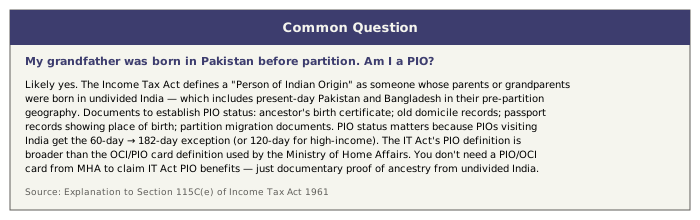
Persons of Indian Origin (PIOs). A person is deemed to be of Indian origin if they, their parents, or any grandparent was born in undivided India. This is a broader category than Indian citizens.
Rajesh, an Indian citizen working in Singapore. He visits India for 90 days during FY 2025-26. His Indian income (rental from property in Bangalore) is ₹6 lakh. He has been in India for 400+ days in the preceding 4 years. Test 1: 90 < 182 → Not Resident under Test 1 Test 2 (modified): Since he's an Indian citizen visiting India with income below ₹15 lakh, the 60-day rule becomes 182-day rule. 90 < 182 → Not Resident under Test 2 Result: Rajesh is Non-Resident for FY 2025-26. Only his Indian-source income (the rental) is taxable in India.
Section 6(1) of Income Tax Act 1961; a taxpayer would qualify as a resident of India if he satisfies one of the following 2 conditions: stay in India for a year is 182 days or more in previous year, OR stay in India for the immediately 4 preceding years is 365 days or more.
ROR vs RNOR — The Ordinarily Resident Tests
Once you're classified as Resident (under either basic test or the deemed residency rule discussed later), the next question is whether you're Resident and Ordinarily Resident (ROR) or Resident but Not Ordinarily Resident (RNOR).
Why this matters. RNOR status is highly favorable — it limits Indian tax to Indian-source income plus foreign income derived from a business or profession controlled from India. Foreign income otherwise (foreign salary, foreign capital gains, foreign rental income, etc.) is NOT taxable for RNORs. ROR status, by contrast, subjects worldwide income to Indian tax.
Here's the comparison matrix:
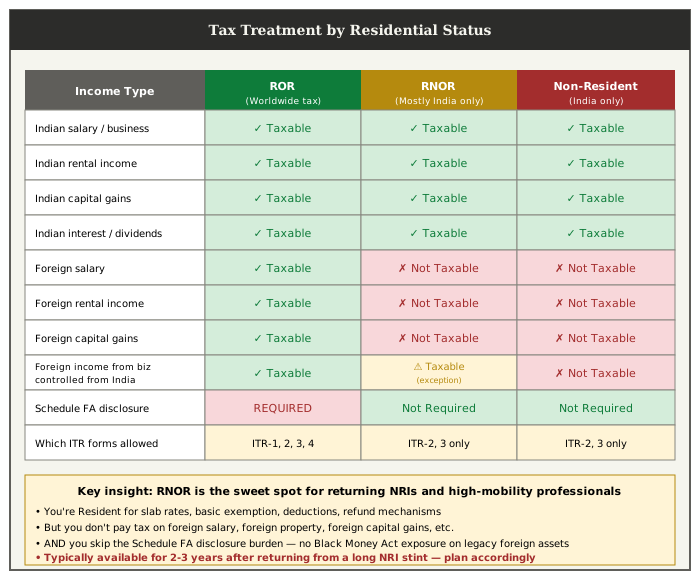
Tests for Ordinarily Resident (ROR) status. A Resident is Ordinarily Resident if BOTH of the following are satisfied:
- Was a Resident of India in at least 2 out of the 10 financial years immediately preceding the relevant year, AND
- Was physically present in India for 730 days or more during the 7 financial years immediately preceding the relevant year
RNOR by default if either test fails. A Resident who fails either of the above tests is classified as RNOR.
Three situations creating RNOR status (typical scenarios).
- Situation 1 — Failing the 10-year residency test. Resident in India for fewer than 2 of the last 10 years. Common for returning NRIs who lived abroad for most of the past decade.
- Situation 2 — Failing the 730-day test. Resident in India for 2+ of the last 10 years but with fewer than 730 days physical presence in the last 7 years. Common for individuals with sporadic India presence.
- Situation 3 — High-income NRI under the 120-day rule (covered separately). Special RNOR classification regardless of the standard tests.
Suresh returns to India after 12 years in the US in FY 2025-26. He spent 200 days in India in FY 2025-26. He had been NR for 9 of the preceding 10 years. Basic test: 200 ≥ 182 days → Resident ROR Test 1: Was Resident in only 1 of the last 10 years → Fails Conclusion: Resident but Not Ordinarily Resident (RNOR) His US salary earned before returning to India is not taxable in India. Only his Indian income (rental, FD interest, etc., earned after return) is taxable.
Suresh returned to India after 12 years in the US. He spent 200 days in India and thus qualified as Resident. However, he had been NR for 9 of the preceding 10 Tax Years — making him RNOR. His US salary earned before return was not taxable in India.
RNOR is generally favorable. Most returning NRIs and high-mobility professionals benefit from RNOR status during the transition period. It's worth planning around.
Section 6(6) of Income Tax Act 1961; An individual is considered a Resident and Ordinarily Resident (ROR) in India if they meet both of the following conditions: They have been a resident of India in at least 2 out of the 10 years immediately preceding the relevant financial year. AND They have spent 730 days or more in India in the seven years preceding.
Indian Citizens Working Abroad — Special Rules
Indian citizens leaving India for employment abroad receive specific treatment under residential status rules to avoid penalizing them for taking foreign jobs.
The 60-day exception for those leaving for employment. An Indian citizen who leaves India during the financial year for the purpose of employment outside India has the 60-day part of Test 2 replaced by 182 days. This means they only become Resident if they were in India for 182+ days during the year — they don't get caught by the lower 60-day threshold.
"Leaves India for employment" — interpretation. The phrase has been interpreted broadly:
- Includes individuals taking up first employment abroad
- Includes individuals changing employers but continuing abroad
- Includes individuals going abroad for self-employment or business (per case law)
- Includes seafarers joining ships
Priya, an Indian citizen and software engineer in Bangalore, gets a job offer from Microsoft in Seattle in July 2025. She moves on July 15, 2025. From April 1 to July 15, 2025, she was in India for about 106 days. Test 1: 106 < 182 → Not Resident under Test 1 Test 2 (modified): Since she left India for employment, the 60-day rule becomes 182-day rule. 106 < 182 → Not Resident under Test 2 Result: Priya is Non-Resident for FY 2025-26. Only her Indian income (salary till July 15, FD interest, etc.) is taxable in India. Her US salary from July 15 onwards is NOT taxable in India. Without the 60-day exception, Priya would have been Resident (since she easily met both 60 days in FY 2025-26 and 365 days in prior 4 years), and her US salary would have been taxable in India for FY 2025-26 — a significant tax burden in her year of relocation.
Crew members of Indian ships. Indian citizens who are crew members of Indian ships have specific protective rules:
- The 60-day rule is replaced by 182 days
- Eligible voyage days outside India don't count as India presence
- "Eligible voyage" means a voyage of an Indian ship undertaken from any port in India to any port outside India or vice versa
Maintain proof: • Employment contract from foreign employer • Travel documents showing departure date • Visa and work permit • Proof of foreign residence • Income evidence from foreign source
Explanation 1(a) to Section 6(1) of Income Tax Act 1961; according to Income Tax rules, an Indian citizen who has stayed overseas for carrying out business/employment or vocation for 182 days or more during a financial year is considered an NRI.
The 120-Day Rule for High-Income NRIs
Finance Act 2020 introduced a stricter residency test for high-income NRIs to prevent them from completely escaping Indian tax through frequent short visits.
The 120-day rule (Section 6(1)(c) with Explanation 1(b)). For an Indian citizen or PIO visiting India whose Indian-source income exceeds ₹15 lakh during the financial year (excluding foreign income), the 60-day threshold in Test 2 is replaced by 120 days (not 182 days).
Here's how the day thresholds vary by your situation:
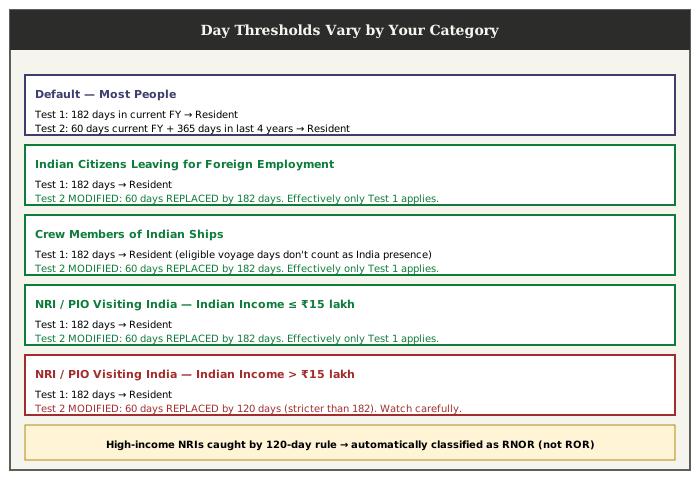
Result for high-income NRIs. These individuals become Resident if:
- They were in India for 120 days or more in the financial year, AND
- They were in India for 365 days or more in the previous 4 years
This is significantly stricter than the 182-day rule that applies to other NRIs and to high-income NRIs with Indian income up to ₹15 lakh.
RNOR by default for those caught by the 120-day rule. Individuals who become Resident solely due to the 120-day rule (i.e., they spent 120-181 days in India) are deemed RNOR — they don't become ROR even if they meet other ROR criteria. This limits their tax burden to Indian income plus business income controlled from India.
Anish, an Indian citizen working in Dubai, with rental income of ₹20 lakh from properties in Mumbai. He spent 130 days in India in FY 2025-26 and was in India for 400+ days in the preceding 4 years. Test 1: 130 < 182 → Not Resident under Test 1 Test 2 (high-income NRI): 130 ≥ 120 AND 400+ ≥ 365 → Resident under modified Test 2 Result: Anish is Resident for FY 2025-26 (under 120-day rule). By default RNOR status applies. His Dubai income is not taxable in India; his Indian rental income (which would have been taxable anyway) is taxed.
Practical implication. High-income NRIs need to carefully count days in India. Crossing 120 days (when they have over ₹15 lakh in Indian income) changes their classification.
Why this rule exists. Pre-2020, an Indian citizen with substantial India ties could spend up to 181 days in India each year without becoming Resident — effectively maintaining strong Indian connections while escaping Resident status. The 120-day rule closed this gap for those with substantial Indian income.
Section 6(1)(c) and Explanation 1(b) of Income Tax Act 1961; an Indian citizen or PIO visiting India will qualify as RNOR if the total stay in India during the relevant tax year is 120 days or more but less than 182 days.
Deemed Residency (Section 6(1A)) — The "Tax-Free Country" Rule
The deemed residency rule under Section 6(1A) targets Indian citizens who structure their affairs to avoid tax both abroad and in India.
The rule. An Indian citizen having Indian-source income exceeding ₹15 lakh during the financial year is deemed to be a Resident of India if they are not liable to tax in any other country by reason of domicile, residence, or any other similar criteria.
Key requirements.
- Must be an Indian citizen (PIOs not covered by this specific rule)
- Indian-source income (excluding foreign income) must exceed ₹15 lakh
- Must not be liable to tax in any other country
- Days in India are irrelevant — even an Indian citizen in India for 0 days can be deemed Resident
"Not liable to tax in any other country" — interpretation. Targets individuals living in:
- Zero-tax jurisdictions (UAE, Monaco, Cayman Islands, Bahamas, Bermuda)
- Countries where they're treated as non-resident and don't pay tax
- Structured arrangements where they claim non-resident status everywhere
RNOR by default for deemed residents. Individuals classified as deemed Residents under Section 6(1A) are deemed RNOR. Their foreign income is not taxable in India; only Indian income is taxed.
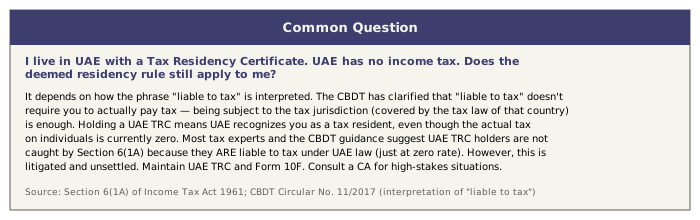
Neha, an Indian citizen working in Dubai for an Indian-owned company. Dubai has no personal income tax. Her income from the Dubai job is ₹25 lakh. She also has Indian income (consulting fees from Indian clients) of ₹18 lakh. She visits India only 30 days in FY 2025-26. Indian income > ₹15 lakh → Triggers deemed residency rule Indian citizen → Yes Not liable to tax anywhere else (Dubai has no income tax) Result: Deemed Resident under Section 6(1A), classified as RNOR Her Dubai income is not taxable in India (because RNOR). Her Indian income (₹18 lakh in consulting) is taxable in India.
Neha was an Indian citizen working in Dubai (no income tax in UAE) and visiting India frequently. Her Indian income exceeded ₹15 lakh. She spent 160 days in India in Tax Year 2026-27. Under the Deemed Residency rule of Section 6(1A), she was deemed Resident in India despite spending less than 182 days.
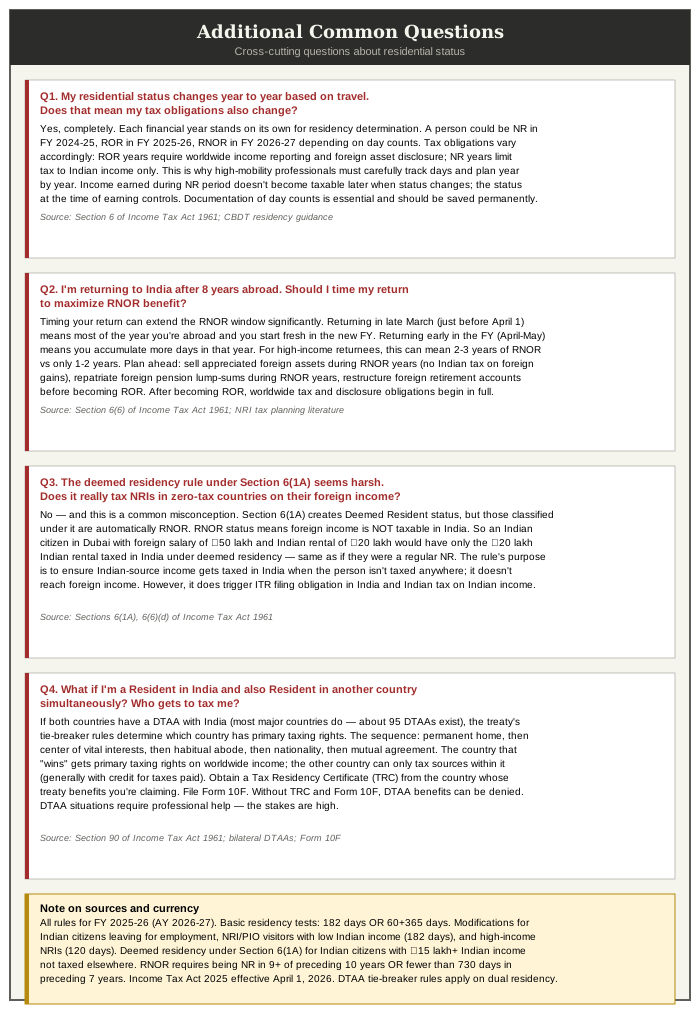
Why this rule exists. Pre-2020, wealthy Indians could move to zero-tax jurisdictions, maintain substantial Indian income, and escape tax everywhere. Section 6(1A) ensures at least minimal Indian tax on their Indian income. RNOR designation softens the impact. Since the deemed Residents are classified as RNOR, the rule doesn't tax their foreign income (which they may pay tax on elsewhere if applicable). It only ensures their substantial Indian income gets taxed in India.
Section 6(1A) of Income Tax Act 1961; a deemed residency rule under Section 6(1A) states that if an Indian citizen earns ₹15 lakh or more from Indian sources and is not liable to tax in any other country, they may be considered a resident for tax purposes.
Returning NRIs and the RNOR Window
Returning NRIs often benefit from a multi-year RNOR window that protects foreign income and assets during their transition back to India.
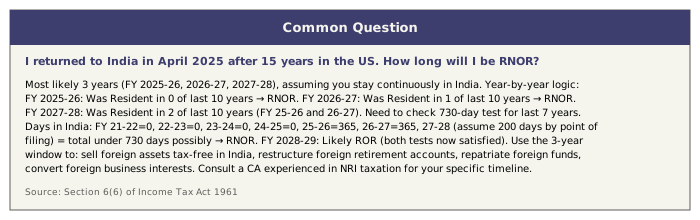
The typical RNOR window for returning NRIs. Depending on how long someone was abroad, they can maintain RNOR status for up to 3 years after returning to India, even while being Resident.
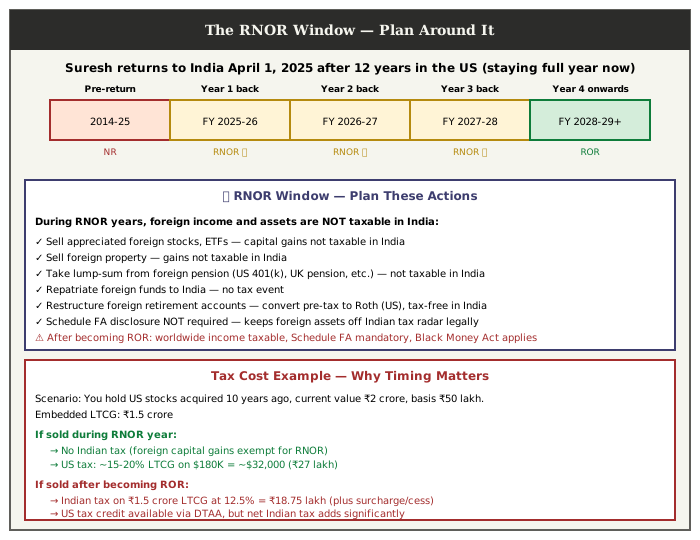
- Year 1 of return. Often RNOR if returning person was Resident in fewer than 2 of the preceding 10 years (likely if abroad most of the period) and was in India for fewer than 730 days in the preceding 7 years (likely if abroad most of the period).
- Year 2 of return. Often still RNOR — the 10-year and 7-year tests still likely fail.
- Year 3 of return. Often still RNOR — depending on years of presence.
- Year 4 of return (and beyond). Typically becomes ROR as the historical tests start being satisfied.
The exact timeline depends on prior India presence. Use the tests carefully each year.
Why RNOR is valuable for returning NRIs.
- Foreign income not taxable. Foreign pensions, foreign rental income, foreign capital gains, foreign dividends — all not taxable in India during RNOR years. Only Indian income is taxed.
- Foreign asset disclosure not required. RNORs don't have to disclose foreign assets in Schedule FA. This significant benefit removes a major reporting burden during the transition.
Planning opportunities during RNOR window.
- Sell foreign assets (foreign stocks, properties) — gains not taxable in India
- Repatriate foreign funds without tax consequences
- Restructure foreign retirement accounts
- Convert foreign holdings before becoming ROR
After becoming ROR. Worldwide income becomes taxable; foreign asset disclosure becomes mandatory; black money rules become aggressively enforced.
Returning NRIs should track their residency status carefully each year. Plan major foreign income events (asset sales, pension distributions) during RNOR years where possible. Consult a CA experienced in NRI taxation before transitioning to ROR.
Section 6 of Income Tax Act 1961; CBDT guidance on residential status determination.
Scope of Income by Residential Status
The scope of income taxable in India varies dramatically by residential status. This is what makes residential status determination so important.
Resident and Ordinarily Resident (ROR).
Taxable in India:
- All income earned in India
- All income earned outside India
- All income deemed to accrue in India
- All income deemed to accrue outside India
Effectively: worldwide income
Disclosure obligations:
- Schedule FA (Foreign Assets) — all foreign assets and accounts
- Schedule FSI (Foreign Source Income) — all foreign income with country-wise breakdown
- Schedule TR (Tax Relief) — foreign tax credit claims
- Tax Residency Certificate for DTAA benefits
Resident but Not Ordinarily Resident (RNOR).
Taxable in India:
- All income earned in India
- All income deemed to accrue in India
- Foreign income from a business controlled in or profession set up in India
- Limited to "Indian connection" income
NOT taxable in India:
- Foreign salary
- Foreign pension
- Foreign rental income
- Foreign capital gains
- Foreign dividends/interest
- Other foreign income with no Indian connection
Disclosure obligations:
- Limited foreign asset disclosure (only foreign business income reported)
- Most foreign assets NOT required to be disclosed
Non-Resident (NR).
Taxable in India:
- Income earned in India
- Income deemed to accrue in India
NOT taxable in India:
- All foreign income
Disclosure obligations:
- Limited to Indian income
- No foreign asset disclosure required
What counts as "Indian income."
Income earned in India includes:
- Salary for services rendered in India
- Income from property situated in India
- Capital gains on transfer of assets situated in India (with some exceptions for NR portfolio investments)
- Business income from operations carried out in India
- Income from any source in India
- Income from professional services performed in India
Income deemed to accrue in India includes (Section 9):
- Salary paid by Government of India to Indian citizens working abroad
- Income from business connection in India
- Income from any asset or source in India
- Capital gains on transfer of capital asset situated in India
- Interest paid by Indian residents (with exceptions)
- Royalty/fees for technical services paid by Indian residents (with treaty considerations)
Sections 5, 6, 9 of Income Tax Act 1961; in India, a resident is taxed on their total income that includes both the income they generate in the country as well as money received outside India. The tax burden on them is limited in the country to the money they earn in the country. Considering this, in case of NRI, the taxation rules change.
DTAA Tie-Breaker Rules and Tax Residency Certificate
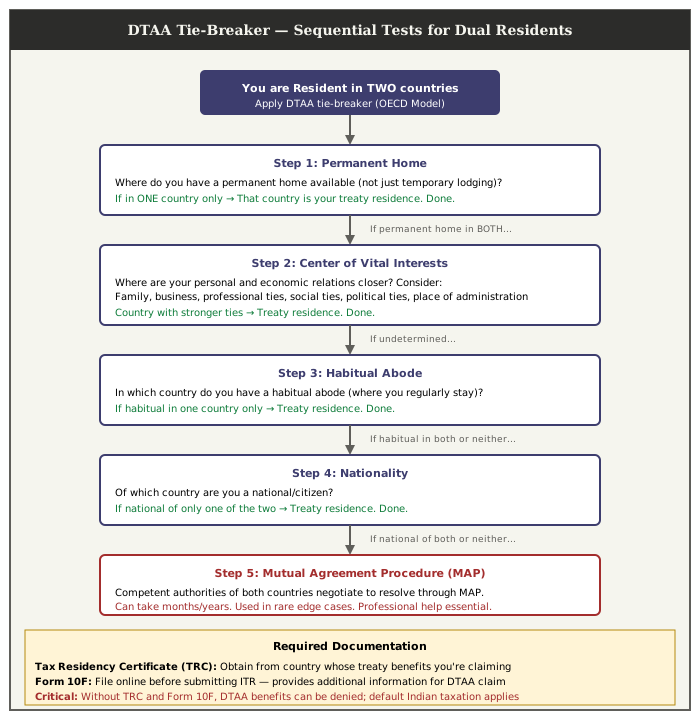
When you're considered Resident in two countries simultaneously, DTAA tie-breaker rules determine which country has the primary right to tax your global income.
Why dual residency happens.
- You spend significant time in two countries
- You have homes, family, business in two countries
- Each country's domestic residency rules can be met independently
- Different countries use different residency tests
DTAA tie-breaker rules (typical sequence, following OECD Model Convention). DTAAs that India has signed (with ~95 countries) typically apply tie-breaker rules in this sequence:
- Step 1 — Permanent Home. You're treated as resident of the country where you have a permanent home available. If permanent home in only one country, that country is your treaty residence.
- Step 2 — Center of Vital Interests. If permanent home in both countries, you're treated as resident where your personal and economic relations are closer (family, business, social ties).
- Step 3 — Habitual Abode. If center of vital interests cannot be determined, you're treated as resident where you have a habitual abode (regularly stay).
- Step 4 — Nationality. If habitual abode in both or neither country, you're treated as resident of the country of which you're a national.
- Step 5 — Mutual Agreement Procedure (MAP). If still undetermined (e.g., national of both countries or neither), competent authorities of the two countries resolve through MAP.
Tax Residency Certificate (TRC). To claim DTAA benefits, you must obtain a TRC from the country whose treaty benefits you're claiming.
- TRC for foreign country benefits. If you're claiming benefits as resident of a foreign country (say, UAE), obtain TRC from UAE tax authorities. Submit to Indian tax authorities along with your Indian ITR.
- TRC for India. If you're claiming Indian residency for foreign country benefits, obtain TRC from Indian tax authorities (Form 10F + declaration).
- Form 10F. Required to be filed online before filing ITR. Provides additional information to support DTAA claim (e.g., nationality, period of stay, etc.).
Common DTAA situations.
- US-India DTAA: Affects software engineers, professionals on H-1B visas, students, returning NRIs
- UAE-India DTAA: Important for many NRI workers in UAE
- UK-India DTAA: Pensions, property, business income
- Singapore-India DTAA: Capital gains exemption on shares (subject to limitation)
Practical impact. DTAAs can provide:
- Reduced withholding rates on dividends, interest, royalties
- Exemption from tax in one country on income taxed in the other
- Tie-breaker rules for dual residents
- Credit for foreign tax paid
Section 90 of Income Tax Act 1961; bilateral DTAAs (text available on Income Tax Department website); CBDT guidance on Form 10F and TRC.
How to Count Days in India
The day-counting that drives residency determination has specific rules that surprise filers.
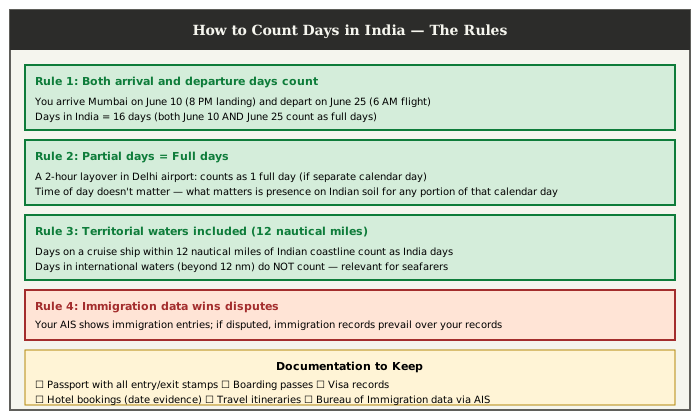
Both arrival and departure days count. If you arrive in India on June 10 and leave on June 25, you count 16 days (both June 10 and June 25 included).
Partial days count as full days. Time spent in India during any portion of a calendar day counts as a full day. A 2-hour layover on Indian soil counts as one day if it's a different calendar day from arrival/departure.
Territorial waters included. Days spent in Indian territorial waters (12 nautical miles into the sea from Indian coastline) count as days in India. Stay in India includes stay in the territorial waters of India i.e. 12 nautical miles into the sea from the Indian coastline.
Passport entry/exit stamps are the primary evidence. Also maintain: • Boarding passes for flights • Travel itineraries • Hotel bookings showing dates • E-tickets and visa records
The Bureau of Immigration data. Indian immigration authorities track entries and exits electronically. This data feeds into AIS (Annual Information Statement) — your day count visible to you and tax authorities.
Disputed days. If there's a discrepancy between your count and what immigration records show, immigration records typically prevail. Verify your AIS days early in the year if you're near residency thresholds.
Cruise ship and international waters. Days on international waters (beyond 12 nautical miles) don't count as India presence. This matters for seafarers and cruise workers.
Aircraft in transit. Time on flights in Indian airspace technically isn't counted as days in India for residency purposes (the day at the airport counts; in-flight time doesn't separately add).
Planning around the count. For individuals near residency thresholds (especially 120-day or 182-day boundaries), even one extra day can change classification. Plan trips carefully and verify counts.
Section 6 of Income Tax Act 1961; CBDT guidance on day counting; case law on residential status.
Special Rule for Crew Members of Indian Ships
Indian citizens who are crew members of Indian ships receive special protective treatment to avoid penalizing them for global voyage work.
The exception. For an Indian citizen who is a crew member of an Indian ship, days spent on the ship during eligible voyages do NOT count as days in India for residency purposes.
Eligible voyage definition. A voyage undertaken by an Indian ship from any port in India to any port outside India or vice versa.
Practical effect. Most seafarers can maintain Non-Resident status even with substantial connections to India:
- Time on eligible voyages doesn't count toward Indian presence
- Time in India between voyages does count
- A seafarer working most of the year on eligible voyages typically remains NR
The 60-day rule modification. Crew members of Indian ships also get the 60-day → 182-day modification (similar to those leaving for employment), making it harder to be classified as Resident.
• Continuous Discharge Certificate (CDC) or Indian Maritime Discharge Book • Letter from employer/shipping company • Voyage details and dates • Passport stamps for shore leave
Foreign-flagged ships. Indian citizens working on foreign-flagged ships are treated like other Indian citizens working abroad — the special crew member exception applies only to Indian ships.
Income taxation for NR seafarers. As NRs, their salary credited to NRE accounts isn't taxable in India. Salary credited directly to foreign accounts is generally also not taxable as NR.
Explanation 1 to Section 6(1)(c) of Income Tax Act 1961; CBDT Circular No. 13/2017 on seafarer taxation.
Connection to Other Lessons
The Residential Status lesson connects to nearly every subsequent lesson:
- Lesson 1 (Filing) — Residential status determines which ITR form you can use. NRs and RNORs cannot use ITR-1 or ITR-4.
- Lesson 3 (Income Sources) — The scope of taxable income depends entirely on residential status.
- Lesson 4 (Deductions) — Most Chapter VI-A deductions are available to Residents but limited or unavailable for NRs.
- Lesson 11 (Senior Citizens) — Indian senior citizens living abroad need to evaluate residential status carefully.
- Lesson 13 (Real Estate) — NR sellers of Indian property face TDS at higher rates (20% for LTCG, 30% for STCG).
- Lesson 17 (NRIs and Foreign Income) — Deep coverage of NRI-specific issues builds on this lesson's foundation.
- Lesson 20 (Capital Gains) — Capital gains treatment varies by residential status and source of asset.
What to Gather to Determine Your Residential Status
• Passport with all entry/exit stamps • Travel itineraries for the financial year • Boarding passes for verification • Hotel bookings and travel records • AIS (Annual Information Statement) showing immigration data
• Records of physical presence for previous 10 years • Prior years' ITRs (showing residential status claimed) • Documentation of foreign employment, residence history
• Foreign tax residency status documents • Foreign tax filings or non-filing certificates • Indian income computation (to compare against ₹15 lakh threshold)
• Calendar of years abroad • Day-by-day breakdown of India presence in last 7 years • Visa records and foreign work permits • Foreign tax residency certificates from prior years
• Tax Residency Certificate (TRC) from foreign country • Form 10F filed online • Foreign tax payment receipts • Documentation of permanent home, family, business in each country
Key Takeaways
- Residential status is the most consequential classification in Indian tax — it determines whether worldwide income or only Indian-source income is taxable.
- Two basic tests create Resident status: 182 days in India during the year (Test 1), or 60 days in the year plus 365 days in the preceding four years (Test 2).
- Indian citizens working abroad have the 60-day threshold replaced by 182 days — preventing accidental Resident classification in the year of departure.
- RNOR status taxes only Indian-source income, not foreign income — available to returning NRIs for up to 3 years of transition, and by default to those caught by the 120-day rule.
- The 120-day rule (Finance Act 2020) applies to Indian citizens/PIOs with Indian income over ₹15 lakh — they become Resident at 120 days instead of 182.
- Section 6(1A) deems Indian citizens Resident if they earn over ₹15 lakh in Indian income and aren't liable to tax anywhere else — closing the zero-tax-jurisdiction escape.
- Both arrival and departure days count; partial days count as full days; Indian territorial waters (12 nautical miles) count as India presence.
Quiz — 5 Questions
Answer one at a timeUnder Test 1, an individual becomes a Resident of India if they were present in India for how many days or more during the financial year?