Personal Information, PAN, Aadhaar, and Choosing the Right ITR Form
The identifiers, filing requirements, and form selection decisions that every Indian taxpayer must get right before anything else.
- Understand PAN and Aadhaar requirements and the mandatory linkage rule
- Distinguish between Previous Year and Assessment Year and apply correct filing deadlines
- Identify when ITR filing is mandatory regardless of income level
- Select the correct ITR form (ITR-1 through ITR-4) based on income type and situation
- Recognize the five heads of income as the framework for all income computation
- Understand the default New Regime and the key difference from the Old Regime
Lesson Overview
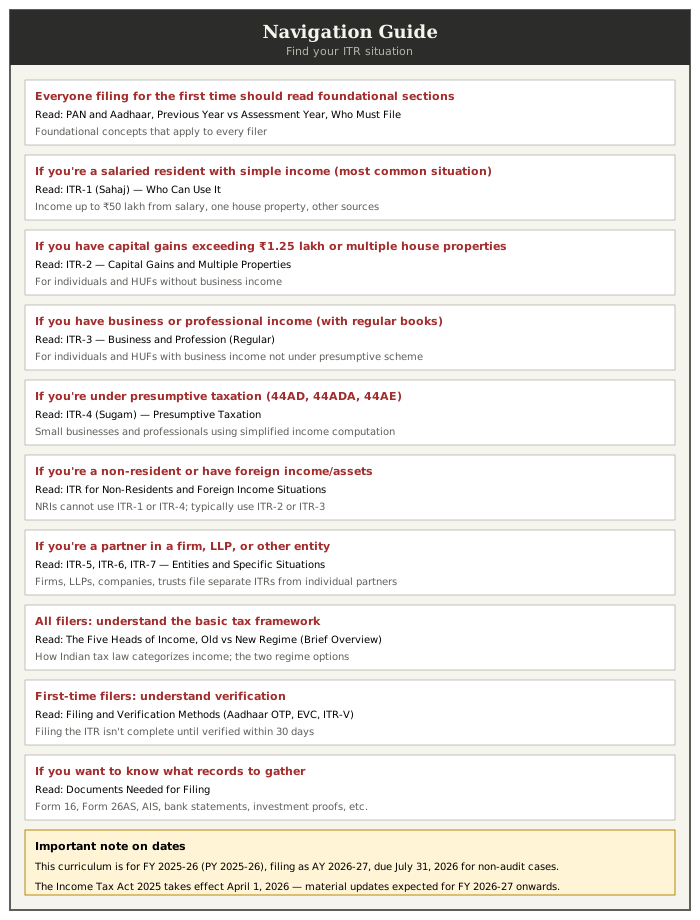
The first step in filing an Indian income tax return is determining what form to use. Unlike the US, where most filers use Form 1040 and add schedules as needed, India has separate ITR forms for different categories of taxpayers. Choosing the wrong form leads to processing delays, defective return notices, and potentially scrutiny.
This lesson covers the foundational identification and classification decisions: PAN and Aadhaar (the identifiers that drive all tax compliance in India), the determination of who must file an ITR, the seven ITR forms and which applies to which type of taxpayer, and the basic concepts that flow through every subsequent lesson — Previous Year vs Assessment Year, residential status (the topic of Lesson 2), and the choice between Old and New Tax Regimes (which gets full treatment in Lesson 5).
This lesson assumes you're an individual filer (HUF and other entities are mentioned but not the focus). The curriculum throughout focuses on individuals.
Key Terminology
Indian tax uses several terms that may be unfamiliar to filers from elsewhere. "Previous Year" or "PY" is the financial year in which income is earned (e.g., FY 2025-26 = PY 2025-26). "Assessment Year" or "AY" is the year following the PY, when tax is assessed and filed (e.g., FY 2025-26 corresponds to AY 2026-27). "Assessee" means a taxpayer. "ITR" means Income Tax Return. "TDS" means Tax Deducted at Source — the equivalent of US withholding but much broader. "DTAA" means Double Taxation Avoidance Agreement — bilateral tax treaty.
PAN and Aadhaar
Two identifiers underpin every aspect of Indian income tax compliance: Permanent Account Number (PAN) and Aadhaar. Without these, you cannot file an ITR, claim refunds, or conduct most financial transactions.
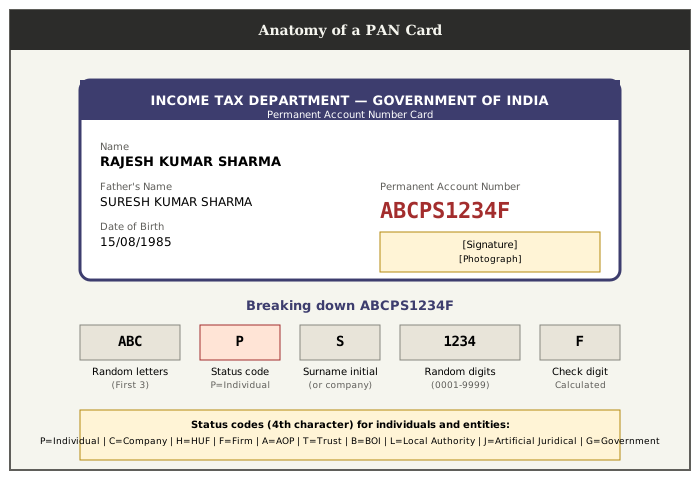
PAN (Permanent Account Number). A 10-character alphanumeric identifier issued by the Income Tax Department. Format: 5 letters, 4 digits, 1 letter (e.g., ABCDE1234F). The fourth letter indicates the type of holder — "P" for individual, "C" for company, "H" for HUF, "F" for firm, etc.
Here's what a PAN card looks like and what each part tells you:
Who needs PAN.
- Anyone whose total income exceeds the basic exemption limit (₹4 lakh under New Regime, ₹2.5 lakh under Old Regime for FY 2025-26)
- Anyone carrying on business or profession with annual turnover above ₹5 lakh
- Anyone wanting to file an ITR (mandatory)
- Anyone making specified financial transactions (large cash deposits, property purchase, vehicle purchase above thresholds, mutual fund purchase above ₹50,000, etc.)
- NRIs with Indian income or assets
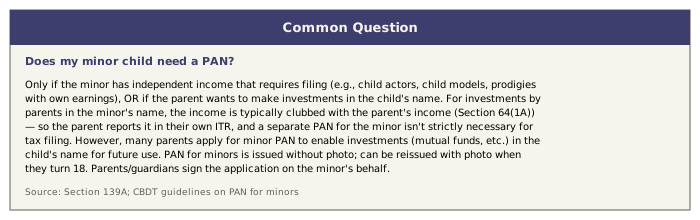
Applying for PAN. Online through NSDL (now Protean eGov) or UTIITSL portals. Documents required: identity proof, address proof, date of birth proof. Standard processing takes 15-20 days; e-PAN (instant) available through Income Tax Department's portal for those with Aadhaar.
Aadhaar. A 12-digit unique identification number issued by UIDAI based on biometric and demographic data. Universal among Indian residents.
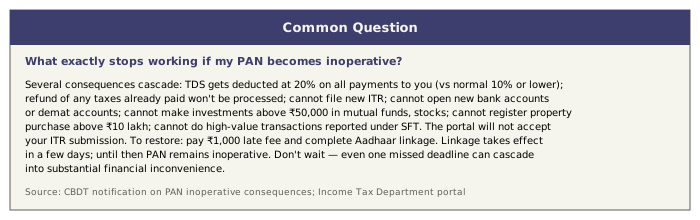
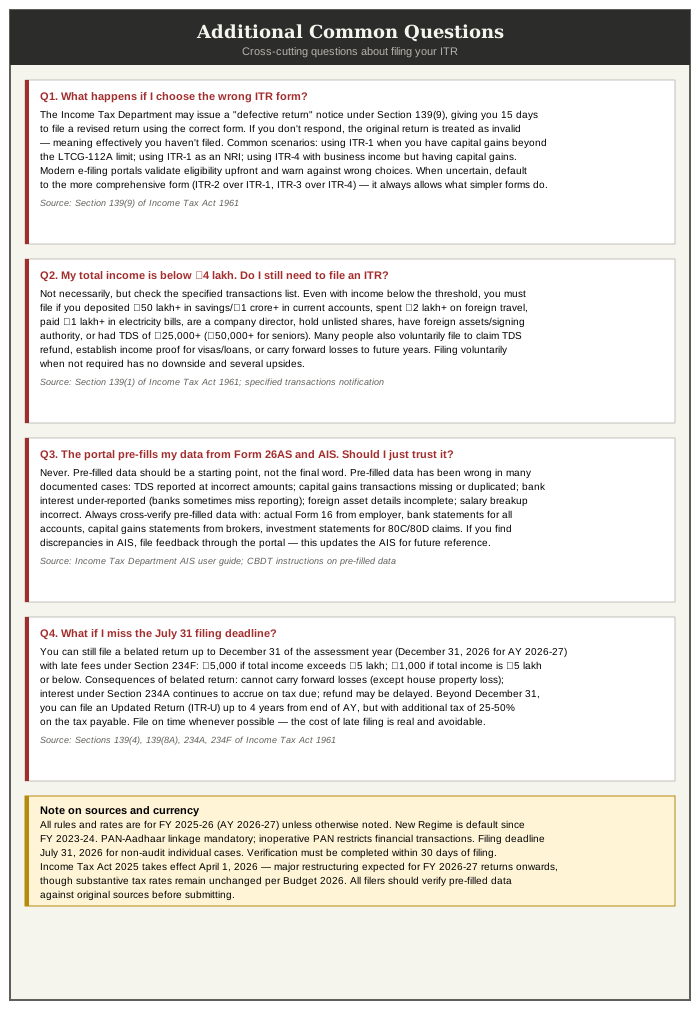
PAN-Aadhaar linkage — mandatory. Since 2017, every PAN holder must link their PAN to their Aadhaar. PANs not linked become inoperative — meaning you cannot file ITRs, claim refunds, conduct major financial transactions, and TDS is deducted at higher rates (20% or more on payments to you).
Restoring an inoperative PAN. Pay a late fee of ₹1,000 and complete the linkage. Once linked, PAN becomes operative again.
Exceptions to PAN-Aadhaar linkage.
- NRIs (Non-Resident Indians as per Income Tax Act)
- Foreign citizens
- Residents of Assam, Meghalaya, and Jammu & Kashmir (state-specific exemption)
- Individuals aged 80 years or above
Why both are needed for ITR. Filing an ITR requires PAN as the primary identifier. Aadhaar is needed for e-verification (Aadhaar OTP — the most common verification method). Linking is required before either can be used effectively.
Sourcing. Section 139A of Income Tax Act 1961; CBDT Notification on PAN-Aadhaar linkage; Income Tax Department portal.
Previous Year vs Assessment Year
This terminology distinction is foundational to Indian tax and trips up new filers regularly.
Previous Year (PY) or Financial Year (FY). The 12-month period in which income is earned. Indian financial year runs April 1 to March 31. So FY 2025-26 means April 1, 2025 to March 31, 2026.
Assessment Year (AY). The 12-month period immediately following the Previous Year, during which the income is assessed and the ITR is filed. AY 2026-27 corresponds to FY 2025-26.
Here's how the dates align:
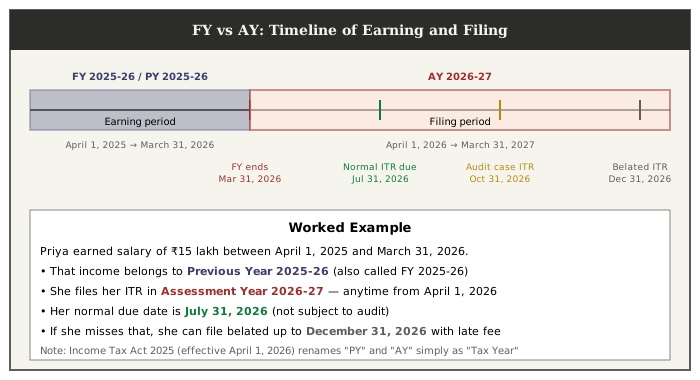
Practical example. If you earned salary, business income, capital gains, etc. between April 1, 2025 and March 31, 2026, you file your return in AY 2026-27 — typically by July 31, 2026. The income earned is from FY 2025-26 / PY 2025-26 / "previous year" in tax terminology.
Why the distinction matters.
- Tax laws and slab rates apply based on the Previous Year (when income was earned)
- ITR forms are designated by Assessment Year (when filed)
- Notifications and amendments reference one or both
- Confusion between the two creates filing errors
Filing deadlines for AY 2026-27 (FY 2025-26 income).
| Category | Deadline |
|---|---|
| Individuals and HUFs not subject to audit | July 31, 2026 |
| Taxpayers subject to audit under section 44AB | October 31, 2026 |
| Taxpayers required to file Transfer Pricing Report (Form 3CEB) | November 30, 2026 |
| Belated returns (with late fee) | Up to December 31, 2026 |
| Updated returns (with additional tax) | Up to 4 years from end of relevant AY (i.e., March 31, 2030 for AY 2026-27) |
Sourcing. Sections 2(34) and 2(9) of Income Tax Act 1961; Section 139 (return filing); CBDT extension notifications.
Who Must File an ITR
Filing is required in many situations beyond just having income above the basic exemption limit.
Income-based filing requirement.
Total income exceeds ₹4 lakh
Under Old Regime.
- Individual under 60: Total income exceeds ₹2.5 lakh
- Senior Citizen (60-79): Total income exceeds ₹3 lakh
- Super Senior Citizen (80+): Total income exceeds ₹5 lakh
"Total income" for this purpose is computed before claiming most deductions under Chapter VI-A (80C through 80U) but after standard deduction and certain other deductions.
Filing required regardless of income — specified transactions.
Even if income is below the basic exemption limit, ITR filing is mandatory if you:
- Deposited ₹1 crore or more in current account(s)
- Deposited ₹50 lakh or more in savings account(s)
- Spent ₹2 lakh or more on foreign travel for yourself or another person
- Paid electricity bills exceeding ₹1 lakh in aggregate during the year
- Are a director in any company
- Hold unlisted equity shares
- Are signing authority on any account outside India
- Have any asset (including financial interest in any entity) located outside India
- Earned tax-deductible income (TDS deducted) totaling ₹25,000+ (₹50,000+ for senior citizens) even if total income is below threshold
- Have business turnover exceeding ₹60 lakh
- Have professional gross receipts exceeding ₹10 lakh
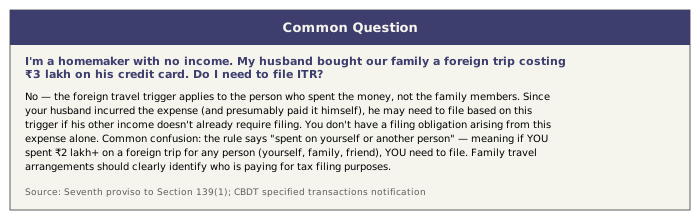
Resident with foreign assets. Any resident (not RNOR, not NR) holding foreign assets or signing authority on foreign accounts must file ITR regardless of income level — and must use ITR-2 or ITR-3 (not the simplified ITR-1 or ITR-4).
Why file even when not required.
- To claim refund of TDS deducted
- To establish income proof for visa, loan applications
- To carry forward losses to future years
- To comply with foreign requirements (some countries require Indian tax compliance)
- To avoid scrutiny questions about non-filing
Sourcing. Section 139(1) of Income Tax Act 1961; if you opt for the new tax regime in FY 2025-26, then, the threshold for filing ITR is Rs.4 lakhs; CBDT notification on specified transactions requiring ITR filing.
ITR-1 (Sahaj) — Who Can Use It
ITR-1, also called Sahaj (meaning "simple"), is the most commonly used form for resident salaried individuals with straightforward income.
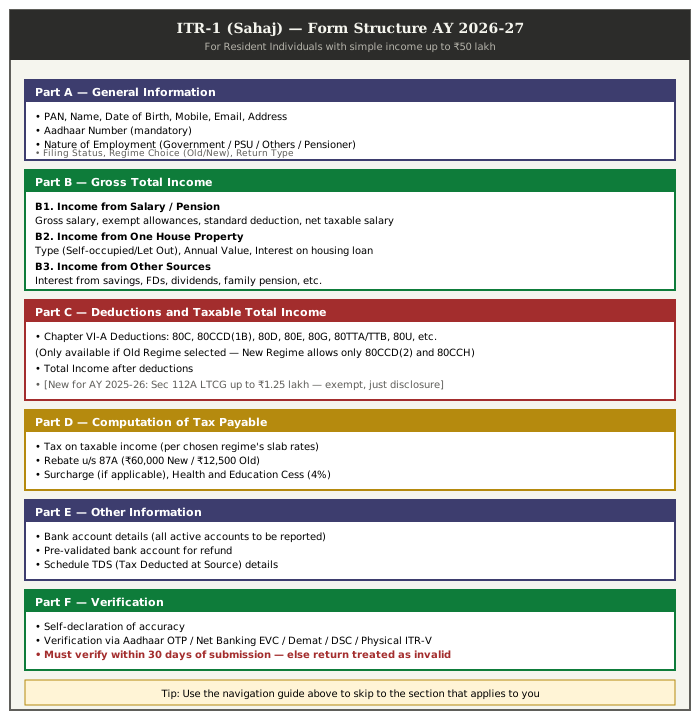
Here's the structure of ITR-1 — what sections you'll be filling and where each piece of information goes:
Eligibility for ITR-1.
You can use ITR-1 if you're a Resident Individual (not RNOR or NR) with total income up to ₹50 lakh, where income consists of:
- Salary or pension
- Income from ONE house property (excluding cases where loss is brought forward from previous years)
- Income from other sources (interest, family pension, dividends, etc. — excluding lottery winnings and income from owning racehorses)
- Agricultural income up to ₹5,000
- New for AY 2025-26: Long-term capital gains under Section 112A from listed equity shares or equity mutual funds, up to ₹1.25 lakh, with no carry-forward losses
Who CANNOT use ITR-1.
You cannot use ITR-1 if you:
- Are a Non-Resident or Resident but Not Ordinarily Resident (RNOR)
- Have total income exceeding ₹50 lakh
- Have income from more than one house property
- Have income from business or profession
- Have capital gains beyond the limited LTCG-112A relaxation above
- Have agricultural income exceeding ₹5,000
- Have foreign income or foreign assets
- Are signing authority for any foreign account
- Are a director in a company
- Hold unlisted equity shares (other than incidental ESOP not yet listed)
- Have brought-forward losses to set off or losses to carry forward
- Have income subject to TDS under Section 194N (cash withdrawals)
- Have deferred tax on ESOPs from eligible start-ups (Section 17(2))
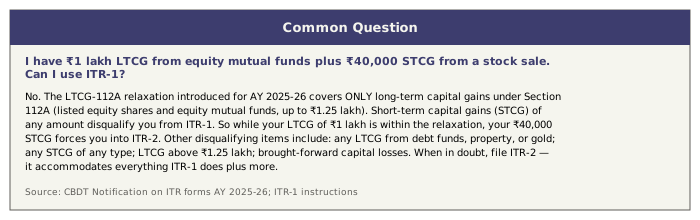
Taxpayers earning long-term capital gains from listed equity shares or equity mutual funds under Section 112A can now file using ITR-1 or ITR-4, provided their LTCG does not exceed ₹1,25,000 and they do not have any carry-forward capital losses. Previously, any capital gains forced filers into ITR-2 or ITR-3. This change reduces compliance burden for small equity investors.
What ITR-1 includes (the form structure).
- Personal Information: PAN, Aadhaar, contact details, bank account, regime choice
- Gross Total Income: Salary, House Property, Other Sources (and LTCG under 112A up to limit)
- Deductions: Chapter VI-A claims under Old Regime
- Computation of Tax: Tax payable based on regime selected
- TDS and Tax Paid: Reconciliation with Form 26AS / AIS
- Bank Account for Refund: Pre-validated bank account
- Verification: Aadhaar OTP, EVC, or signed ITR-V
Sourcing. Section 139 of Income Tax Act 1961; CBDT Notification on ITR forms for AY 2025-26; ITR-1 (Sahaj) is designed for resident individuals whose income sources are straightforward and limited.
ITR-2 — Capital Gains and Multiple Properties
ITR-2 is for individuals and HUFs who don't have business or professional income but have more complex income situations than ITR-1 can accommodate.
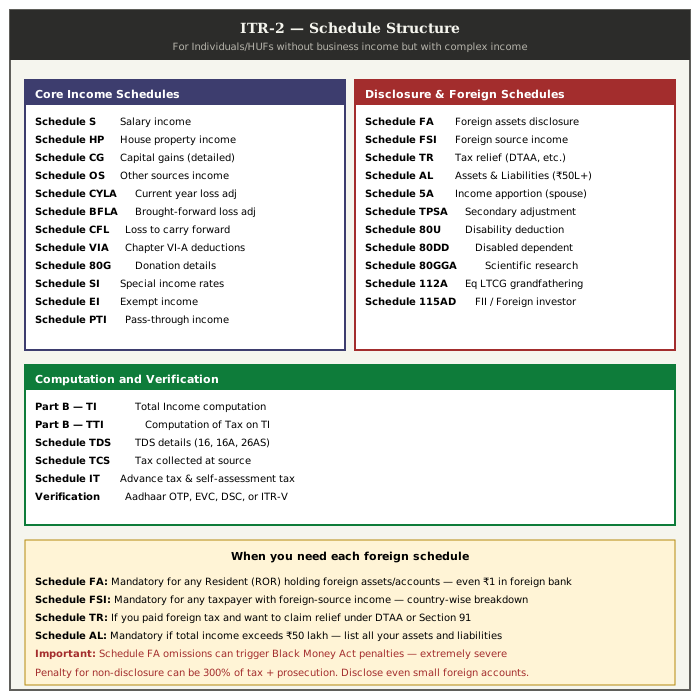
ITR-2 contains many more schedules than ITR-1 — here's the schedule structure:
Eligibility for ITR-2.
Use ITR-2 if you're an Individual or HUF with income from any of the following (and NO business/professional income):
- Salary or pension
- House property (including multiple properties or brought-forward losses)
- Capital gains (any amount, any type)
- Other sources (including lottery winnings, racehorse income)
- Foreign income or assets
- Agricultural income exceeding ₹5,000
- Total income exceeding ₹50 lakh (regardless of source mix)
ITR-2 also required if you:
- Are a Non-Resident or RNOR
- Are a director in a company
- Hold unlisted equity shares
- Have foreign assets or foreign signing authority
- Have brought-forward losses to set off
Key situations forcing ITR-2 instead of ITR-1.
- Sold any property (capital gains on real estate)
- Sold any shares with capital gains beyond ₹1.25 lakh threshold (or any debt fund gains)
- Own more than one house property (even if rented)
- Earned any foreign income
- Hold any foreign assets (even foreign bank account with minimal balance)
What ITR-2 includes (additional sections vs ITR-1).
- Detailed Capital Gains computation (with separate schedules for STCG, LTCG, real estate, securities, etc.)
- Foreign Assets reporting (Schedule FA)
- Asset and Liability disclosure (if income exceeds ₹50 lakh — Schedule AL)
- Multiple house property details
- Brought-forward losses and current year loss adjustments
Sourcing. Section 139 of Income Tax Act 1961; CBDT Notification on ITR forms for AY 2025-26.
ITR-3 — Business and Profession (Regular)
ITR-3 is for individuals and HUFs with income from business or profession under regular accounting (not presumptive).
Eligibility for ITR-3.
Use ITR-3 if you're an Individual or HUF with income from:
- Proprietary business or profession (not under presumptive scheme)
- Partnership firm as a working partner (salary, interest from firm)
- Capital gains, multiple properties, foreign income, etc. (anything else permitted)
Common situations requiring ITR-3.
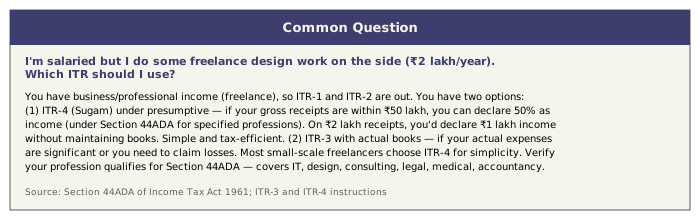
- Self-employed professional (doctor, lawyer, CA, architect, consultant) with gross receipts exceeding presumptive threshold of ₹50 lakh, or choosing not to use presumptive
- Business owner with turnover requiring regular books or choosing not to use presumptive
- Partner in a partnership firm receiving share of profit, remuneration, or interest
- Anyone with income from F&O trading, intraday trading (treated as business income)
- Salaried person also doing freelance/consulting work above presumptive thresholds
Key features of ITR-3.
- Detailed Profit and Loss account
- Balance Sheet of business/profession
- Capital account of proprietor
- All other income sources (salary, property, capital gains, other sources, foreign)
- Audit details if Section 44AB audit applicable (turnover above ₹1 crore for business / ₹50 lakh for profession in most cases)
Sourcing. Section 139 of Income Tax Act 1961; Sections 44AB, 44AD, 44ADA, 44AE for audit and presumptive thresholds.
ITR-4 (Sugam) — Presumptive Taxation
ITR-4, called Sugam (meaning "easy"), is for taxpayers under presumptive taxation schemes — a simplified income computation method for small businesses and professionals.
Eligibility for ITR-4.
You can use ITR-4 if you're a Resident Individual, HUF, or Firm (other than LLP) with:
- Income computed under Section 44AD (business with turnover up to ₹2 crore, or ₹3 crore if cash transactions ≤5%)
- Income computed under Section 44ADA (profession with gross receipts up to ₹50 lakh, or ₹75 lakh if cash transactions ≤5%)
- Income computed under Section 44AE (transport business — specified vehicles)
- Plus salary, one house property, other sources
- Plus the same LTCG-112A relaxation up to ₹1.25 lakh introduced for AY 2025-26
Total income limit: ₹50 lakh.
Presumptive taxation concept.
- Section 44AD: Business income presumed at 8% of turnover (6% for digital/banking transactions)
- Section 44ADA: Professional income presumed at 50% of gross receipts
- Section 44AE: Transport income presumed at fixed rates per vehicle
Who CANNOT use ITR-4.
- Non-residents and RNORs (must use ITR-2 or ITR-3)
- Anyone with capital gains beyond the limited LTCG-112A relaxation
- Anyone with income from more than one house property
- Anyone with foreign income or foreign assets
- Directors of companies, holders of unlisted shares
- Anyone with brought-forward losses
- Income exceeding ₹50 lakh
- LLPs (use ITR-5)
- Anyone with business income above presumptive thresholds choosing not to use presumptive
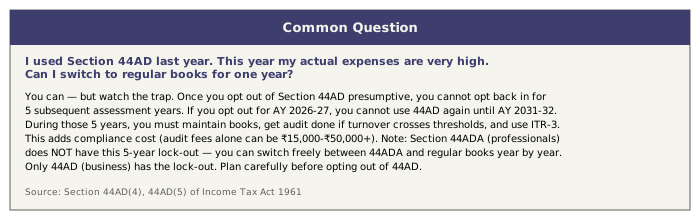
Once you opt for presumptive under 44AD and then later choose to use regular books, you cannot opt back into presumptive for 5 subsequent years. This makes the in/out decision consequential.
Sourcing. Sections 44AD, 44ADA, 44AE of Income Tax Act 1961; CBDT Notification on ITR forms for AY 2025-26; the presumptive taxation scheme is designed to give relief to small taxpayers from the burden of maintaining books of accounts with a turnover not exceeding Rs.2 crore (Rs.3 crore in special cases).
ITR for Non-Residents and Foreign Income Situations
Non-residents face restricted ITR form choices and additional disclosure requirements.
Non-Resident filers.
- Cannot use ITR-1 or ITR-4
- Must use ITR-2 (if no business income) or ITR-3 (if business income)
- Must disclose all India-source income
- May need to disclose treaty benefits claimed
RNOR (Resident but Not Ordinarily Resident) filers.
- Cannot use ITR-1 or ITR-4
- Must use ITR-2 or ITR-3
- Get certain favorable treatment on foreign income (covered in Lesson 2)
Residents with foreign assets.
- Cannot use ITR-1 or ITR-4 (regardless of income amount)
- Must use ITR-2 or ITR-3
- Schedule FA disclosure required for all foreign assets — even foreign bank accounts with trivial balances
- Severe penalties for non-disclosure under Black Money Act
Residents with foreign income.
- Foreign income is taxable for residents (other than RNOR limited cases)
- Foreign tax credit available under Section 90/91 or DTAA
- Must use ITR-2 or ITR-3
- Form 67 must be filed before ITR for FTC claim
Sourcing. Section 6 of Income Tax Act 1961 (residential status); Section 90 (DTAA); Black Money Act 2015; CBDT Notification on ITR forms.
ITR-5, ITR-6, ITR-7 — Entities and Specific Situations
While this curriculum focuses on individuals, brief overview of entity forms helps individuals understand which form their firm/company files (and what they receive from it).
ITR-5. For firms, LLPs, AOPs (Association of Persons), BOIs (Body of Individuals), local authorities, artificial juridical persons, business trusts, and investment funds. NOT for individuals, HUFs, companies, or those claiming exemption under Section 11.
ITR-6. For companies (other than those claiming exemption under Section 11). All companies file ITR-6 electronically with digital signature.
ITR-7. For persons including companies required to furnish return under Section 139(4A) to 139(4F) — generally trusts, political parties, scientific research organizations, news agencies, universities, and similar specified entities.
Partners receive from firm. Partners in partnership firms receive a share of profit (exempt from tax in their hands since taxed at the firm), plus remuneration and interest from the firm (taxable as business income). They file ITR-3 individually.
Shareholders receive from company. Shareholders receive dividends (taxable in hands of recipient as Income from Other Sources at slab rates). They file the appropriate individual ITR based on their other income.
LLP partners receive from LLP. Similar to partnership firm partners — share of profit exempt, remuneration/interest taxable as business income, file ITR-3.
Sourcing. Sections 139(4A) to 139(4F) of Income Tax Act 1961; CBDT Notification on ITR forms.
The Five Heads of Income
Indian tax law classifies all income into five "heads" — categories with their own computation rules. Understanding these heads is essential because each ITR form expects you to compute income under each applicable head separately.
- Head 1 — Income from Salaries. Income from employer-employee relationship. Includes basic pay, allowances, perquisites (perks), bonuses, commissions, pension. Computed after standard deduction (₹75,000 under New Regime, ₹50,000 under Old Regime for salaried) and exempt allowances (HRA, LTA, etc. — Old Regime only mostly). Covered in detail in Lesson 10.
- Head 2 — Income from House Property. Income from owning property (whether rented out or self-occupied for the second and subsequent properties). Computed as Gross Annual Value minus municipal taxes minus 30% standard deduction minus interest on home loan. Self-occupied first property has special rules. Covered in Lesson 13.
- Head 3 — Profits and Gains of Business or Profession (PGBP). Income from carrying on business or professional activities. Either computed under presumptive taxation (44AD/ADA/AE) or as actual profit per books of account. Covered in Lesson 12.
- Head 4 — Capital Gains. Income from sale of capital assets — property, shares, mutual funds, gold, jewellery, etc. Sub-divided into Short-Term Capital Gains (STCG) and Long-Term Capital Gains (LTCG), with different rates depending on asset class and holding period. Covered in Lesson 20.
- Head 5 — Income from Other Sources. Catch-all for income not falling under other heads. Includes interest from bank deposits, dividends, family pension, lottery winnings, casual income, gifts above ₹50,000 from non-relatives, etc.
Gross Total Income. Sum of income under all five heads after applicable head-level deductions and loss adjustments.
Total Income. Gross Total Income minus Chapter VI-A deductions (under Old Regime) minus rebate under Section 87A. Tax is calculated on Total Income.
Sourcing. Sections 14-59 of Income Tax Act 1961 (heads of income); Section 80A et seq (deductions).
Old vs New Regime — Brief Overview
A critical choice every filer must make: Old Regime or New Regime. This gets full treatment in Lesson 5, but a brief overview is necessary in Lesson 1 since the regime choice affects every subsequent calculation.
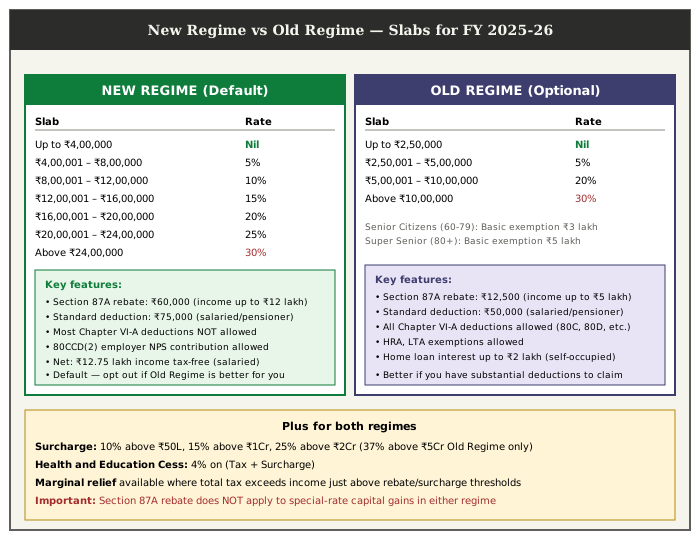
New Regime (default for FY 2025-26). Lower tax slab rates but most deductions and exemptions disallowed. The new tax regime is the default tax regime for FY 2025-26, as per the provisions of section 115BAC of the Income Tax Act, 1961.
Slab rates under New Regime (FY 2025-26).
| Income Range | Tax Rate |
|---|---|
| Up to ₹4 lakh | Nil |
| ₹4 lakh to ₹8 lakh | 5% |
| ₹8 lakh to ₹12 lakh | 10% |
| ₹12 lakh to ₹16 lakh | 15% |
| ₹16 lakh to ₹20 lakh | 20% |
| ₹20 lakh to ₹24 lakh | 25% |
| Above ₹24 lakh | 30% |
Individual tax payers who opt for the new tax regime and have annual taxable income of up to Rs. 12 lakh will be eligible for 100% tax rebate up to Rs. 60,000. Such individuals are eligible for a standard deduction of Rs. 75,000 annually.
A salaried individual under the New Regime pays zero income tax up to ₹12.75 lakh total income (₹12 lakh taxable + ₹75,000 standard deduction). This is a major change from Budget 2025.
Old Regime. Original tax structure with higher slab rates but many deductions and exemptions available.
Slab rates under Old Regime (FY 2025-26, unchanged from prior years).
For individuals under 60:
- Up to ₹2.5 lakh: Nil
- ₹2.5 lakh to ₹5 lakh: 5%
- ₹5 lakh to ₹10 lakh: 20%
- Above ₹10 lakh: 30%
For Senior Citizens (60-79): basic exemption ₹3 lakh
For Super Senior Citizens (80+): basic exemption ₹5 lakh
Rebate under Section 87A (Old Regime). Up to ₹12,500 for income up to ₹5 lakh, effectively making income up to ₹5 lakh tax-free.
Surcharge and cess. Apply to both regimes.
- Surcharge: 10% above ₹50 lakh, 15% above ₹1 crore, 25% above ₹2 crore, 37% above ₹5 crore (Old Regime) / 25% maximum under New Regime
- Health and Education Cess: 4% on (tax + surcharge)
Switching between regimes.
- Salaried individuals without business income: Can switch year by year
- Business income earners: Once they opt out of New Regime, they can re-enter only once
Which is better. Depends on the level of deductions you can claim. Roughly:
- Old Regime favors filers with substantial Section 80C, HRA, home loan interest, and medical insurance deductions
- New Regime favors filers with simpler income and limited deductions
- Calculate both before filing; tax software does this automatically
Sourcing. Section 115BAC of Income Tax Act 1961; Finance Act 2025; the Budget 2025 proposed new tax slab rates under section 115BAC i.e., the New Tax Regime or the Default Tax Regime.
Filing and Verification Methods
Filing an ITR is a two-step process: submission and verification. The return is not considered filed until verification is complete.
E-filing on Income Tax portal. All ITRs must be filed electronically through incometax.gov.in (the e-filing portal). The portal supports:
- Online filing directly through the web interface
- Offline filing using JSON utility downloaded from the portal
- Filing through registered ERIs (e-Return Intermediaries) and tax preparation services
Pre-filled data. The portal pre-fills many fields from Form 26AS, AIS (Annual Information Statement), TIS (Taxpayer Information Summary), and previous ITRs. Always verify pre-filled data — discrepancies can cause issues.
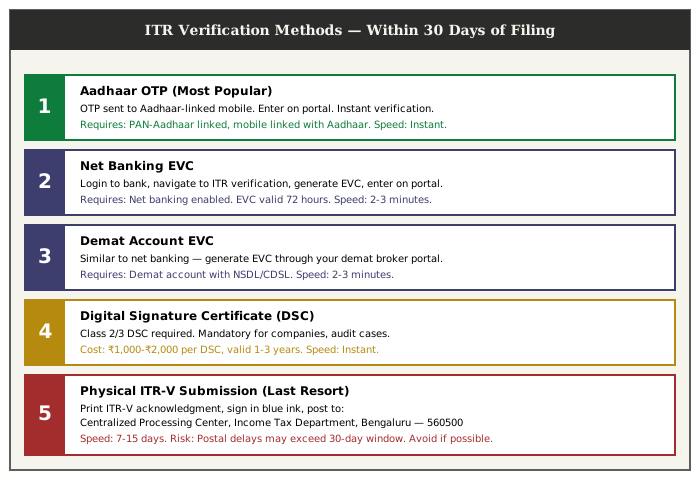
Verification methods.
After filing, verify within 30 days using any of:
- Aadhaar OTP (most common). Generates OTP sent to the mobile number linked with Aadhaar. Enter OTP on portal. Instant verification. Requires PAN linked with Aadhaar and mobile linked with Aadhaar.
- Net banking EVC. Login to your bank's net banking, navigate to tax/ITR verification section, generate EVC, enter on portal. Works with most major banks. EVC valid for 72 hours.
- Demat account EVC. Similar process through demat account login.
- ATM-based EVC. Generate EVC at SBI ATM (and some other bank ATMs) using debit card.
- Digital Signature Certificate (DSC). Required for certain categories (companies, tax audit cases) and optional for others. Requires Class 2 or higher DSC.
- Physical ITR-V submission. Print the ITR-V (Acknowledgment), sign it, and post to CPC Bangalore within 30 days. Slowest method; verify successful delivery.
ITR not verified within 30 days is treated as invalid — meaning the return is not filed for legal purposes. If the filing deadline has passed, late filing penalties may apply. Verify immediately after filing.
Sourcing. Section 139 of Income Tax Act 1961; CBDT Notification on verification methods; Income Tax Department portal documentation.
Documents Needed for Filing
Gathering the right documents before starting your ITR speeds up filing and reduces errors.
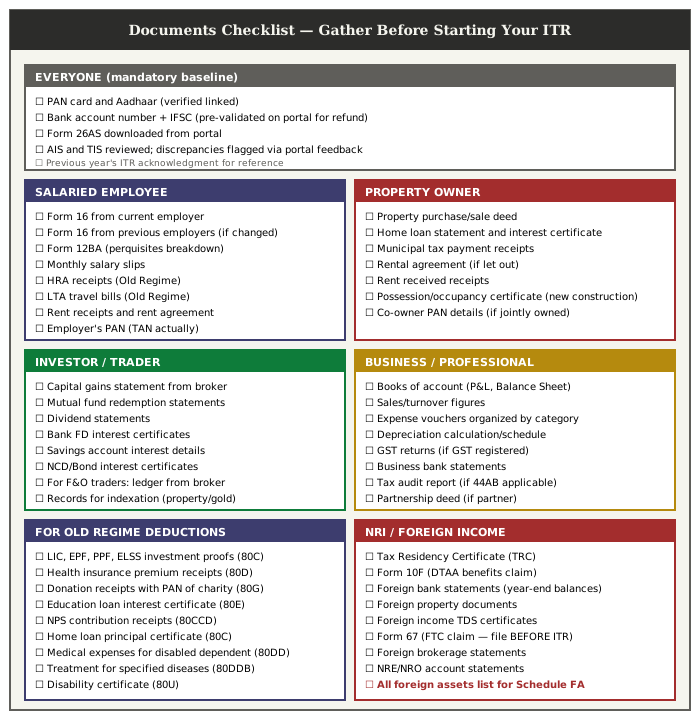
For all filers.
- PAN card
- Aadhaar card
- Bank account details (account number, IFSC code) for refund — must be pre-validated on portal
- Form 26AS (downloadable from portal — tax credit statement)
- Annual Information Statement (AIS) / Taxpayer Information Summary (TIS) — comprehensive view of reported income
- Previous year's ITR acknowledgment (if filed)
For salaried filers.
- Form 16 from employer (Part A for TDS, Part B for salary breakup)
- Salary slips for the year (to verify Form 16)
- Form 12BA for perquisites (if applicable)
For house property income.
- Address and details of property
- Rental income receipts (if let out)
- Municipal tax payment receipts
- Home loan interest certificate from lender (Form/Interest Certificate)
- Possession certificate / occupancy certificate (for under-construction properties)
For capital gains.
- Sale and purchase deeds for property
- Statement of capital gains from brokers/depositories (for shares/mutual funds)
- Cost inflation index calculations (for LTCG with indexation)
- Improvement cost records
- Brokerage and other transaction cost records
For business or profession.
- Books of account (under regular)
- Sales/turnover details (under presumptive)
- Expense vouchers
- Bank statements for business account
- GST returns filed (for GST registered)
- Audit report under Section 44AB (if applicable)
For deductions (Old Regime).
- LIC, EPF, PPF, ELSS investment proof (Section 80C)
- Health insurance premium receipts (Section 80D)
- Donation receipts (Section 80G)
- Education loan interest certificate (Section 80E)
- Home loan principal certificate (Section 80C)
- NPS contribution receipts (Section 80CCD)
For other income.
- Bank statements for all savings accounts (interest income)
- Interest certificates from bank FDs
- Dividend statements
- Lottery winnings TDS certificate
For foreign income/assets (if applicable).
- Foreign bank statements
- Foreign property documents
- Foreign income TDS certificates
- DTAA tax residency certificate
- Form 67 (foreign tax credit claim)
Sourcing. Income Tax Department guidance on filing; Form 26AS user guide.
Key Takeaways
- PAN-Aadhaar linkage is mandatory — inoperative PAN blocks ITR filing, refunds, and major financial transactions, and triggers TDS at 20% or higher. Restore by paying the ₹1,000 late fee and completing the linkage.
- Assessment Year (AY) always follows Previous Year (PY) by one year. Income earned in FY 2025-26 is filed in AY 2026-27, with the deadline of July 31, 2026 for most individuals.
- ITR filing is mandatory in many situations beyond income thresholds — including being a company director, holding foreign assets, large current account deposits, and TDS deductions totaling ₹25,000+.
- ITR-1 (Sahaj) and ITR-4 (Sugam) are the simplified forms. Non-residents, those with foreign assets, directors, and those with capital gains beyond ₹1.25 lakh cannot use either.
- New Regime is the default for FY 2025-26 — salaried individuals pay zero tax up to ₹12.75 lakh total income (₹12 lakh taxable + ₹75,000 standard deduction). Full regime comparison in Lesson 5.
- An ITR is only considered filed after verification. Verify within 30 days — unverified returns are treated as invalid.
Quiz — 5 Questions
Answer one at a timeWhat does 'Assessment Year 2026-27' refer to?