Filing Process, Verification, Refunds, and Notices
Step-by-step ITR filing on the income tax portal, e-verification methods and the 30-day window, refund processing timelines and status tracking, Section 143(1) intimation scenarios, defective return and scrutiny assessment responses, and the three correction mechanisms — Revised Return, ITR-U, and Rectification
- Navigate the 13-step ITR filing process on incometax.gov.in — from login through e-verification — and select the correct form, schedules, and payment codes
- Interpret refund status messages, track processing timelines, and escalate delayed refunds through grievance, CPC helpline, and IT Ombudsman channels
- Distinguish Section 143(1) intimation from an alarming notice, respond correctly to all four possible scenarios, and file rectification under Section 154 when you disagree
- Respond within deadlines to Section 139(9) defective return and Section 143(2) scrutiny assessment notices using the correct portal procedures
- Choose between Revised Return (Section 139(5)), Updated Return ITR-U (Section 139(8A)), and Rectification (Section 154) for different correction scenarios — and know when filing belated before December 31 is preferable to ITR-U
Filing Process, Verification, Refunds, and Notices
This lesson covers the mechanics of actually filing your ITR — what happens when you click "submit," how verification works, when refunds arrive, and what to do when the Income Tax Department sends you a notice afterward. It's the practical bridge between knowing what to file (Lessons 1-8) and the post-filing world.
For most filers, filing goes smoothly: submit, e-verify, wait for refund or confirmation. But things can go wrong — defective returns, scrutiny notices, refund delays, mismatched data. Understanding the post-filing landscape helps you respond appropriately rather than panicking when an email from the IT Department arrives.
We also cover the three "return correction" mechanisms — Revised Returns (Section 139(5)), Updated Returns (Section 139(8A)), and Rectification (Section 154) — and when each applies. Each has different timelines, restrictions, and consequences.
This is the last foundational lesson. Lessons 10-19 will cover career and population-specific situations in depth, building on the framework you have now.
A reminder on terminology: the Income Tax Act 2025 (effective April 1, 2026) renumbers these provisions but preserves the substantive framework. This lesson uses 1961 Act references applicable to FY 2025-26 income filed as AY 2026-27.
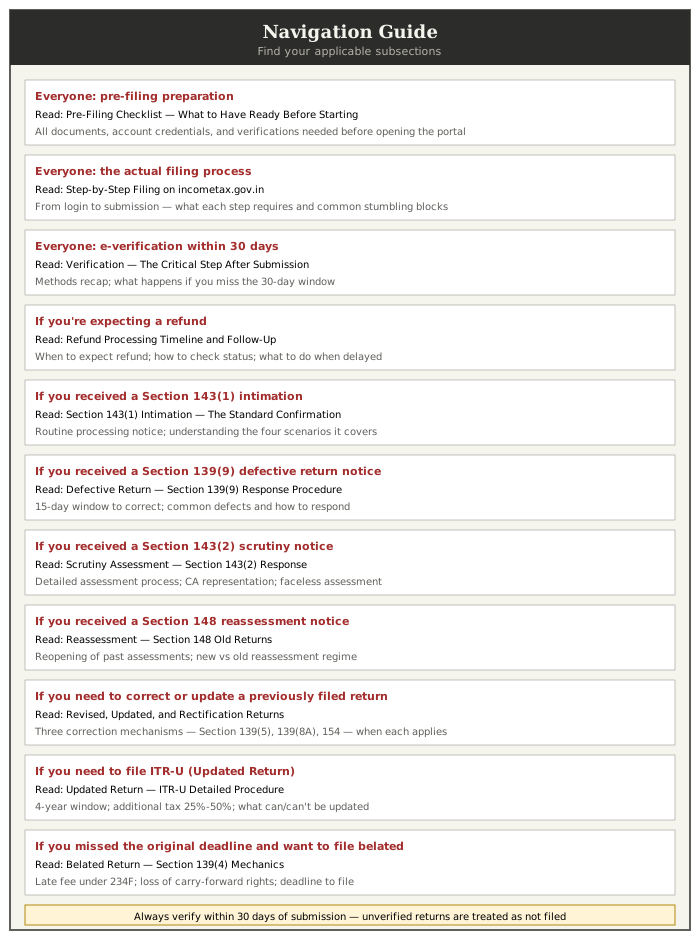
Pre-Filing Checklist — What to Have Ready Before Starting
A few minutes of preparation prevents most filing problems.
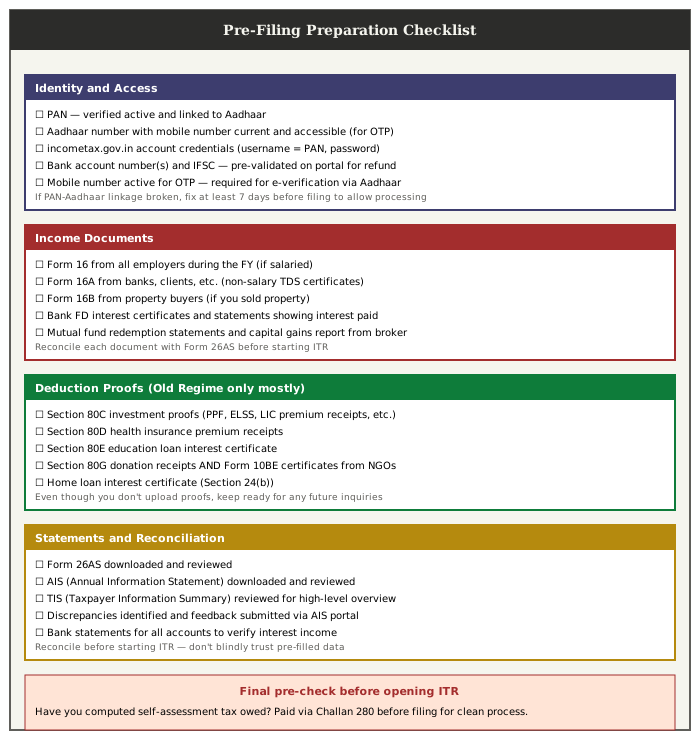
Income Tax Department portal user guide; Form 26AS and AIS access procedures.
Step-by-Step Filing on incometax.gov.in
The portal supports multiple paths to file your ITR. Here's the standard workflow.
Step 1 — Login.
- Go to incometax.gov.in
- Click "Login Here"
- Username: Your PAN
- Password: Your password (reset if forgotten)
- Use Aadhaar OTP if password forgotten
Step 2 — Navigate to filing.
- Click "e-File" in top menu
- Select "Income Tax Returns"
- Click "File Income Tax Return"
- Select Assessment Year (2026-27 for FY 2025-26 income)
Step 3 — Select filing mode.
- "Online" (recommended for most filers) — fills directly in browser
- "Offline" — download utility, fill JSON file, upload
- Most filers use Online for ITR-1 and ITR-2; Offline preferred for ITR-3
Step 4 — Choose status.
- Individual (most common)
- HUF (if filing for Hindu Undivided Family)
Step 5 — Select ITR form.
- ITR-1 (Sahaj) — Simple salary/pension/single property
- ITR-2 — Capital gains, multiple properties, foreign assets
- ITR-3 — Business or professional income
- ITR-4 (Sugam) — Presumptive taxation
The portal helps determine the correct form based on a brief questionnaire.
Step 6 — Reason for filing.
- Taxable income above basic exemption
- Specified transactions (foreign travel, electricity, etc.)
- Other reasons (claim refund, carry forward losses, etc.)
Step 7 — Pre-filled data review.
- Personal information (PAN, name, address, contact) — verify accuracy
- Bank account details — ensure pre-validated account for refund
- Salary details (from Form 16) — verify against employer's Form 16
- Other income (interest, dividends, etc.) — verify against AIS
- TDS details — verify against Form 26AS
- Investment/deduction declarations
Step 8 — Complete each schedule.
For ITR-2 (most common comprehensive form), schedules include:
- Schedule S (Salary): Verify and complete employer details, exemptions
- Schedule HP (House Property): Add rental income, deductions
- Schedule CG (Capital Gains): Enter capital asset transactions
- Schedule OS (Other Sources): Interest, dividends, other
- Schedule VIA (Deductions): Claim Chapter VI-A deductions
- Schedule FA (Foreign Assets): For ROR with foreign assets
- Schedule TDS: Confirm TDS credits
Step 9 — Review tax computation.
- Portal auto-calculates tax based on entries
- Verify regime selection (Old vs New)
- Confirm Section 87A rebate applied correctly
- Check surcharge calculation if income above ₹50 lakh
- Verify cess
Step 10 — Verify summary.
- Total income
- Total deductions
- Taxable income
- Tax payable
- TDS/TCS/Advance tax credit
- Net amount owed or refund
Step 11 — Pay self-assessment tax (if owed).
- Use e-Pay Tax → Challan 280 → Self-Assessment Tax (Code 300)
- Wait 2-7 days for Form 26AS to reflect
- Enter challan details in ITR
Step 12 — Submit.
- Click "Proceed to Validation"
- Resolve any errors flagged
- Click "Submit"
- Note the acknowledgment number
Step 13 — E-verify within 30 days.
Critical step — covered separately below.
incometax.gov.in user guide; CBDT filing procedures.
Verification — The Critical Step After Submission
Filing alone doesn't complete your return. You must verify within 30 days, or the submission is treated as if it never happened.
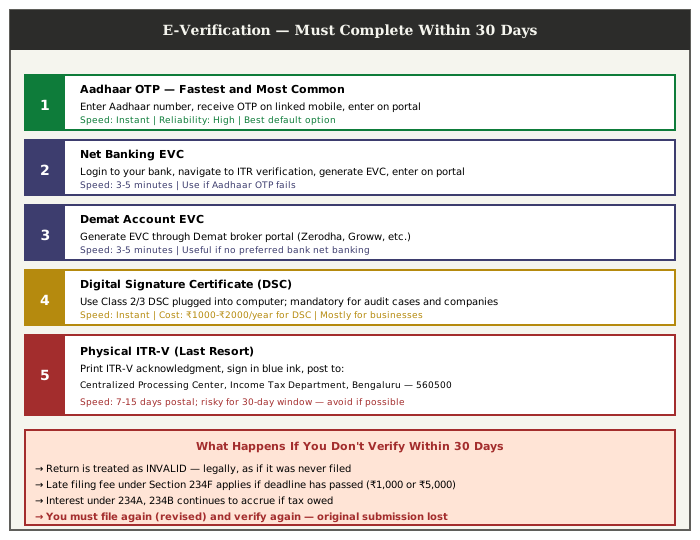
Verify immediately after submission. Best practice is to e-verify within minutes of submitting. Aadhaar OTP takes 30 seconds.
If you cannot verify (Aadhaar mobile number changed, no Aadhaar, etc.). Use net banking EVC or DSC. Physical ITR-V is the last option and risky due to postal delays.
Section 139 of Income Tax Act 1961; CBDT notification on verification methods.
Refund Processing Timeline and Follow-Up
If you've overpaid (via TDS, advance tax, or excess), refund is due back. Here's what to expect.
Normal refund timeline.
| Stage | Time |
|---|---|
| ITR filing and e-verification | Day 0 |
| Processing under Section 143(1) | 7-45 days typical |
| Refund initiated by IT Department | After processing |
| Refund credited to bank account | 1-7 days after initiation |
Total typical timeline: 30-60 days from filing to refund credit.
What can delay refunds.
- TDS mismatch with Form 26AS — most common reason
- Bank account not pre-validated
- Filing during peak season (July-August) — processing backlogs
- High-value refund (above ₹50,000 sometimes triggers additional review)
- Discrepancies between ITR and AIS
- Outstanding tax demand from previous years (refund adjusted against demand)
Checking refund status.
Method 1 — Income Tax portal. incometax.gov.in → Login → Services → Tax Pending Actions → Pending Action/Refund Status.
Method 2 — TIN-NSDL. tin.tin.nsdl.com/oltas/refund-status-pan.html → Enter PAN, AY, status.
Status meanings.
- "Return Submitted" — filed and verified
- "Return Processed" — Section 143(1) completed
- "Refund Issued" — refund initiated
- "Refund Failed" — bank rejected (account issue) — re-validate bank
- "No Refund" — no refund due as per processing
- "Defective" — defective return notice issued
What to do if refund delayed beyond 90 days.
- Step 1. Check refund status and verify all data correct.
- Step 2. Submit grievance through portal: Services → Grievances → Refund/Status Related.
- Step 3. Call CPC (Centralized Processing Center): 1800-103-0025 (toll-free), 1800-419-0025.
- Step 4. Email orm@cpc.incometax.gov.in for written follow-up.
- Step 5. Escalate to Income Tax Ombudsman if no response in 3 months.
Refund interest. If refund is delayed beyond a reasonable period and the IT Department is at fault, you're entitled to interest at 0.5% per month under Section 244A. Calculated from April 1 of the AY (or from date of payment for excess advance tax) until refund credited. Automatically applied during processing if delay is significant.
Section 244A (refund interest) of Income Tax Act 1961; CBDT refund processing guidelines.
Section 143(1) Intimation — The Standard Confirmation
Most filers receive a Section 143(1) intimation after processing. It's not a notice in the alarming sense — it's a standard processing confirmation.
What it contains.
- Your computation as filed
- IT Department's computation as processed
- Differences (if any) between the two
- Final tax position: payable, refundable, or balanced
Four possible scenarios.
Scenario 1: No discrepancy. "As per ITR and IT Dept computation, the figures match." If refund due, it'll be processed. No action needed.
Scenario 2: Demand for additional tax. IT Department computed higher tax than you.
Common reasons:
- TDS claimed higher than 26AS shows
- Deductions disallowed (mismatch with declarations)
- Computation differences
Action: Review carefully. If you agree, pay the demand within 30 days. If you disagree, file rectification under Section 154 with documentation.
Scenario 3: Refund less than expected. IT Department computed lower refund than you. Same as Scenario 2 — review, agree or rectify.
Scenario 4: Refund more than expected (rare). IT Department found additional refund. Usually due to interest under Section 244A being added.
Timeline. Section 143(1) intimation must be issued within 9 months from the end of the FY in which return was filed. So for AY 2026-27 returns filed by July 2026, intimation typically arrives by March 2027.
What to do upon receipt.
- Step 1. Read carefully — compare each line of "As per Return" with "As Computed."
- Step 2. Identify any differences and the reason.
- Step 3. If no differences or you agree with adjustments — no action needed (refund will be processed automatically, or pay demand within 30 days).
- Step 4. If you disagree — file rectification under Section 154 with supporting documents within 4 years.
Section 143(1) of Income Tax Act 1961; CBDT intimation procedures.
Defective Return — Section 139(9) Response Procedure
A more serious notice — your return has errors that prevent processing.
Common defects triggering Section 139(9).
- Missing required schedules (e.g., capital gains in ITR-2 form but Schedule CG empty)
- Used wrong ITR form (e.g., ITR-1 with foreign assets)
- Tax computation inconsistent with form rules
- Missing mandatory bank account details
- Verification failure due to invalid signature
- Critical PAN/Aadhaar inconsistency
The 15-day window. You have 15 days from receipt of notice to file a revised return correcting the defects. Extension can be requested with proper reason, granted at AO discretion.
Consequences of not responding.
- Return treated as INVALID — same as not filing
- All consequences of non-filing apply: late fee, interest, loss of carry-forward, etc.
Response procedure.
- Step 1. Login to portal. Notice appears under "Pending Actions."
- Step 2. Read the notice carefully. It identifies the specific defects.
- Step 3. Click "Submit response" or "Revise return."
- Step 4. Submit corrected return addressing each defect.
- Step 5. E-verify the new return within 30 days.
Common defects and fixes.
| Defect | Fix |
|---|---|
| Used ITR-1 but have capital gains beyond limit | Refile using ITR-2 |
| Foreign assets disclosed but used ITR-1 | Refile using ITR-2 with Schedule FA |
| Used ITR-4 (presumptive) but actual books required | Refile using ITR-3 with full books |
| Bank account not pre-validated | Pre-validate then refile |
| Verification failed | Re-verify using different method |
Section 139(9) of Income Tax Act 1961; CBDT defective return procedures.
Scrutiny Assessment — Section 143(2) Response
A scrutiny notice means the IT Department wants to examine your return in detail. Rare for routine filers but consequential when it happens.
What triggers scrutiny.
- Large variance between claimed deductions and AIS data
- High-value transactions reported but not adequately explained
- Discrepancy patterns flagged by AI/risk-based selection
- Specific industries or income types undergoing focused review
- Random selection (small percentage)
Faceless assessment. Since 2020, most scrutiny is "faceless" — no physical interaction with assessing officer. Conducted entirely through portal.
Timeline.
- Notice under 143(2): Within 3 months from end of FY in which return filed
- Assessment completion: Within 12 months from end of relevant AY
- For AY 2026-27 returns, scrutiny notice (if any) typically issued by March 2027; assessment completed by March 2028.
The scrutiny process.
- Step 1. Notice received. Lists specific issues to be examined.
- Step 2. You respond with documentation through portal.
- Step 3. AO may issue additional queries (Section 142(1) notices).
- Step 4. AO reviews all submissions.
- Step 5. Final assessment order issued — may agree with your return, modify it, or impose additional tax.
Important: Get a CA involved. Scrutiny assessments require professional expertise. The stakes (tax + interest + penalty) can be substantial. Don't navigate this alone.
Your rights during scrutiny.
- Right to be heard
- Right to know specific issues being examined
- Right to representation by authorized representative
- Right to time extensions (with valid reasons)
- Right to appeal adverse orders
Sections 143(2), 142(1), 144 of Income Tax Act 1961; CBDT faceless assessment scheme.
Reassessment — Section 148 for Old Returns
Section 148 allows the IT Department to reopen old returns if they have reason to believe income escaped assessment.
The new reassessment framework (post Finance Act 2021).
- Three-year normal window: Notice under Section 148 can be issued within 3 years from the end of the relevant AY.
- Extended 10-year window: For cases where income escaping assessment is ₹50 lakh or more, notice can be issued within 10 years (in exceptional circumstances even longer).
Before issuing 148. AO must:
- Conduct inquiries under Section 148A
- Provide you opportunity to respond
- Issue order under 148A(d) before issuing 148 notice
This procedural protection prevents arbitrary reopening. AO can't just send a 148 notice — they must first conduct preliminary inquiry and give you chance to explain.
What to do on receipt.
- Step 1. Engage a CA immediately. Time is critical.
- Step 2. Respond to 148A inquiry with documentation.
- Step 3. If 148 notice issued, file revised return for that year (if not already filed) or confirm earlier return.
- Step 4. Cooperate with assessment but ensure your rights are protected.
Sections 148, 148A of Income Tax Act 1961; Finance Act 2021 reassessment amendments.
Revised, Updated, and Rectification Returns
Three distinct mechanisms for correcting filed returns — each with different scope and consequences.
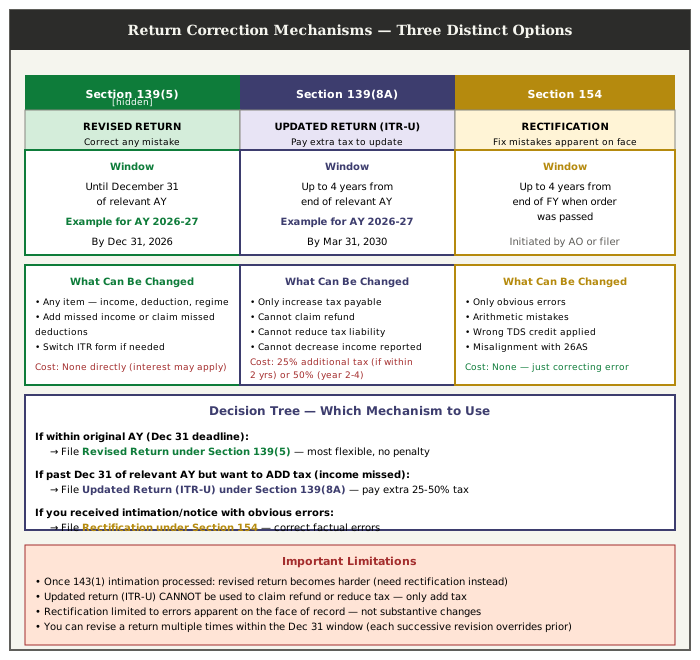
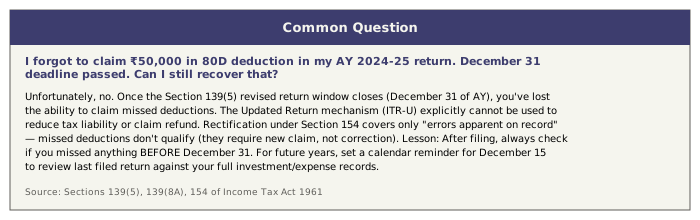
Sections 139(5), 139(8A), 154 of Income Tax Act 1961.
Updated Return — ITR-U Detailed Procedure
ITR-U was introduced in Finance Act 2022 to give taxpayers a one-way mechanism to disclose previously omitted income.
Key features of ITR-U.
| Aspect | Detail |
|---|---|
| Time Limit | 4 years from end of relevant AY |
| Can Be Used To | ONLY add income/pay more tax |
| Cannot Be Used To | Claim refund, reduce tax, change regime |
| Additional Tax | 25% (if within 12 months from end of relevant AY) 50% (if 12-24 months) 60% (if 24-36 months) — proposed enhancement 70% (if 36-48 months) — proposed enhancement |
When ITR-U makes sense.
- You discovered missed income (foreign salary, capital gains, etc.) after Dec 31 of AY
- You want to avoid potential scrutiny/notice for the unreported income
- You want to be in compliance even at additional tax cost
When ITR-U doesn't help.
- You want to claim a refund — not possible via ITR-U
- You want to reduce previously reported income — not possible
- You want to change ITR form — not possible
Process.
- Step 1. Login to portal. Navigate to e-File → Income Tax Returns → File Updated Return.
- Step 2. Select Assessment Year being updated.
- Step 3. Specify reason for update (e.g., income previously not reported).
- Step 4. Fill ITR-U form with corrected figures.
- Step 5. Compute additional tax (25%/50% as applicable).
- Step 6. Pay additional tax via Challan 280.
- Step 7. Submit and verify.
Section 139(8A) of Income Tax Act 1961; Finance Act 2022 introducing ITR-U.
Belated Return — Section 139(4) Mechanics
Filing after the original deadline but within the assessment year — belated return.
Window. Original due date (July 31 / October 31) until December 31 of relevant AY.
Late filing fee under Section 234F.
- ₹1,000 if total income ≤ ₹5 lakh
- ₹5,000 if total income > ₹5 lakh
Consequences of belated filing.
- Lost ability to carry forward losses. Most losses (business loss, capital loss, speculation loss) cannot be carried forward if return filed belated. Only house property loss can be carried forward despite belated filing.
- Interest under Section 234A. 1% per month from original due date.
- Interest under Section 234B/234C continues to accrue. Until tax fully paid.
- Cannot revise belated return (was earlier law). Under current law, even belated returns can be revised within Dec 31. Updated return option available even after that.
- No carry-forward of unabsorbed depreciation. Limited impact for individuals.
Should you file belated or wait for ITR-U?
Belated (by Dec 31): Late fee + interest, but you've filed and can claim refund (if any).
ITR-U (after Dec 31): No late fee under 234F (different mechanism), but 25-50% additional tax. Cannot claim refund.
For most filers with refund or balanced position: file belated before Dec 31. For those with significant unreported income discovered later: ITR-U is the only option.
Sections 139(4), 234F of Income Tax Act 1961.
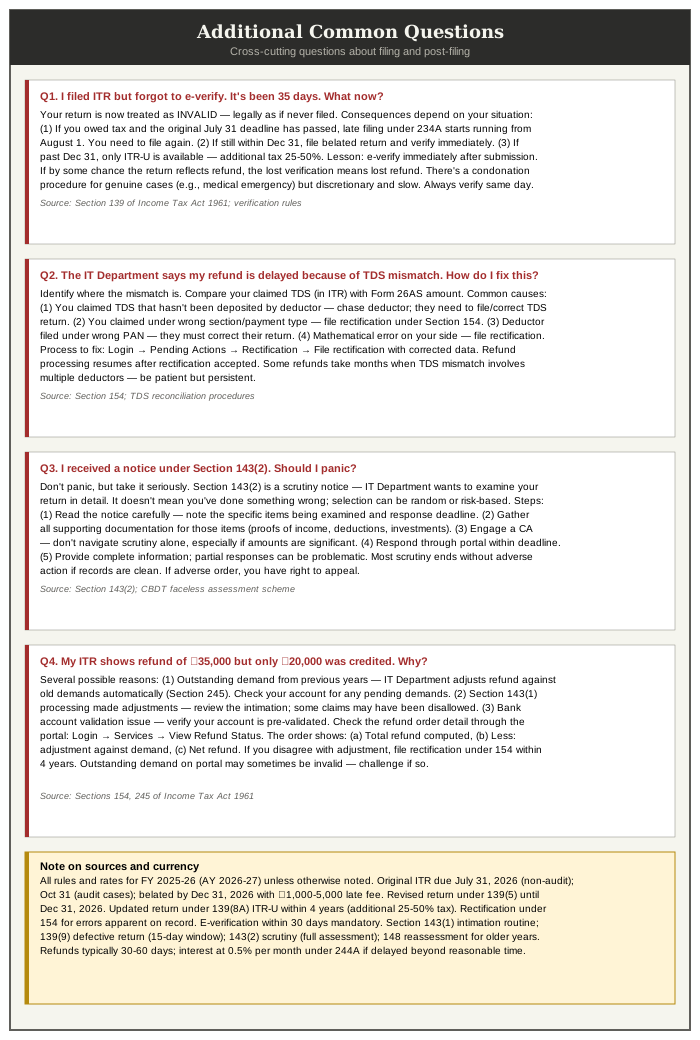
End of lesson — Additional common questions
Key Takeaways
- Filing must be e-verified within 30 days of submission — missing this deadline treats the return as if never filed, with all non-filing consequences (late fee, interest, loss of carry-forward) applying.
- Normal refund timeline is 30-60 days from filing to credit; check status via incometax.gov.in (Services → Pending Action) or TIN-NSDL; if delayed beyond 90 days, escalate through grievance portal, CPC helpline (1800-103-0025), or Income Tax Ombudsman.
- Section 143(1) intimation is a standard processing confirmation, not an alarming notice — four scenarios: no discrepancy (no action), additional tax demand (pay within 30 days or file rectification under Section 154), lower refund (review and rectify), higher refund (rare, interest under Section 244A added).
- Section 139(9) defective return notice gives 15 days to refile with corrections — not responding treats the return as INVALID with all non-filing consequences; common fixes include switching to the correct ITR form and pre-validating the bank account.
- Three correction mechanisms have distinct scopes: Revised Return (Section 139(5)) corrects any error before December 31 of AY; Updated Return ITR-U (Section 139(8A)) only adds income at 25-70% additional tax and cannot claim refunds; Rectification (Section 154) addresses only arithmetic or data-entry errors.
- Scrutiny assessment under Section 143(2) is conducted faceless through the portal since 2020 — always engage a CA, as stakes (tax, interest, and penalty) can be substantial; you have five rights including the right to appeal adverse orders.
- Belated return (by December 31) incurs Section 234F late fee and 234A interest but allows refund claims; ITR-U (after December 31) does not allow refund claims but avoids Section 234F — for filers with unreported income discovered after December 31, ITR-U is the only option.
Quiz — 4 Questions
Answer one at a timeRamesh filed his ITR on July 15 but forgot to e-verify. He remembers 32 days later. What is the consequence?