TDS, TCS, and Form 26AS Reconciliation
TDS across salary, interest, professional fees, rent, and property; the TCS framework under Section 206C; Form 15G/15H to avoid deduction; and step-by-step reconciliation of Form 26AS, AIS, and TIS before filing
- Understand how TDS is deducted and deposited under key sections — 192 (salary), 194A (interest), 194J (professional fees), 194I/IB (rent), and 194-IA (property)
- Identify when TCS applies and how to claim credit for TCS on foreign remittances, tour packages, and luxury purchases
- Determine eligibility for Form 15G/15H and understand the consequences of a false declaration
- Navigate all seven parts of Form 26AS and the AIS/TIS structure to build a complete picture of tax credits
- Execute the reconciliation process — matching TDS certificates against Form 26AS — and resolve common discrepancies before filing
TDS, TCS, and Form 26AS Reconciliation
Tax Deducted at Source (TDS) and Tax Collected at Source (TCS) form the backbone of Indian tax collection. The government collects most of its tax revenue not through direct payments by taxpayers, but through deductions made by employers, banks, tenants, buyers of property, and other payers — who deposit the tax with the government on the taxpayer's behalf.
For filers, this creates a critical responsibility: verify that what was deducted matches what was deposited and credited to your PAN. Discrepancies in TDS credit are among the most common reasons for refund delays, defective return notices, and post-filing demands.
Beyond reconciliation, understanding the TDS framework helps you predict your tax position throughout the year, avoid over-deduction through Form 15G/15H, claim refunds for excess TDS, and structure transactions to manage TDS impact (especially relevant for property sales, freelance professionals, and high-income filers).
This lesson covers the main TDS sections you'll encounter, the TCS framework, all the relevant forms (Form 16/16A/16B/16C, 26AS, AIS, TIS), and a systematic reconciliation process.
A reminder on terminology: the Income Tax Act 2025 (effective April 1, 2026) renumbers TDS sections but preserves the substantive rules. This lesson uses Income Tax Act 1961 references applicable to FY 2025-26.
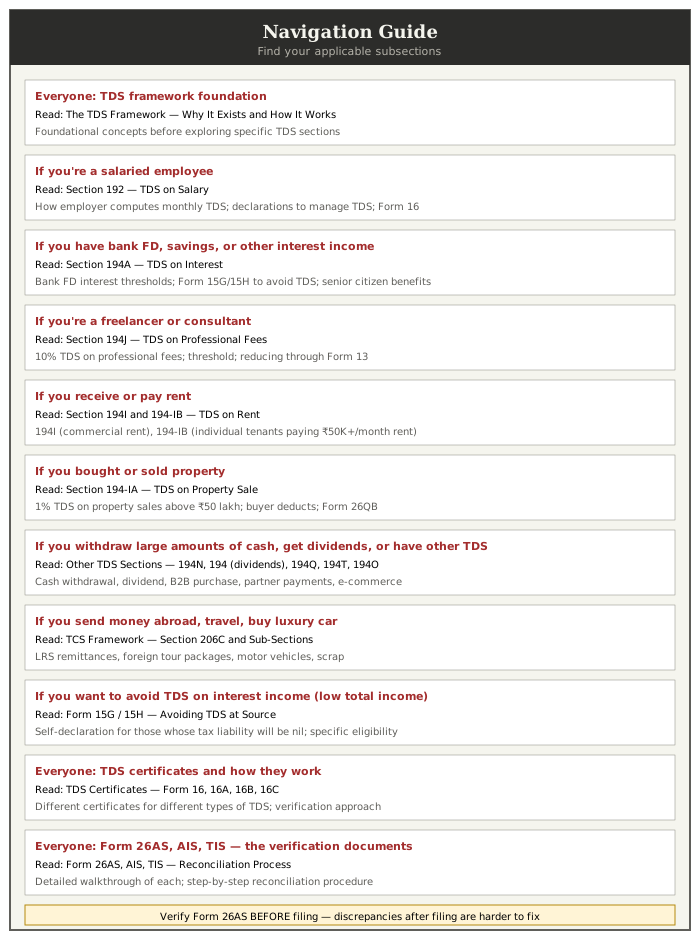
The TDS Framework — Why It Exists and How It Works
TDS is a mechanism where tax is deducted at the source of income — by the person making the payment — and deposited with the government on behalf of the recipient. The recipient gets credit for this tax when filing their ITR.
Why TDS exists.
- Cash flow for government: Tax collected throughout the year rather than at year-end
- Compliance enforcement: Hard to escape tax when it's deducted before you receive income
- Reduced evasion: Independent reporting through the deductor creates verification trail
- Spreads tax payment: Removes burden of large annual payments from individuals
Who is involved.
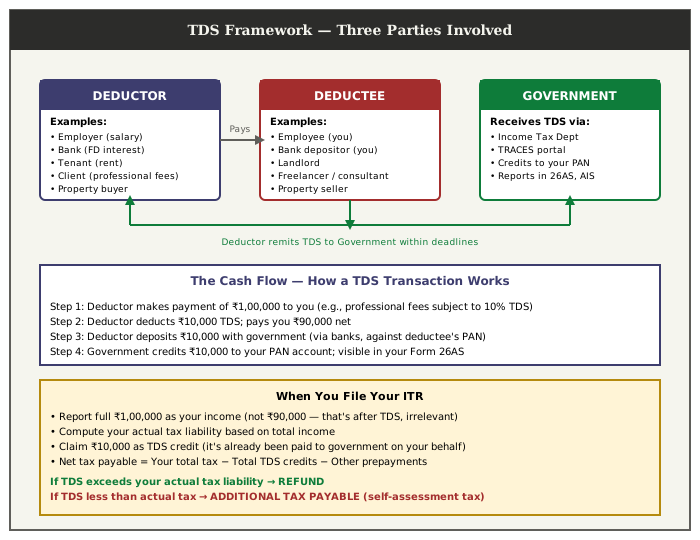
Critical concept: TAN. Every deductor has a Tax Deduction and Collection Account Number (TAN) — distinct from PAN. The deductor uses TAN when depositing TDS with the government. Your TDS shows up in Form 26AS under each deductor's TAN.
Key timing rules.
- TDS must be deducted at the time of payment or credit, whichever is earlier
- Deductor must deposit TDS within 7 days from the end of the month in which deducted (except March, which has till April 30)
- Deductor must file quarterly TDS returns
- Deductor issues TDS certificates (Form 16/16A) within specified time after each quarter or year
Consequence of TDS not being deposited. Even if deductor deducts but doesn't deposit, you can still claim the TDS credit on your ITR IF you have the TDS certificate. The government will pursue the deductor for the deposited amount. However, refund processing is faster when TDS shows in Form 26AS — chase deductors who haven't deposited.
Chapter XVII-B of Income Tax Act 1961 (TDS sections); TRACES (TDS Reconciliation Analysis and Correction Enabling System) portal.
Section 192 — TDS on Salary
The most common TDS for most filers — your employer deducts tax from your salary every month.
How it works.
- Employer estimates your annual tax liability at the start of the year (based on your declared income, deductions, regime choice)
- Divides estimated annual tax by 12 → monthly TDS amount
- Adjusts during the year as your declarations change or income varies
Annual employer process.
April-May. Employer collects declaration of:
- Other income (from previous employer, rental, interest, etc.)
- Regime choice (Old or New)
- Eligible deductions you plan to claim (80C, 80D, 80CCD(1B), Home Loan interest, HRA documentation, etc.)
- Any tax-saving investments confirmed for the year
Throughout the year. Employer:
- Deducts TDS monthly based on declarations
- Deposits TDS with government by 7th of following month
- Files quarterly returns (Form 24Q) on or before:
- Q1 (Apr-Jun): July 31
- Q2 (Jul-Sep): October 31
- Q3 (Oct-Dec): January 31
- Q4 (Jan-Mar): May 31
January-March. Employer typically requests final proof of investments before computing year-end TDS. Failure to submit may result in higher Q4 TDS.
By June 15. Employer issues Form 16 for the previous FY.
Form 16 detail. Already covered in Lesson 3. Two parts: Part A (TDS summary from TRACES) and Part B (salary breakup and tax computation).
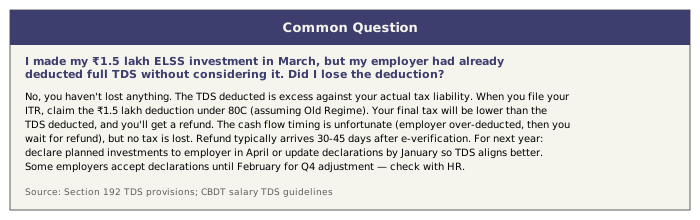
Two employers in a year. If you change jobs:
- Each employer issues separate Form 16 for their period
- Each employer doesn't know about the other's salary → both may have under-deducted (since each thinks you're at a lower tax slab)
- You combine both for ITR; often need to pay additional self-assessment tax
- Strategy: Tell new employer about previous employer's income so they can deduct accurate TDS
No PAN consequence. If you don't furnish PAN to employer, TDS is deducted at 20% or the higher of normal rate, regardless of investment declarations.
Section 192 of Income Tax Act 1961; CBDT Circular No. 24/2022 (employer TDS computation).
Section 194A — TDS on Interest
Banks, post offices, and co-operative societies deduct TDS on interest paid on FDs, recurring deposits, and certain other deposits.
Threshold and rate.
| Recipient | Threshold | TDS Rate |
|---|---|---|
| Individual under 60 | ₹40,000 per year per bank | 10% |
| Senior Citizen (60+) | ₹50,000 per year per bank | 10% |
| If no PAN furnished | Any amount | 20% |
What counts toward threshold. TDS triggers when interest from a single bank crosses the threshold across all FDs/RDs in that bank. Different banks have separate thresholds.
Bank FD interest aggregation. Interest is calculated on accrual basis (annually) even for FDs spanning multiple years. The bank credits interest annually and computes TDS at that point.
TDS applies when interest is credited (annually), not when you withdraw. You report interest as income for the year it's credited, even if you don't physically receive it. Always check Form 26AS to know your actual interest income.
What's NOT covered by 194A.
- Savings account interest (not subject to TDS, but still taxable)
- Interest on government securities, bonds (different sections)
- Interest from co-operative society members (some exceptions)
Strategy if multiple FDs at one bank. Splitting FDs across banks (each under threshold) used to be an evasion technique. Now AIS aggregates total bank interest across institutions; while TDS may not be deducted on small FDs, total interest is still reportable and taxable. Splitting doesn't avoid tax — only delays the TDS deduction.
Section 194A of Income Tax Act 1961; CBDT FD interest TDS thresholds.
Section 194J — TDS on Professional Fees
Critical for freelancers, consultants, doctors, lawyers, CAs, and other professionals.
Coverage and rates.
| Type of Payment | TDS Rate | Threshold (single payment / annual) |
|---|---|---|
| Professional fees | 10% | ₹30,000 |
| Technical services | 2% | ₹30,000 |
| Director's fees (sitting fees) | 10% | None |
| Call centre operator fees | 2% | ₹30,000 |
| Royalty for software / artistic works | 10% | ₹30,000 |
Professionals covered.
- Legal (lawyers, advocates)
- Medical (doctors, surgeons)
- Engineering (consultants, architects)
- Accountancy (CAs, CS, cost accountants)
- Technical consultancy
- Interior decoration
- Advertising
- Specified notified professions
Practical scenarios.
- Freelance designer earning ₹5 lakh annually from one client. Client deducts 10% TDS on each payment → ₹50,000 TDS for year.
- Doctor consulting at hospital. Hospital deducts 10% TDS on consultation fees.
- CA practice with multiple clients. Each client deducts 10% TDS on fees paid (above ₹30K threshold).
Reducing TDS through Form 13. If your projected income for the year is low enough that 10% TDS would result in significant over-deduction, you can apply to the Assessing Officer for a lower TDS rate certificate (Form 13). Once issued, you provide this to payers, and they deduct at the lower specified rate.
Strategy for new freelancers. In your first year:
- Track all income receipts and TDS deducted
- Don't worry about high TDS — recover through ITR refund
- File ITR promptly after FY end to claim refund
Section 194J of Income Tax Act 1961; CBDT notified professions.
Section 194I and 194-IB — TDS on Rent
Two distinct sections cover rent TDS based on the payer.
Section 194I — Commercial Tenants and Large Businesses.
| Type | TDS Rate | Threshold |
|---|---|---|
| Rent on plant/machinery | 2% | ₹2,40,000 per year |
| Rent on building/furniture | 10% | ₹2,40,000 per year |
Applies when the tenant is a business entity, partnership firm, or individual/HUF whose business turnover exceeds tax audit threshold.
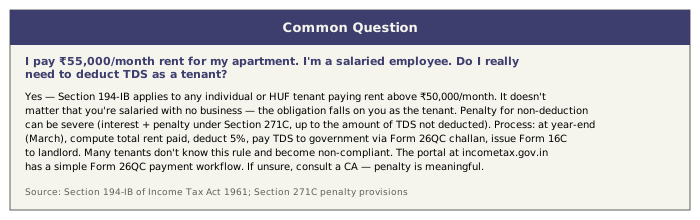
Section 194-IB — Individual Tenants.
| Detail | Specification |
|---|---|
| Who deducts | Individuals and HUFs not covered by 194I |
| Threshold | Rent above ₹50,000 per month |
| TDS Rate | 5% of total rent paid in the financial year |
| When | Deducted at year-end (March) or when tenancy ends |
| Form | Form 26QC for tenant; Form 16C for landlord |
The ₹50,000/month trigger. If you pay rent of ₹50,000 or more per month for any month during the year, you need to deduct TDS. Even one month above threshold triggers the obligation.
Tenant paying ₹60,000/month rent for 12 months. Total annual rent: ₹7,20,000 TDS at 5%: ₹36,000 Net rent paid to landlord over year: ₹6,84,000 Tenant pays ₹36,000 to government and files Form 26QC
Sections 194I, 194-IB of Income Tax Act 1961; Form 26QC payment procedure.
Section 194-IA — TDS on Property Sale
When you buy immovable property worth ₹50 lakh or more, you must deduct 1% TDS from the seller's payment.
Detailed mechanics.
| Aspect | Detail |
|---|---|
| Trigger | Sale consideration ≥ ₹50 lakh |
| Rate | 1% of sale value (NOT capital gains) |
| Deductor | Property buyer |
| Form | Form 26QB (challan) |
| Certificate to seller | Form 16B |
| Timing | TDS paid within 30 days of end of month of payment |
Even if seller has a loss, 1% TDS is deducted on the sale value. Seller claims this TDS credit when filing ITR. If the actual tax on gains is less than TDS, refund follows.
Process for property buyer.
- Pay seller minus 1% TDS. So for ₹1 crore property, pay ₹99 lakh to seller.
- Visit incometax.gov.in → e-Pay Tax → Form 26QB. Fill in details: PAN of buyer and seller; Address of property; Date of agreement, payment date; Amount paid, TDS deducted.
- Pay ₹1 lakh TDS through net banking via 26QB challan.
- Within 7-10 days, download Form 16B from TRACES portal.
- Provide Form 16B to seller (their TDS certificate).
Common mistakes.
- Forgetting to deduct TDS → buyer becomes liable for TDS + interest + penalty
- Wrong PAN of seller → TDS won't credit to seller's account
- Late payment of TDS → 1.5% interest per month
For seller. Verify Form 16B received from buyer; track in Form 26AS Part A2; claim as TDS credit when filing ITR.
Section 194-IA of Income Tax Act 1961; Form 26QB procedure.
Other TDS Sections — 194N, 194 (dividends), 194Q, 194T, 194O
Several other TDS provisions affect different filer profiles.
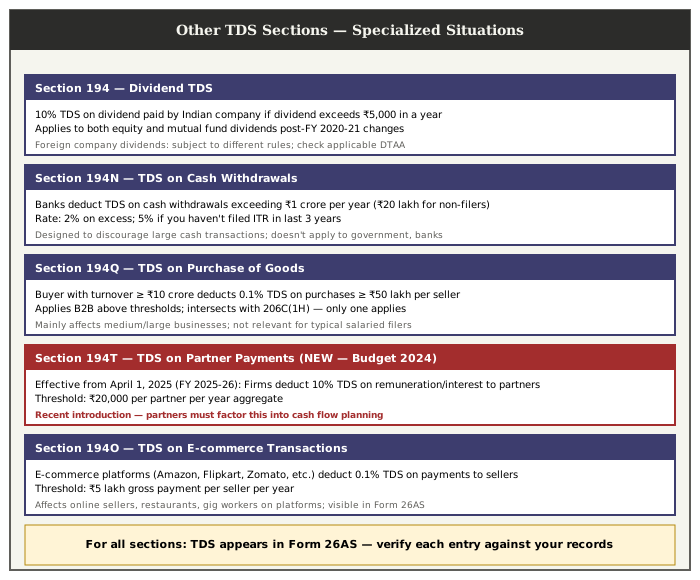
Section 194T — the new partner TDS. Effective FY 2025-26, this is a significant change for partnership firms and LLPs. Previously, payments to partners (remuneration, interest on capital) were not subject to TDS. Now, the firm must deduct 10% TDS on aggregate payments exceeding ₹20,000 per partner per year.
Impact on partners. Partners with remuneration of ₹5 lakh from the firm will see ₹50,000 TDS deducted before they receive payment. They claim this as TDS credit when filing ITR. Net effect: tax payment timing shifts forward, but final liability is the same.
Section 194O — E-commerce TDS. A delivery driver for a food delivery platform earning ₹6 lakh annually from the platform will see 0.1% TDS deducted (above ₹5L threshold) → ₹600 TDS. Modest impact but adds compliance overhead.
Sections 194, 194N, 194Q, 194T, 194O of Income Tax Act 1961; Finance Act 2024 introducing 194T.
TCS Framework — Section 206C and Sub-Sections
Tax Collected at Source (TCS) is similar to TDS but in reverse — the seller collects tax from the buyer and remits to government. Different sections cover different categories.
Common TCS situations.
TCS on Liberalised Remittance Scheme (LRS) — Section 206C(1G).
| Category | Threshold | TCS Rate |
|---|---|---|
| Foreign remittance (other than education/medical) | Above ₹10 lakh per year | 20% |
| Foreign education (loan-funded) | Above ₹7 lakh | 0.5% |
| Foreign education (own funds) | Above ₹10 lakh | 5% |
| Foreign medical treatment | Above ₹7 lakh | 5% |
Foreign tour packages — Section 206C(1G). 5% TCS on any amount (no threshold) for foreign tour packages purchased through Indian tour operators.
TCS on motor vehicle sale — Section 206C(1F). 1% TCS on motor vehicle sale where value exceeds ₹10 lakh per transaction (luxury cars). Seller collects from buyer.
TCS on scrap, minerals — Section 206C(1). Various rates for sale of scrap, tendu leaves, timber, minerals.
TCS on sale of goods — Section 206C(1H). Sellers with turnover exceeding ₹10 crore collect 0.1% TCS on sales above ₹50 lakh per buyer per year. Intersects with 194Q.
Impact for individual filers.
- Sending money abroad: TCS applies, can be substantial
- Buying foreign tour packages from Indian operators: 5% TCS
- Buying luxury cars: 1% TCS
- Travel agents/tour operators: significant TCS compliance burden
Credit claim. TCS appears in Form 26AS Part B. Claim as credit when filing ITR.
Section 206C of Income Tax Act 1961 and its various sub-sections; Finance Act amendments.
Form 15G / 15H — Avoiding TDS at Source
If your total income is below the basic exemption threshold (so no tax will be owed), you can submit Form 15G (under 60) or Form 15H (60+) to deductors to avoid TDS being deducted in the first place.
Eligibility for Form 15G (Under 60).
- Resident individual or HUF
- Total income (including the interest income) below ₹2.5 lakh (Old Regime basic exemption)
- Estimated tax liability for the year = NIL
Eligibility for Form 15H (Senior Citizen 60+).
- Resident individual aged 60 or above
- Estimated tax liability for the year = NIL (after exemptions/rebate)
- For seniors, ₹3 lakh basic exemption + 80TTB ₹50K interest exemption + 87A rebate often results in zero tax
Where to submit. To each deductor separately (each bank for FD interest, etc.). Not a single central declaration.
Common scenarios — should you file 15G/15H?
Retiree with ₹3 lakh FD interest as primary income. Under New Regime, total tax is zero (within ₹4L basic exemption). Submit 15H to avoid 10% TDS on interest above ₹50K threshold.
Homemaker with ₹40K FD interest. Below ₹40K threshold, no TDS anyway. Filing 15G unnecessary.
Person with ₹15 lakh income from various sources. Tax will definitely be owed. Don't file 15G — it would be false declaration, attracting penalty.
Filing 15G/15H falsely (when tax IS owed) can attract penalty under Section 277, including potential prosecution. Don't file if uncertain.
Section 197A of Income Tax Act 1961; Form 15G/15H per Rule 29C.
TDS Certificates — Form 16, 16A, 16B, 16C
Different forms are issued depending on the type of TDS deducted.
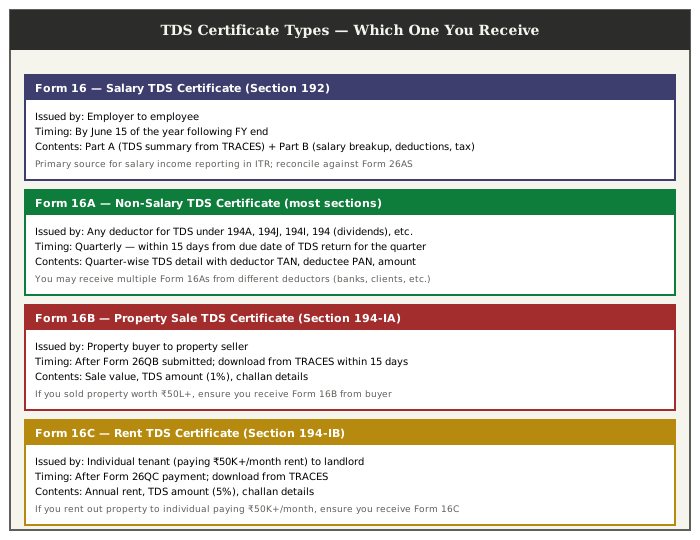
TDS certificates are issued by deductors but the official record is Form 26AS (which shows what's been deposited with the government). If certificate shows ₹50,000 TDS but 26AS shows ₹40,000, the deductor hasn't deposited the difference — chase them.
If you don't receive a TDS certificate. Contact the deductor in writing. If non-responsive, you can still claim TDS based on Form 26AS data. CBDT has clarified that Form 26AS is the conclusive proof of TDS deposit.
Sections 203 of Income Tax Act 1961 (TDS certificate provisions); Rule 31 of Income Tax Rules.
Form 26AS, AIS, TIS — Reconciliation Process
The three documents you must verify before filing.
Form 26AS — Tax Credit Statement (already shown in Lesson 3).
The 7 parts of Form 26AS:
- Part A: TDS (general)
- Part A1: TDS where Form 15G/15H filed
- Part A2: TDS on property sale (Section 194-IA)
- Part B: Tax Collected at Source (TCS)
- Part C: Tax paid (other than TDS/TCS) — advance tax, self-assessment tax
- Part D: Refunds paid by IT Department
- Part E: SFT transactions (high-value transactions reported)
- Part F: TDS on rent (Section 194-IB) and other specific TDS
AIS — Annual Information Statement.
Comprehensive view organized by income category. Shows:
- Salary, pension, family pension
- Interest from savings, FDs, RDs, bonds (by bank/source)
- Dividend (by company/MF)
- Securities transactions (purchase, sale of equity, MFs)
- Capital gains (computed by source)
- Sale and purchase of immovable property
- Foreign remittances received and sent
- Rent received
- Cash deposits, large transactions
- Credit card high-value payments
- Mutual fund transactions
- Off-market securities transactions
TIS — Taxpayer Information Summary.
Simplified, consolidated version of AIS. Shows aggregated totals by category. Useful for quick overview before diving into AIS detail.
The Reconciliation Process — Step by Step.
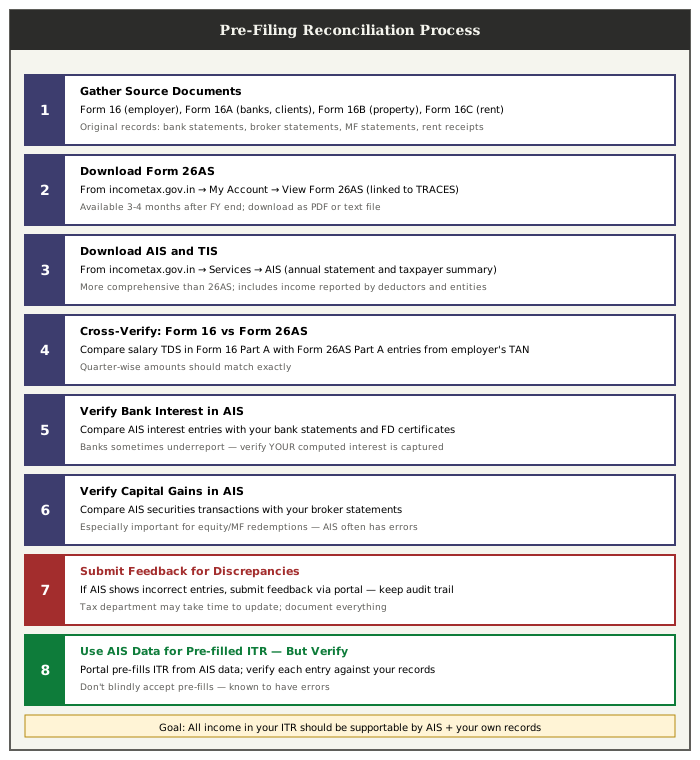
Common discrepancies and how to handle them.
Income shown in AIS but not in your records.
- Could be income reported in your name incorrectly (mistaken identity)
- Could be income you forgot
- Submit feedback in AIS if incorrect; investigate further if your error
Income in your records but not in AIS.
- Deductor may not have filed TDS return
- Bank may have reported under wrong PAN
- Report the income anyway (your liability is based on actual income, not just what's in AIS)
TDS in 26AS but no certificate received.
- 26AS is the conclusive proof — claim TDS credit based on 26AS even without certificate
- Request certificate from deductor for your records
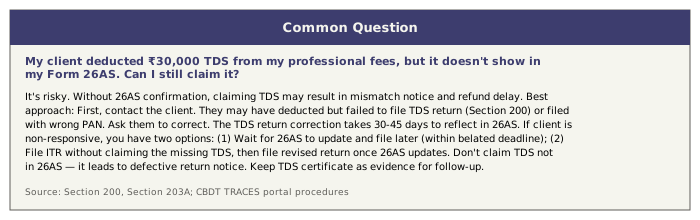
TDS certificate received but not in 26AS.
- Deductor deducted but didn't deposit OR deposited under wrong PAN
- Contact deductor; they need to correct in their TDS return
- May delay your refund significantly
Section 285BA (SFT); CBDT user guide for AIS; TRACES portal documentation.
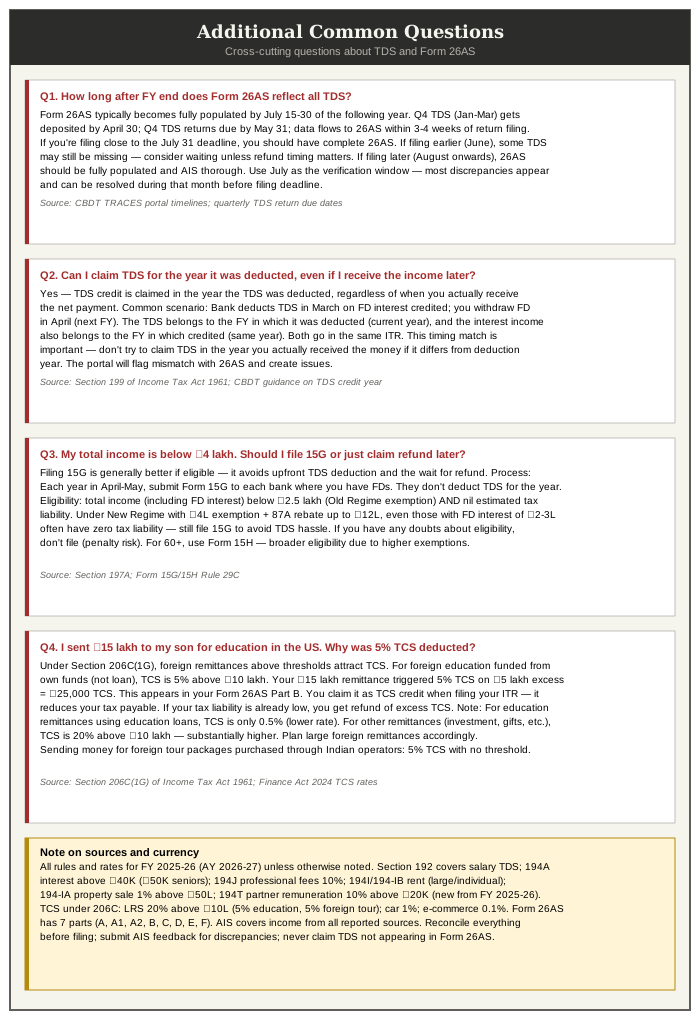
End of lesson — Additional common questions
Key Takeaways
- TDS is deducted by the payer and deposited with the government on your behalf — verify in Form 26AS that the deductor actually deposited it, not just deducted it.
- Section 192 salary TDS is adjusted monthly; two employers in the same year can cause under-deduction — always inform the new employer of previous employer salary.
- Section 194A FD interest TDS is per-bank based on a per-bank threshold; AIS now aggregates total bank interest across all banks, so splitting FDs avoids TDS deduction but not tax liability.
- Section 194-IA: property buyers must deduct 1% TDS on any property worth ₹50 lakh or more using Form 26QB and issue Form 16B to the seller — the seller claims this as credit in their ITR.
- Form 15G/15H only prevents TDS deduction if your estimated tax liability for the year is genuinely NIL; filing it when tax is owed is a false declaration attracting penalty under Section 277.
- TCS on LRS foreign remittances above ₹10 lakh (non-education/medical) is 20% — a significant upfront cash flow impact; claim it as credit when filing ITR.
- Form 26AS is the conclusive proof of TDS/TCS deposit; a mismatch between your TDS certificate and Form 26AS means the deductor hasn't deposited — chase them before filing, as it affects refund processing speed.
Quiz — 4 Questions
Answer one at a timeVikram buys a flat for ₹75 lakh. How much TDS must he deduct from the payment to the seller, and which form does he use to deposit it?