Tax computation: Slab rates, surcharge, cess, AMT, and the complete calculation
The mathematics of computing your Indian income tax — line by line, from Total Income through the final number you owe
- Execute the complete Indian income tax computation sequence from Total Income to final tax payable
- Calculate income tax using progressive slab rates and distinguish marginal rate from effective rate
- Apply surcharge at the correct threshold with marginal relief, and compute the 4% Health and Education Cess
- Compute tax on special-rate incomes (LTCG, STCG, lottery, online gaming) separately from slab-based income
- Identify when AMT under Section 115JC applies and understand clubbed income mechanics and rounding rules
Tax computation: Slab rates, surcharge, cess, AMT, and the complete calculation
This lesson takes you through the actual mathematics of computing your Indian income tax — line by line, from Total Income through the final number you owe (or get refunded). Lessons 3, 4, and 5 established what goes into the computation; Lesson 6 shows you how the computation actually works.
Most filers rely on tax calculators or software that produce the final number without showing intermediate steps. That works fine until something goes wrong — a notice from the IT Department, a refund delay, a discrepancy with employer TDS — and then you need to understand the math yourself. This lesson is the reference for understanding what the calculator is doing.
We cover the standard slab calculation, surcharge with marginal relief at four different thresholds, the 4% cess, and the Alternative Minimum Tax (AMT) provisions that affect certain non-corporate filers. We also address special-rate incomes (lottery, online gaming, casual income) that are computed separately from slab-based income.
A reminder on terminology: the Income Tax Act 2025 (effective April 1, 2026) renumbers many sections — but for FY 2025-26 income (the current year), the 1961 Act sections apply. We use 1961 Act references throughout.
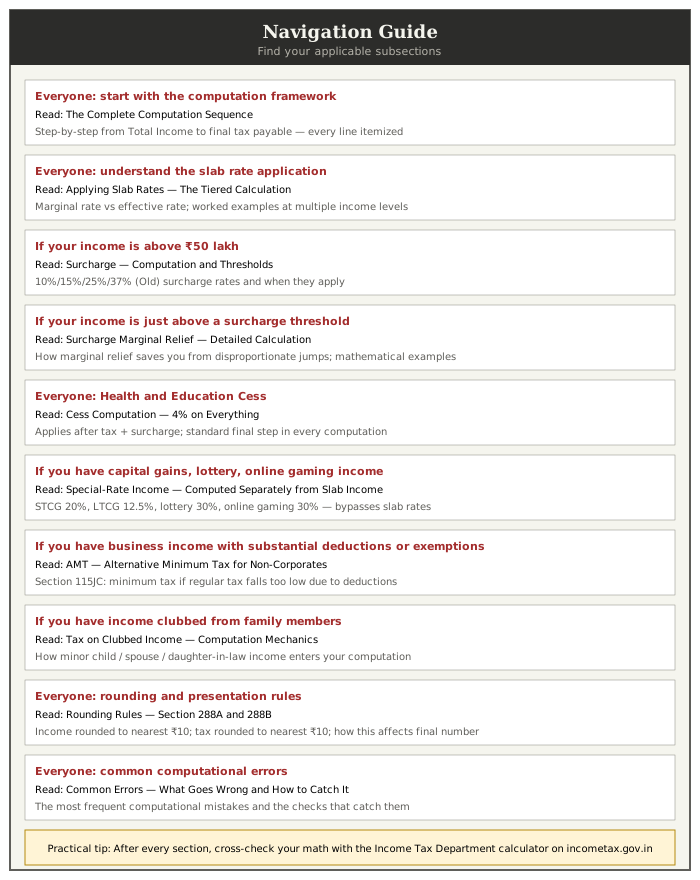
Navigation guide — which subsections apply to your situation
The Complete Computation Sequence
Every Indian tax computation follows the same sequence. The order matters because each step's output feeds into the next.
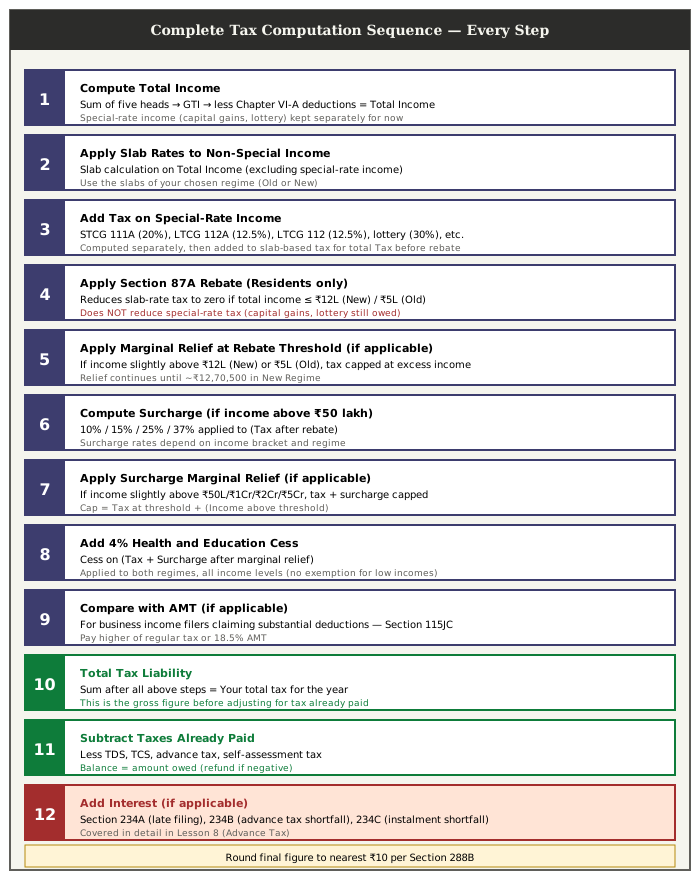
Why the order matters. Take a specific example: someone with ₹13 lakh salary and ₹2 lakh LTCG on equity.
If you incorrectly add the LTCG to slab-rate income before computing tax, you'd treat ₹15 lakh as slab-rate income. But Section 112A LTCG is computed at 12.5%, NOT slab rates. The correct sequence keeps them separate, applies the right rates to each, then sums up.
This is one of the most common errors filers make. Tax software handles this automatically, but understanding the manual sequence helps you verify the output.
Sections 14 (heads of income), 87A (rebate), 111A/112A/112 (special rates), 115BAC (New Regime), 288A/288B (rounding) of Income Tax Act 1961.
Applying Slab Rates — The Tiered Calculation
Indian income tax uses a progressive slab system — different portions of your income are taxed at different rates, NOT all at one rate.
The critical distinction: marginal rate vs effective rate.
Marginal rate. The rate that applies to your NEXT rupee of income. If your taxable income is ₹15 lakh in the New Regime, your marginal rate is 15% (the rate in the ₹12-16 lakh slab).
Effective rate. Your total tax divided by your total income. Always lower than the marginal rate because earlier slabs were taxed at lower rates.
Common misconception. "I'm in the 30% tax bracket" doesn't mean you pay 30% of your total income as tax. It means the portion of your income above the 30% threshold is taxed at 30%, while earlier portions were taxed at progressively lower rates.
Slab-by-slab computation:
| Slab | Income in Slab | Rate | Tax |
|---|---|---|---|
| Up to ₹4 lakh | ₹4,00,000 | 0% | ₹0 |
| ₹4-8 lakh | ₹4,00,000 | 5% | ₹20,000 |
| ₹8-12 lakh | ₹4,00,000 | 10% | ₹40,000 |
| ₹12-16 lakh | ₹4,00,000 | 15% | ₹60,000 |
| ₹16-20 lakh | ₹4,00,000 | 20% | ₹80,000 |
| Total | ₹20,00,000 | ₹2,00,000 |
Marginal rate: 20% (next rupee taxed at 20%) Effective rate: ₹2,00,000 / ₹20,00,000 = 10%
The effective rate is exactly half the marginal rate in this case — a useful sanity check.
Slab-by-slab computation:
| Slab | Income in Slab | Rate | Tax |
|---|---|---|---|
| Up to ₹2.5 lakh | ₹2,50,000 | 0% | ₹0 |
| ₹2.5-5 lakh | ₹2,50,000 | 5% | ₹12,500 |
| ₹5-10 lakh | ₹5,00,000 | 20% | ₹1,00,000 |
| ₹10-20 lakh | ₹10,00,000 | 30% | ₹3,00,000 |
| Total | ₹20,00,000 | ₹4,12,500 |
Marginal rate: 30% Effective rate: ₹4,12,500 / ₹20,00,000 = 20.6%
Note how Old Regime's higher rates at every level produce more than double the tax at ₹20 lakh income — explaining why deductions matter so much for Old Regime to be competitive.
Section 115BAC (New Regime slabs); Schedule I to Finance Act 2025 (Old Regime slabs); CBDT slab notifications.
Surcharge — Computation and Thresholds
Above ₹50 lakh income, surcharge adds to your tax bill. Surcharge is a percentage applied on top of the tax amount (not on income).
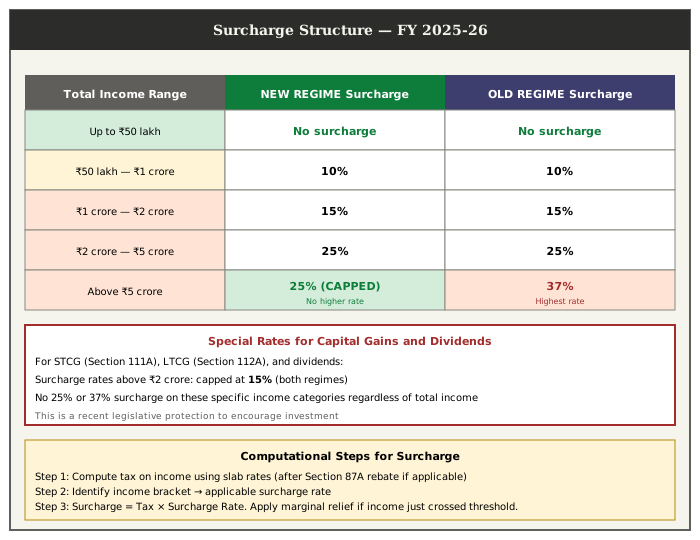
₹75 lakh salary in New Regime (no other income). Slab calculation on ₹75 lakh (after ₹75K standard deduction, taxable ₹74.25 lakh): Up to ₹4L: ₹0 ₹4-8L @ 5%: ₹20,000 ₹8-12L @ 10%: ₹40,000 ₹12-16L @ 15%: ₹60,000 ₹16-20L @ 20%: ₹80,000 ₹20-24L @ 25%: ₹1,00,000 ₹24L-74.25L @ 30%: ₹15,07,500 Total tax: ₹18,07,500 Income above ₹50 lakh → 10% surcharge. Surcharge = ₹18,07,500 × 10% = ₹1,80,750. Tax + surcharge = ₹19,88,250. Cess @ 4% = ₹79,530. Final tax = ₹20,67,780.
First proviso to Section 2(29C); Finance Act 2025 surcharge schedule.
Surcharge Marginal Relief — Detailed Calculation
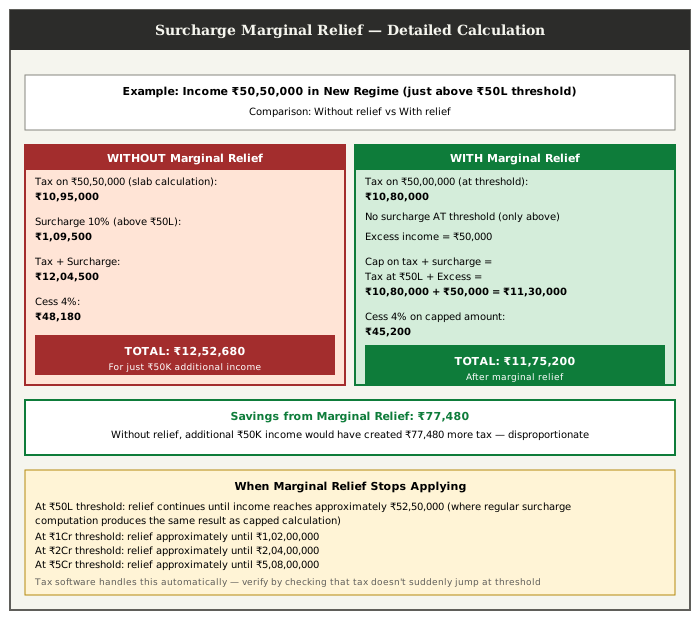
When income just barely crosses a surcharge threshold, marginal relief prevents disproportionate tax jumps. This relief is significant for high-income filers near the boundaries.
The principle. Tax + surcharge after crossing a threshold cannot exceed: (Tax at threshold income) + (Income above threshold).
In other words, the additional tax burden from crossing the threshold can never exceed the additional income earned beyond that threshold.
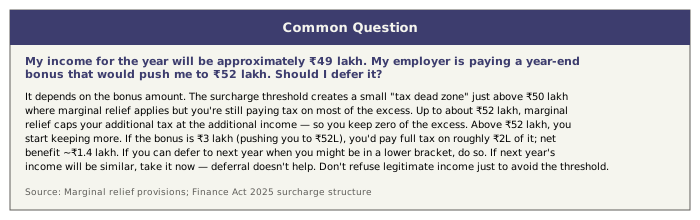
Marginal relief is a long-standing principle of Indian tax law; CBDT guidance and judicial pronouncements; Finance Acts.
Cess Computation — 4% on Everything
Health and Education Cess is a small but universal addition to the tax bill.
The rate. 4% on (Tax + Surcharge after marginal relief).
Applies to.
- Both Old and New Regimes
- All income levels (no exemption)
- All income types (slab-based and special-rate)
Computation example. If your tax + surcharge after all reliefs is ₹3,00,000: Cess = ₹3,00,000 × 4% = ₹12,000 Final tax = ₹3,12,000
What the cess funds. Officially, the cess revenue is earmarked for health and education programs. Though formally a "cess," it functions as a tax addition with no exemption.
Distinguishing cess from surcharge. Different things:
- Surcharge: Applies only above ₹50 lakh; rates vary by bracket
- Cess: Applies to everyone; flat 4%
Both are applied AFTER computing base tax (after rebate, marginal relief, etc.).
Section 2(11) of Finance Act 2024 and subsequent Acts; 4% Health and Education Cess.
Special-Rate Income — Computed Separately from Slab Income
Several income categories are taxed at special flat rates that bypass the slab system entirely. These must be computed separately.
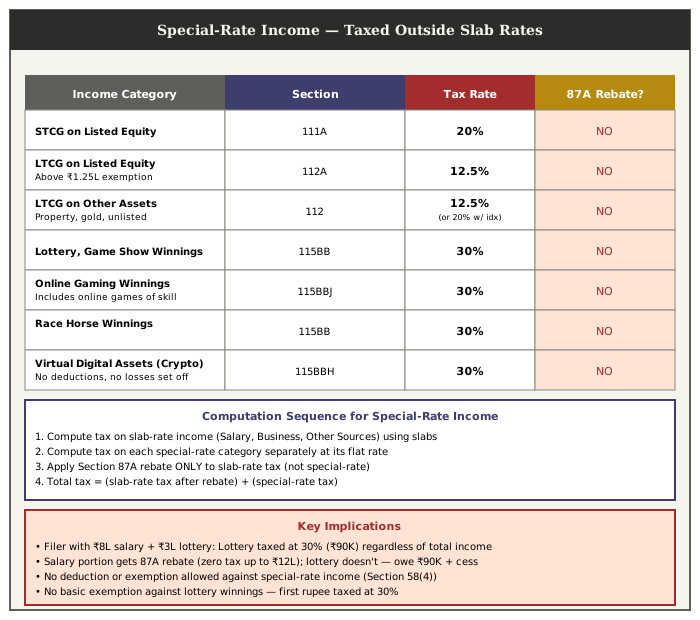
Filer with: Salary: ₹10 lakh LTCG on equity: ₹2 lakh Lottery winnings: ₹50,000 New Regime computation: Step 1: Slab-rate income tax. Taxable salary after ₹75K std ded: ₹9,25,000 Tax: ₹20,000 (₹4-8L) + ₹12,500 (₹8-9.25L at 10%) = ₹32,500 Step 2: Special-rate tax. LTCG: (₹2,00,000 - ₹1,25,000 exemption) × 12.5% = ₹9,375 Lottery: ₹50,000 × 30% = ₹15,000 Step 3: 87A rebate. Total income = ₹10L + ₹2L + ₹50K = ₹12.5 lakh Wait — rebate threshold is ₹12 lakh. Income exceeds. No rebate. Actually, with income at ₹12.5 lakh, marginal relief kicks in (covered later). But for simplicity here, assume no rebate. Step 4: Aggregate. Slab-rate tax: ₹32,500 LTCG tax: ₹9,375 Lottery tax: ₹15,000 Total: ₹56,875 Cess @ 4%: ₹2,275 Final: ₹59,150
Sections 111A, 112A, 112, 115BB, 115BBH, 115BBJ, 58(4) of Income Tax Act 1961.
AMT — Alternative Minimum Tax for Non-Corporates
AMT under Section 115JC affects non-corporate taxpayers (individuals, HUFs, LLPs, partnership firms) who claim substantial deductions that reduce their regular tax below a minimum threshold.
Who does AMT apply to.
AMT applies if you are:
- A non-corporate taxpayer (individual, HUF, partnership, LLP)
- Claiming deductions under:
- Section 10AA (SEZ deduction)
- Section 80H to 80RRB (various business-specific deductions)
- Or have other deductions reducing tax below a certain threshold
Important exclusion. AMT does NOT apply to most individual salaried filers. It primarily affects:
- Businesses claiming SEZ benefits
- Partnerships/LLPs with substantial profession deductions
- Individuals with significant business income claiming heavy deductions
The threshold. AMT does not apply if your "adjusted total income" is ₹20 lakh or less.
How AMT works.
- Step 1: Compute Regular Tax. Compute tax as usual under Old or New Regime.
- Step 2: Compute Adjusted Total Income. Adjusted Total Income = Total Income + Section 10AA deduction + Section 80H to 80RRB deductions (except 80P) + Section 35AD deductions
- Step 3: Compute AMT. AMT = 18.5% of Adjusted Total Income + Surcharge + Cess
- Step 4: Compare. Pay the HIGHER of Regular Tax or AMT.
Sole proprietor with: Business income before specified deductions: ₹50 lakh Section 35AD specified business deduction claimed: ₹20 lakh Net taxable income (after Sec 35AD): ₹30 lakh Regular tax (Old Regime): approximately ₹7,12,500 Adjusted Total Income for AMT: ₹30L + ₹20L = ₹50L AMT @ 18.5%: ₹9,25,000 Higher of two: ₹9,25,000 — so AMT applies.
AMT credit. If AMT exceeds regular tax in a year, the excess is allowed as credit to be carried forward up to 15 years and offset against regular tax in future years when regular tax exceeds AMT.
Section 115JC of Income Tax Act 1961; CBDT instructions on AMT.
Tax on Clubbed Income — Computation Mechanics
When income is clubbed from family members (minor child, spouse with transferred assets, etc.), it's added to your taxable income for computation purposes. Special considerations:
Minor child income clubbed under Section 64(1A).
- Add to parent's income (the parent with higher income)
- Section 10(32) exemption: ₹1,500 per child per year (max 2 children)
- Net clubbed amount goes into the parent's regular slab calculation
- Doesn't separately attract higher rate
Parent has ₹15 lakh salary. Minor child has ₹50,000 interest from bank FDs (gifted by parent). Clubbing computation: Minor's income: ₹50,000 Less Section 10(32) exemption: ₹1,500 Net clubbed: ₹48,500 Added to parent's salary: ₹15,00,000 + ₹48,500 = ₹15,48,500 taxable
Tax computed on the combined figure under parent's regime and slab rates.
Spouse's income from transferred assets.
- Add gross income (no exemption equivalent to ₹1,500)
- Goes into your regular slab calculation
- Calculate using your regime
No special tax rate for clubbed income. It's treated as your income at your applicable slab/rate.
Sections 60-64, 10(32) of Income Tax Act 1961.
Rounding Rules — Section 288A and 288B
The Income Tax Act specifies rounding rules that produce the final number.
Section 288A — Rounding of total income. Total income is rounded off to the nearest multiple of ₹10. Amount of ₹5 or more is rounded up; less than ₹5 rounded down. Example: Total income of ₹15,67,847 is rounded to ₹15,67,850.
Section 288B — Rounding of tax payable. Tax amount is similarly rounded to the nearest multiple of ₹10. Example: Tax of ₹2,34,567 is rounded to ₹2,34,570.
Practical implication. These rules produce small variations between manual calculation and tax software output. Always round at the specified stages. Don't round intermediate amounts (paise should be tracked through the calculation; rounding happens at income and tax stages only).
For e-filing. The portal handles rounding automatically per these rules. Your figures may differ slightly from rough manual calculations — this is correct.
Sections 288A and 288B of Income Tax Act 1961.
Common Errors — What Goes Wrong and How to Catch It
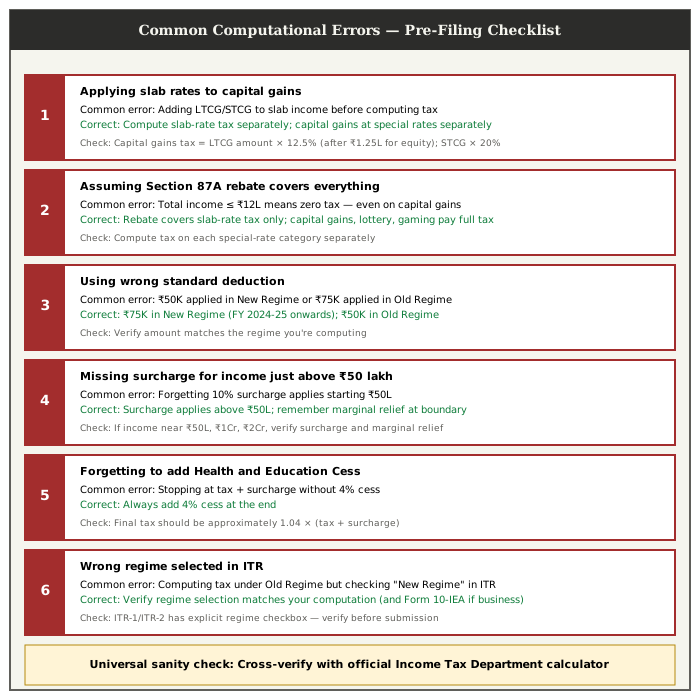
The official calculator. Available at incometax.gov.in (Calculators tab). Input your income figures, choose regime, get verified computation. Use this to cross-check any manual calculation or third-party software output before filing.
Income Tax Department official calculator; CBDT computation guidance.
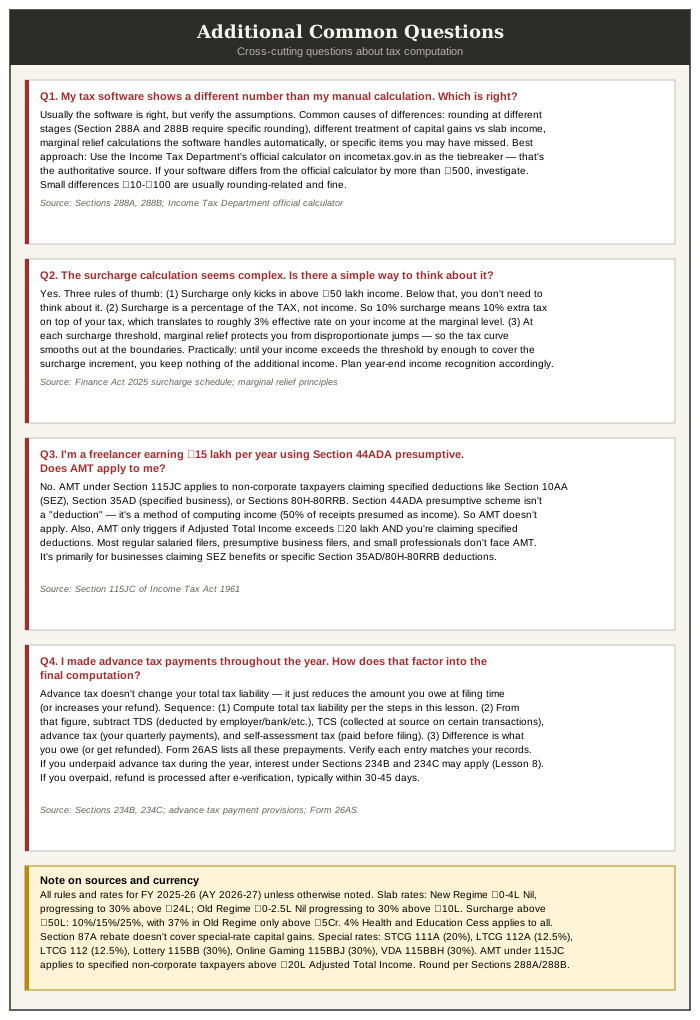
End of lesson — Additional common questions
Key Takeaways
- Indian income tax is progressive — different slabs tax different portions of income at different rates. Effective rate is always lower than marginal rate because earlier slabs attracted lower tax.
- Surcharge applies above ₹50 lakh as a percentage on tax (not on income). Marginal relief ensures the additional tax from crossing a threshold cannot exceed the additional income earned beyond it.
- Special-rate incomes — LTCG, STCG, lottery, online gaming — are taxed at flat rates and computed separately from slab income. Aggregating them into slab income is one of the most common filing errors.
- AMT under Section 115JC applies to non-corporates claiming large deductions (SEZ, 80H-80RRB, 35AD). It does not apply to most salaried individuals or if adjusted total income is ₹20 lakh or less.
- Total income is rounded to the nearest ₹10 under Section 288A; tax payable similarly under Section 288B. These statutory rounding rules explain small differences between manual calculations and software output.
Quiz — 5 Questions
Answer one at a timeA taxpayer in the New Regime has ₹20 lakh taxable income and pays ₹2,00,000 in slab tax. What is their effective tax rate?