Adjustments to Income and Schedule 1-A Deductions
Above-the-line deductions that reduce AGI, plus the four new OBBBA deductions on Schedule 1-A
- Understand why above-the-line adjustments are more valuable per dollar than below-the-line deductions
- Identify which Schedule 1 Part II adjustments apply to your situation
- Navigate the nine Schedule 1 Part II adjustments and determine deductibility for each
- Understand the four new OBBBA Schedule 1-A deductions and who qualifies
- Know what documents to gather for each adjustment that applies to you
Introduction
After you've reported all your income on Form 1040 lines 1 through 8 (covered in Lesson 3) and arrived at Total Income on line 9, the next operation is subtracting Adjustments to Income on line 10. The adjustments come from Schedule 1 Part II, and they reduce your total income to produce Adjusted Gross Income (AGI) on line 11. AGI is one of the most consequential numbers on the entire return because it drives the calculation of many credits, deductions, and tax provisions throughout the rest of the form.
Separately, the One Big Beautiful Bill Act signed in July 2025 created a new Schedule 1-A with four additional deductions: no tax on tips, no tax on overtime, qualified passenger vehicle loan interest, and an enhanced senior deduction. These are technically below-the-line deductions (they reduce taxable income but not AGI), but they share the conceptual space with the Schedule 1 adjustments because both reduce your tax bill by reducing income subject to tax. This lesson covers both because readers preparing their 2025 returns need to understand both sets of deductions together.
The lesson is organized in two main sections. The first section covers the Schedule 1 Part II adjustments — the longstanding above-the-line deductions that reduce AGI. The second section covers the new Schedule 1-A deductions from OBBBA, with an explicit discussion of why their below-the-line nature matters. Both sections use alphabetical organization within them so you can skip to what applies to your situation.
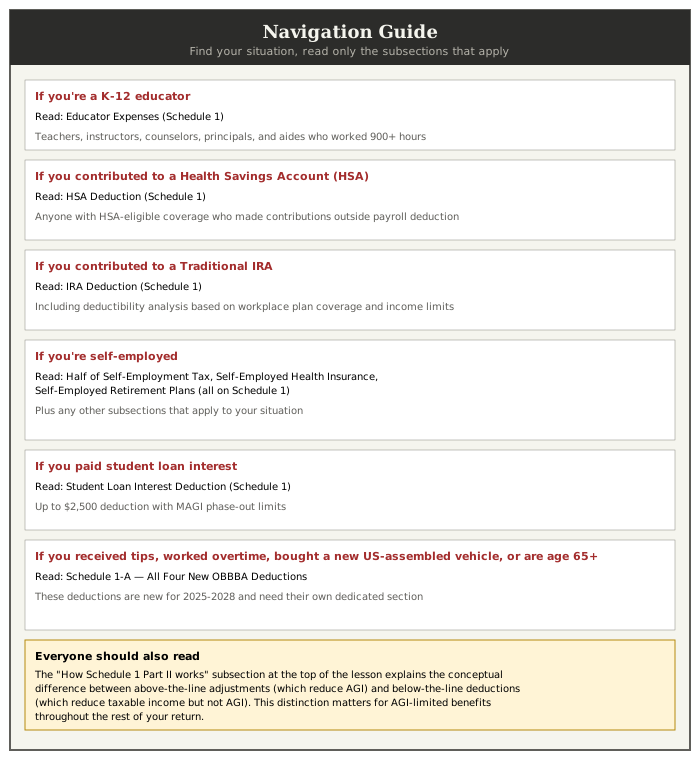
How Schedule 1 Part II works and why "above-the-line" matters
Schedule 1 Part II is where above-the-line adjustments to income get listed. Each adjustment has its own line on the schedule. The total of all the adjustments on line 26 flows to Form 1040 line 10, which gets subtracted from Total Income (line 9) to produce Adjusted Gross Income on line 11.
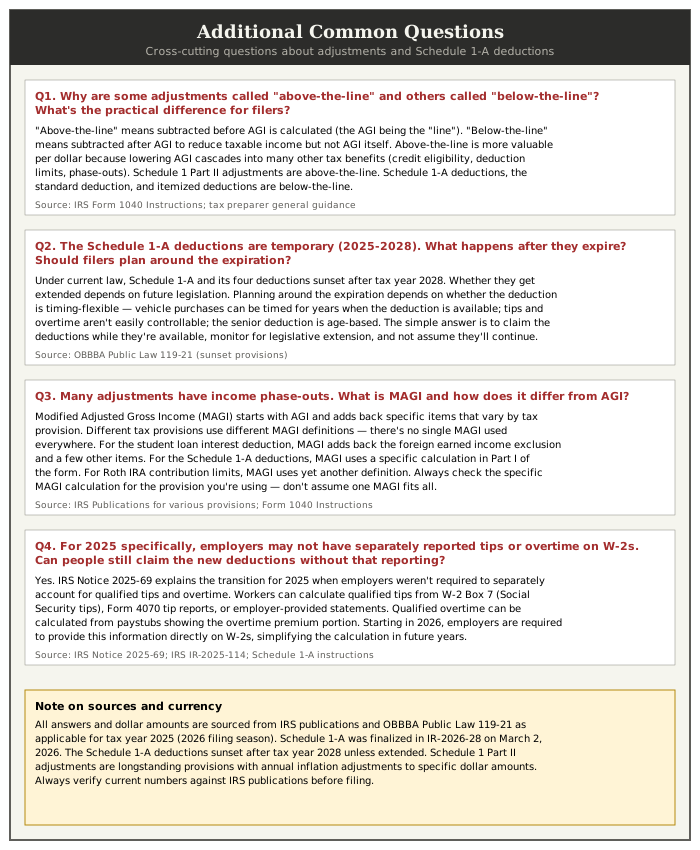
The term "above-the-line" refers to the position relative to the AGI line on the tax return. Adjustments are subtracted from income before AGI is calculated, so they reduce AGI. Itemized deductions or the standard deduction (which come on line 12) are "below-the-line" because they're subtracted after AGI to produce taxable income. The new Schedule 1-A deductions are also below-the-line.
The distinction matters because AGI itself is the basis for many tax provisions throughout the return. Higher AGI means tighter limits on medical expense deductions (which must exceed a percentage of AGI to be deductible), tighter eligibility for many credits (Child Tax Credit, Earned Income Tax Credit, education credits, retirement savings credit), tighter Roth IRA contribution limits, tighter rental loss deductions, and various other items. A $1,000 above-the-line adjustment reduces AGI by $1,000, which often unlocks additional benefits beyond the direct tax savings on that $1,000. A $1,000 below-the-line deduction only reduces taxable income by $1,000 without any cascade effect.
This is why above-the-line adjustments are valuable beyond their face amount and why people specifically try to maximize them. The Schedule 1 Part II adjustments are the main vehicle for above-the-line tax reduction available to most filers.
Educator Expenses (Schedule 1 line 11)
Read this subsection if you worked as a K-12 teacher, instructor, counselor, principal, or aide during the year.
What this deduction covers. Eligible educators can deduct up to $300 of unreimbursed classroom expenses paid during the year. The deduction is up to $300 per eligible educator, with $600 maximum for married filing jointly when both spouses are eligible educators (but no more than $300 per individual).
Who qualifies. You must work at least 900 hours during the school year as a K-12 teacher, instructor, counselor, principal, or aide in a school that provides elementary or secondary education. Preschool teachers and college instructors don't qualify. The 900-hour requirement applies to the school year, not the calendar year — many full-time educators easily exceed this threshold but part-time educators may not.
What expenses qualify. Unreimbursed expenses for books, supplies, computer equipment (including related software and services), other equipment, and supplementary materials used in the classroom. Professional development course fees also qualify if related to the curriculum you teach. Items reimbursed by the school, items used for non-classroom purposes, and items purchased for purposes other than teaching don't qualify.
Decision points. Track expenses throughout the year rather than trying to reconstruct them at tax time. The $300 cap means you don't need extensive documentation beyond proof of payment, but you should keep receipts in case of audit. If your unreimbursed expenses exceed $300, the excess is no longer deductible by W-2 employees as a miscellaneous itemized deduction (that deduction was suspended through 2025 by TCJA and the OBBBA made the suspension permanent).
The deduction is available regardless of whether you itemize or take the standard deduction — that's the point of above-the-line treatment. The $300 cap is per educator, not per household. The $600 MFJ cap requires both spouses to be eligible educators, not just one.
Sourcing. IRS Publication 529; Form 1040 Instructions for Schedule 1 line 11; IRC section 62(a)(2)(D).
Receipts for all classroom-related purchases during the year. Documentation of your hours worked during the school year if questioned. Records of any reimbursements received from the school (those amounts don't count).
Half of Self-Employment Tax (Schedule 1 line 15)
Read this subsection if you had self-employment income reported on Schedule C or Schedule F.
What this deduction is. Self-employed individuals pay both the employer and employee portions of Social Security and Medicare taxes, totaling 15.3% on net self-employment earnings (12.4% Social Security up to the wage base, plus 2.9% Medicare on all earnings, with an additional 0.9% Medicare on high earnings). The deduction on Schedule 1 line 15 lets you deduct half of this self-employment tax — the employer-equivalent portion — as an adjustment to income.
How it's calculated. Schedule SE calculates your self-employment tax based on net earnings from self-employment (typically 92.35% of Schedule C net profit). The total SE tax appears on Schedule 2. Half of that amount appears on Schedule 1 line 15 as the deduction.
Why this deduction exists. Employees don't pay tax on the employer half of FICA (the employer pays it as a business expense). To put self-employed people on equivalent footing, the tax code lets them deduct the equivalent employer-half from gross income. This makes the income tax treatment of FICA more comparable between employees and self-employed people, though the cash flow burden of paying both halves still falls entirely on the self-employed person.
Decision points. This deduction is automatic if you have SE tax — tax software calculates it without any decision on your part. The only consideration is making sure your net self-employment earnings are calculated correctly on Schedule C, since that drives both the SE tax and the resulting deduction.
Sourcing. IRS Publication 334 (Tax Guide for Small Business); Schedule SE Instructions; IRC section 164(f).
Schedule C or Schedule F showing your net self-employment income. Schedule SE will calculate the SE tax and its deductible portion automatically.
Health Savings Account (HSA) Deduction (Schedule 1 line 13)
Read this subsection if you made HSA contributions during the year, either directly or through payroll deduction.
What this deduction is. Contributions to a Health Savings Account are deductible as an adjustment to income. HSAs are available to people enrolled in a High Deductible Health Plan (HDHP) who aren't enrolled in Medicare and aren't claimed as a dependent on someone else's return.
Contribution limits for 2025. $4,300 for self-only HDHP coverage, $8,550 for family HDHP coverage. People age 55 and older can contribute an additional $1,000 catch-up amount. These limits are the maximum total contribution from all sources (you, your employer, your spouse) per HSA per year.
How the deduction works. Contributions made through payroll deduction (with pretax dollars) are already excluded from your W-2 Box 1 wages, so they don't appear on Schedule 1 line 13 — they were already deducted at the source. Contributions made outside payroll (direct contributions you made to your HSA) appear on Schedule 1 line 13. Form 8889 reconciles your total contributions and computes the deductible amount.
Decision points. If your HSA contribution comes through payroll, you don't need to do anything for Schedule 1 — the deduction was already taken via your reduced W-2 wages. If you made additional contributions directly to your HSA (above what came through payroll), those go on Schedule 1 line 13 to give you the deduction. The deadline for making direct contributions for a tax year is the tax filing deadline (April 15 of the following year), so you can still contribute for 2025 until April 15, 2026.
Career path applications. Many W-2 employees with HDHP coverage make HSA contributions through payroll, which automatically reduces their W-2 wages. Self-employed people with HDHP coverage typically make direct HSA contributions and claim them on Schedule 1. Anyone over 55 should consider the catch-up contribution.
Form 8889 is required to claim the HSA deduction. People sometimes forget to file Form 8889 with their return, which can cause processing delays. HSA contributions made for one year (say 2025) by the tax filing deadline (April 15, 2026) get attributed to that year, not the year the contribution was made.
Sourcing. IRS Publication 969 (Health Savings Accounts and Other Tax-Favored Health Plans); Form 8889 Instructions; IRC section 223.
Form 5498-SA from your HSA custodian (shows total contributions for the year). Records of any direct contributions you made outside payroll. Form 8889 to complete the calculation.
IRA Deduction (Schedule 1 line 20)
Read this subsection if you contributed to a Traditional IRA during the year.
What this deduction is. Traditional IRA contributions may be deductible as an adjustment to income, depending on whether you (or your spouse) are covered by a workplace retirement plan and your income level. Roth IRA contributions are never deductible — they're made with after-tax dollars. SEP IRA and SIMPLE IRA contributions for self-employed people are deductible but go on a different line (Schedule 1 line 16, covered below).
Contribution limits for 2025. $7,000 for people under age 50, $8,000 for people 50 and older (catch-up amount). The limit is the total across all your IRAs (Traditional plus Roth combined cannot exceed these amounts).
Deductibility depends on plan coverage and income. If neither you nor your spouse is covered by a workplace retirement plan, your Traditional IRA contribution is fully deductible regardless of income. If you are covered by a workplace plan (the "Retirement plan" box is checked on your W-2 Box 13), the deduction phases out at specific MAGI levels. If your spouse is covered but you're not, different phase-out thresholds apply.
For 2025, the deduction phase-out ranges for taxpayers covered by a workplace plan are approximately $77,000-$87,000 for single filers and $123,000-$143,000 for MFJ. For taxpayers not covered but whose spouse is covered, the phase-out is $230,000-$240,000 MFJ. These ranges adjust annually for inflation; verify current numbers.
Decision points. If your income is in the phase-out range, only part of your contribution is deductible. The non-deductible portion can still be contributed but doesn't get the immediate tax deduction. Non-deductible contributions create "basis" in your Traditional IRA that needs to be tracked on Form 8606 because that basis comes out tax-free in future distributions.
If you're considering a "backdoor Roth" (contributing to a Traditional IRA then converting to Roth), you typically make a non-deductible Traditional contribution and immediately convert it. This requires Form 8606 in the year of the contribution and the year of the conversion.
Career path applications. W-2 employees not covered by a workplace plan have unlimited IRA deductibility. W-2 employees covered by a 401(k) or similar plan face the phase-out limits. Self-employed people without other workplace coverage have unlimited deductibility. Anyone considering a Backdoor Roth needs to carefully navigate the Form 8606 reporting.
Sourcing. IRS Publication 590-A (Contributions to Individual Retirement Arrangements); Form 8606 Instructions; IRC section 219.
Form 5498 from your IRA custodian (shows total contributions for the year). Your W-2 Box 13 to confirm whether you're covered by a workplace plan. Prior year Form 8606 if you have any non-deductible contribution basis.
Moving Expenses (Schedule 1 line 14)
Read this subsection only if you are an active-duty member of the Armed Forces who moved due to military orders.
What this deduction is. The Tax Cuts and Jobs Act of 2017 suspended the moving expense deduction for most taxpayers through 2025, and the OBBBA made this suspension permanent. The only people who can still claim moving expenses are active-duty members of the Armed Forces who moved pursuant to a military order to a permanent change of station.
Who qualifies. Active-duty members of the US Armed Forces. The move must be due to a military order and a permanent change of station. Spouses and dependents who move because the service member moved can have their expenses included too.
What expenses qualify. Reasonable moving expenses including transportation of household goods and personal effects, travel costs for the move itself (one trip per family member), and lodging during the travel. Meals during the move are not deductible.
Sourcing. IRS Publication 521 (Moving Expenses); IRC section 217 as modified by TCJA and OBBBA.
Form 3903 to calculate the deduction. Receipts for moving expenses. Military orders documenting the permanent change of station.
Penalty on Early Withdrawal of Savings (Schedule 1 line 18)
Read this subsection if you paid an early withdrawal penalty on a certificate of deposit or similar account during the year.
What this deduction is. When you withdraw from a CD before maturity, the bank typically charges a penalty (often 3-6 months of interest). This penalty is deductible as an adjustment to income. The penalty appears in Box 2 of your 1099-INT.
How it works. The amount in Box 2 of any 1099-INT you received goes on Schedule 1 line 18. This is purely mechanical — you transfer the number from the 1099-INT to the schedule.
Sourcing. IRS Publication 550; Form 1040 Instructions for Schedule 1 line 18.
Any 1099-INT statements with amounts in Box 2.
Self-Employed Health Insurance (Schedule 1 line 17)
Read this subsection if you're self-employed and paid for your own health insurance during the year.
What this deduction is. Self-employed people can deduct premiums paid for medical, dental, and qualified long-term care insurance for themselves, their spouse, and their dependents. The deduction is limited to the net profit from your self-employment activity — if your business had a net loss, you can't claim this deduction (though you might be able to deduct the premiums elsewhere).
Who qualifies. Self-employed people with net earnings from self-employment. This includes Schedule C filers, Schedule F filers, and partners in partnerships. People eligible to participate in a subsidized health plan through their own employer or their spouse's employer cannot claim this deduction for months they were eligible for that other plan.
How it works. Calculate the deduction using the Self-Employed Health Insurance Deduction Worksheet in the Form 1040 Instructions. The deduction goes on Schedule 1 line 17. Even though you're a self-employed business, the health insurance deduction is taken on Schedule 1 (above the line) rather than on Schedule C (which would reduce SE tax). The placement on Schedule 1 reduces income tax but not SE tax.
Career path applications. Self-employed people without spousal coverage typically claim this. Self-employed people whose spouse has access to employer health coverage may not qualify even if they choose to buy their own insurance.
Sourcing. IRS Publication 535; Form 1040 Instructions for Schedule 1 line 17; IRC section 162(l).
Records of health insurance premiums paid during the year. Documentation of self-employment income. Records of any spouse's employer plan eligibility.
Self-Employed Retirement Plans (Schedule 1 line 16)
Read this subsection if you're self-employed and contributed to a SEP IRA, SIMPLE IRA, or solo 401(k) during the year.
What this deduction is. Contributions to self-employed retirement plans (SEP IRA, SIMPLE IRA, solo 401(k)) are deductible as an adjustment to income on Schedule 1 line 16. The deduction is for the employer portion of the contribution. For solo 401(k) plans, the employee elective deferral portion is treated differently and gets its own treatment (similar to W-2 employee 401(k) deductions).
Contribution limits. SEP IRA contributions can be up to 25% of net self-employment earnings, capped at $70,000 for 2025. SIMPLE IRA contributions are limited to $16,500 employee contribution plus employer match, with higher catch-up for ages 50+. Solo 401(k) plans allow up to $23,500 employee deferral plus up to 25% employer profit-sharing, total capped at $70,000 (2025), with catch-up for ages 50+.
Who qualifies. Self-employed people including sole proprietors, partners, and LLC members who report self-employment income.
Decision points. The choice between SEP, SIMPLE, and solo 401(k) depends on income level, whether you have employees, contribution timing flexibility, and other factors. Solo 401(k) allows highest contributions for moderate income; SEP is simpler to administer; SIMPLE allows employees if you have any.
Sourcing. IRS Publication 560 (Retirement Plans for Small Business); Form 1040 Instructions for Schedule 1 line 16.
Records of contributions made to your self-employed retirement plans during the year. Net self-employment income calculation. Plan documents establishing the retirement plan.
Student Loan Interest Deduction (Schedule 1 line 21)
Read this subsection if you paid interest on a qualified student loan during the year.
What this deduction is. Up to $2,500 of student loan interest paid during the year can be deducted as an adjustment to income. This is the maximum amount regardless of how much interest you actually paid.
Who qualifies. Anyone who paid interest on a qualified student loan used to pay for higher education expenses, with income below the phase-out thresholds. The taxpayer must be legally obligated to pay the interest (parents who pay interest on their child's loan but aren't legally obligated cannot claim the deduction; the child can claim it if they're not claimed as a dependent and meet the income limits).
Income limits for 2025. The deduction phases out for modified AGI between $85,000 and $100,000 for single filers, and between $170,000 and $200,000 for MFJ. Married Filing Separately filers cannot claim this deduction at all.
How it works. Your loan servicer sends Form 1098-E if you paid $600 or more in student loan interest during the year. If you paid less than $600, you can still deduct the interest based on your own records. The deduction goes on Schedule 1 line 21 (subject to the $2,500 cap and the MAGI phase-out).
Decision points. If your MAGI is in the phase-out range, your deduction is partially reduced. If your MAGI exceeds the upper limit, no deduction is available regardless of interest paid. MFS filers should know they're locked out of this deduction even with low income.
Career path applications. Recent graduates with student debt commonly claim this. Anyone repaying student loans (even decades after graduation) can claim the deduction if interest was paid during the year and income is within limits.
The $2,500 cap is the maximum deduction, not the maximum interest paid. You can deduct up to $2,500 even if you paid much more (the excess just isn't deductible). The deduction is available without itemizing because it's above-the-line.
Sourcing. IRS Publication 970 (Tax Benefits for Education); Form 1040 Instructions for Schedule 1 line 21; IRC section 221.
Form 1098-E from your loan servicer (or your own payment records if you paid less than $600 and didn't receive a 1098-E). Documentation of your modified AGI for the phase-out calculation.
Other Adjustments (Schedule 1 line 24)
Read this subsection if you have specific adjustments that don't fit on the named lines above.
What this covers. Schedule 1 line 24 has multiple sub-lines (24a through 24z) for specific less-common adjustments. These include:
- Jury duty pay you gave to your employer (24a). Some employers continue paying your salary during jury duty in exchange for receiving the jury duty pay. The jury duty income is taxable on Schedule 1, but you can deduct it again on line 24a to avoid double taxation.
- Deductible expenses related to income reported on line 8l from rental of personal property not for profit (24b).
- Nontaxable amount of Olympic and Paralympic medals and prizes (24c).
- Reforestation amortization and expenses (24d).
- Repayments of supplemental unemployment benefits (24e).
- Contributions to section 501(c)(18)(D) pension plans (24f).
- Contributions by certain chaplains to section 403(b) plans (24g).
- Attorney fees and court costs for actions involving certain unlawful discrimination claims (24h).
- Attorney fees and court costs for whistleblower awards (24i).
- Various other specific items.
Each sub-line has specific eligibility requirements. Most filers won't have any line 24 adjustments. People with specific situations matching one of the sub-line categories should claim them.
Sourcing. Form 1040 Instructions for Schedule 1 line 24.
Schedule 1-A — The Four New OBBBA Deductions
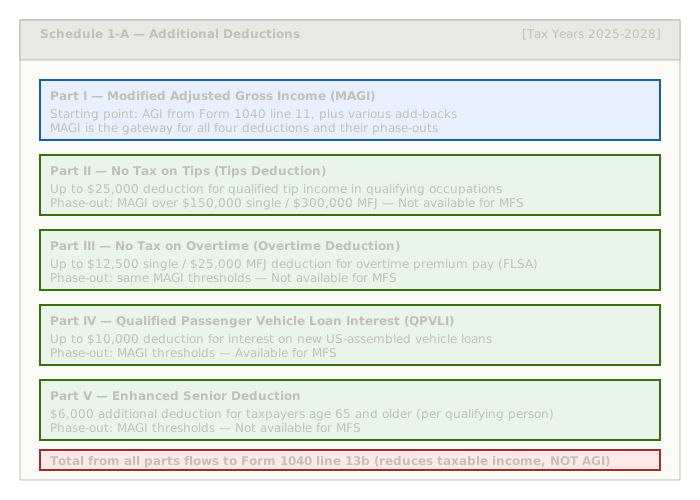
The One Big Beautiful Bill Act, signed July 4, 2025, created four new deductions available for tax years 2025 through 2028 (unless extended). The IRS released the final Schedule 1-A in IR-2026-28 on March 2, 2026. The schedule has five parts: Part I calculates Modified Adjusted Gross Income (MAGI) which is the gateway for the deductions, and Parts II through V handle each individual deduction. The total from all four parts flows to Form 1040 line 13b, reducing taxable income directly.
These deductions reduce taxable income but not AGI. Because AGI drives many other tax provisions (credits, phase-outs, eligibility for various items), reducing AGI through a Schedule 1 Part II adjustment is generally more valuable per dollar than reducing taxable income through Schedule 1-A. But Schedule 1-A deductions are still real dollar reductions in your tax bill — they just don't have the cascading effects of AGI-reducing adjustments.
Only the Qualified Passenger Vehicle Loan Interest deduction (Part IV) is available to Married Filing Separately filers. The tips, overtime, and enhanced senior deductions are not available to MFS filers under OBBBA.
Part II — No Tax on Tips Deduction
Read this section if you received tips during the year in an occupation that customarily and regularly received tips before December 31, 2024.
What it covers. Up to $25,000 deduction for qualified tip income. The deduction is available whether you itemize or take the standard deduction.
Who qualifies. Workers in occupations that customarily and regularly received tips on or before December 31, 2024. The IRS published a list of Treasury Tip Occupation Codes (TTOC) covering these occupations — servers, bartenders, hairdressers, valets, baggage handlers, and similar tipped roles. Workers in non-traditionally-tipped occupations who happen to receive tips don't qualify even if their employer reports them.
MAGI phase-out. The deduction phases out starting at MAGI over $150,000 (single) or $300,000 (MFJ). At higher MAGI, the deduction is reduced or eliminated entirely.
Married Filing Separately filers cannot claim this deduction.
For 2025 specifically. Employers were not required to separately report qualified tips on 2025 W-2s — that requirement starts with 2026 W-2s. For 2025 returns, you determine qualified tips from one of three sources per IRS Notice 2025-69: total Social Security tips in W-2 Box 7, total tips reported to your employer on Forms 4070, or amounts your employer voluntarily reported in W-2 Box 14 or a separate statement.
Decision points. Whether your occupation qualifies under the Treasury Tip Occupation Code list. Whether you have records of your tip income for the year (Box 7 of W-2 is the easiest source). Whether your MAGI exceeds the phase-out thresholds.
Sourcing. IRC sections added by OBBBA Public Law 119-21 section 70201; IRS Notice 2025-69; Schedule 1-A instructions in Form 1040 Instructions.
Your W-2 with attention to Box 7 (Social Security tips) and Box 14 (if your employer voluntarily reported qualified tips). Your tip reporting records (Form 4070 or equivalent). Documentation that your occupation is on the IRS Treasury Tip Occupation Code list.
Part III — No Tax on Overtime Deduction
Read this section if you worked overtime hours during the year and received overtime premium pay under the Fair Labor Standards Act.
What it covers. Up to $12,500 deduction for single filers, $25,000 for MFJ, of overtime premium pay. Only the premium portion counts — the "half" portion of time-and-a-half pay, not the regular hourly rate component.
If your regular hourly rate is $20 and overtime pays $30 ($20 base + $10 premium), only the $10 premium per overtime hour counts toward the deduction, not the full $30. If you worked 100 overtime hours, $1,000 of overtime premium counts toward the deduction (not $3,000 of total overtime pay).
Who qualifies. W-2 employees who received FLSA-required overtime pay. Independent contractors and gig workers don't qualify because they don't receive FLSA overtime. Salaried workers who don't qualify for FLSA overtime under the salary exemption don't have qualifying overtime to deduct.
MAGI phase-out and MFS restriction. Same as the tips deduction: phase-out starts at $150,000 single / $300,000 MFJ; not available for MFS filers.
For 2025 specifically. Same transition relief as tips — employers weren't required to separately report overtime on 2025 W-2s. You determine the overtime premium amount from your paystubs or other records. The IRS guidance (Notice 2025-69) explains how to calculate this when separate reporting isn't available.
Decision points. Whether the overtime you received was FLSA-required (not all overtime is). Whether you have records distinguishing the premium portion from the base portion. Whether your MAGI is below the phase-out threshold.
Sourcing. IRC sections added by OBBBA section 70202; IRS Notice 2025-69; Schedule 1-A instructions.
Paystubs throughout the year showing overtime hours and pay rates. Year-end summary from your employer if voluntarily provided. Your W-2 Box 14 if your employer reported overtime there.
Part IV — Qualified Passenger Vehicle Loan Interest (QPVLI)
Read this section if you took out a loan to buy a new vehicle with final assembly in the United States during 2025 or later.
What it covers. Up to $10,000 deduction for interest paid on a qualified passenger vehicle loan. This deduction makes personal car loan interest deductible for the first time in decades.
Who qualifies. Anyone who took out a qualifying loan, regardless of income level (within phase-out limits). The loan must be for a new vehicle (used vehicles don't qualify), the vehicle must have final assembly in the United States, and the loan must have started after December 31, 2024.
Vehicle requirements. The vehicle must be a new passenger car, SUV, or pickup truck (motorcycles also qualify). Final assembly must be in the United States — you can verify this from the vehicle's documentation or the manufacturer's website. The VIN must be provided on Schedule 1-A.
MAGI phase-out. The deduction phases out at MAGI thresholds (verify current thresholds in IRS guidance).
This is the only Schedule 1-A deduction available for Married Filing Separately filers.
Decision points. Whether your vehicle qualifies (new, US-assembled). Whether your loan originated after December 31, 2024. Whether you can document the VIN and final assembly location. Whether your MAGI is below the phase-out threshold.
Sourcing. IRC sections added by OBBBA section 70203; Schedule 1-A instructions.
Loan statements showing interest paid during 2025. The vehicle's title and registration showing VIN. Documentation of final assembly location (typically from the vehicle's monroney sticker or manufacturer documentation). Records of the loan origination date.
Part V — Enhanced Senior Deduction
Read this section if you (or your spouse on a joint return) were age 65 or older at the end of the tax year.
What it covers. $6,000 deduction per qualifying person age 65 or older. For MFJ where both spouses are 65 or older, the total is $12,000.
Who qualifies. Taxpayers age 65 and older with valid Social Security numbers. The deduction is in addition to the existing additional standard deduction for seniors (which applies for the standard deduction calculation).
MAGI phase-out. The deduction phases out at MAGI thresholds; the phase-out is gradual.
Not available for Married Filing Separately filers.
Decision points. Whether your age qualifies (age 65 by end of tax year). Whether your MAGI is below the phase-out threshold. For MFJ, whether one or both spouses qualify by age.
Sourcing. IRC sections added by OBBBA section 70103; Schedule 1-A instructions.
Documentation of date of birth (already on Social Security record). Documentation of MAGI for phase-out calculation.
Connection to other sections
The Schedule 1 Part II adjustments produce your AGI on line 11, which is the basis for most of what follows on the return. Lower AGI is generally better because it tends to unlock more credits and deductions, lower phase-out impacts, and reduce certain other tax provisions. The above-the-line adjustments are the main vehicle most filers have to reduce AGI.
The Schedule 1-A deductions reduce taxable income on line 15 but don't reduce AGI. They're real tax savings but their benefit doesn't cascade through AGI-based provisions the way above-the-line adjustments do.
After AGI on line 11, the form goes to the deductions section: standard deduction or itemized deductions on line 12, then qualified business income deduction (if applicable) on line 13a, then the new Schedule 1-A deductions on line 13b, summing to line 14, and producing taxable income on line 15. The deductions section gets its own dedicated lesson.
What to gather for the adjustments section
From the various subsections that apply to your situation:
- Form 1098-E for student loan interest paid.
- Form 5498 for IRA contributions.
- Form 5498-SA for HSA contributions.
- Form 8889 for HSA contributions and reconciliation.
- Form 8606 for any non-deductible IRA contributions or distributions from IRAs with basis.
- Records of educator expenses (receipts and hour tracking).
- Self-employment income calculations (Schedule C, SE).
- Self-employed health insurance premium records.
- Self-employed retirement plan contribution records.
- Form 3903 for military moving expenses.
- Any 1099-INT with Box 2 amounts (early withdrawal penalties).
For Schedule 1-A:
- W-2 with tips and overtime information (Box 7 and Box 14).
- Paystubs throughout the year showing overtime premium amounts.
- Loan statements for qualified vehicle loans with VIN.
- Documentation of vehicle's US final assembly.
- Date of birth documentation for senior deduction.
Key Takeaways
- Above-the-line adjustments reduce AGI, which cascades to unlock credits, reduce phase-outs, and improve eligibility for other provisions — making them worth more per dollar than below-the-line deductions.
- Schedule 1 Part II has nine main adjustment categories: educator expenses, half of SE tax, HSA contributions, IRA deductions, moving expenses (military only), early withdrawal penalties, self-employed health insurance, self-employed retirement plans, and student loan interest.
- The OBBBA created four new Schedule 1-A deductions for 2025-2028: no tax on tips (up to $25,000), no tax on overtime premium pay (up to $12,500/$25,000), qualified vehicle loan interest (up to $10,000), and enhanced senior deduction ($6,000 per qualifying person age 65+).
- Schedule 1-A deductions are below-the-line — they reduce taxable income but not AGI — so they don't trigger AGI-based benefits the way Schedule 1 Part II adjustments do.
- Three of the four Schedule 1-A deductions (tips, overtime, senior) are unavailable to Married Filing Separately filers; only the vehicle loan interest deduction is available to MFS.
- For 2025 returns specifically, employers were not required to separately report tips or overtime on W-2s — use Box 7 for tips and paystubs for overtime premium amounts.
Quiz — 5 Questions
Answer one at a timeWhat is the key difference between an above-the-line adjustment and a below-the-line deduction?