Payments, Refund, and Balance Due
The final section of Form 1040 — how withholding and estimated payments compare to total tax to produce your refund or amount owed
- Identify every line in the Form 1040 payments section and what goes on each
- Understand how W-2 withholding, 1099 withholding, estimated payments, and refundable credits combine into Total Payments
- Set up direct deposit correctly to avoid refund delays or misdirected deposits
- Know all available payment options if you owe a balance
- Understand when the underpayment penalty applies and how to avoid it next year
Introduction
After computing your total tax on Form 1040 line 24 (covered through Lessons 6, 7, and 8), the final operation on the return is comparing your total tax to what you've already paid during the year. If you paid more than you owe, you get a refund. If you paid less, you owe the difference. This is the last section of Form 1040, running from line 25 (payments) through line 38 (refund or amount owed).
This section is conceptually simpler than the income, deductions, and credits sections because the math is straightforward — total tax minus total payments equals refund or balance due. But it has several important practical elements: how to ensure your direct deposit goes to the right account, how to pay if you owe, how to apply a refund to next year's estimated tax, and how to set up withholding for next year to avoid surprises.
This lesson covers the payments lines (W-2 withholding, 1099 withholding, estimated tax payments, refundable credits), the refund or balance due calculation, the direct deposit and payment options, and the planning considerations for next year. The lesson also addresses the underpayment penalty that can apply when filers didn't pay enough throughout the year.
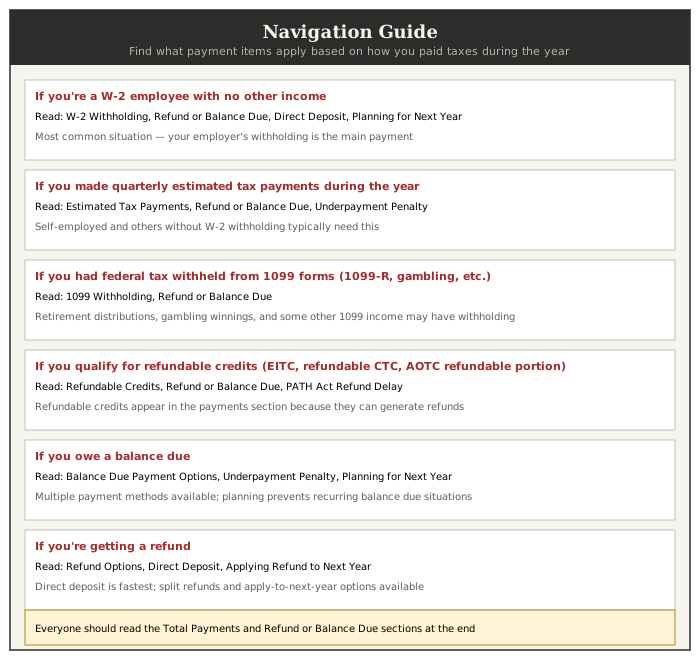
Navigation guide — which payment items apply to your situation
The Form 1040 payments and refund section we're covering
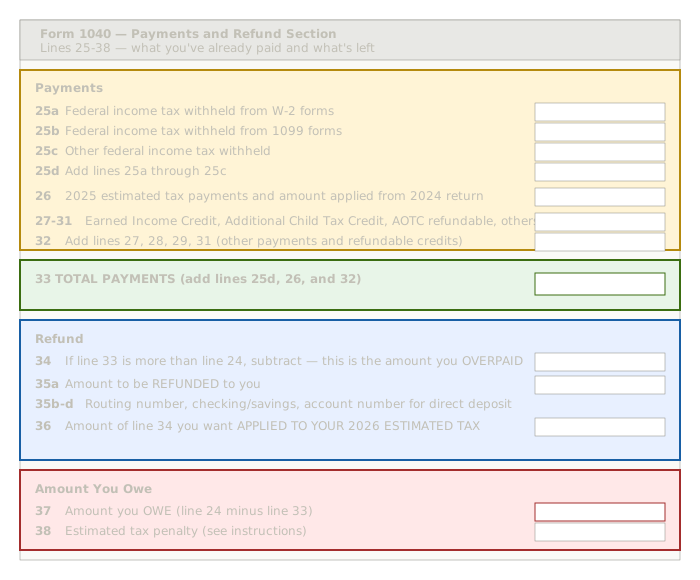
The illustration shows the payments and refund section. The yellow block at the top contains the payment lines (25a-32) that get summed to Total Payments on line 33. The green block highlights line 33 — Total Payments — which is the key number for comparison. The blue block shows the refund section if you overpaid (lines 34-36), and the red block shows the balance due section if you underpaid (lines 37-38).
The logic is straightforward: compare line 33 (total payments) to line 24 (total tax). If payments are larger, you overpaid and the difference goes to line 34 then to refund or applied to next year. If payments are smaller, you underpaid and the difference goes to line 37 as the amount owed.
W-2 Withholding (line 25a)
Read this if you received any W-2 forms during the year.
What this is. The federal income tax your employer withheld from your paychecks throughout the year. The amount comes from Box 2 of each W-2 you received.
How it works. Your employer withholds federal income tax based on the W-4 form you submitted, your filing status, and your wages. The withheld amounts get sent to the IRS quarterly by your employer. At year-end, the total appears in Box 2 of your W-2.
Multiple W-2s. If you worked for multiple employers, sum Box 2 from all W-2s and enter the total on line 25a.
How withholding gets calculated. Your employer uses IRS withholding tables based on your W-4 entries. If you filled out the W-4 to claim allowances or specify extra withholding, those choices affected the amount withheld. The actual tax owed at filing time may be more or less than what was withheld depending on your full tax situation.
Common issues. Withholding is often imperfect for several reasons. New jobs starting mid-year don't have full-year context for the calculation. Spouses with separate jobs each have employers that don't know about the other's income. Workers with side income often don't increase wage withholding to cover the additional tax. The result is that many W-2 employees still face balance dues or unexpectedly large refunds.
Box 2 from every W-2 you received during the year.
1099 Withholding (line 25b)
Read this if you received 1099 forms with federal tax withheld.
What this is. Federal income tax withheld from non-wage income reported on various 1099 forms. The amount comes from the federal withholding box on each 1099.
Common 1099s with withholding:
- 1099-R (retirement distributions, often with 10% default withholding)
- 1099-G (state refunds, unemployment compensation when elected)
- W-2G (gambling winnings, often with 24% required withholding)
- 1099-DIV and 1099-INT (backup withholding when taxpayer didn't provide TIN)
How it works. The payer withholds tax and sends it to the IRS, similar to W-2 withholding. The withheld amount appears in a specific box on the 1099 (the box number varies by form type).
Backup withholding. Some 1099s show backup withholding (typically 24%) which applies when the taxpayer didn't provide a valid TIN or had a prior underreporter issue. Backup withholding gets credited on line 25b like other 1099 withholding.
Every 1099 you received with a federal withholding box. Sum the amounts and enter on line 25b.
Estimated Tax Payments (line 26)
Read this if you made quarterly estimated tax payments during the year or applied a prior year's refund to your current year's estimated tax.
What this is. Quarterly tax payments you sent to the IRS during the year, plus any amount of your 2024 refund that you elected to apply to 2025 estimated tax (on your 2024 return).
Who makes estimated payments. Self-employed people, retirees taking IRA distributions, investors with substantial capital gains, anyone with substantial income not subject to withholding, and anyone whose W-2 withholding is insufficient to cover their tax.
The four quarterly due dates. April 15, June 15, September 15, and January 15 of the following year. Each payment covers roughly one quarter of estimated annual tax, though the schedule isn't exactly quarterly (it follows the IRS's specific dates).
How it works. You estimate your annual tax liability, divide by four, and pay each quarterly amount by the due date. Form 1040-ES has worksheets to help estimate the right amount. Payments can be made online (IRS Direct Pay, EFTPS, or third-party processors), by check, by phone, or through tax software.
Applied prior year refund. When you filed your 2024 return, you may have elected to apply some or all of your refund to 2025 estimated tax. That amount gets credited on line 26.
Generally, paying through withholding plus estimated tax at least 90% of current year tax (or 100% of prior year tax, 110% if prior year AGI exceeded $150,000) protects against the underpayment penalty.
Records of all estimated payments made during the year (dates, amounts, confirmation numbers from electronic payments or check images). Your 2024 tax return if any refund was applied to 2025.
Refundable Credits (lines 27–31)
Read this if you qualify for refundable credits.
What goes here. Lines 27 through 31 are for refundable credits that get treated like payments because they can generate refunds even when no tax is owed.
- Line 27 — Earned Income Credit. EITC for filers with earned income below the limits (covered in Lesson 7). Includes attached Schedule EIC if claiming children.
- Line 28 — Additional Child Tax Credit. The refundable portion of the Child Tax Credit (up to $1,700 per qualifying child for 2025). Calculated on Schedule 8812.
- Line 29 — American Opportunity Credit (refundable portion). Up to 40% of the AOTC (up to $1,000 per student) is refundable. Calculated on Form 8863.
- Line 31 — Amount from Schedule 3, line 15. Other refundable credits including the Premium Tax Credit (Form 8962), excess Social Security tax withheld, credit for federal tax on fuels, and various other items.
- Line 32. Sums the refundable credits on lines 27, 28, 29, and 31.
Returns claiming EITC or Additional Child Tax Credit cannot have refunds issued before mid-February. This applies to the entire refund, not just the credit portion.
Documentation supporting each refundable credit you're claiming (already gathered for Lesson 7's credits section).
Total Payments (line 33) and the Refund or Balance Due
Line 33 sums all your payments: line 25d (total withholding), line 26 (estimated tax payments), and line 32 (refundable credits). This is the total of what you've already paid toward your tax liability.
After computing total payments, the result depends on the comparison with total tax (line 24).
If line 33 (total payments) is greater than line 24 (total tax): You overpaid. The difference goes on line 34 as your "amount you overpaid." From there: Line 35a — Amount you want refunded to you. Enter how much of the overpayment you want as a refund. Lines 35b through 35d — If electing direct deposit, your routing number (35b), checking or savings box (35c), and account number (35d). Line 36 — Amount of the overpayment you want applied to your 2026 estimated tax. Line 35a plus line 36 must equal line 34. You can split your refund between direct deposit and applied-to-next-year, or take it all one way.
If line 33 (total payments) is less than line 24 (total tax): You owe. The difference goes on line 37 as "amount you owe." Line 38 captures the estimated tax penalty if one applies. This penalty is for not paying enough during the year.
Direct Deposit for Refunds (lines 35b–d)
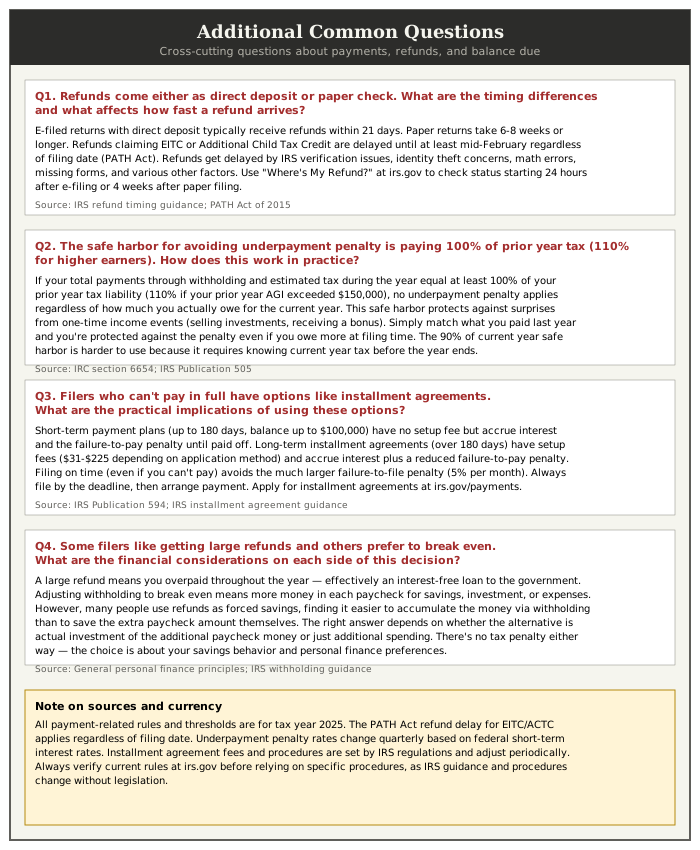
Direct deposit is the fastest way to receive your refund — typically within 21 days for e-filed returns, versus 6-8 weeks for paper checks. The IRS strongly encourages direct deposit.
Routing number (line 35b). The 9-digit number identifying your bank. Available on checks (the first 9 digits at the bottom left), or from your bank's website or mobile app. Verify carefully — a wrong routing number sends your refund to a different bank.
Account type (line 35c). Check either "Checking" or "Savings" box to identify the account type.
Account number (line 35d). Your bank account number, up to 17 characters. Available on checks (the digits between the routing number and check number), or from your bank.
Wrong routing or account numbers can cause refund problems. If the deposit goes to a closed account, the bank rejects it and the IRS issues a paper check (delayed). If the deposit goes to someone else's account due to a typo, the IRS typically cannot recover it for you — you'd need to work with the receiving bank, which has no obligation to return the funds.
Splitting refund into multiple accounts. Use Form 8888 to split your refund across up to three accounts (including IRAs, HSAs, and savings bonds). Without Form 8888, the entire refund goes to the single account you specify.
Apply to next year. Use line 36 to apply some or all of your overpayment to 2026 estimated tax. This can be useful for filers who will owe quarterly estimated taxes next year (self-employed, etc.) — it credits as the first quarterly payment without needing to write a check.
Balance Due Payment Options
If you owe (line 37), several payment methods are available.
- IRS Direct Pay. Free, available through irs.gov/payments. Pays directly from your bank account. No processing fee. The most common method for filers with the cash to pay in full.
- EFTPS (Electronic Federal Tax Payment System). Also free, requires enrollment. Used by businesses and individuals with regular tax payment obligations.
- Credit/Debit card. Available through approved third-party processors. Processing fees apply (typically 1.85%-2.0% for credit cards, a small flat fee for debit cards). Useful for getting card rewards on tax payments if the rewards exceed the processing fee.
- Check or money order. Mailed with a 1040-V payment voucher. Make payable to "United States Treasury" and include your SSN, tax year, and form number on the check.
- Payment plan. If you can't pay in full, you can request an installment agreement. Short-term plans (up to 180 days) are typically free; long-term plans involve setup fees and interest. Available online at irs.gov/payments.
- Offer in compromise. For taxpayers with serious financial hardship, the IRS may accept less than the full amount owed. Strict requirements and significant documentation needed. Form 656 starts the process.
If you owe and don't pay by the filing deadline (April 15 typically), the failure-to-pay penalty is 0.5% per month (up to 25%), plus interest. Filing an extension only extends the filing deadline, not the payment deadline.
The Underpayment Penalty (line 38)
If you didn't pay enough throughout the year, you may owe an underpayment penalty in addition to the balance due.
When the penalty applies. Generally, if your total payments through withholding and estimated tax were less than 90% of your current year tax (or 100% of prior year tax, 110% if prior year AGI was over $150,000), you owe an underpayment penalty.
Exception for small balance dues. No penalty if your balance due is less than $1,000.
Why this exists. The federal tax system is "pay as you go" — the IRS expects taxes to be paid throughout the year, not all at filing time. The penalty incentivizes timely payment.
How to calculate. Form 2210 walks through the calculation. Tax software handles this automatically. The IRS can also calculate the penalty for you — leaving line 38 blank tells the IRS to calculate and bill any penalty separately.
How to avoid. Adjust W-2 withholding through a new W-4 if you anticipate owing. Make quarterly estimated payments if you have income without withholding. Meet the safe harbor of 100% of prior year tax (110% for higher earners) — this is often easier to calculate than 90% of current year tax.
Quarterly application. The penalty is calculated quarterly. Paying more in the fourth quarter doesn't help if you underpaid in the first quarter — each quarter is evaluated separately. For uneven income (like a year-end capital gain), Form 2210 has annualized income methods to potentially reduce the penalty.
Planning for Next Year
The payments section is where filers typically realize they need to make changes for next year. Several planning items connect from this section.
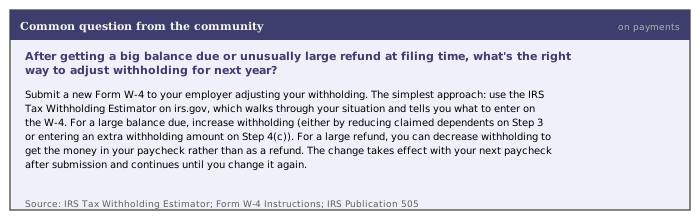
Adjust W-4 if your withholding wasn't right. Submit a new W-4 to your employer to change withholding for next year. Use the IRS Tax Withholding Estimator at irs.gov.
Start quarterly estimated payments if you have income without withholding. Self-employed people, retirees, investors with substantial gains, and others with non-wage income should plan to make quarterly estimated payments next year.
Apply this year's refund to next year's estimated tax. Line 36 lets you carry forward part or all of your refund as the first installment of next year's estimated tax. Useful for filers who'll owe quarterly payments.
Set up direct deposit refund to a savings account. Many people use direct deposit to a separate savings account specifically for tax refunds, making it easier to use the refund as savings rather than spending it.
Large refunds are interest-free loans to the government — you could have had that money in your paycheck throughout the year. Large balance dues mean you avoided overpaying but face a big bill. Most financial planners suggest aiming for a small refund or small balance due as the "right" amount of withholding.
Career path applications
W-2 employees should monitor whether their W-4 produces appropriate withholding. Major life changes (marriage, divorce, new dependent, second job, large raise) all warrant W-4 review.
Self-employed people and gig workers need to make quarterly estimated payments throughout the year, not just at filing time. The IRS doesn't tolerate filing-time-only payment for self-employed income.
Married couples with both spouses working often face withholding shortfalls because each employer doesn't see the other spouse's income. The W-4 has specific instructions for multiple-job households.
Retirees can elect federal withholding from Social Security (Form W-4V), from IRA distributions (custodian-specific forms), and from pensions. Setting up adequate withholding across all retirement income sources avoids balance-due surprises.
Investors with substantial gains can make estimated payments after large gain-realization events to avoid the underpayment penalty on annualized income.
International workers may face unique payment considerations depending on tax treaties and the source of their income.
Common mistakes in this section
Wrong direct deposit numbers. A single wrong digit can send your refund to a different account. Verify routing and account numbers against bank documentation, not memory.
Forgetting estimated payments made early in the year. Self-employed filers sometimes forget payments made in April or June by filing time the following spring. Keep a running record.
Not adjusting withholding after major life changes. Marriage, divorce, having a child, paying off a mortgage, or starting a second job all affect optimal withholding. Many filers don't adjust until they get a surprise at filing time.
Form 4868 (extension to file) extends the filing deadline but NOT the payment deadline. If you owe and file an extension, you must still pay by April 15 to avoid late payment penalties and interest.
Not making quarterly estimated payments. Self-employed people, retirees with IRA distributions, and others with non-withholding income who don't make quarterly payments face balance dues plus underpayment penalties.
Sending payment to wrong address. If paying by check, use the correct IRS address for your state (listed in Form 1040 Instructions). Wrong addresses cause delays and may result in late payment penalties.
Connection to the rest of the return
The payments section is the final calculation on Form 1040. Above it, lines 1-9 reported income (Lesson 3), line 10 was adjustments to income from Schedule 1 (Lesson 4), lines 12-14 were deductions (Lesson 5), line 16 was tax (Lesson 6), lines 19-22 were credits (Lesson 7), and line 23 added Schedule 2 other taxes (Lesson 8). Line 24 is total tax. The payments section (lines 25-32) gives total payments on line 33. The comparison of total tax to total payments produces the refund (line 34) or balance due (line 37).
This is the last operational section of Form 1040 itself. After this, the form has the signature section and the third-party designee section (about who can discuss the return with the IRS).
The "What to gather" lists from prior lessons feed into the payments section. The W-2 amounts that went into income (Lesson 3) also have withholding that goes into payments (this lesson). The credits in Lesson 7 included refundable credits that appear in the payments section here. The Schedule 2 items in Lesson 8 contribute to total tax that the payments section is compared against.
What to gather for the payments section
W-2 forms (Box 2 for federal withholding). All 1099 forms with federal withholding boxes. Records of all quarterly estimated tax payments made during the year (confirmation numbers from online payments, copies of checks). Your prior year tax return if you applied any of that year's refund to this year's estimated tax. Bank routing and account numbers for direct deposit (verified from a check or bank statement). For balance due payment: bank account information or credit card if paying electronically; check made payable to "United States Treasury" if paying by mail with a 1040-V voucher.
Key Takeaways
- Form 1040 lines 25-38 compare total payments (withholding + estimated payments + refundable credits) to total tax — the difference is your refund or balance due
- W-2 Box 2 withholding, 1099 withholding, quarterly estimated payments, and refundable credits all flow into Total Payments on line 33
- Verify direct deposit routing and account numbers against bank documentation — a single digit error can permanently misdirect your refund
- Filing an extension does NOT extend the payment deadline — tax owed must still be paid by April 15 to avoid penalties and interest
- The underpayment penalty applies when total payments were less than 90% of current year tax (or 100% of prior year tax) — no penalty if balance due is under $1,000
- Large refunds are interest-free loans to the IRS; adjust your W-4 or estimated payments to aim for a small refund or small balance due
Quiz — 4 Questions
Answer one at a timeWhat is on Form 1040 line 33, and why does it matter?