Standard Deduction vs. Itemized Deductions and Schedule A
The largest single reduction on most returns — how to calculate both sides and choose correctly for 2025
- Understand where line 12 sits in the Form 1040 structure and why it matters
- Calculate the correct standard deduction including age and blindness add-ons
- Know each Schedule A category, what qualifies, and the 2025 OBBBA changes
- Apply the decision framework to determine whether standard or itemized is better
- Identify optimization opportunities like contribution bunching and timing medical expenses
Introduction
After arriving at Adjusted Gross Income on Form 1040 line 11 (covered in Lessons 3 and 4), the next operation is reducing AGI to get to Taxable Income. The largest single reduction available to most filers happens on line 12 of Form 1040, where you take either the standard deduction or itemized deductions. This is one of the most consequential decisions on the return because the difference can affect thousands of dollars of tax liability for many filers.
The decision is straightforward in principle but requires calculation. You compare your standard deduction (a flat amount based on filing status, age, and blindness status) against your total itemized deductions (the sum of specific expenses you can deduct on Schedule A). Whichever is larger is what you take on line 12. Most filers take the standard deduction because it's larger than their potential itemized deductions, but homeowners in high-tax states, people with large medical expenses, and significant charitable givers often benefit from itemizing.
The 2025 tax year is particularly important to revisit this decision because the One Big Beautiful Bill Act, signed in July 2025, made substantial changes to both sides of the comparison. The standard deduction increased to $15,750 for single filers, $31,500 for married filing jointly, and $23,625 for head of household — these amounts were boosted above the inflation-adjusted baseline by OBBBA. Simultaneously, OBBBA increased the State and Local Tax (SALT) deduction cap from $10,000 to $40,000 ($20,000 for MFS), making itemizing more attractive for residents of high-tax states. The OBBBA also permanently eliminated the 2%-of-AGI miscellaneous itemized deduction floor (those deductions had been suspended through 2025 and are now gone for good). These changes mean the calculation is materially different from prior years.
This lesson covers Form 1040 line 12 (the standard or itemized deduction line), the standard deduction amounts and add-ons for various situations, Schedule A and its categories of itemized deductions, the decision framework for choosing between them, and the OBBBA-driven changes that affect 2025 returns.
The Form 1040 deductions section we're covering
Form 1040 line 12 is a single line: "Standard deduction or itemized deductions (from Schedule A)." There's no separate line for each option — you enter whichever amount is larger and only one of them. Above line 12 is your AGI on line 11; below line 12 is line 13a (Qualified Business Income deduction if applicable), line 13b (Schedule 1-A additional deductions covered in Lesson 4), line 14 (sum of 12 + 13a + 13b), and line 15 (taxable income, which is line 11 minus line 14).
The position of line 12 matters. It comes after AGI is set and reduces AGI to help calculate taxable income. The choice between standard and itemized is the largest single reduction on most returns, often larger than the income adjustments or the line 13 items combined.
The Standard Deduction
The standard deduction is a flat amount you can subtract from AGI based on your filing status. You don't need to track or document any specific expenses — the government provides this deduction regardless of what you actually spent during the year. Most filers (over 80% in recent years) take the standard deduction because it's larger than their potential itemized deductions.
2025 standard deduction amounts (after OBBBA increases). Single filers and Married Filing Separately filers get $15,750. Married Filing Jointly and Qualifying Surviving Spouse filers get $31,500. Head of Household filers get $23,625. These amounts were boosted by OBBBA above the inflation-adjusted baseline and are now permanent (subject to future inflation adjustments). For comparison, the 2026 amounts will be approximately $16,100 single, $32,200 MFJ, and $24,150 HOH per IRS Revenue Procedure 2025-32.
Additional standard deduction for age 65+ or blind. Filers who are 65 or older at the end of the tax year, or who are legally blind, get an additional standard deduction. For 2025, the additions are $2,000 per qualifying person for single or HOH filers, and $1,600 per qualifying person for MFJ, MFS, or QSS filers. If you're both 65+ and blind, you get the addition twice. For MFJ where both spouses qualify, both get the addition. These additions are claimed by checking the relevant boxes in the standard deduction section near the top of Form 1040.
Standard deduction for dependents. If someone can claim you as a dependent, your standard deduction is limited. For 2025, it equals the greater of $1,350 or your earned income plus $450, capped at the regular standard deduction for your filing status ($15,750 single). This means a dependent with only investment income gets a small standard deduction, while a dependent with employment income gets a larger one up to the cap.
When you must take the standard deduction. Generally, the standard deduction is the default — you take it unless you specifically choose to itemize and itemizing produces a larger deduction. Even if itemized would be larger, you can choose to take the standard if you prefer (though this would unnecessarily increase your tax).
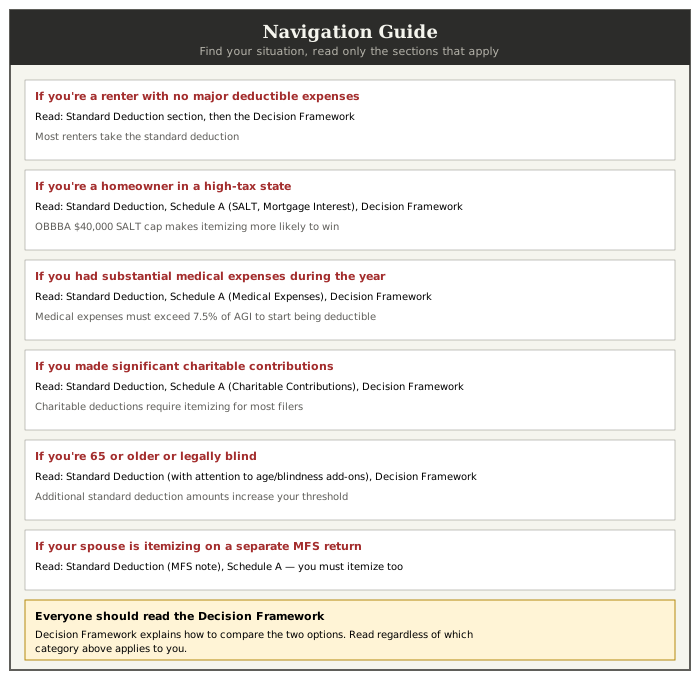
If you're filing MFS and your spouse itemizes on their separate return, you must also itemize. You cannot take the standard deduction. The two spouses on MFS returns must use the same method. If you're a dual-status alien (some part of the year as a nonresident alien), you generally cannot take the standard deduction. If your tax year is less than 12 months because of a change in accounting period, the standard deduction may be limited.
The $6,000 enhanced senior deduction created by OBBBA (claimed on Schedule 1-A as covered in Lesson 4) is separate from the standard deduction's age add-on. Seniors 65+ can claim both — the existing $2,000 (single) or $1,600 (MFJ) age add-on to the standard deduction, AND the new $6,000 OBBBA deduction. The OBBBA deduction is available whether you take the standard or itemize. So seniors actually have triple benefits available: regular standard deduction (or itemized), plus age add-on (if taking standard), plus the new $6,000 OBBBA deduction.
Schedule A — Itemized Deductions
Schedule A is the form you use if you itemize. It has specific categories of deductions you can claim if you incurred them during the year. The total of your itemized deductions on Schedule A flows to Form 1040 line 12 in place of the standard deduction.
The Schedule A categories for 2025 are: medical and dental expenses, taxes paid (SALT), interest paid (mortgage and investment), gifts to charity, casualty and theft losses (only from federally declared disasters), and other itemized deductions (a much smaller list than in the past).
The OBBBA permanently eliminated miscellaneous itemized deductions subject to the 2%-of-AGI floor. These deductions — including unreimbursed employee business expenses, investment management fees, tax preparation fees, and certain other items — were suspended through 2025 by TCJA and are now permanently eliminated by OBBBA. Don't try to claim them; they're gone.
Medical and Dental Expenses (Schedule A lines 1-4)
Read this if you had substantial out-of-pocket medical expenses during the year.
Medical and dental expenses are deductible to the extent they exceed 7.5% of your AGI. For a filer with $80,000 AGI, the first $6,000 (7.5% of $80,000) of medical expenses is not deductible — only expenses above that threshold count.
What qualifies as medical expenses. Payments for diagnosis, cure, mitigation, treatment, or prevention of disease, or for the purpose of affecting any structure or function of the body. This includes doctor visits, hospital stays, prescription drugs, dental care, vision care, mental health care, long-term care, certain medical equipment, and many other items. Health insurance premiums you paid (not amounts your employer paid pretax) count. Travel for medical care can count at a specified mileage rate.
What doesn't qualify. Cosmetic procedures (unless related to a deformity, disease, or injury). Health club memberships unless prescribed for a specific medical condition. Insurance premiums paid with pretax dollars (already excluded from wages). Medicare Part A premiums for most people (paid through payroll taxes). Over-the-counter medicines (except insulin) without a prescription.
Decision points. Track medical expenses throughout the year if you anticipate exceeding the threshold. Combine expenses for everyone on your return (spouse, dependents). If you have major upcoming medical expenses, timing them within a single tax year may help exceed the 7.5% AGI floor for that year versus splitting across years.
Receipts for all medical payments throughout the year. Insurance premium records. Pharmacy printouts of prescription costs. Mileage logs for medical travel. Documentation that any non-obvious medical expenses (like home modifications for disability) qualify.
Taxes Paid (Schedule A lines 5-7) — SALT
Read this if you paid significant state income taxes, local income taxes, property taxes, or sales taxes.
The State and Local Tax (SALT) deduction lets you deduct state and local taxes paid during the year, subject to an aggregate cap. The OBBBA changed this cap substantially for 2025.
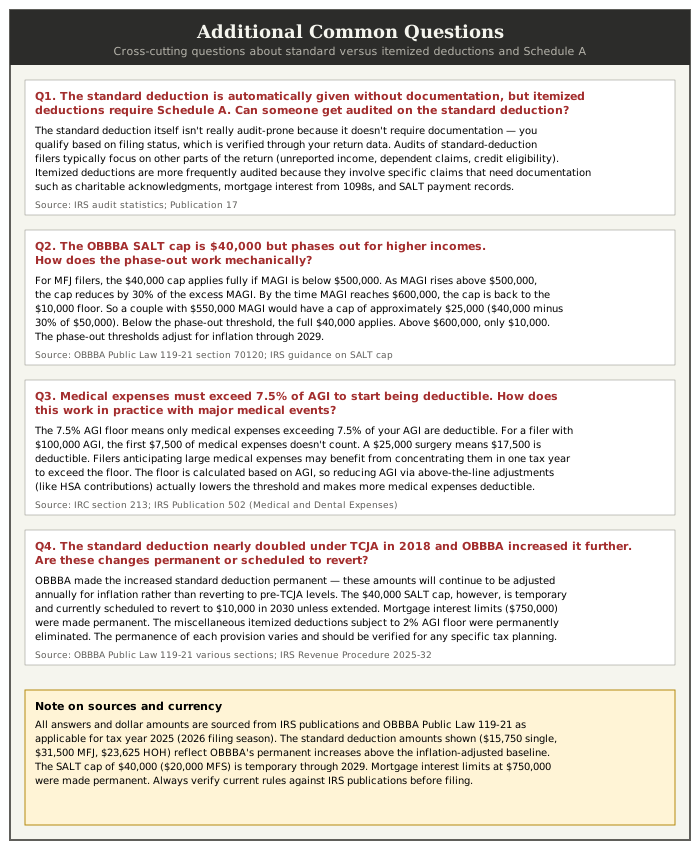
The new $40,000 SALT cap. For 2025, you can deduct up to $40,000 of state and local taxes ($20,000 if MFS). This is a quadrupling of the prior $10,000 cap from TCJA. The increase is temporary and is currently scheduled to revert to $10,000 in 2030 unless further legislation extends it.
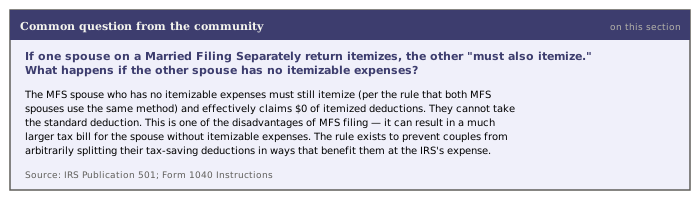
SALT phase-out at high incomes. The $40,000 cap phases out for high earners. For MFJ filers, the full $40,000 cap applies with MAGI below $500,000 and phases down to $10,000 as MAGI rises. Once MAGI reaches $600,000, the deduction reverts to the $10,000 floor. The phase-out thresholds adjust for inflation through 2029.
What counts toward SALT. State and local income taxes (or sales taxes — you choose one or the other, not both). Real property taxes (residential, vacation, investment property up to the cap). Personal property taxes (often on vehicles, based on value). Foreign property taxes do not count.
State income tax versus sales tax choice. Most filers in states with income taxes deduct state income taxes paid. Filers in states without income taxes (Texas, Florida, Washington, etc.) typically deduct sales taxes paid. You can choose either, but not both, in any given year. The IRS provides sales tax tables that estimate sales tax based on income and family size for filers without good documentation of actual sales tax paid.
Decision points. For high-tax-state homeowners, the $40,000 cap is a substantial change. A family with $30,000 of state income tax plus $15,000 of property tax would have $45,000 of state and local taxes, of which $40,000 is now deductible (was capped at $10,000 before OBBBA). This $30,000 increase in deductible amount can make the difference between standard deduction and itemizing winning.
State income tax payments throughout the year (from W-2 Box 17 and any estimated payments). Property tax bills and proof of payment. Vehicle registration showing personal property tax component. If choosing sales tax, receipts for major purchases plus general estimate from IRS tables.
Interest Paid (Schedule A lines 8-10) — Mortgage Interest
Read this if you own a home and pay mortgage interest.
Home mortgage interest is deductible on Schedule A subject to specific limits.
Mortgage interest limit. Interest is deductible on up to $750,000 of "acquisition indebtedness" (debt used to buy, build, or substantially improve your home). This limit was set by TCJA and made permanent by OBBBA. For mortgages originated before December 15, 2017, the older $1,000,000 limit grandfathers in.
Interest on home equity loans or HELOCs is only deductible if the loan proceeds were used to buy, build, or substantially improve the home that secures the loan. If you used a HELOC to pay off credit cards, buy a car, or for other personal expenses, that interest is not deductible. This is one of the most common Schedule A errors.
Points paid. Points (loan origination fees expressed as a percentage of the loan amount) paid to buy or improve your main home are generally deductible in the year paid. Points on refinances are typically deducted over the loan term.
Mortgage insurance premiums (PMI). The PMI deduction expired after 2021 and has not been renewed. PMI is not currently deductible.
Form 1098 from your mortgage lender showing interest paid during the year. Settlement statement (HUD-1) for any home purchase or refinance during the year. Documentation of how HELOC proceeds were used if you have one.
Gifts to Charity (Schedule A lines 11-14)
Read this if you made charitable contributions during the year.
Charitable contributions to qualified organizations are deductible if you itemize.
Cash contributions. Cash contributions to public charities (most well-known nonprofits) are deductible up to 60% of AGI. Excess contributions carry forward for up to 5 years.
Non-cash contributions. Donations of property are deductible at fair market value (with various limitations for appreciated property). Contributions of property over $500 require Form 8283. Contributions over $5,000 generally require a qualified appraisal.
Documentation requirements. Cash contributions of $250 or more require a written acknowledgment from the charity. Non-cash contributions of any amount require receipts and records. The IRS has been increasing scrutiny of charitable deductions, so documentation matters.
What qualifies as charitable. Donations to 501(c)(3) public charities, religious organizations, government agencies, and certain other qualified organizations. Donations to individuals, political organizations, and most foreign charities don't qualify. Use the IRS Tax Exempt Organization Search to verify a charity's qualified status if uncertain.
OBBBA introduces new charitable contribution rules starting in 2026, including a 0.5% AGI floor for itemizers' cash contributions. For 2025 returns, the older rules apply. This is something to monitor for future years.
Acknowledgment letters for cash contributions of $250 or more. Receipts for all charitable contributions. Documentation of non-cash contributions including descriptions, fair market values, and how values were determined. Form 8283 if you made non-cash contributions over $500.
Casualty and Theft Losses (Schedule A line 15)
Read this only if you suffered losses from a federally declared disaster during the year.
Casualty and theft losses are deductible only for losses attributable to a federally declared disaster. The personal casualty loss deduction for non-disaster losses was suspended by TCJA and remains suspended.
What qualifies. Losses from federally declared disasters (hurricanes, floods, wildfires, earthquakes, etc. that the President has declared as disasters). The loss must exceed both $100 per casualty and 10% of AGI.
What doesn't qualify. Theft losses unrelated to a disaster. Property damage from non-disaster events. Losses from declines in market value (like a stock market drop) — only physical loss or destruction qualifies.
FEMA disaster declaration documentation. Photos and records of property damage. Insurance claims and settlements. Form 4684 to calculate the loss.
The Decision Framework — Standard or Itemized?
After understanding both options, the decision comes down to comparing the totals.
- Step 1: Calculate your standard deduction. Look up the base amount for your filing status ($15,750 single, $31,500 MFJ, $23,625 HOH for 2025). Add $2,000 (single/HOH) or $1,600 (MFJ/MFS/QSS) for each age 65+ qualification, and again for each blindness qualification. If you're a dependent, use the dependent calculation instead.
- Step 2: Estimate your itemized deductions. Sum up your medical expenses above 7.5% of AGI, your SALT (capped at $40,000 with phase-outs), your mortgage interest, your charitable contributions, and any disaster losses. This is your potential itemized total.
- Step 3: Choose the larger. Whichever is greater is what you take on line 12.
For most filers, the standard deduction wins. A married couple with no mortgage, modest state taxes, and small charitable giving easily clears the $31,500 hurdle only by having very large medical expenses or unusual circumstances. Their itemized total might be $5,000-$10,000 — far less than the standard deduction.
For homeowners in high-tax states with mortgages, itemizing often wins under OBBBA. A New York or California family with $25,000 of state income tax, $12,000 of property tax (totaling $37,000 SALT, within the new $40,000 cap), and $18,000 of mortgage interest has $55,000 of itemized deductions — well above the $31,500 standard for MFJ.
Run the numbers both ways. Tax software calculates both and chooses the larger automatically. If you're filing on paper or want to verify, calculate both totals and pick the winner. The difference is often $5,000-$20,000 of taxable income reduction, worth $1,000-$5,000 of tax savings depending on your bracket.
Career path applications
Renters and apartment dwellers almost always take the standard deduction. Without mortgage interest or property taxes, the itemized total rarely approaches the standard deduction unless there are huge medical expenses or charitable contributions.
Recent homebuyers are the group most likely to start itemizing for the first time. The combination of mortgage interest, property taxes, and state income tax can quickly exceed the standard deduction, especially with OBBBA's $40,000 SALT cap.
Longtime homeowners with paid-off mortgages may transition back to the standard deduction as mortgage interest declines. Without mortgage interest, the SALT cap of $40,000 alone may not exceed the standard deduction depending on their state's tax levels.
Self-employed people have most of their deductible business expenses on Schedule C rather than Schedule A. The Schedule C deductions are separate from this standard-versus-itemized decision. Self-employed people still face the same Schedule A decision for personal deductions.
Retirees often have lower SALT (no state income tax on Social Security and reduced wage income), reduced or eliminated mortgage interest, and potentially substantial medical expenses. Their decision often turns on medical expenses and charitable giving levels.
High-income earners in high-tax states are the group OBBBA's SALT cap increase most benefits. Before OBBBA, high earners in California, New York, New Jersey, and similar states were largely capped at $10,000 of SALT regardless of how much they actually paid. The new $40,000 cap means much larger deductions, often making itemizing the clear winner.
Charitable givers who donate large amounts may benefit from itemizing if their charitable contributions push them above the standard deduction. Strategies like donor-advised funds and bunching contributions into alternate years can help maximize the benefit.
Common mistakes in this section
Taking the standard deduction when itemizing would be larger. Some filers don't realize they should itemize, especially first-time homeowners or people new to high-tax states. Calculate both ways every year, especially after life changes.
Itemizing when the standard deduction would be larger. The opposite mistake — going through Schedule A documentation only to end up with less than the standard. This is more common with tax preparers who default to itemizing without comparing.
Claiming deductions that no longer exist. Miscellaneous itemized deductions (subject to 2% AGI floor) are permanently gone per OBBBA. Don't try to deduct unreimbursed employee expenses, investment management fees, or tax preparation fees if you're a W-2 employee.
HELOC interest used for non-home purposes. Interest on HELOCs used to pay off credit cards, buy cars, or fund other personal expenses is not deductible. Many homeowners make this mistake.
Forgetting state-specific implications. Some states don't conform to federal standard deduction amounts or itemizing rules. Your federal choice may not be optimal for state purposes — check your state's rules separately.
Claiming charitable deductions without proper documentation. The $250+ written acknowledgment requirement is strict. Donations without it can be disallowed in audit.
Optimization opportunities in this section
Bunch charitable contributions in alternate years. If your itemized deductions are usually just below the standard deduction threshold, consider giving two years' worth of charitable contributions in one year and nothing in the next. This pushes you over the threshold in the giving year while letting you take the larger standard deduction in the off year.
Time medical expenses across years. If you have flexibility about when to schedule major medical procedures, concentrating them in one tax year may help exceed the 7.5% AGI floor for that year while not having scattered amounts in other years that don't qualify.
Use a donor-advised fund for bunched giving. A donor-advised fund (DAF) lets you contribute a large amount to the DAF in one year (getting the immediate deduction) while distributing to actual charities over multiple subsequent years. This is the formal version of bunching.
Verify state implications before optimizing for federal. Some states have their own standard deductions and itemized rules that don't conform to federal. Your federal choice may not optimize state taxes. Consider both jurisdictions if your state taxes are significant.
For seniors, claim both the standard deduction's age add-on and the OBBBA $6,000 senior deduction. These are separate provisions that can both be claimed. Don't miss either one. The OBBBA $6,000 is on Schedule 1-A (covered in Lesson 4) and the age add-on is in the standard deduction section of Form 1040.
For high-tax-state homeowners, reconsider itemizing under OBBBA. If you stopped itemizing after TCJA's $10,000 SALT cap made it not worth the effort, the new $40,000 cap may make itemizing worthwhile again. Run the numbers for 2025.
Connection to other sections
The line 12 deduction works with line 13a (QBI deduction) and line 13b (Schedule 1-A) to reduce AGI to Taxable Income on line 15. The size of this reduction directly affects how much tax you owe.
The Schedule 1-A deductions covered in Lesson 4 work alongside but separately from the standard versus itemized choice. You take Schedule 1-A regardless of which line 12 path you choose. The standard deduction or itemized total is line 12; Schedule 1-A is line 13b. Both reduce taxable income.
The income and adjustments lessons (Lessons 3 and 4) produced AGI on line 11. AGI feeds into the medical expense floor (7.5% of AGI) and the SALT phase-out (starts at $500,000 MAGI for MFJ). Lower AGI helps more medical expenses qualify and avoids the SALT phase-out.
The tax calculation lesson (next) takes Taxable Income from line 15 and applies the tax brackets to determine pre-credit tax liability on line 16.
What to gather for the deductions section
If taking the standard deduction, you generally don't need to gather anything specific — just confirm your filing status, age, and blindness status for the standard deduction amount.
If itemizing, gather:
- Form 1098 from your mortgage lender (mortgage interest).
- Property tax bills and receipts (for SALT property tax component).
- State income tax payments throughout the year (from W-2 Box 17, estimated payments, and prior year refund offsets).
- Vehicle registration showing personal property tax (where applicable).
- Medical expense receipts for the year.
- Charitable contribution receipts and acknowledgment letters.
- Form 8283 if you made significant non-cash charitable contributions.
For comparison purposes, calculate both your standard and itemized totals to confirm which is larger.
Key Takeaways
- The standard deduction is $15,750 (single), $31,500 (MFJ), or $23,625 (HOH) for 2025 — boosted above prior baselines by OBBBA and now permanent subject to inflation adjustments.
- The SALT deduction cap increased from $10,000 to $40,000 ($20,000 for MFS) under OBBBA, making itemizing more attractive for homeowners in high-tax states — though the increase phases out above $500,000 MAGI for MFJ.
- Miscellaneous itemized deductions subject to the 2%-of-AGI floor are permanently eliminated by OBBBA — unreimbursed employee expenses, investment management fees, and tax preparation fees are gone for W-2 employees.
- HELOC interest is only deductible if the loan proceeds were used to buy, build, or substantially improve the home — not for paying off credit cards, buying cars, or personal expenses.
- Seniors 65+ can claim both the standard deduction's age add-on ($2,000 single/$1,600 MFJ) AND the separate $6,000 OBBBA senior deduction on Schedule 1-A — these are separate provisions.
- If your itemized deductions are near the standard deduction threshold, bunching charitable contributions into alternate years and timing major medical expenses can push you above the threshold in high-deduction years.
Quiz — 5 Questions
Answer one at a timeWhat is the 2025 standard deduction for a married couple filing jointly where one spouse is 67 years old and the other is 64?