Form 1040 — Personal Information and Filing Status
The first section of Form 1040 contains the most consequential decision you'll make on the entire return. Every field has specific requirements and the wrong filing status can cost thousands of dollars.
- Complete the identification block accurately — name, SSN, and address requirements
- Select the correct filing status from all five options using the specific eligibility rules
- Answer the digital assets question correctly based on your specific transaction history
- Identify which standard deduction qualifying checkboxes apply to your situation
- Recognize the common mistakes in this section that cause processing delays or incorrect tax calculations
Introduction
The first section of Form 1040 looks deceptively simple. It's just names, addresses, Social Security numbers, and checking a box for filing status. Most people fill it out in under two minutes without much thought. But this section contains the most consequential decision you'll make on the entire return — your filing status — and several smaller decisions that affect everything downstream. Filling out this section thoughtfully sets up everything that follows.
This lesson walks you through every part of the top section of Form 1040: the identification block where you put your name and Social Security number, the address block, the filing status selection, the digital assets question, and the standard deduction qualifying questions. We'll also cover the spouse information that appears when you select certain filing statuses.
Before we get into the specific sections, let me orient you to where this lives on the actual form. The personal information section occupies the entire top of page 1 of Form 1040. When you sit down with the actual form (or open a tax software program), this is the first thing you'll fill out. The form's visual layout puts your identifying information at the very top with the filing status checkboxes immediately below.
The form section we're covering
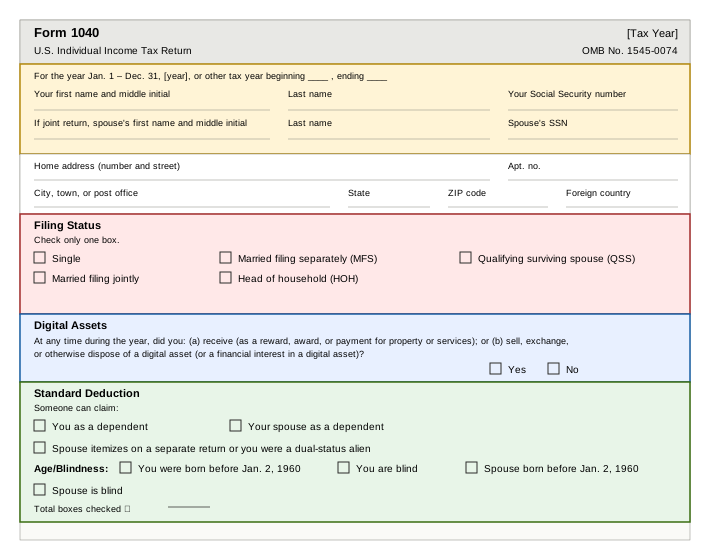
Figure 1.1 — Illustrative layout of the top section of Form 1040. Yellow = identification block, Red = filing status, Blue = digital assets question, Green = standard deduction qualifying questions.
The illustration above represents the layout of the top section of Form 1040. The yellow-highlighted block at the top is the identification section where your personal information goes. The red-highlighted block is the filing status section. The blue-highlighted block is the digital assets question. The green-highlighted block is the standard deduction qualifying questions. The actual IRS form will look slightly different visually but contains all these same elements in the same general arrangement.
The Identification Block (Yellow Highlight)
This is where your basic identifying information goes. Each field has specific requirements that matter for your return being processed correctly.
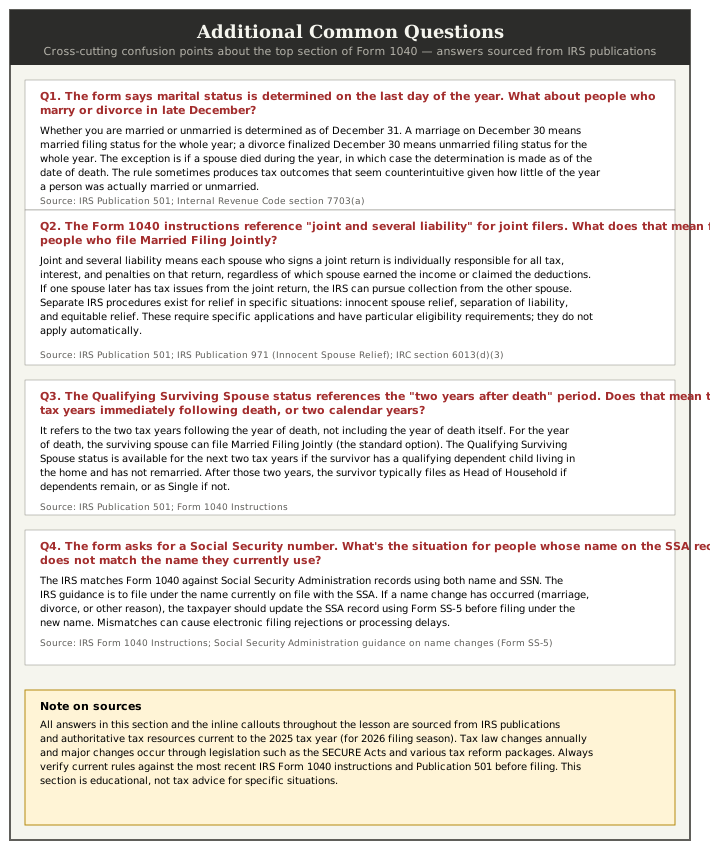
Your first name and middle initial, and your last name. These need to match exactly what the Social Security Administration has on file for you. If you got married and changed your name but haven't updated it with Social Security, you may need to file under your old name. If your name on file with Social Security has a hyphen, an apostrophe, or special characters, your tax return needs to match. The IRS matches your tax return against Social Security records using both your name and SSN, and mismatches cause processing delays or rejections of e-filed returns.
Your Social Security card, or your most recent Social Security statement that shows how your name is recorded. If you've changed your name since you last filed taxes, update Social Security first (using Form SS-5) before filing.
Your Social Security number. Nine digits. This is the single most important piece of identifying information on the return. The IRS uses it to match the return against your wage statements, your prior year returns, your dependents' returns, and every other federal record about you. A wrong digit causes immediate rejection of e-filed returns and major delays on paper returns.
Your Social Security card. Do not guess from memory if you're not certain. Look at the actual card or an official document (like a W-2) that shows the correct number.
Spouse's name and Social Security number. These lines only get filled in if you're filing jointly or if you're filing as Married Filing Separately (in which case you still need your spouse's SSN even though they're filing separately). The same rules apply for matching names to Social Security records.
If you're filing Single, Head of Household, or Qualifying Surviving Spouse, you leave the spouse lines blank.
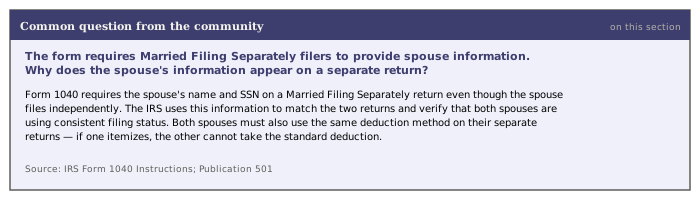
Decision points in the identification block
- Name changes after marriage or divorce. If you changed your name during the tax year, you have a decision about whether to file under your new or old name. The IRS recommends using whichever name matches your Social Security records. If you changed your name with Social Security mid-year, use the new name. If you changed your name but haven't updated Social Security, use the old name and update Social Security as soon as possible.
- Whose name goes first on a joint return. Either spouse can be listed as "you" on a joint return, with the other being the "spouse." This decision matters for one specific reason: refund deposits go to a bank account in the first-listed person's name unless you specify otherwise. If you have separate bank accounts and want the refund to go to a specific person's account, that person should be listed first. Otherwise, it's an arbitrary choice. Some couples keep the same arrangement year to year for consistency.
- ITIN versus SSN. If you're not a US citizen or resident with a Social Security number, you may need an Individual Taxpayer Identification Number (ITIN) instead. ITINs are issued by the IRS to people who need a tax identification number but don't qualify for an SSN. The ITIN goes in the same field where the SSN would go. If you need an ITIN, you apply using Form W-7 and you may need to file your tax return along with the W-7 application.
The Address Block
The address block captures where you live for the IRS to send correspondence. Several things matter here.
- Use your current address, not where you lived during the tax year. The address on the return is where the IRS will send refund checks (if you're getting a paper check), notices, and correspondence. If you moved between the tax year and filing, use your current address.
- Apartment numbers, suite numbers, or unit numbers go in the Apt. no. field. This matters because USPS sometimes has trouble delivering mail when the unit number is missing.
- Foreign addresses have special requirements. There are dedicated lines for foreign country, province, and postal code. If you live abroad, fill these in instead of the US-format address.
- P.O. Boxes are acceptable if you receive mail at a P.O. Box. Some people use a P.O. Box for tax correspondence to keep tax-related mail separate from personal mail.
Filing Status (Red Highlight) — The Most Consequential Decision
Filing status determines almost everything about your tax return: the tax brackets that apply to you, your standard deduction amount, your eligibility for certain credits, the income thresholds for various tax provisions. Choosing the wrong filing status can cost you thousands of dollars unnecessarily, or in some cases cause the IRS to reject your return entirely.
There are five filing statuses. Each has specific eligibility rules.
Single. This applies if you were unmarried, divorced, or legally separated under a decree of divorce or separate maintenance as of December 31 of the tax year. "As of December 31" is important — if you got divorced on December 30, you file as single (or potentially Head of Household) for the entire year. If you got divorced on January 2 of the following year, you still file as Married for the prior year.
Single is also the default for people who never married. If you're a young adult filing your first return, Single is almost always the right choice unless you got married during the tax year.
Married Filing Jointly (MFJ). Both spouses must be married as of December 31 and both agree to file jointly. The "agree" part matters — if your spouse refuses to file jointly, you can't unilaterally file MFJ. Both spouses sign the return and both are jointly responsible for any tax owed (called "joint and several liability").
MFJ is usually the better option for married couples financially. The tax brackets at lower income levels are roughly twice as wide as Single brackets (meaning two earners can each earn up to a similar amount before hitting higher brackets compared to a single filer). The standard deduction is twice the Single amount. Many credits and deductions have higher income limits or only apply to MFJ filers.
Married Filing Separately (MFS). Both spouses must be married but choose to file separately. Each spouse files their own return covering only their own income, deductions, and credits. The MFS status has substantial disadvantages — lower tax brackets, lower standard deduction, ineligibility for several credits (including the Earned Income Tax Credit and the Student Loan Interest Deduction in most cases), and various limitations. Most married couples shouldn't file MFS.
When one spouse has substantial medical expenses and itemizing makes sense only on that spouse's return (medical expenses must exceed a percentage of income, which is easier to meet with one spouse's lower individual income); when one spouse wants to avoid liability for the other spouse's tax issues (a divorce situation, or one spouse has tax problems the other doesn't want to be liable for); when one spouse has income-driven student loan repayment plans where MFS keeps their AGI lower for student loan purposes.
Head of Household (HOH). This status applies to unmarried people who paid more than half the cost of keeping up a home for a qualifying person (usually a child or dependent) for more than half the year. HOH has better tax treatment than Single — wider tax brackets, higher standard deduction, generally lower tax liability for the same income.
The qualifying person requirement is specific. A qualifying child includes your child, stepchild, foster child, sibling, half-sibling, step-sibling, or descendant of any of these who lived with you more than half the year, was under 19 (or under 24 if a full-time student), didn't provide more than half their own support, and isn't filing a joint return with someone else. A qualifying relative includes a parent (who doesn't need to live with you if you provide more than half their support), or another person who lived with you all year and meets specific tests.
HOH is one of the most commonly misapplied filing statuses. Many people think they qualify because they're single with kids living with them, but the specific tests have to be met. The IRS audits HOH returns at higher rates than other filing statuses because of historical misuse.
Qualifying Surviving Spouse (QSS), formerly called Qualifying Widow(er). This status is available for two years after the death of a spouse if you have a qualifying dependent child. It allows you to use the MFJ tax brackets and standard deduction for those two years, which is significantly better than Single. After the two years, you typically file as Head of Household (if you still have qualifying dependents) or Single.
The specific eligibility: your spouse died in one of the prior two tax years, you didn't remarry, you have a child or stepchild (not a foster child or other relative) who lived with you all year, and you paid more than half the cost of keeping up the home.
Decision points in filing status
- Married couples deciding between MFJ and MFS. This is the most common filing status decision point. Run both calculations in tax software if you're uncertain — the difference will be obvious. MFJ wins for most couples but MFS has specific use cases mentioned above.
- Unmarried people with dependents deciding between Single and HOH. This decision depends on whether you actually meet the HOH qualifying tests. If you have a child who lived with you more than half the year and you paid more than half the household expenses, HOH is almost certainly better and you should choose it. If you're uncertain whether you qualify, work through the IRS publication 501 carefully or consult a tax professional.
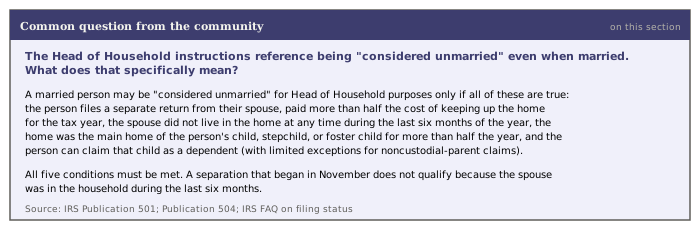
- Year-of-divorce decisions. People going through divorce sometimes have flexibility about when the divorce finalizes (within reason), which affects filing status. If you're divorced or separated by year-end, you can't file jointly. If you're still married on December 31 but separated, you have flexibility. If you have children, HOH may be available even while technically married if you lived apart for the last six months of the year — this is the "considered unmarried" rule covered in the callout above.
- Year-of-marriage decisions. If you got married during the tax year, you can file jointly for that entire year (you're considered married as of December 31). For most newlyweds this saves money. The "marriage penalty" or "marriage bonus" depends on the income distribution between spouses — couples where one earns substantially more than the other usually get a marriage bonus; couples with similar incomes sometimes face a marriage penalty.
The Digital Assets Question (Blue Highlight)
In recent years, the IRS added a question at the top of Form 1040 asking whether you received, sold, or exchanged digital assets (cryptocurrency, NFTs, and similar) during the year. This question is in a prominent position because the IRS specifically wants to confirm that taxpayers acknowledge their digital asset activity.
- You answer "Yes" if: you received cryptocurrency or other digital assets as payment for goods or services, sold digital assets, exchanged one digital asset for another (Bitcoin for Ethereum, for example), received digital assets from mining or staking, received digital assets through an airdrop, or otherwise disposed of digital assets.
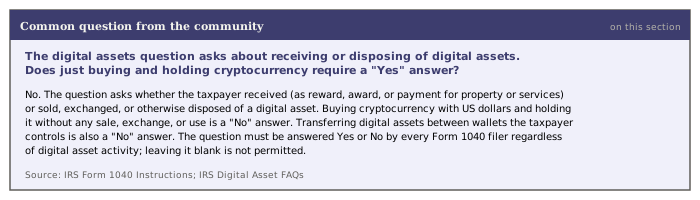
- You answer "No" if: you only held digital assets you previously acquired, transferred digital assets between your own wallets (no sale or exchange), or had no digital asset activity at all.
The "Yes" answer doesn't automatically mean you owe taxes — many digital asset activities are taxable events but specific facts determine the actual tax. The "Yes" answer alerts the IRS that you need to report the activity elsewhere on the return (typically Schedule D for sales, Schedule 1 for income from mining or airdrops). Answering "No" when the correct answer is "Yes" is considered serious because it suggests intentional concealment.
The Standard Deduction Qualifying Questions (Green Highlight)
Below the digital assets question is a series of checkboxes about whether you can be claimed as a dependent, whether you're blind, and whether you were born before a certain date (which qualifies you as a senior for tax purposes). These boxes affect your standard deduction amount.
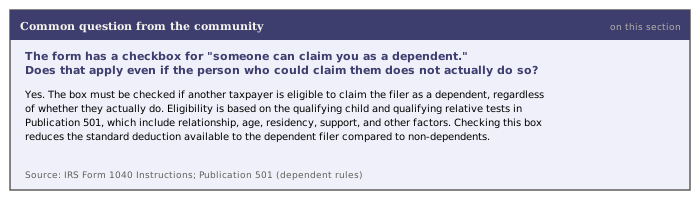
- "Someone can claim you as a dependent." Check this if someone else (typically a parent) can claim you on their return as a dependent. This applies even if they don't actually claim you — what matters is whether they're eligible to. If you're a college student receiving substantial support from your parents, you probably need to check this box. The implication: your standard deduction is reduced compared to non-dependents.
- "Someone can claim your spouse as a dependent." Rare situation, applies if you're filing jointly and someone could claim your spouse as a dependent. Almost never applies in practice.
- "Spouse itemizes on a separate return or you were a dual-status alien." This applies if you're filing MFS and your spouse is itemizing, in which case you must also itemize (you can't take the standard deduction). Or if you had dual-status alien status during the year (some part of the year as a nonresident alien).
- Age/Blindness checkboxes. If you were born before January 2 of a specific year (the year changes annually — it's currently anyone 65 or older at year-end), you check the box. If you're legally blind, you check the box. Each box adds to your standard deduction. If both apply, you check both boxes. For married couples, similar boxes apply for the spouse.
Career Path Applications for the Personal Information and Filing Status Section
Different career situations interact with this section differently.
- W-2 employees typically have straightforward situations for this section. The information matches their tax records, the filing status is whatever their personal situation dictates, and they answer "No" on digital assets unless they specifically dabbled in crypto. The optimization opportunities are mainly in choosing the right filing status given personal circumstances.
- Self-employed people and gig workers have the same personal information section but should pay attention to filing status decisions because they have more flexibility in some respects (more deductions available regardless of filing status, more careful planning around income recognition) and more potential complications in others (state tax implications of business locations).
- Recently married couples have the most consequential decision in their first joint filing. They should specifically calculate both MFJ and MFS to see which produces the lower total tax. In most cases MFJ wins, but the calculation is worth doing once for the first joint return.
- Divorced or separating couples need to understand the filing status rules carefully. The HOH "considered unmarried" provision allows higher tax efficiency for the spouse who maintains the family home with the children. Coordination between separating spouses on filing decisions can save substantial money for one or both parties.
- Single parents should specifically check HOH eligibility. Many single parents file as Single because they don't realize HOH is available to them. The difference in tax liability can be substantial.
- Recently widowed people with dependent children should specifically claim Qualifying Surviving Spouse status for the two years it's available. This preserves MFJ-equivalent tax treatment during the difficult years immediately after a spouse's death.
- International workers may need ITINs rather than SSNs, may have specific issues around the address section if they live abroad, and may face dual-status alien situations that affect the standard deduction qualifying questions.
- Cryptocurrency-active people in any career need to carefully consider the digital assets question. The "Yes" answer must be made if any of the listed activities occurred, regardless of whether the activity resulted in taxable income.
Common Mistakes in This Section
- Wrong SSN or name spelling. The most common error that causes e-file rejections. Always copy from official documents rather than memory.
- Wrong filing status for the situation. Many people file Single when they qualify for HOH. Others file MFJ when MFS would actually save money in their specific situation. Others file HOH when they don't actually meet the qualifying tests. Take this decision seriously.
- Spouse information on wrong filing status. If you're filing Single or HOH, leave spouse fields blank. If you're filing MFS, you still need spouse's SSN even though they're filing separately.
- Wrong address. Using a prior address that you no longer live at causes the IRS to send correspondence somewhere you won't receive it. Always use current address.
- Skipping the digital assets question. This is a required question. You must answer Yes or No, not leave it blank. Leaving it blank can cause processing delays.
- Forgetting dependent or age checkboxes. The standard deduction qualifying questions affect your tax. Missing the age checkbox when you're over 65 means you're paying tax on more income than necessary.
Optimization Opportunities in This Section
The main optimization opportunity is filing status selection. Specifically:
- Run the calculations. If you have any uncertainty about filing status — between MFJ and MFS for married couples, between Single and HOH for unmarried people with dependents — calculate your tax under both options. Tax software makes this easy. The difference is often hundreds or thousands of dollars.
- Check HOH eligibility if you're unmarried with dependents. Many people miss this opportunity. Read IRS Publication 501 carefully or consult a tax preparer.
- Plan year-end events that affect filing status. Marriages, divorces, and the timing of dependents leaving home can affect filing status. If you're in a position to influence the timing of these events, the tax implications might inform the decision (or might be entirely outweighed by personal factors — but the tax implications are worth knowing).
- For widowed people, claim QSS for the two years available. Then transition to HOH if you have dependents, or Single if you don't.
Connection to Other Sections
The filing status you choose at the top of the form affects the tax bracket table you use later, the standard deduction amount applied later, and the income thresholds for various credits and deductions throughout the rest of the form. Filing status is the variable that affects more downstream calculations than any other answer on the return.
The personal information you provide also determines whose income gets included (your income only, or both spouses' income on a joint return) and which dependents get listed on the dependents section that comes next.
What to Gather Before Filing This Section
- Your Social Security card (or other documentation showing your exact SSN)
- Your spouse's Social Security card if filing jointly or MFS
- Your current address
- Documentation of any name changes since your last filing
- If you're claiming HOH, documentation that you paid more than half the household expenses and that your qualifying dependent lived with you more than half the year
- If you have any digital asset activity, records of those transactions for the Yes/No question and for the eventual reporting elsewhere on the return
Key Takeaways
- Your marital status on December 31 determines your filing status for the entire year — a marriage or divorce on December 30 changes your filing status for the entire year
- Filing status determines your tax brackets, standard deduction amount, and eligibility for most credits — it's the single most consequential decision on the return
- Head of Household has better tax treatment than Single — unmarried people with qualifying dependents who paid more than half household expenses should verify they qualify using IRS Publication 501
- Married couples should calculate tax both ways (MFJ and MFS) when one spouse has substantial medical expenses, student loan repayment concerns, or separate tax liability issues
- The digital assets question targets transactions — selling, exchanging, receiving as payment, mining, or airdrops — not simply holding cryptocurrency
- Standard deduction qualifying questions (dependent status, age, blindness) directly affect your standard deduction amount — check them accurately
Quiz — 5 Questions
Answer one at a timeYou got married on December 29. What are your filing status options for that tax year?