Other Taxes (Schedule 2)
The additional taxes added on top of regular income tax — self-employment tax, NIIT, Additional Medicare Tax, and more
- Understand how Schedule 2 adds additional taxes to regular income tax on Form 1040
- Identify which Schedule 2 items apply to your situation
- Calculate self-employment tax and understand the half-deduction
- Know the thresholds for Additional Medicare Tax and Net Investment Income Tax
- Handle early retirement distribution penalties and exceptions correctly
Introduction
After the credits in Lesson 7 reduce your regular income tax, the next operation is adding any additional taxes you owe. These additional taxes come from Schedule 2 and flow to Form 1040 lines 17 (Part I additional taxes) and 23 (Part II other taxes). These taxes are separate from the regular income tax calculated on line 16 — they're added on top.
Most filers don't need Schedule 2 at all. If you're a W-2 employee with no self-employment income, no early retirement withdrawals, no Premium Tax Credit reconciliation, no AMT, no nanny tax, no Additional Medicare Tax, and no Net Investment Income Tax, you skip Schedule 2 entirely. But for filers with any of these specific situations, Schedule 2 captures taxes that don't fit into the regular bracket calculation.
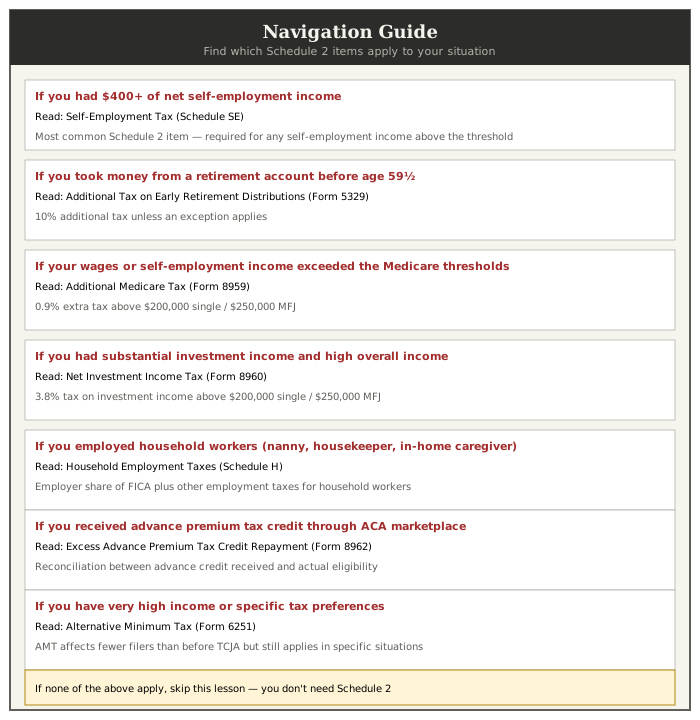
This lesson covers the major Schedule 2 items, organized so readers can skip to what applies to their situation. The most common items are self-employment tax (for anyone with $400+ of net self-employment income), additional Medicare tax (for high earners), and the early withdrawal penalty on retirement accounts (for anyone who took an early distribution).
Navigation guide — which Schedule 2 items apply to your situation
How Schedule 2 fits into Form 1040
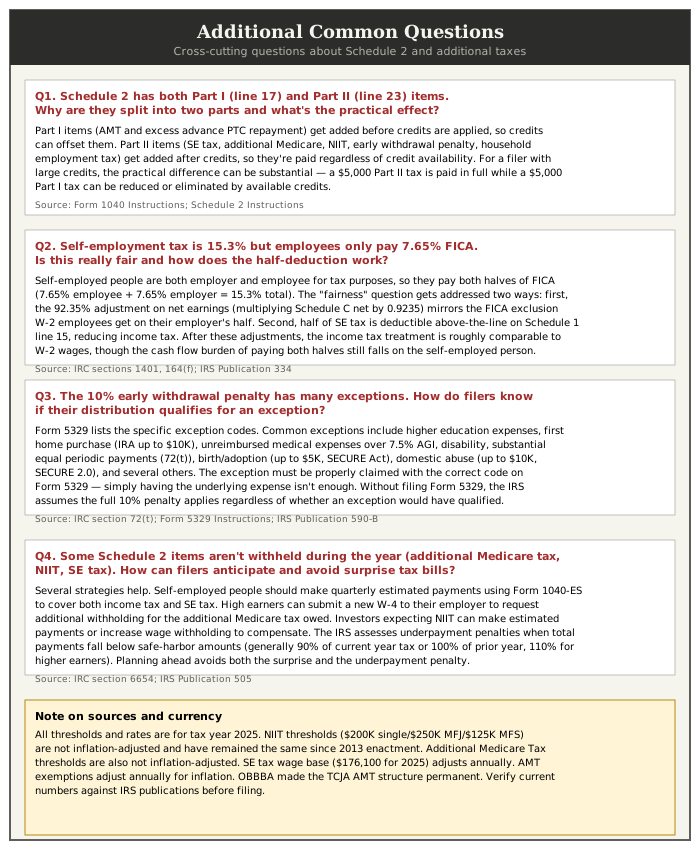
Schedule 2 has two parts. Part I (lines 1-3) covers Alternative Minimum Tax and excess advance Premium Tax Credit repayment, which together flow to Form 1040 line 17 (added to regular income tax before credits are applied). Part II (lines 4-21) covers all the other additional taxes, summing to a total that flows to Form 1040 line 23 (added after credits are applied).
Part I items get added before credits, so credits can offset them. Part II items get added after credits, meaning credits don't reduce them — you pay these regardless of credit availability.
After Schedule 2 items are added on lines 17 and 23, Form 1040 line 24 gives your total tax liability. From there, your payments (withholding, estimated taxes, refundable credits) get subtracted to determine refund or amount owed.
Additional Medicare Tax (Form 8959)
Read this if your wages, self-employment income, or combined household income exceeded specific thresholds.
What this tax is. A 0.9% additional Medicare tax on wages and self-employment income above specific thresholds. This is separate from and in addition to the regular Medicare tax (1.45% on wages, 2.9% on self-employment income).
Thresholds for 2025. $200,000 for single, HOH, and QSS filers. $250,000 for MFJ filers. $125,000 for MFS filers. These thresholds are not inflation-adjusted and have remained the same since enactment.
Employers automatically withhold the 0.9% tax on wages above $200,000 paid by a single employer. But employers don't know about your spouse's income or your other jobs. A couple where each spouse earns $150,000 has combined income of $300,000 — owing additional Medicare tax on $50,000 — but neither employer withheld it (because each individual was below $200,000). The couple owes the tax at filing time without anyone having withheld it during the year.
How to calculate. Form 8959 walks through the calculation in three parts: (1) additional Medicare tax on wages above the threshold, (2) additional Medicare tax on self-employment income above the threshold (after coordinating with wages), and (3) additional Medicare tax on RRTA compensation if applicable. The total flows to Schedule 2 line 11 and ultimately to Form 1040 line 23.
Decision points. If you and your spouse have combined wage income near or above $250,000, anticipate the additional Medicare tax at filing time. Consider increasing withholding or making estimated payments to avoid an unexpected balance due.
Sourcing. IRC section 3101(b)(2); Form 8959 Instructions; IRS Publication 17.
All W-2s (for wage amounts). Schedule SE if you have self-employment income. Documentation of any additional Medicare tax already withheld.
Alternative Minimum Tax (AMT) — Form 6251
Read this if you have high income, substantial itemized deductions, or specific tax preferences that historically triggered AMT.
What AMT is. A parallel tax system designed to ensure high-income filers pay at least a minimum amount of tax even with substantial deductions. AMT calculates an alternative taxable income (adding back certain deductions and preferences), applies different rates (26% or 28%), and compares to regular tax. You pay the higher of the two.
Who's affected. TCJA dramatically reduced AMT exposure by raising exemption amounts and phase-out thresholds. For 2025, the AMT exemption is approximately $88,100 for single/HOH and $137,000 for MFJ, phasing out at high income levels. Most filers below approximately $500,000-$1,000,000 of income don't pay AMT post-TCJA. OBBBA made the TCJA AMT structure permanent.
Common AMT triggers. Large state and local tax deductions (now somewhat moot given the SALT cap). Incentive Stock Option (ISO) exercises. Long-term capital gains pushing total income over the AMT exemption phase-out. Large miscellaneous itemized deductions (now mostly eliminated by TCJA/OBBBA).
How to calculate. Form 6251 calculates AMT. If AMT exceeds regular tax, the difference goes on Schedule 2 line 1 and flows to Form 1040 line 17.
Why it's worth checking. Even though fewer filers are affected post-TCJA, AMT can still apply in specific situations. Tax software calculates AMT automatically and tells you if you owe it.
Sourcing. IRC sections 55-59; Form 6251 Instructions; IRS Publication 17.
Your full Form 1040 and Schedule A. Records of any ISO exercises during the year. Records of any items the IRS instructions identify as AMT preferences.
Early Retirement Distribution Penalty (Form 5329)
Read this if you took money out of a retirement account before age 59½.
What this penalty is. A 10% additional tax on early distributions from retirement accounts. The 10% is on top of the regular income tax that applies to the distribution (covered in the IRA Distributions section of Lesson 3).
Which accounts. Traditional IRAs, Roth IRA earnings (Roth contributions can come out without penalty), 401(k), 403(b), 457(b), SEP, SIMPLE, and most other retirement accounts.
Exceptions that avoid the 10% penalty. Quite a few exceptions exist:
- Distributions used for higher education expenses
- First-time home purchase up to $10,000 lifetime (IRA only)
- Substantial unreimbursed medical expenses
- Distributions due to total and permanent disability
- Distributions to beneficiaries after death of the account owner
- Substantially equal periodic payments under section 72(t)
- Distributions during specific federally declared disasters
- Birth or adoption of a child up to $5,000 (SECURE Act)
- Domestic abuse victim distributions up to $10,000 (SECURE 2.0)
- Various other specific exceptions
How to claim an exception. Form 5329 has a list of exception codes. You enter the code corresponding to your exception, and the form calculates the penalty (or lack thereof) accordingly. Without filing Form 5329 or with the wrong code, the 10% penalty applies even if you qualified for an exception.
Box 7 distribution codes. Your 1099-R Box 7 distribution code tells you what kind of distribution this was. Code 1 is "Early distribution, no known exception" — the broker withholds the 10% by default. Code 2 is "Early distribution, exception applies" — usually used for SEPP distributions. Code 7 is "Normal distribution" (over 59½). The codes affect whether Form 5329 is required and how it's completed.
How it flows. The penalty calculated on Form 5329 goes to Schedule 2 line 8 and to Form 1040 line 23.
Sourcing. IRC section 72(t); Form 5329 Instructions; IRS Publication 590-B.
Form 1099-R for the distribution. Documentation supporting any exception (medical bills, education expenses, etc.). Form 5329 to calculate the penalty or claim an exception.
Excess Advance Premium Tax Credit Repayment (Form 8962)
Read this if you got health insurance through the ACA Marketplace and received advance premium tax credit payments.
What this is. The Affordable Care Act provides Premium Tax Credits to help eligible filers afford Marketplace health insurance. The credit can be paid in advance directly to the insurance company (reducing your monthly premiums) or claimed at filing time on your tax return. Either way, the credit gets reconciled on Form 8962 against your actual eligibility based on actual annual income.
The reconciliation. If your actual income for the year was higher than estimated when you signed up for coverage, you received more advance credit than you were entitled to. The excess gets repaid on Schedule 2 line 1a (Part I). If your actual income was lower than estimated, you may be entitled to additional credit, which gets claimed on Schedule 3 line 9 as a credit.
Estimating income for the upcoming year is hard. If your income went up unexpectedly (got a raise, finished a freelance project, sold investments), you may face a substantial repayment at filing time. Repayment caps apply at lower income levels but not above 400% of the federal poverty line.
Form 1095-A. Your Marketplace sends Form 1095-A in January reporting your monthly premium amounts and any advance credit paid on your behalf. You need this form to complete Form 8962.
How to claim or repay. Form 8962 calculates the reconciliation. The result either adds to tax (excess advance) or adds to credits (additional credit due).
Sourcing. IRC section 36B; Form 8962 Instructions; IRS Publication 974.
Form 1095-A from the Health Insurance Marketplace. Records of any changes in income, family size, or coverage during the year.
Household Employment Taxes (Schedule H)
Read this if you employed household workers like a nanny, housekeeper, in-home caregiver, or gardener.
What this is. If you employ someone in your home and pay them above certain thresholds, you're responsible for federal employment taxes — the employer's portion of Social Security and Medicare, federal unemployment tax (FUTA), and potentially federal income tax withholding (if the worker requested it).
Thresholds for 2025. You owe Social Security and Medicare taxes if you paid the worker $2,700 or more during the year. You owe FUTA if you paid $1,000 or more in any quarter during the year. Lower thresholds may apply for spouses, parents, or children under 21 who are employees.
Employer share. Social Security and Medicare combined is 15.3% (7.65% each for employer and employee). Many household employers cover both the employee and employer portions, making the effective cost 15.3% of wages.
FUTA. Federal unemployment tax of 6.0% on the first $7,000 of wages (offset by state unemployment payments — net federal portion is usually 0.6%).
State requirements. State unemployment and disability insurance vary by state. Many states have their own requirements that go alongside the federal.
How to file. Schedule H reports the household employment taxes. The total flows to Schedule 2 line 9 and to Form 1040 line 23.
Many people who hire household workers don't realize they have employment tax obligations. The "nanny tax" is the colloquial term for this. Properly handling household employment taxes also helps the worker because they get credit for Social Security and Medicare contributions toward future benefits.
Sourcing. IRS Publication 926 (Household Employer's Tax Guide); Schedule H Instructions; IRC sections 3101, 3111, 3301.
Records of all wages paid to household employees during the year. Documentation of any state and federal employment tax payments made during the year.
Net Investment Income Tax (Form 8960)
Read this if you have substantial investment income and your income exceeds the NIIT thresholds.
What this tax is. A 3.8% tax on certain investment income for filers above specific income thresholds. The tax is in addition to regular income tax on the same investment income.
Income thresholds for 2025. $200,000 for single, HOH, and QSS filers. $250,000 for MFJ. $125,000 for MFS. These thresholds are not inflation-adjusted and have remained the same since the tax was enacted in 2013.
What income is subject to NIIT. Interest, dividends, capital gains (including those from mutual funds and ETFs), rental and royalty income (in most cases), passive business income, and non-qualified annuity income. Wages, self-employment income, retirement distributions, Social Security benefits, and tax-exempt interest are NOT subject to NIIT.
How it works. NIIT is 3.8% of the lesser of (a) your net investment income or (b) the excess of your modified AGI over the threshold. So a single filer with MAGI of $250,000 and $30,000 of investment income owes 3.8% × $30,000 = $1,140 (because the $50,000 of MAGI above the $200,000 threshold exceeds the $30,000 of investment income).
Effective rate on capital gains. For NIIT-subject filers, qualified dividends and LTCG face an effective federal rate of 18.8% (15% + 3.8%) or 23.8% (20% + 3.8%) instead of just the headline preferential rates.
How to calculate. Form 8960 walks through the calculation. The result goes to Schedule 2 line 12 and Form 1040 line 23.
Decision points. Investment timing strategies can sometimes spread investment income across years to stay below NIIT thresholds. Tax-loss harvesting can reduce net investment income subject to NIIT. Tax-advantaged accounts (IRAs, 401(k)s) don't generate NIIT because the income inside them isn't reported until distribution.
Sourcing. IRC section 1411; Form 8960 Instructions; IRS Publication 550.
All 1099-INT, 1099-DIV, 1099-B forms. Schedule E if you have rental or royalty income. Documentation of any passive business income.
Self-Employment Tax (Schedule SE)
Read this if you had $400 or more of net self-employment income during the year.
What this tax is. Self-employed people pay both the employer and employee portions of Social Security and Medicare taxes, totaling 15.3% on net self-employment earnings. This is in addition to regular income tax on the same income.
Why this exists. W-2 employees have FICA taxes split with their employer — employee pays 7.65% and employer pays 7.65%. Self-employed people are both employer and employee for tax purposes, so they pay both halves.
The 15.3% breakdown. 12.4% Social Security (on net SE earnings up to the wage base — $176,100 for 2025). Plus 2.9% Medicare (on all net SE earnings, no cap). Plus 0.9% Additional Medicare Tax on net SE earnings above the relevant threshold.
Net earnings calculation. Take your Schedule C (or Schedule F, or partnership K-1) net income. Multiply by 0.9235 (this is the 92.35% adjustment that mirrors the FICA exclusion W-2 employees get on their employer's half). The result is your net earnings subject to SE tax.
How to calculate. Schedule SE walks through the calculation. The SE tax goes to Schedule 2 line 4 and Form 1040 line 23.
The half-deduction. Half of your SE tax is deductible as an adjustment to income on Schedule 1 line 15 (covered in Lesson 4). This offsets the income tax effect of the "employer half" of SE tax.
Coordination with W-2 wages. If you have both W-2 wages and self-employment income, your W-2 Social Security wages reduce the wage base available for SE tax. If you maxed out Social Security through W-2 wages, you only owe the Medicare portion (2.9% plus 0.9% Additional Medicare Tax if applicable) on your SE income.
Quarterly estimated payments. Self-employed people typically need to make quarterly estimated tax payments (Form 1040-ES) to cover both income tax and SE tax on their business income, since no employer withholding occurs.
Sourcing. IRC section 1401; Schedule SE Instructions; IRS Publication 334.
Schedule C (or Schedule F) showing net business income. K-1 if you have partnership income. W-2s for the coordination calculation if you also have wage income.
Other Schedule 2 items (less common)
Schedule 2 has additional lines for less common situations:
- Line 5 — Social Security and Medicare tax on unreported tips (Form 4137). For workers who received tips of $20 or more in a month but didn't report all of them to their employer. The employee owes the Social Security and Medicare tax on the unreported tips.
- Line 6 — Uncollected Social Security and Medicare tax on wages (Form 8919). For workers whose employer incorrectly classified them as independent contractors (no FICA withholding) when they should have been employees. The worker reports the wages and the uncollected FICA on Form 8919, which feeds into Schedule 2.
- Line 13 — Section 965 net tax liability. Reserved for very specific international tax situations affecting certain shareholders of foreign corporations.
- Line 17 and 18 — Various other situations including recapture of certain credits, first-time homebuyer credit repayment, additional tax on Health Savings Accounts (Form 8889 if non-qualified withdrawals), and others.
- Line 21 — Total other taxes. Sums Part II and flows to Form 1040 line 23.
Career path applications for Schedule 2
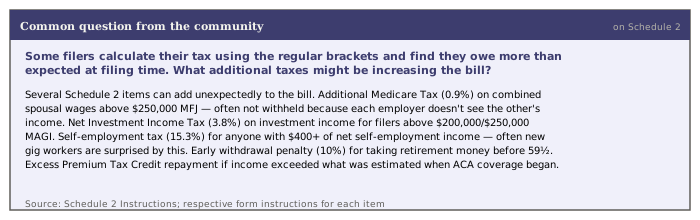
Self-employed people and gig workers almost always need Schedule 2 because they owe self-employment tax. This is the single most common Schedule 2 item. New gig workers are often surprised by the 15.3% additional tax on their net income beyond regular income tax.
High-earning couples often face additional Medicare tax that wasn't withheld during the year because each spouse's employer didn't know about the other spouse's income.
Investors with substantial portfolios above income thresholds face NIIT on their investment income. Tax-loss harvesting and tax-advantaged accounts can reduce this burden.
Anyone taking early retirement distributions needs Form 5329 to either claim the penalty or claim an exception. Without proper handling, the IRS assumes the penalty applies.
Families with household workers need Schedule H. Many people don't realize they have these obligations until faced with consequences (the worker filing for unemployment, IRS audit, etc.).
ACA Marketplace enrollees need Form 8962 to reconcile the advance Premium Tax Credit. Income changes during the year — even positive ones like raises — can produce repayment obligations.
Workers misclassified as independent contractors can use Form 8919 to recharacterize the income and only pay the employee half of FICA (rather than the full 15.3% SE tax). Form SS-8 is the formal mechanism for asking the IRS to determine worker status.
Common mistakes in this section
Self-employed people not paying estimated taxes. Without W-2 withholding, self-employed people often owe substantial tax (income plus SE tax) at filing time. The IRS expects quarterly estimated payments throughout the year and assesses underpayment penalties for not making them.
Missing the Additional Medicare Tax owed by working couples. Each spouse's employer doesn't know about the other's income. The tax is owed at filing time even though neither paycheck had it withheld.
Not claiming early withdrawal exceptions. Form 5329 needs to be filed to claim exceptions to the 10% penalty. Without it, the IRS assesses the full penalty even when an exception applies.
Missing the AMT calculation. Tax software handles AMT automatically but paper filers should verify whether AMT applies, especially for filers with substantial preferences.
Ignoring Form 8962 reconciliation. ACA Marketplace enrollees must file Form 8962 to reconcile advance Premium Tax Credit. Missing it can trigger IRS notices and credit losses.
Underreporting household employment. People who pay household workers more than the threshold but don't report Schedule H are exposed to substantial penalties if discovered.
Optimization opportunities
Make estimated tax payments if you have substantial Schedule 2 items. Self-employed people, high earners owing additional Medicare tax, and investors owing NIIT should make quarterly estimated payments to avoid balance-due surprises and underpayment penalties.
Time investment income to manage NIIT. If your MAGI is near the NIIT thresholds, spreading capital gains realization across multiple years can keep more income below the threshold and reduce or eliminate NIIT in each year.
Use tax-advantaged accounts to shelter investment income from NIIT. Income inside IRAs, 401(k)s, HSAs, and 529 plans doesn't generate NIIT. Maximizing contributions to these accounts shifts income from NIIT-subject to NIIT-exempt status.
Claim Form 5329 exceptions for early withdrawals. If you took an early retirement distribution but qualify for an exception, file Form 5329 with the proper exception code. Don't accept the 10% penalty without checking the exception list.
Reconcile ACA Premium Tax Credit early. If your income changed during the year, contact the Marketplace to update your income estimate. This can reduce the advance credit you receive and prevent a large repayment at filing time.
Get household employment right from the start. If you employ household workers above the thresholds, set up proper withholding and reporting from day one. Trying to catch up retroactively is messy and exposes you to penalties.
Connection to other sections
Schedule 2 items add to your tax liability after the regular tax calculation on Form 1040 line 16 (Lesson 6) and after credits on lines 19-22 (Lesson 7). The Part I items on Schedule 2 are added before credits; the Part II items are added after credits. The result on Form 1040 line 24 is your total tax liability for the year.
After total tax on line 24, the payments section captures all the tax payments you made during the year (withholding, estimated payments, refundable credits). The difference between total tax and total payments determines whether you get a refund or owe a balance — covered in the next lesson.
The income types from Lesson 3 drive several Schedule 2 items. Self-employment income drives SE tax. Investment income drives NIIT. Wages drive additional Medicare tax. Early retirement distributions drive the 10% penalty. Each income type can have downstream Schedule 2 implications.
What to gather for Schedule 2
Depending on which items apply:
- Schedule SE (for self-employment tax — calculated from Schedule C net income).
- Form 8959 (for additional Medicare tax).
- Form 8960 (for NIIT).
- Form 5329 (for early withdrawal penalty or exception).
- Schedule H (for household employment taxes).
- Form 8962 (for ACA Premium Tax Credit reconciliation, requires Form 1095-A).
- Form 6251 (for AMT calculation).
For most filers without these specific situations, no Schedule 2 documents are needed because Schedule 2 itself isn't required.
Key Takeaways
- Schedule 2 adds additional taxes on top of regular income tax — Part I items (AMT, excess advance PTC) are added before credits on line 17; Part II items (SE tax, NIIT, Medicare tax, etc.) are added after credits on line 23.
- Self-employment tax is 15.3% of net SE earnings (12.4% Social Security up to the wage base + 2.9% Medicare on all earnings) — the most common Schedule 2 item, affecting anyone with $400+ of net self-employment income.
- The 0.9% Additional Medicare Tax applies to combined household wages and SE income above $250,000 (MFJ) — often not withheld during the year because employers don't know about a spouse's income.
- NIIT is 3.8% on net investment income (interest, dividends, capital gains, rental income) for filers with MAGI above $200,000 single / $250,000 MFJ — making effective capital gains rates 18.8% or 23.8% for affected filers.
- The 10% early retirement distribution penalty has numerous exceptions — always check Form 5329 exception codes before paying the penalty, as it doesn't apply automatically if an exception applies.
- Most filers skip Schedule 2 entirely — only relevant for self-employed people, high earners, investors, ACA Marketplace enrollees, household employers, and early retirement account distributors.
Quiz — 5 Questions
Answer one at a timeA married couple each earns $160,000 in wages. Neither employer withheld the 0.9% Additional Medicare Tax. How much Additional Medicare Tax do they owe at filing?