Form 1040 — Income Section (Lines 1 Through 9)
All eight income types on Form 1040 in one place — alphabetically organized so you read only the subsections that apply to your situation.
- Use the navigation guide to identify which income subsections apply to your situation
- Read your W-2 box by box, understanding how pretax deductions reduce Box 1 and how withholding flows to Form 1040
- Report capital gains and losses from Form 1099-B through Schedule D to Form 1040 line 7
- Apply the provisional income calculation to determine what percentage of Social Security benefits is taxable
- Identify the new OBBBA qualified tip and overtime deductions and what records to gather for 2025
- Compile all information returns needed for each income type you received during the year
Introduction
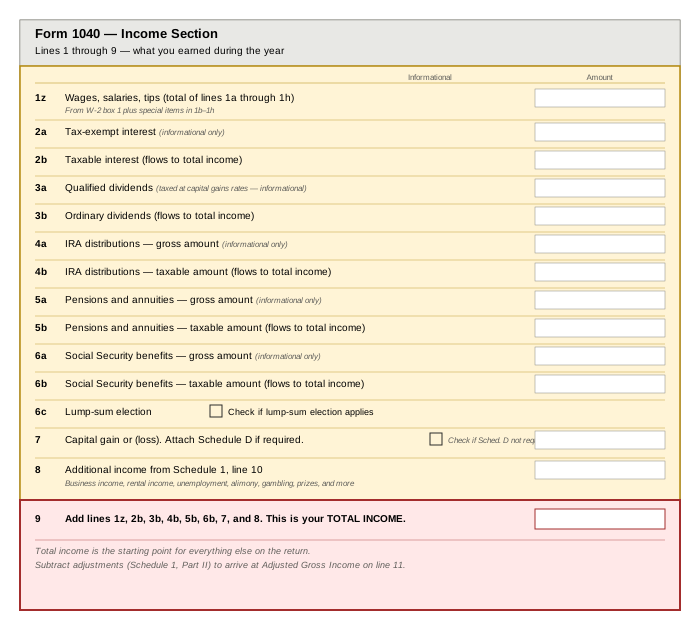
The income section of Form 1040 is where you report what you earned during the tax year. It runs from line 1 (wages) through line 8 (additional income from Schedule 1), then sums everything on line 9 (total income). Almost every reader will have at least one income type to report; many readers will have multiple income types from different sources. This lesson covers all of the income types in one place so you can find what applies to your situation without hunting through multiple lessons.
The lesson is organized alphabetically by income type after the introduction and form overview. The navigation guide immediately below tells you which subsections to read based on your situation. You don't need to read the whole lesson — just the subsections that match the income types you actually received during the tax year. The W-2 employee with no investments only needs to read the Wages subsection. The retiree receiving Social Security, pension payments, and IRA distributions reads three subsections. The self-employed person reads Other Income (Schedule 1) plus any other types they received.
Each income type subsection follows a consistent mini-structure: what this income type is, what form reports it to you, how to read that form, how it flows to Form 1040, decision points specific to this income type, common confusion points, and what to gather. Career-path-specific guidance is woven into each subsection where relevant rather than concentrated in one place, because different career paths interact with different income types.
How the Income Section Works as a Whole
Before getting into specific income types, a few orienting points about the income section as a whole.
The income section reports what you earned during the calendar year (January 1 through December 31 for most filers). The cutoff is the date you received the income, not the date you earned it. A paycheck dated January 3, 2026 for work performed in December 2025 is 2026 income, not 2025, because the IRS uses the "constructive receipt" rule — income is yours when you have the right to receive it, generally when it's paid.
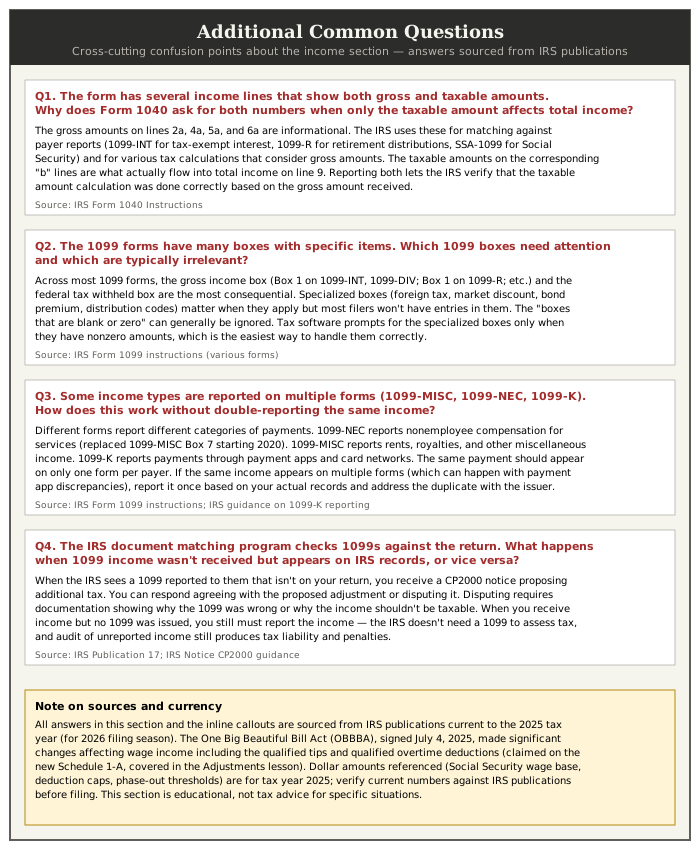
Each income type has its own line or sub-line on Form 1040. The form generally separates gross amounts from taxable amounts for income types where the two differ. Lines 4a, 5a, and 6a show gross amounts (informational); lines 4b, 5b, and 6b show the taxable portions that actually flow into total income. The reason for showing both is to give the IRS visibility into the gross income even when only part of it is taxable, which helps with audit matching against the forms your payers sent.
Total income on line 9 is the sum of all your income before any adjustments or deductions. Line 9 doesn't yet account for your retirement contributions, HSA contributions, student loan interest, or any of the other adjustments — those come on line 10 and produce Adjusted Gross Income on line 11. Adjustments get their own lesson because they're a fundamentally different operation than reporting income.
The income section is where the IRS does its most aggressive document matching. Every 1099, W-2, and similar information return you receive also gets sent to the IRS by the payer. The IRS computers match these against your return. If you forget to include a 1099-INT for interest income, the IRS knows about that income and will send you a notice. Document matching is one of the most common IRS enforcement actions and one of the easiest to avoid by simply including all your income.
Now into the alphabetical income subsections.
Capital Gains and Losses
Read this subsection if you sold investments (stocks, mutual funds, ETFs, cryptocurrency), real estate other than your primary residence, collectibles, or other capital assets during the year.
Capital gains and losses arrive on Form 1040 line 7. The actual calculation happens on Schedule D and Form 8949, and the supporting documentation arrives as 1099-B from your broker (or 1099-DA for cryptocurrency starting 2025).
What capital gains and losses are. When you sell a capital asset for more than you paid for it (your "basis"), you have a capital gain. When you sell for less, you have a capital loss. The gain or loss equals your sale proceeds minus your basis. Capital assets include most things you own for personal use or investment — stocks, bonds, mutual funds, ETFs, cryptocurrency, real estate, collectibles, and so on. Property used in a trade or business has different rules.
Short-term versus long-term. Holding period matters substantially. Assets you held for one year or less produce short-term capital gains, taxed at your ordinary income tax rates. Assets you held for more than one year produce long-term capital gains, taxed at preferential rates (0%, 15%, or 20% depending on your income). The difference can be substantial. For someone in the 24% federal bracket, a $10,000 short-term gain produces $2,400 of federal tax while the same $10,000 long-term gain might produce $1,500 (at 15%) or even $0 (at 0% if total income is low enough).
What forms report this. Your broker sends Form 1099-B (Proceeds from Broker and Barter Exchange Transactions) reporting each sale during the year. For cryptocurrency transactions starting with tax year 2025, brokers send Form 1099-DA. The 1099-B shows the date sold, sale proceeds, cost basis (in most cases), and whether the holding period was short-term or long-term. The broker also reports the same information to the IRS.
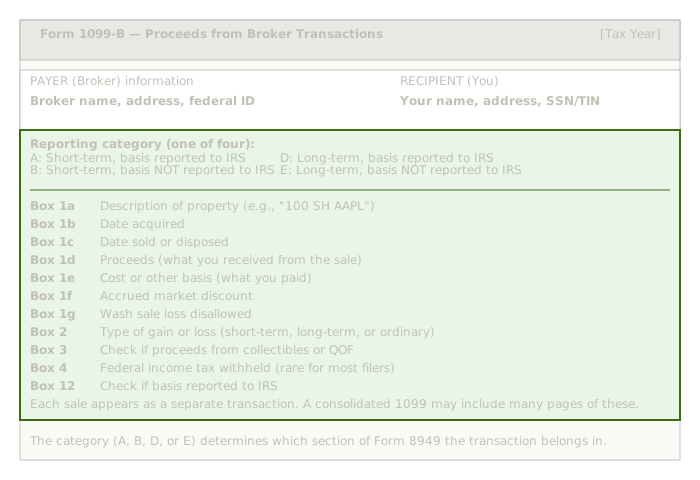
How to read your 1099-B. The form lists each sale separately. The most consequential boxes are Box 1d (proceeds — what you received from the sale), Box 1e (cost basis — what you paid for it), and Box 2 (type of gain or loss). The difference between Box 1d and Box 1e is your gain or loss for that sale. Box 12 tells you whether basis was reported to the IRS, which determines which section of Form 8949 the sale goes in.
Brokers often send consolidated 1099 statements that include 1099-B alongside 1099-DIV and 1099-INT. Inside the consolidated statement, the 1099-B section is typically grouped into the four categories (A, B, D, E) with subtotals for each. Some statements also include "supplemental information" — entries like wash sale adjustments and disallowed losses that need attention.
How it flows to Form 1040. Each sale gets listed on Form 8949 in the appropriate section (A through F). The totals from Form 8949 flow to Schedule D. Schedule D combines all your short-term gains and losses into one net amount, all your long-term gains and losses into another, and produces a net capital gain or loss. The net amount flows to Form 1040 line 7. If you have a net capital loss, you can deduct up to $3,000 against ordinary income per year ($1,500 if MFS) and carry the excess forward to future years.
Decision points specific to capital gains.
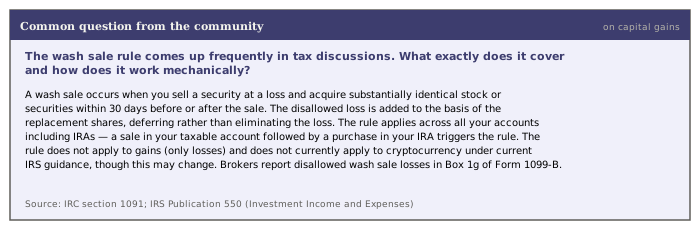
- Whether to harvest gains or losses at year-end. If you have unrealized gains in your portfolio and you're in the 0% long-term capital gains bracket (income low enough to qualify), selling and immediately rebuying can permanently eliminate the tax on those gains. Conversely, if you have unrealized losses and other gains for the year, selling to realize the losses can offset the gains. The wash sale rule prevents claiming a loss if you buy the same or substantially identical security within 30 days before or after the loss sale.
- How to specify which lots get sold when you hold multiple lots of the same security. The default for most brokers is FIFO (first in, first out), which sells your oldest lots first. You can often specify other methods like highest in, first out (HIFO) which sells the highest-basis lots first and minimizes the gain. The choice should be made at or before sale, not after, and proper specification documentation should be kept.
- Whether to use the qualified dividend / capital gains worksheet or the Schedule D Tax Worksheet. The IRS provides different worksheets to calculate tax depending on your specific situation. Tax software handles this automatically; paper filers need to follow the instructions carefully.
Career path applications. Investors at all career stages encounter capital gains when they sell from taxable brokerage accounts. Retirees often have substantial taxable account holdings and may use capital gain harvesting strategies in years with lower other income. Self-employed people who sold business assets may have capital gains from the sale of equipment, vehicles, or other business property (some of which goes on Form 4797 rather than Schedule D). Real estate investors selling properties have capital gains plus depreciation recapture, which has special rules. Cryptocurrency traders have particularly complex tracking requirements because every crypto-to-crypto exchange is a taxable event, not just crypto-to-dollar conversions.
Common confusion points.
- The wash sale rule confuses many investors. Selling a stock at a loss and rebuying within 30 days disallows the loss for that year. The disallowed loss gets added to the basis of the replacement shares, so it's not permanently lost — it just delays the deduction. The rule applies across all your accounts including your IRA, which is a trap many people don't realize.
- Cost basis reporting differs by when you acquired the security. Securities acquired after specific cutoff dates (generally 2011 for stocks, 2012 for mutual funds, 2014 for bonds and options) have basis reported by the broker. Older holdings may not have basis reported, requiring you to calculate it from your records.
- Cryptocurrency basis tracking is famously difficult. Many people own crypto across multiple wallets and exchanges, with transfers between them, and computing basis requires tracking every transaction.
All 1099-B statements from every brokerage. Records of any trades not reflected on a 1099-B (private sales, certain crypto activity). Records of cost basis for older holdings (acquired before broker basis reporting started). Records of any wash sale adjustments. For real estate sales, the HUD-1 or closing statement. For cryptocurrency, transaction records from every exchange and wallet you used.
Dividend Income
Read this subsection if you received dividends from stocks, mutual funds, ETFs, or other investments during the year.
Dividend income arrives on Form 1040 lines 3a (qualified dividends) and 3b (ordinary dividends). The supporting documentation arrives as Form 1099-DIV from your broker, mutual fund company, or company that issued the dividends directly.
What dividend income is. Corporations distribute portions of their earnings to shareholders as dividends. Mutual funds and ETFs that hold dividend-paying stocks pass those dividends through to fund shareholders. The dividends are generally taxable income in the year received, regardless of whether you reinvested them automatically through a DRIP (dividend reinvestment plan) or took them in cash.
Qualified versus ordinary dividends. This distinction matters enormously for tax. Qualified dividends are taxed at the long-term capital gains rates (0%, 15%, or 20%) which are much lower than ordinary income rates. Ordinary dividends are taxed at your regular income tax rates. To qualify for the preferential rate, the dividend must come from a US corporation or qualified foreign corporation, and you must have held the underlying stock for more than 60 days during the 121-day period beginning 60 days before the ex-dividend date. Most dividends from common stocks held long-term are qualified; dividends from REITs, many bond funds, and money market funds are typically ordinary.
What forms report this. Form 1099-DIV. Companies that paid you at least $10 in dividends during the year must send you a 1099-DIV by January 31. Brokers consolidate dividends from all securities you hold in your account into a single 1099-DIV that's part of the consolidated 1099 statement.
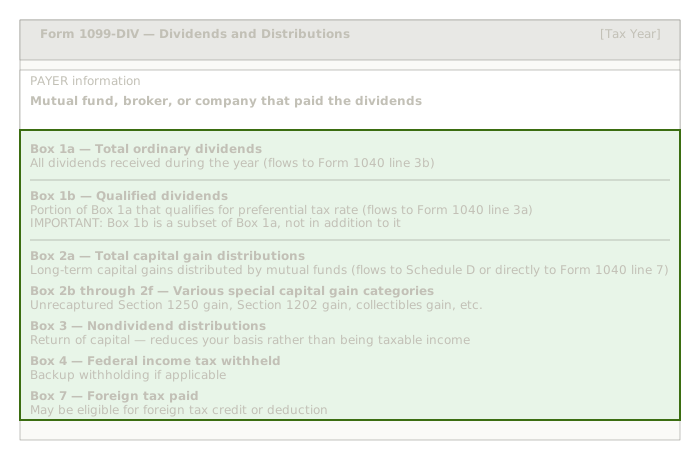
How to read your 1099-DIV. The most important boxes are 1a (total ordinary dividends) and 1b (qualified dividends). Box 1a is what flows to Form 1040 line 3b. Box 1b — which is a subset of Box 1a, not in addition to it — is what flows to line 3a. The confusion many people have is thinking they should add 1a and 1b, but 1b is the portion of 1a that qualifies for the preferential rate. Box 2a reports capital gain distributions from mutual funds, which flow either directly to line 7 of Form 1040 (if Schedule D isn't required) or to Schedule D itself.
How it flows to Form 1040. Total ordinary dividends (Box 1a) go to line 3b. Qualified dividends (Box 1b) go to line 3a. Note that only line 3b actually adds to total income; line 3a is informational and is used by the tax calculation to apply the preferential rate. Capital gain distributions from Box 2a typically flow to Schedule D, line 13, then through to line 7 of Form 1040.
Schedule B requirement. If your total ordinary dividends exceed $1,500, you must file Schedule B (Interest and Ordinary Dividends) which lists each payer separately. Below $1,500, you can just enter the total on Form 1040 without Schedule B.
Decision points specific to dividends.
- Reinvested versus cash dividends. The taxation is the same — you're taxed on the dividend in the year received whether you took cash or had it reinvested through a DRIP. Reinvested dividends increase your basis in the holding, which you'll need to track for when you eventually sell. Many brokers handle DRIP basis tracking automatically; some don't.
- Holding period for qualified dividend treatment. If you bought a dividend-paying stock just before the ex-dividend date and sold it shortly after, you may not meet the more-than-60-days holding period requirement, making the dividend ordinary rather than qualified. The broker generally reports this correctly on the 1099-DIV based on your trading activity.
Career path applications. Investors at all career stages receive dividends if they hold dividend-paying investments. Retirees often have substantial dividend income from income-focused portfolios. Working-age people accumulating wealth in taxable accounts usually have smaller dividend amounts that still need to be reported. Note that dividends within tax-advantaged accounts (IRAs, 401(k)s, HSAs) don't generate 1099-DIVs and aren't reported on the return until distributions occur from those accounts.
Common confusion points. REIT dividends are almost always ordinary, not qualified, even though they look like regular dividends. Money market fund "dividends" are actually interest and get reported on 1099-INT, not 1099-DIV. Bond fund distributions can be a mix of interest and dividends depending on what the fund holds.
All 1099-DIV statements from every brokerage, mutual fund, and any company that paid you dividends directly. If you participate in any DRIPs, the records showing the reinvested dividend amounts and basis impacts.
Interest Income
Read this subsection if you earned interest from a bank account, savings account, CDs, bonds, or any other interest-bearing account during the year.
Interest income arrives on Form 1040 lines 2a (tax-exempt interest) and 2b (taxable interest). The supporting documentation is Form 1099-INT, sent by banks and other payers of interest.
What interest income is. Interest is what financial institutions pay you for the use of your money. Bank savings accounts, money market accounts, certificates of deposit (CDs), corporate bonds, treasury bonds, savings bonds, and similar accounts all generate interest. Most interest is fully taxable as ordinary income. Some interest — most notably from municipal bonds — is tax-exempt at the federal level (and sometimes at the state level too).
What forms report this. Form 1099-INT. Banks and other payers send 1099-INT if they paid you at least $10 in interest during the year, though even smaller amounts need to be reported. You may receive multiple 1099-INTs if you have accounts at multiple institutions.
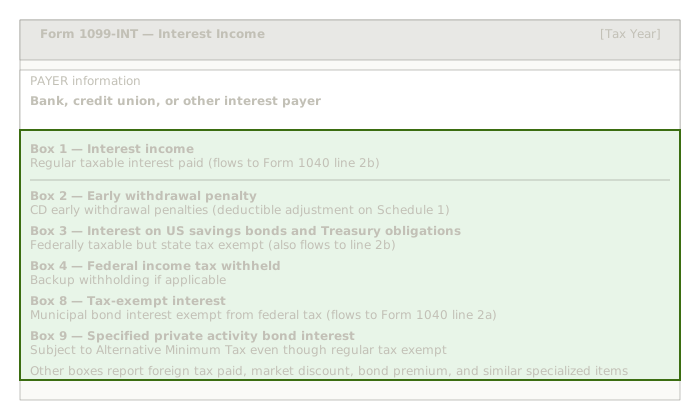
How to read your 1099-INT. Box 1 is the most common — regular taxable interest that flows to Form 1040 line 2b. Box 8 reports tax-exempt interest (typically from municipal bonds) that flows to line 2a as informational reporting. Box 3 is interest from US Treasury obligations and savings bonds — federally taxable (also goes to line 2b) but exempt from state income tax in most states. Box 2 reports early withdrawal penalties from CDs, which become an adjustment to income on Schedule 1.
How it flows to Form 1040. Total taxable interest (sum of Box 1 and Box 3 from all your 1099-INTs) goes to line 2b. Total tax-exempt interest (Box 8) goes to line 2a as informational. Early withdrawal penalties (Box 2) get reported as an adjustment to income on Schedule 1.
Schedule B requirement. If your total taxable interest exceeds $1,500, you must file Schedule B which lists each payer separately. The same threshold applies as for dividends.
Decision points specific to interest.
- Whether municipal bond interest is right for your situation. Tax-exempt interest from municipal bonds is appealing because it's federally tax-free, but the trade-off is generally lower yields. The "tax-equivalent yield" calculation determines whether munis beat taxable bonds for your specific tax bracket. Higher-bracket investors often benefit from munis; lower-bracket investors often don't.
- State tax treatment of US Treasury interest. Treasury interest is exempt from state income tax. If your state has high income tax (California, New York, etc.), Treasuries become more attractive than equivalent-yield corporate bonds because of this state-tax advantage. Your state return will need to back out Treasury interest from federal taxable interest.
Career path applications. Interest is the most universal income type — almost everyone with a bank account earns at least some interest. Retirees often have substantial interest income from CDs, bonds, and money market accounts as part of their fixed-income allocation. Working-age accumulators usually have smaller amounts that still need to be reported.
Common confusion points. Interest from credit union accounts is reported as "interest" even though credit unions technically call it "dividends" — this is reported on 1099-INT, not 1099-DIV. Interest from savings bonds redeemed during the year is reported in the year of redemption, even if the bonds were earning interest for decades.
All 1099-INT statements from every bank, credit union, brokerage, and other interest payer. Records of any interest under the $10 reporting threshold that wasn't on a 1099-INT but still needs to be reported. Year-end statements for any accounts that might have generated interest you weren't sure about.
IRA Distributions
Read this subsection if you took money out of a traditional or Roth IRA during the year, including required minimum distributions (RMDs), early withdrawals, Roth conversions, or rollovers.
IRA distributions arrive on Form 1040 lines 4a (gross amount) and 4b (taxable amount). The supporting documentation is Form 1099-R from the IRA custodian.
What IRA distributions are. Any money you took out of an IRA during the year is an IRA distribution. This includes RMDs that retirees are required to take, voluntary withdrawals at any age, Roth conversions from traditional IRAs, and rollovers to other retirement accounts. The taxability depends on what type of IRA, how old you are, and what you did with the money.
Traditional versus Roth distributions. Traditional IRA distributions are generally fully taxable because you got a tax deduction when you contributed. Exceptions exist if you made nondeductible contributions (tracked on Form 8606), in which case part of each distribution is tax-free. Qualified Roth IRA distributions are entirely tax-free if you're over 59½ and have had a Roth IRA for at least five years. Non-qualified Roth distributions can be partially taxable depending on the ordering rules.
What forms report this. Form 1099-R. The IRA custodian sends 1099-R if you took any distributions during the year, even if the distribution was a rollover or trustee-to-trustee transfer.
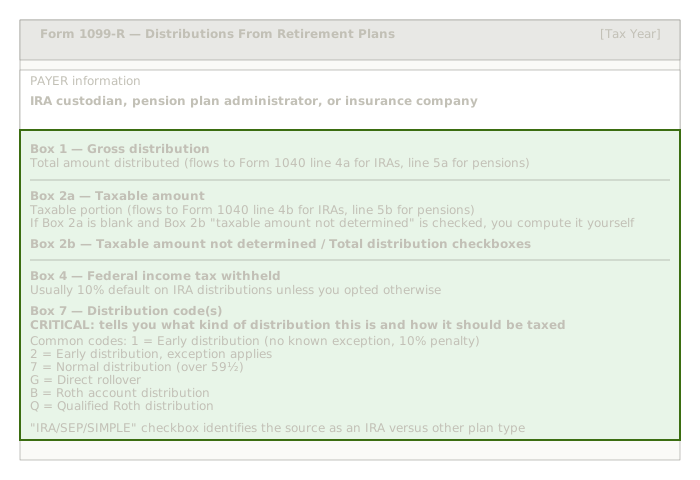
How to read your 1099-R. Box 1 (gross distribution) shows the total amount withdrawn. Box 2a (taxable amount) shows what's actually taxable — often the same as Box 1 for traditional IRAs, but possibly less for Roth IRAs or traditional IRAs with nondeductible contributions. Box 4 shows federal tax withheld; many people elect 10% withholding on IRA distributions by default. Box 7 is the distribution code, which tells you what kind of distribution this is — this matters enormously because different codes have different tax treatment.
The "IRA/SEP/SIMPLE" checkbox tells you whether the distribution is from an IRA-type account or another retirement plan type. The codes in Box 7 combined with the IRA checkbox determine which lines of Form 1040 the distribution flows to (line 4 for IRA-type plans, line 5 for pensions and other employer plans).
How it flows to Form 1040. For IRA distributions, Box 1 (gross) goes to line 4a and Box 2a (taxable) goes to line 4b. If Box 2a is blank with the "taxable amount not determined" checked, you may need to compute the taxable portion using Form 8606 (especially relevant for IRAs with nondeductible contributions). Rollover distributions (code G) show in Box 1 with $0 taxable in Box 2a — they're reported on line 4a but don't add to taxable income.
Decision points specific to IRA distributions.
- Whether to have taxes withheld. The default for IRA distributions is 10% federal withholding unless you opt out or specify a different amount. If you're going to owe substantial tax on the distribution, increasing the withholding now avoids quarterly estimated tax obligations. If you have other tax payments covering the distribution's tax, you can opt out.
- Whether early distribution penalties apply. Distributions before age 59½ generally trigger a 10% additional penalty on top of regular income tax. Exceptions exist for substantial education expenses, first-time home purchases up to $10,000 lifetime, certain medical expenses, periodic payments under 72(t), and others. The exceptions are claimed on Form 5329.
- Roth conversion timing. Converting traditional IRA money to Roth creates a current-year tax bill but eliminates future tax on the converted amount and its growth. The decision involves comparing current tax rates to expected future tax rates, available cash to pay the conversion tax, and the time horizon for the Roth account.
Career path applications. Retirees taking RMDs (currently required starting at age 73) will have annual IRA distributions reported on 1099-R. Working-age people doing backdoor Roth conversions will have 1099-Rs showing the conversions. Anyone who left a job and rolled over their 401(k) to an IRA will have a 1099-R for the rollover. Early retirees using SEPP (Substantially Equal Periodic Payments) under section 72(t) will have annual 1099-Rs.
Common confusion points. Rollovers between retirement accounts are reported on 1099-R even though they're not taxable. Box 1 shows the rolled amount but Box 2a should be $0 with a rollover distribution code (G or H). The 1099-R for a Roth conversion shows the converted amount as taxable in Box 2a — this is the conversion tax. Form 8606 needs to be filed in Roth conversion years and in years with nondeductible IRA contributions or distributions from IRAs with basis.
All 1099-R statements from every retirement plan that made distributions. Form 8606 from prior years if you have any nondeductible basis in traditional IRAs. Records of any rollovers including the dates and amounts. For Roth conversions, the basis breakdown for the converted amounts.
Other Income (Schedule 1)
Read this subsection if you had income that doesn't fit on Form 1040 lines 1 through 7 — including business income, rental income, farm income, unemployment compensation, alimony received under pre-2019 agreements, gambling winnings, prizes, jury duty pay, cancelled debt, or other miscellaneous income.
Other income flows from Schedule 1 to Form 1040 line 8. Schedule 1 has many separate lines for different income types, and the total of all those types lands on Schedule 1 line 10, which transfers to Form 1040 line 8.
What Schedule 1 other income covers. The major categories include business income from Schedule C (line 3), refunds of state and local taxes when you itemized in a prior year (line 1), alimony received under pre-2019 divorce agreements (line 2a), rental real estate, royalties, partnerships, S corporations, and trusts from Schedule E (line 5), farm income from Schedule F (line 6), unemployment compensation (line 7), and a long list of specific other items on line 8a through 8z (gambling winnings, prizes and awards, jury duty pay, cancelled debt, Olympic medals, and dozens of other less common income types).
What forms report these.
- Business income through Schedule C is reported by you — there's no 1099 for being self-employed in general, though you may receive 1099-NEC, 1099-MISC, and 1099-K forms reporting payments from clients and customers.
- Rental income through Schedule E is reported by you based on your own records of rent received and expenses paid. Form 1099-MISC may report rents you received.
- Unemployment compensation arrives on Form 1099-G from the state unemployment agency.
- Gambling winnings of $600 or more (or specific other thresholds for different types of gambling) arrive on Form W-2G.
- Prizes and awards arrive on Form 1099-MISC if the payer reports them, but smaller amounts may not be reported on any form even though they're still taxable.
- Cancelled debt of $600 or more arrives on Form 1099-C.
How Schedule 1 works. You list each income type on its specific line. Business income goes through Schedule C first and the net comes to Schedule 1 line 3. Rental income goes through Schedule E first and the net comes to Schedule 1 line 5. Unemployment goes directly on Schedule 1 line 7. Miscellaneous items go on lines 8a through 8z based on what they are. Line 10 sums everything and transfers to Form 1040 line 8.
Decision points specific to other income.
- Self-employment income definitions. If you received 1099-NEC for work you performed, that's typically self-employment income requiring Schedule C and Schedule SE (self-employment tax). If you received 1099-MISC for hobby income, it goes on Schedule 1 line 8j without self-employment tax — but the IRS has specific tests for whether an activity is a business (allowing deductions) or a hobby (limiting deductions).
- Rental versus passive versus active business. Real estate rental is typically passive activity reported on Schedule E. If you provide substantial services to tenants (like a bed and breakfast), it may become a business reported on Schedule C with self-employment tax. The distinction has substantial tax implications.
- Gambling winnings and losses. Winnings are reported as income on Schedule 1 line 8b. Losses can only be deducted as itemized deductions on Schedule A (not as adjustments to income), and only up to the amount of winnings, and only if you itemize rather than taking the standard deduction. Many casual gamblers can't deduct losses because they don't itemize.
Career path applications. Self-employed people and gig workers have Schedule C as their primary income reporting mechanism. Real estate investors with rental property have Schedule E. Farmers have Schedule F. People who received unemployment during the year report it here. The IRS has been increasing 1099-K reporting for payment app transactions — people who received money through Venmo, PayPal, CashApp, or similar may receive 1099-K reporting their gross receipts, even for personal transactions in some cases. Read the 1099-K carefully and determine whether the reported amounts represent taxable income or personal transactions that shouldn't be taxed.
Common confusion points. State tax refunds are only taxable if you itemized in the year you paid the state tax and got a benefit from the deduction. If you took the standard deduction, your state refund isn't taxable income. Cancelled debt that's reported on 1099-C may be excludable in certain situations (insolvency, bankruptcy, qualified principal residence indebtedness) — Form 982 handles these exclusions.
Schedule C if self-employed. Schedule E if you have rental, royalty, partnership, or S-corp income. Schedule F if you're a farmer. All 1099-G forms for unemployment. All W-2G forms for gambling. All 1099-K forms for payment app receipts. All 1099-C forms for cancelled debt. Records of any other income that may or may not have been reported on a 1099 (prizes, jury duty pay, hobby income, etc.).
Pensions and Annuities
Read this subsection if you received pension payments, annuity payments, or distributions from employer retirement plans like 401(k) or 403(b) accounts during the year.
Pension and annuity income arrives on Form 1040 lines 5a (gross amount) and 5b (taxable amount). The supporting documentation is also Form 1099-R, the same form used for IRA distributions but the IRA/SEP/SIMPLE checkbox is not checked when it's from a non-IRA retirement plan.
What pensions and annuities are. Pensions are payments from a defined benefit plan you participated in through your employer or a union. Annuities are payments from insurance contracts you purchased, either personally or through your employer. Distributions from 401(k), 403(b), 457(b), TSP (federal Thrift Savings Plan), and similar employer plans are reported the same way as pensions even though the plans themselves are technically defined contribution rather than defined benefit.
How taxation works. Generally, pension and annuity income is fully taxable as ordinary income because the contributions were pre-tax. Exceptions exist when you made after-tax contributions to the plan, in which case part of each payment is a tax-free return of your basis. The simplified method or general rule (depending on the plan and circumstances) determines how to compute the taxable portion.
How it flows to Form 1040. Box 1 of 1099-R goes to line 5a, Box 2a goes to line 5b. If Box 2a is blank with "taxable amount not determined" checked, you compute it using the simplified method worksheet or general rule worksheet in the Form 1040 instructions.
Decision points specific to pensions.
- Lump sum versus periodic payments. Some pensions offer a choice between taking the entire benefit as a lump sum or receiving monthly payments for life. The decision has substantial tax implications because a lump sum becomes immediately taxable (or rollable to an IRA to defer tax) while monthly payments spread the tax over years.
- Survivor benefit options. When a pension offers survivor benefits for a spouse, the monthly amount is reduced to fund the survivor coverage. The trade-off involves longevity expectations, alternative survivor income sources, and the survivor's other resources.
Career path applications. Retirees with pension income from former employers will see these amounts on annual 1099-R forms. People taking 401(k) or similar distributions in retirement also report through this section. Survivors receiving spousal pension benefits report them here. Disability pension recipients have specific rules depending on the disability and the pension's funding source.
All 1099-R statements for pensions, annuities, and employer plan distributions. For traditional pensions, the year-of-retirement paperwork showing your contributions and the plan's accounting of any after-tax basis you have.
Wages
Read this subsection if you received wages from one or more employers during the year. This is the most common income type.
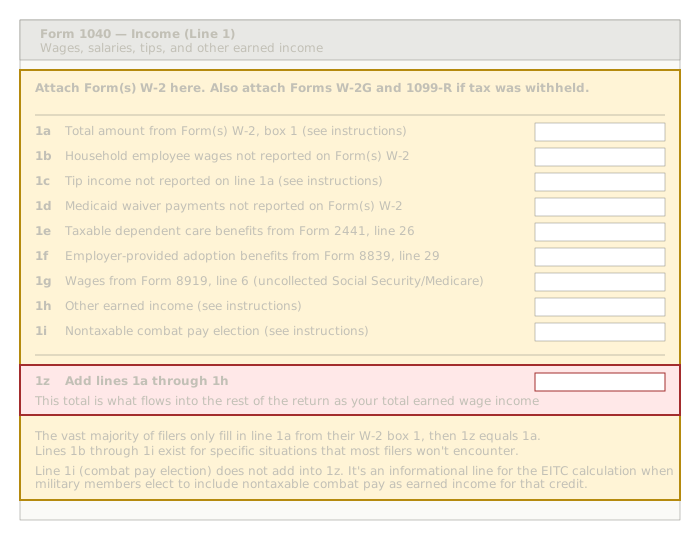
Wages arrive on Form 1040 line 1, which is actually a series of sub-lines from 1a through 1h with the total on 1z. The supporting documentation is Form W-2 from each employer.
What wages are. Wages, salary, tips, bonuses, commissions, and similar compensation from working as an employee. The defining characteristic of wages versus self-employment income is the employee-employer relationship — your employer withholds Social Security, Medicare, and income taxes from your paycheck and sends them to the government on your behalf.
What forms report this. Form W-2. Every employer must send you a W-2 by January 31 reporting your wages and tax withholding from the prior calendar year. If you worked for multiple employers, you receive a separate W-2 from each. If you didn't receive a W-2 by mid-February, contact your employer first; if that doesn't resolve it, you can request IRS assistance.
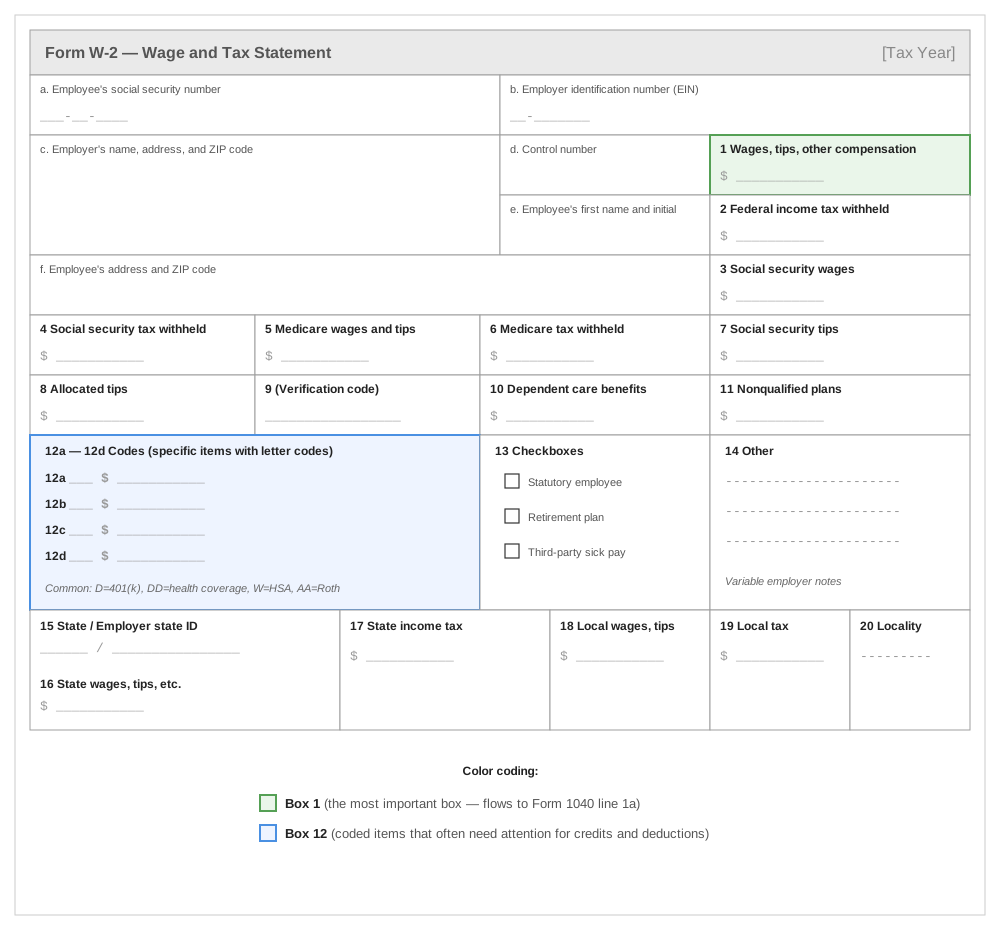
How to read your W-2.
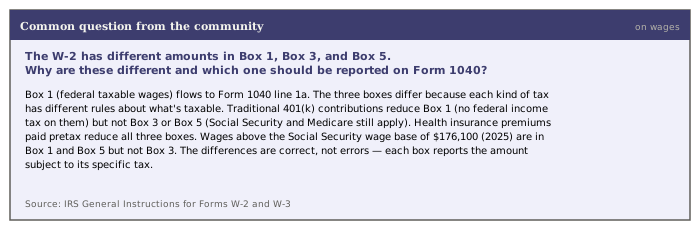
- Box 1 (Wages, tips, other compensation) is the single most important box — this is your federal taxable wages that flows to Form 1040 line 1a. Box 1 reports what you were paid that's subject to federal income tax. It excludes pretax contributions to retirement plans (traditional 401(k), 403(b)), pretax health insurance premiums, and other pretax deductions. So if you earned $60,000 gross but contributed $5,000 to a traditional 401(k) and $3,000 to health insurance through payroll, your Box 1 would be approximately $52,000.
- Box 2 (Federal income tax withheld) is the total federal income tax your employer withheld throughout the year. This flows to Form 1040 line 25a in the payments section. It's what you've already paid toward your annual tax liability.
- Box 3 (Social Security wages) is the amount of your wages subject to Social Security tax, up to the annual wage base ($176,100 for 2025, increasing to $184,500 for 2026). Box 3 differs from Box 1 because 401(k) contributions reduce Box 1 but not Box 3 — you pay Social Security tax on 401(k) contributions even though you don't pay federal income tax on them.
- Box 4 (Social Security tax withheld) equals 6.2% of Box 3.
- Box 5 (Medicare wages and tips) has no wage base limit, so Box 5 can be substantially higher than Box 3 if your wages exceeded the Social Security wage base. Like Box 3, Box 5 includes 401(k) contributions even though Box 1 doesn't.
- Box 6 (Medicare tax withheld) equals 1.45% of Box 5, plus an additional 0.9% on wages over $200,000.
Box 12 uses letter codes to report specific items. The most common codes:
- D: Traditional 401(k) contributions
- AA: Roth 401(k) contributions
- E: 403(b) contributions
- DD: Cost of employer-sponsored health coverage (informational, not taxable)
- W: HSA contributions through payroll (both employer and employee portions)
- C: Group-term life insurance over $50,000
Box 12 can have up to four entries (12a, 12b, 12c, 12d). Code DD specifically is just informational — it tells you the value of employer-provided health insurance but doesn't change your taxable income.
Box 13 has three checkboxes. The "Retirement plan" box being checked affects whether you can deduct traditional IRA contributions (at certain income levels). The "Statutory employee" box affects how you report income (statutory employees use Schedule C even though they receive W-2s). The "Third-party sick pay" box indicates that some or all of your wages came from a third-party insurer rather than your employer directly.
Box 14 is a free-form field where employers report items that don't fit elsewhere. Common entries include state disability insurance withheld, union dues, uniform allowances, or vehicle lease values. The OBBBA reporting for qualified tips and qualified overtime starting 2026 will likely appear here or in Box 12 with new codes.
Boxes 15-20 report state and local tax information.
How it flows to Form 1040. Box 1 from all your W-2s gets summed and entered on line 1a of Form 1040. The other Form 1040 line 1 sub-lines (1b through 1i) are for special situations most people don't encounter. Total wages then appear on line 1z, which adds into total income on line 9. Federal tax withholding from Box 2 flows to line 25a in the payments section.
The One Big Beautiful Bill Act, signed July 4, 2025, created two new deductions effective for tax years 2025 through 2028: a deduction for qualified tips and a deduction for qualified overtime premium pay. These are deductions claimed on a new Schedule 1-A (covered in the adjustments lesson), but understanding them starts with your W-2. For 2025, employers were not required to separately report qualified tips or qualified overtime on W-2s — the requirement starts with 2026 W-2s. For 2025 returns, you can still claim the deductions using paystubs, your own records, or whatever your employer voluntarily reported in Box 14 of your W-2. The IRS issued Notice 2025-69 explaining how to compute these deductions without separate W-2 reporting. Qualified tips means tips received in an occupation that customarily and regularly received tips before December 31, 2024 (servers, bartenders, hairdressers, and similar). The deduction is capped at $25,000 annually with phaseout starting at MAGI of $150,000 (single) or $300,000 (MFJ). Qualified overtime means the premium portion of overtime pay required by FLSA (the "half" portion of time-and-a-half). Only the premium counts, not the base hourly rate. The deduction is capped at $12,500 (single) or $25,000 (MFJ) with the same MAGI phaseout. If you received tips or worked overtime during 2025 and your employer didn't separately report the amounts on your W-2, you'll need to calculate them from paystubs to claim the deductions. Save your final paystub and any documentation showing tip income or overtime premium earned.
Decision points specific to wages.
- Multiple W-2s in one year. If you worked for more than one employer, add Box 1 from all W-2s together for line 1a. Watch for excess Social Security tax withholding if your combined Box 3 amounts exceeded the wage base — you can claim the excess as a credit on Schedule 3.
- Mid-year job changes. If you changed jobs mid-year, you'll receive W-2s from both employers. The new employer's withholding may have been calculated as if your annual income was just from that job, potentially under-withholding. Review your total tax situation when you get your W-2s to anticipate any balance due.
- Adjusting withholding for the next year. If your current year's withholding seems off (large refund or large balance due), submit a new Form W-4 to your employer to adjust withholding for the next year.
Career path applications.
- W-2 employees at single employers have the simplest situation — just transfer Box 1 to line 1a. Most filers fit this category.
- Tipped workers in restaurants, bars, hair salons, and similar industries need to track tips carefully for the OBBBA qualified tips deduction. Tips reported to the employer appear in Box 1 (federal taxable) and Box 7 (Social Security tips). Unreported tips need to be reported separately on Form 1040 line 1c.
- Workers with multiple jobs need to combine W-2 information from all employers and watch for excess Social Security withholding.
- Statutory employees (some commissioned salespeople, certain delivery drivers) have a checkmark in Box 13 and report income on Schedule C rather than line 1, even though they received a W-2.
- Workers receiving substantial overtime in 2025 should track the overtime premium amounts to claim the new OBBBA qualified overtime deduction on Schedule 1-A.
- Military members have special W-2 considerations including combat zone tax exclusions (excluded from Box 1) and various allowances that may or may not be taxable.
Common confusion points. Box 1 being less than Box 3 confuses many people, but it's normal when you have pretax 401(k) contributions. Box 12 code DD is just informational about your employer-provided health insurance and doesn't affect your tax. Reimbursed business expenses may or may not be in your wages depending on whether the reimbursement was made under an accountable plan.
All W-2 forms from all employers you worked for during the year. Final paystubs from each employer (useful for verification and for OBBBA tip/overtime calculations). Records of any tips received that weren't reported to your employer. For 2025 specifically, paystub records showing overtime premium amounts if you're planning to claim the qualified overtime deduction.
Total Income
After working through all the income subsections that apply to your situation, you sum your income types to get Total Income on Form 1040 line 9. The line 9 calculation adds:
Line 1z (total wages) plus line 2b (taxable interest) plus line 3b (ordinary dividends) plus line 4b (taxable IRA distributions) plus line 5b (taxable pensions/annuities) plus line 6b (taxable Social Security) plus line 7 (capital gain or loss) plus line 8 (Schedule 1 additional income).
Note that the gross-amount lines (2a, 4a, 5a, 6a) are not included in this sum — they're informational only. Lines 3a (qualified dividends) also doesn't add into line 9; it's used elsewhere for the preferential rate calculation.
Total income is the starting point for everything that follows on the return. From total income, you subtract adjustments on line 10 (which come from Schedule 1 Part II — that's a separate lesson) to arrive at Adjusted Gross Income (AGI) on line 11. AGI is then used for many purposes throughout the rest of the return: it determines eligibility for various credits and deductions, drives the calculation of your itemized deductions for medical expenses, and gets used by many other tax provisions.
Connection to Other Sections
The income section establishes Total Income on line 9, which is the starting point for the rest of the return. The next operation is subtracting Adjustments to Income on line 10, which produces Adjusted Gross Income (AGI) on line 11. The adjustments come from Schedule 1 Part II and get their own dedicated lesson because they involve different mechanics — claiming deductions that reduce gross income rather than reporting income types.
AGI then flows to the deductions section (standard or itemized deduction on line 12), the qualified business income deduction (line 13 if applicable), taxable income (line 15), tax (line 16), and downstream to credits and payments. Many credits and deductions throughout the return use AGI or modified AGI as the basis for income limits, so getting the income section right matters for everything that follows.
The information returns you used in this lesson (W-2, 1099-INT, 1099-DIV, 1099-R, SSA-1099, 1099-B, 1099-DA, 1099-MISC, 1099-NEC, 1099-K, 1099-G, 1099-C, W-2G) connect to specific income types and feed specific Form 1040 lines. Keeping all these forms organized by income type as you receive them in January and February makes filing dramatically easier than scrambling at the deadline.
What to Gather for the Income Section as a Whole
Bringing together the document needs from each subsection:
- All W-2s from all employers (Wages section).
- All 1099-INT forms for interest income, even from accounts where the interest was under the $10 reporting threshold (Interest section).
- All 1099-DIV forms for dividend income (Dividends section).
- All 1099-B and 1099-DA forms for sales of securities, plus your own records for basis where the broker didn't have it (Capital Gains section).
- All 1099-R forms for retirement plan and IRA distributions, plus any Form 8606 from prior years (IRA Distributions, Pensions sections).
- SSA-1099 for Social Security benefits (Social Security section).
- All 1099-NEC, 1099-MISC, 1099-K, 1099-G, 1099-C, and W-2G forms for other income types (Other Income section).
- Your own records for any income types not reported on a 1099 (small interest amounts, unreported tips, prizes, hobby income, etc.).
Paystub records if you're going to claim the OBBBA qualified tips or qualified overtime deductions.
Key Takeaways
- The income section uses the "constructive receipt" rule — a January 3 paycheck for December work is next year's income, not last year's.
- Box 1 of your W-2 is federal taxable wages — lower than gross pay because pretax 401(k) contributions and health insurance premiums are excluded.
- Long-term capital gains (assets held over one year) are taxed at preferential rates of 0%, 15%, or 20% — potentially far less than your ordinary income tax rate.
- Up to 85% of Social Security benefits can be taxable under federal law, based on provisional income — a threshold not indexed for inflation.
- The IRS matches every 1099, W-2, and information return against your return — forgotten income triggers automatic notices.
- For 2025, new OBBBA deductions exist for qualified tips (up to $25,000) and qualified overtime premium pay (up to $12,500 single/$25,000 MFJ) — both claimed on Schedule 1-A.
Quiz — 5 Questions
Answer one at a timeWhat does Box 1 of Form W-2 report, and why is it often less than your gross annual salary?
Social Security Benefits
Read this subsection if you received Social Security retirement, disability (SSDI), or survivors benefits during the year. SSI (Supplemental Security Income) is not Social Security and is not reported here.
Social Security benefits arrive on Form 1040 lines 6a (gross amount), 6b (taxable amount), and 6c (lump-sum election checkbox). The supporting documentation is Form SSA-1099 from the Social Security Administration.
What Social Security benefits are. The federal Social Security program pays benefits to retirees (typically starting between age 62 and 70 depending on when you claim), to disabled workers (SSDI), and to survivors of deceased workers. Each January, recipients get Form SSA-1099 showing the total benefits received the previous year.
How taxation works. Social Security taxation is unique because the percentage of benefits that's taxable depends on your other income. The calculation uses "provisional income" — your other income plus tax-exempt interest plus half your Social Security benefits. Based on provisional income and filing status, 0%, up to 50%, or up to 85% of your benefits become taxable. The maximum is 85% — Social Security benefits are never 100% taxable under federal law.
The taxability thresholds. For single filers, if provisional income is under $25,000, none of your Social Security is taxable. Between $25,000 and $34,000, up to 50% is taxable. Above $34,000, up to 85% is taxable. For MFJ, the thresholds are $32,000 and $44,000. The thresholds are not indexed for inflation and have not changed since they were established, which means more retirees fall into the taxable categories over time as their other income grows with inflation.
How it flows to Form 1040. Total Social Security benefits (from SSA-1099 Box 5) go to line 6a. The taxable amount (computed using the Social Security Benefits Worksheet in the Form 1040 instructions) goes to line 6b. Tax software handles this calculation automatically; paper filers work through the worksheet.
Decision points specific to Social Security.
Career path applications. Retirees and disabled workers receive Social Security. Survivors of deceased workers receive benefits as widow/widower or as parents of dependent children. Each category gets an SSA-1099 reporting the benefits.
Common confusion points. Medicare premiums deducted from Social Security checks reduce your net deposit but don't reduce the amount reported on SSA-1099 — the gross benefit before Medicare premium deduction is what's reported as Social Security income. The Medicare premiums become a potential itemized deduction separately. SSI (Supplemental Security Income) is welfare-based and not taxable; it's not reported on SSA-1099 because it's not Social Security.
SSA-1099 (or SSA-1042S for nonresident aliens). Records of any voluntary withholding you elected. If you're filing for a deceased person who received Social Security, the SSA-1099 issued in the deceased person's name for the partial year before death.