Tax Calculation
How Form 1040 line 16 converts taxable income into your federal tax bill using brackets, worksheets, and preferential rates
- Understand how Form 1040 line 16 fits into the overall return and what it represents
- Read and apply the 2025 federal tax brackets correctly for any filing status
- Distinguish between marginal rate and effective rate — the most commonly misunderstood aspect of tax brackets
- Determine which calculation method applies to your situation: standard tables, Qualified Dividends and Capital Gain Tax Worksheet, or Schedule D Tax Worksheet
- Identify optimization opportunities around bracket thresholds and the 0% long-term capital gains rate
Introduction
After arriving at taxable income on Form 1040 line 15 (covered through Lessons 3, 4, and 5), the next step is calculating the actual federal income tax on that taxable income. This calculation produces the number on line 16, which represents your tax liability before any credits, additional taxes, or payments are applied.
The calculation itself uses the federal tax brackets, but the path through those brackets depends on what types of income you have. Filers with only ordinary income use the standard tax tables or tax rate schedules. Filers with qualified dividends and long-term capital gains use the Qualified Dividends and Capital Gain Tax Worksheet because those income types get taxed at preferential rates. Filers with substantial capital gains may need the Schedule D Tax Worksheet, which handles certain less-common situations.
This lesson covers Form 1040 line 16, the tax brackets and how they work, the difference between marginal and effective tax rates, the calculation methods for different income situations, and the worksheets that apply to filers with preferential-rate income.
Navigation guide — which calculation method applies to you
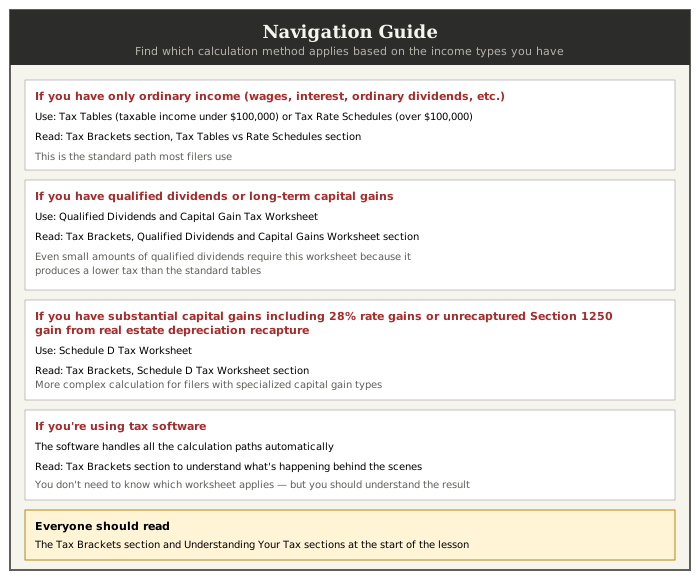
How tax calculation fits into Form 1040. Line 16 of Form 1040 is where tax goes. The line just says "Tax (see instructions). Check if any from Form(s): 1) 8814, 2) 4972, 3)" followed by a small box for the amount. The "Check if any from" references are for specialized situations (election to report child's investment income on parent's return, lump-sum distributions averaging) that don't apply to most filers.
What you put on line 16 depends on which calculation method applies based on your income types. The Form 1040 instructions explicitly tell you which method to use through a decision tree. The result is a single dollar amount representing your tax liability before credits, before additional taxes, and before withholding payments are credited.
Below line 16, the form continues with line 17 (Schedule 2 line 3 — Alternative Minimum Tax and excess advance premium tax credit), then line 18 (total of lines 16 + 17), then credits (lines 19 through 22), then line 23 (other taxes from Schedule 2), then line 24 (total tax), and so on through to payments and refund or amount owed.
The 2025 Federal Tax Brackets
The federal income tax uses a progressive bracket system. Your taxable income gets divided into "slices" based on the bracket thresholds, and each slice gets taxed at the rate for that bracket. This is called the marginal rate system — only the income within each bracket gets taxed at that bracket's rate, not your total income.
The 2025 brackets are:
Single filers and MFS:
- 10% on taxable income up to $11,925
- 12% on taxable income from $11,925 to $48,475
- 22% on taxable income from $48,475 to $103,350
- 24% on taxable income from $103,350 to $197,300
- 32% on taxable income from $197,300 to $250,525
- 35% on taxable income from $250,525 to $626,350
- 37% on taxable income above $626,350
Married Filing Jointly and Qualifying Surviving Spouse:
- 10% on taxable income up to $23,850
- 12% on taxable income from $23,850 to $96,950
- 22% on taxable income from $96,950 to $206,700
- 24% on taxable income from $206,700 to $394,600
- 32% on taxable income from $394,600 to $501,050
- 35% on taxable income from $501,050 to $751,600
- 37% on taxable income above $751,600
Head of Household:
- 10% on taxable income up to $17,000
- 12% on taxable income from $17,000 to $64,850
- 22% on taxable income from $64,850 to $103,350
- 24% on taxable income from $103,350 to $197,300
- 32% on taxable income from $197,300 to $250,500
- 35% on taxable income from $250,500 to $626,350
- 37% on taxable income above $626,350
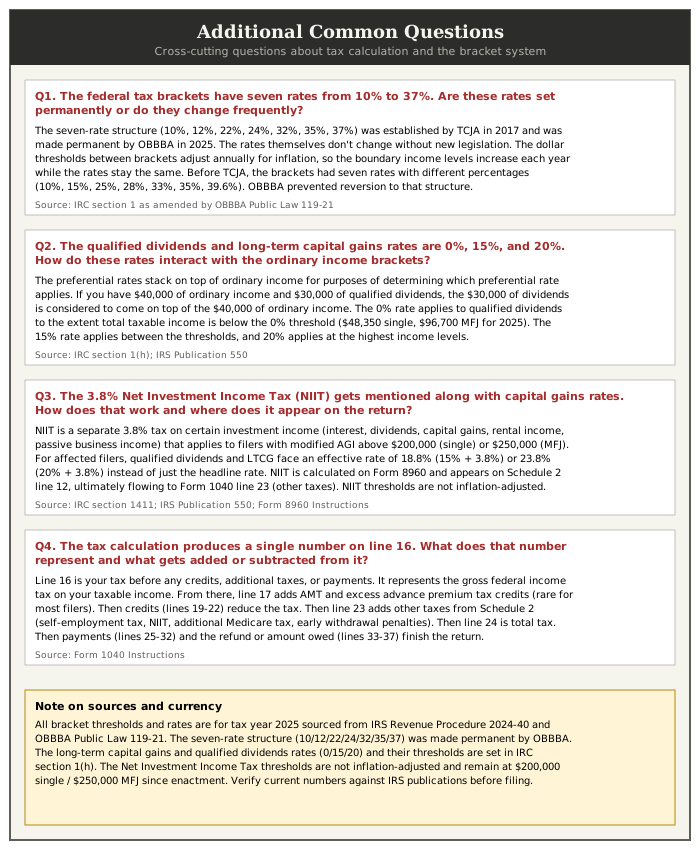
The OBBBA made the seven-bracket structure permanent (it had been scheduled to revert to a different structure after 2025). The bracket thresholds adjust for inflation annually.
Marginal versus effective tax rates — the most common confusion
The single most common confusion about tax brackets is the difference between marginal rate (the rate on your last dollar of income) and effective rate (your total tax divided by your total income).
Marginal rate. The rate applied to your highest bracket of income. A single filer with $80,000 taxable income has a marginal rate of 22% — that's the rate that would apply to additional income they earn.
Effective rate. Total tax divided by total income. The same single filer with $80,000 taxable income has an effective rate of approximately 13% — because most of their income was taxed at the lower brackets, not all of it at 22%.
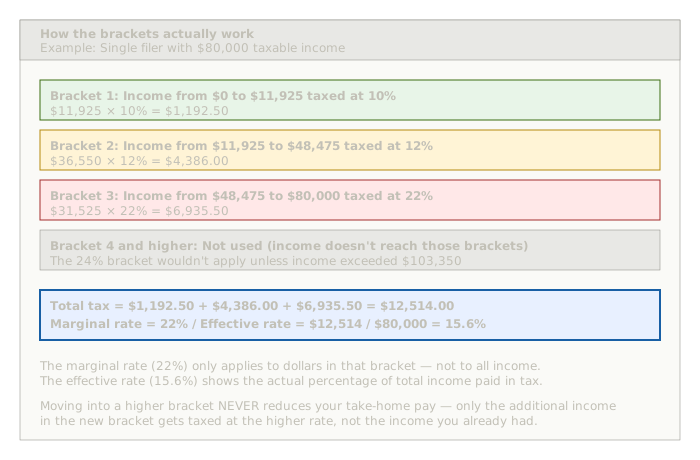
The math for a single filer with $80,000 taxable income works like this:
- First $11,925 at 10% = $1,192.50
- Next $36,550 ($11,925 to $48,475) at 12% = $4,386.00
- Next $31,525 ($48,475 to $80,000) at 22% = $6,935.50
- Total tax = $12,514.00
This person's effective rate is $12,514 / $80,000 = 15.6%, even though their marginal rate is 22%.
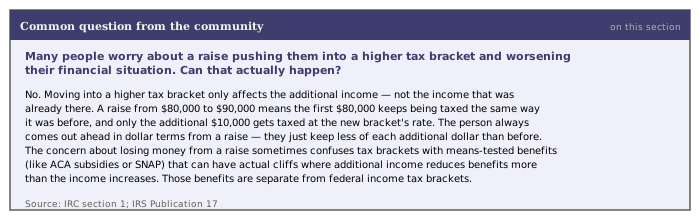
This distinction matters because people commonly think "I'm in the 22% bracket so my next $1,000 of income gets taxed at 22%." That's correct — but they sometimes incorrectly extrapolate to "so my whole income gets taxed at 22%." That extrapolation overstates their tax burden. The bracket system means each dollar of income only gets taxed at one rate, and the rates ramp up as income increases.
Tax Tables versus Tax Rate Schedules
The IRS provides two ways to look up your tax once you know your taxable income.
Tax Tables are used when taxable income is less than $100,000. The tables are organized by $50 increments of taxable income with separate columns for each filing status. You find the row matching your taxable income range, then read across to your filing status column for the tax amount. This is convenient because the IRS has already done all the bracket calculations for each $50 income range. Tax software does the equivalent automatically.
Tax Rate Schedules are used when taxable income is $100,000 or more. The schedules give the bracket structure directly and you do the calculation: find your bracket, multiply the appropriate amounts by the bracket rates, and sum to get your tax.
The IRS publishes both in the Form 1040 Instructions each year. For paper filers, the choice depends on income level (under or over $100,000). For e-filers using tax software, the software handles this automatically without you needing to think about it.
The Qualified Dividends and Capital Gain Tax Worksheet
This worksheet is required if you have qualified dividends on Form 1040 line 3a or net long-term capital gains on Form 1040 line 7 (and you don't need the more complex Schedule D Tax Worksheet for specialized situations).
Why this worksheet exists. Qualified dividends and long-term capital gains get taxed at preferential rates (0%, 15%, or 20%) rather than ordinary income rates. The standard tax tables and rate schedules don't account for this — they would tax everything at ordinary rates. The Qualified Dividends and Capital Gain Tax Worksheet separates your income into the part that gets ordinary rates and the part that gets preferential rates, calculates each separately, and sums them.
The 2025 long-term capital gains brackets. The preferential rate depends on your total taxable income (including the gains themselves):
- 0% rate applies if taxable income is at or below $48,350 (single), $96,700 (MFJ), or $64,750 (HOH)
- 15% rate applies for taxable income above those thresholds and up to $533,400 (single), $600,050 (MFJ), or $566,700 (HOH)
- 20% rate applies above those upper thresholds
How the worksheet works mechanically. The worksheet first calculates tax on your ordinary income alone using the regular brackets. Then it calculates tax on your qualified dividends and long-term gains at the preferential rates. Then it adds them together. The result is generally lower than if you used the standard tables for all your income.
For most filers using tax software, this worksheet runs invisibly. You'll see a tax amount on line 16 that's slightly lower than what the standard tables would have produced if you have qualified dividends or LTCG, but you won't see the worksheet itself.
For paper filers, the worksheet is in the Form 1040 Instructions and runs about 25 lines of calculations. Working through it carefully is critical because skipping it (and using the standard tables) overstates your tax.
The Schedule D Tax Worksheet
This worksheet replaces the Qualified Dividends and Capital Gain Tax Worksheet for filers with certain specialized capital gain types: 28% rate gains (collectibles, qualified small business stock), unrecaptured Section 1250 gain (real estate depreciation recapture), or in certain other less-common situations.
The Schedule D Tax Worksheet is more complex because it handles up to four different rate categories: ordinary rate income, preferential-rate gains and qualified dividends, 28% rate gains, and unrecaptured Section 1250 gain. The calculation runs about 40 lines.
For most readers, you won't need this worksheet. Tax software determines whether you need it and runs it automatically. If you're a paper filer with real estate sales that produced depreciation recapture, or with collectibles sales, you'll need to work through the Schedule D Tax Worksheet rather than the simpler one.
Career path applications
W-2 employees with no investment income use the standard tax tables or rate schedules. The calculation is straightforward.
Investors with qualified dividends and long-term gains need the Qualified Dividends and Capital Gain Tax Worksheet. The preferential rates can save substantial tax — sometimes the 0% rate fully eliminates federal tax on qualified dividends and LTCG for filers with moderate income.
Real estate investors who sold property with depreciation taken may need the Schedule D Tax Worksheet because the recaptured depreciation is taxed at 25% (the unrecaptured Section 1250 rate), which is higher than the regular long-term capital gains rates.
Self-employed people still use the same tax calculation methods on Form 1040 line 16 for their income tax. Their additional self-employment tax (Social Security and Medicare on business income) gets calculated on Schedule SE and appears on Schedule 2, separate from the line 16 income tax calculation.
Retirees often have multiple income types (Social Security, pensions, IRA distributions, qualified dividends, capital gains) that interact through these calculations. The Qualified Dividends and Capital Gain Tax Worksheet is common for retirees because they often have substantial preferential-rate income.
High-income filers in the top brackets pay 32%, 35%, or 37% on their highest dollars of ordinary income, while their qualified dividends and LTCG max out at 20%. The rate differential makes investment income substantially more tax-efficient than wages at high income levels.
Common mistakes in this section
Confusing marginal and effective rates. People sometimes use their marginal rate to estimate total tax on their total income, which substantially overstates the actual tax burden. Always use the bracket calculation or the tax tables, not "my income times my marginal rate."
Skipping the Qualified Dividends and Capital Gain Tax Worksheet when it applies. Paper filers sometimes use the standard tables when they have qualified dividends, which overstates their tax. Tax software handles this automatically.
Using the wrong filing status's brackets. The brackets are different for single, MFJ, MFS, HOH, and QSS. Using the wrong bracket structure produces wrong tax amounts. Verify your filing status produces the brackets you're using.
Assuming a higher bracket means more total tax on everything. Brackets are marginal — only income in that bracket gets that rate, not all income. Don't make this mistake when comparing tax situations or making decisions about additional income.
Thinking the bracket thresholds apply to gross income. Brackets apply to taxable income (line 15), not gross income or AGI. Your taxable income is generally substantially less than your gross income because of the standard deduction or itemized deductions and any QBI deduction or Schedule 1-A deductions.
Optimization opportunities in this section
Manage taxable income to stay below bracket thresholds. If your income is near a bracket boundary, additional pre-tax retirement contributions or HSA contributions can reduce taxable income enough to keep more income in the lower bracket. The savings equal the bracket differential multiplied by the amount kept below the threshold.
Manage taxable income to qualify for the 0% LTCG bracket. Filers with taxable income below the LTCG 0% threshold ($48,350 single, $96,700 MFJ) pay no federal tax on qualified dividends and LTCG. Selling appreciated investments in years when other income is low can permanently eliminate the federal tax on those gains. This is most relevant for retirees managing income flexibly, or for unemployed periods.
Harvest losses to offset capital gains. If you have realized capital gains in the year, realizing capital losses to offset them reduces the taxable gain. Net capital losses up to $3,000 can also offset ordinary income, with the excess carrying forward to future years.
Time income across years near bracket thresholds. If you have flexibility about when to recognize income (Roth conversions, deferred compensation timing, etc.), spreading it across years to stay in lower brackets reduces total tax compared to bunching into one year.
If your modified AGI is approaching $200,000 single or $250,000 MFJ, additional investment income triggers NIIT. Above the threshold, every dollar of additional investment income costs 3.8% more than it would below.
Connection to other sections
The tax calculation on line 16 produces your pre-credit federal tax. The credits section (next lesson) reduces this amount. After credits, Schedule 2's other taxes get added, producing total tax on line 24. Then your payments (withholding, estimated payments, refundable credits) get subtracted to determine refund or amount owed.
The income, adjustments, and deductions lessons together produced your taxable income on line 15. The bracket calculation in this lesson converts that taxable income to a tax amount. The credits lesson then offsets that tax with various credits you may qualify for.
The qualified dividends and long-term capital gains amounts from the income section (Lesson 3) drive whether you use the Qualified Dividends and Capital Gain Tax Worksheet versus the standard tables. The tax software handles the routing automatically.
What to gather for the tax calculation
For most filers using tax software, you don't need to gather anything specific for line 16 — the software calculates it from the taxable income you've already established. Just verify the tax amount is reasonable based on your taxable income and filing status.
For paper filers, you need: the Form 1040 Instructions which include the tax tables (for taxable income under $100,000) and the tax rate schedules (for taxable income $100,000 and over). The Qualified Dividends and Capital Gain Tax Worksheet from the Form 1040 Instructions if you have qualified dividends or LTCG. The Schedule D Tax Worksheet from the Schedule D Instructions if you have specialized capital gain types.
Key Takeaways
- Form 1040 line 16 is your tax liability before credits, additional taxes, or payments — it converts taxable income (line 15) into a dollar amount of tax
- The progressive bracket system taxes each "slice" of income at that bracket's rate — your marginal rate applies only to your highest dollars, not all your income
- Effective rate (total tax / total income) is always lower than marginal rate — a $80,000 single filer in the 22% bracket pays an effective rate of about 15.6%
- Qualified dividends and long-term capital gains get preferential rates (0%, 15%, or 20%) — the QDCG worksheet must be used instead of the standard tables when you have these income types
- Brackets apply to taxable income (line 15), not gross income or AGI — the standard deduction alone typically reduces taxable income by $15,000 or more
- The 0% LTCG rate applies below $48,350 (single) or $96,700 (MFJ) — years with low other income are opportunities to realize gains tax-free
Quiz — 4 Questions
Answer one at a timeWhat does the tax amount on Form 1040 line 16 represent?