Credits
How tax credits reduce your bill — and when they generate refunds
- Understand the difference between refundable and nonrefundable credits and how each affects your tax liability
- Calculate the Child Tax Credit and Credit for Other Dependents using Schedule 8812
- Determine EITC eligibility and apply the credit correctly
- Apply education credits, the Saver's Credit, the Child and Dependent Care Credit, and other major credits to your return
- Identify common mistakes and optimization opportunities across credits
Refundable versus nonrefundable credits — the critical distinction
Before getting into specific credits, you need to understand the difference between refundable and nonrefundable credits because this determines how the credit actually affects your tax bill.
Nonrefundable credits can reduce your tax to zero but not below. If your pre-credit tax is $1,500 and you have a $2,000 nonrefundable credit, the credit eliminates the $1,500 of tax but the extra $500 is lost. You can't get a refund for the excess.
Refundable credits can reduce your tax below zero, generating a refund. If your pre-credit tax is $1,500 and you have a $2,000 refundable credit, the credit eliminates the $1,500 of tax and you get a $500 refund of the excess. Refundable credits effectively turn into payments to you.
Partially refundable credits are partly nonrefundable and partly refundable. The Child Tax Credit is the major example — up to $1,700 per child is refundable (as the Additional Child Tax Credit), with the rest being nonrefundable.
After tax calculation produces your pre-credit tax on Form 1040 line 16 (covered in Lesson 6), the next operation is applying credits that reduce that tax. Credits are different from deductions in a fundamental way: deductions reduce taxable income (the amount that gets multiplied by your tax bracket rate), while credits reduce the actual tax amount dollar-for-dollar. A $1,000 deduction in the 22% bracket saves $220 of tax. A $1,000 credit saves $1,000 of tax. Credits are substantially more valuable per dollar.
This makes credits one of the most important areas of the return to understand. Missing credits you qualify for is leaving money on the table — often substantial amounts. The Earned Income Tax Credit alone is worth up to about $8,000 for qualifying families, and IRS estimates have historically shown one in five eligible filers misses it.
Credits appear on Form 1040 in two main places. Lines 19 and 20 of Form 1040 are reserved for specific credits (Child Tax Credit and Schedule 3 nonrefundable credits). Line 28 captures the refundable Additional Child Tax Credit and certain other refundable credits. Schedule 3 itself has many sub-lines for different credits, and several major credits have their own dedicated forms (Schedule 8812 for CTC, Form 2441 for child care, Form 8863 for education, Form 8880 for retirement savings, Schedule EIC for EITC).
This lesson covers the major individual tax credits, organized by who they affect, with explicit attention to the OBBBA changes that affect 2025 returns.
Navigation guide — which credits apply to your situation
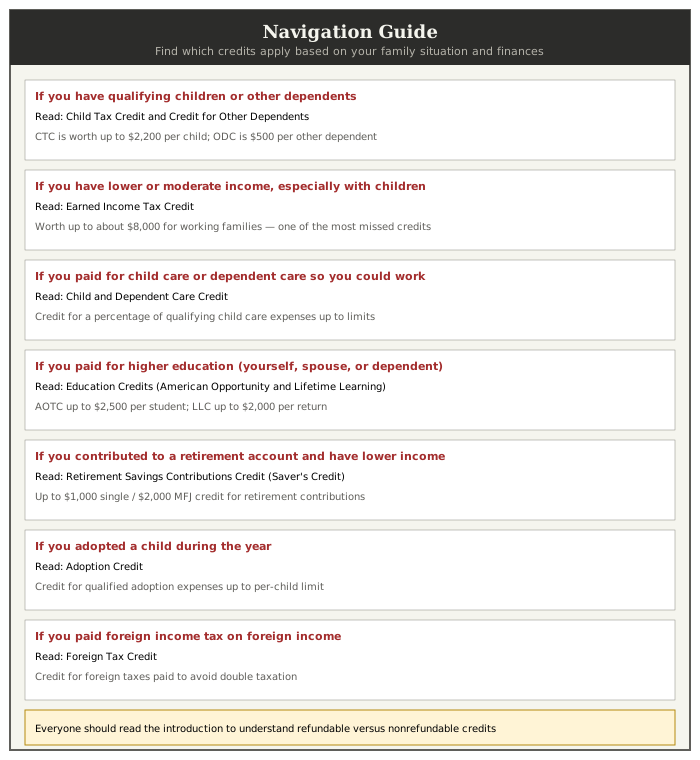
Filers with low or zero tax liability benefit much more from refundable credits than from nonrefundable ones. A low-income family with $0 tax liability and a $5,000 nonrefundable credit gets nothing from the credit. The same family with a $5,000 refundable credit gets a $5,000 refund. This is why credits like the EITC, the refundable portion of the CTC, and the partially refundable American Opportunity Credit are specifically designed to benefit lower-income families.
Child Tax Credit and Credit for Other Dependents
Read this section if you have dependents listed on your return.
The Child Tax Credit (CTC) and Credit for Other Dependents (ODC) were covered briefly in Lesson 2 (Dependents) — this section provides the full credit mechanics. Both credits are calculated on Schedule 8812 and flow to Form 1040 line 19 (the nonrefundable portion) and line 28 (the refundable Additional Child Tax Credit portion).
CTC amount for 2025. Up to $2,200 per qualifying child under age 17, with valid SSN. Up to $1,700 per child is refundable through the Additional Child Tax Credit. The remainder is nonrefundable. OBBBA made the $2,200 amount permanent and indexed it for inflation starting in 2026.
ODC amount for 2025. $500 per qualifying dependent who doesn't qualify for CTC. Nonrefundable. Made permanent by OBBBA.
Phase-out. Both credits phase out at $50 per $1,000 of MAGI above $200,000 (single) or $400,000 (MFJ). The thresholds are not inflation-adjusted and were made permanent by OBBBA.
SSN requirements (changed by OBBBA). The child must have a valid SSN issued before the return's due date. The taxpayer claiming the credit must also have a valid SSN. On MFJ returns, at least one spouse must have a valid SSN. ITINs do not qualify the child for CTC (though they do qualify for ODC).
How to claim. List qualifying dependents in the Dependents section of Form 1040, checking the CTC box (for children under 17 with valid SSN) or ODC box (for other dependents). Complete Schedule 8812 to calculate the credit amount. The nonrefundable portion goes to Form 1040 line 19; the refundable portion (ACTC) goes to line 28.
Decision points. Make sure each dependent's checkbox is correct (CTC vs ODC). Confirm SSN validity for each qualifying child. Watch for the phase-out if your MAGI is near $200,000 single or $400,000 MFJ.
Common confusion. A child turning 17 during the tax year drops from $2,200 (CTC) to $500 (ODC). College students over 17 generally qualify for ODC, not CTC. Dependents who don't qualify for either credit still get listed in the Dependents section and still affect filing status and other items.
Sourcing. IRS Publication 972 (historical); Schedule 8812 Instructions; IRC section 24 as amended by OBBBA.
Earned Income Tax Credit (EITC)
Read this section if you have earned income and your AGI is in the moderate-to-lower range, especially if you have children.
The EITC is one of the largest tax credits available and historically one of the most commonly missed. It's refundable, meaning low-income workers can get substantial refunds even with zero tax liability.
Maximum EITC amounts for 2025. The amounts vary by number of qualifying children:
- No children: up to $649
- One child: up to $4,328
- Two children: up to $7,152
- Three or more children: up to $8,046
Income limits for 2025. Earned income and AGI must both be below specific thresholds that depend on filing status and number of children. For single or HOH filers, the upper limits are approximately $19,104 (no children), $50,434 (one child), $57,310 (two children), $61,555 (three or more). For MFJ filers, add about $7,000 to each of those thresholds.
Investment income limit. Investment income must be below approximately $11,950 for 2025 to qualify. This rules out filers with substantial passive income.
Earned income requirement. You must have earned income from working (wages or net self-employment) — investment income alone doesn't qualify.
Qualifying child requirements. Similar to but stricter than the qualifying child rules for dependents. The child must have a valid SSN, meet age and relationship tests, and live with you more than half the year.
Filing status restrictions. Married Filing Separately filers generally cannot claim EITC, with limited exceptions for separated parents meeting specific criteria.
How to claim. Compute the credit using the EITC worksheet in the Form 1040 Instructions. If you have qualifying children, attach Schedule EIC listing them. The credit goes on Form 1040 line 27.
Why this credit gets missed. Several reasons. The eligibility rules are complex. Many eligible filers don't earn enough to be required to file a tax return at all, so they don't file and miss the credit. The IRS estimates roughly 20% of eligible filers don't claim EITC each year, missing out on substantial refunds.
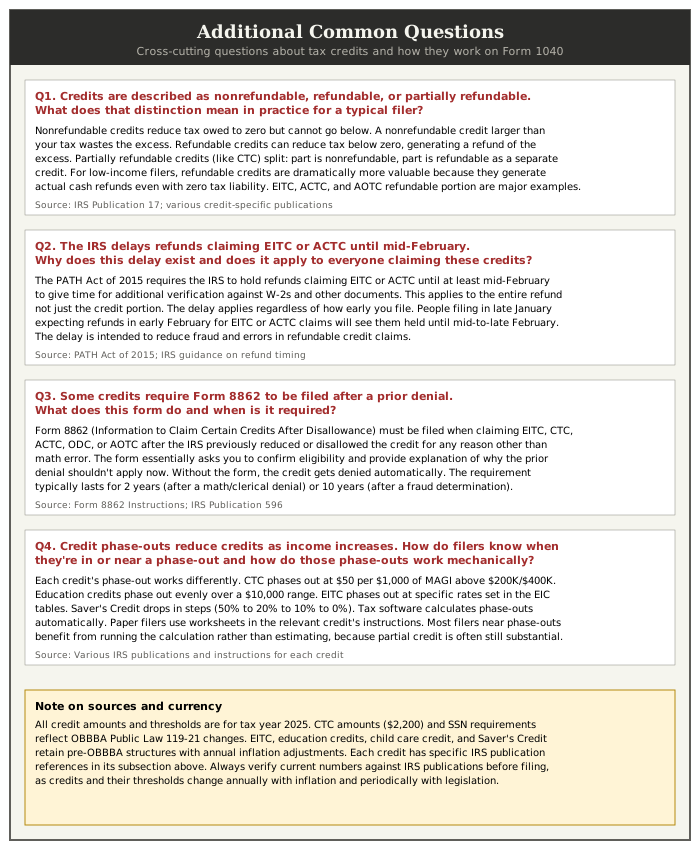
The IRS cannot issue refunds before mid-February for returns claiming the ACTC or EITC, even if you file in January. This is required by law (PATH Act) to give the IRS time to verify the credits.
Sourcing. IRS Publication 596 (Earned Income Credit); Schedule EIC Instructions; IRC section 32.
Child and Dependent Care Credit
Read this section if you paid for child care or care for a disabled spouse or dependent so you could work or look for work.
The Child and Dependent Care Credit (CDCC) covers a percentage of qualified child or dependent care expenses paid during the year. Despite the name similarity, this is completely different from the Child Tax Credit.
Qualifying expenses. Day care, after-school programs, summer day camp (not overnight camp), in-home care, preschool. The care must enable you (and your spouse if MFJ) to work or look for work. The care must be for a qualifying person — a child under 13, or a spouse or dependent unable to care for themselves.
Maximum qualifying expenses. $3,000 for one qualifying person, $6,000 for two or more qualifying persons. These caps haven't been adjusted in years and significantly understate actual child care costs in most areas.
Credit percentage. Varies from 20% to 35% based on AGI. At higher incomes (above $43,000), the credit is 20% of qualifying expenses. Lower-income filers get higher percentages, up to 35% for filers with AGI below $15,000.
Maximum credit. $600 to $2,100 depending on AGI and number of qualifying persons.
How to claim. Use Form 2441 to calculate the credit. The credit flows to Schedule 3 line 6 and ultimately to Form 1040 line 20. The credit is nonrefundable for most filers (only refundable in limited situations).
Earned income requirement. Both spouses on MFJ must have earned income (with exceptions for student-spouses and disabled spouses). Single filers must have earned income.
Provider information required. You must report the name, address, and TIN (SSN or EIN) of each care provider. Without this information, the credit is denied.
Coordination with FSA dependent care. If you contributed to a Dependent Care FSA at work (pre-tax up to $5,000 per year), those amounts reduce the expenses available for the credit. The FSA route is generally more valuable than the credit for most middle and upper-income filers.
Sourcing. IRS Publication 503 (Child and Dependent Care Expenses); Form 2441 Instructions; IRC section 21.
Education Credits — American Opportunity and Lifetime Learning
Read this section if you, your spouse, or your dependent paid for higher education during the year.
Two education credits exist, with different rules and amounts. You can only claim one credit per student per year (though you can claim different credits for different students on the same return).
American Opportunity Tax Credit (AOTC)
Amount. Up to $2,500 per eligible student per year. 40% of the credit (up to $1,000) is refundable.
Eligibility. Student must be pursuing a degree or credential, enrolled at least half-time, in their first four years of post-secondary education, and have not completed four years previously. No felony drug convictions.
Income limits. Phases out at MAGI between $80,000 and $90,000 for single filers, $160,000 and $180,000 for MFJ. MFS filers cannot claim AOTC.
Qualifying expenses. Tuition, required enrollment fees, and required course materials (textbooks, supplies). Room and board, transportation, and personal expenses do not qualify.
Lifetime Learning Credit (LLC)
Amount. Up to $2,000 per return (not per student). Nonrefundable.
Eligibility. Less restrictive than AOTC. Any post-secondary education, including job-related courses for working adults. No degree or half-time enrollment requirement. No four-year limit.
Income limits. Phases out at MAGI between $80,000 and $90,000 for single filers, $160,000 and $180,000 for MFJ. MFS filers cannot claim LLC.
Qualifying expenses. Same as AOTC — tuition and required fees.
Choosing between AOTC and LLC
For undergraduate students in their first four years, AOTC is almost always better because it's worth more ($2,500 vs $2,000) and has a refundable portion. LLC becomes the only choice for graduate students, students beyond the first four years, students taking job-related courses, or students enrolled less than half-time.
Form 1098-T. Your educational institution sends Form 1098-T showing tuition paid. The amount in Box 1 of the 1098-T is the starting point for calculating qualifying expenses, though you may have additional qualifying expenses not on the 1098-T (like required textbooks).
How to claim. Calculate the credits on Form 8863. The credits flow to Schedule 3 line 3 (nonrefundable portion) and Form 1040 line 29 (refundable portion of AOTC).
Sourcing. IRS Publication 970 (Tax Benefits for Education); Form 8863 Instructions; IRC sections 25A.
Retirement Savings Contributions Credit (Saver's Credit)
Read this section if you contributed to a retirement account and have lower or moderate income.
The Saver's Credit rewards low-to-moderate income filers for contributing to retirement accounts. It's one of the most commonly overlooked credits.
Amount. 10%, 20%, or 50% of up to $2,000 in contributions ($4,000 if MFJ), depending on AGI. Maximum credit is $1,000 single / $2,000 MFJ.
Income limits for 2025. The 50% credit applies to AGI up to about $23,750 single / $47,500 MFJ. The 20% credit applies to higher income. The 10% credit applies to higher income still. The credit phases out entirely at AGI of about $39,500 single / $79,000 MFJ for 2025.
Qualifying contributions. Contributions to traditional or Roth IRAs, 401(k) plans, 403(b) plans, 457(b) plans, SIMPLE IRAs, and SEP IRAs.
Eligibility. Must be age 18 or older, not a full-time student, and not claimed as a dependent on someone else's return.
Nonrefundable. Can reduce tax to zero but not below.
How to claim. Use Form 8880 to calculate the credit. Flows to Schedule 3 line 4.
Why this credit gets missed. Many lower-income filers don't realize their retirement contributions qualify. The income limits are calibrated to lower-income workers, but they're high enough that many people who qualify don't realize they do.
Sourcing. IRS Publication 590-A; Form 8880 Instructions; IRC section 25B.
Adoption Credit
Read this section if you adopted a child during the year.
Amount for 2025. Credit for qualified adoption expenses up to approximately $17,000 per child (inflation-adjusted; verify current amount). Both nonrefundable and refundable portions exist following recent legislative changes.
Qualifying expenses. Reasonable and necessary adoption fees, court costs, attorney fees, travel expenses, and other expenses directly related to the legal adoption. Surrogacy and adoption of stepchildren do not qualify.
Income limits. Phases out at MAGI above approximately $252,150 for 2025 (verify current amount).
Timing. Expenses can be claimed in the year paid for foreign adoptions if the adoption is finalized. Domestic adoption expenses can be claimed in the year incurred (even if adoption isn't finalized) or year of finalization, depending on the timing.
How to claim. Use Form 8839.
Sourcing. IRS Publication 968 (historical); Form 8839 Instructions; IRC section 23.
Foreign Tax Credit
Read this section if you paid income taxes to a foreign country.
If you have foreign income that's also taxed by the United States, the Foreign Tax Credit prevents double taxation by giving you a credit for foreign taxes paid.
Who needs this. US citizens with foreign-source income (foreign salary, foreign interest, foreign dividends, foreign rental income). US residents working in foreign countries part of the year. Investors in foreign stocks that pay foreign withholding tax on dividends.
How it works. You can take a credit for foreign income taxes paid up to the US tax that would otherwise apply to that foreign income. The credit can't exceed the US tax liability on the foreign-source income.
De minimis simplification. If your foreign tax is under $300 ($600 MFJ), you can claim the credit directly on Schedule 3 line 1 without filing Form 1116. This commonly applies to investors with foreign tax shown on 1099-DIV Box 7 from mutual funds holding foreign stocks.
For larger amounts. Form 1116 calculates the credit limitation based on the ratio of foreign income to total income.
Credit vs deduction. You can alternatively deduct foreign taxes on Schedule A instead of taking the credit. The credit is almost always better because credits are worth more per dollar than deductions.
How to claim. Form 1116 (or direct claim on Schedule 3 line 1 for de minimis amounts).
Sourcing. IRS Publication 514 (Foreign Tax Credit for Individuals); Form 1116 Instructions; IRC sections 901-908.
Career path applications for credits
- Families with young children typically claim CTC and possibly EITC and CDCC. The combination can produce substantial credits, sometimes thousands of dollars.
- Working families with lower income should specifically check EITC eligibility. The credit is one of the largest available to working-poor and lower-middle-class families.
- Self-employed people with lower income can claim EITC if their net self-employment earnings qualify. The earned income requirement includes self-employment income.
- College students or families of college students claim AOTC during the undergraduate years and may continue with LLC for graduate school.
- Working adults taking continuing education can claim LLC for job-related courses even if not pursuing a degree.
- Lower-income retirement savers can stack the Saver's Credit with their retirement plan contribution. A worker contributing $2,000 to a Roth IRA at the 50% rate gets a $1,000 credit on top of the future tax-free growth.
- International workers with foreign income claim the Foreign Tax Credit to avoid double taxation.
- Adoptive parents can claim the Adoption Credit for qualified expenses, sometimes worth thousands.
Common mistakes in this section
The most commonly missed credit. Even people who think they earn too much should run the calculation if they have qualifying children — the income limits are higher than many people expect.
Each dependent qualifies for one credit or the other, never both. Tax software prevents this but paper filers should be careful.
If the IRS previously denied your EITC or CTC and you're claiming it now, you must file Form 8862. Without it, the credit may be automatically denied.
For first-four-years undergraduates, AOTC is almost always better. Some filers default to LLC without checking. The difference can be $500+ per student.
Many lower-income filers contribute to retirement accounts without realizing they qualify for an additional credit on top of the contribution's other benefits.
The Child and Dependent Care Credit requires the care provider's name, address, and TIN. Without this information, the credit is denied.
Several credits (EITC, education credits in most cases, dependent care) are unavailable or restricted for MFS filers. The decision to file MFS should account for these losses.
Optimization opportunities in this section
Income limits adjust annually. A year you previously didn't qualify, you might qualify now if your income changed. The credit is too valuable to overlook.
AOTC is per-student per-year. If you're paying for a child's college, ensure expenses fall in years when the child meets AOTC eligibility (first four years, half-time enrollment). Sometimes paying spring semester tuition in December vs January affects which year the expenses count.
Lower-income filers who can spare even $200-500 for an IRA or workplace plan contribution get back 50% as a credit (under specific income limits). This is one of the highest-return tax moves available.
For most middle-income filers with employer-sponsored Dependent Care FSAs, the FSA is more valuable than the CDCC. Run the comparison or check with HR. Both can be used together — FSA reduces qualifying expenses for the credit but doesn't eliminate the credit entirely if expenses exceed the FSA amount.
If the IRS denied EITC, CTC, or other credits in prior years and you're now eligible, file Form 8862. Without it, the credit will be denied again automatically.
Investors with mutual funds holding foreign stocks often have small foreign tax amounts on 1099-DIV that qualify for the de minimis simplified credit. Even $50-100 of credit is worth claiming.
Connection to other sections
The credits flow from various forms (Schedule 8812, Form 2441, Form 8863, Form 8880, Form 8839, Form 1116, Schedule EIC) through Schedule 3 to Form 1040 lines 19, 20, 27, 28, and 29. The credits reduce your pre-credit tax from line 16 (covered in Lesson 6) and produce your tax-after-credits amount.
After credits, Schedule 2's other taxes get added on line 23 (other taxes — covered in the next lesson). The total tax on line 24 is what you ultimately owe before payments are credited.
Many credits use AGI or modified AGI (from Lessons 3 and 4) for phase-out calculations. Lower AGI generally helps qualify for more credit at higher amounts. The credits section is where the value of AGI-reducing above-the-line adjustments compounds — those adjustments not only reduce taxable income but also unlock credit amounts that would otherwise be phased out.
The dependent claims from Lesson 2 drive CTC, ODC, EITC, and CDCC eligibility. Getting the dependents section right is the foundation for getting these credits right.
What to gather for credits
Documentation of dependent information (already gathered in Lesson 2). For EITC, earned income documentation (W-2s, Schedule C). For CDCC, child care provider information including name, address, and TIN, plus payment records. For education credits, Form 1098-T from the educational institution plus records of qualifying expenses not on the 1098-T (required textbooks, etc.). For Saver's Credit, records of retirement contributions during the year. For Adoption Credit, records of adoption expenses and finalization documentation. For Foreign Tax Credit, Form 1099-DIV showing foreign tax (or other documentation of foreign taxes paid).
Key Takeaways
- Credits reduce tax dollar-for-dollar, making them more valuable per dollar than deductions — a $1,000 credit saves $1,000 of tax regardless of your bracket
- Refundable credits can generate a refund even with zero tax liability; nonrefundable credits can only reduce tax to zero
- The EITC is one of the largest credits available and one of the most commonly missed — roughly 20% of eligible filers don't claim it
- The Child Tax Credit is $2,200 per qualifying child under 17 for 2025, with up to $1,700 refundable as the Additional Child Tax Credit
- For undergraduate students in their first four years, AOTC ($2,500 per student) is almost always better than the LLC ($2,000 per return)
- ACTC and EITC refunds cannot be issued before mid-February due to the PATH Act — even if you file in January
- The Saver's Credit rewards lower-income retirement savers with a credit of 10%, 20%, or 50% of contributions
- If the IRS previously denied EITC or CTC and you're now eligible, file Form 8862 or the credit will be denied again automatically
Quiz — 5 Questions
Answer one at a timeYour pre-credit tax is $800 and you have a $1,500 nonrefundable credit. What is your tax after applying the credit?