Candles in Context — Reading Price Sequences
Knowing the vocabulary of a single candle is the first step. This lesson puts that vocabulary into motion: seeing a bullish candle, a bearish candle, and a marubozu as they actually appear inside a price sequence — and learning what each one means in context.
- Distinguish a standard trend candle from a signal candle in a price sequence
- Explain why a single bullish or bearish candle mid-trend is not a reversal signal
- Describe what a marubozu signals when it appears at a trend turning point
- Apply contrast recognition — identifying what makes a candle different from the ones around it
- Explain how the foundational candle vocabulary serves as the canvas for every pattern that follows
Candle anatomy basics — bullish, bearish, marubozu
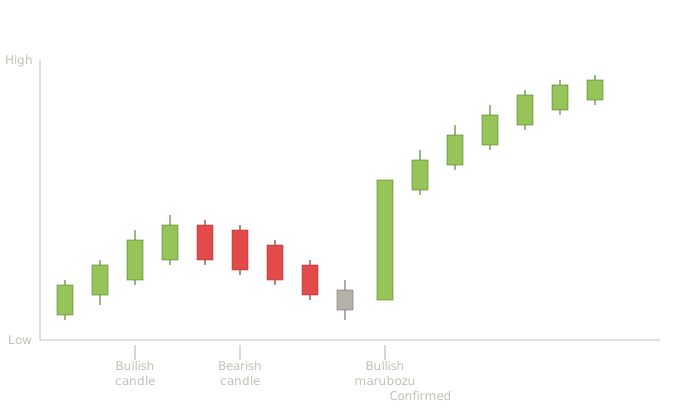
Bullish candle, bearish candle, and bullish marubozu — foundational shapes in a price sequence
This is a standard bullish candle within an established uptrend. The close sits above the open, the body is moderate, and small shadows on both ends show some intraday volatility before the session resolved higher. Real-world takeaway: most candles in a trend look like this. The teaching point is that a single bullish candle is not a signal — it's just price moving. Students need to resist reading meaning into every candle and reserve interpretation for distinctive shapes in distinctive locations.
A standard bearish candle appearing after the uptrend stalls. Close below open, moderate body, small shadows. The candle itself isn't a reversal signal — it's the first session of a pullback that may or may not develop. Real-world takeaway: students often want to label the first bearish candle in an uptrend as a reversal. It isn't. Reversal requires either a recognized pattern or a sequence of bearish candles establishing a new trend direction.
The marubozu has no shadows — open at the low, close at the high. One-sided buyer control for the entire session. Appearing here at the end of a brief pullback, it signals that buyers have decisively retaken control. The next candle continues higher with another solid bullish candle, confirming the marubozu's signal. The original uptrend resumes. Real-world takeaway: a marubozu is one of the cleanest single-candle signals because its meaning isn't ambiguous. No shadow means no opposing pressure during the session. When it appears at a turning point — end of a pullback, end of a consolidation, start of a breakout — it carries more weight than its size alone would suggest.
The three candles introduce the foundational vocabulary in motion. Students see that ordinary bullish and bearish candles are the background noise of trend — the canvas on which signals appear. The marubozu stands out specifically because it lacks shadows; that absence is what makes it informative. The interpretive habit being trained here is contrast recognition — noticing what's different about a candle relative to the ones around it. That habit applies to every pattern that follows.
Key Takeaways
- Most candles in a trend are ordinary — moderate body, small shadows. A single bullish or bearish candle is not a signal; it is price moving
- The first bearish candle in an uptrend is not a reversal. Reversal requires a recognized pattern or a sequence establishing a new trend direction
- A marubozu stands out by lacking shadows — no opposing pressure from open to close. When it appears at a turning point, that absence is the signal
- Contrast recognition is the core interpretive habit: notice what is different about a candle relative to the ones surrounding it
- Ordinary candles are the canvas. Distinctive shapes in distinctive locations are the signals painted on it
Quiz — 3 Questions
Answer one at a timeA bullish candle appears in the middle of a five-session uptrend. It has a moderate body and small shadows on both ends. What does this candle signal?