Two-Candle Patterns — The Relationship Between Sessions
When two consecutive candles interact, the relationship between them carries information the individual candles cannot. Engulfing patterns show decisive control shifts. The piercing family captures the midpoint threshold. Harami patterns are conditions, not signals.
- Define a bullish and bearish engulfing pattern and explain the structural engulfment requirement
- Explain why an engulfing pattern in sideways price action is not a valid signal
- Define the piercing pattern and dark cloud cover and explain the midpoint rule
- Define a harami and explain why it is a condition, not a confirmed signal
- Distinguish between a harami and a harami cross and explain which signals sharper indecision
Two-Candle Patterns
Now the relationship between consecutive candles starts to matter.
- Bullish engulfing — A two-candle pattern appearing in a downtrend. The first candle is bearish; the second is bullish with a real body that completely contains (engulfs) the first candle's real body. The second candle opens below the prior close and closes above the prior open. Suggests a shift from seller control to buyer control.
- Bearish engulfing — The mirror image, appearing in an uptrend. The first candle is bullish; the second is bearish with a body that engulfs the first body.
- Piercing pattern — A two-candle bullish reversal in a downtrend. The first candle is a long bearish candle. The second opens below the prior low (a downside gap) but rallies to close above the midpoint of the first candle's body. Buyers absorbed the gap-down and pushed back into the prior session's body.
- Dark cloud cover — The bearish mirror of the piercing pattern, appearing in an uptrend. The second candle gaps above the prior high, then sells off to close below the midpoint of the first candle's body.
- Harami — A two-candle pattern where the second candle's small body sits entirely inside the prior candle's larger body. The name comes from a Japanese word meaning 'pregnant' — the large candle is the mother, the small one is the child. Read as a pause or potential reversal because the second session failed to extend the prior session's move.
- Harami cross — A harami where the second candle is a doji rather than a small-bodied candle. The indecision is even sharper.
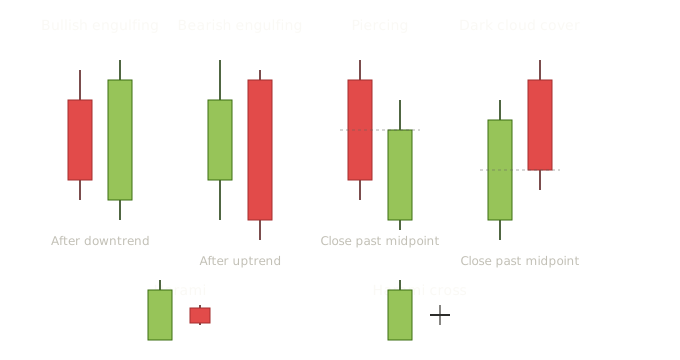
Bullish engulfing, bearish engulfing, piercing pattern, dark cloud cover, harami, and harami cross — the two-candle pattern family with structural requirements
Two-Candle Patterns — Pattern Reference
| Pattern | Confirmation | Volume | Reliability | Common Failure Mode |
|---|---|---|---|---|
| Bullish engulfing | Next candle closes above the engulfing candle's close, or simply continues higher. Many traders use the engulfing pattern itself as sufficient signal when magnitude is strong. | Engulfing candle formed on volume higher than the prior candle's is significantly more reliable. The volume expansion shows real participation in the shift. | One of the more widely respected two-candle reversal signals, especially with volume confirmation and good location. | Forms in choppy sideways action where every candle engulfs the prior. Without a clear prior trend, the pattern has no trend to reverse. |
| Bearish engulfing | Next candle closes below the engulfing candle's close. | Higher volume on the engulfing candle than the prior bullish candle strengthens the signal. | Comparable to bullish engulfing in mirror. | In strong uptrends, a single bearish engulfing can be absorbed and the trend resumes within two or three sessions. |
| Piercing pattern | Next candle closes above the piercing candle's close. | Heavy volume on the second candle, especially during the recovery from the gap down, strengthens the signal. | Generally considered less reliable than a full bullish engulfing because the second candle only penetrates the prior body partially. | The penetration depth is too shallow (just past midpoint) and sellers reassert. |
| Dark cloud cover | Next candle closes below the dark cloud candle's close. | Heavy volume during the second candle's decline confirms real selling. | Comparable to piercing in mirror. | In a strong uptrend, gets overrun within two sessions. |
| Harami | Next candle closes outside the small candle's range, in the reversal direction. Essential — the harami alone is a pause signal, not a reversal. | Light volume on the small inside candle confirms the loss of momentum. | Generally considered less reliable than engulfing as a reversal signal. Better read as a momentum pause that may or may not resolve into reversal. | The small candle is just a quiet pause in an ongoing trend that resumes the next session. |
| Harami cross | Same as harami — next candle must close outside the doji's range in the reversal direction. | Light volume on the doji is expected. | Generally considered more telling than standard harami because the doji is sharper indecision. Still requires confirmation. | Same as harami. |
Bearish engulfing: Liberated Stock Trader's testing shows a 57% winner rate with 0.62% profit per trade. Bullish harami cross: Liberated Stock Trader's testing shows a 55.3% winner rate with 0.58% profit per trade. Bearish harami cross: Liberated Stock Trader's testing shows a 57% winner rate with 0.57% profit per trade.
Key Takeaways
- Bullish engulfing: second candle's body completely contains the first — opens below prior close, closes above prior open. Appears after a downtrend. Bearish engulfing: mirror, after uptrend
- Engulfing patterns in sideways price action are not signals — the pattern requires a prior trend to reverse
- Piercing pattern and dark cloud cover: second candle gaps in the trend direction then reverses into the first candle's body — must close beyond the first candle's midpoint to qualify as reversal
- Harami — second candle's small body sits entirely inside the prior candle's larger body. A condition, not a confirmed reversal. The harami creates the condition for a reversal but does not itself reverse anything
- Harami cross — harami where the second candle is a doji. Sharper indecision than standard harami. Same confirmation rule applies — confirmation is required
Quiz — 3 Questions
Answer one at a timeA bearish candle is followed by a bullish candle whose body completely contains the bearish candle's body, in a sustained downtrend. What pattern has formed?