Indecision and the Doji Family
A doji forms when open and close are essentially equal — neither buyers nor sellers won the session. The shape of its shadows determines which subtype it is, and location determines whether it means anything at all.
- Define a doji and explain what the open-equals-close relationship means
- Identify and name all four members of the doji family by their shadow configuration
- Explain why a doji is a context signal, not a standalone reversal signal
- Describe what a dragonfly doji communicates about the buyer-seller battle
- Describe what a gravestone doji communicates about the buyer-seller battle
Indecision and the Doji Family
- Doji — A candle where open and close are essentially equal, producing a real body that's just a horizontal line (or extremely thin). Represents indecision — neither buyers nor sellers won the session. The shape of its shadows determines which subtype it is.
- Long-legged doji — A doji with long upper and lower shadows of roughly equal length. Price swung widely in both directions before returning to the open. Maximum indecision.
- Dragonfly doji — A doji where open and close occur at (or near) the high. Long lower shadow, no upper shadow. Sellers pushed price down during the session but buyers recovered all of it by the close.
- Gravestone doji — A doji where open and close occur at (or near) the low. Long upper shadow, no lower shadow. Buyers pushed price up during the session but sellers recovered all of it by the close.
- Four-price doji — A rare candle where open, high, low, and close are all the same price. Appears as a single horizontal dash. Indicates no trading range — typical only in extremely illiquid conditions.
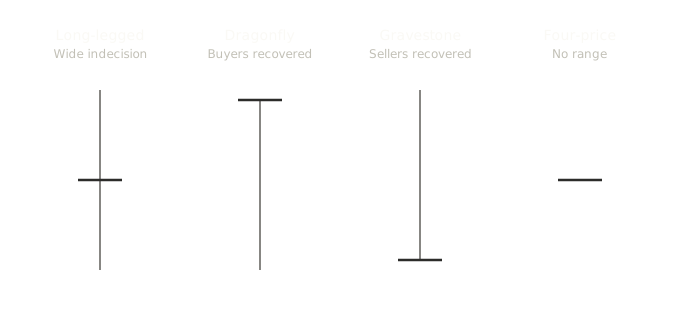
Long-legged doji, dragonfly doji, gravestone doji, and four-price doji — shadow configurations and what each encodes about the buyer-seller battle
Doji Family — Pattern Reference
| Pattern | Confirmation | Volume | Reliability | Common Failure Mode |
|---|---|---|---|---|
| Doji (general) | Next candle's direction tells the story. A doji is indecision; the following candle resolves it. | Heavy volume on a doji is more telling than light volume — it means significant trading occurred without net progress, which is a stronger signal of stalemate. | The doji is a context signal, not a standalone trade signal. Reliability depends entirely on what surrounds it. | Traders act on the doji alone, before confirmation, and get whipsawed. |
| Dragonfly doji | Next candle closes above the dragonfly's body line. | Strong volume strengthens the bullish read — sellers tested the downside heavily and were absorbed. | Generally considered more reliable than a long-legged doji because the recovery to the open shows clear buyer dominance by close. | The low gets retested and breaks the next session. |
| Gravestone doji | Next candle closes below the gravestone's body line. | Heavy volume strengthens the bearish read. | Comparable to dragonfly in mirror — clear seller dominance by close. | The high gets retested and breaks the next session. |
| Long-legged doji | Whichever direction the next candle closes resolves the indecision. A bullish next candle confirms bullish intent; a bearish next candle confirms bearish intent. The doji itself carries no directional prediction. | Heavy volume on a long-legged doji is more significant than light volume — high-volume indecision means significant trading activity produced no net result, which is a sharper signal of stalemate. | No directional lean — reliability is context-dependent. The pattern itself signals symmetric indecision with no edge on either side. | Treated as a reversal signal when it is actually a continuation pause. Most mid-trend long-legged doji are noise. |
| Four-price doji | Not applicable — four-price doji are data artifacts of thin instruments. No actionable signal is present regardless of what follows. | By definition, very low volume. The pattern itself signals absence of participation. | No reliable signal content — appears only in extremely thin markets with negligible trading activity. | Misidentification as a meaningful signal. In thin instruments, a four-price doji is a data artifact. |
Gravestone doji: Liberated Stock Trader's testing shows a 57% winner rate with 0.65% profit per trade — ranking among their top candle patterns. No isolated large-sample published figure for the dragonfly specifically. Multi-source pool for students to consult: thepatternsite.com (Bulkowski) — most extensive single source, methodology measures 10-day post-breakout performance; liberatedstocktrader.com (Barry D. Moore) — 20-year backtest on Dow components; quantifiedstrategies.com — independent backtest framework; Google Scholar / SSRN — academic literature with transaction-cost adjustments.
Key Takeaways
- Doji — open and close are essentially equal, producing a real body that's just a horizontal line. Represents indecision — neither buyers nor sellers won the session
- Long-legged doji: long upper and lower shadows of roughly equal length — maximum indecision, both sides pushed and failed equally
- Dragonfly doji: open and close at or near the high, long lower shadow — sellers pushed and lost. Potential bullish signal after a downtrend
- Gravestone doji: open and close at or near the low, long upper shadow — buyers pushed and lost. Potential bearish signal after an uptrend
- A doji is a context signal — it requires a prior trend to reverse and a next candle to confirm. Without both, it is noise
Quiz — 3 Questions
Answer one at a timeA gravestone doji forms: Open = Close = $100, High = $115, Low = $100. What happened during this session and what does it suggest?