Three-Candle Patterns — Setup, Indecision, Confirmation
Three-candle patterns include their own confirmation built into the structure. The first candle establishes that the prior trend is still in force. The second shows momentum has faltered. The third proves the other side has taken control.
- Define the morning star and evening star and explain the role of each of the three candles
- Explain what makes a morning doji star stronger than a standard morning star
- Define three white soldiers and three black crows and state the structural open-within-body rule
- Explain why penetration depth on the third candle of a morning/evening star affects signal quality
- Explain why three-candle patterns are generally more reliable than two-candle patterns
Three-Candle Patterns
Three-candle patterns add a setup-confirmation rhythm: the first candle establishes the prior trend, the second signals indecision or reversal, and the third confirms.
- Morning star — A three-candle bullish reversal in a downtrend. The first candle is a long bearish candle continuing the decline. The second is a small-bodied candle (the 'star') that gaps below the first, showing the selling has lost steam. The third is a long bullish candle that closes well into the body of the first candle. The middle candle is the moment of indecision; the third is the confirmation.
- Evening star — The bearish mirror, appearing in an uptrend. Long bullish candle, small-bodied star gapping above it, then a long bearish candle that closes well into the first candle's body.
- Morning doji star — A morning star where the middle candle is a doji rather than a small-bodied candle. The indecision is sharper, and the reversal signal is generally considered stronger.
- Evening doji star — The bearish mirror, with a doji as the middle candle.
- Three white soldiers — Three consecutive long bullish candles, each opening within the prior candle's body and closing near its high. Each candle adds to the previous, showing sustained buying pressure. Read as a strong bullish signal, especially when appearing after a downtrend or consolidation.
- Three black crows — The bearish mirror. Three consecutive long bearish candles, each opening within the prior body and closing near its low. Sustained selling pressure.
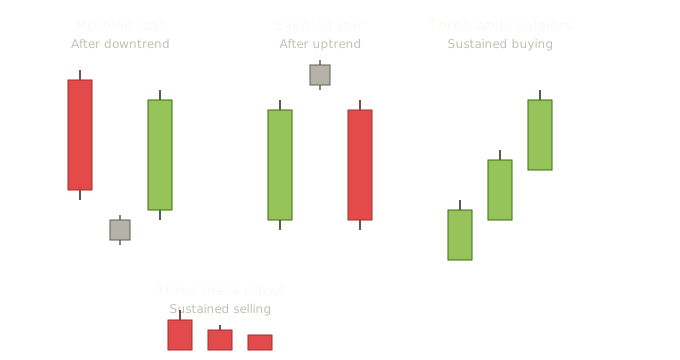
Morning star, evening star, morning doji star, evening doji star, three white soldiers, and three black crows — the three-candle pattern family showing setup, indecision, and confirmation roles
Three-Candle Patterns — Pattern Reference
| Pattern | Confirmation | Volume | Reliability | Common Failure Mode |
|---|---|---|---|---|
| Morning star | The third candle is itself the confirmation. Additional confirmation: a fourth candle continuing higher. Strongest signal: third candle is a long bullish marubozu closing near the first candle's open. | Ideal volume pattern — declining volume on the first two candles, expanding volume on the third. Shows seller exhaustion followed by buyer entry. | Widely considered among the more reliable three-candle reversal signals, especially when penetration depth on the third candle is strong. | Third candle is short and only barely penetrates the first body — pattern technically forms but signal is weak. |
| Evening star | Third candle is the confirmation. Strongest signal: third candle is a long bearish marubozu closing near the first candle's open. | Ideal — declining volume on the first two candles, expanding volume on the third. | Comparable to morning star in mirror. | Same as morning star — weak penetration on the third candle. |
| Morning doji star / Evening doji star | Third candle is confirmation. Generally regarded as a slightly stronger variant than the standard star because the middle candle is sharper indecision. | Same pattern as standard star — declining then expanding. | Generally regarded as marginally more reliable than the non-doji version. | Same as standard star. |
| Three white soldiers | The third soldier is itself confirmation. Further follow-through next session strengthens. | Steady or expanding volume across the three candles. Declining volume across the three is a warning sign. | Widely considered a strong bullish signal when location is good (after a downtrend or sideways consolidation). Less reliable when appearing late in an extended uptrend — can mark exhaustion rather than continuation. | 'Three soldiers' appearing at the top of an already-extended uptrend often precedes a sharp correction. Magnitude matters — soldiers that are unusually long for the chart's recent volatility are suspect. |
| Three black crows | The third crow is itself confirmation. | Steady or expanding volume across the three candles strengthens the signal. | Comparable to three white soldiers in mirror. | Same — three crows late in a downtrend can mark capitulation rather than continuation, and a sharp reversal follows. |
Multi-source pool for students to consult: thepatternsite.com (Bulkowski) — morning star, evening star, three white soldiers, and three black crows all have extensive pattern pages with rank, frequency, and 10-day performance data; liberatedstocktrader.com (Barry D. Moore) — 20-year Dow backtest covering morning/evening star variants; quantifiedstrategies.com — independent backtests with explicit rule definitions, star patterns and soldier/crow patterns included in their 75-pattern study; Google Scholar / SSRN — academic literature. Key researchers: Lu, Shiu & Liu (Asian markets, three-line patterns); Caginalp & Laurent (early reversal work). General conclusion across sources: most three-candle patterns work modestly above 50% in isolation. Context — location, confluence, confirmation quality — is what separates tradeable setups from noise.
Key Takeaways
- Morning star — three-candle bullish reversal: long bearish candle, small star (gap below), long bullish candle closing well into the first body. Evening star: bearish mirror
- Morning doji star and evening doji star: the star is a doji — sharper indecision — generally considered marginally stronger than the standard version
- Three-candle patterns include their own confirmation. The third candle is the confirmation — no external fourth session required
- Three white soldiers: three consecutive long bullish candles, each opening within the prior candle's body. Three black crows: bearish mirror. The open-within-body rule is what makes the pattern valid
- Three white soldiers late in an extended uptrend may signal exhaustion. Three black crows late in a downtrend may signal capitulation. Location within the larger trend is always required context
Quiz — 3 Questions
Answer one at a timeIn a morning star pattern, the third candle closes just barely above the midpoint of the first candle's body. Compared to a morning star where the third candle closes near the first candle's open, how does this affect signal quality?