Doji Family in Context — Reading Indecision in a Price Sequence
Knowing the four doji shapes is necessary but not sufficient. This lesson puts them inside a price sequence so you can see the difference between a doji that means something and one that is just noise.
- Identify why a doji in sideways action is noise regardless of its shape
- Explain what makes a dragonfly doji at the bottom of a downtrend a high-quality signal
- Explain what makes a gravestone doji at the top of an uptrend a high-quality signal
- Apply the four quality dimensions — location, magnitude, confluence, confirmation — to evaluate a doji
- Describe the failure mode for each doji type in context
Doji family in context — long-legged, dragonfly, gravestone
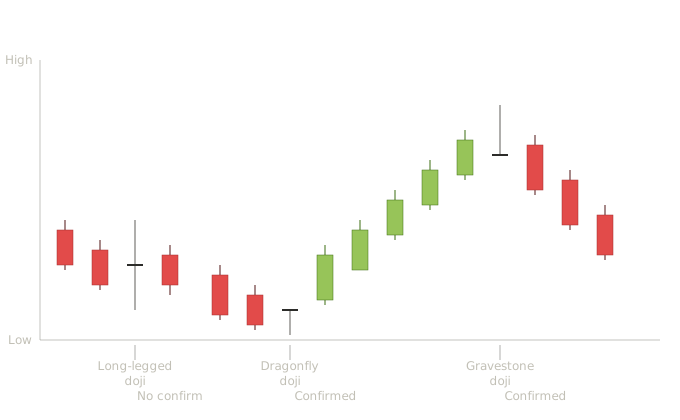
Long-legged doji, dragonfly doji, and gravestone doji — with confirmation and non-confirmation
The first doji appears in choppy, directionless price action. The long upper and lower shadows show that the session swung widely in both directions before closing essentially where it opened — maximum indecision. The next candle is a bearish candle similar to those that preceded the doji, meaning no confirmation arrived. The market remained directionless and drifted lower. Real-world takeaway: a long-legged doji appearing in sideways action without a clear prior trend has nothing to reverse. Students should learn to skip these rather than trade them.
This doji appears after several bearish sessions have pushed price into a low. The long lower shadow shows that sellers tested even lower during the session, but buyers absorbed the selling completely and pushed price back to the open by the close. The next candle is a strong bullish candle that closes well above the dragonfly's body — confirmation present. The recovery follows. Real-world takeaway: location turns the dragonfly into a high-quality signal. The same shape in the middle of a sideways range would be noise; after a sustained decline with clear seller exhaustion, it's a signal worth acting on once confirmation arrives.
This doji appears after a sustained advance has carried price into the chart's high. The long upper shadow shows buyers tried to push higher and failed — sellers recovered the entire intraday rally by the close. The next candle is a long bearish candle closing well below the gravestone's body — confirmation present. The reversal follows. Real-world takeaway: gravestone at the top of an extended rally is the mirror image of the dragonfly scenario. Students should specifically watch for it when an uptrend looks tired and the session opens, rallies, and gives back the gains.
The three doji types all encode indecision, but their shadows tell different stories about who was in control during the indecision. Long-legged means both sides fought equally. Dragonfly means sellers pushed and lost. Gravestone means buyers pushed and lost. Reading the shadows tells the student which side has tipped — and combining that with location (where in the trend) and confirmation (what happens next) is the full interpretive process. The chart also models the four-dimension quality framework in action: the first doji failed on location (no trend to reverse) and confirmation (next candle didn't break either way). The second and third succeeded on all dimensions — location (clear prior trend), magnitude (long shadows), and confirmation (next candle closed decisively in the reversal direction).
Key Takeaways
- A doji in sideways action has no trend to reverse — it is noise. Location is the first filter, before anything else
- Dragonfly doji after a downtrend: sellers tested lower and lost — buyers recovered everything by the close. Location + confirmation = high-quality signal
- Gravestone doji after an uptrend: buyers pushed higher and lost — sellers recovered everything by the close. Mirror of the dragonfly
- The four quality dimensions apply to every doji: location (where in the trend), magnitude (length of the shadow), confluence (support or resistance nearby), confirmation (what the next candle does)
- A doji never confirms itself — the candle after it is always required. Acting on the doji alone, before confirmation, is the primary failure mode
Quiz — 3 Questions
Answer one at a timeA dragonfly doji appears in the middle of a sideways trading range. The next candle is bullish. Should you treat this as a high-quality reversal signal?