Continuation Candle Patterns — Rising Three Methods, Tasuki Gaps, and Separating Lines
These signal that the current trend is pausing, not reversing. The market catches its breath, then resumes in the original direction.
- Define a continuation pattern and distinguish it from a reversal pattern
- Identify rising three methods and falling three methods by their five-candle bounded counter-trend structure
- Explain the gap-holding rule for upside and downside tasuki gaps
- Describe mat hold and explain how its opening gap distinguishes it from rising three methods
- Describe separating lines and explain why the same-open rule is evidence of strong trend persistence
- Apply the confirmation, volume, and reliability framework to each continuation pattern
Continuation patterns
These signal that the current trend is pausing, not reversing. The market catches its breath, then resumes in the original direction.
- Rising three methods — A five-candle bullish continuation pattern in an uptrend. The first candle is a long bullish candle. Three small-bodied candles follow, each typically bearish, that drift downward but stay within the range of the first candle. The fifth candle is a long bullish candle that closes above the first candle's close. The small middle candles represent a brief pullback; the final candle confirms the uptrend is intact.
- Falling three methods — The bearish mirror. Long bearish candle, three small candles drifting upward within its range, then a long bearish candle closing below the first.
- Upside tasuki gap — A three-candle bullish continuation pattern. Two bullish candles separated by an upward gap, followed by a bearish candle that opens within the second candle's body and closes within the gap — but does not close the gap entirely. The gap holding is what makes this a continuation rather than reversal signal.
- Downside tasuki gap — The bearish mirror.
- Separating lines — Two candles of opposite color where both open at the same price. In an uptrend, a bearish candle is followed by a bullish candle opening at the same price as the prior open — the bearish candle is rejected and the uptrend resumes.
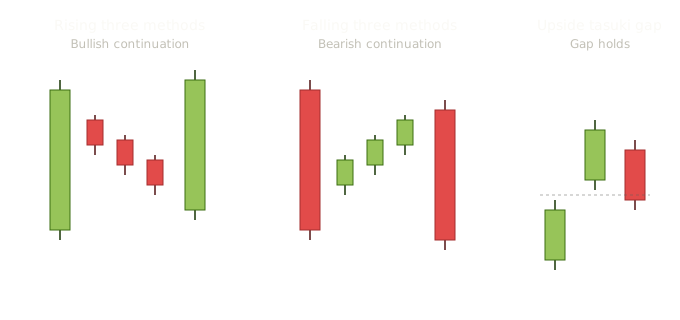
Rising three methods, falling three methods, tasuki gap, mat hold, and separating lines — the continuation pattern family showing the bounded counter-trend structure
Continuation patterns — pattern reference
| Pattern | Confirmation | Volume | Reliability | Common Failure Mode |
|---|---|---|---|---|
| Rising three methods / falling three methods | The fifth candle is the confirmation. It must close beyond the first candle's close in the trend direction. | Heaviest volume on the first and fifth candles; light volume on the three small middle candles. This volume signature is what distinguishes a true rising three methods from random consolidation. | Generally regarded as a respected continuation pattern when the volume signature is present. Without proper volume, less trustworthy. | The small middle candles drift outside the first candle's range, breaking the pattern's structural rule. |
| Upside tasuki gap / downside tasuki gap | The pattern is itself a continuation signal — confirmation is the next candle continuing in the original trend direction. Critically, the gap must remain unfilled. | Higher volume on the gap candle, lower volume on the third (counter-trend) candle is the constructive signature. | Modest as a standalone signal. Useful primarily as a check on whether a gap is being respected. | The gap fills within a few sessions, invalidating the continuation read. |
Rising three methods: PatternsWizard's research across 4,120 markets found the rising three methods and falling three methods pattern confirms 74.5% of the time on average. The Robust Trader's backtest framework covers this pattern alongside 75 others and reports it as a reliable tool for predicting short-term price movements. Falling three methods: Bulkowski's testing shows the falling three methods acts as a bearish continuation 71% of the time, with a reversal-rank of 7 (very high, where 1 is best). Frequency rank is 91 out of 103, meaning the pattern is rare. Overall performance ranks 89th, likely due to the small sample size of 64 instances found across 4.7 million candle lines studied. Teaching point: The 71% continuation rate and 74.5% confirmation rate from two different sources cluster well, but note the extreme rarity — students may go months without seeing the pattern. The combination of high reliability and low frequency makes this a wait-for-it pattern rather than a workhorse. Multi-source pool: thepatternsite.com, patternswizard.com, therobusttrader.com, quantifiedstrategies.com, academic Google Scholar searches.
Key Takeaways
- Continuation patterns signal a healthy pause, not a reversal — the trend resumes after the structure completes
- Rising three methods: the bounded counter-trend rule requires the three middle candles to stay within the first candle's range; if they breach it, the continuation signal is invalidated
- Rising three methods confirms 74.5% of the time (PatternsWizard); falling three methods confirms 71% (Bulkowski) — but rare at frequency rank 91/103
- The tasuki gap is valid only when the counter-trend third candle does not fully fill the gap — gap closure invalidates the signal
- Volume signature matters: heavy on the bookend candles, light on the middle candles is the constructive signature
- Separating lines: both candles open at the same price — the counter-trend session is completely absorbed and the trend resets to the same starting point, which is evidence of strong trend persistence
Quiz — 3 Questions
Answer one at a timeIn a rising three methods pattern, what happens if the third small bearish candle closes below the first long bullish candle's low?