Technical 200Lesson 4 of 138 min
The Interpretation Framework — Location, Magnitude, Confluence, and Confirmation
This is where students often get stuck — they memorize patterns but can't tell which signals to trust. These terms describe how to evaluate a pattern's quality once you've identified it.
What you'll learn
- Define pattern reliability, failure rate, and pattern failure
- Define confirmation candle and volume confirmation
- Define confluence, location, magnitude, and penetration depth
- Apply the four quality dimensions — location, magnitude, confluence, confirmation — to any identified pattern
The interpretive layer
This is where students often get stuck — they memorize patterns but can't tell which signals to trust. These terms describe how to evaluate a pattern's quality once you've identified it.
- Pattern reliability — The historical frequency with which a pattern produces the move it predicts. Not every engulfing pattern reverses the trend; reliability is a statistical property, not a guarantee. Higher-reliability patterns produce their predicted move more often, but no pattern works every time.
- Failure rate — The percentage of times a pattern's predicted move does not occur. Often more useful than reliability for risk management — knowing a pattern fails 40% of the time tells you to size positions accordingly.
- Pattern failure — A specific instance where a pattern formed correctly but the predicted move did not follow. A failed bullish reversal in a downtrend often accelerates the downtrend, because traders who entered on the signal are forced out.
- Confirmation candle — The candle immediately following a reversal signal that either supports or rejects it. A bullish reversal pattern is confirmed when the next candle closes above the pattern's high; rejected when it closes below the pattern's low.
- Volume confirmation — Higher-than-average trading volume on a pattern's signal candle. Patterns formed on strong volume are generally more reliable than identical patterns formed on weak volume, because volume indicates broad participation in the move.
- Confluence — The occurrence of a candlestick signal at the same price level as another technical factor — a support line, a resistance level, a moving average, a Fibonacci retracement, a prior pivot. Patterns at confluence points are more reliable than the same patterns appearing in isolation.
- Location — Where in the broader trend a pattern appears. A bullish reversal pattern after a sustained, exhausted downtrend carries more weight than the same pattern after a two-bar dip. Location is what separates a meaningful signal from random noise.
- Magnitude — The size of a pattern relative to recent candles. An engulfing pattern where the second candle is twice the size of recent candles is more significant than one barely larger than the first.
- Penetration depth — In patterns where one candle pierces into the prior candle's body (piercing pattern, dark cloud cover, morning star), the percentage of the prior body that the new candle penetrates. Deeper penetration (closer to fully engulfing) generally indicates stronger reversal signals.
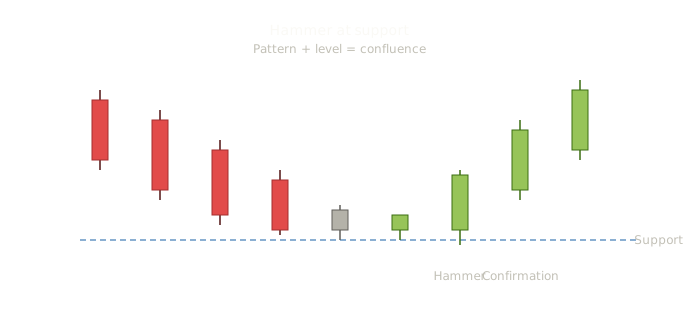
Hammer at a prior support level — confluence of candlestick signal, horizontal support, and trend context
Key Takeaways
- Pattern reliability is a statistical property — higher-reliability patterns produce their predicted move more often, but no pattern works every time
- Failure rate is often more useful than reliability for risk management — knowing a pattern fails 40% of the time tells you to size positions accordingly
- A failed bullish reversal in a downtrend often accelerates the downtrend, because traders who entered on the signal are forced out
- Confirmation candle: a bullish reversal is confirmed when the next candle closes above the pattern's high; rejected when it closes below the pattern's low
- Volume confirmation: patterns formed on strong volume are generally more reliable because volume indicates broad participation
- Location is what separates a meaningful signal from random noise — a bullish reversal after a sustained exhausted downtrend carries more weight than the same pattern after a two-bar dip
Quiz — 3 Questions
Answer one at a timeQuestion 1 of 30 answered
A bullish engulfing pattern forms correctly but the next candle closes below the engulfing candle's low. What has occurred?
AThe pattern is still valid — one rejecting candle does not invalidate an engulfing pattern
BPattern failure — the pattern formed correctly but the predicted move did not follow; the downtrend often accelerates from here as forced exits add selling pressure
CThe pattern requires one more candle before being confirmed or rejected
DThis converts the engulfing into a three inside down pattern