Extended Three-Candle Patterns — Three Inside and Three Outside
The pattern family tree: harami confirmed = three inside up; engulfing confirmed = three outside up. How a third candle converts a tentative two-candle signal into a confirmed reversal — and the bearish mirrors.
- Identify three inside up and three inside down and trace their harami parentage
- Identify three outside up and three outside down and trace their engulfing parentage
- Define stick sandwich and matching low and explain how matching closes function as support evidence
- Identify the concealing baby swallow and explain why its fourth candle signals exhaustion rather than continuation
- Apply the confirmation, volume, and reliability framework to each extended multi-candle pattern
More multi-candle patterns
These extend the two-candle vocabulary by adding a confirmation candle — converting tentative signals into structurally proven reversals.
- Three inside up — A three-candle bullish reversal that builds on the harami. First candle: long bearish. Second candle: small bullish body contained inside the first (a bullish harami). Third candle: a bullish candle that closes above the first candle's open. The harami sets up the indecision; the third candle confirms the reversal.
- Three inside down — The bearish mirror in an uptrend.
- Three outside up — A three-candle bullish reversal built on engulfing. First candle: bearish. Second candle: bullish engulfing pattern. Third candle: another bullish candle closing higher than the second. The engulfing signals the shift; the third candle confirms follow-through.
- Three outside down — The bearish mirror.
- Stick sandwich — A three-candle pattern. Two bearish candles separated by a bullish candle, where the two bearish candles close at the same price. Read as a bullish reversal because the bullish candle in the middle shows that buyers have established a floor at that closing price.
- Matching low — Two bearish candles in a downtrend that close at the same price. Similar logic to a tweezer bottom but measured by closes rather than lows.
- Concealing baby swallow — A rare four-candle bullish reversal in a downtrend. Two bearish marubozu candles, then a third bearish candle that opens with a downside gap but trades up into the prior candle's body, then a fourth long bearish candle that engulfs the third. The "swallowing" of the third candle by the fourth, paradoxically, exhausts the selling — the pattern marks capitulation rather than continuation.
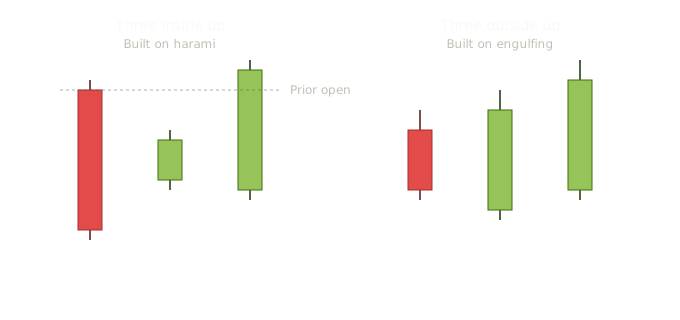
Three inside up, three inside down, three outside up, three outside down, and concealing baby swallow — structure showing the two-candle parent pattern plus its confirmation candle
Extended three-candle patterns — pattern reference
| Pattern | Confirmation | Volume | Reliability | Common Failure Mode |
|---|---|---|---|---|
| Three inside up / three inside down | Third candle is the confirmation built into the pattern. Further follow-through strengthens. | Ideal — light volume on the harami middle candle, expanding volume on the third confirming candle. | Generally regarded as more reliable than the bare harami because confirmation is structurally required by the pattern definition. | Third candle is short and doesn't decisively break the prior trend. |
| Three outside up / three outside down | Third candle is confirmation. Follow-through next session strengthens. | Expanding volume on the engulfing candle (second) and the confirmation candle (third) is the strongest signal. | Generally regarded as more reliable than a bare engulfing pattern because confirmation is structurally required. | Same as engulfing — occurs in sideways chop with no real trend to reverse. |
| Stick sandwich | Next candle closes above the pattern's high (for bullish stick sandwich). | No specific signature widely emphasized; volume confirmation on the breakout candle is the key check. | Generally regarded as less reliable than morning star or three inside up. More of a curiosity pattern in most curricula. | Frequent. The two matching closes can be coincidence rather than meaningful support. |
| Matching low | Next candle closes above the matching low level. | Heavier volume on the second matching candle suggests real seller exhaustion at the level. | Modest. Better treated as a level-identification tool than a trade signal. | The level breaks on the third or fourth session. |
| Concealing baby swallow | Next candle continuing higher, ideally with a gap up. | Heavy volume on the fourth (engulfing) candle is the key signature. | Rare enough that meaningful reliability data is hard to come by. Generally regarded as a high-conviction signal when correctly identified, but verification is difficult. | Misidentification is the dominant failure — the pattern's specific structural requirements (two marubozu, gap-down third, engulfing fourth) are easy to approximate but hard to find exactly. |
Three inside up / three inside down and three outside up / three outside down are covered in the standard multi-source pools but specific aggregate statistics are less widely cited than for single and two-candle patterns, partly because their structural requirements are strict enough that sample sizes are smaller in backtests. The four primary sources students can consult: thepatternsite.com (Bulkowski — post-breakout 10-day performance), liberatedstocktrader.com (Moore — 10-day holding period on Dow components), quantifiedstrategies.com (independent SPY-based backtest), and academic literature via Google Scholar and SSRN. Teaching point: for three inside up and three outside up, the reliability advantage over the bare parent patterns (harami, engulfing) is the central claim — not a specific percentage. The structural confirmation requirement filters out the ambiguous harami and engulfing instances that fail quickly, leaving a population of signals that by definition have already produced a confirming third candle. Students who understand this filtering mechanism understand why the three-candle versions outperform the two-candle versions without needing a specific number. Stick sandwich and matching low: generally treated as level-identification tools in the literature rather than high-reliability trade signals. Both patterns identify a closing price that held twice; the question is whether the market will defend it a third time. Concealing baby swallow: rarity itself reduces the available backtest sample. Pattern sites note the pattern's extremely strict structural requirements — two marubozu, gap-down third, engulfing fourth — make random false positives extremely unlikely, which is the qualitative basis for the high-conviction assessment. Multi-source pool: thepatternsite.com, liberatedstocktrader.com, quantifiedstrategies.com, litefinance.org, patternswizard.com.
Key Takeaways
- Three inside up is a bullish harami with a confirming bullish third candle built into the pattern definition — confirmation is structural, not hoped for
- Three outside up is a bullish engulfing with a confirming bullish third candle — same logic, different parent pattern
- The meta-principle: many three-candle patterns are two-candle patterns + structural confirmation; knowing the parent makes the child automatic
- Stick sandwich and matching low identify levels where buyers twice prevented sellers from closing below a specific price — useful as level markers, not primary signals
- Concealing baby swallow: a rare four-candle bullish reversal — two bearish marubozu, a gap-down third that trades back into the prior body, a fourth that engulfs the third; the swallowing marks capitulation, not continuation
- Rarity is a reliability indicator when structural requirements are strict — patterns that noise cannot manufacture carry higher signal value when they do appear
Quiz — 3 Questions
Answer one at a timeA student sees a bullish harami in a downtrend. The next candle is a small doji — not clearly bullish. Is this a completed three inside up?