The Penetration Spectrum — One Variable Separates Continuation from Reversal
On-neck, in-neck, thrusting, and piercing are not four patterns — they are four points on one continuum. The midpoint of the prior body is the single threshold that changes bearish continuation into bullish reversal.
- Define on-neck line, in-neck line, and thrusting line and place each on the penetration spectrum
- Explain why below-midpoint penetration favors continuation and above-midpoint penetration favors reversal
- Apply the confirmation, volume, and reliability framework to on-neck, in-neck, and thrusting
- Explain why on-neck is the most reliable continuation signal of the three and thrusting is the weakest
The penetration spectrum
- On-neck line — A two-candle bearish continuation pattern in a downtrend. Long bearish candle followed by a small bullish candle that closes at (or very near) the prior candle's low. The bullish candle fails to penetrate into the prior body — the downtrend's momentum is intact.
- In-neck line — Similar to on-neck but with the bullish candle closing slightly above the prior low (just barely into the prior body). Also a bearish continuation; the shallow penetration is what distinguishes it from a piercing pattern.
- Thrusting line — A two-candle pattern where the second bullish candle closes deeper into the prior bearish body than an in-neck line, but still below the midpoint. Ambiguous — usually bearish continuation but weaker than on-neck or in-neck.
The progression from on-neck to in-neck to thrusting to piercing pattern is a continuum based on how deeply the second candle penetrates the first. Only the piercing pattern (close above midpoint) becomes a reversal signal; the others remain continuation patterns of decreasing certainty.
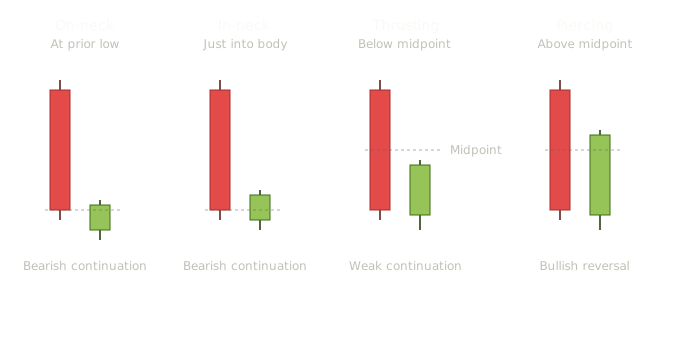
The penetration spectrum — on-neck, in-neck, thrusting, and piercing shown as four points on a single continuum with the midpoint threshold marked
Penetration spectrum — pattern reference
| Pattern | Confirmation | Volume | Reliability | Common Failure Mode |
|---|---|---|---|---|
| On-neck / in-neck / thrusting line | Next candle continuing in the original (bearish) direction. These are continuation patterns, so confirmation is trend resumption. | Light volume on the small bullish candle is consistent with weak counter-trend pressure. | On-neck generally considered the most reliable continuation; in-neck slightly less; thrusting the weakest. The progression reflects penetration depth — the less the second candle penetrates, the stronger the continuation read. | The small bullish candle gains traction and the next session breaks higher, converting what looked like continuation into a reversal setup. |
On-neck: Bulkowski's testing shows the on-neck functions as a bearish continuation 56% of the time, which he characterizes as near-random. Angel One's analysis describes the on-neck as showing the best confirmation among the three continuation members (on-neck, in-neck, thrusting). Multi-source pool: thepatternsite.com, angelone.in, chart-formations.com, quantifiedstrategies.com. In-neck: AnalyzingAlpha's 21-year backtest reports that in-neck as a bearish continuation pattern generally 'loses money or barely breaks even' under standard rules. Teaching point: The in-neck illustrates that pattern reliability and pattern profitability are different things. A pattern can 'work' in the directional sense (price continues) while still failing to produce trading profits after costs. Multi-source pool: thepatternsite.com, angelone.in, analyzingalpha.com, chart-formations.com. Thrusting line: Source aggregation describes the thrusting pattern as a reliable continuation sign in established downtrends when volume expansion accompanies the confirmation candle. LiteFinance characterizes the thrusting pattern as a reliable indicator in robust trends with accuracy depending on market situation, trading volumes, and key levels. Multi-source pool: thepatternsite.com, litefinance.org, chart-formations.com, strike.money. Piercing pattern (for reference): Source aggregation cites a ~64–80% success rate range for the piercing line across various methodologies. Teaching point: That 64–80% range across sources is wider than for most patterns — methodological choices substantially affect how the piercing pattern is measured. Students looking at any single source's piercing-pattern statistics should ask what specifically that source defined as success. Multi-source pool: thepatternsite.com, strike.money, litefinance.org, chart-formations.com, ATAS research aggregation.
Key Takeaways
- On-neck, in-neck, and thrusting are three points on the penetration spectrum — all bearish continuation patterns of decreasing reliability as penetration depth increases
- The midpoint of the prior bearish candle's body is the threshold: below it favors continuation, above it (piercing pattern) favors reversal
- On-neck shows 56% continuation (Bulkowski — near-random but the most reliable of the three); in-neck 'loses money or barely breaks even' in AnalyzingAlpha's 21-year backtest; thrusting is the weakest continuation signal
- Light volume on the small bullish candle confirms weak counter-trend pressure; heavy volume on the thrusting candle is a warning that reversal may be building
- The progression compresses three pattern names into one measurement: where did the second candle close relative to the prior body's midpoint?
Quiz — 3 Questions
Answer one at a timeA downtrend produces a long bearish candle. The next session opens lower and closes at exactly the prior candle's low. What is this pattern?