ACA Premium Tax Credit in Depth
How the Premium Tax Credit works, MAGI calculation, APTC reconciliation, Form 8962, repayment caps, income management strategies, and the critical 2026 subsidy cliff return
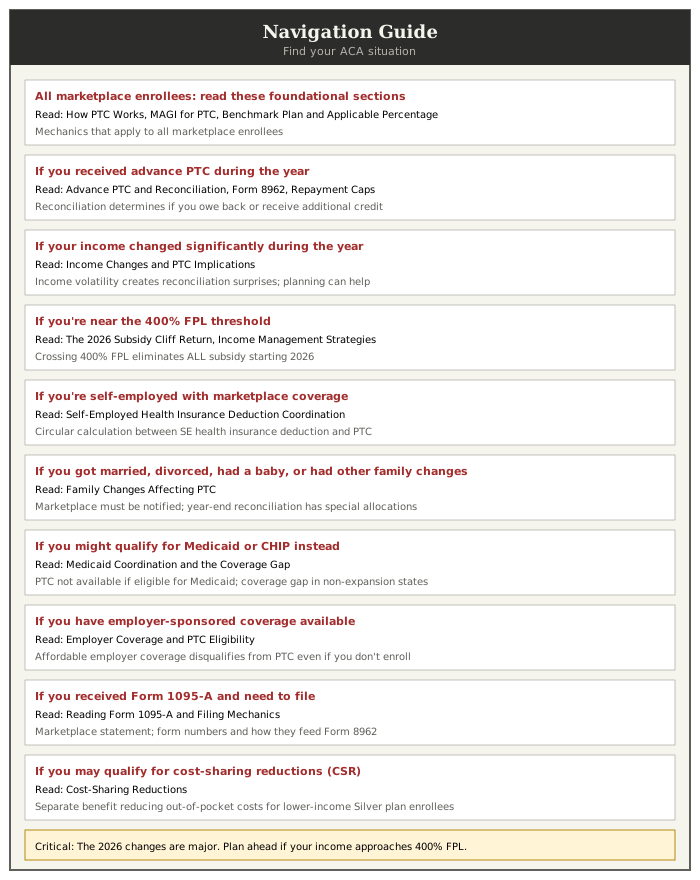
- Calculate the PTC using the benchmark plan premium and applicable percentage
- Compute MAGI for PTC purposes including the add-backs for non-taxable income
- Reconcile advance PTC payments on Form 8962 and understand repayment caps
- Identify income management strategies to reduce MAGI for PTC eligibility
- Explain the 2026 subsidy cliff return and its impact on filers above 400% FPL
- Handle the self-employed iterative calculation for SE health insurance deduction and PTC
- Navigate family changes, employer coverage rules, and Medicaid coordination
- Read Form 1095-A and understand Cost-Sharing Reductions
ACA Premium Tax Credit in Depth
The ACA Premium Tax Credit (PTC) is one of the most consequential provisions for filers who buy individual health insurance through the marketplace. It can reduce monthly premium payments substantially through advance payments (APTC), or generate refundable credits at filing time. But the reconciliation process at filing creates surprises every year: filers who underestimated income owe substantial repayments, while filers who overestimated income receive larger refunds. Understanding how PTC actually works — and its dramatic 2026 changes — is essential for marketplace enrollees.
This lesson covers PTC for both the 2025 tax year (filing in early 2026) and the major changes affecting 2026 coverage and beyond. The enhanced PTC provisions enacted in 2021 (American Rescue Plan Act) and extended through 2025 (Inflation Reduction Act) expired on January 1, 2026, causing subsidies to revert to pre-ARPA levels. The implications are significant — millions of filers will see substantial premium increases or lose subsidy eligibility entirely starting with 2026 coverage.
The lesson covers how PTC works, the income calculation (MAGI), the benchmark plan concept, advance payments and reconciliation, common reconciliation surprises, income management strategies, and the major 2026 changes restoring the 400% FPL cliff.
How PTC Works
The Premium Tax Credit makes individual health insurance coverage purchased through the Health Insurance Marketplace more affordable for filers below specific income thresholds.
The basic formula. PTC = Benchmark plan premium - Required contribution
Your required contribution is your household income times the "applicable percentage" — a sliding scale based on your income as a percentage of the federal poverty level. The benchmark plan is the second-lowest-cost Silver plan available in your area. You can apply your credit to any Marketplace plan (Bronze, Silver, Gold, Platinum) — but the credit amount is fixed based on benchmark, regardless of which plan you choose.
A 40-year-old single filer in a typical area with $40,000 income (about 270% FPL): Benchmark Silver premium: $500/month ($6,000/year) Applicable percentage at 270% FPL: about 4% (under enhanced rules) Required contribution: $40,000 × 4% = $1,600/year ($133/month) PTC: $6,000 - $1,600 = $4,400/year ($367/month) If the filer chose the benchmark Silver plan, they'd pay $133/month after credit. If they chose a cheaper Bronze plan with $400/month premium, they'd pay $33/month after credit ($400 - $367). If they chose an expensive Gold plan with $700/month premium, they'd pay $333/month after credit ($700 - $367).
Two payment methods.
- Advance PTC (APTC). Estimated credit paid directly to the insurance company each month, reducing your monthly premium payment. Most enrollees use APTC. At year-end, you reconcile actual income with the estimate to determine final credit.
- Year-end PTC. Pay full premium during the year, claim full PTC as refundable credit at filing time. Better for filers with uncertain income who want to avoid reconciliation surprises.
Refundable credit. PTC is refundable — if it exceeds your tax liability, you get the difference back. This makes it valuable even for low-income filers with little or no income tax liability.
IRC section 36B; IRS Publication 974 (Premium Tax Credit); Form 8962 Instructions; the underlying IRC §36B premium tax credit structure remains intact after enhanced provisions expire.
MAGI for PTC
Modified Adjusted Gross Income (MAGI) for PTC purposes determines both eligibility and the credit amount.
MAGI for PTC = AGI + Tax-exempt interest + Excluded foreign earned income + Non-taxable Social Security benefits
Note this is broader than the AGI on Form 1040. The additions matter:
- Tax-exempt interest (Form 1040 line 2a). Municipal bond interest is added back. A filer with $20,000 of muni interest has it included in MAGI for PTC even though it's not in AGI.
- Excluded foreign earned income. US citizens abroad using the Foreign Earned Income Exclusion (Form 2555) add back the excluded amount. This often disqualifies expats from PTC since their full income counts.
- Non-taxable Social Security. The portion of Social Security not included in taxable income (the 15%-100% nontaxable portion) is added back for PTC. This catches lower-income retirees whose Social Security is mostly nontaxable.
Household MAGI. PTC is calculated based on combined MAGI of all household members required to file a tax return:
- The tax filer
- The filer's spouse if filing jointly
- Any dependent required to file their own tax return (e.g., dependent child with significant earnings)
Household composition. Generally everyone you claim as a tax dependent counts toward household size for FPL calculation, plus the filer and spouse. A family of four counts as four people for FPL purposes regardless of who's covered by the marketplace plan.
The income window. PTC eligibility starts at 100% of FPL (or 138% in Medicaid expansion states where below-138% goes to Medicaid). For 2025 enhanced rules, there's no upper limit — PTC available at any income if benchmark premium exceeds 8.5% of MAGI. For 2026 forward, upper limit returns to 400% FPL.
Marketplace enrollees estimate their MAGI when they enroll (often the prior fall for the following year). Actual MAGI may differ substantially: job loss, retirement, or transition; unexpected bonus, business income, or capital gains; Roth conversions; inheritance or other windfalls. Underestimation results in repayment at filing time. Overestimation results in additional credit at filing time.
IRC section 36B(d); IRS Publication 974; Form 8962 Instructions.
The Benchmark Plan and Applicable Percentage
The benchmark plan and applicable percentage are the two variables that determine your credit amount.
The benchmark plan — second lowest cost Silver. In each rating area, the marketplace identifies the second-lowest-cost Silver plan. This benchmark sets the maximum premium your credit will cover.
Why second-lowest, not lowest. Provides some choice within the benchmark category. If you choose the lowest-cost Silver plan, you pay less than your required contribution. If you choose the second-lowest, you pay exactly your required contribution. If you choose a more expensive plan, you pay the difference.
The benchmark varies by:
- Location (rating area)
- Family composition (single, family with children, etc.)
- Age of household members (premiums scale with age)
- Tobacco use (some areas)
Applicable percentage — your required contribution as % of MAGI.
Enhanced PTC rules (2025 — final year of enhanced rules).
- Under 150% FPL: 0% (premium fully covered)
- 150-200% FPL: 0% to 2%
- 200-250% FPL: 2% to 4%
- 250-300% FPL: 4% to 6%
- 300-400% FPL: 6% to 8.5%
- Over 400% FPL: 8.5% maximum (no upper income limit)
Pre-enhanced (returning for 2026 forward) rules.
- Under 133% FPL: 2.07%
- 133-150% FPL: 3.10% to 4.14%
- 150-200% FPL: 4.14% to 6.52%
- 200-250% FPL: 6.52% to 8.33%
- 250-300% FPL: 8.33% to 9.83% (varies annually with indexing)
- 300-400% FPL: 9.83% (varies annually)
- Over 400% FPL: NOT eligible (the subsidy cliff returns)
Under enhanced rules, a 400% FPL filer paid at most 8.5% of income for benchmark Silver. Under returning rules, the same filer caps at 9.83% — but anyone at 400.01% FPL gets ZERO credit and pays full premium.
Federal Poverty Level (FPL) for 2025 (used for 2025 PTC). For the 48 contiguous states + DC:
- 1 person household: $15,060 (100% FPL)
- 2 person household: $20,440
- 3 person household: $25,820
- 4 person household: $31,200
- Add $5,380 for each additional person
- 400% FPL for single: $60,240
- 400% FPL for family of 4: $124,800
- Alaska and Hawaii use higher FPLs.
IRC section 36B(b); HHS poverty guidelines published annually; enhanced premium tax credits set to expire at the end of 2025.
Advance PTC and Reconciliation
Most marketplace enrollees use Advance Premium Tax Credit (APTC) and must reconcile at filing time.
APTC mechanics.
- At enrollment, you estimate your household MAGI for the coverage year
- Marketplace calculates APTC based on the estimate
- APTC paid directly to insurer monthly, reducing your monthly premium
- At year-end, marketplace issues Form 1095-A showing actual APTC received
- You file Form 8962 reconciling APTC to actual PTC based on actual MAGI
Possible reconciliation outcomes.
- Underestimated income (got more APTC than entitled to). You owe the excess as additional tax on your return. Subject to repayment caps for lower-income filers (see below).
- Overestimated income (got less APTC than entitled to). You receive additional credit (refundable) on your return.
- Perfect estimate (rare). No reconciliation impact.
Form 8962. The reconciliation form.
Inputs:
- Form 1095-A from marketplace (premiums paid, APTC received, benchmark plan premium)
- Your actual MAGI for the year
- Household size and composition
- Allocation rules if family changed during year
Outputs:
- Final PTC for the year
- Net additional credit OR excess APTC repayment
- Carries to Form 1040 line 8 (Schedule 3 for additional credit) or Form 1040 line 17 (Schedule 2 for excess APTC repayment)
Filing Form 8962 is required if you or anyone in your tax family received APTC during the year. Failure to file Form 8962 disqualifies you from APTC in future years.
Reconciliation surprises — the most common scenarios.
- "My income was lower than expected." Pleasant surprise — additional PTC reduces tax owed or increases refund.
- "My family changed during the year." Marriage, divorce, dependent changes complicate allocation. Special rules in Form 8962 instructions handle these.
- "I forgot about the marketplace coverage." If you had APTC and don't file Form 8962, you'll lose future eligibility and the IRS will assess the full APTC as additional tax.
IRC section 36B; Form 8962 Instructions; IRS Publication 974.
Form 8962 and Repayment Caps
When you owe back APTC, repayment caps may limit the amount, especially for lower-income filers.
Repayment cap amounts for 2025. Single/HoH/MFS:
- Under 200% FPL: $375
- 200-300% FPL: $975
- 300-400% FPL: $1,625
- 400% FPL and above: Full repayment (no cap)
MFJ/QSS:
- Under 200% FPL: $750
- 200-300% FPL: $1,950
- 300-400% FPL: $3,250
- 400% FPL and above: Full repayment (no cap)
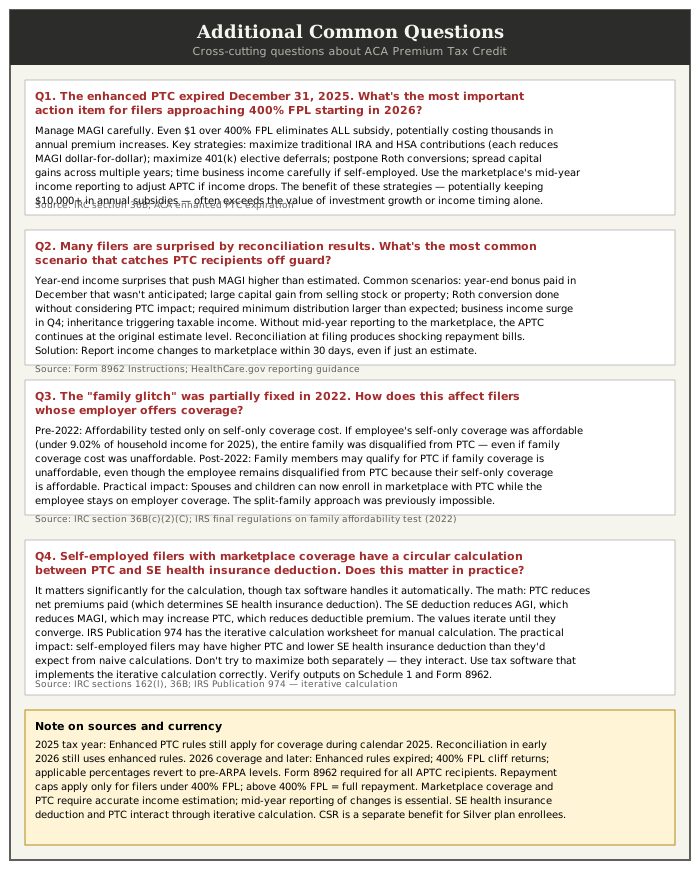
If you estimated 350% FPL but actually earned 405% FPL, you owe the FULL excess APTC — which could be many thousands of dollars. Repayment caps apply only if you were under 400% FPL. Crossing the threshold eliminates the protection — even by $1 of income.
Form 8962 walkthrough (simplified).
- Line 1: Tax family size
- Line 2a: Your MAGI
- Line 2b: Dependents' MAGI (if any required to file)
- Line 3: Household income (sum of 2a and 2b)
- Line 4: FPL for household size
- Line 5: Income as % of FPL (line 3 / line 4 × 100)
- Line 7: Applicable percentage from table
- Line 8a: Annual required contribution (line 3 × line 7)
- Lines 9-12: Allocation rules if family changed
- Lines 14-26: Monthly calculations of PTC
- Line 24: Total PTC
- Line 25: Total APTC (from 1095-A)
- Line 26: Net PTC (refundable, if line 24 > line 25)
- Line 27: Excess APTC (if line 25 > line 24)
- Line 28: Repayment cap (if applicable)
- Line 29: Net excess APTC to repay (smaller of 27 or 28)
Form 8962 Instructions; IRC section 36B(f); annual indexing of repayment caps.
Income Changes and PTC Implications
Income volatility during the year creates PTC reconciliation challenges.
Mid-year income increases.
Common causes.
- New job with higher pay
- Promotion or significant raise
- Year-end bonus
- Business income surge
- Capital gains from stock sale or property sale
- Roth conversion
- IRA distributions
- Inheritance triggering taxable income
Action items.
- Report income change to marketplace within 30 days
- Marketplace recalculates APTC for remaining months
- Reduces or eliminates surprise at reconciliation
- Failure to report doesn't affect tax credit — but increases reconciliation surprise
Mid-year income decreases.
Common causes.
- Job loss or hours reduction
- Business income decline
- Spouse stopping work
- Other reduction in earnings
Action items.
- Report income decrease to marketplace
- Marketplace recalculates APTC for remaining months — likely increasing it
- Higher monthly APTC immediately, more cash flow help
- Reconciliation may produce additional credit at filing
End-of-year income management. For filers near critical thresholds (especially the 400% FPL cliff returning in 2026), end-of-year tax planning matters more than usual.
Strategies to reduce MAGI.
- Maximize traditional IRA contributions (up to $7,000 for under-50, $8,000 for 50+ for 2025)
- Maximize HSA contributions if HSA-eligible ($4,300 self / $8,550 family for 2025, $1,000 catch-up at 55+)
- Maximize 401(k) elective deferrals if employer plan available
- Defer income to next year if possible (delay year-end bonus, business invoicing)
- Accelerate deductible expenses to reduce AGI
Strategies to increase MAGI (only relevant for filers below 100% FPL in non-expansion states needing to qualify for PTC instead of falling into Medicaid coverage gap).
- Take additional IRA distributions
- Realize capital gains
- Do Roth conversions
IRC section 36B; HealthCare.gov guidance on reporting changes; IRS Publication 974.
The 2026 Subsidy Cliff Return
The 2026 changes to PTC are among the most significant changes affecting individual tax planning for filers with marketplace coverage.
What expired December 31, 2025. The temporary enhancements under American Rescue Plan Act of 2021, extended through December 31, 2025 by the Inflation Reduction Act: elimination of the 400% FPL cliff for subsidy eligibility; premium cap reduction from 9.83% to 8.5% of household income for benchmark coverage; increased applicable percentage tables providing more generous subsidies across all income bands; zero-premium bronze plans for households at 100-150% FPL.
What returns for 2026.
- The 400% FPL cliff: income above 400% FPL = ZERO subsidy, regardless of premium cost
- Higher applicable percentages: 100-400% FPL filers pay higher share of income for benchmark coverage
- Required contributions back to pre-2021 levels (indexed each year)
Practical impact on subsidy amounts.
A 60-year-old single filer earning $50,000 (about 332% FPL).
- 2025 enhanced rules: Required contribution ~7% = $3,500/year ($292/month); meaningful subsidy
- 2026 returning rules: Required contribution 9.83% = $4,915/year ($410/month); reduced subsidy
A 60-year-old single filer earning $65,000 (about 432% FPL).
- 2025 enhanced rules: Required contribution 8.5% = $5,525/year ($460/month); still substantial subsidy if premium is higher
- 2026 returning rules: ZERO subsidy; pays full benchmark premium which for older filers in some states could be $1,000+/month
A single filer earning $60,239 (just under 400% FPL for 2025 = $60,240) qualifies for full benchmark-percentage subsidy. The same filer earning $60,241 (just over 400% FPL) gets ZERO subsidy. The difference of $2 in income can mean $5,000-$30,000+ in lost annual subsidy for older or higher-cost-area enrollees.
Cash flow impact: $15,000-$30,000+ annual increase will be common for clients above 400% FPL who lost all subsidy eligibility. Older filers (premiums scale with age), enrollees in high-cost areas, self-employed filers, early retirees without employer coverage, small business owners.
Strategies for 2026 and forward.
- Stay below 400% FPL. For filers near the threshold, even small income reductions can preserve subsidy worth thousands. Income management becomes much more valuable.
- Aggressive retirement contributions. For clients near 400% FPL threshold, income management is important: Traditional IRA contributions: $7,000 ($8,000 age 50+) MAGI reduction. HSA contributions: If switching to HDHP, $4,300 single/$8,550 family (age 55+ catch-up $1,000). Roth conversion suspensions: Pause conversions if pushing client over 400% FPL cliff.
- Roth conversion timing. Roth conversions add to MAGI. For filers managing PTC eligibility, postpone Roth conversions until Medicare age or use timing carefully.
- Capital gains harvesting timing. Realizing gains pushes MAGI up. For PTC-eligible filers, spread capital gains across multiple years instead of taking large gains in one year.
- Self-employed: maximize business deductions and retirement contributions. Solo 401(k) deductible contributions plus SE health insurance deduction can significantly reduce MAGI.
- Consider COBRA or short-term plans. For filers above 400% FPL who lose subsidy eligibility, COBRA from a former employer or short-term medical plans may be more affordable than full-cost marketplace coverage.
- Marketplace plan choice. Without subsidy, plan choice matters more. Bronze plans (lower premium, higher out-of-pocket) versus Silver/Gold (higher premium, lower out-of-pocket) calculus changes significantly.
In 2022, the Inflation Reduction Act extended these enhanced PTCs through the end of 2025, setting up the current expiration cliff and causing subsidies to revert to pre-ARPA levels on Jan. 1, 2026; IRC section 36B; HHS guidance on marketplace coverage.
Self-Employed Health Insurance Deduction Coordination
Self-employed filers with marketplace coverage face circular calculations between the SE health insurance deduction and PTC.
The circular problem. SE health insurance deduction (Schedule 1 line 17) reduces AGI. PTC depends on MAGI (which starts with AGI). PTC reduces the net premium paid (which determines the SE health insurance deduction). The variables depend on each other.
The IRS solution. A specific iterative calculation procedure in Publication 974 (the "iterative calculation"). Tax software handles this automatically; manual filers use the worksheet.
Simplified concept.
- Total premium paid for marketplace coverage
- Less: PTC received (advance or claimed at year-end)
- Equals: Net out-of-pocket premium
- This net amount is potentially deductible as SE health insurance deduction (subject to SE income limit)
- The deduction reduces AGI, which reduces MAGI, which may increase PTC, which reduces deductible premium...
The iterative calculation converges at the correct values, but the math is complex enough that manual calculation is error-prone.
Self-employed marketplace enrollees should: use tax software that handles iterative calculation; verify that both PTC and SE health insurance deduction are properly calculated; don't try to maximize both separately — they interact.
IRC sections 162(l), 36B; IRS Publication 974 — iterative calculation methodology.
Family Changes Affecting PTC
Changes in family composition during the year complicate PTC reconciliation.
- Marriage during the year. Special pre-marriage allocation rules can apply when one or both spouses had marketplace coverage as singles before marrying.
- Divorce during the year. Form 8962 allocation rules between former spouses based on coverage period and family composition.
- Birth or adoption. Adding a household member changes FPL calculation. If APTC continued without notification, may receive less APTC than ultimately entitled to.
- Dependent leaving household. Common when adult children move out, divorce removes dependent, etc. Reduces family size, may reduce eligibility.
- Aging out of marketplace. Becoming Medicare-eligible (at age 65 typically) ends marketplace eligibility for that person. Medicare enrollment becomes the new option.
- Death of household member. Final year reconciliation involves special allocation rules.
All these changes should be reported within 30 days to allow APTC to adjust mid-year. Year-end reconciliation handles the math but failing to report creates larger surprises.
Form 8962 Instructions (allocation rules); IRC section 36B; HealthCare.gov guidance on reporting changes.
Medicaid Coordination and the Coverage Gap
PTC interacts with Medicaid eligibility in important ways.
Medicaid disqualifies from PTC. Filers eligible for Medicaid (whether enrolled or not) generally can't claim PTC. The exception: in non-Medicaid-expansion states, filers between 100% and 138% FPL can claim PTC even though they'd be Medicaid-eligible in expansion states.
- Below 100% FPL: Not eligible for either Medicaid OR PTC
- 100-138% FPL: Eligible for PTC
The poorest filers in non-expansion states are excluded from both programs. Currently in non-expansion states: Alabama, Florida, Georgia, Kansas, Mississippi, South Carolina, Tennessee, Texas, Wisconsin, Wyoming.
- CHIP coordination. Children's Health Insurance Program is similar — children eligible for CHIP generally must enroll rather than receiving PTC for marketplace coverage.
- Income changes affecting Medicaid eligibility. Filers who become Medicaid-eligible mid-year through income decrease should report immediately. Continuing APTC after becoming Medicaid-eligible may result in repayment obligations.
IRC section 36B(c)(2)(B); IRS Publication 974; state Medicaid eligibility rules.
Employer Coverage and PTC Eligibility
Employer-sponsored coverage availability affects PTC eligibility — even if you don't enroll.
If your employer offers coverage that meets the affordability test, you (and your family) are generally NOT eligible for PTC, even if you decline the employer coverage to buy marketplace instead.
Affordability for 2025. Employer coverage is "affordable" if the employee's cost for self-only coverage (lowest cost plan) is no more than 9.02% of household income for 2025 (annually indexed).
Minimum value. Employer coverage must also provide "minimum value" — covering at least 60% of expected costs. Almost all employer plans meet this test.
Family coverage glitch — partially fixed. Historically, affordability was tested only on self-only coverage cost, not family coverage cost. Even if family coverage was unaffordable, the family was disqualified if self-only coverage was affordable. This was the "family glitch." Final regulations in 2022 partially fixed this — now family members may qualify for PTC if family coverage is unaffordable, but the employee themselves is still disqualified if their own self-only coverage is affordable.
Practical implications.
- Always check whether spouse/dependents have access to affordable employer coverage when applying for PTC
- Document accurately — false information about employer coverage availability can void PTC claim
- COBRA coverage doesn't disqualify from PTC (it's not "available" employer coverage in the relevant sense)
IRC section 36B(c)(2)(C); IRS Notice 2022-41; HHS regulations on family glitch fix.
Reading Form 1095-A and Filing Mechanics
Form 1095-A is the marketplace's annual statement and the source document for Form 8962.
Form 1095-A — Health Insurance Marketplace Statement. Issued by the marketplace to enrollees by January 31 of the year after coverage.
- Part I — Recipient Information. Name, address, SSN, marketplace identifier.
- Part II — Covered Individuals. Each covered family member listed with coverage start/end dates.
- Part III — Monthly Coverage Information. For each month: Column A: Monthly enrollment premium (total premium for your plan); Column B: Monthly second-lowest-cost Silver plan premium (benchmark); Column C: Monthly advance PTC paid
The benchmark premium (Column B) drives your credit calculation. If it's wrong on the 1095-A, your credit calculation will be wrong. Check carefully — marketplace errors are not uncommon.
Filing mechanics.
- Form 1095-A arrives by January 31 (sometimes corrected versions later)
- Enter Form 1095-A information into tax software (or manually onto Form 8962)
- Form 8962 calculates reconciliation
- Net result flows to Form 1040: Line 8 (Schedule 3) for additional credit, or Line 17 (Schedule 2) for excess APTC repayment
Special situations.
- Multiple 1095-As. Possible if family had different marketplace plans, or if family changed plans mid-year. Combine on Form 8962.
- Corrected 1095-A. If marketplace issues a corrected version, use the corrected amounts. May require amending if already filed.
- No 1095-A received. Contact marketplace immediately. Cannot file Form 8962 (and may have problems filing the return at all) without 1095-A information.
- 1095-B and 1095-C. Different forms. 1095-B comes from insurers for non-marketplace coverage. 1095-C comes from large employers. Neither is needed for PTC — only 1095-A.
Form 1095-A Instructions; Form 8962 Instructions; IRS Publication 974.
Cost-Sharing Reductions
Cost-Sharing Reductions (CSR) are a separate benefit from PTC that reduces out-of-pocket costs for lower-income Silver plan enrollees.
Eligibility. Filers under 250% FPL who enroll in Silver plans through the marketplace.
Income tiers.
- Under 150% FPL: Most generous CSR (very low deductibles and out-of-pocket maximums)
- 150-200% FPL: Strong CSR
- 200-250% FPL: Modest CSR
Mechanics. CSR is built into the Silver plan automatically when you enroll. The insurer offers a "CSR variant" of the Silver plan with reduced cost-sharing for eligible enrollees. No separate application or reconciliation.
CSR only applies to Silver plans. Bronze, Gold, and Platinum plans don't have CSR variants. Eligible filers who choose Bronze (for lower premium) lose the CSR benefit.
No tax filing impact. CSR doesn't appear on tax returns. It's an in-year subsidy paid via the insurer's plan design, not reconciled at filing time.
ACA section 1402; HHS regulations on cost-sharing reductions; CMS guidance.
Connection to Other Lessons
The ACA PTC lesson connects to many other lessons:
- Lesson 4 (Adjustments) — Self-employed health insurance deduction on Schedule 1 line 17 interacts with PTC through iterative calculation.
- Lesson 6 (Tax Calculation) — PTC and excess APTC repayment flow into the tax calculation; PTC is refundable, excess APTC is additional tax.
- Lesson 7 (Credits) — PTC is one of the refundable credits on Schedule 3.
- Lesson 11 (Retirees) — Roth conversions and IRA distributions affect MAGI, which affects PTC eligibility for early retirees on marketplace coverage.
- Lesson 12 (Self-Employed) — Self-employed health insurance deduction interaction; income management for PTC eligibility.
- Lesson 17 (International) — US citizens abroad have foreign earned income exclusion added back for MAGI calculation, generally disqualifying expats from PTC.
- Lesson 18 (Major Life Changes) — Family changes (marriage, divorce, birth) affect PTC calculation; job loss is a qualifying event for special enrollment.
- Lesson 19 (Disabilities) — Disability-related early retirement may make marketplace coverage the only option until Medicare eligibility.
What to Gather for PTC Filers
For marketplace enrollees:
- Form 1095-A from the marketplace (Health Insurance Marketplace Statement)
- Documentation of income changes reported during the year
- Records of any plan changes during the year
- Documentation of household composition (dependents, spouse)
- Total premium payments and APTC received documentation
For self-employed marketplace enrollees:
- Schedule C income calculation
- SE health insurance deduction calculation
- Documentation that coverage qualifies (marketplace-purchased, not from employer or COBRA)
For filers with employer coverage available:
- Documentation of employer coverage availability
- Cost of self-only coverage at lowest plan
- Documentation that coverage meets minimum value
- Section 9.02% affordability test calculation
For filers with mid-year changes:
- Documentation of changes reported to marketplace
- Dates of changes
- Records of APTC adjustments mid-year
- Form 1095-A reflecting changes (or multiple 1095-As if applicable)
For income-management planning:
- Projection of full-year MAGI
- IRA, 401(k), HSA contribution capacity remaining for the year
- Discretionary income/deduction timing options
- FPL calculation for household size
Key Takeaways
- PTC = Benchmark plan premium − Required contribution; required contribution = household MAGI × applicable percentage
- MAGI for PTC adds back tax-exempt interest, excluded foreign income, and non-taxable Social Security to AGI
- Most enrollees use APTC and must reconcile on Form 8962 at filing time — underestimated income results in repayment
- Repayment caps ($375–$1,625 single / $750–$3,250 MFJ for 2025) only apply below 400% FPL; crossing the threshold means full repayment of all excess APTC
- The 2026 subsidy cliff return eliminates all subsidies above 400% FPL — income management near this threshold is worth thousands annually
- Self-employed filers face an iterative calculation between SE health insurance deduction and PTC — use tax software, don't manually calculate
- Employer coverage availability (even if declined) disqualifies from PTC if the coverage is "affordable" at 9.02% of household income for 2025
- Form 1095-A must be received and verified before filing — the benchmark premium in Column B drives your entire credit calculation
- Cost-Sharing Reductions apply automatically for Silver plan enrollees under 250% FPL — choosing Bronze to save on premium loses this separate benefit
Quiz — 5 Questions
Answer one at a timeWhat is the PTC formula?