Filers with Disabilities and Their Caregivers
ABLE accounts, disability-related medical deductions, impairment-related work expenses, credits, caregiver tax issues, special needs trusts, and disability income taxation
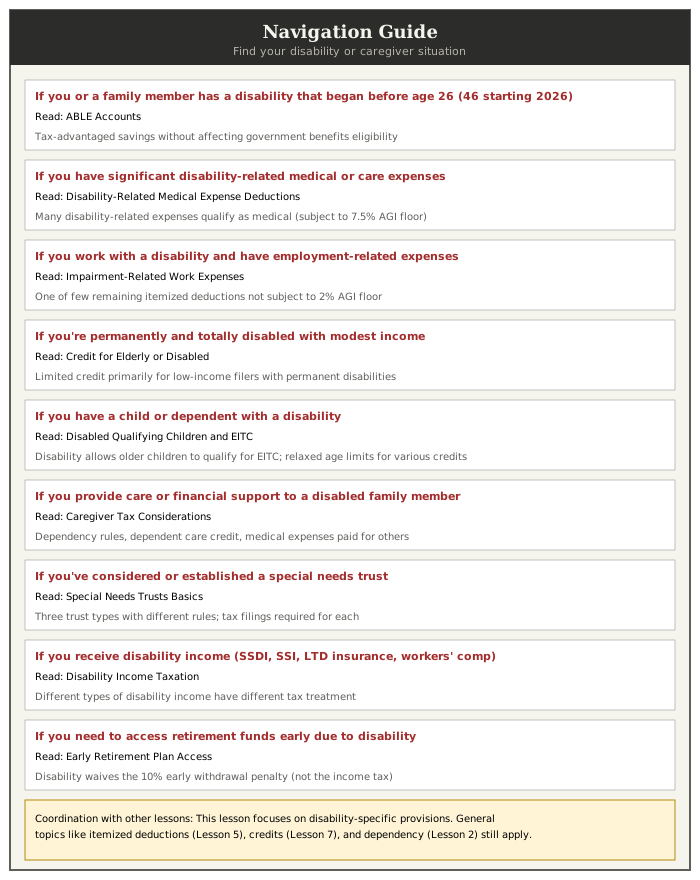
- Open and use ABLE accounts for tax-advantaged disability savings without affecting SSI and Medicaid eligibility
- Identify which disability-related expenses qualify as medical deductions and navigate the 7.5% AGI floor
- Claim impairment-related work expenses as the itemized deduction not subject to the 2% AGI floor
- Apply the Credit for Elderly or Disabled and understand its practical income limitations
- Claim disabled qualifying children of any age as EITC qualifying children
- Navigate caregiver tax considerations including dependent claims, dependent care credit, and household employment
- Understand the three types of special needs trusts and their tax filing requirements
- Determine which disability income is taxable and which is excluded from the federal return
- Access retirement plan funds before 59½ using the disability exception to the 10% penalty
Filers with Disabilities and Their Caregivers
Filers with disabilities and their caregivers face tax considerations that don't apply to most other filers. The tax code has several specific provisions designed to address the unique financial challenges of disability: ABLE accounts for tax-advantaged disability savings, special rules for disability-related medical expenses, impairment-related work expenses as one of the narrow remaining miscellaneous itemized deductions, the Credit for Elderly or Disabled, EITC qualification for filers with disabled qualifying children of any age, special considerations for caregivers, and special needs trust rules.
This lesson covers both perspectives — the filer with a disability and the caregiver who supports them. Many situations involve both perspectives in a single family (a parent caring for an adult disabled child, for example). The provisions covered apply at the federal level; state-level disability tax provisions vary significantly.
Lesson 18 covered the year of becoming disabled. This lesson covers the ongoing tax considerations once disability is established, plus the broader topic of caregiver tax issues.
ABLE Accounts
ABLE (Achieving a Better Life Experience) accounts are tax-advantaged savings accounts specifically designed for people with disabilities. They allow tax-free growth and withdrawals for qualified disability expenses, without affecting eligibility for means-tested government benefits like SSI and Medicaid.
Eligibility requirements. The designated beneficiary must have a qualifying disability that:
- Began before age 26 (for accounts opened through 2025)
- Beginning in 2026, the age threshold rises to 46 (under SECURE Act 2.0) — substantially expanding eligibility
The disability must meet specific criteria, generally requiring either:
- Entitlement to SSDI or SSI benefits based on disability, OR
- A disability certification from a licensed physician confirming a condition resulting in marked and severe functional limitations expected to last at least 12 months or result in death
Annual contribution limit. $19,000 for 2025 (equal to the annual gift tax exclusion). Contributions can come from anyone — the beneficiary, family members, friends.
ABLE-to-Work additional contributions. If the designated beneficiary is employed and not contributing to a defined contribution retirement plan, they can contribute additional amounts up to the lesser of:
- Their compensation for the year, OR
- $15,650 for residents of the continental US ($19,550 in Alaska, $17,990 in Hawaii) for 2025
These limits track the federal poverty line for a one-person household.
The ABLE-to-Work provisions and Saver's Credit eligibility for ABLE contributions were made permanent by OBBBA. The age threshold expansion from 26 to 46 (effective 2026) is also a permanent expansion under SECURE Act 2.0.
Account balance limits. Each state sets its own ABLE account balance limit (typically aligned with the state's 529 plan limit, often $300,000-$500,000+). Once a beneficiary's account exceeds the state's limit, no new contributions allowed until balance decreases.
SSI asset exclusion. Up to $100,000 in an ABLE account is excluded from SSI's $2,000 asset limit. Amounts above $100,000 still count and may temporarily suspend SSI eligibility, but Medicaid coverage continues regardless of ABLE balance.
Tax treatment.
- Contributions: NOT federally deductible (some states offer state-level deductions for in-state ABLE plans)
- Growth: Tax-free
- Withdrawals: Tax-free if used for qualified disability expenses
- Non-qualified withdrawals: Taxable as ordinary income plus 10% additional tax on earnings portion
Qualified disability expenses. Broad category including:
- Education (including tutoring, special needs services)
- Housing (rent, mortgage, utilities, repairs)
- Transportation
- Employment training and support
- Assistive technology
- Personal support services
- Health care
- Prevention and wellness
- Financial management
- Legal fees
- Funeral and burial
- Basic living expenses generally aimed at improving health, independence, or quality of life
The breadth of qualified expenses makes ABLE accounts highly flexible compared to other tax-advantaged accounts.
529-to-ABLE rollovers. Families can roll over funds from a 529 education savings plan to an ABLE account for the same beneficiary or a family member, up to the annual ABLE contribution limit. Useful when education savings exceed what will be used for education and the beneficiary has a disability.
Saver's Credit for ABLE contributions. ABLE beneficiaries who contribute to their own ABLE account may qualify for the Saver's Credit (Form 8880). Beneficiary must be at least 18, not a full-time student, not a dependent on someone else's return, and meet income limits. Credit ranges from 10% to 50% of contributions up to $2,000.
Forms.
- Form 5498-QA: Annual ABLE account contribution information (institutional filing)
- Form 1099-QA: Distributions from ABLE accounts (for tax year reporting)
- Form 8880: Saver's Credit if applicable
Anyone meeting the disability criteria should consider opening an ABLE account, even with modest contributions. The flexibility of qualified expenses, asset exclusion from SSI, tax-free growth, and family contribution allowance make ABLE accounts a uniquely valuable tool for the disabled community. State-administered programs vary; compare options on the ABLE National Resource Center (ablenrc.org).
Sourcing. IRC section 529A; IRS Publication 907 (Tax Highlights for Persons with Disabilities); IRS guidance on ABLE accounts; SECURE Act 2.0 provisions; OBBBA provisions.
Disability-Related Medical Expense Deductions
Many disability-related expenses qualify as medical expenses for the itemized medical deduction, but the 7.5% AGI floor and the higher standard deduction post-TCJA mean fewer filers benefit than would otherwise.
The general framework. Medical expenses above 7.5% of AGI are deductible as itemized deductions on Schedule A. For 2025, the standard deduction is $15,750 single / $31,500 MFJ — so itemized deductions must collectively exceed those amounts to benefit from itemizing.
Disability-specific qualifying expenses.
Equipment and modifications.
- Wheelchairs, walkers, mobility scooters
- Hearing aids and batteries
- Prosthetic devices
- Special telephone equipment for hearing-impaired
- TTY/TDD devices
- Specialized reading devices for visually impaired
- Computer equipment to compensate for disability (limited; primarily for activities of daily living)
Home modifications. Modifications to a home for medical purposes are deductible to the extent they don't increase the home's value. Common examples:
- Wheelchair ramps
- Widening doorways
- Adding railings, grab bars
- Modifying bathrooms for accessibility
- Modifying kitchens for accessibility from wheelchair
- Lifts (chair, platform)
- Modifying stairs
Excess of cost over property value increase. If a $20,000 modification adds $5,000 to home value, only $15,000 is deductible. Modifications that don't add value (most accessibility modifications) are fully deductible.
Transportation expenses.
- Cost of medical transportation (ambulance, special transport services)
- Out-of-pocket vehicle costs for medical purposes (mileage at 21¢/mile for 2024 — check 2025 rate)
- Modifications to vehicles for accessibility
- Tolls and parking for medical visits
Service animals.
- Cost of guide dogs and other service animals
- Veterinary care, food, grooming for service animals
- Training costs
Personal care services.
- Wages paid to personal care assistants (where the services qualify as medical)
- Nursing services provided in the home
Specialized education.
- Special schools for disabled children (where main purpose is to provide education compensating for disability)
- Tutoring for learning disabilities
- Specialized therapy programs
Conferences and education for parents. Conferences and seminars about your dependent's specific disability may qualify when the primary purpose is medical care (not vacation/entertainment).
Therapies.
- Physical therapy
- Occupational therapy
- Speech therapy
- Mental health therapy
- ABA therapy and other behavioral therapies
Medications. Both prescription medications and insulin are deductible. Over-the-counter medications generally aren't (with some exceptions).
Care facility expenses. If primary purpose is medical care (not custodial), nursing home and assisted living costs may qualify.
For a filer with $50,000 AGI, only medical expenses exceeding $3,750 are deductible. For higher AGI, the threshold is much higher. Filers with disability-related expenses should track all qualifying expenses throughout the year to know whether itemizing makes sense.
If you have an HSA or healthcare FSA, paying disability-related medical expenses through these tax-advantaged accounts is generally better than itemized deduction (HSA/FSA dollars come out pre-tax with no floor; itemized requires exceeding 7.5% AGI).
Sourcing. IRC section 213; IRS Publication 502 (Medical and Dental Expenses); IRS Publication 907.
Impairment-Related Work Expenses
Impairment-related work expenses (IRWE) are one of the few categories of miscellaneous itemized deductions not affected by the 2% AGI floor (which was permanently eliminated by OBBBA for other miscellaneous deductions but was already not applicable to IRWE).
What qualifies. Ordinary and necessary expenses paid in connection with your work that allow you to work despite a disability. Required for the work to be performed.
Requirements.
- You have a physical or mental disability
- The expense is necessary for you to work
- The expense isn't reimbursed
- The expense isn't deducted elsewhere (medical expenses, business expenses)
Common examples.
- Attendant care services at workplace
- Special transportation costs to/from work above what others spend
- Adaptive equipment for workplace use (computer modifications, reading devices, etc.)
- Special telephones for hearing-impaired
- TTY/TDD services for work communications
- Hearing aid batteries (if used primarily at work)
- Service animal expenses while at work
- Modifications to workspace
- Sign language interpreters for work meetings
Where deducted.
- For employees: Schedule A as itemized deduction (NOT subject to 2% floor)
- For self-employed: Schedule C as business expense
TCJA eliminated most miscellaneous itemized deductions subject to the 2% AGI floor (unreimbursed employee expenses, investment fees, etc.) from 2018-2025. OBBBA made this elimination permanent. IRWE was always in a separate category not subject to the 2% floor, so it survived TCJA and continues under OBBBA.
Documentation. Keep detailed records:
- Medical documentation of disability
- Receipts for IRWE expenses
- Documentation that expenses were necessary for work specifically
- Distinction between IRWE and personal medical expenses (avoid double-deducting)
Some expenses could be either IRWE or medical expense. If the expense allows you to work despite disability → IRWE (deduct in full). If the expense is for medical care of the disability → medical expense (subject to 7.5% AGI floor). Choose the more beneficial categorization. IRWE is generally better when applicable because it's not subject to the medical floor.
Sourcing. IRC section 67 (specifically the exclusion for IRWE); IRS Publication 529 (Miscellaneous Deductions); IRS Publication 907.
Credit for Elderly or Disabled
The Credit for Elderly or Disabled (Form 1040 Schedule R) is a small credit available to filers who are:
- Age 65+ by end of tax year, OR
- Under 65 and retired on permanent and total disability
Income limits. The credit phases out at modest income levels:
- Single, HoH, QSS: Income limit around $17,500 (with non-taxable Social Security limit around $5,000)
- MFJ both qualifying: Income limit around $25,000
- MFJ one qualifying: Income limit around $20,000
- MFS (lived apart from spouse): Around $12,500
Maximum credit. Up to $750 for single, $1,125 for MFJ both qualifying. Non-refundable (can only reduce tax to zero, can't generate refund).
The credit's low income thresholds and non-refundable nature mean most filers don't benefit from it. Many low-income filers with disabilities don't have income tax liability to offset. Filers who do qualify typically benefit from a small amount ($100-$500 range).
Form 1040 Schedule R. Used to calculate the credit. Requires permanent and total disability determination if claiming based on disability rather than age.
Permanent and total disability definition. For credit purposes, you're permanently and totally disabled if:
- You can't engage in substantial gainful activity because of physical or mental condition
- A physician determines the condition has lasted or can be expected to last continuously for at least 12 months or end in death
Sourcing. IRC section 22; IRS Publication 524 (Credit for Elderly or Disabled); Schedule R Instructions.
Disabled Qualifying Children and EITC
Disability status of a child affects several tax provisions for the parents/family caring for them.
Qualifying child for EITC — age requirement waived for disability. A child meeting the relationship and residency tests for EITC qualifying child must also meet the age test (under 19, or under 24 if full-time student). BUT a child of any age who is permanently and totally disabled meets the age test automatically.
Families with adult disabled children can continue claiming them as EITC qualifying children indefinitely. This can be substantial — EITC with one qualifying child can reach $4,328 for 2025; with multiple qualifying children even more.
Qualifying child for CTC. CTC requires child under 17. There's no disability waiver for the age requirement for CTC. Adult disabled children may qualify under the Credit for Other Dependents instead ($500 per qualifying person).
Qualifying child for dependency. A permanently and totally disabled child of any age can be claimed as a qualifying child for dependency (parents claim them as dependent) provided other requirements (support, residency) are met.
Qualifying relative for dependency. Even disabled adult children who don't meet the qualifying child rules may qualify as qualifying relatives. Requirements:
- Relationship: Child (any age), or other qualifying relative
- Income: Gross income less than $5,200 for 2025 (excluding non-taxable income like SSI, SSDI, certain veterans' benefits)
- Support: You provide more than half of the person's support
SSI: Not counted (it's a means-tested program). SSDI: Not counted as gross income for dependency test (treated as Social Security). Earnings from work: Counted (could push over $5,200 threshold).
Filing as Head of Household. Maintaining a home for a disabled qualifying child or dependent can qualify the supporting family member as HoH (with the higher standard deduction $23,625 for 2025 and better brackets than single).
Special rules for disabled adult children. Filing for SSDI or SSI on a disabled adult child's behalf often happens when they reach age 18 or 22. The income/disability determination process is lengthy. During the determination period, dependency rules can be complex.
Sourcing. IRC sections 32, 24, 152; IRS Publication 596 (EITC); IRS Publication 503; IRS Publication 17.
Caregiver Tax Considerations
Caregivers (those providing significant support to disabled family members) have specific tax considerations.
Claiming a family member as a dependent. Caregivers often financially support family members who could be claimed as qualifying relatives.
Qualifying relative requirements.
- Relationship: Child, parent, sibling, grandparent, niece/nephew, in-law, etc. (most relatives qualify); OR member of household (if not related, lived with you all year)
- Income: Gross income less than $5,200 for 2025 (excluding SSI, SSDI, certain VA benefits)
- Support: You provide more than half of the person's support
- Filing status: Not filing MFJ (with limited exceptions)
- Citizenship: US citizen, national, or resident, or resident of Canada/Mexico
Calculating "more than half of support." All sources of support combined:
- Food, clothing, shelter (fair rental value if you provide a home)
- Medical care
- Recreation
- Transportation
- Education
- Other necessities
You must provide more than 50% of the total support to claim. Sometimes multiple family members each provide some support; only one can claim if no individual exceeds 50%. Multiple Support Agreement (Form 2120) allows family members to designate which one claims.
Dependent care credit. If you pay for care so you (and spouse if MFJ) can work, the Child and Dependent Care Credit may apply. Disabled adult dependent care expenses qualify (as well as childcare under age 13). Up to $3,000 expenses for one qualifying person, $6,000 for two or more.
Medical expenses paid for a dependent. Medical expenses you pay for a person you claim as a dependent count toward your medical expense deduction. You can deduct medical expenses paid for a parent you support even if their income exceeds the dependency income limit — special rule for "medical dependents."
You can deduct medical expenses paid for someone who would qualify as your dependent except for the gross income test. Useful for adult children with disabilities receiving Social Security disability or having moderate income that exceeds $5,200 — you can still deduct medical expenses you pay for them even if you can't claim them as dependent.
FSA dependent care for dependents. Dependent Care FSAs (employer-sponsored) can be used for care of disabled adult dependents who can't care for themselves. Up to $5,000 ($2,500 MFS) annual pre-tax contribution. Often better tax outcome than the dependent care credit for working families.
Caregiver expenses (broader). Some states have caregiver tax credits. Federally, there's no specific "caregiver credit" but the combination of dependency exemption (where applicable), medical expense deductions, and dependent care credit can provide significant total benefit.
If you pay a person to provide care in your home, you may have household employment tax obligations (Form Schedule H). Threshold for 2025: wages of $2,800+ per household employee trigger Social Security/Medicare tax obligations. Exception for spouses, children under 21, and parents caring for grandchildren.
Sourcing. IRC sections 21, 152, 213; IRS Publication 503 (Child and Dependent Care Expenses); IRS Publication 501; IRS Publication 502; Form Schedule H Instructions.
Special Needs Trusts Basics
Special needs trusts (SNTs) are structured to provide for a disabled person without disqualifying them from means-tested government benefits like SSI and Medicaid. The tax treatment depends on trust type.
The three main types.
First-party (self-settled) special needs trust. Funded with the disabled person's own assets (often from inheritance, lawsuit settlement, or other windfall). Used when the disabled person already has assets that need to be sheltered.
Key features:
- Established under 42 USC 1396p(d)(4)(A)
- Must be established before age 65
- Trust beneficiary must be disabled
- "Payback" provision required: at death, remaining assets must reimburse Medicaid for benefits received during beneficiary's life
- Generally a grantor trust for tax purposes — income taxed to the beneficiary
Third-party special needs trust. Funded by someone other than the disabled person (parents, grandparents, etc., often through their estate plan). The most common type for family planning.
Key features:
- Funded with assets that never belonged to the disabled beneficiary
- No payback requirement to Medicaid
- After beneficiary's death, remaining assets go to family-designated beneficiaries
- Tax treatment depends on trust terms — could be grantor trust (taxed to grantor), simple/complex trust (taxed to trust or beneficiary based on distributions), or other arrangement
Pooled special needs trust. Managed by a non-profit organization that pools assets from multiple disabled beneficiaries. Each beneficiary has their own subaccount. Useful for smaller amounts where individual trust administration would be too expensive.
Key features:
- Established under 42 USC 1396p(d)(4)(C)
- Available to disabled individuals of any age (though over-65 funded may have different state Medicaid rules)
- Non-profit administers the pooled trust
- Payback to Medicaid required (or assets retained by the pooled trust depending on state)
Tax filing requirements.
- Most SNTs need their own EIN
- Annual Form 1041 filing if gross income exceeds $600 or has any taxable income
- Distributions to beneficiary may be reportable as DNI (distributable net income) on Schedule K-1 from the trust
Grantor trust treatment. Many SNTs are grantor trusts for income tax purposes:
- First-party SNTs: Typically grantor trust as to beneficiary (trust income taxed on beneficiary's individual return, even if not distributed)
- Third-party SNTs: Often grantor trust as to the grantor while they're alive, becoming non-grantor at grantor's death
Cash distributions to beneficiary may be considered "income" for SSI/Medicaid eligibility. In-kind support (food/shelter) provided through trust may reduce SSI by up to ⅓. Distributions for non-food, non-shelter expenses (medical care, education, recreation, etc.) typically don't affect SSI. Strict adherence to allowable distributions is critical.
Special needs trusts involve complex interactions between trust law, tax law, and benefits law. Most families benefit from a special needs attorney for establishing the trust, plus a tax preparer experienced with trusts for ongoing administration.
Sourcing. 42 USC 1396p(d)(4); IRC sections 671-679 (grantor trust rules); IRS Form 1041 Instructions; state Medicaid rules.
Disability Income Taxation
Different types of disability income have different tax treatment.
Social Security Disability Insurance (SSDI). Same taxation rules as regular Social Security:
- Up to 0% taxable for low income
- Up to 50% taxable when combined income exceeds first threshold ($25,000 single / $32,000 MFJ)
- Up to 85% taxable when combined income exceeds second threshold ($34,000 single / $44,000 MFJ)
Supplemental Security Income (SSI). NOT taxable. SSI is a means-tested program, not Social Security. Doesn't appear on tax return.
Workers' compensation. Generally NOT taxable (for workers' comp received due to occupational injury or illness). Does not appear on tax return.
Disability insurance — employer-paid premiums. Benefits paid out are taxable as ordinary income. Premiums paid by employer were excluded from your wages.
Disability insurance — employee-paid premiums (after-tax). Benefits paid out are tax-free. Premiums were paid with after-tax dollars.
Disability insurance — employee-paid premiums (pre-tax through cafeteria plan). Treated like employer-paid. Benefits paid out are taxable.
Mixed-premium situations. If premiums were paid partly by employer and partly by employee with after-tax dollars, benefits are partially taxable in proportion to premium contributions.
Long-term care insurance (LTC) benefits. Generally not taxable for qualified LTC policies. Subject to certain per-day limits ($420/day for 2025) for indemnity policies; reimbursement policies generally have no per-day limit if covering actual qualified LTC services.
VA disability compensation. NOT taxable. Veterans Affairs disability compensation for service-connected disabilities is excluded from federal income tax.
State disability insurance (SDI) — California, etc. Most state disability insurance benefits are taxable federally if the employee paid no tax on the premiums (most cases). State-specific treatment varies.
If you receive a lump-sum back payment for prior years (common when SSDI is finally approved after long process), Form SSA-1099 shows the breakdown. You can use the "lump-sum election" to treat the back pay as if received in the years it was actually earned, potentially reducing tax in the lump-sum year. Calculation is on Schedule SS Worksheet or via Publication 915.
Sourcing. IRC sections 86, 104, 105; IRS Publication 525 (Taxable and Nontaxable Income); IRS Publication 907; IRS Publication 915 (Social Security and Equivalent Railroad Retirement Benefits).
Early Retirement Plan Access
Disability allows access to retirement plan funds before 59½ without the 10% early withdrawal penalty.
The disability exception. Distributions from qualified retirement plans (401(k), traditional IRA, etc.) before age 59½ are normally subject to a 10% additional tax. The disability exception waives this penalty.
Definition of "disabled." For purposes of this exception:
- You must be unable to engage in any substantial gainful activity due to physical or mental impairment
- The impairment must be expected to result in death OR be of long-continued and indefinite duration
- Physician determination required
The disability exception doesn't make the distribution tax-free. Regular income tax still applies to distributions of pre-tax retirement funds (traditional IRA, 401(k), etc.). Only the 10% additional tax is waived.
Form 5329. Used to report exception from 10% penalty. Use code 03 (disability) on the form.
Coordination with SSDI. Receiving SSDI is strong evidence of qualifying disability for the retirement plan exception, but not automatic — you need physician certification at the time of withdrawal.
Roth IRA considerations. Roth IRA contributions can be withdrawn anytime without tax or penalty. Earnings withdrawn before 59½ generally are subject to tax and penalty, but the disability exception waives both the penalty AND tax on earnings if certain other conditions are met (Roth held at least 5 years).
Inherited retirement account considerations. If you inherit retirement assets and are disabled, you may qualify as an "eligible designated beneficiary" allowing lifetime distributions instead of the 10-year rule under SECURE Act.
Even with the disability exception, withdrawing retirement funds early reduces retirement security. Consider whether other resources (ABLE accounts, savings, disability insurance benefits) should be used first.
Sourcing. IRC section 72(t)(2)(A)(iii); IRS Publication 590-B; Form 5329 Instructions.
Connection to Other Lessons
- Lesson 1 (Personal info and filing status) — Caregiver of disabled family member often qualifies for HoH filing status. Blind filer adjustment to standard deduction applies.
- Lesson 2 (Dependents) — Disabled qualifying child has age requirement waived. Qualifying relative income test specifically excludes SSI and SSDI.
- Lesson 3 (Income) — SSDI taxation follows Social Security rules. SSI doesn't appear. Workers' comp doesn't appear. VA disability comp doesn't appear.
- Lesson 5 (Standard vs Itemized) — Medical expense deduction with 7.5% AGI floor. IRWE not subject to 2% floor (which OBBBA eliminated anyway).
- Lesson 7 (Credits) — Saver's Credit, EITC (with disability waiver for child age), Credit for Elderly or Disabled, dependent care credit.
- Lesson 11 (Retirees) — Senior-specific topics overlap with disability-related early retirement plan access and elderly disabled credit.
- Lesson 12 (Self-Employed) — Disabled self-employed filers can deduct impairment-related work expenses on Schedule C as business expenses.
- Lesson 18 (Major Life Changes) — Year of becoming disabled covered in Lesson 18; ongoing issues covered here.
What to Gather
For ABLE account holders:
- Form 5498-QA (annual contributions)
- Form 1099-QA (distributions, if any taken)
- Documentation of qualified disability expenses paid with ABLE funds
- Employment records if making ABLE-to-Work additional contributions
For medical expense tracking:
- Receipts for all disability-related medical expenses
- Documentation of home modifications and any value increase analysis
- Mileage logs for medical transportation
- Records of service animal expenses
- Special education and therapy expense records
For employment with disability:
- Documentation of IRWE — receipts, employer documentation
- Medical documentation of disability
- Records distinguishing work-required expenses from personal medical expenses
For caregivers:
- Records of total support provided to dependents
- Records of medical expenses paid for dependents
- Documentation of dependent care expenses (provider name, address, TIN, amounts)
- Form W-2 or 1099 for any household employees
- Form Schedule H if applicable
For disability income recipients:
- Form SSA-1099 for SSDI
- 1099-MISC or W-2 for LTD insurance benefits
- Documentation of premium payment history (for determining taxability)
- Workers' comp documentation (for verification, even though not taxable)
- VA disability documentation (for verification, even though not taxable)
For special needs trust beneficiaries:
- Schedule K-1 from the trust if distributions received
- Form 1099-G or similar for state benefit interactions
For early retirement plan distributions:
- Form 1099-R for distributions
- Physician documentation of disability (for Form 5329 exception)
- Form 5329 to claim disability exception
Key Takeaways
- ABLE accounts allow tax-free growth and withdrawals for qualified disability expenses while preserving SSI and Medicaid eligibility; anyone meeting disability criteria should open one
- Disability-related medical expenses follow the same 7.5% AGI floor as all medical deductions — track all qualifying expenses year-round to determine whether itemizing makes sense
- Impairment-related work expenses (IRWE) are NOT subject to the 2% AGI floor and survived TCJA and OBBBA; self-employed disabled filers deduct IRWE on Schedule C
- A permanently and totally disabled child of any age meets the EITC age test — families with adult disabled children can claim them as EITC qualifying children indefinitely
- SSDI is taxable like regular Social Security; SSI, workers' compensation, and VA disability compensation are NOT taxable and don't appear on the return
- The disability exception to the 10% early withdrawal penalty waives only the penalty — regular income tax still applies to pre-tax retirement distributions
- Special needs trusts require careful coordination between trust law, tax law, and benefits law; cash and in-kind distributions have different effects on SSI eligibility
- Caregivers who provide more than half of a family member's support may claim them as qualifying relatives, access the dependent care credit, and deduct medical expenses paid on their behalf
Quiz — 5 Questions
Answer one at a timeWhat is the 2025 annual contribution limit to an ABLE account?