Filers Going Through Major Life Changes
Marriage, divorce, new children, inheritance, retirement, disability — every major life event has specific tax implications that can create lasting consequences if handled incorrectly.
- Choose the optimal filing status (MFJ vs MFS) in the year of marriage and identify when MFS is advantageous
- Apply the 2018 alimony cutoff rule and understand QDRO vs IRA transfer requirements in divorce
- Identify the dependency, credit, and property transfer rules that apply after divorce
- Recognize tax benefits available to new parents: Child Tax Credit, adoption credit, and dependent care
- Apply step-up in basis rules to inherited assets and understand which assets do not receive step-up
- Coordinate education credits (AOTC, LLC) with 529 plan distributions to avoid double-benefiting
- Plan for tax impacts of job loss, major income changes, and the year of retirement transition
- Understand disability income taxation, ABLE accounts, and the Qualifying Surviving Spouse filing status
Introduction
Major life changes can transform a tax situation overnight. Marriage, divorce, the birth or adoption of a child, the death of a spouse or parent, sending a child to college, retirement, a major income change, becoming disabled, inheriting assets — each event triggers specific tax considerations that may not be obvious. Filing the wrong way in a year with major life changes can create lasting consequences: missed deductions or credits, suboptimal filing status, problems with retirement account transfers, complications with inherited assets, and lasting state residency issues.
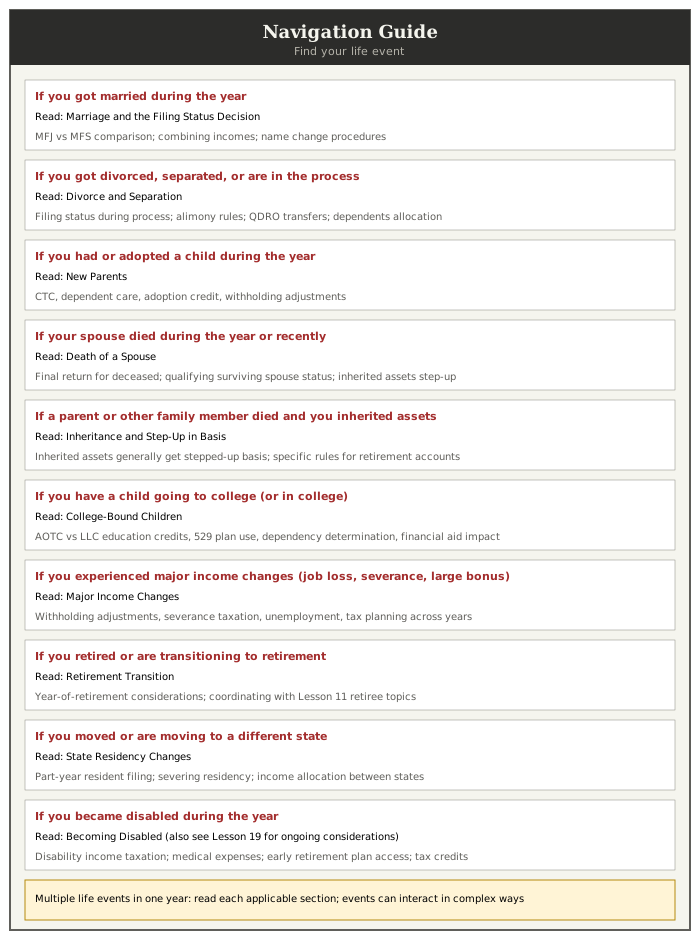
This lesson covers the most common life changes and the tax-specific implications of each. It's organized by event type — find the section that applies to your situation. The lesson assumes the foundation lessons (especially Lesson 1 on filing status and dependents, Lesson 11 on retiree topics, and Lesson 12 on self-employed topics) are in place.
Marriage and the Filing Status Decision
Getting married affects every aspect of your tax situation. The IRS considers you married for the entire tax year if you were married on December 31 — even if you married on December 31. Marriage opens new options and creates new decisions.
Your filing status options as a married person.
Married Filing Jointly (MFJ). Combines both spouses' income, deductions, and credits on a single return. Both spouses are jointly and severally liable for the full tax liability.
Married Filing Separately (MFS). Each spouse files their own return with their own income and deductions. Generally produces higher total tax than MFJ.
MFJ benefits.
- Higher standard deduction ($31,500 for 2025 — twice the single amount)
- Generally lower combined tax than two single returns for couples with similar incomes
- Access to credits not available to MFS (most education credits, dependent care credit, EITC)
- Access to traditional IRA deduction for non-working spouse
- Better Social Security taxation thresholds at retirement
- QBI deduction thresholds doubled
- Capital loss limit doubled ($6,000 vs $3,000)
MFS reasons. A few scenarios favor MFS:
- One spouse has high medical expenses (the 7.5% AGI floor is calculated on the lower MFS income)
- One spouse has substantial miscellaneous itemized deductions subject to AGI limits
- Income-based student loan repayment plans benefit from MFS
- Concerns about the other spouse's tax liability (one spouse owes back taxes, has problematic deductions, etc.)
- Pending divorce and want financial separation
- One spouse has substantial business losses being limited
When MFS is required despite being unfavorable. If your spouse files separately and itemizes, you must also itemize (you can't take the standard deduction). This sometimes forces both spouses into MFS-itemized when one would have preferred MFJ-standard.
Common changes for the year of marriage.
Combining incomes pushes into higher brackets. Two single filers each earning $80,000 (total $160,000) may move into higher brackets when combined. This is the "marriage penalty" affecting some dual-high-earner couples. Conversely, single-earner households often see a "marriage bonus."
W-4 adjustments. Both spouses should update their W-4 forms after marriage. The IRS Tax Withholding Estimator (irs.gov) helps couples coordinate withholding properly given combined income.
Name change procedures. If you changed your name, notify Social Security Administration (Form SS-5) before filing your tax return. Your name on the return must match SSA records, or processing delays result.
Existing financial arrangements. Many prenup-related arrangements have tax implications. Beneficiary designations on retirement accounts, life insurance, and other assets typically need updating after marriage.
Same-sex marriages. Treated identically to opposite-sex marriages for federal tax purposes since 2013 (Windsor decision; further confirmed by Obergefell). All federal tax provisions for married couples apply.
Common-law marriages. Recognized for federal tax purposes if the marriage is recognized as common-law in the state where established. Approximately 9 states still recognize common-law marriages with various requirements.
Sourcing. IRS Publication 17; IRS Publication 501; Form 1040 Instructions; IRS Tax Withholding Estimator.
Divorce and Separation
Divorce is one of the most tax-sensitive life events. Multiple complex rules interact: filing status, alimony treatment, retirement account divisions, property transfers, and dependency claims.
Filing status during the divorce process.
Still married on December 31? You can file MFJ or MFS. Even if you're separated and haven't lived together, if you're not legally divorced by December 31, you're married for tax purposes.
Legally separated (with court decree of separate maintenance)? Treated as unmarried — can file as single or HoH if otherwise qualifying.
Divorced by December 31? Treated as unmarried for the full year. Can file as single or HoH if otherwise qualifying.
Head of Household considerations. A divorced or separated parent maintaining a home for a qualifying child more than half the year can file HoH (with its better standard deduction and rates than single). Both former spouses can potentially qualify for HoH if they each have a qualifying child.
Alimony rules — the 2018 cutoff is critical.
Pre-2019 divorce agreements. Alimony is deductible by the payer (above-the-line) and taxable to the recipient. This treatment continues for old agreements unless modified after 2018 to specify the new rules apply.
Post-2018 divorce agreements. Alimony is NOT deductible by the payer AND NOT taxable to the recipient. The change shifts the tax burden from recipient to payer for new agreements.
The cutoff date. The alimony rule change applies to divorce or separation agreements executed after December 31, 2018. Modifications of pre-2019 agreements after that date generally preserve the old rules unless the modification specifically calls for the new rules.
Distinguishing alimony from other payments. Alimony has specific requirements:
- Cash payments only (not property transfers)
- Payments must be required by divorce agreement
- Spouses must not be members of the same household
- Liability must terminate at death of recipient
- Payments must not be designated as something other than alimony
Child support is NEVER deductible or taxable, regardless of when the agreement was executed.
QDRO transfers (Qualified Domestic Relations Order).
Purpose. A QDRO is a court order that allows splitting of qualified retirement accounts (401(k), pension plans) between spouses as part of divorce without triggering immediate taxation or penalty.
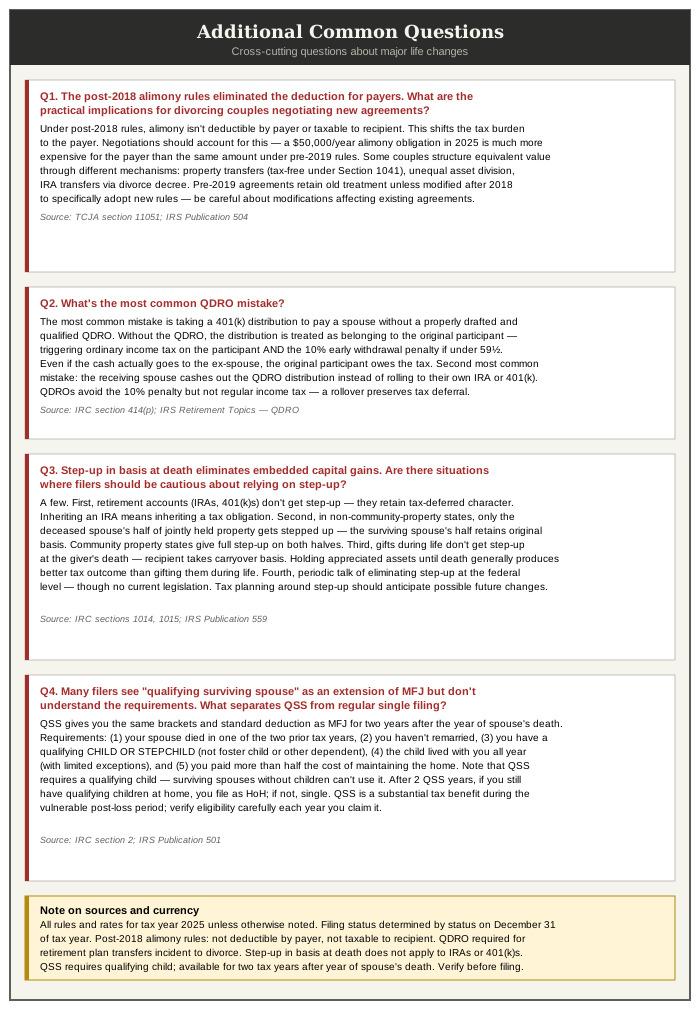
Without QDRO. Withdrawing from a 401(k) to pay a spouse triggers ordinary income tax plus 10% early withdrawal penalty if under 59½.
With QDRO. The receiving spouse becomes an alternate payee. Funds can transfer directly to the alternate payee's own retirement account (preserving tax deferral) OR be taken as a distribution (taxable but no early withdrawal penalty under QDRO exception).
IRAs don't need QDROs. IRA splits can be done directly without QDRO — the divorce decree authorizes the transfer, which is treated as a non-taxable transfer between spouses under Section 408(d)(6).
The QDRO must be drafted correctly, qualified by the plan administrator, and executed before retirement distributions. Issues that have created problems: receiving spouse withdrawing funds before the transfer is properly recorded (treated as distribution to original participant); QDRO referencing benefits not available under the plan; QDRO not specifying child support, alimony, or marital property division clearly.
Property transfers between divorcing spouses.
Section 1041 — no tax on transfer. Transfers of property between divorcing spouses (or former spouses if incident to divorce) are tax-free transfers. No gain or loss recognized.
Carryover basis. The receiving spouse takes the property at the transferor's basis. This is critical for assets that have appreciated — the receiving spouse takes the embedded gain and will pay tax on it eventually.
A couple dividing $200,000 of assets 50/50 may have unequal tax outcomes if assets have different bases. Example: one spouse takes $100,000 of cash; the other takes $100,000 of stock with $20,000 basis. The stock-receiving spouse has $80,000 of embedded capital gain. After tax (say 15% LTCG), they net $88,000 — substantially less than the $100,000 cash on the other side.
Dependency claims after divorce.
General rule. The custodial parent (the parent with whom the child lived more nights during the year) claims the child as a dependent.
Form 8332 — release to non-custodial parent. The custodial parent can release the dependency exemption to the non-custodial parent by signing Form 8332. The non-custodial parent attaches Form 8332 to their return.
What transfers with the dependency release. Releasing the dependency to the non-custodial parent transfers:
- Child Tax Credit
- Credit for Other Dependents
- Educational tax credits (AOTC, LLC) if claimed for the child
What does NOT transfer.
- Earned Income Credit (always stays with custodial parent)
- Child and Dependent Care Credit (always stays with custodial parent)
- Head of Household filing status (always stays with custodial parent)
- Medical expense deductions
Tiebreaker rules. If parents share custody equally and both claim the child without a Form 8332, IRS tiebreakers apply: the parent with higher AGI generally wins.
Other divorce tax considerations.
Selling the marital home. Section 121 home sale exclusion ($250K single / $500K MFJ) requires 2-of-5 years ownership and use. Divorcing spouses may have planning opportunities to qualify under various scenarios. Special rule allows a spouse to count the other spouse's ownership/use period in some cases.
Legal fees. Generally not deductible. Some fees specifically allocated to tax advice during divorce may be deductible (Schedule A miscellaneous deductions are gone post-TCJA but some specific situations may apply).
Filing the year of divorce. First year filing as single or HoH. Update W-4 with new filing status. Estimated tax payments may need adjustment.
Sourcing. IRS Publication 504 (Divorced or Separated Individuals); IRC sections 71, 215, 1041, 408(d)(6); Form 8332 Instructions; Tax Cuts and Jobs Act provisions on alimony.
New Parents
Having or adopting a child triggers multiple tax considerations and benefits.
Getting an SSN or ATIN. Apply for the child's Social Security Number (SSN) immediately after birth — typically done at the hospital. SSN is required for claiming the Child Tax Credit. For adoption, an Adoption Taxpayer Identification Number (ATIN) is available if the child doesn't yet have an SSN.
Child Tax Credit. $2,200 per qualifying child under age 17 for 2025 (made permanent and indexed for inflation by OBBBA). Up to $1,700 is refundable as the Additional Child Tax Credit. The credit phases out at higher incomes ($200,000 single / $400,000 MFJ).
Both parents (if MFJ) must have a valid SSN (not just an ITIN) to claim CTC starting with the 2025 tax year. The child must have a valid SSN issued before the return due date.
Adoption credit. Up to $17,280 per child for 2025 (adjusted annually for inflation). Covers qualified adoption expenses including legal fees, court costs, travel, and other adoption-related costs. Special needs adoptions allow the full credit without regard to actual expenses. Phase-out begins at $259,190 MAGI (2025) and completes at $299,190. Non-refundable but excess can carry forward.
Dependent care expenses. If both parents work (or one is a full-time student) and pay for childcare for a child under 13, the Child and Dependent Care Credit applies. Up to $3,000 of expenses for one child or $6,000 for two or more, with a credit percentage ranging from 20% to 35% based on income.
Many employers offer Dependent Care Flexible Spending Accounts allowing pre-tax contributions up to $5,000 ($2,500 if MFS) to pay for childcare. Pre-tax savings are usually better than the credit for working parents in moderate or higher tax brackets.
Adjusting withholding. New child generally increases dependents claimed on Form W-4, reducing withholding. Coordinate with the Tax Withholding Estimator to get the right amount.
Medical expenses. Birth and prenatal care expenses can contribute toward the medical expense itemized deduction (subject to 7.5% AGI floor). Most filers don't have enough medical expenses to exceed the floor.
Education savings — 529 plans. Starting a 529 plan for the new child enables tax-free growth and withdrawals for qualified education expenses. Contributions are not federally deductible but many states offer state-level deductions. Annual gift tax exclusion ($19,000 for 2025) applies; 5-year forward-funding election allows up to $95,000 lump sum without gift tax issues.
EITC qualification. Adding a qualifying child can substantially increase Earned Income Tax Credit for lower-income filers. The credit increases significantly with each qualifying child up to three.
Surrogacy or adoption-specific considerations. Adoption from foreign countries has specific timing rules for claiming the adoption credit. Surrogacy arrangements have complex tax implications often requiring professional advice.
Sourcing. IRC sections 24, 23, 21, 32; IRS Publication 503 (Child and Dependent Care Expenses); IRS Publication 970 (Tax Benefits for Education); OBBBA child tax credit provisions.
Death of a Spouse
The death of a spouse triggers several specific tax considerations across multiple tax years.
Year of death — filing status. You can still file MFJ for the year your spouse died if you didn't remarry during the year. This applies even if your spouse died early in the year — the IRS treats you as still married for that year.
Year of death — special considerations.
- File MFJ to use combined deductions and brackets
- Sign return as surviving spouse
- Indicate spouse's death date on return
- Final return for the deceased includes income earned through the date of death
- Joint income earned during the year is generally split based on when earned (before vs after death)
Filing for the deceased. The deceased's final return reports income earned through the date of death. Income earned after death belongs to the estate (potentially filed on Form 1041).
Qualifying Surviving Spouse (QSS). For the two years AFTER the year of death, a surviving spouse with a qualifying dependent child can file as Qualifying Surviving Spouse, using the same brackets and standard deduction as MFJ.
Requirements for QSS:
- Spouse died in one of the two prior tax years
- You haven't remarried
- You have a qualifying child or stepchild (not foster child)
- The child lived with you all year (with some exceptions)
- You paid more than half the cost of maintaining the home
After QSS years. Once QSS years end (typically 3 years after death of spouse, including the year of death), you file as single or HoH depending on dependents.
Estate considerations.
Estate tax. Most decedents don't owe federal estate tax due to the high exemption ($13.99 million per person for 2025). Estate tax filing (Form 706) is required only if the estate exceeds the exemption OR if the surviving spouse wants to elect portability of the deceased spouse's unused exemption.
Portability election. If the deceased spouse didn't use their entire estate tax exemption, the surviving spouse can claim the unused portion through portability. This effectively doubles the surviving spouse's available exemption. Portability requires filing Form 706 within 9 months of death (or 15 months with extension), even if the estate doesn't otherwise owe tax. Late portability elections may be available under specific procedures.
Inherited assets and step-up in basis. Most inherited assets get a "step-up" in basis to fair market value at the date of death. This often eliminates the embedded capital gains accumulated during the deceased's ownership. For the surviving spouse:
- In community property states: both halves of community property get stepped up. This is a major advantage of community property states.
- In non-community-property states: only the deceased spouse's half gets stepped up. The surviving spouse's half retains original basis.
Step-up exceptions. Retirement accounts (IRAs, 401(k)s) don't get step-up — they retain their original tax-deferred character. Income in respect of a decedent (income earned but not yet recognized at death) is taxable to the recipient at their tax rates.
Inherited IRAs. Covered in detail in Lesson 11. Surviving spouses can roll over to their own IRA (treating as their own), or remain as beneficiary (allowing distributions without 10% penalty if under 59½). Other beneficiaries are subject to the 10-year rule under SECURE Act.
Final return mechanics.
Who files for the deceased. Surviving spouse (if filing jointly) or the executor/administrator of the estate. If no executor appointed yet, the surviving spouse can sign.
Form 1310. Required when claiming a refund for a deceased person. Establishes the claimant's right to receive the refund.
Final return deadline. Same as regular returns (April 15) for the year of death. Filed under the deceased's SSN.
Income reporting after death. Income earned after death (interest on bank accounts, dividends, etc.) generally belongs to the estate or the beneficiaries who inherited the asset. The estate may need to file Form 1041 if it has gross income of $600+ during administration.
Sourcing. IRC sections 1014, 2010, 2056, 6013; IRS Publication 559 (Survivors, Executors, and Administrators); Form 1310 Instructions; Form 706 Instructions; Revenue Procedure on portability.
Inheritance and Step-Up in Basis
Inheritance triggers tax considerations primarily through basis rules.
Step-up in basis — the general rule. When you inherit property, your basis is generally the fair market value at the date of the decedent's death (or 6 months later under the alternate valuation date election). This "step-up" eliminates embedded capital gains accumulated during the decedent's ownership.
Your parent bought stock for $10,000 thirty years ago. At their death, the stock is worth $100,000. You inherit the stock with $100,000 basis (not $10,000). If you sell immediately for $100,000, no taxable gain.
Why step-up matters. Without step-up, inherited appreciated assets would carry forward the deceased's low basis, triggering massive capital gains taxes when sold. Step-up is one of the most significant tax benefits in the code, particularly for filers inheriting long-held appreciated assets.
Step-up DOES apply to:
- Stocks, bonds, mutual funds (non-IRA)
- Real estate
- Personal property (collectibles, art)
- Business interests (sole proprietorship assets, partnership interests, S-corp stock)
- Most other appreciated assets
Step-up does NOT apply to:
- Retirement accounts (IRAs, 401(k)s — these are "income in respect of a decedent" and retain tax-deferred character)
- Annuities (similarly)
- US Savings Bonds where the accumulated interest is taxable to the recipient
- Items received as gifts during the decedent's life (no step-up at death since not part of estate)
Holding period for inherited property. Inherited property is automatically treated as long-term (held more than one year) regardless of how long the decedent owned it or how soon you sell. This means inherited assets always qualify for long-term capital gains treatment.
Alternate valuation date. The estate's executor can elect to value assets at the date 6 months after death (or earlier sale/distribution date) instead of date of death. Used when assets have decreased in value and lower estate tax results. The election affects basis for inheritors too.
Inherited IRAs. Covered in Lesson 11. Beneficiary withdrawals are taxable income (no step-up). 10-year rule for non-eligible designated beneficiaries; lifetime distributions for surviving spouses, minor children of decedent, disabled or chronically ill beneficiaries, beneficiaries not more than 10 years younger than decedent.
Receiving an inheritance isn't itself taxable income to the recipient (no federal inheritance tax for individual recipients). The estate may have paid estate tax, but the recipient generally doesn't pay tax on receipt. Income generated by inherited assets after inheritance IS taxable (interest, dividends, rental income, capital gains on sale).
State inheritance and estate taxes. Some states have inheritance tax (paid by recipient based on relationship to decedent) or estate tax (paid by estate). The list changes; current states with these taxes include Pennsylvania, Maryland, Nebraska, New Jersey (with various exemptions), and several others. Federal step-up generally doesn't affect state inheritance tax obligations.
Sourcing. IRC sections 1014, 691, 2032; IRS Publication 559; IRS Publication 590-B.
College-Bound Children
Sending a child to college triggers several tax considerations.
Dependency continuation. A college student under age 24 who is a full-time student for at least 5 months of the year can generally still be claimed as a qualifying child by the parents (as long as they don't provide more than half of their own support).
American Opportunity Tax Credit (AOTC). Up to $2,500 per eligible student for the first 4 years of post-secondary education. 100% of first $2,000 of qualified expenses, 25% of next $2,000. Up to 40% ($1,000) is refundable. Phases out at $80,000-$90,000 MAGI single / $160,000-$180,000 MFJ. Student must be pursuing degree or credential, enrolled at least half-time, no felony drug conviction. The student must have a valid SSN issued by the return due date.
Lifetime Learning Credit (LLC). Up to $2,000 per return (not per student). 20% of first $10,000 of qualified expenses. No 4-year limit; available for any post-secondary education or job-skill courses. Phases out at $80,000-$90,000 single / $160,000-$180,000 MFJ. Non-refundable. More flexible than AOTC but lower amount.
AOTC is generally better for traditional undergraduate students. LLC is useful for graduate school, part-time students, fifth-year undergraduates, or job-skill training. Can't claim both for the same student in the same year.
529 plans. Earnings grow tax-free; withdrawals for qualified education expenses are tax-free. Qualified expenses include tuition, fees, books, supplies, equipment, and room and board (subject to limits). K-12 tuition up to $10,000 per year is also a qualified expense.
Expenses paid by 529 plans are NOT eligible for education credits (you can't double-benefit). Strategically pay some expenses with 529 (tax-free) and some from other sources to qualify for AOTC.
Student loan interest deduction. Up to $2,500 of interest paid on student loans is deductible above-the-line. Phases out at higher incomes. Parent-paid student loan interest can qualify if the parent has primary responsibility for the loan.
Scholarships. Generally tax-free if used for qualified expenses (tuition, fees, required books and supplies) for degree-seeking students. Amounts used for room and board, transportation, or other non-qualified expenses are taxable.
Work-study and student employment. Taxable wages, but may be eligible for EITC if income is low. Filing requirement applies to student with earned income exceeding the standard deduction.
Kiddie tax. Children under 18 (or under 24 if full-time students) with unearned income over a threshold pay tax at the parent's marginal rate on the excess. For 2025, the first $1,350 is tax-free; next $1,350 taxed at child's rate; excess taxed at parent's rate. Affects investment income, including 529 plan earnings if not used for qualified expenses.
FAFSA and tax implications. Some 529 plan ownership structures affect financial aid calculations. Generally, parent-owned 529 plans are assessed at lower rates than student-owned. Grandparent-owned 529 plans no longer count as income on the student's FAFSA under recent changes — making them more attractive for college funding.
Sourcing. IRC sections 25A, 529, 221; IRS Publication 970 (Tax Benefits for Education); Form 8863 Instructions.
Major Income Changes
Major income changes (job loss, severance package, large bonus, retirement) require tax planning attention.
Job loss and unemployment.
Unemployment compensation. Fully taxable. Reported on Form 1099-G from the state unemployment agency. Most states allow voluntary withholding (Form W-4V); without it, you may owe at filing time.
Severance pay. Taxable as ordinary income. Generally subject to standard withholding rates. Large severance packages may push you into higher brackets for the year — consider tax planning if you have flexibility on timing.
Health insurance after job loss. COBRA continuation coverage maintains your employer plan but you pay full premium plus 2%. Premium tax credit through marketplace may be available — the loss of employer coverage is a qualifying event for special enrollment. Self-employed health insurance deduction available if you become self-employed.
Severance package timing. If your employer offers severance to be paid in installments versus lump sum, consider tax impact. Installment payments across years may stay in lower brackets; lump sums push into higher brackets.
Retirement plan withdrawals after job loss.
401(k) options. Leave with former employer, roll to new employer's plan, roll to IRA, or take distribution. Distributions before 59½ generally trigger 10% early withdrawal penalty.
Separation from service exception. Distributions from a 401(k) after separation from service in or after the year you turn 55 (50 for public safety employees) avoid the 10% early withdrawal penalty. This is broader than the 59½ rule for 401(k)s but not for IRAs.
Rule of 72(t) distributions. Series of substantially equal periodic payments from an IRA avoid the 10% penalty if continued for 5 years or until age 59½ (whichever is longer). Complex rules; modifications can trigger retroactive penalties.
Major income increases (large bonus, business sale, etc.).
Withholding may be insufficient. Standard withholding may not cover the tax on unusual income. Make estimated payments to avoid underpayment penalty.
Bracket management. Consider timing of optional income/deductions to smooth income across years. Retirement contributions, HSA contributions, charitable contributions can reduce taxable income in the high-earning year.
Capital gains harvesting. Large income year may push capital gains into the 15% or 20% bracket. Consider whether to defer or accelerate sales based on overall tax planning.
ACA Premium Tax Credit reconciliation. Large income increase may require repayment of advance PTC received during the year (subject to repayment caps).
Medicare IRMAA implications. For Medicare beneficiaries, large income years create higher Part B and D premiums two years later (covered in Lesson 11).
Sourcing. IRS Publication 17; IRC section 72(t); various provisions on unemployment and severance.
Retirement Transition
The year you retire creates unique considerations beyond ongoing retirement issues covered in Lesson 11.
Year-of-retirement complexities.
Mid-year income shift. You have wages (or business income) through the retirement date, then a different income profile after. Combined year totals may be unusual.
Final paycheck and accrued benefits. Final wages, unused vacation/PTO payouts, deferred compensation triggers, and severance all hit in the year of retirement.
Pension or 401(k) start. First pension or 401(k) withdrawal begins. Tax withholding on these may be insufficient for new income profile.
Social Security claiming decision. If claiming Social Security in the year of retirement, the earnings test applies if claiming before full retirement age. Earnings above the threshold ($23,400 in 2025) reduce Social Security temporarily.
Medicare enrollment. If retiring at 65+, Medicare enrollment is critical. Late enrollment penalties for Medicare Part B apply unless you had qualifying employer coverage at age 65+.
Tax bracket changes. Income often drops in retirement, creating planning opportunities:
- Roth conversion strategy works well in early retirement (covered in Lesson 11)
- Realizing capital gains in low-income years
- Tax-loss harvesting different from working years
Required Minimum Distributions (RMD) considerations. First RMD due by April 1 of the year after turning 73. Take in year of turning 73 to avoid having two RMDs in the following year.
Coordinate with Lesson 11. All ongoing retiree considerations (Social Security taxation, RMDs, IRMAA, Medicare, etc.) apply starting in the retirement year.
State residency planning. Many retirees move to lower-tax states. The year of move requires part-year resident filing in both states.
Sourcing. IRS Publication 17; IRS Publication 575 (Pension and Annuity Income); IRS Publication 590-B; Social Security Administration earnings test rules.
State Residency Changes
Moving to a new state requires careful attention to both states' filing requirements.
Part-year resident returns. In the year of move, you typically file as part-year resident in both states — the state you left and the state you moved to. Each state taxes the income you earned during the period you were a resident there.
Income allocation. Generally allocate income based on when earned:
- Wages: based on where work was performed
- Self-employment: based on where business activities occurred
- Investment income: based on residence at time received (interest, dividends) or where property is located (rent, certain capital gains)
- Retirement income: based on residence at time received (post-USERRA generally)
Establishing new state residency. Steps depend on state:
- Update driver's license
- Register to vote in new state
- Register vehicle in new state
- Update address with banks, employer, IRS
- Establish home in new state (own or rent)
- File final return as part-year resident in old state
Severing old state residency. Critical for high-tax states (CA, NY, etc.):
- File final return marked as part-year resident
- Surrender driver's license
- Move physical residence
- Take affirmative steps to establish new state ties
- Spend less than threshold days in old state going forward
The 183-day rule. Many states consider you a resident if you spend more than 183 days in the state during the year. Even with moves, spending too many days back in the old state can extend residency.
Domicile vs residency. Domicile is your true home — the place you intend to return. Residency is where you physically live. Some states use domicile test, others use physical presence test, and some use both.
State retirement plan considerations.
- Some states tax retirement income; others don't (covered in Lesson 11)
- IRA, 401(k), and pension distributions from a former state aren't generally taxable in that state if you've moved away (but verify state-specific rules)
Reciprocal agreements. Some neighboring states have reciprocal agreements where you only file in your state of residence even if you work in the other (Pennsylvania-New Jersey, Maryland-Virginia, others). Affects W-2 withholding and filing.
Sourcing. State Department of Revenue websites; state residency case law; multistate tax research services.
Becoming Disabled
Becoming disabled during the year triggers several specific tax considerations.
Disability income classification.
Employer-paid disability insurance. Premiums paid by employer are excluded from wages. Disability benefits paid out are taxable income to you.
Employee-paid disability insurance (after-tax). Premiums paid with after-tax dollars. Disability benefits paid out are tax-free.
Social Security Disability Insurance (SSDI). Taxable like regular Social Security — up to 85% may be taxable depending on overall income.
Supplemental Security Income (SSI). Not taxable.
Workers' compensation. Generally not taxable.
Long-term disability (LTD) from insurance. Taxability depends on who paid premiums and with what funds — same rules as regular disability insurance.
Early retirement plan access. If totally and permanently disabled, the 10% early withdrawal penalty doesn't apply to distributions from retirement plans before 59½. Distributions still trigger income tax but not the penalty.
Medical expense deductions. Significant disability-related medical expenses may push you above the 7.5% AGI floor for itemized medical deduction. Includes home modifications, special equipment, certain caregiver expenses.
Credit for Elderly or Disabled. Small credit for low-income filers under 65 who are permanently and totally disabled. Generally provides little benefit due to low income thresholds.
Continuing income considerations. If still working part-time with disability, both income tax and SE tax (if self-employed) may apply. SSDI recipients have specific work incentive programs allowing trial work periods.
ABLE accounts. Available to individuals with disabilities that began before age 26 (changing to age 46 for disabilities beginning in 2026 and later under SECURE Act 2.0). Tax-advantaged savings without losing SSI/Medicaid eligibility. Annual contribution limit equal to gift tax exclusion ($19,000 for 2025).
Connection to Lesson 19. For ongoing disability considerations beyond the year of becoming disabled, Lesson 19 covers tax issues for filers with disabilities and their caregivers.
Sourcing. IRC sections 22, 105, 106, 72(t); IRS Publication 525 (Taxable and Nontaxable Income); IRS Publication 524 (Credit for Elderly or Disabled); Social Security Administration disability information.
Connection to Other Lessons
The Life Changes lesson connects to nearly every other lesson in the curriculum:
- Lesson 1 (Personal info and filing status) — Filing status changes are central to most life events. Marriage opens MFJ/MFS. Divorce returns you to single/HoH. Death triggers QSS for two years.
- Lesson 2 (Dependents) — Children of divorced parents have complex dependency rules. New babies need to be added as dependents. College students remain dependents until conditions change.
- Lesson 5 (Standard vs Itemized) — Major medical expenses from disability or illness may push you above the 7.5% AGI floor.
- Lesson 7 (Credits) — Most life events affect credit eligibility. Marriage may increase or decrease EITC. New babies enable CTC and dependent care credit. College students enable AOTC.
- Lesson 9 (Payments) — Withholding adjustments are needed for every life change. New W-4 after marriage, after a baby, after a job change, after a major raise.
- Lesson 11 (Retirees) — Retirement transition connects to all retiree topics.
- Lesson 13 (Real Estate Investors) — Selling the marital home during divorce requires Section 121 analysis.
- Lesson 17 (International) — State residency changes connect to broader residency analysis.
What to Gather for Filers with Major Life Changes
For marriage:
- Marriage certificate (for records, not filed)
- Both spouses' tax history
- SSA notification of name change (if applicable)
- Combined income projections for withholding planning
For divorce:
- Divorce decree or separation agreement
- Property settlement documentation
- QDRO documentation if retirement accounts were divided
- Form 8332 if dependency is being shared
- Records of alimony paid or received with dates
- New W-4 reflecting new filing status
For new parents:
- Child's SSN (for CTC and other benefits)
- Adoption documentation if applicable
- Records of qualified adoption expenses
- Dependent care expense records and provider information
- New W-4 reflecting additional dependent
For death of family member:
- Death certificate
- Decedent's final return information
- Estate or trust documentation
- Beneficiary documentation for inherited assets
- Form 1310 if claiming refund for deceased
- Form 706 if estate tax filing or portability election
For inheritance:
- Date of death valuations for inherited assets
- Documentation of step-up in basis
- Estate distribution records
- Inherited IRA documentation with beneficiary information
For college expenses:
- Form 1098-T from educational institution
- Records of qualified education expenses
- 529 plan distribution records
- Records of scholarships and grants
For major income changes:
- W-2 from former employer with severance details
- 1099-G from unemployment agency
- Records of any large bonus or unusual income
- Adjusted withholding documentation
For state residency change:
- Records of move date
- Documentation of new state residency steps
- Income earned in each state with dates
- Property and other ties severed in former state
Key Takeaways
- The IRS considers you married for the entire tax year if married on December 31. MFJ is usually better, but MFS can be advantageous for high medical expenses, income-based student loan plans, or when one spouse has liability concerns.
- Alimony tax treatment has a hard cutoff: pre-2019 agreements make alimony deductible by payer and taxable to recipient; post-2018 agreements make it neither. Modifications generally preserve old rules unless they specifically adopt the new rules.
- QDRO is required to split qualified retirement plans (401(k), pensions) in divorce without immediate tax and penalty. IRAs don't need a QDRO — the divorce decree authorizes a direct non-taxable transfer under Section 408(d)(6).
- Property transfers between divorcing spouses have no immediate tax, but the receiving spouse inherits the transferor's basis. A 50/50 asset split can be economically unequal after tax if assets have different embedded gains.
- Inherited assets generally receive a step-up in basis to fair market value at date of death, eliminating embedded capital gains. Retirement accounts (IRAs, 401(k)s) do NOT receive step-up — they remain income in respect of a decedent.
- The American Opportunity Tax Credit and 529 plan distributions cannot both apply to the same qualified expenses. Strategically allocate expenses: pay some from non-529 sources to preserve credit eligibility.
- Unemployment compensation is fully taxable and requires proactive withholding (Form W-4V). Large income events require estimated payments to avoid underpayment penalties.
- In the year of a spouse's death, you can still file MFJ. For the following two years, Qualifying Surviving Spouse status provides MFJ-equivalent rates and deductions if you have a qualifying child.
Quiz — 5 Questions
Answer one at a timeA divorce agreement was executed in March 2021. Is the alimony paid under this agreement deductible by the payer?