Partners in Partnerships and Multi-Member LLCs
How K-1 income flows to your personal return, SE tax rules for general and limited partners, basis tracking, guaranteed payments, and partnership-specific considerations
- Understand how partnership income passes through to your individual return via Schedule K-1
- Read and interpret every section of your Form 1065 K-1
- Apply the correct SE tax rules for general partners, limited partners, and LLC members
- Track your outside basis and understand the three-tiered loss limitation rules
- Handle guaranteed payments, distributions, and the tax implications of selling a partnership interest
Introduction
Partnerships and multi-member LLCs taxed as partnerships present a different set of tax considerations from sole proprietorships or S-corporations. The partnership itself is a pass-through entity — it files an information return (Form 1065) and issues each partner a Schedule K-1 reporting their share of income, deductions, credits, and other tax items. Partners then report these items on their individual returns.
Partnership taxation is one of the most complex areas of the tax code. The complexity stems from several factors: partnerships can make "special allocations" of income and deductions that don't match ownership percentages (with substantial economic effect requirements), capital accounts and tax basis are tracked separately and can diverge significantly over time, the distinction between general and limited partners affects self-employment tax treatment differently than in other entities, guaranteed payments function as a unique form of compensation that isn't quite salary and isn't quite distribution, partnership interests can be sold with complex character-of-gain rules, and distributions from partnerships have specific timing rules that don't always match when income is taxed.
This lesson covers the partnership-specific issues that affect individual partners filing their personal returns. The deeper mechanics of partnership tax accounting (Section 704(b) allocations, hot assets under Section 751, disguised sale rules) are beyond the scope of an individual filer's lesson — partners with complex situations need professional preparation. But understanding how K-1 information flows to your return, what each box on the K-1 means, how SE tax applies to general vs limited partners, and what distributions mean for your tax situation is essential for anyone receiving partnership K-1s.
The lesson assumes Lesson 12 (Self-Employed) is in place — many of the underlying concepts about business income, business expenses, the QBI deduction, retirement plans for self-employed people, and SE tax mechanics carry over to partners.
Navigation guide — which subsections apply to your situation
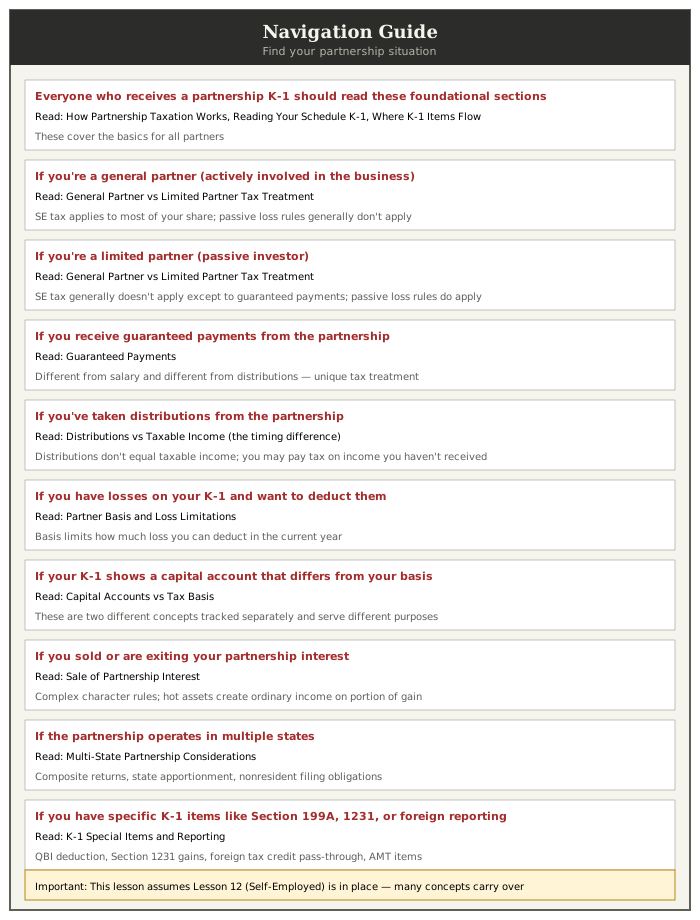
How Partnership Taxation Works
Partnerships are pass-through entities for federal tax purposes. The partnership itself generally doesn't pay federal income tax. Instead, the partnership files an information return (Form 1065) reporting its income, deductions, and other tax items, then issues each partner a Schedule K-1 reporting their share. Partners report the K-1 items on their individual returns.
The partnership's federal information return. Due March 15 for calendar-year partnerships (or extension to September 15). The return reports the partnership's total income, deductions, credits, and other items. It also includes Schedule K (the partnership-level total of pass-through items) and Schedule M (capital account reconciliations).
Each partner receives their own K-1 showing their share of partnership items. The K-1 is generated from the Form 1065 information and allocates items based on the partnership agreement.
Pass-through treatment. Each partner reports their share of:
- Ordinary business income or loss
- Real estate rental income/loss
- Other rental income/loss
- Interest income
- Dividend income
- Capital gains (short-term and long-term)
- Section 1231 gains/losses
- Other items as applicable
Allocation flexibility (special allocations). Unlike S-corps, which require strict pro-rata allocation based on ownership percentage, partnerships can make "special allocations" where specific income, deductions, or credits are allocated to specific partners. These special allocations must have "substantial economic effect" under Section 704(b) regulations — they must affect the economic outcomes for the partners, not just the tax outcomes. For example, a partnership could allocate all depreciation to a specific partner if the corresponding economic loss is also borne by that partner.
Self-employment tax treatment differs from S-corp. Partnership distributions and allocations of business income are subject to self-employment tax for general partners on their full share. Limited partners generally don't pay SE tax on their share of business income (with exceptions for guaranteed payments).
Calendar year required. Most partnerships are required to use a calendar tax year that matches their partners' tax years. Fiscal year partnerships face significant restrictions.
Sourcing. IRS Publication 541 (Partnerships); Form 1065 Instructions; IRC sections 701-777.
Reading Your Schedule K-1
Schedule K-1 (Form 1065) is a multi-page form with many boxes corresponding to different types of partnership items. Understanding what each box means and where the amount goes on your individual return is essential.
Part I — Information about the partnership. EIN, name, address of the partnership. The IRS Service Center where the partnership filed its Form 1065.
Part II — Information about the partner.
- Box A: Your TIN (SSN or EIN)
- Box B: Your name, address, ZIP
- Box C: General/limited partner status — critical for SE tax treatment
- Box D: Domestic/foreign partner status
- Box E: Indicates type of entity (individual, corporation, partnership, trust, etc.)
- Box F: Indicates if your share has decreased due to sale, exchange, or partial liquidation
- Box G: Partnership representative information
- Box H: PTP indicator (publicly traded partnership)
- Box I: Type of partner (general, limited, LLC member, etc.)
- Box J: Your share of profit/loss/capital percentages
- Box K: Your share of liabilities (recourse and nonrecourse)
- Box L: Capital account analysis (beginning balance, contributions, current year income/loss, distributions, ending balance)
- Box M: Disregarded entity information
- Box N: Type of share
Part III — Partner's share of current year income, deductions, credits, and other items. This is where the income and deductions are listed.
- Box 1 — Ordinary business income/loss. Your share of the partnership's ordinary business income or loss from operations. Reported on Schedule E Part II of your Form 1040. This is the main pass-through item from most operating partnerships.
- Box 2 — Net rental real estate income/loss. Your share of net real estate rental income or loss. Goes on Schedule E Part II.
- Box 3 — Other net rental income/loss. Rental income from non-real-estate (equipment, vehicle rental). Goes on Schedule E Part II.
- Box 4a — Guaranteed payments for services. Compensation for services rendered to the partnership. Goes on Schedule E Part II. Subject to SE tax for the recipient regardless of general/limited partner status.
- Box 4b — Guaranteed payments for capital. Payments for use of capital you contributed. Goes on Schedule E Part II.
- Box 4c — Total guaranteed payments. Sum of 4a and 4b.
- Box 5 — Interest income. Goes on Schedule B and Form 1040 line 2b.
- Box 6a — Ordinary dividends. Goes on Form 1040 line 3b. Box 6b shows qualified portion (line 3a).
- Box 7 — Royalties. Goes on Schedule E Part I.
- Box 8 — Net short-term capital gain/loss. Goes on Schedule D.
- Box 9a — Net long-term capital gain/loss. Goes on Schedule D.
- Box 9b — Collectibles gain. 28% rate gain on collectibles. Goes on Schedule D.
- Box 9c — Unrecaptured Section 1250 gain. Goes on Schedule D, subject to 25% maximum rate.
- Box 10 — Net Section 1231 gain/loss. Goes on Form 4797.
- Box 11 — Other income/loss with various codes. Items like Section 743(b) adjustments, cancellation of debt, mining exploration, etc.
- Box 12 — Section 179 deduction. Limited at the partner level, not the partnership level.
- Box 13 — Other deductions with various letter codes. Includes things like investment interest expense (code H), Section 754 step-up amortization (code W), etc.
- Box 14 — Self-employment earnings (loss). Code A shows net earnings subject to SE tax for general partners. Code C shows gross nonfarm earnings.
- Box 15 — Credits with various codes. Pass-through credits like work opportunity credit, foreign tax credit, etc.
- Box 16 — Foreign transactions (Schedule K-3 details).
- Box 17 — AMT items. Various adjustments for AMT calculation.
- Box 18-20 — Various other items including tax-exempt income, distributions, Section 199A QBI information, etc.
The supplemental statement. Many K-1s include a supplemental statement with additional details about Box 11 ("Other income") items, Box 13 ("Other deductions") items, Box 20 codes, and other items requiring further explanation. Read these carefully — they often contain important details about how to report items.
Sourcing. Schedule K-1 (Form 1065) Instructions; Form 1040 Instructions; various form instructions for downstream forms.
Where K-1 Items Flow
The Box 1 ordinary business income is just one piece. Various K-1 items flow to different parts of your individual return.
Schedule E Part II. Receives Box 1 ordinary business income, Box 2 rental real estate income, Box 3 other rental income, and Box 4c guaranteed payments. This is the main place K-1 items appear.
Schedule B. Box 5 interest income.
Form 1040 directly. Box 6 ordinary dividends to line 3b; qualified portion in 6b to line 3a.
Schedule D. Box 8 short-term gains, Box 9a long-term gains, Box 9b collectibles gains, Box 9c unrecaptured Section 1250 gains.
Form 4797. Box 10 Section 1231 gains/losses.
Form 6251. Box 17 AMT adjustments.
Form 8582. Tracks passive losses from K-1 items if applicable.
Schedule SE. Box 14 code A self-employment earnings for general partners (subject to SE tax).
Form 1116. Box 16 foreign tax credit items.
Form 8995 or 8995-A. Box 20 code Z QBI information feeds the QBI deduction calculation.
Critical reconciliation. The K-1 box numbers correspond to specific line items on the partnership's Schedule K (the partnership-level totals). The partnership's tax preparer determines what goes in each box based on the partnership agreement and tax law allocations. Discrepancies between your K-1 and the partnership-level Schedule K shouldn't happen — if you see one, contact the partnership for clarification.
Sourcing. Schedule K-1 (Form 1065) Instructions; Form 1040 Instructions; various form instructions for downstream forms.
General Partner vs Limited Partner Tax Treatment
The distinction between general partner and limited partner status has major tax implications, particularly for self-employment tax.
General partner status.
- Active management role in the partnership
- Personal liability for partnership obligations (unless protected by LLC structure)
- Box 1 ordinary business income is subject to SE tax
- Generally satisfies material participation for passive activity rules
Limited partner status.
- Passive investor role; doesn't actively manage
- Limited liability (only to amount invested)
- Box 1 ordinary business income generally NOT subject to SE tax
- Generally subject to passive activity rules (losses limited to passive income)
The LLC complication. Many "partnerships" today are actually LLCs taxed as partnerships. LLC members all have limited liability protection, blurring the traditional general/limited partner distinction. The IRS has wrestled with how to apply general/limited partner SE tax rules to LLC members.
LLC member SE tax — the current standard. Generally, LLC members performing substantial services for the LLC are treated as general partners for SE tax purposes, even if they're passively listed as "members." Members who are merely passive investors (don't perform services) are generally treated as limited partners. This has been litigated extensively, with the IRS pushing for broader SE tax application to LLC members.
Materially participating LLC members. If you materially participate in the LLC's business (more than 500 hours, or another material participation test), the IRS generally treats your share of LLC income as subject to SE tax — like a general partner.
Non-materially participating LLC members. If you don't materially participate, your share of LLC income may not be subject to SE tax — similar to a limited partner.
The Box 14 indicator. The partnership's K-1 Box 14 (with various codes) tells you what portion of your K-1 income is subject to SE tax. Code A specifically indicates net earnings from self-employment subject to SE tax.
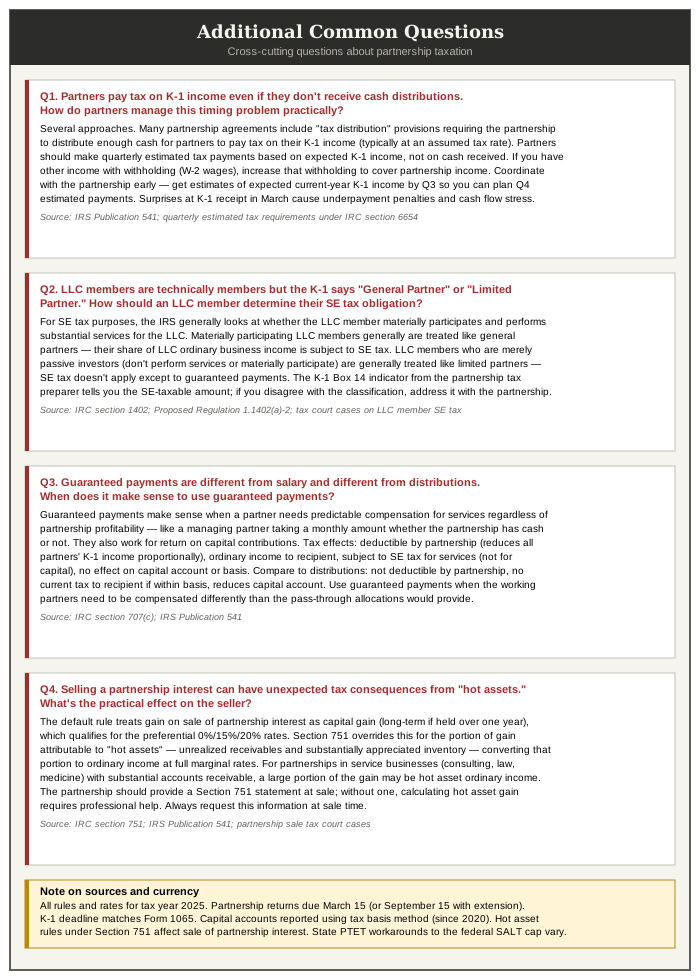
Guaranteed payments are different. Regardless of general/limited partner status, guaranteed payments for services are subject to SE tax. A limited partner receiving guaranteed payments pays SE tax on those payments but not on the rest of their Box 1 share.
Self-employed health insurance deduction. General partners (and limited partners receiving guaranteed payments for services) can deduct self-employed health insurance premiums on Schedule 1 line 17. The deduction is limited to net SE earnings (the same as for sole proprietors).
Retirement plan participation. Partners are eligible for self-employed retirement plans (SEP IRA, SIMPLE IRA, Solo 401(k) only if no other employees besides spouse) based on their net SE earnings. Limited partners without SE earnings generally can't contribute to self-employed plans through the partnership (but can still have personal IRAs).
Sourcing. IRC section 1402; Proposed Regulation 1.1402(a)-2 (LLC member SE tax); IRS Publication 541; tax court cases on LLC member SE tax.
Guaranteed Payments
Guaranteed payments are a unique form of partnership compensation that doesn't fit cleanly into salary or distribution categories.
Definition. Guaranteed payments are payments made by a partnership to a partner without regard to the partnership's income. They're "guaranteed" in the sense that the partner receives them whether or not the partnership has income.
Two types.
- Guaranteed payments for services (Box 4a): Payments for personal services rendered to the partnership. Function similarly to salary but aren't subject to payroll/FICA — they're subject to SE tax.
- Guaranteed payments for capital (Box 4b): Payments for the use of the partner's capital contribution. Function similarly to interest but with different tax treatment.
Tax treatment for the partner receiving guaranteed payments.
- Reported as ordinary income on Schedule E Part II
- Subject to SE tax for the recipient (regardless of general or limited partner status), but only for guaranteed payments for services — guaranteed payments for capital aren't subject to SE tax
- Do NOT increase the partner's basis or capital account (the payments are taxed as ordinary income but don't add to investment in the partnership)
- Subject to ordinary income tax rates at the partner level
Tax treatment for the partnership making guaranteed payments.
- Deductible as a business expense on Form 1065 Line 10
- Reduces the partnership's ordinary business income that's passed through to all partners
Why guaranteed payments instead of salary? Partnerships cannot pay their partners W-2 wages. A partner who works for the partnership is providing services to a partnership they own — not employee services. To compensate working partners for their services, partnerships use guaranteed payments.
Why guaranteed payments instead of distributions? Distributions only happen when the partnership has cash to distribute and the partnership agreement provides for them. Guaranteed payments happen regardless of partnership profitability — they're a fixed payment for services or capital use. They also have different tax treatment (deductible by partnership, ordinary income to recipient) than distributions (not deductible by partnership, generally not taxable when received because the underlying income was already taxed via K-1).
Common scenarios.
- A managing partner taking a regular fixed monthly amount for their services
- A capital partner receiving a fixed return on their capital contribution
- An incoming partner receiving signing/recruitment payments structured as guaranteed payments
Coordination with capital account. Unlike distributions (which reduce capital account), guaranteed payments don't affect capital account or basis. The partner receives the payment and pays tax on it as ordinary income, but their "investment" in the partnership doesn't change.
SE tax planning. Some partners try to structure compensation as distributions rather than guaranteed payments to avoid SE tax. The IRS and courts may recharacterize distributions as guaranteed payments if they're effectively payments for services regardless of partnership income.
Sourcing. IRC section 707(c); IRS Publication 541; Form 1065 Instructions; Schedule K-1 Instructions.
Distributions vs Taxable Income (the timing difference)
One of the most confusing aspects of partnership taxation: you pay tax on your share of partnership income whether or not you receive cash distributions. This creates timing differences that can surprise partners.
The general rule. Your taxable income from the partnership is your distributive share of the partnership's income (as shown on K-1) — NOT what the partnership distributes to you in cash. You pay tax on the K-1 income regardless of what you actually received.
Why distributions don't equal income.
- The partnership may retain earnings for operations, working capital, or future investments
- Allocations may be determined by the partnership agreement, not by cash distributed
- Distributions can occur at any time based on partnership agreement, not necessarily matching when income is earned
- Some allocations represent non-cash items (depreciation, capital gains, etc.) that don't generate cash
A partnership has $200,000 of net income for the year. You're a 25% partner so your K-1 shows $50,000 of ordinary business income. You pay tax on the $50,000 even if you received only $10,000 in distributions. The other $40,000 stays in the partnership but is still your taxable income.
Basis effects of distributions. Distributions reduce your basis in the partnership but don't generally create additional taxable income (because the underlying income was already taxed). If your basis is sufficient to cover the distribution, no current tax. If distributions exceed your basis, the excess becomes taxable capital gain.
Liquidating vs non-liquidating distributions. A regular distribution (non-liquidating) follows the rules above — reduce basis, generally not taxable unless excess. A liquidating distribution (when you completely withdraw from the partnership) has different rules — you compute gain or loss based on whether you receive cash plus marketable securities exceeding your basis, with adjustments for various items.
Property distributions. Distributions of property (not cash) generally don't trigger gain to the partner unless the partnership recognized gain on the distribution. The partner takes the partnership's basis in the property. Special rules apply to certain property types ("hot assets," marketable securities, etc.).
Budget for tax on your K-1 income, not on your cash distributions. Many partners are caught short when they pay tax on income they didn't receive. Some partnership agreements include "tax distribution" provisions requiring the partnership to distribute enough cash to cover partners' tax obligations.
Sourcing. IRC sections 731-737; IRS Publication 541; Schedule K-1 Instructions.
Partner Basis and Loss Limitations
Your basis in the partnership is critical for determining how much loss you can deduct and what happens when distributions exceed basis.
Initial basis. When you joined the partnership, your initial basis equals what you contributed (cash, property at adjusted basis, services valued at fair market value if applicable) plus your share of partnership liabilities at that time.
Annual basis adjustments — increases.
- Your share of partnership income (ordinary income, capital gains, dividends, interest, etc.) — even if not distributed
- Additional capital contributions
- Increases in your share of partnership liabilities (importantly, partnerships allow inclusion of debt in basis, unlike S-corps which don't)
- Tax-exempt income
Annual basis adjustments — decreases.
- Distributions (cash and property at partnership's basis)
- Your share of partnership losses
- Decreases in your share of partnership liabilities
- Non-deductible expenses paid by the partnership
The liability rule advantage. Partners can include their share of partnership debt in their basis. This is a major advantage over S-corp shareholders (who can't include corporate debt in basis unless they personally loan to the corporation). The result: partners can often deduct more in losses than equivalent S-corp shareholders because their basis is higher.
Recourse vs nonrecourse debt.
- Recourse debt: Partners are personally liable. Only general partners include this in basis (generally).
- Nonrecourse debt: Lender's only recourse is the collateral. All partners can include nonrecourse debt in basis in certain proportions.
- Qualified nonrecourse financing (real estate): Even limited partners can include this in basis if it meets specific conditions.
Loss deductibility limits. Three sequential limitations apply to partnership losses:
- Basis limitation: You can only deduct losses up to your basis. Excess losses suspended until basis increases.
- At-risk limitation: Even with basis, you must be at risk for the loss amount. Includes cash invested and certain debts.
- Passive activity limitation: Losses must offset passive income (with the $25,000 special allowance for rental real estate; covered in Lesson 13).
Tracking basis. Each year, update your basis based on K-1 information. The partnership tracks capital accounts (covered next) but you must track your tax basis separately for federal tax purposes. Many partnerships now provide basis information on K-1 supplemental statements, but accuracy depends on the partnership preparer.
Sourcing. IRC sections 705, 752; IRS Publication 541; partnership basis tracking guides.
Capital Accounts vs Tax Basis
Capital accounts and tax basis are related but distinct concepts that often confuse partners.
Capital account. Reflects the partner's equity in the partnership based on contributions, distributions, and book allocations. Capital accounts are shown on K-1 Box L. Under current rules, capital accounts must be reported using the tax basis method.
Tax basis (outside basis). Your investment in the partnership for federal tax purposes. Different from capital account in important ways.
Why they differ.
- Capital accounts traditionally tracked book values (sometimes including unrecognized appreciation); tax basis tracks federal tax investment
- Capital accounts didn't include partner's share of partnership liabilities; tax basis does
- Capital accounts could reflect Section 704(b) book allocations; tax basis follows tax allocations
Current rules require tax basis capital accounts. Since 2020, all partnerships must report capital accounts on K-1 using the tax basis method. This has reduced (but not eliminated) the historical book-tax differences.
- Capital account determines your economic share of partnership equity
- Tax basis determines your tax consequences (loss deductibility, distribution tax treatment, sale gain calculation)
Maintain your own basis records — don't rely solely on the partnership's calculations. The partnership tracks capital accounts but may not always provide complete tax basis tracking. When you sell your interest or exit the partnership, your basis determines gain or loss — and getting this wrong can be expensive.
Sourcing. IRC section 705 (basis); IRS Publication 541; Form 1065 Instructions; recent IRS guidance on tax basis capital reporting.
Sale of Partnership Interest
Selling your partnership interest involves complex character-of-gain rules.
General rule. When you sell a partnership interest, the gain or loss is calculated as: amount realized minus your tax basis. Amount realized includes cash received plus the assumption of your share of partnership liabilities by the buyer.
Character of gain — the general rule. Generally, gain on sale of a partnership interest is capital gain (long-term if held over one year). This is the appealing default.
The "hot assets" exception (Section 751). The character of gain attributable to partnership "hot assets" is converted to ordinary income, regardless of how long you held the interest. Hot assets include:
- Unrealized receivables (income earned but not yet recognized)
- Substantially appreciated inventory
- Certain other items
The portion of your gain attributable to your share of hot assets becomes ordinary income. The remainder stays as capital gain.
Calculating hot asset ordinary income. Requires looking at the partnership's hot assets, your share of those assets, and the gain attributable to those assets. The partnership usually provides this information on a Section 751 statement. Without this information, you may need professional help calculating properly.
Section 1250 unrecaptured gain. If the partnership owns depreciable real estate, your share of unrecaptured Section 1250 gain (depreciation recapture taxed at 25%) on the sale is reported separately.
Section 1231 considerations. Partnership gains and losses on Section 1231 property pass through to partners as Section 1231 items, which are netted at the partner level.
Net Investment Income Tax. Gain on sale of partnership interest may be subject to NIIT for high-income filers ($200K single / $250K MFJ thresholds). Materially participating partners may be exempt from NIIT on their gain attributable to active trades or businesses.
State tax implications. Most states tax gain on sale of partnership interest, often allocating based on where the partnership's underlying assets are located. Complex apportionment may apply for multi-state partnerships.
Sourcing. IRC sections 741, 751, 1250; IRS Publication 541; tax court cases on partnership sale taxation.
Multi-State Partnership Considerations
Partnerships operating in multiple states create complex state tax issues for partners.
State-level partnership returns. The partnership generally files informational returns in each state where it has nexus (does business). Some states require partnership-level tax payments through composite returns or pass-through entity taxes.
State K-1s. In addition to the federal K-1, you may receive state-specific K-1s for each state where the partnership operates. These show your apportioned share of state-source income.
Composite returns. Many states allow partnerships to file composite returns on behalf of nonresident partners, paying state tax at the entity level rather than requiring each partner to file individually. The partnership withholds state tax and pays it for the nonresident partners.
Pass-through entity tax (PTET). Many states enacted PTET as a workaround to the federal SALT cap. The partnership pays state tax at the entity level (deductible federally as a business expense), and partners get credits on their state returns. Optimal PTET election depends on individual state tax situations and the SALT cap calculation.
Nonresident partner filing. Partners may need to file nonresident state returns in each state where they earn partnership-source income. Their home state typically provides a credit for tax paid to other states.
Apportionment. Partnership income gets apportioned among states using each state's apportionment formula (typically sales, payroll, property factors). The apportioned amount is the state-source income for that state.
Sourcing. State Department of Revenue guidance for each relevant state; state-specific composite return and PTET rules; multistate tax research services.
K-1 Special Items and Reporting
Several K-1 items have specific reporting requirements that need attention.
Section 199A QBI information (Box 20 Code Z). The partnership provides information necessary for partners to calculate their QBI deduction. Includes:
- Each partner's share of qualified business income
- Each partner's share of W-2 wages paid by the partnership
- Each partner's share of unadjusted basis immediately after acquisition (UBIA) of qualified property
- Whether the activity is a specified service trade or business (SSTB)
This information flows to Form 8995 or 8995-A on the individual return. Partners need this data to claim the QBI deduction properly.
Section 1231 gains/losses (Box 10). Reported on Form 4797 at the partner level. Net Section 1231 gains receive long-term capital gain treatment; net Section 1231 losses are ordinary losses.
Foreign transactions (Box 16, Schedule K-3). International activities require detailed reporting on Schedule K-3 (more granular detail than the historical K-1 Box 16). Information flows to Form 1116 (Foreign Tax Credit) or Form 2555 (Foreign Earned Income Exclusion) as applicable.
AMT adjustments (Box 17). Various adjustments for Alternative Minimum Tax calculation. Most filers don't owe AMT post-TCJA, but the calculation still must be done.
Tax-exempt income (Box 18 Code A). Municipal bond interest and similar tax-exempt items. Increases your basis without being taxed. Reported on Form 1040 line 2a for information.
Distributions (Box 19). Cash distributions and property distributions received during the year. Affects basis (decrease) but not income (the underlying income was already passed through).
Section 743(b) adjustment (Box 11 Code F). If the partnership has a Section 754 election in effect and you acquired your interest in a sale or exchange, you may have a Section 743(b) basis adjustment. This adjusts the partnership's basis in its assets specifically for you, creating additional depreciation deductions or other items reflected on your K-1.
Cancellation of debt income. If the partnership had cancellation of debt income, your share appears on your K-1. May have specific exclusions or deferrals depending on circumstances.
Sourcing. Schedule K-1 (Form 1065) Instructions; specific form instructions for downstream forms; IRC sections 743, 754, 199A, 1231.
Connection to Other Lessons
The Partnerships lesson builds on Lesson 12 (Self-Employed). Several concepts carry over:
- Lesson 3 (Income) covered the basic mechanics of where K-1 items flow on Form 1040. The Schedule E Part II line that receives partnership ordinary business income is the same one that receives S-corp K-1 ordinary business income.
- Lesson 4 (Adjustments) covered the self-employed health insurance deduction and self-employed retirement plan contribution deduction on Schedule 1. These apply to partners with net SE earnings (general partners or limited partners with guaranteed payments for services).
- Lesson 6 (Tax calculation) covered the preferential rates on long-term capital gains, which apply to partnership long-term capital gains pass-through and to certain portions of gain on sale of partnership interest.
- Lesson 8 (Other Taxes) covered self-employment tax mechanics. Partnership SE earnings flow to Schedule SE the same way as sole proprietor earnings.
- Lesson 9 (Payments) covered estimated tax requirements. Partners with significant K-1 income generally need quarterly estimated payments since no withholding occurs on K-1 income.
- Lesson 12 (Self-Employed) covered the QBI deduction. Partnership ordinary business income qualifies for QBI based on the information provided in K-1 Box 20 Code Z.
- Lesson 13 (Real Estate) covered passive activity loss rules, which apply to limited partners and to partners not materially participating.
- Lesson 15 (S-Corp Business Owners) — the comparison between partnership and S-corp structures helps clarify the differences. Partnerships have flexibility in allocations but limited ability to reduce SE tax. S-corps have rigid pro-rata allocations but can reduce SE tax through W-2 / distribution structure.
What to Gather for Partner Returns
From the partnership:
- Schedule K-1 (Form 1065) — the central document
- Any supplemental statements attached to the K-1 (Section 199A info, Section 751 info, foreign reporting, etc.)
- Section 751 statement if you sold or exchanged your interest
- Schedule K-3 if foreign reporting applies
- Tax basis statement (if provided by the partnership)
- Confirmation of state K-1s if multi-state partnership
For your own records:
- Prior year K-1s for capital account and basis tracking continuity
- Your own basis tracking spreadsheet (don't rely solely on partnership)
- Records of capital contributions you made
- Records of cash distributions you received
- Records of any loans between you and the partnership
- Documentation of services performed (relevant for SE tax determination if LLC member)
For the individual return:
- K-1 ordinary business income to Schedule E Part II
- K-1 interest to Schedule B
- K-1 dividends to Form 1040 line 3
- K-1 capital gains to Schedule D
- K-1 Section 1231 to Form 4797
- K-1 guaranteed payments to Schedule E Part II AND to Schedule SE (for SE tax)
- K-1 SE earnings (Box 14 code A) to Schedule SE
- K-1 QBI information to Form 8995 or 8995-A
- K-1 foreign tax credit info to Form 1116
- Form 8582 if passive activity rules apply
Key Takeaways
- Partnership income is taxed to you via K-1 whether or not you receive cash distributions — budget for tax on K-1 income, not on cash received
- General partners pay SE tax on their full share of ordinary business income; limited partners generally don't, but materially participating LLC members are treated like general partners
- Guaranteed payments for services are always subject to SE tax for the recipient, regardless of general or limited partner status
- Partners include their share of partnership debt in their outside basis — a key advantage over S-corp shareholders that allows deducting more in losses
- Three sequential limitations apply to partnership losses: basis limitation first, then at-risk limitation, then passive activity limitation
- The "hot assets" rule (Section 751) converts part of your capital gain on sale of a partnership interest into ordinary income based on the partnership's unrealized receivables and appreciated inventory
- Maintain your own outside basis records — the partnership tracks capital accounts but your tax basis (which includes partnership liabilities) differs and determines your actual tax consequences
Quiz — 5 Questions
Answer one at a timeYou are a general partner in a partnership. Your K-1 shows $80,000 in Box 1 (ordinary business income). You received only $20,000 in cash distributions. How much of the partnership income is subject to self-employment tax?