Filers with International Tax Considerations
FEIE, Foreign Tax Credit, FBAR, and the full toolkit for US citizens abroad and residents with foreign income
- Understand US citizenship-based taxation and the worldwide filing obligation that applies regardless of where you live
- Apply the Foreign Earned Income Exclusion (FEIE) and Foreign Tax Credit (FTC) to prevent double taxation
- Identify when FBAR and Form 8938 reporting is required and the severe penalties for non-compliance
- Navigate rules for nonresident aliens, tax treaties, foreign retirement accounts, and PFIC investments
- Use streamlined procedures if you're behind on international filings and understand state tax obligations abroad
Overview
International tax considerations apply to several distinct populations: US citizens living and working abroad (expats), US residents with foreign income or assets, nonresident aliens working in the US, dual residents who may face conflicting tax claims from two countries, and US citizens or residents with foreign retirement accounts or business interests. Each situation involves different forms, rules, and planning considerations.
This lesson covers the major international tax topics affecting individual filers. The depth necessary varies considerably depending on situation — a US citizen living abroad with foreign employment income needs to master FEIE and Form 2555; a US resident with a foreign bank account needs to understand FBAR and Form 8938; a nonresident alien working briefly in the US needs to understand residency tests and tax treaty benefits. Read the sections that apply to your situation.
International tax has the heaviest professional preparation needs of any individual tax area. The penalties for non-compliance (particularly for FBAR violations and information return failures) are severe — often substantially exceeding the tax that would have been owed. Most individuals with significant international tax issues benefit from professional preparation.
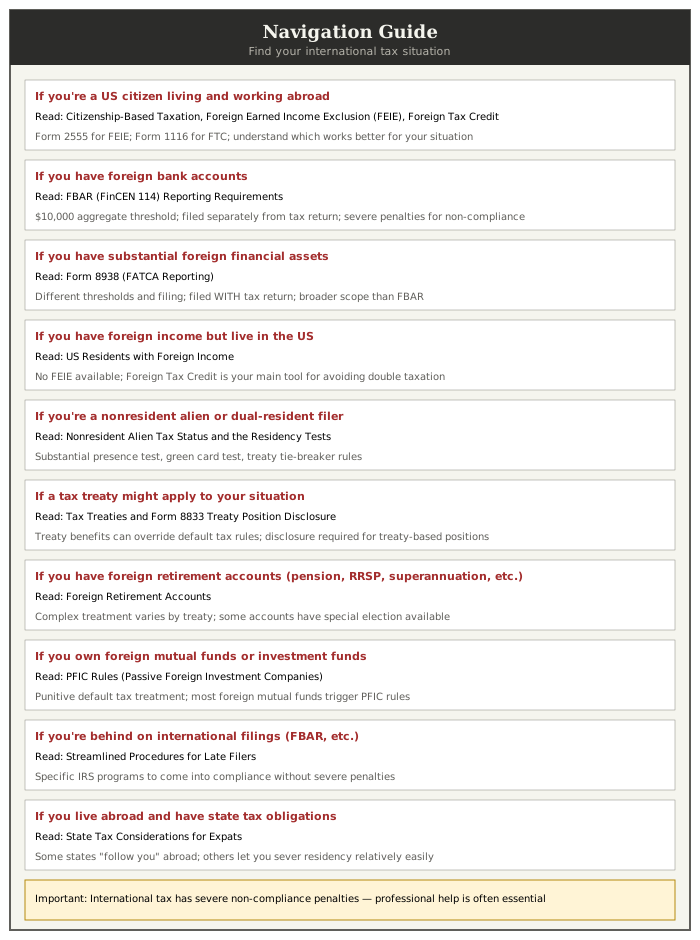
Navigation guide — which subsections apply to your situation
Citizenship-Based Taxation
The US is one of very few countries (along with Eritrea) that taxes based on citizenship rather than residency. Understanding what this means is foundational for international tax.
The basic principle. US citizens and US tax residents must file US tax returns reporting worldwide income, regardless of where they live or where the income was earned. A US citizen living in Singapore for 30 years still has annual US filing obligations on their worldwide income.
Who counts as a US tax resident.
- US citizens (whether born in the US or naturalized)
- Green card holders (lawful permanent residents)
- Other individuals who meet the substantial presence test (covered later)
Filing thresholds. The same filing thresholds apply whether you live in the US or abroad. For 2025: $15,750 (single) or $31,500 (MFJ) of worldwide income generally triggers filing obligation.
Common misconceptions to clear up.
The fundamental principle distinguishing US tax from most other countries: the US taxes on citizenship and residency, not just on location of income. A US citizen working in Japan still must file a US tax return reporting worldwide income, even if they're also paying Japanese taxes. The US has mechanisms (the Foreign Earned Income Exclusion and the Foreign Tax Credit) to mitigate double taxation, but the filing obligation persists regardless.
- "I haven't lived in the US for years, I don't need to file." False — citizenship alone creates the obligation. Living abroad doesn't suspend US filing requirements.
- "I'm paying taxes where I live, so I don't need to file in the US." False — paying foreign taxes doesn't eliminate the US filing obligation. The Foreign Tax Credit prevents double taxation but requires filing to claim.
- "I make less than the FEIE amount, so I don't need to file." False — the FEIE eliminates tax on excluded income but you still must file to claim the exclusion. Without filing and claiming the exclusion, all foreign income is taxable.
- "I'm a dual citizen so I follow my other country's rules." False — dual citizens are still US tax residents and must file US returns reporting worldwide income.
The automatic 2-month extension for expats. US citizens living abroad get an automatic extension to June 15 (instead of April 15). You can extend further to October 15 with Form 4868. The June 15 extension applies automatically — you don't need to file anything to claim it. However, interest accrues on any tax owed from April 15.
Form 2350 — additional extension to meet FEIE tests. If you need to extend beyond October 15 to meet the physical presence test for FEIE, Form 2350 can extend further.
Renunciation considerations. Some US citizens renounce US citizenship to eliminate ongoing US tax obligations. The expatriation tax under Section 877A may apply to "covered expatriates" — those meeting net worth, average income tax, or compliance certification thresholds. This is a specialized area requiring professional help.
IRC sections 1, 877A, 911; IRS Publication 54 (Tax Guide for US Citizens and Resident Aliens Abroad); various IRS expat tax pages.
Foreign Earned Income Exclusion (FEIE)
The FEIE allows qualifying US expats to exclude a substantial amount of foreign earned income from US taxation.
The 2025 exclusion amount. $130,000 per qualifying person. Adjusted annually for inflation. For 2026, projected to be approximately $132,900.
Married couples. Each qualifying spouse can claim their own FEIE. A married couple with both spouses qualifying can exclude up to $260,000 combined for 2025 — if both have their own foreign earned income.
Form 2555. Used to claim the FEIE. Attached to Form 1040. Includes detailed information about residency tests, days abroad, employer information, and income calculations.
Eligibility tests — must meet ONE of these.
Bona fide residence test. You're a bona fide resident of a foreign country for an uninterrupted period that includes an entire tax year (January 1 to December 31). This test is based on the totality of facts and circumstances — intent to remain, ties to the foreign country, length of stay, etc. Generally easier for US citizens than for US residents (resident aliens must use the physical presence test).
Physical presence test. Physically present in a foreign country for at least 330 full days during a consecutive 12-month period. The 12-month period doesn't have to be a calendar year — it can span across years. Travel days are partial days, not full days. Time in international waters or airspace doesn't count toward foreign presence.
What qualifies as foreign earned income.
- Wages, salaries, professional fees for personal services performed in a foreign country
- Self-employment income from services performed in a foreign country
- Bonuses, commissions, etc. for services performed abroad
What does NOT qualify.
- Investment income (interest, dividends, capital gains) — even from foreign sources
- Pension or retirement plan distributions
- Income earned while in the US (even on business trips)
- Income paid by US government for services as an employee
- Income earned outside the qualifying period
The "tax home" requirement. Your tax home must be in a foreign country during the qualifying period. Tax home generally means your regular or main place of business. Maintaining a home in the US while living abroad doesn't necessarily disqualify you, but your foreign location should be your primary work location.
Foreign housing exclusion/deduction. In addition to the FEIE, you can exclude (employees) or deduct (self-employed) certain foreign housing costs above a base amount. The 2025 base housing amount is about $20,800 (16% of FEIE), and the maximum is generally 30% of FEIE ($39,000) — though specific high-cost locality limits can be higher (Hong Kong, London, Singapore, and others have higher caps published annually by IRS).
How the exclusion works mechanically. You report all your worldwide income on Form 1040 (line 1, etc.). The FEIE amount is then "subtracted" on Form 1040 line 8 via Schedule 1. The exclusion reduces your taxable income but the calculation gets complex when you have income above the exclusion — your remaining income is taxed at the marginal rate as if the excluded income had been included (the "stacking rule"). This means filers with income above the exclusion don't get the benefit of the lowest brackets for their remaining income.
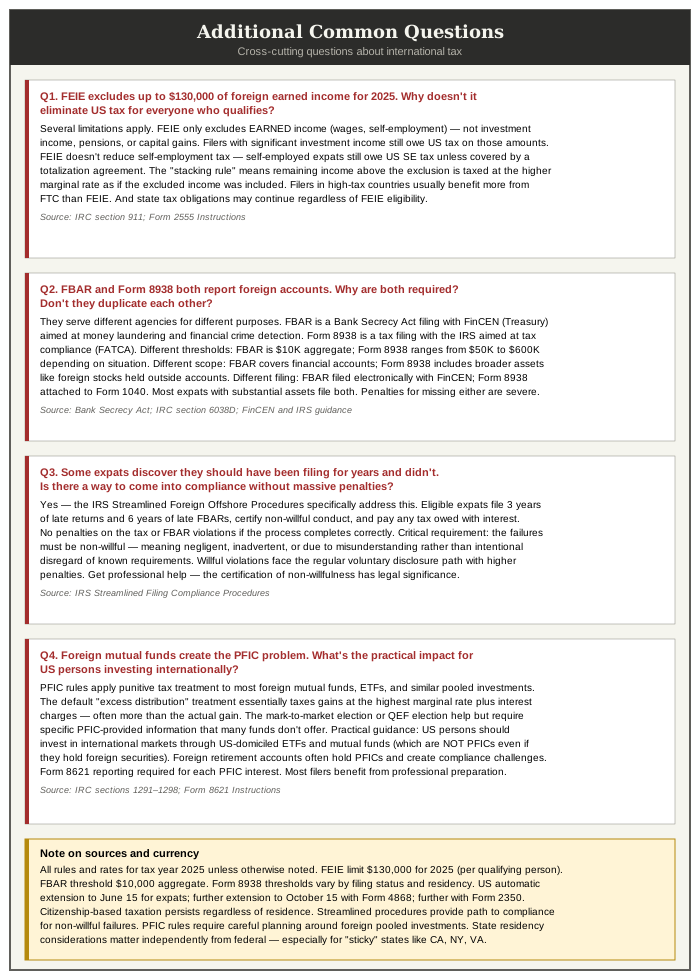
Self-employment tax considerations. The FEIE excludes income for income tax purposes but does NOT exclude it from self-employment tax. Self-employed expats abroad still owe US SE tax on their net SE earnings (15.3% subject to wage base limits) unless they qualify for a totalization agreement exemption (the US has totalization agreements with about 30 countries that prevent double Social Security/payroll tax).
FEIE is generally better if you're in a low-tax or no-tax country (Singapore for non-tax-resident expats, UAE, Bahamas). FTC is generally better if you're in a high-tax country where foreign taxes paid exceed what US tax would be on the income (most of Western Europe, Australia, Japan).
Once you elect FEIE, the election applies for that year and subsequent years until revoked. If you revoke, you generally can't re-elect for 5 years without IRS permission.
IRC section 911; Form 2555 Instructions; IRS Publication 54; IRS Revenue Procedure on annual FEIE amounts.
Foreign Tax Credit (FTC)
The Foreign Tax Credit allows US filers to claim a credit for foreign income taxes paid, preventing double taxation.
Basic concept. Foreign income taxes you paid (or accrued) on foreign-source income generate a credit against US tax on the same income. If your US tax on the foreign income is $5,000 and you paid $4,000 in foreign income tax, you get a $4,000 credit (reducing US tax to $1,000 net).
Form 1116. The form for calculating and claiming FTC. Attached to Form 1040. Complex calculations involve apportioning income and deductions between US-source and foreign-source.
Qualifying foreign taxes.
- Foreign income taxes paid on foreign-source income
- Withholding taxes on foreign dividends and interest
- Taxes imposed in lieu of an income tax (some countries' alternative taxes)
Non-qualifying.
- Foreign property tax (deductible as itemized deduction subject to SALT cap, but not FTC)
- Foreign sales/VAT tax
- Foreign social security/employment tax (with limited exception under totalization agreements)
- Taxes on US-source income (generally don't qualify for FTC)
FTC limitation. Your FTC is limited to the US tax that would apply to your foreign income. You can't use foreign tax credit to reduce US tax on US-source income. The limitation prevents using foreign taxes to subsidize taxes on US income.
FTC categories (baskets). Foreign income is sorted into categories ("baskets") with separate limitation calculations:
- General category (most active business and employment income)
- Passive category (most investment income — interest, dividends, capital gains)
- Section 901(j) category (income from countries the US doesn't recognize, like Cuba, Iran, North Korea, Sudan, Syria)
- Income re-sourced by treaty
- Lump-sum distributions
The basket system prevents combining excess credits in one category with shortfalls in another. Foreign tax paid in a category can only offset US tax on income in that same category.
Carry-back and carry-forward. Unused FTC can be carried back 1 year and forward 10 years. This allows recovery of taxes paid in years with low US tax liability when US tax liability is higher in other years.
The "high-tax kick-out" for passive income. Passive income subject to high foreign tax (effectively higher than US tax rate) can be elected as general category instead — useful in some planning situations.
Foreign taxes can also be deducted on Schedule A (as part of state and local taxes, subject to the $40,000 SALT cap post-OBBBA). The credit is almost always better than the deduction because it reduces tax dollar-for-dollar versus reducing only by your marginal tax rate. The deduction option exists mainly for filers who can't use the credit fully due to limitations.
If foreign tax credit on passive income is less than $300 ($600 MFJ), you can claim it without filing Form 1116 — just enter on Schedule 3 directly. This is a simplified procedure for filers with small amounts of foreign withholding on dividends/interest.
IRC sections 901–908; Form 1116 Instructions; IRS Publication 514 (Foreign Tax Credit for Individuals).
FBAR (FinCEN 114) Reporting Requirements
Foreign bank account reporting is one of the most heavily enforced areas of international tax — with severe penalties for non-compliance.
Who must file FBAR. US persons (citizens, residents, corporations, partnerships, trusts) with:
- Financial interest in, or signature authority over,
- One or more financial accounts in a foreign country,
- With aggregate value exceeding $10,000 at any time during the calendar year
The $10,000 aggregate threshold. This is the total across ALL foreign accounts, not per account. A checking account with $6,000 and a savings account with $5,000 together exceed the threshold.
What counts as a financial account.
- Bank accounts (checking, savings)
- Securities accounts
- Other financial accounts (commodity futures, options, certain insurance products with cash value)
- Some foreign retirement accounts (depending on country)
FinCEN Form 114 is filed electronically through the BSA E-Filing System (bsaefiling.fincen.treas.gov). NOT filed with the IRS. NOT filed with your tax return. Separate, electronic-only filing system.
Deadline. April 15 of the following year, with automatic extension to October 15. The extension is automatic — no form needed to claim it.
Information required for each account.
- Account number
- Name and address of financial institution
- Maximum value during the year (in US dollars at year-end exchange rate)
- Type of account
- Joint owners if applicable
Penalties for non-compliance. Some of the harshest in the tax code:
- Non-willful failure: up to $10,000 per violation per year (recently litigated whether per account or per form)
- Willful failure: greater of $100,000 or 50% of account value per violation per year
- Criminal penalties for willful failure including imprisonment
The Supreme Court in Bittner v. United States (2023) held that non-willful FBAR penalties apply per form (per year), not per account — limiting the maximum non-willful penalty to $10,000 per year regardless of how many accounts. Still substantial but less than per-account interpretation.
Signature authority alone triggers filing. Even if you don't own foreign accounts, you must file if you have signature authority over them — common for corporate officers and trustees.
Common scenarios that trigger FBAR.
- Working abroad with local bank accounts
- Inherited foreign accounts
- Foreign rental property income deposited in foreign account
- Foreign retirement accounts (depending on type and country)
- Foreign business interests with bank signature authority
Bank Secrecy Act (31 USC 5314); FinCEN regulations; FinCEN Form 114 Instructions; Bittner v. United States (2023).
Form 8938 (FATCA Reporting)
Form 8938 reports specified foreign financial assets — a broader category than FBAR.
Who must file Form 8938. US persons with specified foreign financial assets exceeding thresholds:
Living in the US:
- Single/HoH/MFS: $50,000 on last day of year OR $75,000 at any point during the year
- MFJ: $100,000 on last day OR $150,000 at any point
Living abroad:
- Single/HoH/MFS: $200,000 on last day OR $300,000 at any point
- MFJ: $400,000 on last day OR $600,000 at any point
The thresholds are MUCH higher for filers living abroad — reflecting that expats often have significant foreign accounts as a normal part of their daily life.
What counts as specified foreign financial assets.
- Foreign financial accounts (broader than FBAR — includes any account at foreign financial institution)
- Foreign stocks or securities held outside an account
- Foreign partnership interests
- Foreign mutual funds
- Foreign cash value insurance contracts
- Foreign retirement accounts (sometimes)
- Other foreign financial instruments
Where filed. Form 8938 is attached to your Form 1040 (unlike FBAR, which is filed separately with FinCEN).
Penalties. $10,000 for failure to file, increasing to $50,000 for continued failure after IRS notice. Plus 40% accuracy-related penalty on understatements related to unreported foreign assets. Criminal penalties for willful failure.
FBAR vs Form 8938 differences.
- FBAR threshold: $10,000 aggregate. Form 8938 threshold: $50,000–$600,000 depending on situation
- FBAR scope: Foreign financial accounts. Form 8938 scope: Broader, includes assets not in accounts
- FBAR filing: With FinCEN, separate from tax return. Form 8938 filing: With Form 1040
- FBAR enforcement: Bank Secrecy Act. Form 8938 enforcement: Internal Revenue Code Title 26
FBAR and Form 8938 serve different purposes for different agencies, and meeting one threshold often means meeting the other.
IRC section 6038D; Form 8938 Instructions; IRS Publication on FATCA.
US Residents with Foreign Income
US residents (citizens or green card holders) living in the US with foreign income face different considerations than expats.
The Foreign Earned Income Exclusion requires tax home in a foreign country. US residents working domestically with some foreign income don't qualify, even if the foreign income is from work performed outside the US during travel.
Foreign Tax Credit is the main tool. US residents with foreign income generally use Form 1116 to claim Foreign Tax Credit for foreign taxes paid on that income.
Common scenarios.
- US-based employee on temporary international assignment
- US resident with rental property abroad
- US resident with foreign investments paying foreign withholding tax
- US resident inheriting foreign assets
- US citizen returning to US after period abroad
Foreign-source income types.
- Wages from foreign employer (for work performed outside US)
- Foreign rental income
- Foreign business income
- Foreign investment income (dividends, interest, capital gains)
State tax considerations. State tax treatment of foreign income varies. Most states tax worldwide income for residents, paralleling federal treatment. Foreign tax credit at the state level varies widely.
Treaty considerations. Tax treaties can reduce foreign withholding on US residents' foreign investments. Filing for treaty benefits in the source country requires understanding both treaties and source country procedures.
IRC chapter 1, subchapter N; IRS Publication 514; IRS Publication 519 (US Tax Guide for Aliens) for cross-border considerations.
Nonresident Alien Tax Status and the Residency Tests
Nonresident aliens (NRAs) face different tax rules than US tax residents.
Who's a nonresident alien. Foreign nationals who don't meet any of the US tax residency tests.
The residency tests.
Green card test. You're a US tax resident if you're a lawful permanent resident (have a green card) at any time during the calendar year. This applies even if you spent the entire year outside the US.
Substantial presence test. You're a US tax resident if you were physically present in the US for:
- At least 31 days during the current year, AND
- 183 days during the 3-year period (current year + 1/3 of prior year days + 1/6 of two-years-prior days)
The weighted calculation prevents short-term visitors from becoming tax residents while making frequent business visitors residents.
Closer connection exception. Even if you meet the substantial presence test, you can claim nonresident status if:
- You were in the US fewer than 183 days in the current year
- You have a tax home in a foreign country
- You have a closer connection to a foreign country than to the US
Form 8840 is used to claim this exception.
Treaty tie-breaker rules. If you're a tax resident under both US and foreign country tests, tax treaties typically have "tie-breaker" rules to determine sole residency. Factors include where you have a permanent home, center of vital interests, habitual abode, and citizenship.
Taxation of NRAs.
- US-source income only (not worldwide income like US residents)
- Two categories: "effectively connected income" (taxed at regular rates) and "FDAP" (fixed, determinable, annual, or periodic income — taxed at flat 30% generally, often reduced by treaty)
- File Form 1040-NR (not Form 1040)
- Limited deductions compared to US residents
- No standard deduction (with some exceptions for students from certain countries with treaties)
Filers who change status during the year (arriving from or departing for abroad) may have "dual-status" returns — taxed as resident for part of the year and nonresident for the other part. Complex filing requirements; often beneficial to make the "first-year choice" election to be treated as a full-year resident.
IRC sections 7701(b), 871–879; IRS Publication 519 (US Tax Guide for Aliens); Form 1040-NR Instructions.
Tax Treaties and Form 8833
Tax treaties between the US and other countries can substantially modify default tax rules.
Treaty purposes.
- Prevent double taxation
- Provide reduced withholding rates on cross-border income
- Allocate tax rights between countries (which country taxes what)
- Provide tie-breaker rules for dual residents
- Establish procedures for resolving disputes
- Combat tax evasion through information exchange
Where treaties matter most for individuals.
- Reduced withholding on foreign dividend, interest, and royalty income paid to US residents
- Reduced US withholding on US-source income paid to NRAs in treaty countries
- Tie-breaker rules for dual residents
- Special rules for students, teachers, athletes, performers from treaty countries
- Pension and Social Security treatment
Form 8833 — Treaty-Based Return Position Disclosure. Required to disclose treaty-based positions that override US tax law. Examples:
- Claiming nonresident status under treaty tie-breaker despite meeting substantial presence test
- Claiming reduced withholding rate under treaty
- Claiming income exclusion under treaty student/teacher provisions
$1,000 per failure for individuals, $10,000 per failure for corporations.
Common treaty benefits for expats. Many treaties provide:
- Specific rules for retirement plans (allowing tax deferral on contributions to foreign retirement plans)
- Exemption from tax in one country for income taxed in the other
- Reduced withholding on cross-border investment income
Limitations on benefits (LOB). Most modern treaties have LOB provisions limiting benefits to qualifying residents — preventing "treaty shopping" by third-country residents using treaty country entities to gain benefits.
Reading treaties. Treaties are technical documents. The IRS publishes treaty texts on irs.gov. For complex treaty interpretations, professional help is essential.
Specific bilateral tax treaties; IRC section 6114 (treaty disclosure); Form 8833 Instructions; IRS Publication 901 (US Tax Treaties).
Foreign Retirement Accounts
Foreign retirement accounts have complex US tax treatment depending on the account type and applicable treaty.
Most foreign retirement accounts don't qualify for the tax-deferred treatment that US-qualified retirement plans receive. Default US tax treatment may require: including employer contributions in current US taxable income, including investment earnings in current US taxable income (no tax deferral on growth), and reporting the account on FBAR and Form 8938.
Treaty solutions. Several US tax treaties provide special treatment for that country's main retirement accounts:
- UK pensions. US-UK treaty Article 17 allows tax deferral on UK pension contributions and growth for US persons working in UK.
- Canadian RRSPs. US-Canada treaty allows tax deferral on RRSP growth (election required on first year). Form 8891 was previously required but was eliminated in 2014 — election is now automatic.
- Australian superannuation. Treatment is unclear and contested. Some argue it's a foreign grantor trust; others apply Section 402(b) employees' trust rules. Often treated under foreign grantor trust rules with current taxation of growth — but this is an unsettled area.
- French retirement accounts. US-France treaty has specific provisions for certain retirement plans.
- German retirement accounts. Similar treaty provisions.
Reporting requirements regardless of tax treatment.
- FBAR if account value combined with other foreign accounts exceeds $10,000
- Form 8938 if specified foreign financial asset thresholds met
- Possibly Form 3520 or Form 3520-A for foreign trust treatment
Foreign retirement accounts often hold foreign mutual funds, which are PFICs under US tax law. The PFIC rules add another layer of complexity.
Specific bilateral tax treaties; IRC section 402; IRS guidance on specific foreign retirement plans.
PFIC Rules (Passive Foreign Investment Companies)
PFIC rules apply punitive tax treatment to investments in foreign mutual funds, ETFs, and similar pooled investment vehicles.
What's a PFIC. A foreign corporation that meets one of two tests:
- Income test: 75% or more of gross income is passive (interest, dividends, capital gains, etc.)
- Asset test: 50% or more of assets produce or are held to produce passive income
Most foreign mutual funds, ETFs, money market funds, hedge funds, and similar pooled investments are PFICs.
Why the rules exist. Without PFIC rules, US persons could defer US tax indefinitely by investing in foreign corporations that accumulated investment earnings without distributing them. PFIC rules force current recognition or punitive treatment to prevent deferral.
Three treatment options.
Excess distribution method (default). Apply punitive rules:
- Annual distributions taxed at ordinary income rates
- "Excess distributions" (above 125% of average prior 3-year distributions) and gains on sale treated as if earned ratably over the holding period and taxed at highest marginal rate, plus interest charge
- This treatment is generally the worst option
Qualified Electing Fund (QEF) election. Annual taxation of your share of the PFIC's ordinary earnings and net capital gains. Requires PFIC to provide annual reports with required information — many foreign funds don't provide this. Best option when available.
Mark-to-market election. Annual recognition of gain/loss based on year-end market value. Available only for "marketable" PFIC stock. Better than default but worse than QEF for long-term holdings.
Form 8621. Required to report each PFIC interest annually. Significant complexity, particularly under the default method.
US persons should generally avoid investing in foreign mutual funds, foreign ETFs, and similar pooled investments. Use US-domiciled funds even when investing in foreign markets (US-listed international ETFs are NOT PFICs). Foreign retirement accounts often hold PFICs, creating compliance challenges. Inherited foreign mutual funds create immediate compliance burden.
IRC sections 1291–1298; Form 8621 Instructions; IRS Publication on PFIC rules.
Streamlined Procedures for Late Filers
Many US persons living abroad fall behind on US filings — sometimes unaware of the obligation, sometimes overwhelmed by complexity. The IRS provides streamlined procedures for coming into compliance.
Streamlined Foreign Offshore Procedures. For US persons living outside the US who failed to comply due to non-willful conduct.
Requirements.
- File 3 years of late tax returns
- File 6 years of late FBARs
- Submit certification of non-willful conduct
- Pay any tax and interest owed
No penalties on tax owed or FBAR violations for participants who qualify and complete the procedures correctly.
Streamlined Domestic Offshore Procedures. For US persons living in the US who have undisclosed foreign accounts due to non-willful conduct.
Requirements. Same returns and FBARs, but with a 5% miscellaneous offshore penalty on the highest aggregate balance of undisclosed foreign accounts during the period.
Both programs require certification that the non-compliance was non-willful (not intentional disregard of known requirements). Willful violations are excluded from streamlined procedures and face more serious enforcement.
Voluntary Disclosure Practice. For willful violations, the IRS has a separate voluntary disclosure practice that can avoid criminal prosecution but doesn't eliminate civil penalties.
Delinquent FBAR submission procedures. For filers who didn't file FBARs but did file tax returns and reported all income from foreign accounts. Can submit late FBARs with explanation; no penalty if income was properly reported.
If you're behind on FBAR or international tax filings, evaluate which procedure applies. Streamlined Foreign is best for expats with non-willful failures. Most filers in these situations benefit from professional help to ensure proper qualification and completion.
IRS Streamlined Filing Compliance Procedures (on irs.gov); IRS Voluntary Disclosure Practice.
State Tax Considerations for Expats
State tax obligations don't automatically end when you move abroad.
Some states actively pursue former residents and may continue claiming residency: California, New York, Virginia, New Mexico, South Carolina. These states require affirmative steps to terminate residency — moving abroad alone isn't enough.
Steps to sever state residency.
- File final state return marked as part-year resident
- Surrender state driver's license
- Register to vote outside the state (if eligible somewhere)
- Update address with all financial institutions
- Sell or rent out (don't keep as available) residence in the state
- Avoid maintaining significant assets, family ties, or business interests
- Spend no more than the state's threshold (often 6 months) physically in the state in future years
Some states have no income tax, eliminating state filing concerns when you leave: Florida, Texas, Washington, Nevada, Tennessee, South Dakota, Wyoming, Alaska, New Hampshire. These states are common "domicile" states for expats who want to maintain US ties while not having state tax obligations.
Maintaining state residency abroad. Some expats deliberately maintain state residency for various reasons:
- To keep voting rights in their home state
- Access to in-state college tuition for children
- Continued state-specific benefits
For these filers, state filing obligations continue throughout the time abroad. Most states have provisions for crediting taxes paid to other jurisdictions, partially mitigating double taxation.
Active military and certain government employees. Special rules apply that maintain residency in the state of legal residence regardless of military assignment location.
State Department of Revenue websites for each relevant state; state residency case law.
Connection to Other Lessons
Lesson 1 (Personal info and filing status) — Filing status considerations may differ for filers with nonresident spouses. Election to treat a nonresident alien spouse as a resident allows joint filing but subjects worldwide income to US tax.
Lesson 3 (Income) — All foreign income must be reported on Form 1040 lines just like US income. The FEIE then excludes qualifying foreign earned income on Schedule 1.
Lesson 4 (Adjustments) — Schedule 1 includes the FEIE amount as a negative item if claimed. Some moving expense considerations apply for certain military situations.
Lesson 5 (Deductions) — Foreign property tax is not deductible (only state and local US property tax counts for SALT). Foreign income tax can be claimed as itemized deduction OR Foreign Tax Credit (credit almost always better).
Lesson 7 (Credits) — The Foreign Tax Credit appears on Schedule 3. Other credits (Child Tax Credit, etc.) generally apply to US residents and citizens regardless of where they live.
Lesson 11 (Retirees) — Foreign pension and retirement distributions add complexity to the regular retiree topics. Some are tax-favored under treaties; many are not.
Lesson 12 (Self-Employed) — Self-employed expats still owe SE tax unless covered by a totalization agreement. The FEIE doesn't reduce SE tax.
What to Gather for International Tax Filers
For US citizens living abroad.
- All foreign income documents (foreign W-2-equivalent, foreign self-employment records)
- Travel records (passport stamps, calendar, boarding passes) for FEIE qualification
- Foreign tax returns and tax payment records (for FTC calculation)
- Foreign bank account statements with maximum and year-end balances
- Foreign investment account statements
- Foreign retirement account statements
- Records of any US-source income (which doesn't qualify for FEIE)
- Housing expense records if claiming foreign housing exclusion
For US residents with foreign income.
- Foreign income documents from each source
- Foreign tax paid (Form 1042-S or foreign withholding statements)
- Foreign account statements meeting FBAR or Form 8938 thresholds
For nonresident aliens.
- US-source income records (Forms W-2, 1099-NEC, 1042-S, etc.)
- Records of presence in the US (passport entry/exit stamps)
- Tax treaty position documentation if applicable
- Records to support closer-connection exception if claimed
For filers with foreign retirement or investment accounts.
- Year-end statements for all foreign financial accounts
- Records of contributions, withdrawals, and earnings
- Documentation of foreign mutual fund holdings (for PFIC analysis)
- Treaty position research for retirement account treatment
For all international filers.
- FBAR submission records (or process for submitting)
- Forms 8938 calculations
- Records of how thresholds were calculated and verified
Key Takeaways
- US citizens and residents must file US tax returns reporting worldwide income regardless of where they live — citizenship alone creates the filing obligation.
- The FEIE excludes up to $130,000 (2025) of foreign earned income from income tax but does NOT eliminate self-employment tax on that income.
- Foreign Tax Credit prevents double taxation and is almost always better than deducting foreign taxes — it reduces US tax dollar-for-dollar.
- FBAR must be filed separately with FinCEN (not the IRS) when aggregate foreign account balances exceed $10,000 at any point during the year — non-willful penalties can reach $10,000 per year; willful penalties are far higher.
- Most foreign mutual funds and ETFs are PFICs subject to punitive tax treatment — US persons should use US-domiciled international funds instead.
- Hard-to-leave states like California and New York require affirmative steps to sever state residency; moving abroad alone is not enough.
- Streamlined procedures exist for expats behind on filings due to non-willful conduct, providing penalty relief when properly completed.
Quiz — 4 Questions
Answer one at a timeWhat is the 2025 Foreign Earned Income Exclusion (FEIE) amount per qualifying person?