Retirees: Career-Specific Considerations
Coordinating multiple income sources, managing RMDs, executing Roth conversions, and optimizing withdrawal sequencing in retirement
- Understand how annuity taxation differs between qualified and non-qualified contracts
- Apply the three stacking senior deductions — base standard deduction, age add-on, and OBBBA $6,000 senior deduction
- Use the home sale exclusion effectively when downsizing in retirement
- Navigate inherited IRA distribution rules including the 10-year rule for non-eligible designated beneficiaries
- Calculate and plan around Medicare IRMAA surcharges and their two-year lag
- Understand Social Security provisional income calculation and the tax torpedo effect
- Execute tax-efficient withdrawal sequencing across taxable, tax-deferred, and Roth accounts
Retirees: Career-Specific Considerations
Retirees face a tax landscape distinct from working-age filers. The foundation lessons covered the mechanics of each Form 1040 line, including the income types that retirees most commonly receive (IRA distributions, Social Security, pensions, qualified dividends, capital gains — all in Lesson 3). What this lesson adds is the situational complexity that comes from being retired: coordinating multiple income sources, managing Required Minimum Distributions, understanding how Medicare premiums work, planning Roth conversions during low-income years, executing tax-efficient withdrawal strategies, handling inherited retirement accounts, and using qualified charitable distributions.
Retirement tax planning is fundamentally about decisions that play out over decades rather than single filing seasons. The choices a 65-year-old makes about Social Security claiming age affect taxation for the rest of their life. Roth conversions done in the early retirement years before RMDs begin can shift hundreds of thousands of dollars from future taxable income to future tax-free withdrawals. Failing to manage Medicare premium surcharges (IRMAA) can cost thousands annually for two years at a time. The lesson is organized to help retirees identify their situation and make these decisions with the relevant framework in mind.
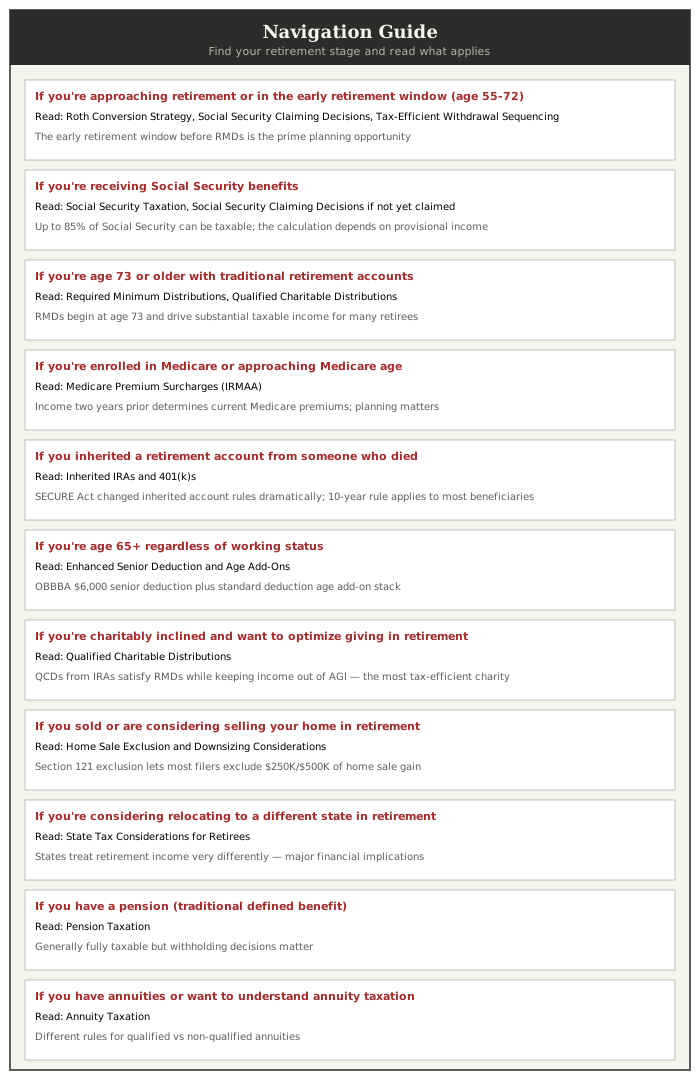
The lesson is organized alphabetically by topic within the major sections, with a navigation guide for retirees in different stages of retirement. Use the navigation guide to find what applies to your situation.
Navigation guide — which subsections apply to your situation
Annuity Taxation
Read this if you receive annuity payments or are considering purchasing an annuity.
Annuities have specialized tax treatment that depends on whether the annuity is "qualified" (purchased within a retirement account) or "non-qualified" (purchased with after-tax money).
Qualified annuities. Annuities held within an IRA, 401(k), or similar tax-advantaged account. Payments are fully taxable as ordinary income because the underlying contributions were pretax. Box 1 (gross distribution) and Box 2a (taxable amount) of the 1099-R both show the full payment as taxable.
Non-qualified annuities. Annuities purchased with after-tax money. Payments are partially taxable — the portion representing return of your original investment (basis) is not taxable, while the portion representing investment growth is taxable as ordinary income. The 1099-R Box 2a will show only the taxable portion. An "exclusion ratio" determines how much of each payment is basis return versus taxable earnings.
Variable annuities. Function similarly to non-qualified annuities for tax purposes when held outside retirement accounts. Withdrawals before annuitization are treated as earnings first (taxable) then basis. Surrender charges may apply but don't affect tax treatment.
Early withdrawal penalty. Like other retirement accounts, withdrawals before age 59½ from qualified annuities trigger the 10% early withdrawal penalty (unless an exception applies — covered in Lesson 8). Non-qualified annuities have their own early withdrawal rules and penalties.
Death benefits. Annuity death benefits to beneficiaries are taxable to the extent they exceed the deceased owner's basis. Spouses can typically continue the annuity contract; non-spouse beneficiaries have more limited options and different tax timing.
IRS Publication 575 (Pension and Annuity Income); IRS Publication 939 (General Rule for Pensions and Annuities); IRC sections 72, 402.
Form 1099-R for annuity payments. Original contract documentation showing your basis (for non-qualified annuities). Records of any prior withdrawals.
Enhanced Senior Deduction and Age Add-Ons
Read this if you (or your spouse on a joint return) are 65 or older.
Three different age-related deductions stack for senior filers, and getting all three requires understanding how they interact.
The base standard deduction. For 2025, $15,750 (single/MFS), $31,500 (MFJ/QSS), $23,625 (HOH). Available to all filers who don't itemize.
The standard deduction age add-on. Filers 65 or older add $2,000 (single/HOH) or $1,600 (MFJ/MFS/QSS) per qualifying person to the standard deduction. Available only if taking the standard deduction (not when itemizing). If you're both 65+ and legally blind, the add-on applies twice (each box checked is a separate add-on).
The OBBBA $6,000 enhanced senior deduction. A new deduction created by OBBBA for tax years 2025-2028. Available whether you itemize or take the standard deduction. Claimed on Schedule 1-A (covered in Lesson 4) and flows to Form 1040 line 13b. Phases out starting at MAGI of $75,000 (single/HOH) or $150,000 (MFJ), reduced by $60 per $1,000 of excess MAGI. Eliminated entirely at MAGI of $175,000 single or $250,000 MFJ. Not available for MFS filers.
Triple stacking example. A married couple, both age 65+, with $80,000 of MAGI, taking the standard deduction:
- Standard deduction: $31,500
- Age add-ons: $1,600 × 2 = $3,200
- OBBBA senior deduction: $6,000 × 2 = $12,000 (full amount because under MFJ $150,000 threshold)
- Total deductions: $46,700
A non-senior MFJ couple with the same income would have only the $31,500 standard deduction. The senior provisions add $15,200 of additional deductions for this couple.
Decision points. Understanding that all three provisions can be claimed simultaneously. Calculating MAGI carefully if income is near the OBBBA senior deduction phase-out thresholds. Comparing itemized versus standard with consideration of the age add-on (only available with standard) and the OBBBA senior deduction (available with either).
Form 1040 Instructions for 2025; IRC section 63(f) for age add-on; OBBBA Public Law 119-21 section 70103 for enhanced senior deduction; Schedule 1-A Instructions.
Documentation of age (already on file with SSA). MAGI calculation if approaching phase-out thresholds for the OBBBA deduction.
Home Sale Exclusion and Downsizing Considerations
Read this if you sold or are considering selling your home in retirement.
The home sale exclusion under IRC section 121 lets most home-sellers exclude substantial gain from federal income tax. This is particularly relevant for retirees who often have substantial appreciation in long-held homes.
The exclusion amounts. Up to $250,000 of gain (single) or $500,000 (MFJ) can be excluded from income on the sale of your primary residence.
Eligibility requirements. You must have owned the home for at least 2 of the last 5 years before sale (ownership test). You must have used the home as your primary residence for at least 2 of the last 5 years (use test). For MFJ to get the full $500,000, at least one spouse must meet the ownership test and both must meet the use test, and neither can have used the exclusion within the prior 2 years.
Gain calculation. Sale price minus selling expenses minus your basis. Your basis is generally the original purchase price plus any major improvements (additions, renovations, new roof, etc.) minus any depreciation if you ever used part of the home for business or rental.
Gain above the exclusion. The portion of gain exceeding the exclusion ($250K/$500K) is taxable as long-term capital gain (assuming you held the home more than one year, which is virtually always the case for retirees). This means the preferential LTCG rates apply (0%, 15%, or 20% depending on overall income).
Frequency limitation. You can use the exclusion once every 2 years. Selling multiple homes in quick succession can disqualify the later sales from the exclusion.
Partial exclusion for unforeseen circumstances. If you sell before meeting the 2-year ownership/use tests but the sale is due to health, employment, or other "unforeseen circumstances," a partial exclusion may apply.
Surviving spouse rules. A surviving spouse who hasn't remarried can use the $500,000 MFJ exclusion for up to 2 years after the spouse's death, provided other requirements are met.
Downsizing in retirement. Many retirees downsize from family homes to smaller residences. The exclusion typically covers all or most of the gain on the sale. Proceeds beyond the new home's cost can be invested or spent without further tax consequence at the federal level.
State tax considerations. Most states with income tax conform to the federal exclusion for state purposes, but verify your specific state.
IRS Publication 523 (Selling Your Home); IRC section 121; Form 8949 and Schedule D Instructions.
Closing statement (HUD-1) from when you bought the home (for basis). Records of all major improvements made during ownership. Closing statement from sale (sale price and selling expenses). Documentation of meeting the ownership and use tests.
Inherited IRAs and 401(k)s
Read this if you inherited a retirement account from someone who died.
The SECURE Act of 2019 dramatically changed inherited retirement account rules. The rules now depend on whether you're an "eligible designated beneficiary" or a "non-eligible designated beneficiary," and on when the original owner died.
Spousal beneficiaries. Spouses inheriting an IRA can roll the inherited account into their own IRA, treating it as theirs going forward. The spouse follows their own RMD rules based on their own age. This is usually the most tax-efficient option for surviving spouses.
Eligible designated beneficiaries. Spouses, minor children of the deceased (until they reach majority, then 10-year rule starts), disabled or chronically ill individuals, and individuals not more than 10 years younger than the deceased. These beneficiaries can take distributions over their own life expectancy.
Non-eligible designated beneficiaries (everyone else, including adult children). Subject to the 10-year rule. The entire inherited account must be distributed within 10 years of the original owner's death. Annual distributions are not required during the 10-year period if the original owner died before their required beginning date (RBD); annual RMDs ARE required if the original owner died after their RBD, with the full balance distributed by year 10.
Inherited Roth IRAs. Same 10-year rule applies for non-eligible designated beneficiaries, but distributions are tax-free (no income tax owed on inherited Roth distributions). The 10-year rule is about timing, not taxation, for Roth accounts.
Inherited 401(k)s. Generally subject to the same rules as inherited IRAs, but the plan document may impose additional restrictions. Many beneficiaries roll inherited 401(k)s to inherited IRAs to get more flexibility.
Tax planning for the 10-year rule. Beneficiaries should plan distributions across the 10 years to manage their tax brackets. Concentrating distributions in low-income years (especially before claiming Social Security or before retirement) can save substantial tax compared to waiting until year 10 and taking everything in one year.
RMD requirements during the 10 years. Recent IRS guidance has clarified that annual RMDs are required for inherited accounts where the original owner died after their RBD, even within the 10-year window. The IRS provided penalty relief for missed RMDs for 2021-2024, but starting with 2025, the annual RMDs must be taken.
Decision points. Whether to use spousal rollover or treat as inherited account (for spouses). How to time distributions across the 10-year period to manage taxes. Whether to roll inherited 401(k) to inherited IRA for more flexibility.
IRS Publication 590-B (Distributions from IRAs); SECURE Act of 2019; SECURE 2.0 Act of 2022; recent IRS Notices on inherited account RMDs.
Documentation of the original owner's date of death and date of birth. Documentation of your relationship to the deceased. Account statements showing inherited balance. Your own age for required distribution calculation if eligible designated beneficiary.
Pension Taxation
Read this if you receive pension payments from a defined benefit plan.
Traditional pension payments from a defined benefit plan are generally fully taxable as ordinary income because contributions were typically made with pretax dollars.
Reporting. Pension payments come to you via Form 1099-R from the pension plan. Box 1 is the gross distribution; Box 2a is the taxable amount (usually the same as Box 1 for traditional pensions). The amount goes on Form 1040 line 5b (Pensions and annuities — taxable amount).
Withholding. Pensions can have federal tax withheld at the source. You complete Form W-4P (specifically for pension withholding) to elect the amount. Default withholding may apply if you don't make an election.
Lump sum versus annuity payments. Many pension plans offer a choice between taking the pension as a lifetime annuity or as a lump sum. The tax consequences differ:
- Annuity payments are taxed as ordinary income as received over time
- Lump sums are typically rolled to an IRA to avoid immediate taxation; if taken as cash, the full amount is taxable in the year received and 20% federal withholding usually applies
- Direct rollover to IRA preserves the tax deferral and lets you control distributions
State taxation of pensions. State treatment varies dramatically. Some states (Illinois, Pennsylvania, Mississippi) fully exempt all retirement income including pensions. Others (Michigan, Georgia) have age-based or amount-based exclusions. Several states (Florida, Texas, Washington, Nevada, South Dakota, Wyoming, Tennessee, Alaska, New Hampshire) have no state income tax at all. Your state of residence makes a major difference.
Survivor benefits. Many pensions include survivor benefit options. The decision to take a single-life or joint-and-survivor option affects monthly payment amounts and tax timing for the surviving spouse.
Public sector pensions. Government pensions (federal, state, local government employees) have additional complexity. The Social Security Fairness Act repealed the Windfall Elimination Provision and Government Pension Offset effective for 2024 benefits paid, increasing Social Security benefits for many public sector retirees.
IRS Publication 575 (Pension and Annuity Income); IRC section 72; Form W-4P Instructions.
Form 1099-R for pension distributions. Pension plan documentation if considering a lump sum versus annuity decision. Current Form W-4P on file with the pension plan for withholding elections.
Qualified Charitable Distributions (QCDs)
Read this if you're 70½ or older and charitably inclined.
A Qualified Charitable Distribution (QCD) is a direct transfer from your IRA to a qualified charity. QCDs have unique tax advantages that make them the most tax-efficient way for older retirees to give to charity.
How QCDs work. Your IRA custodian sends money directly from your IRA to the charity (the check must be made out to the charity, not to you). The QCD amount is excluded from your gross income — it never appears on your return as income. It also counts toward your Required Minimum Distribution for the year.
Eligibility. You must be at least 70½ at the time of the distribution. The QCD must be a direct transfer from the IRA to the charity. The charity must be a qualified 501(c)(3) public charity (not a private foundation, donor-advised fund, or supporting organization).
Annual limit. $108,000 per person in 2025 (indexed for inflation; verify current amount). For MFJ where both spouses are 70½+, each can do up to $108,000 from their own IRAs.
Why QCDs are uniquely valuable. Three reasons:
- The distribution doesn't increase your AGI, so it doesn't push you into higher tax brackets, increase Social Security taxation, or trigger IRMAA
- It satisfies your RMD without you actually receiving and being taxed on the money
- You get the equivalent of a charitable deduction without having to itemize (the standard deduction takers benefit equally)
Comparison to traditional charitable giving. A retiree giving $10,000 to charity via QCD avoids $10,000 of AGI inclusion. The same retiree giving $10,000 in cash (taken from the IRA as a normal distribution then donated) has $10,000 of additional AGI and gets a $10,000 itemized charitable deduction — but only if they itemize, and the AGI increase may trigger other tax consequences. The QCD route is almost always better for charitably inclined retirees.
Account restrictions. QCDs must come from IRAs (traditional or Roth, though Roth QCDs are unusual since Roth distributions aren't taxable anyway). 401(k)s, 403(b)s, and other employer plans don't allow QCDs directly — money must first be rolled to an IRA.
Reporting on the return. Your 1099-R will show the QCD as a normal distribution (full Box 1 amount). You report the gross distribution on Form 1040 line 4a, then on line 4b you report only the non-QCD portion as taxable, and write "QCD" next to line 4b. The tax software handles this automatically if you indicate the QCD amount.
Decision points. Coordinating QCDs with RMD requirements. Choosing which charities to support via QCD versus other methods. Timing QCDs early in the year to ensure they happen before RMDs are taken (RMDs cannot be retroactively recharacterized as QCDs).
IRC section 408(d)(8); IRS Publication 590-B; IRS Notice 2007-7.
Charity confirmation letters for QCDs received. Your IRA custodian's documentation of the distribution. Form 1099-R showing the distribution (typically marked as a normal distribution, not specifically as a QCD).
Required Minimum Distributions (RMDs)
Read this if you're age 73 or older and have a traditional IRA, 401(k), or other tax-deferred retirement account.
Required Minimum Distributions (RMDs) are mandatory annual withdrawals from traditional retirement accounts starting at a specific age. They exist because the government deferred taxation on contributions and growth; RMDs ensure the government eventually collects tax on those amounts.
Age at which RMDs begin. Under SECURE Act 2.0, RMDs begin at age 73 for taxpayers reaching that age after 2022. The age moves to 75 starting in 2033. Anyone who turned 72 before 2023 should have already started RMDs under older rules.
First RMD deadline. Your first RMD can be deferred until April 1 of the year following the year you turn 73 ("required beginning date" or RBD). All subsequent RMDs must be taken by December 31 of each year.
Delaying the first RMD to April 1 of the following year means taking TWO RMDs in that year (the deferred first RMD plus the second year's RMD by December 31). This bunching can push you into higher tax brackets and trigger IRMAA. Most retirees should take the first RMD by December 31 of the year they turn 73, not defer it.
Calculation. RMD = Prior year-end account balance ÷ Life expectancy factor from IRS Uniform Lifetime Table. For example, at age 73 the factor is 26.5. A $500,000 IRA at the end of the prior year would have an RMD of $500,000 / 26.5 = $18,868 for the current year. The factors decline each year as you age, increasing the percentage of the account that must be withdrawn.
Accounts subject to RMDs. Traditional IRAs, SEP IRAs, SIMPLE IRAs, traditional 401(k)s, 403(b)s, 457(b)s, and most other tax-deferred retirement accounts. Roth IRAs are NOT subject to RMDs during the owner's lifetime. Roth 401(k)s previously had RMDs but SECURE 2.0 eliminated them starting in 2024.
Aggregating RMDs. If you have multiple traditional IRAs, you calculate the RMD for each but can take the total from any combination of accounts. If you have multiple 401(k)s from different employers, RMDs must be taken from each plan separately (no aggregation across 401(k)s).
Penalty for missed RMDs. SECURE 2.0 reduced the penalty from 50% to 25% of the amount not withdrawn. The penalty drops to 10% if you correct the missed RMD promptly (within the "correction window," generally 2 years). Form 5329 reports missed RMDs and requests waiver if applicable.
Reporting on the return. RMDs come to you via Form 1099-R like any other IRA distribution. They go on Form 1040 line 4a (gross) and 4b (taxable). You don't need to specifically identify them as RMDs on the return — they're just part of total IRA distributions.
Decision points. Whether to take RMDs early in the year (more flexibility, no risk of late-year market drops affecting calculation) or later. Whether to use QCDs to satisfy RMD obligations while avoiding income inclusion. How RMDs interact with other planning items (Roth conversions, Medicare IRMAA, Social Security taxation).
IRS Publication 590-B; IRC section 401(a)(9); SECURE Act and SECURE 2.0 Act.
Account statements showing prior year-end balances for each account. IRS Uniform Lifetime Table for the calculation. Documentation of distributions taken during the year.
Roth Conversion Strategy
Read this if you have traditional IRA or 401(k) balances and want to optimize long-term taxes through conversions to Roth.
A Roth conversion moves money from a traditional retirement account (where contributions were pretax and distributions are taxable) to a Roth account (where distributions are tax-free). The converted amount is taxable in the year of conversion. The strategic question is whether to convert and how much, given your current versus expected future tax rates.
Why convert. Multiple reasons:
- Pay tax at current rates rather than potentially higher future rates
- Reduce future RMDs by shrinking traditional account balances
- Create tax-free income in retirement for flexibility
- Leave Roth assets to heirs (no RMDs during your lifetime, more favorable treatment for inherited Roth)
- Reduce future Medicare IRMAA exposure by lowering future MAGI
The "early retirement window." The years between retirement (often early-to-mid 60s) and RMD beginning at age 73 are often the optimal conversion years. Income tends to be lower (no wages, possibly delayed Social Security), creating room in low brackets for conversions. Converting during this window shifts assets to Roth at favorable rates while reducing future RMDs.
Tax bracket management. The goal of most conversion strategies is to "fill up" lower tax brackets each year without spilling into higher brackets. For 2025, a single retiree might convert enough to bring taxable income to the top of the 12% bracket ($48,475) or the top of the 22% bracket ($103,350). Converting beyond these thresholds means paying 24% or higher rates, which may not be worthwhile.
IRMAA considerations. Roth conversions increase MAGI, which can trigger Medicare IRMAA surcharges two years later. Plan conversions to stay below IRMAA thresholds, or accept the IRMAA cost as part of the conversion calculation. The two-year lag means conversions done at age 65 affect Medicare premiums at age 67.
Social Security taxation interaction. If you're already collecting Social Security, conversion income can push more of your Social Security into the taxable range. The combination of Social Security taxation and the conversion itself creates a higher effective tax rate on the conversion than the bracket alone suggests.
No income limits for conversions. Unlike Roth contribution limits, there are no income limits on Roth conversions. Anyone with a traditional IRA can convert any amount in any year.
No annual limits. You can convert any amount in a single year. Strategic conversion strategies typically spread across many years rather than concentrating in one.
No re-characterization (since TCJA). Before 2018, you could undo a Roth conversion ("recharacterize") if it turned out to be a bad decision. TCJA eliminated this option. Conversions are now permanent once executed.
Pay conversion taxes from outside money if possible. If you pay the tax on a conversion from the converted amount itself, you reduce the amount that goes into the Roth. Paying from outside funds (taxable account, savings) lets more money enter the tax-free Roth environment. This often makes conversions more attractive.
Pro-rata rule for converting after-tax IRA money. If you have any traditional IRA balances with basis (non-deductible contributions tracked on Form 8606), the pro-rata rule treats every distribution or conversion as containing a proportional share of basis and pre-tax money. This complicates "backdoor Roth" strategies if you have substantial traditional IRA balances.
Decision points. How much to convert each year. Whether to convert at all (depends on current vs expected future rates). Timing within the year (early in year locks in lower brackets if planning multi-year strategy). Coordination with other income decisions (when to start Social Security, when to take other taxable income).
IRS Publication 590-A; IRC section 408A; various IRS guidance on conversions.
Current traditional IRA balances. Form 8606 history if you've made any non-deductible contributions. Tax projections for current and expected future years.
State Tax Considerations for Retirees
Read this if you live in (or are considering moving to) any state, since state tax treatment of retirement income varies dramatically.
State income tax treatment of retirement income varies more widely than almost any other tax category. The differences can be financially significant for retirees with substantial retirement income.
No state income tax at all. Florida, Texas, Washington, Nevada, South Dakota, Wyoming, Tennessee, Alaska, and New Hampshire (which only taxes interest and dividends, being phased out). Retirees in these states have no state tax on Social Security, pensions, IRA distributions, or any other income.
States that fully exempt all retirement income. Illinois, Pennsylvania, and Mississippi don't tax Social Security, pension, or 401(k)/IRA distribution income from qualified retirement plans (Illinois has some complexity around the source). Retirees in these states get significant relief even if other income is taxed.
States with partial retirement income exclusions. Many states have age-based or amount-based exclusions for retirement income. Georgia exempts up to $65,000 per person of retirement income for filers 65+. Michigan has tiered exclusions based on birth year. New York exempts the first $20,000 of pension/retirement income per person.
States that fully tax retirement income. California, Minnesota, Vermont, and several others tax retirement income essentially like wages, with limited or no exclusions.
Social Security taxation by state. Most states don't tax Social Security at all, even when they tax other retirement income. As of 2025, 41 states plus DC don't tax Social Security. The 9 states that do tax Social Security to some degree: Colorado, Connecticut, Kansas, Minnesota, Montana, New Mexico, Rhode Island, Utah, and Vermont (each with various exclusions and thresholds).
Establishing residence in a new state. To change your state of residence for tax purposes, you generally need to:
- Spend more than half the year in the new state (183+ days)
- Establish substantial ties (driver's license, voter registration, address, bank accounts)
- Sever ties with the old state (sell or rent out the old home, change everything to the new state)
- Be prepared to demonstrate this if challenged by your old state
High-tax states (especially California, New York, New Jersey, Illinois) actively pursue former residents who claim to have moved but maintain substantial ties to the old state. Successful residency change requires thorough documentation.
Property tax considerations. States vary widely in property tax burdens. Some have homestead exemptions for seniors that significantly reduce property taxes. New Hampshire and Texas have high property taxes despite no income tax.
Inheritance and estate tax. Federal estate tax applies above $13.99 million for 2025 (per person, $27.98M MFJ). Several states have their own estate or inheritance taxes with much lower thresholds. Massachusetts, Oregon, Washington, Maine, and others have state estate taxes. Pennsylvania, Maryland, and several others have inheritance taxes paid by recipients.
Decision points. Whether to relocate for tax purposes (and weighing tax savings against quality of life). How to properly establish residence in a new state. Coordination of moves with capital gain realization (sometimes selling appreciated assets after establishing new state residence saves substantial state tax).
State Department of Revenue websites for each state. Multistate residency rules and case law.
Documentation establishing your state of residence (driver's license, voter registration, lease or property records, utility bills). Records of days spent in each state if multistate situation. State-specific retirement income rules.
Tax-Efficient Withdrawal Sequencing
Read this if you have multiple types of retirement accounts and need to decide which to draw from first.
Most retirees have a mix of account types: taxable brokerage accounts, tax-deferred accounts (traditional IRAs, 401(k)s), and tax-free accounts (Roth IRAs, Roth 401(k)s). The order in which you draw from these accounts significantly affects lifetime taxes and retirement portfolio longevity.
The conventional sequencing. A common rule of thumb:
- Taxable accounts first (already paid tax on contributions; only gains are taxable, often at preferential capital gains rates)
- Tax-deferred accounts second (traditional IRA, 401(k))
- Roth accounts last (preserve tax-free growth as long as possible; pass to heirs tax-free)
This sequence lets the tax-deferred and tax-free accounts continue growing while you use already-taxed money.
The modern refinement. The conventional sequencing isn't optimal for everyone. A more sophisticated approach considers:
- Filling up low tax brackets each year (some traditional IRA distributions even in early years if you have room in 12% or 22% bracket)
- Reserving Roth withdrawals for years that would otherwise push you into higher brackets or IRMAA tiers
- Roth conversions in early retirement to shift future taxable to future tax-free
- QCDs to satisfy RMDs while keeping income out of AGI
- Tax-loss harvesting in taxable accounts to offset gains
RMD considerations. Once RMDs begin at age 73, you must take them regardless of strategy. Plan around this by Roth-converting before 73 to reduce future RMDs. Use QCDs to satisfy RMDs without income inclusion if charitably inclined.
As discussed in the Social Security Taxation section, additional income can push more Social Security into the taxable range. Sequence withdrawals to manage provisional income, especially in years when small income changes have large tax effects.
Cap gains harvesting in low-income years. In years with low AGI, you may be in the 0% LTCG bracket ($48,350 single / $96,700 MFJ for 2025). Selling appreciated taxable investments in these years can permanently eliminate federal tax on the gains. Even if you immediately rebuy the same investment, you've reset your basis higher without paying tax.
Tax-loss harvesting. Realized losses can offset gains plus up to $3,000 of ordinary income, with the excess carrying forward. This reduces taxable income in the current year.
Spousal account coordination. Couples should coordinate which spouse's accounts to draw from based on age differences (RMD timing differs), basis differences, and tax bracket implications.
Decision points. Which accounts to draw from in any given year. How to time large withdrawals around IRMAA thresholds and Social Security taxation. Whether to do partial conversions in some years and large withdrawals in others. Coordination with charitable giving (QCDs reduce taxable distributions).
General financial planning principles; IRC sections on RMDs (401(a)(9)) and capital gains (1(h)); IRS publications on retirement accounts.
Account statements for all retirement and taxable investment accounts. Cost basis records for taxable account positions. Tax projections for current and future years to inform sequencing decisions.
Connection to other lessons
The Retirees lesson assumes the foundation lessons are in place. Specific lessons that retirees most need to revisit:
Lesson 3 (Income) covered the mechanics of IRA distributions, pensions, annuities, Social Security reporting, and capital gains — all the income types retirees most commonly receive. This lesson built on that by covering strategic considerations for managing those incomes in retirement.
Lesson 4 (Adjustments and Schedule 1-A) covered the OBBBA $6,000 senior deduction in detail. This lesson reinforced the deduction in context of total senior tax planning.
Lesson 5 (Standard versus itemized deductions) covered the age add-on to the standard deduction, relevant to all retirees 65+.
Lesson 6 (Tax calculation) covered the preferential rates on qualified dividends and long-term capital gains, including the 0% bracket that's especially valuable for retirees managing income levels.
Lesson 8 (Other taxes) covered Net Investment Income Tax that affects retirees with substantial investment income and high overall income.
Lesson 9 (Payments) covered estimated tax payments that retirees often need (since no W-2 withholding catches most retirees' tax obligations).
What to gather for retirees' returns
Form 1099-R for every distribution from IRAs, 401(k)s, pensions, and annuities. Form SSA-1099 for Social Security benefits. Form 1099-B for any taxable investment sales. Form 1099-DIV and 1099-INT for investment income. Form 1099-Q for any 529 plan distributions (typically for educating grandchildren). Property tax bills if itemizing. Charitable contribution acknowledgments. QCD documentation if applicable. Documentation of any home sale during the year. Records of medical expenses if substantial. Medicare premium statements (for documentation, even though Medicare premiums are not income tax deductible for non-self-employed people).
Key Takeaways
- Three age-related deductions stack for senior filers: the base standard deduction, the age add-on ($2,000 single / $1,600 MFJ per person 65+), and the new OBBBA $6,000 senior deduction — all available simultaneously
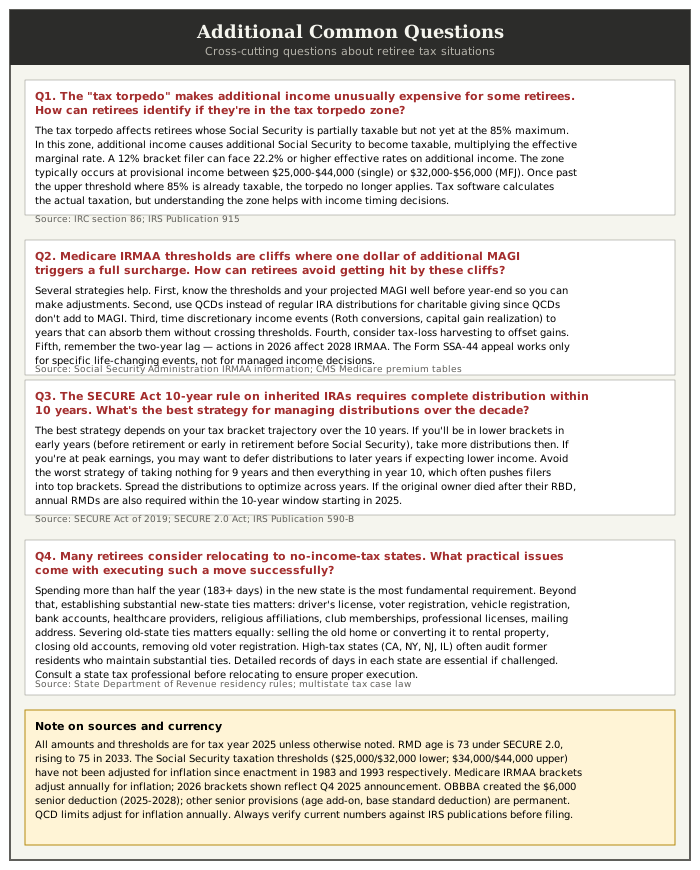
- IRMAA surcharges are cliffs, not gradual — one dollar above a threshold triggers thousands in additional Medicare premiums annually, making income management critical near threshold boundaries
- QCDs (available at 70½+) exclude IRA distributions from gross income entirely, satisfy RMDs, and provide a charitable deduction equivalent without itemizing — the most tax-efficient giving tool for older retirees
- The 10-year rule for inherited IRAs (non-eligible designated beneficiaries) requires full distribution within 10 years, with annual RMDs required if the original owner died after their required beginning date
- The "tax torpedo" occurs when additional income pushes more Social Security into the taxable range, creating effective marginal rates dramatically higher than the stated tax bracket
- The early retirement window between retirement and RMD onset at 73 is typically optimal for Roth conversions — income is lower, bracket room exists, and conversions reduce future taxable RMDs
- Tax-efficient withdrawal sequencing requires coordination of taxable, tax-deferred, and Roth accounts across years, accounting for IRMAA thresholds, Social Security provisional income, RMD requirements, and capital gain harvesting opportunities
Quiz — 5 Questions
Answer one at a timeA married couple filing jointly has MAGI of $218,001 in 2024. What happens to their Medicare Part B premiums for 2026 compared to a couple with $218,000 MAGI?
Social Security Claiming Decisions
Read this if you haven't yet started receiving Social Security benefits.
When to claim Social Security is one of the most important financial decisions for retirees, with implications for monthly benefit amounts, lifetime total benefits, and taxation.
Eligibility ages. Earliest claiming age is 62 (with permanently reduced benefits). Full Retirement Age (FRA) is 66-67 depending on birth year (67 for everyone born 1960 or later). Maximum benefits at age 70 (delayed retirement credits stop accruing after 70).
Benefit amounts at different ages. Claiming at 62 produces about 70-75% of FRA benefit (the exact reduction depends on your FRA). Claiming at FRA produces 100% of your calculated benefit. Each year past FRA adds 8% in delayed retirement credits (up to 24-32% increase at age 70 depending on FRA).
The breakeven age analysis. Comparing early versus delayed claiming, the breakeven age (when delayed claiming surpasses early claiming in cumulative benefits received) is typically around age 80-82. Living past breakeven favors delayed claiming; dying before breakeven favors early claiming.
Tax implications. Once claimed, your Social Security may be partially taxable depending on your other income (covered in the Social Security Taxation section below). Delayed claiming gives higher benefits but those higher benefits may face more taxation if other income is also high.
The earnings test (before FRA). If you claim Social Security before FRA and continue working, your benefits are reduced by $1 for every $2 of earnings above a threshold ($23,400 for 2025). In the year you reach FRA, the threshold rises and the reduction is $1 for every $3 above. After FRA, no earnings test applies.
Spousal benefits. A spouse may be entitled to a benefit equal to 50% of the other spouse's benefit at FRA (reduced if claimed earlier). Spousal benefits cannot start until the other spouse files. Same-sex spouses have the same rights as opposite-sex spouses.
Survivor benefits. Surviving spouses can receive 100% of the deceased spouse's benefit (or 100% of their own, whichever is larger). Claiming strategy decisions affect what the survivor will receive.
Decision points. When to claim based on health, financial need, life expectancy, and spousal considerations. Whether to coordinate spousal claiming for couples. Whether to delay one spouse's benefits while claiming the other's. How claiming interacts with Roth conversion strategy and other income management.
Social Security Administration publications; SSA Quick Calculator at ssa.gov; IRS Publication 915 for taxation.
Your Social Security earnings record (available at ssa.gov via my Social Security account). Calculated benefit amounts at different claiming ages (from SSA). Health and life expectancy considerations. Spouse's benefit information for joint planning.