Business Owners with S-Corporation Elections
S-corp elections, reasonable compensation requirements, payroll obligations, basis tracking, and when the S-corp strategy makes sense
- Understand when S-corp election makes financial sense and how to calculate the break-even threshold
- Learn the mechanics of electing S-corp status with Form 2553 and the eligibility requirements
- Master the reasonable compensation requirement and IRS scrutiny factors
- Understand payroll obligations, salary vs. distribution mechanics, and health insurance rules for 2% shareholders
- Learn how retirement plan contributions interact with the low-salary strategy
- Track your basis in the S-corp using Form 7203 and understand why basis tracking matters
- Navigate multi-state considerations and understand revocation and termination rules
Introduction
The self-employed lesson (Lesson 12) introduced S-corporations briefly as one option for business entity structure. This lesson goes deeper into the S-corporation election — when to make it, how it works mechanically, the reasonable compensation requirement that's central to the S-corp tax strategy, the payroll and reporting obligations that come with S-corp status, the special rules for shareholder fringe benefits, retirement plan considerations, basis tracking, and the considerations around revoking or terminating S-corp status.
S-corporations are not a separate type of legal entity — they're a tax classification that LLCs and corporations can elect. The election gives the business pass-through taxation (income flows to shareholders' individual returns without entity-level income tax) while providing the potential to reduce self-employment tax on profits distributed beyond reasonable compensation. This combination of benefits explains why S-corp elections are so popular among small business owners, particularly those with substantial profits beyond what would constitute reasonable compensation for their work.
The S-corp strategy isn't appropriate for everyone. Below certain profit levels, the administrative burden outweighs the tax savings. Above certain profit levels, the strategy creates retirement plan limitations and other constraints. The reasonable compensation requirement, if not properly observed, exposes the owner to IRS reclassification of distributions as wages with back taxes, penalties, and interest. This lesson helps you understand when S-corp status makes sense and how to operate properly under it.
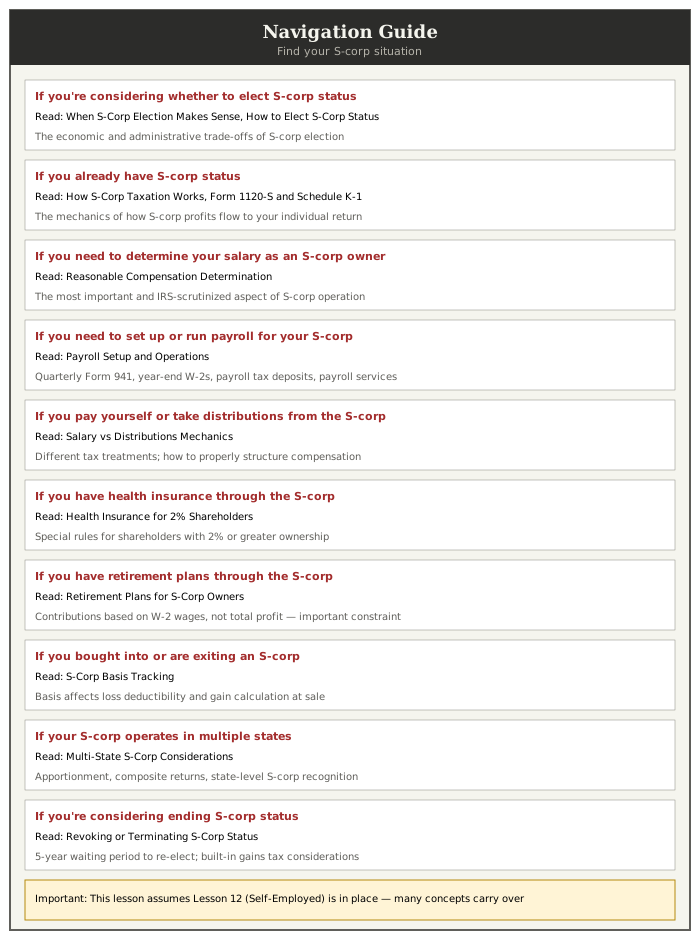
Navigation guide — which subsections apply to your situation
When S-Corp Election Makes Sense
The S-corporation election is fundamentally about reducing self-employment tax on business profits. Understanding when the math works is the first step.
The basic comparison. A sole proprietor or single-member LLC pays self-employment tax (15.3% on net earnings up to the Social Security wage base, 2.9% above plus 0.9% additional Medicare for high earners) on all business net profit. An S-corp owner pays FICA only on the W-2 salary portion — distributions of remaining profits avoid FICA entirely.
The break-even threshold. Below approximately $50,000-$75,000 of net business profit, the S-corp administrative costs typically outweigh the tax savings. The administrative costs include: separate corporate tax return (Form 1120-S, typically $500-$1,500 in preparer fees), payroll service ($500-$1,500 annually), additional bookkeeping for the corporate structure, and the time investment in managing payroll and corporate compliance.
Where the math favors S-corp. Above approximately $50,000-$75,000 of profit, the SE tax savings on distributions typically exceed administrative costs. The savings scale with profit — a business netting $200,000 with $100,000 of reasonable compensation has $100,000 of distributions that avoid 15.3% SE tax, saving approximately $15,300 annually (less administrative costs).
A consultant nets $150,000 from sole proprietorship. SE tax is approximately $20,000 (15.3% on most of it, with the half-deduction reducing income tax effect). As an S-corp paying $80,000 reasonable compensation, FICA is $12,240 (employer + employee) and $70,000 of distributions avoid SE tax — saving approximately $9,800 in payroll taxes. Administrative costs of $1,500-$3,000 still leave $6,800-$8,300 of net savings.
Where S-corp doesn't help.
- Low-profit businesses (under $50,000 net) where admin costs eat the savings
- Single-employee personal service businesses where reasonable compensation essentially equals all the profit (lawyers, doctors with no equity in capital — IRS expects high salaries reflecting service value)
- Businesses with substantial capital investment where the return is properly characterized as return on capital rather than service compensation
QBI deduction interaction. The QBI deduction (covered in Lesson 12) is calculated based partly on W-2 wages paid for non-SSTB businesses above the income thresholds. S-corp salary counts as W-2 wages for the QBI W-2 wage limitation. This can affect the QBI deduction differently than sole proprietorship status. The interaction depends on income level and business type.
Retirement plan implications. S-corp retirement plan contributions are based on W-2 wages, not on total business profit. Setting a low reasonable compensation limits retirement plan contribution capacity — a real trade-off against SE tax savings. We cover this in detail in the retirement plans section.
Decision points. Whether your profit level justifies S-corp election. Whether your business activity supports lower reasonable compensation. Whether you need retirement plan capacity beyond what limited compensation allows. Whether the additional administrative complexity is acceptable.
Sourcing. IRC sections 1361-1378; IRS Publication 542; tax court cases on reasonable compensation; general financial planning principles.
How to Elect S-Corp Status
Form 2553. The election to be treated as an S-corporation is made on Form 2553. The form must be signed by all shareholders of the corporation.
Deadlines. The election generally must be filed by March 15 of the year for which it should apply (for calendar-year filers). For new businesses, the election must be filed within 2 months and 15 days of formation. Late elections may qualify for IRS relief under Revenue Procedure 2013-30 if certain conditions are met.
Eligibility requirements.
- Must be a domestic corporation or LLC eligible to be treated as a corporation
- Maximum 100 shareholders
- Shareholders must be individuals (with limited exceptions for certain trusts and estates), not other corporations or partnerships
- Shareholders must be US citizens or resident aliens (no nonresident alien shareholders)
- Must have only one class of stock (though differences in voting rights are permitted)
LLC electing S-corp. A single-member or multi-member LLC can elect S-corp tax treatment by filing Form 8832 (entity classification election) to be treated as a corporation, then filing Form 2553 to elect S-corp status. Many LLCs combine these by filing Form 2553 which is treated as a deemed corporate election under Rev. Proc. 2013-30.
Effective date. The election generally takes effect from the beginning of the tax year for which filed (assuming filed by March 15 deadline). New businesses can have the election effective from formation.
Federal S-corp election doesn't automatically apply at the state level in all states. Most states recognize federal S-corp status, but some require separate state election. New York, California, New Jersey, and several others have separate state S-corp election requirements.
Sourcing. IRC section 1362; Form 2553 Instructions; Revenue Procedure 2013-30 (late election relief).
How S-Corp Taxation Works
S-corporations are pass-through entities — the corporation itself generally doesn't pay federal income tax. Instead, income, deductions, credits, and other items flow through to the shareholders' individual returns via Schedule K-1.
Form 1120-S — the corporate return. The S-corporation files Form 1120-S annually, due March 15 (or extension to September 15). The return reports the corporation's income, deductions, credits, and various other items. The return doesn't generate income tax owed by the corporation in most cases (some states impose state corporate tax on S-corps; built-in gains tax may apply in specific situations covered later).
Schedule K-1. Each shareholder receives a Schedule K-1 from the corporation reporting their pro-rata share of the corporation's income and other tax items. The K-1 shows:
- Ordinary business income or loss (the main pass-through item)
- Real estate rental income/loss
- Other rental income/loss
- Interest income
- Dividend income
- Capital gains
- Section 179 deduction
- Various other items
Pro-rata allocation. Each shareholder's share is determined by their percentage ownership during the year. Income, deductions, credits, and other items are generally allocated based on ownership percentage on a daily basis. Special allocations are not allowed (unlike partnerships) — S-corp allocations follow strict pro-rata rules.
Individual return reporting. The K-1 amounts flow to the shareholder's individual return:
- Ordinary business income/loss to Schedule E Part II
- Other items to various other schedules and forms
The ordinary business income on the K-1 is NOT subject to self-employment tax. This is the central tax benefit of S-corp election. The shareholder's W-2 wages from the corporation are subject to FICA (employee and employer halves both paid through payroll), but the pass-through profits aren't.
Loss limitations. S-corp shareholders can deduct losses only to the extent of their basis in the corporation (covered in detail in the Basis Tracking section). Excess losses are suspended until basis increases.
Passive activity rules. S-corp losses are subject to passive activity rules if the shareholder doesn't materially participate. Material participation is determined the same way as for other passive activity analysis (covered in Lesson 13).
Net Investment Income Tax. S-corp pass-through income is generally NOT subject to NIIT for materially participating shareholders. This is another benefit relative to passive investment income. Non-materially-participating shareholders may have NIIT on their pass-through income.
Sourcing. IRS Publication 542; Form 1120-S Instructions; Schedule K-1 Instructions; IRC sections 1361-1378.
Reasonable Compensation Determination
This is the central operational issue for S-corp owners — and the area of greatest IRS scrutiny. Setting reasonable compensation correctly is essential to avoid IRS recharacterization of distributions as wages.
The legal requirement. IRC section 162(a)(1) requires that compensation paid to a shareholder-employee for services rendered must be reasonable. The IRS treats this requirement as binding — when S-corp shareholders take distributions while drawing low or no salary for substantial services, the IRS can recharacterize distributions as wages.
The IRS's view. Under Revenue Ruling 74-44, distributions paid in lieu of reasonable compensation get recharacterized as wages subject to FICA. Multiple tax court cases have upheld IRS recharacterization, with the most cited being Veterinary Surgical Consultants, P.C. v. Commissioner.
Factors the IRS considers when determining reasonable compensation.
- Training and experience of the shareholder
- Duties and responsibilities
- Time and effort devoted to the business
- Dividend history of the company
- Payments to non-shareholder employees
- Timing and manner of paying bonuses to key people
- Comparable salaries for similar positions in similar businesses
- Salary policy for all employees
- Use of company assets by the shareholder
The "what would you pay someone else" test. A practical question: if you weren't the owner and someone else were hired to do your job, what salary would you pay them? That's a reasonable starting point for your S-corp salary.
Build a defensible salary determination using: Bureau of Labor Statistics (BLS) Occupational Outlook Handbook for comparable wages, industry salary surveys, local market data from job sites (Indeed, Glassdoor, LinkedIn), reasonable compensation studies (RC Reports, Willis Towers Watson, etc.), and board resolutions documenting the salary determination.
A common rumor suggests S-corp owners should pay 60% as salary and 40% as distributions, or vice versa. The IRS has never endorsed any specific ratio. Reasonable compensation is determined by the value of services performed, not by an arbitrary percentage of profit. The rumor leads to over-simplification and potential audit issues.
Common patterns by industry. While avoiding the 60/40 myth, certain patterns emerge by industry:
- Personal service businesses (lawyers, doctors, consultants): Higher salary percentage, often 70%+ of profits as salary
- Capital-intensive businesses (manufacturing, retail with substantial inventory): Lower salary percentage, more profit attributable to capital returns
- Businesses with substantial employee leverage: Lower owner salary appropriate (owner's services are smaller portion of business value)
When the IRS challenges. Audits focus on shareholders with no or very low W-2 wages while taking substantial distributions. Audit triggers include:
- Zero W-2 wages while distributions exceed industry-comparable salary
- Very low W-2 wages while business has substantial profits
- Pattern of growing distributions but flat or declining salary
- Comparison to non-shareholder employees in similar roles
Consequences of recharacterization.
- Back payroll taxes (FICA, FUTA, and federal income tax withholding)
- Interest on unpaid amounts
- Penalties (failure to deposit, failure to file, accuracy-related)
- Potential additional state-level consequences
- Damaged credibility in future audits
Some new S-corp owners pay themselves no salary in the first year, taking everything as distributions. This is the highest-risk approach. Even a startup year with low profits should typically have some salary to establish the pattern of compensation for services.
Sourcing. IRC section 162(a)(1); Revenue Ruling 74-44; Veterinary Surgical Consultants v. Commissioner; IRS "S Corporation Compensation and Medical Insurance Issues" web resource; Bureau of Labor Statistics salary data.
Payroll Setup and Operations
S-corps with shareholder-employees must operate payroll, which involves federal, state, and sometimes local compliance.
EIN required. Even if you're the only employee, the S-corp must have its own Employer Identification Number (EIN) for payroll purposes. Obtained free from IRS (online at irs.gov/EIN).
State unemployment registration. Most states require employer registration for state unemployment insurance. Some states also require disability insurance registration.
Federal payroll taxes.
- Social Security (6.2% employee + 6.2% employer up to wage base of $176,100 for 2025)
- Medicare (1.45% employee + 1.45% employer on all wages; additional 0.9% employee tax above $200K single/$250K MFJ)
- Federal income tax withholding (based on W-4)
- FUTA (6.0% on first $7,000 of wages, mostly offset by state credits to 0.6% effective)
State payroll taxes. Vary by state. Most have state income tax withholding, state unemployment insurance (paid by employer), and disability insurance in some states.
Quarterly filings.
- Form 941 (federal employment taxes) — quarterly
- State employment tax returns — quarterly (timing varies)
- Federal tax deposits (Form 941 amounts) — monthly or semi-weekly depending on liability
Annual filings.
- Form 940 (FUTA) — annual
- W-2s — to employees by January 31, to SSA by January 31
- Form W-3 (transmittal of W-2s) — to SSA by January 31
Payroll services. Most S-corp owners use payroll services rather than doing payroll manually. Common options:
- Gusto, OnPay (small business specialists)
- ADP, Paychex (larger payroll providers)
- QuickBooks Payroll (if using QuickBooks accounting)
- Patriot, Square Payroll (lower-cost options)
Costs typically range from $40-$100/month for a single-employee S-corp. The service handles tax calculations, deposits, filings, and W-2 issuance.
S-corp-specific payroll considerations. S-corp shareholders with health insurance have specific reporting requirements (covered in next section). Retirement plan contributions for shareholders go through payroll. State conformity issues may complicate multi-state S-corp payroll.
Sourcing. IRS Publication 15 (Employer's Tax Guide); Form 941 Instructions; state employment tax agencies.
Salary vs Distributions Mechanics
The mechanics of paying yourself from an S-corp involve clear distinctions between salary and distributions.
Salary mechanics.
- Paid through payroll like any other employee wage
- Subject to FICA (employee and employer halves)
- Federal income tax withheld per W-4
- State income tax withheld where applicable
- Reported on W-2 at year-end
- Deductible expense on Form 1120-S as wages
- Reduces S-corp ordinary business income flowing through K-1
Distribution mechanics.
- Not run through payroll
- No FICA withholding or payment
- No income tax withholding (you handle through estimated payments on your own income tax return)
- Not reported on W-2 (reported on K-1 or in shareholder's basis tracking)
- Not a deductible expense for the corporation (it's a distribution of after-tax profit)
- Doesn't reduce S-corp ordinary business income
Recording distributions. Distributions reduce your basis in the corporation (covered in Basis Tracking section). They don't appear as taxable items on your individual return — the underlying profit was already taxed via K-1. Distributions are essentially the cash mechanism for getting your already-taxed profit out of the corporation.
Timing flexibility. You don't have to take distributions equal to your K-1 income. You can leave profits in the corporation (increasing your basis), take distributions less than current-year profits, or take distributions of accumulated prior-year profits. The timing of distributions doesn't affect your tax — only the K-1 income amount affects your tax in the current year.
Required vs optional. You're required to take W-2 wages as a shareholder-employee performing services. You're not required to take distributions — many S-corp owners retain some profit in the company for working capital or expansion. The income still passes through to your individual return on K-1 whether distributed or not.
Cash flow planning. Common practice is to take a regular W-2 salary (monthly or biweekly through payroll) and take distributions periodically as cash flow allows. The distributions don't have to match payroll timing.
Sourcing. IRS Publication 542; IRC section 1368 on S-corp distributions; Form 1120-S Instructions.
Retirement Plans for S-Corp Owners
S-corp retirement plan contributions are limited by W-2 wages — not by total business profit. This creates trade-offs with the low-salary strategy.
The fundamental constraint. Retirement plan contribution limits for S-corp shareholders are based on W-2 wages from the corporation, not on the corporation's total profit. Pass-through income via K-1 does NOT count as compensation for retirement plan contribution purposes.
An S-corp shareholder takes $60,000 W-2 salary and $90,000 K-1 distributions. Their compensation for retirement plan purposes is $60,000, not $150,000. Their Solo 401(k) employee deferral capacity is up to $23,500 (which works within their $60,000 salary). But their employer profit-sharing contribution capacity (25% of W-2 wages) is only $15,000 — limited by the low wage.
The S-corp retirement gap. Reducing W-2 salary to save FICA also reduces retirement plan contribution capacity. Owners who want maximum retirement plan contributions may find sole proprietorship or partnership structures more accommodating. The trade-off matters significantly for high-income owners.
Solo 401(k) for S-corp. Employee deferral ($23,500 for 2025) is taken from W-2 wages via payroll. Employer profit-sharing (up to 25% of W-2 wages) is contributed by the corporation. Combined limit is $70,000 ($77,500 with 50+ catch-up).
SEP IRA for S-corp. Employer-only contributions. Contributions up to 25% of W-2 wages, capped at $70,000 for 2025. No employee deferral component.
SIMPLE IRA for S-corp. Lower contribution limits but useful for businesses with employees beyond the owner.
When determining reasonable compensation, factor in retirement plan needs. If you want to contribute $40,000+ to retirement plans, your W-2 salary needs to support that contribution mathematically. Sometimes the optimal salary is higher than the absolute SE-tax-minimization level because of retirement plan benefits.
Defined benefit and cash balance plans. For high earners wanting larger contributions, defined benefit or cash balance plans can allow contributions of $200,000+ annually. These plans require actuarial calculations and are more complex but offer substantial contribution capacity. Available to S-corp owners with appropriate W-2 wages.
Sourcing. IRC sections 401, 408(k), 415; IRS Publication 560; defined benefit plan regulations.
S-Corp Basis Tracking
Basis tracking determines how much loss you can deduct and the gain or loss when you eventually sell your shares.
Why basis matters.
- Losses are only deductible up to your basis (excess losses suspended)
- Distributions in excess of basis become taxable capital gains
- When you sell shares, gain or loss equals sale proceeds minus basis
Initial basis. When you formed or bought into the S-corp, your initial basis equals what you paid for the shares (cash, property, services contributed).
Annual basis adjustments — increases.
- Pass-through income (your K-1 amounts) increases basis
- Additional capital contributions increase basis
- Tax-exempt income (like municipal bond interest) increases basis
- Excess of depletion deductions over the property's adjusted basis increases basis
Annual basis adjustments — decreases.
- Distributions (cash or property) decrease basis
- Pass-through losses decrease basis
- Non-deductible expenses (like 50% of meals) decrease basis
- Depletion (up to adjusted basis) decreases basis
Order of adjustments. Generally:
- Increase by income items first
- Decrease by distributions
- Decrease by losses and deductions
Since 2021, shareholders must file Form 7203 reporting their basis when: claiming a deduction for loss, disposing of stock, receiving distributions or loan repayments, or having a loan repaid by the corporation. The form tracks beginning basis, increases, decreases, and ending basis. Maintaining annual records is essential — reconstructing basis years later is difficult.
Loan basis vs stock basis. If you loan money to your S-corp, you may have separate "loan basis" tracking. Loan basis is increased by loans you make and decreased by repayments and by losses passed through that exceeded stock basis. The interaction with stock basis is complex but important for owners who lend to their corporations.
At-risk rules. Even if you have basis, the at-risk rules can limit loss deductions. At-risk amounts include cash invested and loans you're personally liable for. Generally similar to basis but with specific differences for non-recourse loans.
Sourcing. IRS Publication 542; Form 7203 Instructions; IRC sections 1366, 1367.
Multi-State S-Corp Considerations
S-corps operating in multiple states face complex state tax issues.
State conformity to federal S-corp election. Most states recognize federal S-corp status automatically. Exceptions:
- New Hampshire, Tennessee, Texas: Don't have personal income tax but may have entity-level taxes that apply to S-corps differently
- New York, California, New Jersey: Recognize federal S-corp but require separate state election or have specific state rules
- Washington, Wyoming, South Dakota: No state income tax issues for S-corps generally
Composite returns. Some states allow S-corps to file a composite return on behalf of nonresident shareholders, paying the state tax at the entity level. This simplifies the shareholders' individual state filings but may not be optimal for all shareholders.
State income apportionment. When an S-corp does business in multiple states, the corporation's income is apportioned among states based on each state's apportionment formula (typically using sales, property, and payroll factors). The apportioned income from each state is what gets reported on each shareholder's K-1 for that state.
Nonresident shareholder filings. Each shareholder may need to file nonresident tax returns in each state where the S-corp earned income, claiming credit for taxes paid in the source state on the resident return.
Many states have enacted optional pass-through entity taxes (PTETs) as a workaround to the federal SALT cap. The S-corp pays state tax at the entity level (deductible as a business expense for federal purposes), and shareholders get a credit or deduction on their state returns. The optimal PTET election depends on the SALT cap and the shareholder's specific state tax situation.
S-corp acquiring residency. S-corp's "state of residence" generally relates to where it's organized and where management is. Multi-state operations don't change the entity's home state but create source income in other states.
Sourcing. State Department of Revenue websites for each state; multistate tax research services; state PTET legislation.
Revoking or Terminating S-Corp Status
S-corp status can be revoked voluntarily or terminated involuntarily, with consequences for future tax treatment.
Voluntary revocation. Shareholders holding more than 50% of stock can revoke the S-corp election by filing a statement with the IRS. Effective date can be specified — typically the start of a year for clean transitions. The election to revoke must be carefully timed and documented.
Involuntary termination. S-corp status terminates automatically if:
- The corporation has more than 100 shareholders
- An ineligible entity (corporation, partnership) becomes a shareholder
- A nonresident alien becomes a shareholder
- The corporation creates a second class of stock (other than voting differences)
Effective date of termination. Generally the date of the disqualifying event. The corporation files a short-year S-corp return for the period through the termination date and a short-year C-corp return for the period after.
After voluntary revocation or involuntary termination, the corporation generally cannot re-elect S-corp status for 5 years. The IRS can waive this waiting period under specific circumstances if the cessation was inadvertent.
If a C-corporation converts to S-corporation status, any "built-in gain" (appreciation in corporate assets above their tax basis at conversion) can be subject to corporate-level tax if recognized within 5 years (formerly 10 years) of conversion. This deters companies from converting just before selling appreciated assets. Built-in gains tax does NOT apply to entities that were S-corps from inception (i.e., LLCs that elected S-corp status from the start).
Why companies revoke. Reasons for voluntary revocation:
- Bringing in investors (VC, PE) that disqualify S-corp status
- Going public (S-corp status doesn't work with public ownership)
- Significant changes in business needs (need C-corp benefits like fringe benefits, retirement plans, retained earnings)
- Tax law changes making C-corp more attractive
Sourcing. IRC section 1362; IRS Publication 542; Form 1120-S Instructions; Treasury regulations on S-corp election.
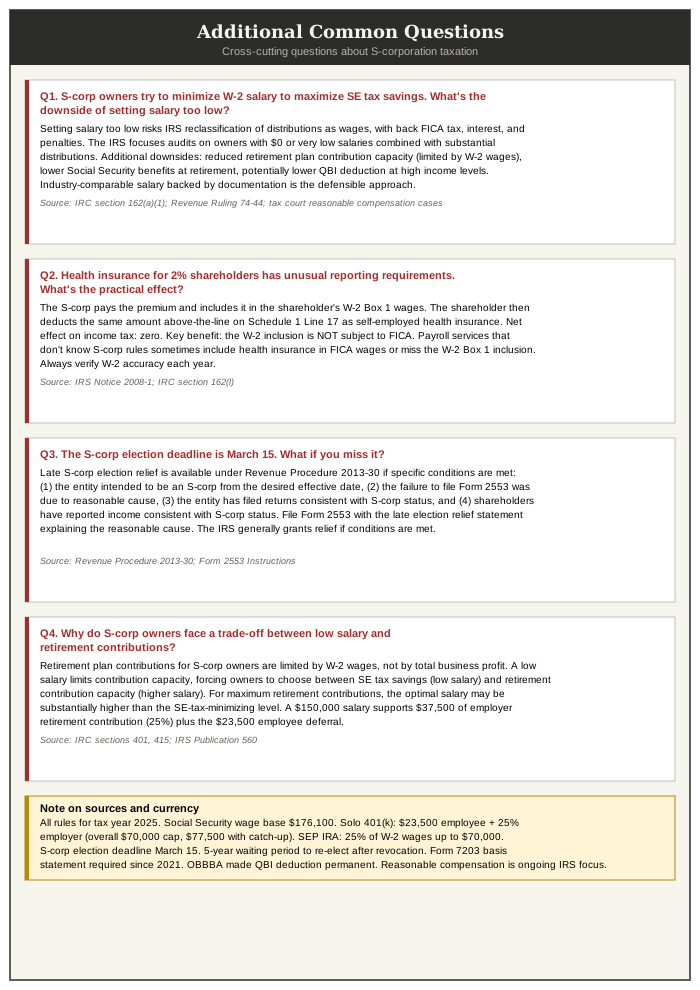
Connection to Other Lessons
The S-Corp Business Owners lesson builds on Lesson 12 (Self-Employed). Several concepts carry over directly:
Lesson 4 (Adjustments) covered the self-employed health insurance deduction, which applies to 2% S-corp shareholders through the W-2 inclusion / Schedule 1 deduction mechanism described above. Same line on Schedule 1.
Lesson 8 (Other Taxes) covered self-employment tax. S-corp shareholders avoid SE tax on the K-1 pass-through income — that's the central tax benefit. But the W-2 wages from the S-corp are still subject to FICA (paid through payroll, both employer and employee halves).
Lesson 9 (Payments) covered estimated tax requirements. S-corp shareholders typically need quarterly estimated payments on the income tax that will be due on their K-1 pass-through income, since no withholding occurs on that income. The W-2 wages have withholding through payroll.
Lesson 12 (Self-Employed) covered the QBI deduction. S-corp shareholders qualify for QBI on their K-1 ordinary business income (but NOT on W-2 wages from the S-corp). The W-2 wages paid by the S-corp affect the QBI calculation through the W-2 wage limitation for filers above the income thresholds.
What to Gather for S-Corp Owner Returns
Form 1120-S (S-corp tax return), Schedule K-1 from the corporation showing your pro-rata share of items, W-2 from the corporation for wages paid, Form 7203 (S-corp basis statement) or basis tracking spreadsheet, and records of distributions taken during the year.
Quarterly Form 941 filings (to verify payroll consistency), Form 940 (FUTA filing), state employment tax filings, reasonable compensation analysis documentation (BLS data, industry surveys, board resolutions setting salary), health insurance premium records (for 2% shareholder treatment), retirement plan contribution records (separating employer profit-sharing from employee elective deferrals), and records of any loans between you and the corporation (affects basis tracking).
For the individual return:
- K-1 income flows to Schedule E Part II
- W-2 wages flow to Form 1040 line 1
- Health insurance from W-2 inclusion is deducted on Schedule 1 line 17
- Retirement plan contributions taken from payroll are already reflected in W-2 Box 1 (reduced by deferrals); employer profit-sharing contributions don't appear on the individual return (they reduce the K-1 income)
- Basis statement on Form 7203 if claiming losses, taking distributions, or disposing of stock
Key Takeaways
- S-corp election is a tax classification, not a separate legal entity — LLCs and corporations elect it to reduce self-employment tax on profits beyond reasonable compensation
- The break-even threshold is approximately $50,000-$75,000 of net profit — below this, administrative costs typically exceed tax savings
- Reasonable compensation is the central operational requirement: IRS scrutinizes low or zero salaries, and recharacterization of distributions as wages triggers back payroll taxes, interest, and penalties
- S-corp payroll is mandatory — quarterly Form 941, annual Form 940, W-2s, and state filings are required even if you're the only employee
- Health insurance for 2% shareholders must be included in W-2 Box 1 but NOT in Boxes 3 and 5; the shareholder then deducts it on Schedule 1
- Retirement plan contributions are based on W-2 wages only — a low salary strategy limits contribution capacity and may not be optimal for high earners wanting large retirement contributions
- Track basis annually using Form 7203 — losses are only deductible up to your basis, and distributions exceeding basis trigger capital gains
- Built-in gains tax does NOT apply to LLCs that elected S-corp status from inception — only to C-corps converting to S-corp status
Quiz — 5 Questions
Answer one at a timeBelow approximately what profit level do S-corp administrative costs typically outweigh the tax savings?