W-2 Employees: Career-Specific Considerations
Situational guidance for multi-job households, military service, stock compensation, tipped workers, and more
- Apply the foundation lessons to your specific W-2 employment situation
- Understand special tax treatment for clergy, military service members, K-12 educators, and performing artists
- Navigate multi-job withholding issues and mid-year job changes correctly
- Handle stock-based compensation (RSUs, ESPPs, ISOs, NQSOs) without double-taxing income
- Optimize employer benefits including FSAs, HSAs, and dependent care
Overview
The foundation lessons covered how Form 1040 works for everyone, including the W-2 wage reporting (Lesson 3) and the standard tax calculation that applies to W-2 employees. This lesson builds on that foundation to cover the situational complexity that affects different kinds of W-2 employees differently.
If you're a W-2 employee at a single employer with no other income sources, no special employer benefits, no stock-based compensation, and no spouse with separate income, the foundation lessons mostly cover everything you need. This lesson exists for W-2 employees whose situations have additional complexity — multi-job households, mid-year job changes, military service, tipped occupations, stock compensation, and so on.
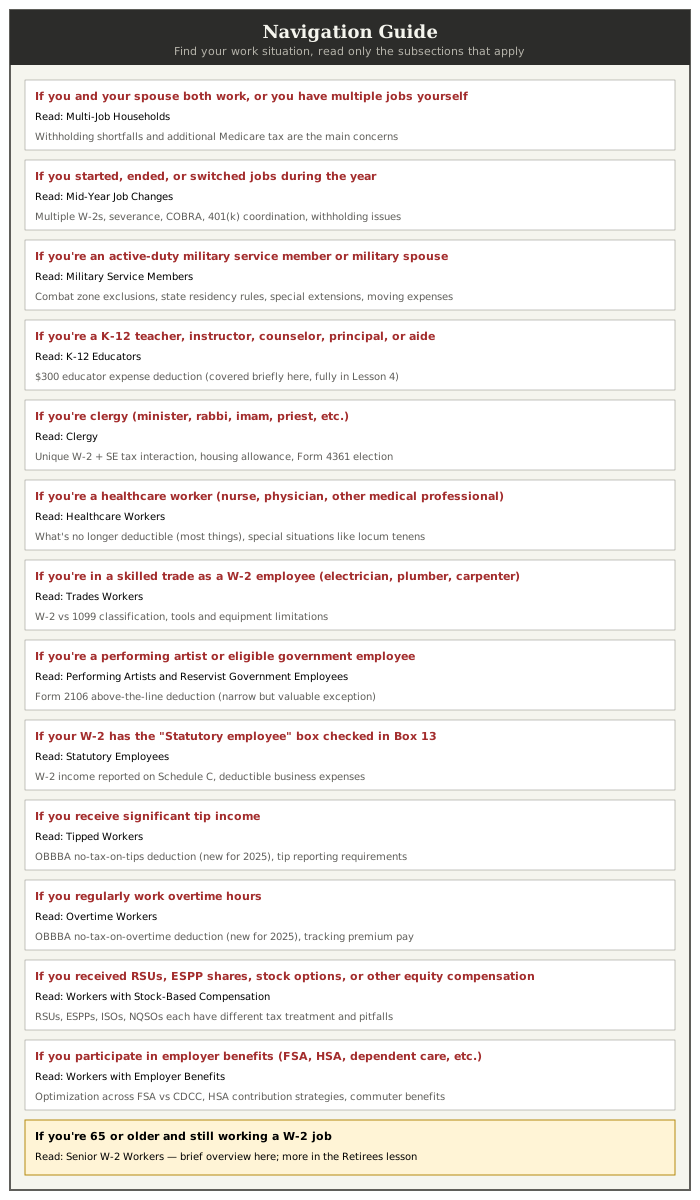
The lesson is organized alphabetically by subcategory. Use the navigation guide to find your situation. Most W-2 employees only need to read one or two subsections.
Brief recap from the foundation lessons
Before getting into specific subcategories, a quick reminder of what the foundation lessons covered for W-2 employees:
Lesson 3 walked through Form 1040 line 1 (wages) and explained every box on the W-2 form. Box 1 is your federal taxable wages, which is what flows to line 1a. Boxes 3 and 5 are Social Security and Medicare wages respectively, which can differ from Box 1 because of pretax deductions. Box 12 has coded items like 401(k) contributions, HSA contributions, and employer-provided health insurance value.
Lesson 4 covered the Schedule 1 Part II adjustments and the new Schedule 1-A from OBBBA, including the no-tax-on-tips and no-tax-on-overtime deductions that affect tipped and overtime W-2 workers.
Lesson 5 covered the standard versus itemized deduction decision that applies to all filers including W-2 employees.
Lesson 8 covered Schedule 2 other taxes including additional Medicare tax that catches many multi-job households.
Lesson 9 covered the payments section where W-2 withholding gets credited and where filers see whether they're getting a refund or owe a balance.
This lesson covers what's specific to particular kinds of W-2 employment situations beyond those foundation topics.
Clergy
Read this if you're an ordained minister, rabbi, imam, priest, or other clergy member receiving compensation for ministerial services.
Clergy have one of the most distinctive tax situations among W-2 workers because they're treated differently for income tax (W-2 employee) versus Social Security and Medicare tax (self-employed).
Income tax treatment. You receive a W-2 from your religious organization showing your salary as wages. This income is taxed under the regular income tax rules — your wages go on Form 1040 line 1a like any other W-2 employee.
Self-employment tax treatment. Despite the W-2 reporting, you're considered self-employed for Social Security and Medicare tax purposes on your ministerial earnings. You file Schedule SE and pay the full 15.3% self-employment tax on your ministerial income plus housing allowance (covered below). Your employer doesn't withhold or pay FICA on ministerial wages.
Housing allowance (parsonage). A portion of your compensation can be designated as a housing allowance by your employer. The amount designated is excludable from federal income tax (doesn't appear in W-2 Box 1) up to specific limits. However, the housing allowance IS subject to self-employment tax. The exclusion limit is the lesser of: the amount designated by the employer, the amount actually spent on housing (rent or mortgage, utilities, furnishings, repairs), or the fair rental value of the home (including utilities).
Form 4361 election. Clergy may elect out of self-employment tax for religious reasons by filing Form 4361. The election is irrevocable and must be made within specific deadlines. Clergy who file Form 4361 don't pay SE tax on ministerial earnings but also don't accrue Social Security or Medicare benefits from those earnings. This is a significant long-term decision that requires careful consideration.
Estimated tax payments. Because there's no FICA withholding from ministerial wages and the income tax withholding may not cover the SE tax obligation, clergy typically need to make quarterly estimated tax payments. Some clergy ask their employer to withhold extra income tax to cover the SE tax — this is allowed and avoids estimated tax obligations.
Decision points. Whether to take a housing allowance designation (almost always yes if eligible). Whether to file Form 4361 (significant long-term decision affecting Social Security eligibility). How to handle estimated taxes given the no-FICA-withholding situation. Whether to elect voluntary income tax withholding through the W-4 to cover SE tax obligations.
Sourcing. IRS Publication 517 (Social Security and Other Information for Members of the Clergy and Religious Workers); Form 4361 Instructions; IRC sections 1402(a)(8) and 1402(e).
Your W-2 with housing allowance designation in Box 14 if applicable. Records of actual housing expenses (rent/mortgage, utilities, furnishings, repairs). Documentation of fair rental value (rental comparisons in your area). Form 4361 if filed in a prior year.
Healthcare Workers
Read this if you're a nurse, physician, therapist, technician, or other healthcare professional working as a W-2 employee.
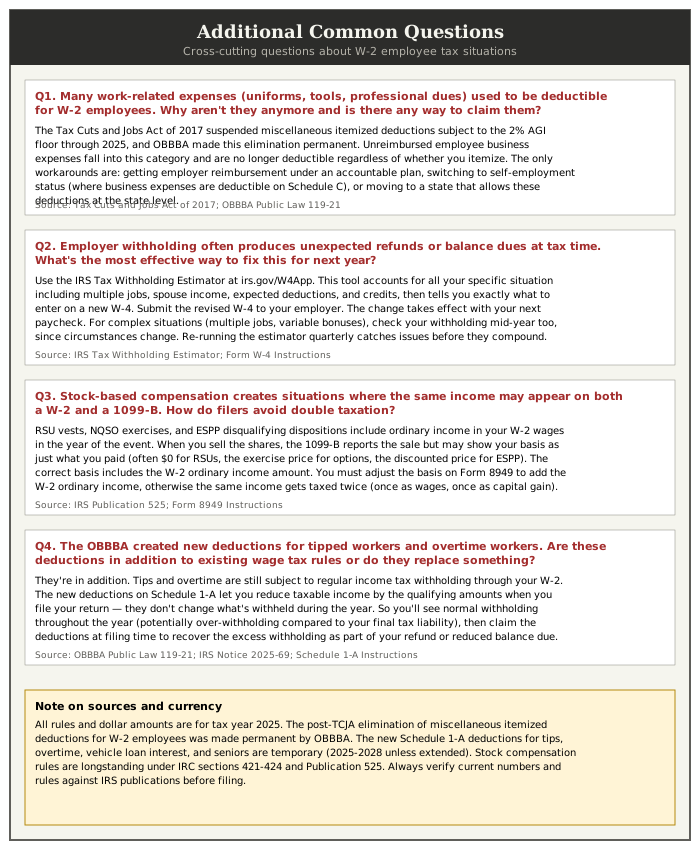
Healthcare workers as W-2 employees face a tax situation that's largely about what's NO LONGER deductible. The Tax Cuts and Jobs Act of 2017 suspended miscellaneous itemized deductions subject to the 2% AGI floor through 2025, and the One Big Beautiful Bill Act made this elimination permanent. For W-2 healthcare workers, this means many work-related expenses that used to be deductible are no longer deductible at all.
No longer deductible for W-2 healthcare employees:
- Professional license renewal fees
- Malpractice insurance premiums paid out of pocket
- Continuing medical education (CME) costs
- Scrubs and uniforms (even if required by employer)
- Stethoscopes, otoscopes, and other equipment purchased personally
- Medical journals and professional subscriptions
- Professional society dues (AMA, ANA, etc.)
- Job-search expenses if changing positions within healthcare
- Home office expenses for charting from home
These items were previously deductible as unreimbursed employee expenses. They're not deductible now and won't be deductible in future years unless Congress changes the law.
What employer reimbursements look like. Many healthcare employers reimburse some of these expenses (CME, license fees, professional society memberships). Reimbursements made under an "accountable plan" are not included in your W-2 wages and don't create a deduction or income event. If your employer reimburses these expenses, you can't also deduct them — but the reimbursement itself isn't taxable.
Locum tenens physicians and travel nurses. Healthcare workers who travel for short-term assignments often have mixed situations. The primary engagement may classify them as W-2 (with the agency or hospital). Additional engagements may classify them as 1099 (independent contractor). The 1099 income gets reported on Schedule C with deductible business expenses — covered in the Self-Employed lesson. The W-2 income gets reported normally on line 1a without the business expense deductions.
Travel between work locations. If you're a W-2 employee with a primary work location and you travel to other locations for the same employer, mileage and travel are generally employer responsibility (and shouldn't be deducted by you even if unreimbursed, due to the elimination of miscellaneous itemized deductions). If you're considered to have multiple regular workplaces, you may have different rules — consult IRS Publication 463 for the specifics.
Stipends, sign-on bonuses, retention bonuses. Healthcare workers commonly receive various lump-sum payments. These are all wages subject to W-2 reporting and regular income tax. The tax withholding on bonuses uses a special rate (typically 22% federal flat rate for supplemental wages under $1 million), which may be more or less than your actual marginal rate. The actual tax owed on the bonus comes out in the wash at filing time.
State licensing across multiple states. If you're licensed in multiple states (common for travel nurses, locum tenens physicians, telehealth providers), the license fees in states where you're not primarily employed are no longer deductible for W-2 employment. For self-employment income earned in those states, the fees are deductible on Schedule C.
Decision points. Negotiating reimbursement arrangements with employers for items that would otherwise be non-deductible expenses (turning them into employer benefits rather than personal expenses). Understanding the W-2 vs 1099 distinction for short-term assignments and the very different tax treatment. Tracking state tax obligations if working across multiple states.
Sourcing. IRS Publication 17; IRS Publication 463 (Travel, Gift, and Car Expenses); Tax Cuts and Jobs Act provisions; OBBBA Public Law 119-21 (permanent elimination of miscellaneous itemized deductions).
Your W-2(s) from healthcare employers. Documentation of any 1099 income from healthcare engagements (covered separately in Self-Employed lesson). Records of any employer reimbursements you received.
K-12 Educators
Read this if you work at least 900 hours during the school year as a kindergarten through 12th grade teacher, instructor, counselor, principal, or aide.
The K-12 educator subcategory is mostly about one specific provision: the $300 educator expense deduction on Schedule 1 line 11. Lesson 4 covered this in detail; this section adds K-12-specific context.
The educator expense deduction recap. Up to $300 per eligible educator ($600 MFJ if both spouses are eligible educators, but no more than $300 per individual) deductible above-the-line for unreimbursed classroom expenses. This applies whether you itemize or take the standard deduction.
What qualifies. Books, supplies, computer equipment (including software and services), other equipment, and supplementary materials used in the classroom. Professional development courses related to the curriculum you teach also qualify if not reimbursed.
The 900-hour requirement. You must work at least 900 hours during the school year (not the calendar year) at a school providing K-12 education. Full-time teachers easily meet this. Part-time teachers may not. The 900 hours is the threshold that triggers eligibility — there's no proportional reduction for lower hours.
What used to be deductible but isn't anymore. Like other W-2 employees, K-12 teachers used to deduct unreimbursed employee expenses above $300 (and many other work-related items) as miscellaneous itemized deductions. The TCJA eliminated this through 2025 and OBBBA made the elimination permanent. The $300 educator expense deduction is now the only specific provision for K-12 teacher classroom expenses.
Strategy for teachers spending more than $300 on classroom supplies. The excess above $300 is not deductible. Some teachers seek reimbursement from their school for amounts above $300 (often available through specific grant programs or PTA funds). Some teachers fund classroom supplies through DonorsChoose or similar platforms that take donations from third parties (so the teacher isn't out of pocket). The expense beyond $300 isn't going to come back in tax savings.
The deduction is specific to K-12. Preschool teachers don't qualify regardless of hours. College and university instructors don't qualify even if teaching prerequisite courses.
Sourcing. IRS Publication 529; Form 1040 Instructions for Schedule 1 line 11; IRC section 62(a)(2)(D).
Receipts for classroom expenses throughout the year. Documentation of your hours worked during the school year. Records of any reimbursements from the school (which reduce the deductible amount).
Mid-Year Job Changes
Read this if you started, ended, or switched jobs during the year.
Mid-year job changes create several specific tax issues that don't affect employees at the same job all year.
Multiple W-2s. You'll receive a W-2 from each employer you worked for during the year. Each W-2 shows the wages paid and tax withheld during the period you worked there. Add Box 1 from all W-2s for Form 1040 line 1a. Add Box 2 from all W-2s for line 25a.
Withholding may have been calculated incorrectly. Each employer's withholding is calculated as if your annual income comes from just that job. If you worked at Employer A January through June and then Employer B July through December, Employer A withheld based on your half-year wages annualized to a full year (which probably under-projected your total annual income), and Employer B withheld based on its half-year wages similarly annualized. Your actual total income may push you into a higher bracket than either employer assumed, creating a balance due at filing time.
The fix for next year. Submit a new W-4 to your current employer using the IRS Tax Withholding Estimator at irs.gov. The estimator accounts for prior-year jobs and helps prevent the same issue in subsequent years.
Excess Social Security tax withholding. If your combined Social Security wages from multiple employers exceeded the wage base ($176,100 for 2025), you paid too much Social Security tax. The excess (each employer's withholding above 6.2% × $176,100 prorated) becomes a credit on Schedule 3 line 11. This is one situation where multiple W-2s can produce extra refunds rather than balance dues — but only if combined Social Security wages exceeded the wage base.
Severance pay. If you received severance when leaving a job, the payment is taxed as wages on the W-2. Often the withholding on severance uses the supplemental wage rate (22% federal), which may be more or less than your actual marginal rate. The actual tax liability comes out in the wash at filing time.
Vacation payout. Unused vacation paid out at termination is also taxed as wages. Same withholding considerations as severance.
COBRA health continuation. If you continued health insurance through COBRA after leaving a job, the premiums you paid are out-of-pocket medical expenses (potentially deductible on Schedule A if you itemize and clear the 7.5% AGI floor — see Lesson 5). The premiums are not deductible above-the-line for non-self-employed people. Self-employed people who continued COBRA may be able to deduct the premiums as self-employed health insurance (covered in the Self-Employed lesson).
401(k) contribution coordination. The IRS sets a per-person annual limit on 401(k) employee elective deferrals ($23,500 for 2025, $31,000 if age 50+ with catch-up). This limit is total across all 401(k) plans you participate in during the year. If you contributed to both Employer A's plan and Employer B's plan, your combined contributions must be within the limit. Excess contributions need to be withdrawn (with earnings) by April 15 of the following year, or they become double-taxed (once when contributed, again when distributed).
HSA contribution coordination. HSA contribution limits ($4,300 self-only, $8,550 family for 2025, plus $1,000 catch-up at 55+) are per person per year, including all employer and employee contributions. If both employers contributed to an HSA on your behalf, monitor the total.
Health FSA limitations. Most health FSAs forfeit any unused balance at the end of the plan year. If you left Employer A mid-year with a remaining FSA balance you hadn't used, you typically lost it. Some plans offer a grace period or limited rollover. The "use it or lose it" risk is highest for FSAs at jobs you're considering leaving.
Decision points. Whether to adjust withholding for the rest of the year after a mid-year change. Whether to delay leaving a job until after year-end for tax bracket reasons (rarely worth it). Whether to roll over your 401(k) from the old employer to an IRA, the new employer's plan, or leave it where it is. How to handle FSA balances when changing jobs.
Sourcing. Form W-4 Instructions; Schedule 3 Instructions (excess Social Security); IRC section 402(g) for 401(k) limits; IRC section 223 for HSA limits.
All W-2s from all employers during the year. Records of any 401(k) contributions to multiple plans. Records of any HSA contributions to multiple plans. Severance documentation. COBRA premium payment records if continuing health insurance.
Military Service Members
Read this if you're an active-duty member of the US Armed Forces, a reservist, a member of the National Guard called to active duty, or the spouse of a military service member.
Military service members have several tax provisions specific to their status. The major ones:
Combat zone tax exclusion. Pay earned while serving in a designated combat zone is excluded from federal income tax. The exclusion is unlimited for enlisted personnel and warrant officers; for commissioned officers, the exclusion is capped at the highest enlisted pay rate. Your W-2 shows the exclusion via Code Q in Box 12, and Box 1 (federal taxable wages) excludes the combat zone pay. You don't need to do anything special on your return — the W-2 already reflects the exclusion.
Combat pay and EITC interaction. Nontaxable combat pay generally doesn't count as earned income for the Earned Income Tax Credit, which could reduce eligibility for low-income service members. However, you can ELECT to include nontaxable combat pay as earned income for EITC purposes if doing so produces a larger credit. This election is made on Form 1040 line 1i. Run the calculation both ways to see which is better.
State of legal residence. Military service members can maintain their state of legal residence (the state they consider their permanent home, often where they're from) for state tax purposes even when stationed elsewhere. Many service members maintain residence in states with no income tax (Florida, Texas, Washington, Alaska, Nevada, South Dakota, Tennessee, Wyoming, New Hampshire) to avoid state income tax on their military pay regardless of where stationed.
Military Spouses Residency Relief Act (MSRRA). Spouses of military members can typically maintain the same state of legal residence as their service member spouse, with limited exceptions. This provides similar state tax benefits for the spouse. SCRA and MSRRA together make state tax considerations much different for military families than civilian families.
Filing extensions for combat zone service. Service members in a combat zone get automatic extensions of various tax deadlines (typically 180 days after leaving the combat zone, plus the days remaining in the filing period when entering). The IRS doesn't assess late filing or late payment penalties during these extensions.
Moving expense deduction. Active-duty military members are the ONLY taxpayers who can still deduct moving expenses (covered in Lesson 4). The move must be due to military orders to a permanent change of station. Form 3903 calculates the deduction.
Reservists' travel deduction. Members of the reserves and National Guard who travel more than 100 miles away from home for reservist duties (and stay overnight) can deduct unreimbursed travel expenses above-the-line on Form 2106 then on Schedule 1. This is one of the narrow remaining exceptions to the elimination of unreimbursed employee expenses.
Special W-2 codes. Box 12 Code Q shows nontaxable combat pay. Code P shows excludable moving expense reimbursements. Various other codes apply to specific military situations.
Decision points. Whether to maintain your state of legal residence or change it. Whether to elect to include combat pay as earned income for EITC purposes. Whether to use the moving expense deduction if you moved due to military orders. Coordination with your spouse's state tax situation under MSRRA.
Sourcing. IRS Publication 3 (Armed Forces' Tax Guide); IRC section 112 (combat zone exclusion); Servicemembers Civil Relief Act; Military Spouses Residency Relief Act; Form 3903 Instructions.
Your military W-2 with Box 12 codes. Military orders documenting your assignments and any combat zone deployment. Documentation of your state of legal residence (DD Form 2058). Form 3903 if claiming moving expenses. Reservist travel records if applicable.
Multi-Job Households
Read this if you and your spouse both work, or if you have multiple W-2 jobs yourself.
Multi-job households face several specific issues that single-job households don't.
The withholding shortfall problem. When you have multiple W-2 jobs, each employer calculates withholding as if their wages are your only income. The progressive bracket structure means your combined income may be in a higher bracket than either employer assumed. Combined withholding often falls short of your actual tax, producing a balance due at filing time.
The W-4 multiple-job calculation. Form W-4 has specific Step 2 instructions for multiple-job households. Three methods are available:
- Use the IRS Tax Withholding Estimator at irs.gov (most accurate, accounts for everything in your situation)
- Use the Multiple Jobs Worksheet in the W-4 instructions
- Check the Step 2(c) box on the W-4 of each job (simple but assumes both jobs have similar income)
Most filers don't follow these instructions when filling out new W-4s, leading to under-withholding. If you've had balance dues in past years, fix the W-4 now using the IRS estimator.
Additional Medicare Tax often catches multi-job households. The 0.9% additional Medicare Tax applies to combined wages above $250,000 MFJ (or $200,000 single with multiple jobs). Each employer withholds the additional Medicare tax only on wages over $200,000 from THAT job — they don't know about other jobs. A couple with combined wages over $250,000 but neither spouse individually over $200,000 owes the additional Medicare tax with no withholding to cover it.
Excess Social Security tax withholding. If your combined Social Security wages from multiple W-2 jobs exceed the wage base ($176,100 for 2025), you paid too much Social Security tax. The excess becomes a credit on Schedule 3 line 11. This applies whether multiple jobs are from the same person or two spouses — only multiple jobs from the SAME person trigger the excess credit.
Coordinating retirement plan contributions. The annual 401(k) employee deferral limit ($23,500 for 2025, plus catch-up if 50+) is per person across all 401(k) plans you participate in. If both you and your spouse contribute to 401(k)s, your individual limits apply separately — you each get the full limit. If YOU have multiple jobs with 401(k) plans, your contributions across all your plans must stay within your individual limit.
Coordinating HSA contributions. HSA limits are per person per year, including employer and employee contributions. Family HDHP coverage limit ($8,550 for 2025) is for the family unit. If both spouses have HSAs through their respective employers, total combined contributions are limited.
Coordinating dependent care FSA. The Dependent Care FSA limit ($5,000 MFJ for 2025) is per household, not per person. If both spouses contribute to dependent care FSAs through their employers, combined contributions are limited to $5,000.
Decision points. Whether to update W-4s after each spouse's job change or income change. Whether to deliberately have more withholding from one spouse to cover the household's tax obligations. Whether to use estimated tax payments to cover shortfalls rather than adjusting withholding (sometimes useful for variable bonus situations). How to coordinate retirement contributions and benefit elections across two employers.
Sourcing. Form W-4 Instructions; IRS Tax Withholding Estimator (irs.gov); Form 8959 for additional Medicare tax; Schedule 3 Instructions for excess Social Security; IRC sections 402(g), 223 for retirement and HSA limits.
All W-2s from all jobs for both you and your spouse. Records of all retirement plan contributions. Records of all HSA contributions. Current W-4s on file with each employer.
Overtime Workers
OBBBA introduced a new deduction for qualified overtime premium pay for tax years 2025-2028, covered fully in Lesson 4 on Schedule 1-A. This section adds W-2-specific context for overtime workers preparing their tax data.
Recap of the OBBBA overtime deduction. Up to $12,500 (single) or $25,000 (MFJ) deduction for the "premium portion" of FLSA overtime — the "half" portion of time-and-a-half pay, not the base hourly rate. Phase-out at MAGI over $150,000 single / $300,000 MFJ. Not available for Married Filing Separately.
What "qualified overtime" means. Overtime required by the Fair Labor Standards Act (FLSA) and reported on a W-2. This means you're a non-exempt employee under FLSA whose employer is required to pay you 1.5 times your regular rate for hours over 40 in a workweek. Salaried employees who don't qualify for FLSA overtime under the salary exemption don't have qualifying overtime to deduct. Independent contractors and gig workers also don't qualify.
Calculating the premium portion. If your regular hourly rate is $20 and your overtime rate is $30 ($20 + $10 premium), only the $10 premium per overtime hour counts toward the deduction. For 100 overtime hours during the year, $1,000 of premium is the deductible amount, not $3,000 of total overtime pay.
2025 transitional reporting. Employers were not required to separately report qualified overtime on 2025 W-2s. The IRS provided transition relief through Notice 2025-69 explaining how workers can calculate qualified overtime from paystubs or other employer records. For 2026 and later, W-2s will have new fields for separate reporting.
What to track during the year. Each paystub should show your regular hourly rate, your overtime rate, and overtime hours worked. Save final paystubs from each pay period if possible, especially if your employer hasn't started separately reporting qualified overtime. Year-end summary statements from employers may also provide the data.
Sourcing. OBBBA Public Law 119-21 section 70202; IRS Notice 2025-69; Schedule 1-A Instructions; Fair Labor Standards Act.
Your W-2 with attention to Box 14 if your employer voluntarily reported qualified overtime. Paystubs throughout the year showing overtime hours and pay rates. Year-end summary from employer if voluntarily provided.
Performing Artists and Reservist Government Employees
Read this if you're a qualified performing artist, a reservist with armed forces travel expenses, or a fee-basis state or local government official.
A narrow but valuable exception to the elimination of unreimbursed employee expenses exists for these three specific categories. They can still claim above-the-line deductions on Form 2106 that flow to Schedule 1.
Qualified performing artists. Must have at least two W-2 jobs from performing arts during the year, have performing arts expenses exceeding 10% of gross income from those performances, and have AGI of $16,000 or less (a very low threshold). Most performing artists don't qualify due to the AGI limit, but those who do can deduct work-related expenses above-the-line.
Armed forces reservists' travel. Members of the reserves or National Guard who travel more than 100 miles from home for reservist duties and stay overnight can deduct unreimbursed travel expenses on Form 2106 and Schedule 1 line 12.
Fee-basis state or local government officials. Employees of state or local governments paid in whole or part on a fee basis can deduct work-related expenses above-the-line. This is a narrow category but specific.
For these specific categories, the elimination of miscellaneous itemized deductions doesn't apply because they have their own above-the-line provisions.
Sourcing. IRC section 62(a)(2); Form 2106 Instructions.
Form 2106 to calculate the deduction. Documentation of relevant expenses (travel, supplies, etc.).
Senior W-2 Workers
Read this if you're 65 or older and still working a W-2 job.
Working at 65+ creates intersection between the W-2 employment situation and senior-specific tax provisions. The Retirees lesson covers most senior tax considerations in depth; this section flags the W-2-specific items.
OBBBA $6,000 senior deduction. If you're 65+, you may claim this new deduction on Schedule 1-A (covered in Lesson 4) on top of your regular standard or itemized deduction. The senior deduction phases out at MAGI above $75,000 single / $150,000 MFJ. Still-working seniors with W-2 income often exceed the phase-out thresholds; check whether you qualify based on your specific situation.
Standard deduction age add-on. Filers 65+ get an additional $2,000 (single/HOH) or $1,600 (MFJ/QSS) added to the standard deduction. This is separate from the OBBBA senior deduction and applies regardless of MAGI.
Social Security taxation while still working. If you've started collecting Social Security but are still working, your earnings can affect Social Security in two ways: the earnings test reduces your Social Security benefits if you're below full retirement age and earn over thresholds; and your other income (including W-2 wages) affects how much of your Social Security is taxable. Working seniors should consider whether to delay Social Security to avoid the earnings test issue. The Retirees lesson covers Social Security taxation in detail.
Medicare premium surcharges (IRMAA). Medicare Part B and Part D premiums increase for filers with MAGI above $103,000 single / $206,000 MFJ (2025 thresholds, based on two-year-old income). High-earning seniors should be aware that current income affects future Medicare premiums.
Catch-up retirement contributions. Workers 50+ get catch-up contribution limits on retirement accounts. For 2025, the 401(k) catch-up is $7,500 (making the total $31,000 for 50+ workers). The IRA catch-up is $1,000 (making the total $8,000 for 50+ workers). Workers 60-63 may have higher "super catch-up" amounts under SECURE 2.0 provisions.
See the Retirees lesson for the broader senior tax context including Required Minimum Distributions, Social Security taxation, Medicare considerations, and tax-efficient withdrawal strategies for retirement accounts.
Statutory Employees
Read this if your W-2 has the "Statutory employee" box checked in Box 13.
Statutory employees are a unique W-2 category. They receive W-2 wages but are treated as self-employed for income tax purposes, meaning they file Schedule C and can deduct business expenses.
Who's a statutory employee. Specific categories defined in IRC section 3121(d)(3):
- Certain agent or commission drivers
- Full-time life insurance salespeople
- Home workers performing work according to specifications provided by the person for whom services are performed
- Traveling or city salespersons who solicit orders on behalf of a principal company
The categories are narrow and specific. Most W-2 workers are not statutory employees. The employer determines whether you qualify and marks Box 13 accordingly.
Tax treatment if you're a statutory employee. Your W-2 wages from this employer go on Schedule C as gross receipts rather than on Form 1040 line 1a. You can deduct ordinary and necessary business expenses on Schedule C. The net profit (or loss) flows from Schedule C to Schedule 1 then to Form 1040 line 8.
FICA considerations. Your statutory employer withheld FICA (Social Security and Medicare) as if you were a regular employee. You don't owe additional self-employment tax on this income because FICA was already paid. This is the major distinction from true self-employment — statutory employees get the FICA tax treatment of W-2 employees but the deduction treatment of self-employed people.
Decision points. Verify with your employer whether the statutory employee designation is correct. The designation affects which forms you file and what you can deduct. If you have both W-2 statutory employee income and other W-2 wages, you handle them separately — the statutory income on Schedule C, the regular W-2 income on line 1a.
Sourcing. IRC section 3121(d)(3); IRS Publication 15-A (Employer's Supplemental Tax Guide); Schedule C Instructions.
Your W-2 with Box 13 statutory employee box checked. Records of business expenses related to this work for Schedule C deduction.
Tipped Workers
Read this if you work in a tipped occupation (server, bartender, hairdresser, valet, etc.) and receive significant tip income.
OBBBA introduced a new deduction for qualified tip income for tax years 2025-2028, covered fully in Lesson 4 on Schedule 1-A. This section adds W-2-specific context for tipped workers.
Recap of the OBBBA tips deduction. Up to $25,000 deduction for qualified tip income for workers in occupations that customarily and regularly received tips before December 31, 2024. The IRS published a list of Treasury Tip Occupation Codes (TTOC). Phase-out at MAGI over $150,000 single / $300,000 MFJ. Not available for Married Filing Separately.
What's a qualified tip occupation. The TTOC list covers traditionally tipped service occupations: restaurant servers, bartenders, baristas, bussers, hosts, hairdressers, barbers, manicurists, masseurs and masseuses, valets, parking attendants, baggage handlers, hotel housekeepers, taxi drivers, food delivery drivers, and similar service workers. Workers in non-traditionally-tipped occupations who happen to receive tips don't qualify even if their employer reports them.
Tip reporting basics. Tips you receive must be reported to your employer monthly (using Form 4070 or equivalent) if you received more than $20 in tips for that month. Reported tips appear on your W-2 in Box 7 (Social Security tips), and the federal income tax on those tips is part of Box 2 withholding. Cash tips not reported to your employer still need to be reported to the IRS on your return.
Allocated tips. If you work in a large food or beverage establishment, your employer may allocate additional tips to you based on a percentage of sales when reported tips fall below 8% of sales. Allocated tips appear in W-2 Box 8 and aren't included in Box 1. You may need to report them as additional income on Form 4137.
For 2025 specifically. Employers were not required to separately report qualified tips on 2025 W-2s. Workers can determine qualified tips from W-2 Box 7 (Social Security tips), Form 4070 tip reports, or amounts the employer voluntarily reported in Box 14 or a separate statement. Starting in 2026, separate reporting will be required.
Sourcing. OBBBA Public Law 119-21 section 70201; IRS Notice 2025-69; Schedule 1-A Instructions; IRS Publication 531 (Reporting Tip Income); Form 4137 Instructions.
Your W-2 with attention to Box 7 (Social Security tips) and Box 14 if employer voluntarily reported qualified tips. Your tip reporting records (Form 4070 or equivalent). Documentation that your occupation is on the IRS Treasury Tip Occupation Code list. Records of any cash tips not reported to your employer.
Trades Workers
Read this if you work in a skilled trade (electrician, plumber, carpenter, HVAC technician, mechanic) as a W-2 employee.
Many trades workers are actually self-employed (sole proprietors, single-member LLCs, or independent contractors), in which case the Self-Employed lesson applies. This section covers W-2 employees in trades.
The W-2 vs 1099 classification question. Many trades workers are misclassified. If you receive a W-2 but feel like you should be a 1099 contractor, or vice versa, the IRS has specific rules for determining proper classification. Form SS-8 is the formal mechanism to ask the IRS to determine your status. Misclassification has significant tax implications because W-2 employees can't deduct work expenses (post-TCJA elimination) while 1099 contractors can.
Tools and equipment. Tools and equipment purchased by W-2 trades workers are no longer deductible at the federal level (eliminated by TCJA, made permanent by OBBBA). This is a major change from pre-2018 when trades workers could deduct substantial amounts for tools and equipment as miscellaneous itemized deductions.
Some states still allow these deductions. Several states didn't conform to the federal elimination and still allow miscellaneous itemized deductions. If your state allows them, track these expenses for state tax purposes even though they don't help federally.
Uniforms and protective equipment. Required uniforms not suitable for regular wear (steel-toed boots, hard hats, branded company uniforms, FR-rated workwear, etc.) were previously deductible. They're no longer deductible for W-2 employees. Employer-provided uniforms aren't taxable income.
Travel between job sites. If you're a W-2 employee with no regular workplace (genuine multi-site work like construction trades), mileage between job sites was previously deductible. It's no longer deductible for W-2 employees, though if your employer reimburses mileage under an accountable plan, the reimbursement isn't taxable.
Trade school and apprenticeship costs. Continuing education in your trade was previously deductible. The Lifetime Learning Credit (covered in Lesson 7) may still apply for qualifying courses, but the general unreimbursed employee expense deduction is gone.
Strategy for trades workers seeking deductions. Consider whether moving to 1099/self-employed status would benefit you tax-wise. The trade-off is loss of W-2 protections (unemployment insurance, workers' compensation, employer-paid FICA) in exchange for business deductions and Schedule C reporting. This is a major career decision, not just a tax decision.
Sourcing. IRS Publication 17; Tax Cuts and Jobs Act provisions; OBBBA Public Law 119-21; Form SS-8 for classification determinations.
Your W-2 from the trades employer. Documentation of any reimbursed work expenses (which don't create deductions but aren't taxable income either). State-specific records if your state allows deductions the federal level doesn't.
Workers with Stock-Based Compensation
Read this if you received RSUs, Employee Stock Purchase Plan shares, Incentive Stock Options, or Non-Qualified Stock Options during the year.
Stock-based compensation creates some of the most complex W-2 situations because the same income may appear in multiple places and the basis tracking has long-term implications.
Restricted Stock Units (RSUs)
How RSUs work. Your employer grants you RSUs that vest over time (typically 3-4 years). When they vest, the value of the shares at vesting is taxable as ordinary income and gets included in your W-2 Box 1.
Tax withholding on vest. Your employer typically sells some shares to cover taxes ("sell-to-cover") and gives you the remaining shares. The withheld amount appears in your W-2 Box 2. Often the default withholding (22% federal supplemental rate) is less than your actual marginal rate, leaving you with a tax shortfall.
Basis after vest. Your basis in the shares equals the value at vesting (which is the amount included in W-2 wages). When you eventually sell, the gain or loss is the difference between sale proceeds and this basis. The duration from vesting to sale determines whether the gain is short-term or long-term.
Form 1099-B from your broker may report your basis as $0 (the actual cost you paid) instead of the vest-date value. If you report the gain based on the 1099-B's $0 basis, you'll pay tax twice on the vest-date value (once as ordinary income via W-2, again as capital gain). You must adjust the basis on Form 8949 to reflect the correct vest-date value. This is the most common stock-comp error.
Employee Stock Purchase Plan (ESPP)
How ESPPs work. Employee Stock Purchase Plans let you buy company stock at a discount (typically up to 15% off). The discount creates a taxable benefit, but the timing and character depend on holding periods.
Qualifying disposition. Selling at least 2 years after the grant date AND 1 year after the purchase date. The discount is taxed as ordinary income at sale, but capped at the lesser of (a) the actual gain or (b) the discount based on the price at grant. Additional gain is long-term capital gain.
Disqualifying disposition. Selling earlier than the qualifying period. The full discount (based on purchase date price) is taxed as ordinary income at sale, regardless of actual gain. Additional gain may be short-term or long-term.
Form 3922. Your employer sends Form 3922 reporting ESPP purchase information. You'll need this for basis calculation when you sell.
Common error. Similar to RSUs, the 1099-B may report basis without the ordinary income component, leading to double taxation if not adjusted on Form 8949.
Incentive Stock Options (ISOs)
How ISOs work. Stock options that give you the right to buy company stock at a fixed price. ISOs have specific tax-advantaged treatment if held long enough.
At grant. No tax consequence.
At exercise. No regular tax consequence (the bargain element — difference between exercise price and FMV at exercise — isn't taxable for regular tax). BUT the bargain element IS an AMT preference item, potentially triggering AMT. ISO exercises are one of the most common AMT triggers.
At sale, qualifying disposition. Selling at least 2 years after grant and 1 year after exercise. The entire gain (sale price minus exercise price) is long-term capital gain.
At sale, disqualifying disposition. Selling earlier. The bargain element at exercise becomes ordinary income (added to W-2 in the year of disqualifying disposition or reported on Form 1040). Additional gain may be short-term or long-term.
Form 3921. Your employer sends Form 3921 for ISO exercises. Critical for tracking the AMT preference and basis calculations.
AMT credit. If ISO exercise triggers AMT in one year, you may get a credit for some of that AMT in future years when regular tax exceeds AMT.
Non-Qualified Stock Options (NQSOs)
How NQSOs work. Stock options without ISO tax treatment. Simpler than ISOs but less tax-advantaged.
At exercise. The bargain element (FMV at exercise minus exercise price) is ordinary income reported on W-2. Your employer typically withholds tax on this amount.
At sale. Gain or loss equals sale price minus FMV at exercise. Short-term or long-term depending on holding period after exercise.
Basis tracking. Your basis equals the FMV at exercise (the amount included in W-2 as ordinary income). The 1099-B may show only the exercise price as basis, requiring adjustment on Form 8949.
Stock-comp general considerations
Quarterly estimated taxes after major events. Large RSU vests, ESPP sales, or option exercises can produce substantial tax liability that wage withholding doesn't cover. Make quarterly estimated payments in the quarter of the event to avoid underpayment penalties.
Diversification considerations. Concentration in employer stock creates investment risk on top of tax considerations. Many financial planners suggest selling stock comp as it vests/becomes available unless you have specific reasons to hold.
State tax implications. Stock comp creates tax obligations in the state where you worked when the compensation was earned, which may differ from where you live when you sell. Multi-state stock comp situations get complex.
Sourcing. IRS Publication 525 (Taxable and Nontaxable Income); IRS Publication 550; Form 8949 Instructions; Form 3921 and 3922 Instructions; IRC sections 421-424 (ISOs and ESPPs).
W-2 from your employer. Form 3921 for ISO exercises. Form 3922 for ESPP purchases. Form 1099-B for any stock sales during the year. Vesting and exercise records from your employer's stock plan administrator.
Workers with Employer Benefits
Read this if you participate in employer-sponsored benefits like Flexible Spending Accounts, Health Savings Accounts, dependent care benefits, commuter benefits, or other pretax benefits.
Employer benefits affect your W-2 in various ways and create opportunities for tax optimization that workers without these benefits don't have.
Health Flexible Spending Account (Health FSA). Pretax contributions reduce your W-2 Box 1 wages. The 2025 limit is $3,300 per employer plan. FSA funds reimburse qualified medical expenses tax-free. "Use it or lose it" — most plans forfeit unused balances at year-end, though some allow grace periods or carryovers.
Dependent Care FSA. Pretax contributions up to $5,000 per household for 2025 reduce W-2 Box 1 wages. Reimburses child care or dependent care expenses tax-free. The amount in W-2 Box 10 reports total dependent care benefits provided through the FSA.
FSA vs Child and Dependent Care Credit decision. You can't get both benefits on the same expenses. The FSA route (pretax payroll deduction) is generally more valuable for middle-to-upper income filers because it saves taxes at your marginal rate. The CDCC (covered in Lesson 7) is generally better for lower-income filers because the credit percentage is higher at lower incomes. Run both calculations for your situation.
Health Savings Account (HSA). Available only with HDHP coverage. Contributions through payroll are pretax (reducing W-2 Box 1) and appear in Box 12 Code W. Contributions outside payroll are deductible on Schedule 1 line 13 (covered in Lesson 4). The 2025 limits are $4,300 self-only / $8,550 family, plus $1,000 catch-up at age 55+. HSAs have triple tax advantage: tax-deductible contributions, tax-free growth, tax-free withdrawals for qualified medical expenses.
HSA optimization strategy. Many financial planners suggest maxing HSA contributions, paying current medical expenses out of pocket rather than from the HSA, investing the HSA balance, and reimbursing yourself decades later for old medical expenses (which the IRS doesn't time-limit). This effectively uses the HSA as a tax-advantaged investment account with the future right to tax-free withdrawals.
Commuter benefits. Pretax transit and parking benefits reduce W-2 Box 1 wages. Limits are $315 per month for transit and $315 per month for parking for 2025. The benefit appears as reduced wages rather than in Box 12.
Group-term life insurance over $50,000. Employer-paid group life insurance up to $50,000 is tax-free. Coverage above $50,000 has imputed income reported on W-2 Box 12 Code C. The imputed income increases your W-2 Box 1 wages but isn't a cash benefit you receive.
Adoption assistance. Employer adoption assistance up to specific limits (approximately $17,000 for 2025) is excluded from income tax. Amounts above the exclusion are taxable. The benefit appears on W-2 Box 12 Code T.
Educational assistance. Employer educational assistance up to $5,250 per year is excluded from income. This covers tuition, books, and supplies. Amounts above the limit are taxable. Some employers also cover student loan payments under this provision (provision extended through 2025).
Retirement plan contributions. 401(k) and 403(b) traditional contributions are pretax and reduce W-2 Box 1 wages. Roth versions reduce after-tax pay. Both appear in W-2 Box 12 (Code D for traditional 401(k), AA for Roth 401(k)).
Decision points. How much to contribute to each FSA given the use-it-or-lose-it risk versus the tax savings. Whether to use FSA or CDCC for child care expenses. Whether to participate in HSA and use it as an investment vehicle or for current medical expenses. Which retirement contribution vehicle to use (traditional vs Roth) based on current vs expected future tax rates.
Sourcing. IRS Publication 969 (HSAs, FSAs, and similar); IRS Publication 503 for dependent care; IRS Publication 15-B (Employer's Tax Guide to Fringe Benefits); various IRC sections.
Your W-2 with attention to Boxes 10, 12 (various codes), and 14. Records of qualified medical expenses paid out of pocket if planning HSA reimbursement strategy. Records of child care expenses if claiming CDCC after using FSA.
Key Takeaways
- Each employer withholds as if their wages are your only income — multi-job households and mid-year job changers often owe a balance unless they use the IRS Tax Withholding Estimator to adjust their W-4
- TCJA eliminated miscellaneous itemized deductions and OBBBA made the elimination permanent — healthcare workers, trades workers, and others can no longer deduct unreimbursed work expenses at the federal level
- RSU, ESPP, and NQSO compensation is included in W-2 Box 1 wages — if you report sales using the broker's 1099-B basis without adjustment, you pay tax twice on the same income
- Clergy pay self-employment tax on ministerial earnings despite receiving a W-2, and housing allowance is excluded from income tax but not from SE tax
- Active-duty military are the only W-2 workers who can still deduct moving expenses; reservists can still deduct qualifying travel expenses above-the-line
- Statutory employees receive a W-2 but file Schedule C with business expense deductions — look for the checkbox in Box 13
- The OBBBA overtime and tips deductions (2025-2028) apply to the premium portion of FLSA overtime and to workers in traditionally tipped occupations — employers were not required to separately report these amounts on 2025 W-2s
- HSAs provide triple tax advantage and can be used as long-term investment accounts — the IRS doesn't time-limit reimbursements for prior medical expenses
Quiz — 5 Questions
Answer one at a timeYou received RSUs that vested when the stock was worth $50 per share, and your employer included that value in your W-2 Box 1. Your broker's Form 1099-B shows $0 basis for the shares when you sell them at $60 per share. What is your correct taxable gain?