Roth Conversion Mechanics and Strategy
The mechanics, pro-rata rule, five-year rules, backdoor strategies, bracket-filling, and when conversions help versus hurt
- Understand the full mechanics of a Roth conversion — what happens step by step, the deadline, and where conversions can originate
- Calculate the taxable amount of a conversion, including the impact of paying tax from external cash versus withholding from the IRA
- Apply the pro-rata rule to determine the taxable portion of a conversion when after-tax and pre-tax IRA balances are mixed
- Distinguish between the two distinct five-year rules — the qualified distribution rule for earnings and the conversion penalty rule — and how each applies based on age
- Identify the strongest conversion windows (early retirement, low-income years, market downturns) and the situations where conversions are counterproductive
- Execute backdoor Roth and mega backdoor Roth strategies, including Form 8606 reporting requirements and common filing mistakes
- Model conversion amounts using bracket-filling and account for IRMAA and ACA PTC interactions that expand the true marginal cost of conversion income
Roth Conversion Mechanics and Strategy
Roth conversions — moving money from a traditional IRA or 401(k) to a Roth IRA — represent one of the most important and underused tax planning strategies. Done well, conversions can reduce lifetime tax liability significantly, enable tax-free retirement income, eliminate required minimum distributions, and create estate planning benefits. Done poorly, they create unnecessary tax bills, push filers into higher brackets, trigger ACA premium tax credit cliffs (especially after 2025), and create five-year rule complications.
This lesson covers the mechanics of Roth conversions, the underlying tax treatment, the critical pro-rata rule that complicates backdoor Roth strategies, the two distinct five-year rules, when conversions make strategic sense, and when they don't. Roth conversions are particularly relevant for early retirees (before RMDs and before Medicare), high-income earners using backdoor strategies, and filers in unusually low-income years.
The lesson assumes Lesson 11 (Retirees) is in place — particularly the discussion of RMDs and Roth conversion strategy. This lesson goes deeper into the mechanics.
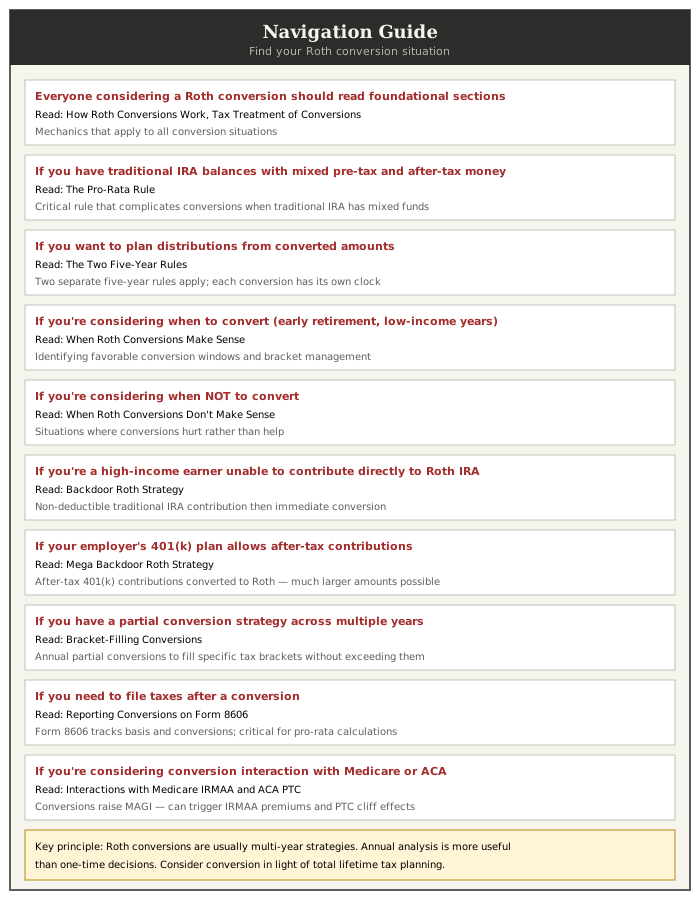
How Roth Conversions Work
A Roth conversion is the act of moving money from a tax-deferred retirement account (traditional IRA, traditional 401(k), 403(b), etc.) to a Roth account, paying income tax on the converted amount in the year of conversion.
The mechanics.
- You instruct the custodian of your traditional IRA (or 401(k)) to transfer a specific amount to a Roth IRA. The custodian can be the same firm or a different firm.
- The transfer happens — usually in 3-5 business days for IRAs at the same firm, longer for transfers between firms. Securities can transfer in kind (no need to sell) or as cash after selling.
- The transferred amount is treated as a distribution from the traditional account for income tax purposes, and a contribution to the Roth account. The distribution is taxable; the Roth contribution is not.
- At year-end, you receive Form 1099-R showing the distribution with code "2" or "7" indicating the conversion. The taxable amount appears in Box 2a.
- You file Form 8606 reporting the conversion and pay tax on the converted amount (or applicable portion under pro-rata rule).
Key rules.
- No 10% early withdrawal penalty on conversion itself. Even if you're under 59½, the conversion isn't subject to the early withdrawal penalty. However, withdrawing the converted amount within 5 years of conversion DOES trigger the 10% penalty (the "five-year conversion rule" — covered separately).
- Conversion deadline. December 31 of the conversion year. Unlike contributions (which have until April 15 of the following year), conversions must be completed by year-end to count for that year.
- No conversion limits. You can convert any amount in any year — no annual conversion limit (unlike the $7,000/$8,000 contribution limit). Some filers convert millions of dollars in a single year if circumstances warrant.
- No income limits for conversion. Unlike Roth contributions (which phase out at higher incomes), there's no income limit for conversions. This is what makes the backdoor Roth strategy work.
- Conversion can't be undone. Pre-2018, conversions could be "recharacterized" (undone) by October 15 of the following year. TCJA eliminated this recharacterization option. Now conversions are permanent — you can't undo them if your circumstances change.
- Where conversions can come from. Traditional IRA, SEP IRA, SIMPLE IRA (after 2-year holding period), traditional 401(k), traditional 403(b), governmental 457(b), and similar pre-tax accounts. Converting from employer plans (401(k), 403(b)) typically requires you to have separated from the employer or have an in-service distribution provision.
- In-plan Roth conversions. Some employer plans allow conversion from traditional 401(k) to Roth 401(k) within the same plan, without moving funds outside the plan. Tax treatment is the same (taxable in year of conversion).
Tax Treatment of Conversions
Converting a tax-deferred dollar makes it taxable in the year of conversion. The math determines whether this trade-off helps or hurts your lifetime tax bill.
The taxable amount. Generally, the pre-tax portion of the converted amount is included in your ordinary income for the conversion year. After-tax portions (basis from non-deductible contributions) are not taxable.
Effect on your tax return.
- Conversion increases your taxable income by the pre-tax amount converted
- Higher income may push you into higher brackets
- Higher income may trigger AMT (rare post-TCJA)
- Higher income may affect Social Security taxation, Medicare IRMAA, ACA PTC, NIIT, and various other thresholds
- Conversion is reported as IRA distribution on Form 1040 line 4 with taxable amount on 4b
Paying the tax — important consideration.
Pay the tax owed from outside the IRA. This maximizes the amount that ends up in the Roth (since the full converted amount becomes Roth principal). Better long-term outcomes.
Have the custodian withhold tax from the conversion amount. Reduces the amount actually converting to Roth. If under 59½, the withheld amount is treated as a distribution to you, triggering the 10% early withdrawal penalty.
Converting $100,000 with 22% marginal rate = $22,000 federal tax. Paying from external cash: Full $100,000 ends up in Roth; $22,000 tax paid from savings. Withholding from conversion: $78,000 ends up in Roth; $22,000 paid as withholding; if under 59½, additional $2,200 penalty on the $22,000 withheld.
State tax considerations. Most states tax conversions like federal — the converted amount is state taxable income. States with no income tax (Florida, Texas, etc.) don't tax conversions at all.
Quarterly estimated tax implications. Conversions in the latter part of the year may require Q4 estimated payment to avoid underpayment penalty. Annualized installment method may help avoid penalty if conversion is concentrated.
Safe harbor for estimated payments. Pay 100% of prior year tax (110% if AGI over $150,000) or 90% of current year tax through withholding and estimates to avoid underpayment penalty regardless of large conversion.
The Pro-Rata Rule
The pro-rata rule is one of the most important and least understood aspects of Roth conversions. It can derail backdoor Roth strategies when traditional IRA balances exist.
The rule. When you convert (or withdraw) from a traditional IRA, the IRS treats it as coming proportionally from ALL your traditional, SEP, and SIMPLE IRAs combined — including both pre-tax balances (deductible contributions and earnings) and after-tax balances (non-deductible contributions).
The formula.
- Pre-tax % = Pre-tax balance / Total IRA balance
- Conversion taxable amount = Conversion amount × Pre-tax %
- Conversion non-taxable amount = Conversion amount × After-tax %
Calculated as of December 31 of the conversion year, not the conversion date. Even if you "isolated" after-tax contributions in a separate IRA, all IRAs are aggregated for the calculation. The IRS looks at the December 31 total.
You have $93,000 in a traditional IRA, all from deductible contributions and earnings. You make a $7,000 non-deductible contribution to that same IRA (total now $100,000, of which $7,000 is after-tax basis). You convert $7,000. Pre-tax % = $93,000 / $100,000 = 93%. Taxable conversion = $7,000 × 93% = $6,510. Non-taxable conversion = $7,000 × 7% = $490. You expected to convert just your after-tax $7,000 tax-free. Instead, $6,510 of the conversion is taxable. The remaining $6,510 of after-tax basis stays in the traditional IRA, to be applied to future conversions/distributions.
You have $50,000 in IRA #1 (all pre-tax), $20,000 in IRA #2 (all pre-tax), and a $7,000 non-deductible contribution sitting in IRA #3 (intended for "clean" backdoor conversion). All three are aggregated: Total $77,000, of which $7,000 is after-tax basis. You convert $7,000 from IRA #3. Pre-tax % = $70,000 / $77,000 = 90.9%. Taxable conversion = $7,000 × 90.9% = $6,364. The backdoor strategy was undermined — most of the "after-tax" contribution still got pro-rated.
Workarounds for the pro-rata rule.
- Roll pre-tax IRAs into a 401(k). Most 401(k) plans accept rollovers from IRAs. By rolling pre-tax IRA balances into a 401(k), you remove them from the IRA aggregation. Your only remaining traditional IRA is then the after-tax basis, which can be cleanly converted.
- Convert everything to Roth. If pre-tax balances are modest and you can afford the tax, converting everything eliminates the pro-rata problem for future backdoors.
- Skip the backdoor. If neither workaround is feasible, the backdoor Roth strategy may not be worth pursuing.
Important: 401(k) balances are NOT aggregated with IRAs. The pro-rata rule applies only to IRA aggregation. Separate 401(k) balances don't affect IRA pro-rata calculations.
Solo 401(k) for self-employed filers. Self-employed filers can establish a Solo 401(k) and roll pre-tax IRAs into it. This eliminates IRA pro-rata issues for backdoor Roth strategies.
SEP and SIMPLE IRAs. These ARE included in the pro-rata aggregation. Self-employed filers with SEP-IRAs are particularly affected.
The Two Five-Year Rules
There are two distinct five-year rules for Roth IRAs. They apply differently to converted amounts versus earnings, and they can create confusion.
Five-Year Rule #1 — Qualified Distributions (Tax-Free). Applies to earnings on Roth IRA balances. Your Roth IRA must be at least 5 years old (measured from your first Roth contribution to any Roth IRA) to withdraw earnings tax-free. This rule applies to the Roth IRA, not to specific contributions or conversions.
Five-Year Rule #2 — Conversion Penalty Rule. Applies to each individual conversion. Converted amounts withdrawn within 5 years of conversion are subject to the 10% early withdrawal penalty (if under 59½), even though the conversion itself wasn't taxable when you withdraw.
Each conversion has its own five-year clock. A conversion in 2020 has a separate 5-year clock from a conversion in 2025. Each starts January 1 of the conversion year.
Order of withdrawals from Roth IRAs. The IRS treats Roth IRA withdrawals as coming out in a specific order:
- Contributions (always tax-free and penalty-free, regardless of age)
- Conversions (in order of conversion year; subject to 5-year penalty rule if under 59½)
- Earnings (subject to both five-year rules and age test for tax-free treatment)
Practical implications.
If you're 59½ or older. The conversion 5-year penalty rule doesn't matter (no early withdrawal penalty anyway). The qualified distribution 5-year rule still matters for tax-free earnings.
If you're under 59½. Both rules matter. Plan conversions with 5-year horizons in mind.
Strategy: First Roth contribution starts the qualified distribution clock. Even a tiny initial Roth contribution (when first eligible) starts the 5-year clock for tax-free earnings purposes. Many financial advisors recommend opening and minimally funding a Roth IRA early in any client's life to start the clock running, even if substantial contributions come later.
You make your first Roth contribution at age 50. Five years later (at age 55), the qualified distribution clock has been satisfied. When you later convert $200,000 at age 58, the conversion is subject to its own 5-year penalty clock (until age 63). Earnings on the conversion would be tax-free starting age 59½ (since the qualified distribution clock was satisfied earlier).
Roth 401(k) and Roth IRA five-year clocks are SEPARATE. Time in a Roth 401(k) doesn't count for the Roth IRA clock unless you roll over the Roth 401(k) into a Roth IRA (and even then, the Roth IRA clock is the controlling one).
When Roth Conversions Make Sense
Identifying favorable conversion windows is key to a successful Roth conversion strategy.
Strong conversion candidates — situations where conversions usually pay off.
- Early retirement years (ages 60-72). Many retirees experience their lowest income years between retirement and Social Security/RMDs starting. This window often allows conversions at low marginal rates that will be higher when forced RMDs and Social Security combine to push income up.
- Unusually low-income year. Job loss, sabbatical, business loss, year of starting a business — any year with lower-than-normal income creates conversion opportunity.
- Market downturn. Converting during a market dip means converting fewer "dollars worth" of pre-tax money. The recovery happens in Roth (tax-free) rather than traditional (taxable). The dollar amount converted is the same, but the share of total retirement assets shifted is higher.
- Pre-Medicare retirees. For early retirees before age 65, conversion impacts only income tax (not Medicare premiums since not yet on Medicare). Once Medicare starts, IRMAA implications make conversions more expensive.
- Wealthy filers expecting to leave Roth IRAs to heirs. Roth IRAs inherited by non-spouse beneficiaries are subject to the 10-year rule but stay tax-free. Compare to inheriting a traditional IRA where heirs pay tax on distributions. Converting before death effectively pays the tax now at the filer's bracket rather than letting heirs pay at theirs (which could be higher).
- To avoid future RMDs. Traditional IRAs require RMDs starting at age 73. Roth IRAs have no RMDs during the owner's lifetime. Converting reduces or eliminates future RMD requirements.
- Tax bracket diversification. Having a mix of traditional, Roth, and taxable accounts gives flexibility in retirement to manage taxable income strategically. Pure traditional IRA holders have less flexibility.
- The "bracket-filling" approach. Convert just enough each year to fill the current tax bracket without bumping into the next one. Detailed in a separate section below.
The Rule of Thumb. If you expect your future tax rate to be higher than your current rate, conversion makes sense. If lower, traditional is better. If equal, it's a wash (but Roth still provides flexibility benefits).
When Roth Conversions Don't Make Sense
Some situations make conversions a bad idea.
- You expect to be in a lower bracket in retirement. Conversion accelerates tax to the current year. If future bracket is lower, this is the wrong direction.
- You have no funds outside the IRA to pay conversion tax. Paying tax from the IRA reduces amount available for compounding. If under 59½, withheld amount triggers 10% penalty. Conversions are most beneficial when paid from external cash.
- You're at the top of an important bracket. Adding conversion income that pushes you over a key threshold (like 32% to 35% bracket, or 24% to 32%) makes the conversion much more expensive. Better to stop conversion at the bracket edge.
- You're near 400% FPL and receive ACA Premium Tax Credit. Starting 2026 (with cliff returning), conversion income pushing over 400% FPL eliminates ALL subsidy. Possibly tens of thousands in lost subsidy. Conversion may need to wait until Medicare age.
- You're on Medicare or approaching it. Conversion income raises MAGI, triggering IRMAA premium increases two years later. Substantial conversions can mean thousands in additional Medicare premiums.
- You have short remaining life expectancy. The benefits of Roth compound over time. With limited remaining life, conversion may not pay back.
- You expect to give most of the IRA to charity. Charity isn't subject to income tax on inherited IRA. Better to leave traditional IRA to charity than convert (paying tax now) and leave smaller Roth balance.
- You need the converted funds within 5 years and are under 59½. Five-year conversion rule creates 10% penalty if you need the converted amount early.
- You're already in retirement and have stable, low income. If you've already navigated to a sustainable retirement income level, large conversions disrupt the stable picture without much benefit.
- Tax law uncertainty. If you expect tax rates to fall in the future (unusual but possible), conversion now locks in tax at current rates. Worth considering political and economic projections.
Backdoor Roth Strategy
For high earners above the Roth IRA contribution income limits, the backdoor Roth strategy allows Roth contributions through a two-step process.
Why the backdoor exists. Direct Roth IRA contributions are limited:
- 2025: phase-out begins at $150,000 MAGI single / $236,000 MFJ; complete phase-out at $165,000 / $246,000
- Above phase-out, no direct Roth contribution allowed
But there's no income limit on:
- Non-deductible traditional IRA contributions
- Roth conversions
Combine these and you have a "backdoor" path: contribute non-deductible to traditional IRA, then immediately convert to Roth.
The mechanics.
- Make non-deductible contribution to traditional IRA (up to $7,000 for under-50, $8,000 for 50+ for 2025).
- Wait briefly (sometimes recommended just to be safe, though no required waiting period legally).
- Convert the contribution from traditional IRA to Roth IRA.
- File Form 8606 reporting both the non-deductible contribution and the conversion.
As covered earlier, the pro-rata rule treats all IRAs as aggregated. If you have existing pre-tax IRA balances, the backdoor conversion becomes mostly taxable rather than tax-free.
Successful backdoor requires no other pre-tax IRA balances. Or, you must first clear out pre-tax balances (typically by rolling them into a 401(k)).
Annual implementation. Many high-income filers do backdoor Roth every year, contributing the maximum and immediately converting.
Reporting on Form 8606. Both spouses (if both doing backdoor) file separate Form 8606s. The form tracks:
- Non-deductible contributions for the year
- Total basis (cumulative non-deductible contributions less prior conversions)
- Conversions during the year
- Taxable amount of conversions
Common backdoor Roth mistakes.
- "Failed to file Form 8606." Without Form 8606, the IRS doesn't know about your basis. Future conversions or distributions look fully taxable. Penalty: $50 per missed form.
- "Forgot about existing IRA balance." The pro-rata calculation surprises filers who thought their backdoor would be tax-free.
- "Waited too long between contribution and conversion." No specific waiting period required, but lengthy gaps may allow earnings to accumulate, making the conversion partially taxable on the earnings.
- "Recharacterized the contribution." The TCJA eliminated conversion recharacterization, but you can still recharacterize contributions (between traditional and Roth). However, recharacterizing a backdoor Roth contribution defeats the purpose.
Mega Backdoor Roth Strategy
For employees whose 401(k) plans allow after-tax contributions, the mega backdoor Roth strategy enables much larger Roth contributions than the standard backdoor.
The setup requirements.
- Employer 401(k) plan must allow after-tax (non-Roth) contributions
- Plan must allow in-service distributions or in-plan Roth conversions
- These features aren't standard; check your specific plan documentation
The mechanics.
- Maximize regular 401(k) contributions ($23,500 employee deferral for 2025, or $31,000 with catch-up at 50+).
- Make after-tax contributions to 401(k) up to the overall contribution limit ($70,000 total for 2025 including employer match and all contributions; $77,500 with catch-up at 50+). The after-tax contribution capacity = $70,000 - $23,500 - employer match.
- Convert the after-tax 401(k) balance to Roth, either via in-plan Roth conversion (becomes Roth 401(k)) or rollover to Roth IRA (if plan allows in-service distributions).
- Repeat annually if plan allows.
The magnitude. A high earner with no employer match could potentially contribute $46,500 in after-tax 401(k) money for backdoor conversion ($70,000 - $23,500), in addition to the $23,500 regular Roth/traditional split. Total Roth-eligible contributions could approach $70,000 per year — far more than the $7,000 standard Roth limit.
Why this is "mega." Much larger amounts of money can be moved to Roth than through the standard backdoor (which is limited to the $7,000/$8,000 IRA contribution limit).
Convert after-tax contributions quickly after making them — before earnings accumulate. Earnings on after-tax contributions are pre-tax and would be partially taxable on conversion.
Plan-specific implementation. Each plan handles this differently. Some allow automatic in-plan Roth conversions of after-tax contributions. Others require periodic manual processes. Check with plan administrator.
Bracket-Filling Conversions
The bracket-filling approach involves converting just enough each year to fill the current tax bracket without bumping into the next one.
The concept. Each tax bracket represents a tax rate. Converting up to the top of a bracket means all conversion dollars are taxed at that bracket's rate. Converting beyond the top means additional dollars are taxed at the next bracket's higher rate.
| Rate | Income Range |
|---|---|
| 10% | $0 – $11,925 |
| 12% | $11,925 – $48,475 |
| 22% | $48,475 – $103,350 |
| 24% | $103,350 – $197,300 |
| 32% | $197,300 – $250,525 |
| 35% | $250,525 – $626,350 |
| 37% | $626,350+ |
Retiree with $30,000 of other taxable income. Standard deduction $15,750 (single). Taxable income: $14,250. Within 12% bracket through $48,475. Bracket-filling conversion: Convert up to $34,225 to fill the 12% bracket. Conversion taxed entirely at 12%. If they converted $80,000 instead, the additional $45,775 would be at 22% — significantly more expensive.
Annual repetition. Each year, fill the relevant bracket again. Over 10-15 years in early retirement, this can move substantial amounts to Roth at low rates.
Multi-year planning horizon. The bracket-filling approach requires:
- Annual income projections
- Tracking remaining traditional IRA balance to convert
- Reassessing each year based on actual circumstances
- Considering RMD start date as the end of the conversion window
Coordination with capital gains. Long-term capital gains 0% bracket extends through ~$48,475 (2025 single, indexed). Conversions push income into this bracket, but capital gains stacked on top stay in the 0% gains bracket as long as total income stays below the LTCG threshold. Coordinating bracket-filling conversions with 0% capital gains harvesting requires careful calculation.
Tax software for planning. Modern tax software allows hypothetical conversion modeling — adding hypothetical income and seeing the tax impact. Use this for year-by-year planning.
Reporting Conversions on Form 8606
Form 8606 is the critical form for Roth conversion reporting. It tracks basis in traditional IRAs, non-deductible contributions, conversions, and distributions.
Who must file Form 8606.
- Anyone making non-deductible traditional IRA contributions
- Anyone converting from traditional to Roth IRA
- Anyone taking distributions from a traditional IRA with non-deductible basis
- Anyone inheriting an IRA with non-deductible basis (separate handling)
Form structure.
- Part I — Non-deductible contributions to traditional IRAs. Lines 1-3 track non-deductible contributions and total basis. Line 4 calculates distributions (including conversions).
- Part II — Conversions from traditional to Roth. Reports the conversion amount and calculates taxable portion using the pro-rata calculation.
- Part III — Distributions from Roth IRAs. Used when taking distributions from Roth IRAs that don't qualify for completely tax-free treatment.
The pro-rata calculation on Part I.
- Line 6: Year-end value of all traditional IRAs (the critical aggregation)
- Line 8: Distributions and conversions
- Line 10: Calculated non-taxable portion based on basis percentage
- Line 12: Conversion taxable amount (Line 8 - Line 11 portions)
- Line 13: Total basis remaining at end of year
Common Form 8606 mistakes.
- "Forgot to file Form 8606 for non-deductible contribution year." Without the form, the IRS has no record of basis. Future distributions/conversions treated as fully taxable. File Form 8606 for prior year (no SOL limitation on basis tracking).
- "Forgot to file Form 8606 for conversion year." Conversion reported on Form 1099-R but pro-rata calculation requires Form 8606. Without it, full conversion may be treated as taxable.
- "Used wrong year-end IRA balance." The aggregation is as of December 31. Some filers use the balance on conversion date, getting wrong pro-rata calculation.
- "Multiple spouses, single Form 8606." Each spouse files their own Form 8606. Joint filing on the income tax return doesn't combine the 8606s.
Carrying basis forward. Form 8606 tracks cumulative basis year to year. Save copies of all prior Form 8606s — you need them to substantiate basis claims on current returns and future distributions.
Interactions with Medicare IRMAA and ACA PTC
Roth conversions raise MAGI, which can trigger Medicare premium surcharges and (starting 2026) ACA PTC cliff effects.
Medicare IRMAA (Income-Related Monthly Adjustment Amount). Medicare Part B and Part D premiums increase for higher-income filers. The lookback is 2 years — 2025 income determines 2027 premiums.
| MAGI (Single) | Approximate Monthly Surcharge |
|---|---|
| Up to $103,000 | Standard premium (~$174.70/month Part B for 2024; 2025 will be similar) |
| $103,000–$129,000 | ~$70 surcharge |
| $129,000–$161,000 | ~$175 surcharge |
| $161,000–$193,000 | ~$280 surcharge |
| $193,000–$500,000 | ~$385 surcharge |
| $500,000+ | ~$420 surcharge |
Practical IRMAA impact of conversions. A retiree on Medicare doing a large Roth conversion in 2025 could see their 2027 Medicare premiums increase by $100-$400+ per month per person — translating to $2,400-$10,000+ annually in additional premium for two years before MAGI normalizes.
Pre-Medicare advantage. Filers who convert before age 65 don't trigger IRMAA (they're not yet on Medicare). This makes the early retirement conversion window especially valuable.
ACA PTC (starting 2026). With enhanced PTC expired and the 400% FPL cliff returning, conversions can push filers over the cliff and eliminate subsidies entirely.
For a 60-year-old filer on marketplace coverage with $58,000 MAGI (about 385% FPL): Without conversion — PTC available, modest required contribution. With $5,000 conversion — $63,000 MAGI (over 400% FPL for single), ZERO PTC, potentially $10,000+ annual subsidy lost. The $5,000 conversion cost much more than $5,000 — the $1,100 income tax PLUS the $10,000 in lost PTC. The conversion is sometimes worth less than the embedded subsidy. Modeling these interactions is essential before executing.
For pre-Medicare filers. Time conversions to avoid PTC cliff. Either stay well below 400% FPL with smaller conversions, or wait for ACA coverage to end (Medicare eligibility) before large conversions.
For Medicare filers. Time conversions to manage IRMAA brackets. The lookback is 2 years, so a 2025 conversion affects 2027 premiums. Spreading conversions across multiple years keeps each year's MAGI within manageable IRMAA brackets.
The hidden expansion of marginal rate. When considering conversions, true marginal cost includes:
- Federal income tax bracket
- State income tax bracket
- IRMAA implications (if Medicare-age)
- PTC cliff implications (if pre-Medicare with marketplace coverage)
- NIIT implications (if MAGI over $200K/$250K)
- Other phase-outs (LTCG bracket interactions, etc.)
The "effective marginal rate" on conversion income can be 40%+ when all these are stacked, much higher than the headline tax bracket.
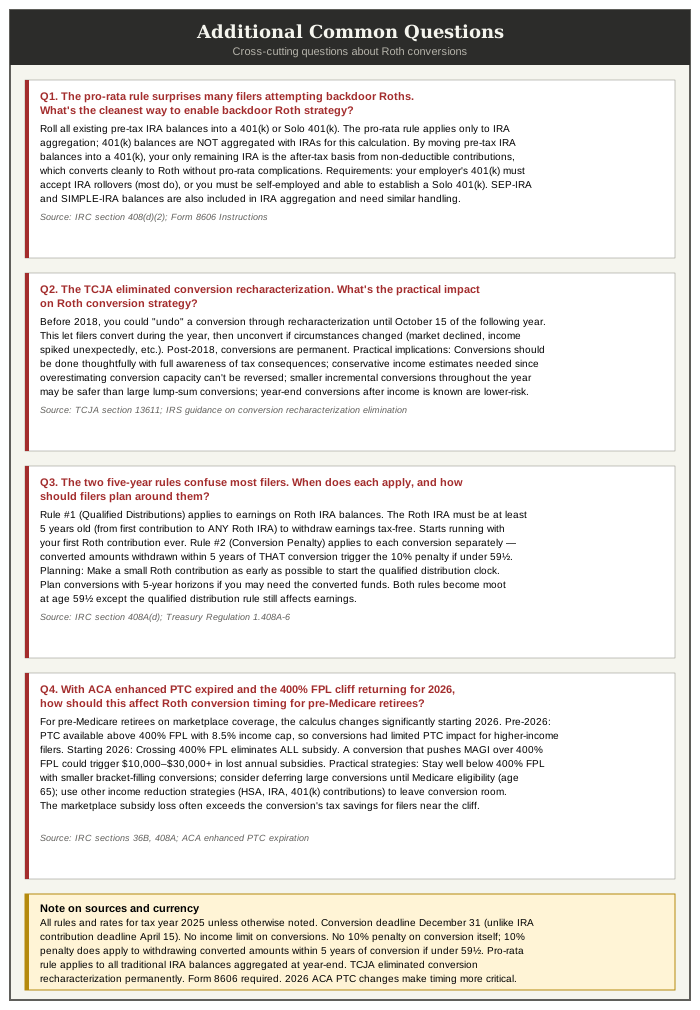
Connection to Other Lessons
The Roth Conversion lesson connects to several other lessons:
- Lesson 3 (Income) — Conversion appears as IRA distribution on Form 1040 line 4 with taxable amount on 4b.
- Lesson 4 (Adjustments) — Traditional IRA deduction (Schedule 1) interacts with later conversion decisions.
- Lesson 6 (Tax Calculation) — Conversion income affects tax bracket and may trigger AMT in rare cases.
- Lesson 8 (Other Taxes) — Conversions affect NIIT thresholds and additional Medicare tax thresholds.
- Lesson 11 (Retirees) — RMDs interact with conversion strategy; Social Security taxation thresholds affected by conversion income; Medicare IRMAA brackets affected with 2-year lookback.
- Lesson 12 (Self-Employed) — Solo 401(k) enables pro-rata workaround; SEP-IRA balances are part of pro-rata aggregation.
- Lesson 17 (International) — Conversions create taxable income that affects foreign tax credit calculations for US persons abroad with conversions.
- Lesson 18 (Major Life Changes) — Conversions in life transition years (early retirement, job loss) often make sense due to lower marginal rates.
- Lesson 20 (ACA PTC) — Conversions raise MAGI, potentially triggering 2026 cliff if PTC eligible.
What to Gather for Filers Doing Roth Conversions
For all conversions:
- Form 1099-R from custodian showing distribution
- Account statements showing pre-conversion and post-conversion balances
- Documentation of how tax was paid (external cash vs withholding)
- Prior Form 8606s (for basis tracking)
For backdoor Roth:
- Records of non-deductible contribution date and amount
- Records of conversion date and amount
- Year-end statements for ALL traditional, SEP, and SIMPLE IRAs (for pro-rata calculation)
- Documentation of any rollovers from IRAs to 401(k)s during the year
For bracket-filling conversions:
- Income projection for the year
- Tax bracket boundaries
- Calculations showing how much conversion fills the bracket without exceeding it
For multi-year conversion strategy:
- Long-term retirement income projections
- Expected RMD start date and amount
- Social Security claim date
- Medicare enrollment date
For interaction analysis:
- ACA marketplace plan information if applicable
- Medicare premium history (for IRMAA reference)
- NIIT calculations if applicable
Key Takeaways
- Roth conversions move money from pre-tax accounts to Roth, with income tax due in the conversion year — but no 10% early withdrawal penalty on the conversion itself.
- Pay conversion tax from external cash, not withheld IRA funds — withholding reduces the amount converting to Roth and triggers the 10% early withdrawal penalty if under 59½.
- The pro-rata rule aggregates all traditional, SEP, and SIMPLE IRAs — you can't isolate after-tax contributions for a clean backdoor conversion unless pre-tax balances are eliminated or rolled into a 401(k).
- Two distinct five-year rules apply: Rule #1 governs tax-free earnings (one clock per person, starting from first Roth contribution), Rule #2 imposes early withdrawal penalties on converted amounts withdrawn within 5 years (one clock per conversion year).
- Optimal conversion windows include early retirement years before RMDs and Social Security, unusually low-income years, and market downturns when the same dollar amount converts more shares.
- Roth conversions raise MAGI — before executing, model the impact on Medicare IRMAA (2-year lookback) and ACA Premium Tax Credit cliffs, which can push the effective marginal rate above 40%.
- The mega backdoor Roth strategy allows up to ~$46,500 in additional Roth contributions for employees whose 401(k) plans permit after-tax contributions and in-service distributions or in-plan conversions.
Quiz — 4 Questions
Answer one at a timeYou convert $50,000 from your traditional IRA to a Roth IRA at age 45. Which statement is correct regarding the early withdrawal penalty?