Self-Employed and Gig Workers: Career-Specific Considerations
Schedule C, business expenses, home office, vehicle deductions, QBI, estimated payments, retirement plans, and gig-worker rules
- Navigate Schedule C and report self-employment income and expenses accurately
- Identify all deductible business expenses and apply the home office and vehicle deduction rules
- Calculate depreciation and Section 179 deductions for business assets
- Understand the Qualified Business Income (QBI) deduction and whether your business qualifies
- Set up quarterly estimated tax payments to avoid underpayment penalties
- Select the right self-employed retirement plan for your situation
- Apply gig-worker-specific rules for mileage, platform income, and 1099 reporting
Introduction
Self-employed people face the most complex tax situation of any career category. Unlike W-2 employees whose tax setup is largely handled by employer withholding, self-employed people are responsible for everything — tracking income, identifying deductible expenses, making quarterly estimated payments, calculating self-employment tax, and selecting retirement plans. The complexity is also where the opportunity lies: self-employed people have access to deductions and tax-advantaged structures unavailable to W-2 employees, and proper planning can substantially reduce overall tax burden.
The foundation lessons covered the mechanics of self-employment income reporting on Form 1040 line 8 (via Schedule 1, originating from Schedule C). Lesson 4 covered the self-employed adjustments on Schedule 1 — half SE tax deduction, self-employed health insurance, and self-employed retirement contributions. Lesson 8 covered self-employment tax mechanics on Schedule SE. This lesson builds on that foundation to cover Schedule C in depth, the comprehensive list of deductible business expenses, the home office and vehicle deduction rules, depreciation and Section 179, the Qualified Business Income (QBI) deduction, quarterly estimated tax payment mechanics, retirement plan options for self-employed people, and gig-worker-specific considerations as a subset.
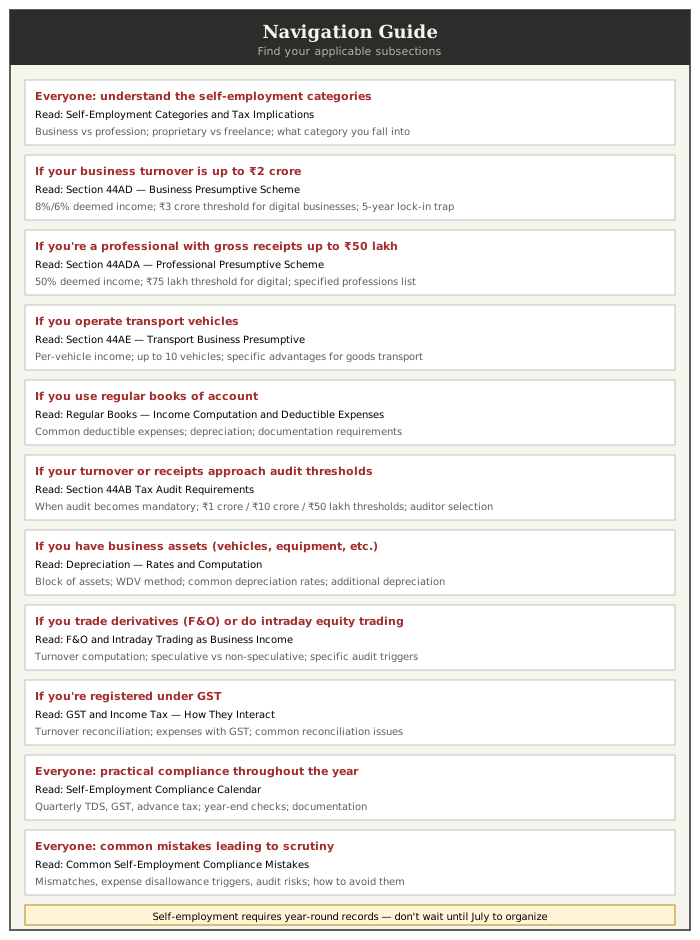
The lesson is organized so readers can skip to what applies. The first sections cover Schedule C and general self-employed concepts that all self-employed readers need. Later sections cover specific situations and the gig worker subset.
Schedule C Walkthrough
Schedule C (Profit or Loss From Business) is where sole proprietors and single-member LLCs report business income and expenses. The form has several parts that need to be filled out in sequence.
Part I — Income.
Line 1 is Gross Receipts or Sales — the total payments your business received from customers during the year. This is gross revenue before any deductions. It includes everything: payments processed through 1099-K platforms, 1099-NEC payments from clients, direct payments from customers, cash, checks, electronic transfers, and tips. The total should reconcile to your bank deposits plus any cash you didn't deposit.
If you drove for Uber and earned $20,000 gross fare income with Uber retaining $5,000 in fees, your Line 1 amount is $20,000 (gross) — not $15,000 (net). The Uber fees are then deducted as business expenses elsewhere on Schedule C.
- Line 2 is Returns and Allowances — refunds you gave customers. Most service businesses have $0 here.
- Line 3 is Line 1 minus Line 2 — your adjusted gross receipts.
- Line 4 is Cost of Goods Sold from Part III — applies to businesses that sell physical products. Service businesses leave this blank.
- Line 5 is Line 3 minus Line 4 — your gross profit.
- Line 6 is Other Income — interest from business bank accounts, recovered bad debts, and other miscellaneous business income.
- Line 7 is Line 5 plus Line 6 — Gross Income for the business.
Part II — Expenses.
Lines 8-27 list specific expense categories with subtotals. Major categories covered in detail below: car and truck expenses (Line 9), depreciation (Line 13), insurance (Line 15), legal and professional fees (Line 17), office expenses (Line 18), rent (Line 20), repairs and maintenance (Line 21), supplies (Line 22), taxes and licenses (Line 23), travel and meals (Line 24), and utilities (Line 25). Line 27a captures all other business expenses with itemization detail.
- Line 28 is Total Expenses — sum of Lines 8-27.
- Line 29 is Tentative Profit or Loss — Line 7 minus Line 28.
- Line 30 is the Home Office Deduction (from Form 8829 for the regular method or calculated directly for the simplified method).
- Line 31 is Net Profit or Loss — Line 29 minus Line 30. This is the key number that flows to Schedule 1 Part I, then to Form 1040 line 8, and also to Schedule SE for self-employment tax calculation.
Part III — Cost of Goods Sold. Only for businesses selling physical products. Calculates beginning inventory + purchases - ending inventory = COGS.
Part IV — Information on Your Vehicle. Only if you didn't use Form 4562 to claim vehicle expenses. Captures vehicle business use percentage and other vehicle data.
Part V — Other Expenses. Detailed itemization of expenses claimed on Line 27a.
Business Expenses — What's Deductible
Business expenses must be "ordinary and necessary" to be deductible. Ordinary means common and accepted in your trade or business. Necessary means helpful and appropriate. Personal expenses are not deductible even if loosely related to business.
The major deductible business expenses on Schedule C:
- Advertising (Line 8). Online ads, social media advertising, business cards, signage, website design and hosting, promotional materials.
- Car and truck expenses (Line 9). Covered in detail in the Vehicle Expenses section below.
- Commissions and fees (Line 10). Payment processor fees (Stripe, Square, PayPal), platform fees taken by Uber/DoorDash/etc., affiliate commissions you pay.
- Contract labor (Line 11). Payments to independent contractors. Issue 1099-NEC to any contractor you paid $2,000 or more for 2026 (the threshold increased from $600 under OBBBA, retroactive to 2026 payments — though states may have lower thresholds). The 2025 threshold remains $600.
- Depreciation (Line 13). Covered in detail in the Depreciation and Section 179 section below.
- Employee benefit programs (Line 14). Only if you have employees. Self-employed health insurance for yourself isn't here — it's an above-the-line deduction on Schedule 1 (covered in Lesson 4).
- Insurance other than health (Line 15). Business liability insurance, professional liability/malpractice insurance, business property insurance, errors and omissions insurance, cyber liability.
- Interest (Line 16). Interest on business loans, business credit cards, equipment financing. Mortgage interest on business property goes on Line 16a.
- Legal and professional services (Line 17). Attorney fees, accountant fees, bookkeeping services, business consulting. Tax preparation fees for the business portion of your return are deductible here.
- Office expense (Line 18). Stationery, postage, printer ink, small office supplies that aren't capital equipment. Computer software with useful life of one year or less is here.
- Pension and profit-sharing plans (Line 19). Only for employee retirement plans. Your own retirement contributions go on Schedule 1 line 16 (covered separately).
- Rent or lease — vehicles, machinery, equipment (Line 20a) and other business property (Line 20b). Office rent, equipment leases, vehicle leases (for business-use portion).
- Repairs and maintenance (Line 21). Routine maintenance of equipment and business property. Major improvements that extend useful life are depreciated instead.
- Supplies (Line 22). Consumable items used in the business — different from inventory (which is COGS). Includes things used up in operations.
- Taxes and licenses (Line 23). Business licenses, business property tax, state and local business taxes, sales tax remitted (if collected from customers), payroll taxes for employees. Federal income tax, federal SE tax, and personal property taxes go elsewhere.
- Travel (Line 24a). Business travel including airfare, hotels, ground transportation, and related expenses. Travel to and from your home and your primary workplace is commuting and not deductible.
- Meals (Line 24b). Meals while traveling for business or with business clients/contacts. The deduction is 50% of qualifying meal expenses. Provide a business purpose for each meal in your records.
- Utilities (Line 25). Electricity, gas, water, business phone (separate business line is fully deductible; personal phone used for business is partially deductible based on business use percentage), internet (similarly proportional if shared with personal use).
- Wages (Line 26). Wages paid to W-2 employees. Your own draws from the business are NOT wages and not deductible — they're how you receive your profit, not a business expense.
- Other expenses (Line 27a + Part V). Anything that doesn't fit the named categories. Examples: bank fees, business meals not at restaurants, continuing education, dues and subscriptions, gifts (limited to $25 per recipient per year), uniforms and protective gear if not suitable for general wear.
Personal expenses. Commuting between home and primary workplace. Clothing suitable for general wear (even if used for work). Fines and penalties paid to government. Personal political contributions. Health club memberships unless required for specific business reasons. Life insurance premiums for personal coverage.
Home Office Deduction
Read this if you use part of your home regularly and exclusively for business.
The home office deduction is available to self-employed people who use a portion of their home regularly and exclusively for business. W-2 employees cannot take the home office deduction after TCJA (made permanent by OBBBA) regardless of whether they work from home.
Eligibility — the regular and exclusive use test. The space must be used regularly (not just occasionally) AND exclusively (only for business, not also for personal purposes) for business. A spare bedroom used only as your business office qualifies. A kitchen table where you sometimes work and sometimes eat doesn't qualify. The exclusive use requirement is strict — even occasional personal use of the space generally disqualifies it.
Principal place of business test. The home office must be your principal place of business OR a place where you regularly meet clients OR a separate structure used in connection with your business. If you have an outside office where you primarily work, your home office probably doesn't qualify unless used substantially for administrative or management work.
Two calculation methods. You can choose either method each year:
- Simplified method. $5 per square foot of home office space, up to 300 square feet maximum. Maximum deduction is $1,500. Simple to calculate — no allocation of home expenses needed. No depreciation recapture when you sell the home (a significant benefit). Caps out at $1,500 regardless of actual expenses.
- Regular method. Calculate the percentage of your home used for business (office square footage divided by total home square footage). Multiply that percentage by actual home expenses (mortgage interest, property tax, utilities, insurance, repairs, depreciation). The deduction can be larger than the simplified method, especially for high-cost homes. Requires more record-keeping. Subject to depreciation recapture when you sell.
Choosing between methods. The regular method typically produces a larger deduction for filers with substantial home expenses (over $5/sqft of business space) or larger office space (over 300 sqft). The simplified method is easier and avoids the depreciation recapture issue when selling. Many filers run both calculations and choose the better one each year.
Form 8829 (Regular Method). Detailed calculation of business-use percentage applied to home expenses. The result flows to Schedule C line 30.
Limitations. The home office deduction cannot create or increase a loss from your business. If your business income (before home office) is $5,000 and your calculated home office expense is $8,000, you can only deduct $5,000 in the current year. The unused $3,000 carries forward to future years (only for the regular method; the simplified method's $1,500 cap doesn't carry over).
Depreciation recapture when selling. Under the regular method, you depreciate the business portion of your home each year. When you sell, the accumulated depreciation gets recaptured (taxed at up to 25% rate). The home sale exclusion (covered in Lesson 11) doesn't apply to the business-use portion in some situations. The simplified method avoids this issue.
Working from home occasionally isn't enough — you need regular and exclusive use of dedicated space. A laptop on the kitchen counter doesn't create a home office deduction. Multiple businesses operated from the same home space don't multiply the deduction.
Sourcing. IRS Publication 587 (Business Use of Your Home); Form 8829 Instructions; IRC section 280A.
Vehicle Expenses
Read this if you use a vehicle for business.
Vehicle expenses are often the largest deduction for self-employed people who drive for business. The rules apply equally to rideshare drivers, delivery drivers, contractors visiting job sites, salespeople driving to clients, and anyone else who uses a vehicle for business purposes.
Two methods, must choose one per vehicle.
- Standard mileage method. Multiply business miles driven by the IRS standard mileage rate. For 2025, the rate is 70 cents per mile (up from 67 cents in 2024; 72.5 cents projected for 2026). This rate covers gas, insurance, maintenance, depreciation, and routine wear and tear — you don't deduct these separately when using the standard mileage rate. You can still deduct parking and tolls separately.
- Actual expense method. Deduct actual costs for the business-use percentage of the vehicle. Track all expenses: gas, insurance, registration, maintenance, repairs, depreciation, lease payments, parking, tolls. Multiply total expenses by your business use percentage to get the deductible amount.
Choosing between methods. Generally, the standard mileage method is simpler and often produces a larger deduction for fuel-efficient vehicles driven many miles. The actual expense method may produce a larger deduction for expensive vehicles, vehicles with high maintenance costs, or vehicles that are heavily used for business and lightly for personal.
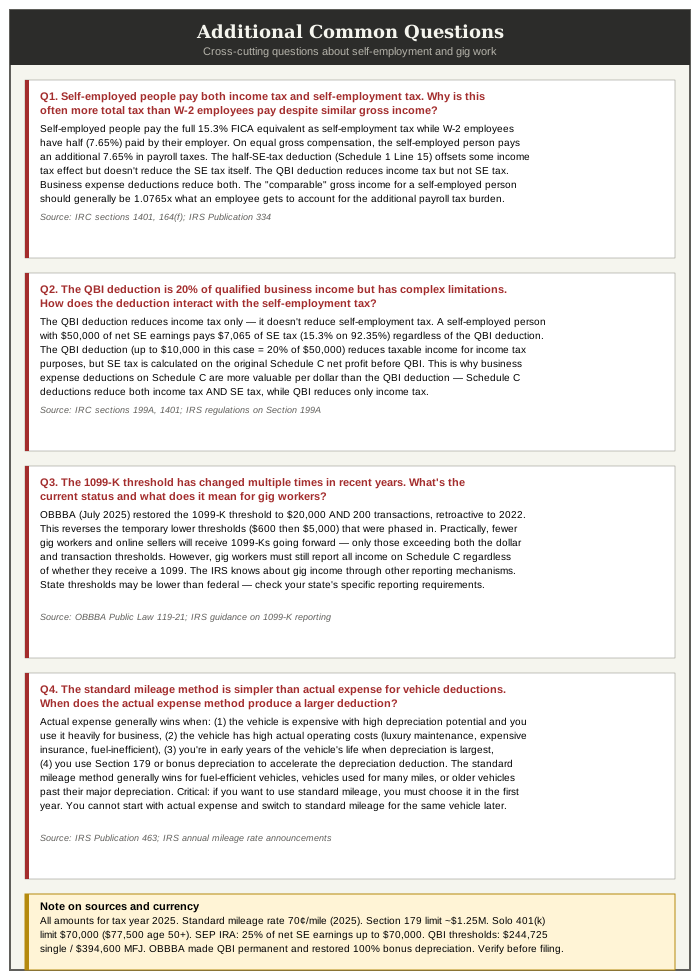
If you want to use the standard mileage method, you must choose it in the FIRST year you use the vehicle for business. You can switch to actual expense in later years if you started with standard mileage. But you cannot start with actual expense and later switch to standard mileage for that vehicle. This first-year decision is permanent.
Mileage tracking requirements. The IRS requires "contemporaneous records" — meaning records kept throughout the year, not reconstructed at tax time. For each business trip, record:
- Date
- Starting and ending locations
- Business purpose
- Miles driven
Mileage tracking apps (Stride, Everlance, MileIQ, Hurdlr, Gridwise) automate this and meet IRS documentation standards. Reconstructed annual estimates are challengeable in audit.
Business miles versus personal miles. Only business miles count. Common business miles:
- Driving to client meetings or job sites
- Driving between business locations
- Delivery driving (active delivery time)
- Rideshare driving (online and available, plus passenger-carrying miles)
- Business errands
Personal miles include commuting to your primary workplace, personal errands, family drives, and any non-business driving.
Commuting versus business driving. The first trip from home each day to your primary workplace and the last trip from your primary workplace home are commuting (not deductible). Other trips during the day to other business locations are deductible. For people whose home is their principal place of business (legitimate home office), all business-related driving from home qualifies.
Vehicle depreciation under actual expense method. Under actual expense, you depreciate the business portion of the vehicle over the recovery period (typically 5 years for cars). Section 179 expensing and bonus depreciation can accelerate this (covered below). Vehicle depreciation has additional limits beyond regular property — luxury auto limits cap annual depreciation for higher-cost vehicles.
Lease payments. Lease payments on a vehicle used for business are deductible (under actual expense method) based on the business use percentage. An "inclusion amount" reduces the deduction slightly for higher-cost leased vehicles.
OBBBA QPVLI deduction for vehicle loan interest. This is separate from the vehicle expense deduction — covered in Lesson 4 on Schedule 1-A. The QPVLI deduction is for personal car loan interest on new US-assembled vehicles ($10,000 cap). Business vehicle interest goes on Schedule C as a business expense for the business use portion. If a vehicle is used for both personal and business, allocate accordingly.
Sourcing. IRS Publication 463 (Travel, Gift, and Car Expenses); Schedule C Instructions; IRS announcements on annual mileage rates.
Depreciation and Section 179
Read this if you purchased equipment, vehicles, or other long-lived assets for your business.
Assets that will last more than one year (typically equipment, vehicles, furniture, computers, machinery) are generally depreciated over their useful life rather than expensed immediately. Several provisions allow accelerated or immediate deduction.
Regular depreciation. Spreads the cost of the asset over its IRS-determined useful life (called "recovery period"). For most equipment, the recovery period is 5 or 7 years. The MACRS (Modified Accelerated Cost Recovery System) determines annual depreciation amounts. Form 4562 calculates depreciation.
Section 179 expensing. Lets you deduct the full cost of qualifying assets in the year of purchase, up to a dollar limit. For 2025, the Section 179 limit is approximately $1.25 million with a phase-out for businesses placing more than approximately $3.13 million of assets in service. The limit is also capped at your business income — Section 179 can't create a loss.
Bonus depreciation under OBBBA. OBBBA restored 100% bonus depreciation for qualifying property acquired after January 19, 2025. Before OBBBA, bonus depreciation was phasing down (60% for 2024, scheduled to be 40% for 2025). The OBBBA restoration means new and used property can be fully expensed in the year placed in service for tax years 2025 and forward. This is a major change for self-employed people purchasing equipment or vehicles.
Section 179 vs bonus depreciation. Both allow immediate expensing, but they have different rules:
- Section 179 is limited by business income; bonus depreciation can create losses
- Section 179 has a phase-out at higher asset levels; bonus depreciation doesn't
- Section 179 lets you choose which assets to expense; bonus depreciation applies automatically unless you elect out
- Both are mutually exclusive on the same asset — you choose one approach per asset
Listed property restrictions. Vehicles, certain computers, and some other "listed property" have stricter requirements. To use Section 179 or bonus depreciation on a vehicle, the vehicle must be used more than 50% for business. Vehicles used 50% or less for business must use straight-line depreciation only.
Luxury auto limits. Passenger vehicles have annual depreciation limits regardless of method. For 2025, the first-year limit for a passenger vehicle is approximately $20,200 (with bonus depreciation). These limits cap accelerated depreciation on expensive vehicles. Trucks and vans with gross vehicle weight rating (GVWR) over 6,000 pounds are exempt from these limits — explaining why business-use SUVs and trucks are popular among small business owners.
De minimis safe harbor. Items costing $2,500 or less per item (or $5,000 if you have audited financial statements) can be expensed immediately as supplies rather than depreciated, regardless of useful life. This safe harbor avoids depreciation calculations for routine equipment purchases. You must make this election on your tax return.
When you sell a depreciated asset, the prior depreciation is "recaptured" at ordinary income rates (rather than capital gains rates), up to the amount of depreciation taken. This applies to all depreciation methods — Section 179, bonus, and regular MACRS.
Sourcing. IRS Publication 946 (How to Depreciate Property); Form 4562 Instructions; IRC sections 167, 168, 179.
Qualified Business Income (QBI) Deduction
Read this if you have any qualifying business income from a sole proprietorship, partnership, S-corporation, or qualifying rental activity.
The QBI deduction (Section 199A) allows eligible self-employed people and small business owners to deduct up to 20% of their qualified business income. OBBBA made this deduction permanent — it had been scheduled to expire after 2025.
Basic mechanics. The deduction equals 20% of qualified business income (with various limitations). For a sole proprietor with $50,000 of net Schedule C profit, the deduction could be up to $10,000 (20% of $50,000) — reducing federal taxable income by $10,000.
Where it flows. The QBI deduction goes on Form 1040 line 13a. It doesn't reduce AGI (it's below-the-line) but it reduces taxable income, which means it reduces your tax bracket-based income tax. It does NOT reduce self-employment tax — the QBI deduction is for income tax only.
Forms used. Form 8995 (simplified) if your taxable income is below the threshold ($244,725 single / $394,600 MFJ for 2025). Form 8995-A (complex) for income above the threshold or for specified service trades or businesses.
Specified Service Trades or Businesses (SSTBs). Certain professional services are limited. SSTB categories include:
- Health (doctors, dentists, veterinarians, etc.)
- Law (lawyers)
- Accounting (accountants, enrolled agents)
- Actuarial science
- Performing arts
- Consulting
- Athletics
- Financial services (including financial advisors)
- Brokerage services
- Investment management
- Any trade where the principal asset is the reputation or skill of one or more employees
If you're an SSTB, your QBI deduction phases out as your taxable income increases above the threshold and is fully eliminated above the upper phase-out limit.
Non-SSTB businesses. For non-SSTB businesses (manufacturing, retail, construction, restaurants, most service businesses that aren't on the SSTB list), the QBI deduction is available regardless of income level, though the calculation becomes more complex above the threshold (involves wages paid and unadjusted basis of qualified property).
Income thresholds for 2025. Phase-out begins at taxable income of $244,725 single / $394,600 MFJ. Phase-out completes at $294,725 single / $494,600 MFJ. SSTBs lose the deduction entirely above the upper limit; non-SSTBs have wage and basis limitations applied.
What counts as QBI. Net business income from qualifying activities. Generally excluded: investment income, wages from your S-corp paid to yourself, guaranteed payments from a partnership, capital gains/losses, dividends, foreign income.
Rental real estate. Rental activities can qualify for QBI deduction if they rise to the level of a trade or business (250+ hours of rental services per year is a safe harbor). Triple-net leases generally don't qualify.
Decision points. Whether your business is an SSTB. Whether you're below, near, or above the income thresholds (which affects calculation complexity). For S-corp owners, the wage you pay yourself affects both the QBI calculation and the overall tax efficiency of S-corp election.
Sourcing. IRS Publication 535 historical; IRC section 199A; Form 8995 and 8995-A Instructions; IRS final regulations on Section 199A.
Self-Employed Retirement Plans
Read this if you want to save for retirement through tax-advantaged accounts as a self-employed person.
Self-employed people have access to retirement plan options that can shelter substantially more income than the IRA limits available to W-2 employees. The deduction for these contributions goes on Schedule 1 line 16 (covered in Lesson 4).
SEP IRA (Simplified Employee Pension). Easy to set up and administer. Contribution limit is 25% of net self-employment earnings (after the half-SE-tax deduction), capped at $70,000 for 2025. For a sole proprietor with $100,000 of Schedule C net profit (roughly $50,000 of allowed contribution after the adjustments). No catch-up provision. If you have employees, you must contribute the same percentage for them as for yourself.
SIMPLE IRA. For businesses with up to 100 employees. Contribution limit is $16,500 (employee portion) plus employer match for 2025. Catch-up of $3,500 if 50+. Less common for sole proprietors than SEPs or Solo 401(k)s because of the lower contribution limits.
Solo 401(k) (Individual 401(k)). For self-employed people with no employees other than a spouse. Has two contribution components:
- Employee elective deferral: $23,500 for 2025 (or 100% of net SE earnings if less); additional $7,500 catch-up if 50+
- Employer profit-sharing: up to 25% of net self-employment earnings
Combined total cap is $70,000 for 2025 ($77,500 with catch-up at 50+). Solo 401(k) allows the highest contributions of any plan for self-employed people with moderate income because the employee elective deferral is a flat amount rather than a percentage. A self-employed person with $30,000 of net earnings could contribute $23,500 employee + about $5,500 employer = $29,000 to a Solo 401(k), compared to maybe $5,500 to a SEP at the same income level.
Solo 401(k) Roth option. Solo 401(k) plans can offer Roth (after-tax) employee deferrals. Recent rule changes also allow Roth employer contributions in some plans.
Comparison. For self-employed people without other employees:
- Income under $50,000: Solo 401(k) usually best (max contribution from employee elective deferral)
- Income $50,000-$200,000: Solo 401(k) usually best (combination of employee + employer)
- Income over $200,000: Difference narrows; choose based on administrative preferences
Plan setup deadlines. SEP IRAs can be established and funded as late as the tax filing deadline (including extensions) for the year. Solo 401(k) plans must be established by December 31 of the tax year for which contributions are claimed (under SECURE Act 2.0, some flexibility exists for solo 401(k) employer contributions). SIMPLE IRAs must be established by October 1.
Deduction location. Contributions go on Schedule 1 line 16 — above-the-line deduction reducing AGI.
Sourcing. IRS Publication 560 (Retirement Plans for Small Business); IRS Publication 590-A; IRC sections 408(k), 408(p), 401(k).
Self-Employed Health Insurance
Read this if you pay for your own health insurance and are self-employed.
Self-employed health insurance is one of the most valuable above-the-line deductions for self-employed people. Lesson 4 covered the basics; this section adds self-employed-specific context.
Eligibility. Self-employed people with net earnings from self-employment can deduct health insurance premiums for themselves, their spouse, and their dependents. The plan can be:
- Marketplace (ACA) plan you purchased
- Plan purchased through a private insurer
- Continuation coverage (COBRA) from a former employer
- Medicare Part B premiums (yes, Medicare counts as self-employed health insurance for self-employed people)
- Long-term care insurance (subject to age-based limits)
The deduction. Premiums paid are deductible as an adjustment to income on Schedule 1 line 17. This is above-the-line, reducing both AGI and taxable income.
Limitation to business income. The deduction can't exceed the net profit from your self-employment activity. If your business has a $5,000 loss, you can't deduct $8,000 of health insurance premiums against your business — though the unused portion may be deductible on Schedule A as a medical expense if you itemize and exceed the 7.5% AGI floor.
You can't claim the deduction for any month you were eligible to participate in your spouse's employer-sponsored health plan. Even if you choose not to enroll in the spouse's plan, eligibility disqualifies you.
Coordination with ACA Premium Tax Credit. If you got ACA Premium Tax Credit, the self-employed health insurance deduction interacts in complex ways with the PTC calculation. Generally, the deduction reduces your AGI, which affects your PTC eligibility, creating a circular calculation. The IRS has a specific worksheet (in Publication 974 or as part of tax software) to resolve this.
Why it's above-the-line. Unlike most health insurance premiums (which are deductible only as itemized medical expenses subject to 7.5% AGI floor), the self-employed health insurance deduction is above-the-line. This makes it much more valuable per dollar — you get the full deduction regardless of itemizing, and it reduces AGI which helps with other tax provisions.
Sourcing. IRS Publication 535; IRC section 162(l); Self-Employed Health Insurance Deduction Worksheet in Form 1040 Instructions.
Quarterly Estimated Tax Payments
Read this if you have self-employment income — most self-employed people need to make these payments.
Self-employed people don't have employer withholding to cover their tax obligations. Instead, the IRS requires quarterly estimated tax payments to ensure taxes are paid throughout the year (the "pay as you go" system).
Who needs to make estimated payments. Generally anyone expecting to owe $1,000 or more in federal tax for the year after withholding and refundable credits. Most self-employed people meet this threshold once their business reaches modest income levels.
The four quarterly deadlines. April 15, June 15, September 15, and January 15 of the following year. Each payment covers the prior period's tax obligation.
How to calculate quarterly amounts. Several methods:
- Method 1: Safe harbor of 100% of prior year tax (110% if prior year AGI was over $150,000). Divide your prior year total tax by 4 and pay that amount each quarter. This guarantees no underpayment penalty regardless of current year tax. Simple and protective.
- Method 2: 90% of current year tax. If you can estimate current year tax accurately, divide by 4 and pay quarterly. Riskier if income varies but pays only what's needed.
- Method 3: Annualized income method. For income that varies seasonally, you can pay based on actual income through each quarter. More complex but matches payments to income timing.
- Method 4: Adjust as the year progresses. Start with the safe harbor amount, then adjust later quarters if income changes significantly. The IRS doesn't care which method you use as long as you meet the safe harbor.
Where to pay. Several options:
- IRS Direct Pay (irs.gov/payments) — free, links to your bank account
- EFTPS (Electronic Federal Tax Payment System) — requires enrollment, free
- Credit/debit card via approved processors — fees apply
- Check with Form 1040-ES voucher mailed to IRS
State estimated payments. Most states with income tax also require quarterly estimated payments. State deadlines often match federal but not always. Check your state's requirements.
Quarterly estimated payments should cover both income tax AND self-employment tax. The 15.3% SE tax on $50,000 of net earnings is $7,500 — substantial enough that ignoring it would create big balance dues at filing time.
Decision points. Whether to use the safe harbor (simple, certain) or to estimate current year more precisely. Whether to pay equal amounts each quarter or to vary based on actual income (the annualized method). How to coordinate payments if income is highly seasonal.
The underpayment penalty. If you don't meet the safe harbor and don't pay enough, the IRS assesses an underpayment penalty (covered in Lesson 9). The penalty is calculated quarterly, so paying more in Q4 doesn't compensate for underpaying in Q1.
Sourcing. IRS Publication 505 (Tax Withholding and Estimated Tax); Form 1040-ES Instructions; IRC section 6654.
Gig Workers (Subset of Self-Employed)
Read this if you work as a rideshare driver (Uber, Lyft), delivery driver (DoorDash, Instacart, Uber Eats, Grubhub), task worker (TaskRabbit, Handy), freelance platform worker (Upwork, Fiverr, Toptal), or similar platform-based gig.
Gig workers are self-employed for tax purposes, so all the foundation sections above apply. This subset adds gig-specific considerations.
You're self-employed even if you don't feel like it. Gig platforms classify their workers as independent contractors (1099 status) rather than W-2 employees. This means you're a self-employed business owner running a small business — even if your business is just yourself driving rides or delivering food. You file Schedule C, pay SE tax, can deduct business expenses, and qualify for self-employed retirement plans and the QBI deduction.
1099-K threshold restored by OBBBA. OBBBA restored the 1099-K reporting threshold to $20,000 AND 200 transactions (retroactive to 2022). Under the temporarily lower thresholds (which were $600 then $5,000), many gig workers received 1099-Ks even for modest earnings. Under the restored threshold, fewer gig workers will receive 1099-Ks.
This is the most important point for gig workers. The 1099-K and 1099-NEC are reporting mechanisms — they don't define what's taxable. You must report all gross business income on Schedule C Line 1, whether you received any 1099s or not. The IRS knows about platform income through other channels even when 1099s aren't issued.
1099-K versus 1099-NEC distinction for gig platforms.
- 1099-K reports payments processed through the platform's payment system. For rideshare drivers, this is the gross fare income from rides (what passengers paid, before the platform's fees are deducted).
- 1099-NEC reports non-payment-processed income like referral bonuses, sign-on bonuses, promotional payments, and incentives. Generally issued at $600 threshold ($2,000 for 2026 payments under OBBBA).
You may receive one, both, or neither depending on your earnings. Both are forms of business income reported on Schedule C Line 1.
Platform fees as a major expense. The 1099-K reports gross income — the full amount passengers paid or customers spent. The platform took a substantial fee before paying you. Those fees are deductible business expenses on Schedule C Line 10 (Commissions and fees). For a driver who received $20,000 gross fares from a platform that took $5,000 in fees, you report $20,000 of income on Line 1 and $5,000 of expense on Line 10 — netting to $15,000 of business income.
Mileage tracking is critical. For rideshare and delivery drivers, the mileage deduction is typically the largest business deduction. A driver who drives 30,000 business miles in 2025 can deduct $21,000 (30,000 × $0.70 per mile under the standard mileage method). This often exceeds the gross income, creating a small or negative net business income.
What miles count for gig drivers.
- Rideshare: miles online and available, miles to pick up a passenger, miles with passenger, and between rides while still online
- Delivery: miles online and available, miles to pickup, miles to dropoff, between active deliveries
- All require contemporaneous tracking — not estimates at year-end
Most platforms provide year-end mileage summaries (Uber's Tax Summary, DoorDash's annual summary, etc.). These typically only show miles WITH PASSENGER or ACTIVE DELIVERY — missing the substantial mileage online and available, plus to-pickup miles. Your own tracking app (Stride, Everlance, MileIQ, Hurdlr, Gridwise) captures all qualifying mileage and produces a larger, more accurate deduction.
Common gig deductions beyond mileage.
- Phone and data plan business-use portion
- Vehicle accessories specifically for gig work (phone mount, dash cam, snacks/water for passengers, USB chargers offered to passengers)
- Insurance riders for rideshare/delivery (regular auto insurance doesn't cover gig work)
- Car washes and detailing if maintaining vehicle condition is important for business
- Tolls and parking during gig work
- Platform-required materials (insulated bags for delivery, signs, etc.)
Multi-platform gig workers. Many gig workers work multiple platforms (Uber + Lyft, or DoorDash + Uber Eats + Grubhub simultaneously). All income from all platforms goes on a single Schedule C since it's all the same business (transportation/delivery services). Track expenses across all platforms collectively. Mileage tracking apps handle this automatically when you mark trips as business.
Tips as income. Tips received through platforms are income and reported on the 1099-K or platform records. Cash tips not processed through the platform are still taxable income — report them as additional income on Schedule C even though no form documents them. The OBBBA no-tax-on-tips deduction generally doesn't apply to gig workers since the deduction is for W-2 tipped occupations on the Treasury Tip Occupation Code list — most gig delivery/driving isn't on that list.
Gig workers without W-2 income elsewhere typically need to make quarterly estimated payments. Many gig workers don't realize this and face large balance dues plus underpayment penalties at filing time. The 15.3% SE tax alone on $30,000 of net earnings is $4,590 — substantial enough to require estimated payments.
Self-employed retirement options for gig workers. Even modest gig earnings can support a Solo 401(k) or SEP IRA. A driver netting $25,000 from gig work could contribute to retirement, getting the deduction now while building long-term savings. Many gig workers don't realize they have access to better retirement options than IRAs alone.
Health insurance. Gig workers who don't have spousal employer coverage typically purchase ACA Marketplace plans. Premiums paid are self-employed health insurance deductible (covered above). ACA Premium Tax Credit may apply for lower income gig workers.
State and local issues. Some states (California with AB5, others) have legislation classifying some gig workers as employees rather than contractors. The IRS classification (independent contractor) generally controls for federal tax purposes regardless of state legislation. Some platforms have implemented different worker classifications in different states.
Sourcing. IRS Sharing Economy Tax Center; IRS Publication 535; IRS Publication 463; Schedule C Instructions; platform-specific year-end tax summaries.
Business Entity Considerations
Read this if you're operating as something other than a sole proprietor — LLC, S-corp, partnership.
The business entity you operate under affects how you report income and pay taxes. Most self-employed individuals start as sole proprietors and may transition to other structures as the business grows.
- Sole Proprietorship. The default for individual self-employed people. Income on Schedule C, SE tax on Schedule SE. Simple — no separate business tax return.
- Single-Member LLC (SMLLC). State legal status but federal tax default is sole proprietorship treatment ("disregarded entity"). File the same Schedule C as a sole proprietor. The LLC provides liability protection but no federal tax benefit beyond that. Many self-employed people form SMLLCs purely for liability protection while reporting taxes identically to sole proprietors.
- Multi-Member LLC. Default federal tax treatment is partnership (Form 1065). Each partner gets a K-1 reporting their share of income. The K-1 income flows to Schedule E of each partner's individual return. SE tax may or may not apply depending on the partner's role (active vs passive).
- S-Corporation. Tax election available to LLCs and other entities. The business files Form 1120-S; owners receive K-1s. The major potential benefit: you can pay yourself a reasonable W-2 salary AND take additional profits as distributions that don't get hit with self-employment tax. For high-earning self-employed people, this can save substantial SE tax. Requires reasonable compensation analysis to avoid IRS challenge.
- C-Corporation. Separate tax entity paying corporate income tax (currently 21% flat rate). Rare for individual self-employed people because of double taxation (corporate tax plus shareholder dividend tax). Used in specific situations like seeking outside investment.
S-Corp election worth considering when net SE earnings exceed approximately $50,000-$75,000. Below this level, the administrative cost of S-corp (separate return, payroll setup, reasonable compensation analysis) usually outweighs the SE tax savings. Above this level, the math often favors S-corp election.
The S-corp reasonable compensation issue. You must pay yourself a reasonable W-2 salary for services performed. Setting wages too low to maximize distributions is an IRS focus area and can lead to reclassification and penalties. The reasonable amount depends on industry, role, location, and other factors.
State entity considerations. State filing fees and franchise taxes vary widely. California has high franchise taxes ($800 minimum). Other states are more business-friendly. Some considerations for entity selection are state-specific.
Sourcing. IRS publications on entity types; IRC sections on partnerships, S-corps, and C-corps; state-specific entity rules.
Business Losses and Hobby Loss Rules
Read this if your business activity has a loss for the year or has had losses for multiple years.
A genuine business loss reduces your other income. A "hobby" that loses money doesn't.
Genuine business losses. If your business has more expenses than income, the loss flows from Schedule C to Schedule 1 Line 3 (negative amount), then to Form 1040 Line 8. The loss reduces your total income, potentially producing a refund if other income (wages, etc.) is offset.
Net Operating Loss (NOL). If business losses exceed all your other income, you may have an NOL that can be carried forward to future years to offset future income. NOL rules have changed multiple times; current law generally allows indefinite carryforward but caps the offset at 80% of taxable income.
Hobby loss rules — the key threat. If the IRS determines your activity is a hobby rather than a business, your "income" is taxable but your "expenses" aren't deductible. The hobby is taxed at full income with no offsetting deductions.
The 9-factor test for hobby vs business. The IRS considers multiple factors to determine if you're operating a genuine business:
- The manner in which you carry on the activity (business-like records, separate accounts, etc.)
- Your expertise or the expertise of advisors
- Time and effort devoted to the activity
- Expectation that assets will appreciate
- Your success in similar activities
- History of income or loss
- Amount of occasional profits
- Your financial status
- Personal pleasure or recreation
Safe harbor presumption. Activities that show profit in 3 of any 5 consecutive years (2 of 7 for horse breeding/training) are presumed to be businesses. The IRS can still challenge but bears the burden.
Common hobby-loss scrutiny areas. Horse activities, photography, art, writing, fishing, antique dealing, multi-level marketing distributorships, and similar activities that combine personal pleasure with claimed business purposes are scrutinized.
Indicators of business intent. Separate business bank account. Business records and accounting. Marketing and advertising effort. Time devoted. Pricing for profit (not just covering costs). Operating businesslike practices.
Decision points. Whether your activity has business characteristics or hobby characteristics. How to strengthen the business case if challenged. Whether to abandon an activity that's clearly a hobby for tax purposes (continuing as a hobby is fine personally — you just can't deduct losses).
Sourcing. IRC section 183; IRS Publication 535; relevant tax court cases.
Paying Others — 1099-NEC and Payroll
Read this if you pay contractors or have employees in your business.
When your business pays others, you have information reporting and possibly employment tax obligations.
1099-NEC for contractors. If you pay a contractor (non-employee) $2,000 or more for services in 2026 (the threshold increased from $600 under OBBBA, retroactive for payments in 2026), you must issue them a 1099-NEC. For 2025 payments, the threshold remains at $600.
Information required. Get Form W-9 from contractors before paying them. The W-9 provides their name, address, and TIN (SSN or EIN) needed to issue the 1099-NEC.
Deadlines. 1099-NECs must be sent to recipients and filed with IRS by January 31 of the following year.
Penalties for non-filing. Significant penalties apply for failing to issue required 1099s or filing late. Penalties scale with size of failure and timing.
Backup withholding. If a contractor doesn't provide a W-9 with their TIN, you may be required to withhold 24% backup withholding from payments and remit to IRS.
1099-MISC for other payments. Rent, royalties, prizes, and certain other payments are reported on 1099-MISC (not 1099-NEC). The $600 threshold applies for these.
Hiring employees vs contractors. Significant tax and legal implications:
- Employees: W-2, withhold federal/state taxes, pay employer FICA (7.65%), pay federal/state unemployment tax, workers' comp insurance, potentially benefits
- Contractors: 1099-NEC at year-end, no withholding, no employer FICA, no benefits
The IRS has a multi-factor test (control test) for determining proper classification. Misclassifying employees as contractors creates substantial liability if discovered.
Payroll for employees. Setting up payroll involves federal/state EIN registration, payroll service or software, regular tax deposits (federal Form 941 quarterly, state requirements vary), W-2 issuance, and various other compliance items. Most small businesses use payroll services (Gusto, ADP, QuickBooks Payroll) to handle these obligations.
Hiring your spouse or children. Special rules apply:
- Spouse on payroll creates employee benefits eligibility but adds payroll complexity
- Children under 18 hired by their parent's sole proprietorship are exempt from federal payroll taxes (FICA, FUTA)
- Hiring children creates valid business deductions for legitimate work (cleaning, basic office work) at reasonable wages
Sourcing. IRS Publication 15 (Employer's Tax Guide); IRS Publication 1779 (Employee or Independent Contractor?); Form W-9, 1099-NEC, 1099-MISC instructions; Form SS-8 for classification disputes.
Connection to Other Lessons
The self-employed lesson assumes the foundation lessons are in place. Specific lessons most relevant to self-employed readers:
- Lesson 3 (Income) covered the mechanics of how Schedule C net profit flows to Schedule 1 then to Form 1040 line 8.
- Lesson 4 (Adjustments) covered the self-employed adjustments on Schedule 1: half-SE-tax deduction, self-employed health insurance, and self-employed retirement contributions. This lesson built on those by covering the underlying business expense and retirement plan mechanics in depth.
- Lesson 6 (Tax calculation) applied to self-employed people the same as W-2 employees. The QBI deduction reduces taxable income before tax calculation.
- Lesson 8 (Other taxes) covered self-employment tax mechanics on Schedule SE in detail.
- Lesson 9 (Payments) covered the quarterly estimated tax requirement that's most relevant to self-employed people without W-2 withholding.
What to Gather for Self-Employed Returns
Records of all business income: bank deposit records, platform 1099-Ks if received, 1099-NECs from clients, cash income tracking, and reconciliation between bank deposits and reported income.
- Records of all business expenses by category: receipts, invoices, credit card statements with business expenses identified, payment confirmations. Categories matching Schedule C lines for easier preparation.
- Mileage log if claiming vehicle expense via standard mileage method, or vehicle expense records and total mileage if using actual expense method.
- Home office details if claiming: total home square footage, business-use square footage, home expense records (mortgage/rent, utilities, insurance, repairs), purchase price and depreciation history.
- Records of business equipment purchases for depreciation/Section 179 calculation.
- Records of payments to contractors with their W-9 information for 1099-NEC issuance.
- Records of self-employed health insurance premiums paid.
- Records of retirement plan contributions made during the year.
- Records of estimated tax payments made (federal and state) — confirmation numbers from electronic payments or copies of checks.
Schedule SE will calculate based on Schedule C net profit. Schedule 1 Part II adjustments come from Lesson 4 inputs. Form 8995 or 8995-A for QBI calculation.
Key Takeaways
- Self-employed people must track all income (even without 1099s), identify deductible expenses, pay quarterly estimated taxes, and choose retirement plans — everything W-2 employees get automatically.
- The home office deduction requires regular and exclusive use of dedicated space; W-2 employees cannot claim it after TCJA (made permanent by OBBBA).
- For vehicles, the standard mileage method must be chosen in the first year of business use; you can switch to actual expense later but cannot switch back.
- Section 179 and bonus depreciation (restored to 100% by OBBBA for property acquired after January 19, 2025) allow immediate expensing of business assets.
- The QBI deduction (permanently extended by OBBBA) can reduce taxable income by up to 20% of net business income, but phases out for SSTBs above income thresholds.
- Gig workers must report gross income as shown on 1099-K, then deduct platform fees separately — and must track their own mileage because platform summaries miss substantial qualifying miles.
- The 1099-K reporting threshold was restored by OBBBA to $20,000/200 transactions, but all income must be reported regardless of whether a 1099 is received.
- Quarterly estimated payments must cover both income tax AND self-employment tax; the SE tax alone at 15.3% creates substantial payment obligations.
Quiz — 5 Questions
Answer one at a timeA rideshare driver received a 1099-K showing $18,000 in gross fares. The platform retained $4,500 in fees and paid the driver $13,500. What should the driver report on Schedule C Line 1?