Real Estate Investors
Passive activity rules, depreciation, REP status, short-term rentals, 1031 exchanges, and the full tax picture for rental property owners
- Navigate Schedule E Part I and understand every income and expense line for rental property
- Apply the passive activity loss rules and the $25,000 special allowance correctly based on your MAGI
- Understand Real Estate Professional status requirements, the spouse strategy, and the documentation the IRS demands
- Determine whether a short-term rental qualifies for the STR loophole and what material participation requires
- Calculate gain on sale including the depreciation recapture portion taxed at up to 25%, and understand how 1031 exchanges defer that gain
Introduction
Real estate investors face one of the most complex tax situations in the individual tax code. The complexity stems from multiple interacting rule systems: passive activity loss rules that limit when rental losses can offset other income, depreciation rules that create paper losses despite positive cash flow, material participation tests that determine whether activities are passive or active, the special real estate professional status that can unlock substantial tax benefits, like-kind exchange rules that defer recognition of gains, the unique tax treatment of short-term rentals that can qualify as a trade or business rather than passive activity, and depreciation recapture rules that affect the eventual sale.
Most of this lesson focuses on rental real estate because that's where most individual real estate investors concentrate. The lesson also covers the tax treatment of buying and selling investment properties, the special rules for property converted from personal residence to rental, and the considerations specific to short-term rentals operating through platforms like Airbnb and VRBO.
The lesson assumes the foundation is in place. Lesson 3 covered the basic income reporting mechanics. Lesson 6 covered the preferential capital gains rates that apply to long-term property sales. This lesson adds the real-estate-specific complexity.
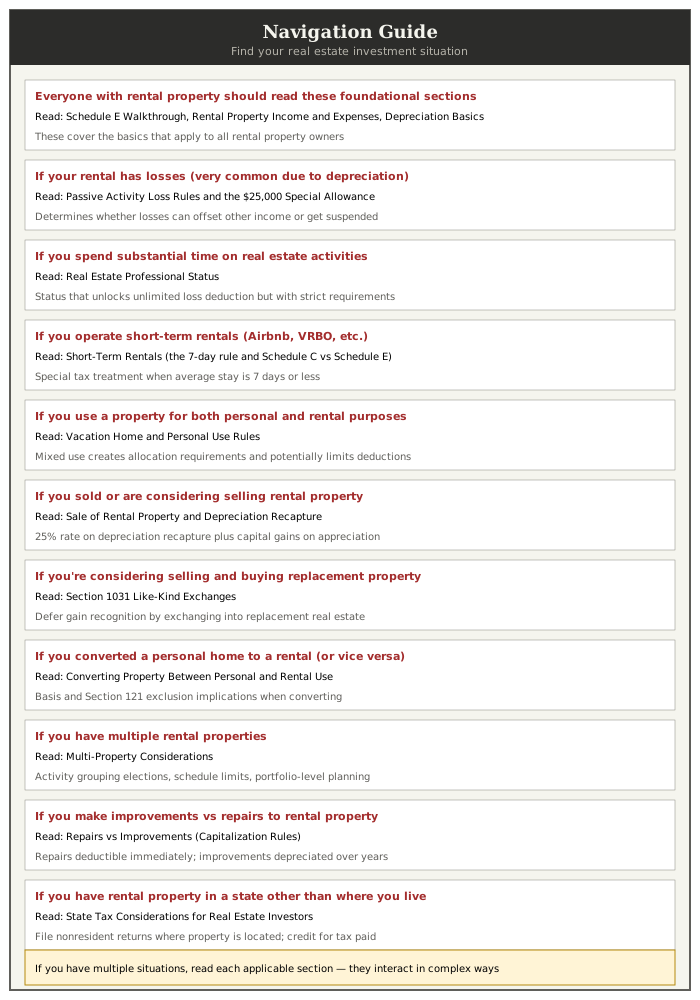
Navigation guide — which subsections apply to your situation
Schedule E Walkthrough
Schedule E (Supplemental Income and Loss) is where rental real estate income gets reported. The form also handles royalties, partnerships, S-corporations, estates, trusts, and REMICs, but this lesson focuses on Part I — rental real estate.
Part I structure. Schedule E Part I has columns for up to three properties (A, B, and C). If you have more than three rental properties, use additional Schedule E forms.
Lines 1a and 1b — Property information. Line 1a captures the physical address. Line 1b captures the type of property using IRS codes: 1 (single family residence), 2 (multi-family residence), 3 (vacation/short-term rental), 4 (commercial), 5 (land), 6 (royalties), 7 (self-rental), or 8 (other). The classification affects how passive activity rules apply.
Line 2 — Fair rental days and personal use days. Critical for properties with mixed personal and rental use. Track exactly how many days each property was rented at fair market value and how many days it was used personally. This drives the vacation home rules covered later.
Lines 3-4 — Income:
- Line 3: Rents received. Include all rental income from tenants — base rent, late fees, pet fees, application fees, lease termination fees, security deposits kept (not refunded), and any other amounts received.
- Line 4: Royalties received. For royalty income from minerals, copyrights, patents.
Lines 5-19 — Expenses (by category):
- Line 5: Advertising
- Line 6: Auto and travel (mileage to property, travel for property management)
- Line 7: Cleaning and maintenance
- Line 8: Commissions (real estate agent commissions for finding tenants)
- Line 9: Insurance (property insurance, liability insurance)
- Line 10: Legal and other professional fees (attorney, accountant for rental matters)
- Line 11: Management fees (property management company)
- Line 12: Mortgage interest paid to banks (the major expense for most rentals)
- Line 13: Other interest
- Line 14: Repairs (immediate-deduction repairs, not improvements)
- Line 15: Supplies
- Line 16: Taxes (real estate property tax, business license fees)
- Line 17: Utilities (if owner pays)
- Line 18: Depreciation expense (from Form 4562)
- Line 19: Other expenses with description (HOA fees, pest control, etc.)
Line 20 — Total expenses. Sum of lines 5-19.
Line 21 — Income or loss from rental real estate. Line 3 minus line 20. This is the net income or loss before passive activity loss limitations are applied.
Lines 22-26 — Adjustments. These lines apply passive activity loss limitations and other restrictions. Line 23a-c — Total amounts. Aggregates from multiple properties. Line 26 — Total rental real estate and royalty income or loss. The bottom-line number that flows to Schedule 1 Line 5 and then to Form 1040 Line 8.
Rental Property Income and Expenses
What counts as rental income. All amounts received from tenants in exchange for the right to use your property. The major categories:
Base rent received. Whether collected in cash, check, electronic payment, or otherwise. Report on a cash basis (when received) unless you have elected accrual accounting.
Advance rent. Rent received in advance (e.g., last month's rent collected upfront) is taxable in the year received, not the year it applies to.
Security deposits. If you intend to return the deposit, it's not income when received. If you keep all or part of it (for damages, unpaid rent, etc.), the kept portion becomes income in the year you keep it.
Property or services in lieu of rent. If a tenant pays rent through services (painting, repairs) instead of cash, the fair market value of the services is rental income to you.
Lease cancellation payments. Amounts received from tenants for breaking a lease are rental income.
Late fees, pet fees, application fees, and other tenant charges. All taxable as rental income.
Common deductible expenses. Most expenses connected to operating the rental property are deductible:
Mortgage interest. The interest portion of mortgage payments on the rental property. The principal portion of the payment is not deductible (it's reducing your loan balance, not an expense). Get this from the lender's 1098.
Property taxes. Real estate taxes paid to local government on the rental property.
Insurance. Property insurance, liability insurance, flood insurance, umbrella policies covering the rental.
Property management. Fees paid to property management companies.
Repairs. Expenditures to keep the property in operating condition — covered in detail in the Repairs vs Improvements section below.
Utilities. If the landlord pays for utilities (water, sewer, trash, electricity, gas).
HOA and condo fees. Regular association dues.
Travel to and from property. Mileage at the IRS standard rate (70 cents/mile for 2025) or actual expenses for trips to handle property issues, meet tenants, inspect, etc. Local travel must be related to property management activities, not personal visits.
Legal and professional services. Attorney fees for evictions or lease drafting, accountant fees for rental tax preparation.
Advertising. Costs to advertise the property for rent.
Depreciation. Covered in detail in the Depreciation Basics section below.
Expenses you cannot deduct. Improvements to the property (must be depreciated instead). Personal expenses not related to the rental. The principal portion of mortgage payments. Cost of buying the property (added to basis instead). Cost of getting the loan (amortized over the loan term).
Forgetting to track mileage to properties. Not reporting security deposits kept. Treating major improvements as repairs. Not depreciating personal property used in the rental (appliances, furniture, carpeting — these depreciate faster than the building). Missing HOA fees as deductible expenses. Forgetting to claim depreciation in early years (the IRS assumes you claimed it whether you did or not, meaning you face recapture even on never-deducted depreciation).
Depreciation Basics
Depreciation lets you deduct the cost of long-lived property over its useful life. For rental real estate, depreciation creates substantial paper losses even on cash-flow-positive properties — making it one of the most powerful aspects of real estate tax treatment.
What depreciates. The building (structure) depreciates. Land does not depreciate. When you buy a rental property, you must allocate the purchase price between land and building. The county assessor's allocation between land and building value is one common starting point. Better allocations use appraisals or insurance replacement cost analyses.
Depreciation periods:
- Residential rental real estate (houses, apartments): 27.5 years straight-line
- Commercial real estate: 39 years straight-line
- Land improvements (driveways, fences, landscaping): 15 years
- Personal property in rental (appliances, furniture, carpeting): 5 or 7 years
Mid-month convention. Real estate uses a mid-month convention — regardless of when in the month you place the property in service, depreciation starts mid-month. Property placed in service in January gets 11.5 months of depreciation in the first year. Property placed in service in December gets 0.5 months.
Annual depreciation calculation. Building basis ÷ 27.5 = annual depreciation for residential. For a $300,000 building (already separated from land value): $300,000 / 27.5 = $10,909 per year. The first and last years are prorated for the mid-month convention.
Cost segregation studies. A cost segregation study identifies components of the property that qualify for shorter depreciation periods than the 27.5-year building. Things like specialty lighting, certain finishes, dedicated electrical for appliances, and landscaping might be separated from the building and depreciated over 5, 7, or 15 years instead of 27.5. The shorter depreciation accelerates deductions and saves taxes in early years. Cost segregation studies cost $5,000-$15,000+ for a typical residential property but can save tens of thousands in early-year taxes for the right properties.
Bonus depreciation on improvements. OBBBA restored 100% bonus depreciation for qualifying property acquired after January 19, 2025. This applies to assets with recovery periods of 20 years or less (including land improvements at 15 years and personal property at 5-7 years). The 27.5-year building itself doesn't qualify for bonus depreciation, but cost-segregated portions and improvements often do.
Section 179 expensing. Section 179 can apply to certain improvements to non-residential property (HVAC, roofs, fire protection, security systems, building interiors). Residential rental property generally doesn't qualify for Section 179 on the building itself.
Form 4562. Required for reporting depreciation, Section 179, and bonus depreciation. The form details each asset's cost, recovery period, depreciation method, and current-year depreciation. The total flows to Schedule E line 18.
The IRS treats depreciation as "allowed or allowable" — when you sell, depreciation recapture applies based on what you SHOULD have claimed, not what you actually claimed. Failing to claim depreciation in past years means you face recapture at sale anyway, without having received the corresponding tax benefit during ownership. If you've failed to depreciate, Form 3115 (Application for Change in Accounting Method) can catch up on missed depreciation, generally as a current-year deduction.
IRS Publication 527 (Residential Rental Property); IRS Publication 946 (How to Depreciate Property); Form 4562 Instructions; IRC sections 167, 168.
Passive Activity Loss Rules and the $25,000 Special Allowance
Read this if your rental property has losses (very common due to depreciation).
Rental real estate is generally considered a passive activity under federal tax law. This classification has major implications for whether you can deduct rental losses against your other income.
The general passive activity rule. Losses from passive activities can only offset income from passive activities. They cannot offset wages, self-employment income, interest, dividends, or other "active" or "portfolio" income. Excess passive losses get suspended and carry forward to offset future passive income or until you dispose of the activity.
Why this matters for real estate investors. Most rental properties show losses on Schedule E because of depreciation — even cash-flow-positive properties. A property generating $5,000 of cash flow can easily show a $5,000 paper loss after $10,000 of depreciation. Without ways around the passive activity rules, that paper loss couldn't offset W-2 wages or other non-passive income.
The $25,000 special allowance for rental real estate. A specific exception lets active participants in rental real estate deduct up to $25,000 of rental losses against non-passive income, subject to MAGI limits.
Eligibility for the special allowance. You must "actively participate" in the rental activity. This is a lower standard than "material participation" — making management decisions (approving tenants, setting rent, approving repairs) generally counts as active participation. You must own at least 10% of the property by value. You cannot be a limited partner in the rental activity.
MAGI phase-out of the special allowance. Full $25,000 allowance available with MAGI up to $100,000 (MFJ or single). Phase-out: $1 reduction in allowance for every $2 of MAGI above $100,000. Fully phased out at MAGI of $150,000. So a filer with $125,000 MAGI gets a $12,500 special allowance ($25,000 minus half of the $25,000 MAGI excess). A filer with $150,000+ MAGI gets no special allowance.
Married Filing Separately filers who lived with their spouse during the year get $0 special allowance. MFS filers living apart from spouse get $12,500 with phase-out starting at $50,000 MAGI.
Suspended losses. Passive losses that can't be used in the current year don't disappear — they carry forward. They can offset future passive income from any source, future rental losses that would otherwise be suspended, and gain on disposition of the activity (when you sell the property). When you sell a rental property at a gain (or in a fully taxable transaction), all your suspended losses for that property become deductible against the gain and any other income. This is called "freeing up" suspended losses at disposition.
Form 8582. Calculates passive activity losses allowed for the current year and tracks suspended losses by activity. Required if you have suspended losses or are subject to the special allowance phase-out.
Practical implications. For middle-income real estate investors with W-2 jobs (MAGI under $100,000), the $25,000 special allowance often allows full deduction of typical rental losses against wages. As income rises into and above the $100,000-$150,000 phase-out, the deductibility decreases. High-income filers (MAGI over $150,000) cannot deduct any rental losses against non-passive income unless they qualify as real estate professionals or invest in short-term rentals with material participation.
IRC section 469; IRS Publication 925; Form 8582 Instructions.
Real Estate Professional Status
Read this if you spend substantial time on real estate activities — potentially unlocking unlimited rental loss deduction.
Real Estate Professional (REP) status is one of the most valuable but most strictly policed designations in the tax code. Qualifying as a real estate professional removes the passive activity classification from your rental real estate activities (if you also materially participate in them), allowing unlimited loss deduction against any income.
Two requirements to qualify as a Real Estate Professional.
Requirement 1 — More than half of personal services. More than 50% of all personal services you perform during the year (in all trades or businesses) must be in real property trades or businesses. If you work a W-2 job for 2,000 hours and on real estate for 500 hours, you don't qualify — 50% of total personal services must be in real estate.
Requirement 2 — More than 750 hours. You must perform more than 750 hours of services during the year in real property trades or businesses in which you materially participate.
Both requirements must be met. Failure on either disqualifies you from REP status for that year.
What counts as real property trade or business. Real property development, redevelopment, construction, reconstruction, acquisition, conversion, rental, operation, management, leasing, or brokerage. Both your own properties and services for others count if you have at least a 5% ownership stake in the business performing the services.
The W-2 challenge. Full-time W-2 employees in non-real-estate jobs essentially cannot qualify as REPs in the same year. The first requirement (more than 50% of personal services in real estate) typically fails when you have a full-time W-2 job.
The spouse strategy. For MFJ couples, only ONE spouse needs to qualify as a REP. If one spouse is a stay-at-home or self-employed person who can devote substantial hours to real estate, that spouse can qualify even if the other spouse works a W-2 job. The REP-qualifying spouse's status allows the couple to treat all rental real estate as nonpassive.
Material participation in rental activities. REP status alone doesn't make rentals nonpassive — you must also materially participate in each rental activity (or make a grouping election to treat all rentals as one activity for material participation testing).
Material participation tests. You materially participate in an activity if you meet any of these tests:
- 500+ hours of participation in the activity during the year
- Substantially all participation in the activity is by you
- More than 100 hours and at least as much as any other individual
- Significant participation in multiple activities totaling more than 500 hours
- Materially participated in the activity for any 5 of the preceding 10 years
- Personal service activity, materially participated for any 3 prior years
- Facts and circumstances show regular, continuous, and substantial participation
The grouping election. Without a grouping election, you must material-participate in each property separately. Most rental investors can't reach 500 hours per property. The grouping election (under Revenue Procedure 2010-13) lets you treat all your rental real estate as one activity for material participation testing — making it easier to clear the 500-hour bar across the portfolio.
The IRS aggressively audits REP claims. Maintain contemporaneous records of: time spent on each real estate activity (date, duration, what you did), time spent on non-real-estate activities (for the 50% test), and documentation that activities were in real property trades or businesses. A daily log or calendar showing time allocation across activities is the gold standard for documentation. Reconstructed estimates at audit time are routinely rejected by the IRS.
Benefits of REP status with material participation. Rental losses become fully deductible against any income — wages, self-employment, investment income, etc. No $25,000 cap, no MAGI phase-out, no suspended losses. This can produce substantial tax savings for high-income filers with multiple properties.
Risks of REP status. Aggressive IRS scrutiny. Without strong contemporaneous documentation, the IRS may successfully challenge the claim, retroactively reclassifying losses as passive and assessing tax, interest, and potentially penalties.
IRC section 469(c)(7); IRS Publication 925; Form 8582 Instructions; relevant tax court cases.
Short-Term Rentals
Read this if you operate short-term rentals through Airbnb, VRBO, or similar platforms.
Short-term rentals have unique tax treatment because they don't fit cleanly into the passive activity classification used for traditional rental real estate. The distinction matters significantly for tax planning.
The seven-day rule. If the average customer rental period for a property is 7 days or less, the IRS does NOT consider it a "rental activity" under the passive activity rules. Instead, it's treated more like a business. This creates a tax planning opportunity sometimes called the "short-term rental loophole."
Average rental period calculation. Total days the property was rented divided by the number of rental periods. If you rented for 60 total days across 10 separate guest stays, your average rental period is 6 days — qualifying for short-term rental treatment. If those 60 days were 4 stays of 15 days each, your average is 15 days — not qualifying.
Schedule C vs Schedule E for short-term rentals. The choice depends on the services provided.
Schedule E with no SE tax. If average rental period is 7 days or less and you don't provide substantial services beyond what a typical landlord provides (cleaning between stays, basic maintenance, utility provision), report on Schedule E. The activity is excluded from passive activity rules (per IRC section 469), but it's still reported on Schedule E because Schedule E is the appropriate form for real estate rental income. No self-employment tax applies because the income is rental, not business.
Schedule C with SE tax. If you provide substantial services to guests — daily housekeeping during the stay, meal preparation, concierge services, guided activities, transportation — the IRS treats the activity as a hotel-like business rather than rental. Report on Schedule C, with all the business reporting and self-employment tax that entails.
The "substantial services" distinction. Routine services that traditional landlords provide don't trigger Schedule C treatment: cleaning between guests (not during stays), maintenance, utility provision, providing keys, basic Wi-Fi. Substantial services that DO trigger Schedule C treatment: housekeeping during stays, meals, concierge services, guided tours, transportation, daily linen service.
The "STR loophole" with material participation. Combining the 7-day-or-less average stay with material participation (typically requiring 100+ hours of personal involvement, more than anyone else) lets you treat the rental as nonpassive. Losses (including substantial first-year losses from cost segregation and bonus depreciation) can offset W-2 wages and other active income — without needing real estate professional status.
This is particularly attractive for high-income W-2 employees who can't qualify as real estate professionals. They buy a short-term rental, do a cost segregation study to accelerate first-year depreciation, materially participate in the rental (100+ hours, more than any management company), and use the resulting losses to offset W-2 income.
Material participation for STR. All seven material participation tests apply. The two most commonly relied on for STRs: Test 3 (more than 100 hours and at least as much as any other individual) and Test 1 (500+ hours). Test 3 is the easier path. If you spend 150 hours on the property and your cleaning service spends 100 hours, you meet test 3. If you outsource everything and spend less than your service providers, you don't materially participate.
If you rent your home (including a vacation home) for 14 days or fewer during the year and used it personally for more than 14 days, the rental income is completely tax-free. You don't report it. You also can't deduct expenses, but the income exclusion is often valuable. This is sometimes called the "Augusta rule" after homeowners renting during the Masters golf tournament. Above 14 rental days, the income becomes reportable.
Personal use of short-term rentals. Same rules as traditional vacation homes (covered in the next section). Personal use of more than 14 days or more than 10% of rental days creates a "residence" classification with expense deduction limitations.
IRC sections 280A, 469, 1402; Regulation 1.469-1T(e)(3); IRS Publication 527; relevant tax court cases on short-term rentals.
Vacation Home and Personal Use Rules
Read this if you use a property for both personal and rental purposes.
Mixed-use properties (personal use AND rental use) have specific allocation and limitation rules.
The classification framework. Depending on the relative personal and rental use, your property falls into one of three classifications.
Pure rental property (no personal use beyond 14 days AND not more than 10% of rental days). Treated as a regular rental. All rental expenses fully deductible (subject to passive activity limits). Standard Schedule E reporting.
Pure personal residence (rented 14 days or fewer during the year, used personally more than 14 days). The 14-day exclusion (Augusta rule) applies. Rental income not reported. Expenses not deductible against rental. Mortgage interest and property taxes deductible on Schedule A (subject to SALT cap and standard deduction analysis).
Mixed-use (personal use exceeds the greater of 14 days or 10% of rental days, but also rented for more than 14 days). Most restrictive category. Expenses must be allocated between personal and rental use. Rental expenses limited to rental income — cannot create a loss. Specific ordering rules for expense deductions.
Allocation formula. Total expenses × (rental days / total days used). The denominator includes both rental and personal use days, not the full year.
Expense ordering for mixed-use properties. When rental income is insufficient to cover all expenses, the IRS requires a specific order:
- Allocable mortgage interest and property tax first
- Operating expenses (utilities, insurance, maintenance) next
- Depreciation last
This ordering matters because mortgage interest and property tax might be deductible on Schedule A anyway (subject to SALT cap), while the other expenses provide rental-specific benefit only.
Personal use days defined. Days you, your spouse, family members, or anyone using the property at less than fair market rental rent counts as personal use. Days you spend repairing or maintaining the property (substantially full-time) generally don't count as personal use even if family members are also there.
If you're close to the personal-use thresholds, careful tracking matters. One extra day of personal use can shift a property from pure rental to mixed-use status with substantially worse tax treatment. Strategic timing of personal stays vs maintenance days can preserve the more favorable classification.
IRC section 280A; IRS Publication 527.
Repairs vs Improvements (Capitalization Rules)
Read this if you make any expenditures on rental property.
The distinction between repairs and improvements determines whether expenses are deducted immediately or capitalized and depreciated over years.
Repairs are deductible immediately. Repairs keep the property in normal operating condition. They restore the property to its previous condition rather than making it better, longer-lasting, or more useful. Examples: fixing a broken window, replacing a few damaged shingles, repainting, replacing a single broken pipe, fixing a leaky faucet.
Improvements must be capitalized and depreciated. Improvements better the property, make it more useful, extend its life, or adapt it to new use. Examples: complete roof replacement, full repaint of the building, replumbing the property, adding a new room, replacing all windows, full HVAC system replacement.
The improvement standard (BAR test). Under regulations, an expenditure must be capitalized if it results in:
- Betterment — Material increase in capacity, productivity, efficiency, strength, quality, output, or value
- Adaptation — Property is adapted to a new or different use
- Restoration — Restoration of a property to a like-new condition after the end of its economic useful life, or rebuilding to like-new condition
Routine maintenance safe harbor. Recurring activities you reasonably expect to perform more than once during the property's life don't have to be capitalized. Examples: regular HVAC maintenance, gutter cleaning, periodic inspections, routine appliance servicing.
De minimis safe harbor. Items costing $2,500 or less per invoice (or $5,000 if you have audited financial statements) can be expensed immediately as supplies rather than depreciated. Requires election on your tax return.
Safe harbor for small taxpayers. Real estate owners with less than $10 million in gross receipts AND properties with unadjusted basis of less than $1 million can deduct certain building improvements up to the lesser of 2% of basis or $10,000 per property per year. Useful for smaller landlords.
Common borderline situations:
- Replacing a single broken appliance: typically depreciated as personal property (5-7 years), not the building's 27.5 years. With bonus depreciation, may be fully deductible in year one.
- Roof replacement: capitalized (improvement). Patch on the roof: deductible repair.
- New flooring throughout: capitalized improvement. Refinishing existing floors: typically repair.
- Full HVAC replacement: capitalized improvement. Single component replacement on HVAC: typically repair.
- Painting entire interior: depending on circumstances, may be deductible as routine maintenance or may need capitalization. Painting in connection with other major work usually capitalized as part of the project.
A $10,000 repair is fully deductible in the year paid. A $10,000 improvement is depreciated over 27.5 years — about $364/year. The repair is dramatically more valuable in the short term. Tax preparers and IRS examiners both pay attention to whether expenses are properly classified.
IRC section 263(a); Treasury Regulations on tangible property; Revenue Procedure 2014-16 (de minimis safe harbor election).
Sale of Rental Property and Depreciation Recapture
Read this if you sold or are considering selling rental property.
Selling a rental property triggers tax on the gain, with specific rules for depreciation recapture that add complexity.
Calculating the gain. Sale price minus selling expenses minus your adjusted basis. Adjusted basis = original cost basis plus capitalized improvements minus accumulated depreciation. For a property bought for $200,000, with $30,000 of capitalized improvements over the years, and $50,000 of accumulated depreciation, your adjusted basis is $180,000. If you sell for $300,000 net of selling expenses, your gain is $120,000.
Two parts to the gain — unrecaptured Section 1250 and capital gain.
Unrecaptured Section 1250 gain (depreciation recapture portion). Up to the amount of accumulated depreciation, the gain is taxed at a maximum rate of 25%. This is higher than the regular long-term capital gains rates (0%, 15%, 20%) and reflects the policy that depreciation deductions should be partially "paid back" at sale.
Long-term capital gain (appreciation above original cost basis). Any gain above the depreciation recapture portion is regular long-term capital gain at the preferential rates (0%, 15%, or 20% depending on your total income).
Example continuing the above. $120,000 total gain. $50,000 is unrecaptured Section 1250 gain (the depreciation taken) taxed at up to 25%. The remaining $70,000 is regular LTCG taxed at the preferential rates.
Filers above NIIT thresholds ($200,000 single / $250,000 MFJ) pay an additional 3.8% on the gain. So depreciation recapture for high-income filers maxes out at 28.8% (25% + 3.8%), and LTCG maxes out at 23.8% (20% + 3.8%).
State tax. Most states tax the gain like ordinary income (some at preferential rates). Verify your state's treatment. Gain on out-of-state property is generally taxed by the state where the property is located (not your home state), though you may get a credit on your home state return for taxes paid to the other state.
Reporting. Sale of rental property is reported on Form 4797 (Sales of Business Property) and Schedule D. Form 4797 calculates the gain and the depreciation recapture portion. The amounts then flow to other forms.
Suspended passive losses freed up. Any passive activity losses suspended on Form 8582 for this property are freed up at sale and can offset the gain plus other income. This is one of the benefits of suspended losses — they're not lost forever, just deferred.
Installment sale option. If you sell with seller financing (you take a note from the buyer), you can use the installment method to spread gain recognition over the years you receive payments. Each payment includes a portion of capital gain, depreciation recapture, and return of basis. Form 6252 handles installment sales. Note that depreciation recapture must be recognized fully in the year of sale even on installment sales — only the capital gain portion can be spread.
IRS Publication 544 (Sales and Other Dispositions of Assets); IRS Publication 537 (Installment Sales); IRC sections 1231, 1245, 1250.
Section 1031 Like-Kind Exchanges
Read this if you're considering selling and buying replacement investment property.
Section 1031 allows real estate investors to defer recognition of gain by exchanging one investment property for another. The original gain isn't taxed at the time of exchange — instead, the basis from the relinquished property carries over to the replacement property, deferring the tax until eventual sale (or until death, when the step-up in basis often eliminates the deferred gain entirely).
Eligible property. Must be real property held for productive use in trade or business or for investment. Both the relinquished property and the replacement property must qualify. TCJA limited Section 1031 to real property only (personal property and intangibles no longer qualify), and OBBBA made this permanent.
Like-kind requirement is broad for real estate. Any real estate held for investment can be exchanged for any other real estate held for investment. A residential rental can be exchanged for commercial. Vacant land can be exchanged for a building. Domestic property can be exchanged only for other domestic property (US for US; foreign for foreign).
The qualified intermediary requirement. Most 1031 exchanges are deferred exchanges using a qualified intermediary (QI). You don't take possession of the sale proceeds — the QI holds them and uses them to purchase the replacement property. Direct receipt of cash by the seller breaks the exchange and triggers immediate gain recognition.
45 days from sale of relinquished property to IDENTIFY potential replacement properties in writing. 180 days from sale to CLOSE on the replacement property. These deadlines are strict. Missing either one disqualifies the entire exchange and triggers full gain recognition. The 180-day deadline cannot be extended — even for natural disasters, IRS service interruptions, or other circumstances that ordinarily extend tax deadlines.
Identification rules. Within 45 days, you can identify potential replacement properties using one of three rules:
- Three-property rule: Identify up to three properties of any value
- 200% rule: Identify any number of properties with total fair market value not exceeding 200% of the relinquished property's value
- 95% rule: Identify any number of properties of any value, but must close on properties representing at least 95% of total identified value
Equity and debt replacement. To fully defer gain, you must replace both equity and debt. If your relinquished property was sold for $500,000 with a $200,000 mortgage paid off, your "equity" is $300,000 and your "debt" is $200,000. Your replacement property must cost at least $500,000 (equity replacement) AND you must take on at least $200,000 of new debt (debt replacement) or contribute additional cash to offset less debt.
Boot. Cash or non-like-kind property received in the exchange ("boot") triggers gain recognition to the extent of the boot. If you exchange a $500K property for a $400K property and pocket $100K, the $100K is taxable gain. Mortgage reduction is also boot — if your new mortgage is smaller than your old one, the difference is boot unless offset by additional cash you contribute.
Carry-over basis. Your basis in the replacement property equals your basis in the relinquished property plus any additional cash invested minus any boot received. The deferred gain is "embedded" in this lower basis. When you eventually sell the replacement property, you face the deferred gain plus any additional appreciation.
Reverse 1031 exchanges. If you acquire the replacement property BEFORE selling the relinquished property, special "reverse exchange" rules apply. A QI holds the new property temporarily until the old property sells. More expensive and complex than standard deferred exchanges.
State conformity. Most states conform to federal Section 1031, but a few don't recognize the exchange or impose their own rules. California has specific provisions tracking exchanges across state lines. Verify state treatment before relying on full state-level deferral.
IRS Publication 544; IRS Form 8824 Instructions; IRC section 1031; Treasury regulations on like-kind exchanges.
Converting Property Between Personal and Rental Use
Read this if you converted a personal residence to a rental, or a rental to a personal residence.
Conversions trigger several specific tax rules around basis, depreciation, and the home sale exclusion.
Personal residence converted to rental. When you stop using your home as a residence and rent it out:
Basis for depreciation. The lower of (a) fair market value at conversion or (b) your adjusted basis in the property. Generally fair market value if the property has appreciated, or adjusted basis if the property has declined. This is different from the basis used for calculating gain or loss on sale.
Depreciation begins at conversion. You start depreciating from the conversion date based on the depreciation basis (above). Use Form 4562 in the first year of rental.
Section 121 home sale exclusion still potentially available. If you sell within three years after conversion AND you used the home as your principal residence for at least 2 of the 5 years before sale, the home sale exclusion ($250K single / $500K MFJ) may still apply to the appreciation portion. Depreciation taken during the rental period is recaptured at sale (no exclusion for the depreciation portion).
Rental converted to personal residence. When you stop renting and move in:
Depreciation stops. No more depreciation deductions once converted to personal use.
Suspended passive losses don't free up. Conversion to personal use isn't a "disposition" that frees up suspended passive losses. The losses remain suspended until actual disposition (sale).
Section 121 exclusion has special rules. The home sale exclusion is reduced for "non-qualified use" periods (time the property was used for rental rather than personal residence). The pre-2009 rental period doesn't reduce the exclusion (grandfathered). Post-2009 rental period reduces the exclusion proportionally.
You bought a property in 2010, used it as a rental for 5 years, converted to your residence in 2015, and lived there until selling in 2025. You meet the 2-of-5-years residence test. But the 5 years of rental between 2010-2015 reduces your exclusion. Of the 15 total years of ownership, 5 (33%) were non-qualified use. Only 67% of the gain (above depreciation recapture) qualifies for the exclusion.
Depreciation recapture always applies. Regardless of conversion timing, depreciation taken during the rental period is recaptured at sale at up to 25%. The Section 121 exclusion doesn't apply to the depreciation portion.
IRC section 121; IRS Publication 523; IRS Publication 527.
Multi-Property Considerations
Read this if you own multiple rental properties.
Multi-property investors face additional considerations beyond single-property issues.
Schedule E column limit. Each Schedule E has columns for three properties. With more than three properties, use additional Schedule E forms. There's no limit on the number of Schedule E forms you can file.
Aggregating activities for material participation. Without grouping, you must materially participate in each rental separately — generally impossible for portfolio investors. The grouping election under Reg. 1.469-9(g) lets you treat all rental real estate as one activity for material participation testing.
Grouping election binding. Once made, the grouping election is generally binding for future years. You can revoke under specific circumstances but the IRS limits flexibility.
Suspended losses by activity. Without grouping, suspended losses are tracked per property and only freed up when that specific property is sold. With grouping (all properties as one activity), losses are tracked at the group level and free up only when you dispose of substantially all the group.
Separate Form 4562 considerations. Each property typically has its own depreciation schedule on Form 4562. Track each separately for accuracy.
Tracking complexity. Multi-property portfolios benefit from accounting software (Stessa, Buildium, AppFolio, QuickBooks) that handles property-level income and expenses. Manual tracking becomes error-prone past 3-5 properties.
IRC section 469(c)(7); Regulation 1.469-9(g); Revenue Procedure 2010-13.
State Tax Considerations for Real Estate Investors
Read this if your rental property is in a different state from where you live.
Out-of-state rental property creates multi-state tax obligations.
Your home state. Your state of residence taxes your worldwide income, including the out-of-state rental income. To avoid double taxation, your home state generally provides a credit for taxes paid to the other state on the same income.
Filing complexity. You'll file: federal return reporting all income, home state return reporting all income with credit for tax paid to other state, and nonresident return(s) in the state(s) where rental properties are located.
State conformity to federal rules. Most states follow federal rules for rental property income, deductions, and depreciation. Some states have variations — particularly on depreciation methods, Section 179 limits, and bonus depreciation conformity.
State passive activity rules. Most states conform to federal passive activity rules. Some have variations or don't recognize the $25,000 special allowance or real estate professional status. Verify state-specific rules.
Property tax considerations. Each state has its own property tax system. Some have property tax limits (California Prop 13), homestead exemptions (Florida, Texas), or other features that affect the operating economics of property ownership.
Local taxes. Some cities and counties impose additional taxes on rental income (city income taxes in New York, Philadelphia; gross receipts taxes in some California cities; occupancy/lodging taxes for short-term rentals). Research local requirements where properties are located.
State Department of Revenue websites for each state where you have property; state-specific rental property guides.
Connection to other lessons
The Real Estate Investors lesson assumes the foundation is in place. Specific lessons most relevant to real estate investors:
Lesson 3 (Income) covered the basic mechanics of where Schedule E flows on Form 1040 (Schedule 1 line 5, then Form 1040 line 8).
Lesson 4 (Adjustments) covered Schedule 1 Part II adjustments, none of which directly apply to rental real estate but which can interact through AGI calculations affecting the passive activity loss allowance phase-out.
Lesson 5 (Deductions) covered the mortgage interest deduction on Schedule A. Mortgage interest on rental property is deducted on Schedule E (not Schedule A) — these are different deductions on different forms despite both being mortgage interest.
Lesson 6 (Tax calculation) covered the preferential rates on long-term capital gains, which apply to property sale gains (except for the depreciation recapture portion taxed at up to 25%).
Lesson 8 (Other taxes) covered the Net Investment Income Tax that applies to rental income for high-income filers (rental income is investment income for NIIT purposes).
Lesson 12 (Self-Employed) covered the QBI deduction, which can apply to rental activities that rise to the level of trade or business (250+ hours of rental services per year is a safe harbor for QBI eligibility).
What to gather for real estate investors
For each rental property: address, type, dates placed in service, basis allocation between land and building, and depreciation history. Income records: rent received, security deposits kept, fees collected, any other income. Expense records by category: mortgage interest (Form 1098), property tax, insurance, repairs, maintenance, utilities, management fees, advertising, legal/professional fees, supplies, HOA fees, travel/mileage. Form 1098 from each lender. Property tax bills and proof of payment. Records of any improvements (capitalized, depreciated separately). Mileage log for travel to properties. Form 4562 history for accumulated depreciation tracking. Closing statements (HUD-1) from purchases and sales.
- If 1031 exchange: Form 8824, QI documentation, identification letters, exchange agreement.
- If short-term rental: contemporaneous logs of average rental period, personal use days, time spent on management activities (for material participation), and any substantial services provided.
- If real estate professional: contemporaneous time logs of all activities (real estate AND non-real-estate) demonstrating both the 50% test and 750-hour test.
- Form 8582 from prior years for suspended passive loss tracking.
- Form 1099-K (if received from short-term rental platforms — though OBBBA restored the $20K/200-transaction threshold meaning most STRs may not receive them).
Key Takeaways
- Rental real estate is passive by default — losses can only offset passive income unless you qualify for the $25,000 special allowance (available up to $100K MAGI, phased out by $150K) or Real Estate Professional status
- Depreciation creates paper losses even on cash-flow-positive properties — but the IRS treats it as "allowed or allowable," so you face recapture at sale even if you never claimed it
- Real Estate Professional status requires both 750+ hours AND more than 50% of all personal services in real estate — full-time W-2 employees in other fields essentially can't qualify, but their spouse can
- Short-term rentals with 7-day-or-less average stays fall outside passive activity rules — combined with material participation (100+ hours, more than anyone else), losses can offset W-2 wages without REP status
- Property sale gain has two components: depreciation recapture (taxed up to 25%) and capital gain (taxed at preferential 0%/15%/20% rates) — Section 1031 defers both, but the 45-day identification and 180-day closing deadlines are absolute
- Out-of-state rental property requires nonresident filing in the state where the property is located, plus a credit on your home state return to avoid double taxation
Quiz — 4 Questions
Answer one at a timeA W-2 employee with $90,000 MAGI has a rental property showing a $20,000 loss due to depreciation. The property is cash-flow positive. How much of the loss can offset their W-2 wages?