Capital Gains in Depth
Budget 2024 and 2025 reforms; holding periods by asset class; STCG at 20% and LTCG at 12.5% for equity; indexation vs 12.5% choice for property; equity exemption under Section 112A; mutual fund taxation including Budget 2023 debt fund changes; VDA taxation at 30% with no loss offsets; Section 54 family of exemptions; Capital Gains Account Scheme mechanics; loss set-off and carry-forward rules; Section 47 exempt transfers; Section 49 cost basis for inherited assets; and Schedule CG completion with 10 common errors
- Identify capital assets under Section 2(14), classify them as short-term or long-term by asset class, and apply the correct holding period thresholds
- Compute capital gains tax for equity, property, mutual funds, gold, cryptocurrency, and unlisted shares — selecting the optimal rate (12.5% or indexed 20%) where applicable
- Apply Section 87A rebate restriction to special-rate gains and calculate final tax with surcharge, cess, and the ₹1.25 lakh equity LTCG exemption under Section 112A
- Match the correct exemption section (54, 54B, 54EC, 54F, 54GB) to each capital gain scenario and implement Capital Gains Account Scheme mechanics
- Set off and carry forward short-term and long-term capital losses across years following Sections 70, 71, and 74, noting the distinct VDA loss restrictions
- Complete Schedule CG accurately and avoid the 10 most common filing errors — including wrong holding period classification, Section 54 vs 54F confusion, and CGAS deposit timing
Capital Gains in Depth
Capital gains taxation has been one of the most actively reformed areas of Indian tax law in recent years. Budget 2024 introduced sweeping changes to rates, holding periods, and indexation. Budget 2025 made further refinements. The cumulative effect is a substantially different capital gains regime than what existed just a few years ago — and one that affects every filer who sells equity, property, gold, or any other capital asset.
This lesson takes a comprehensive approach to capital gains. We cover every major asset class, every key section, every relevant exemption route. We work through actual computations for property, equity, gold, debt mutual funds, and cryptocurrency. We address the procedural mechanics — Schedule CG completion, advance tax timing for capital gains, loss set-off and carry-forward rules — that filers often get wrong.
Earlier lessons touched on specific capital gains topics — Lesson 13 covered property in detail, Lesson 17 addressed foreign assets, Lesson 5 explained the Section 87A interaction with special-rate gains. This lesson serves as the comprehensive reference, drawing those threads together and adding the asset classes not yet covered in depth.
A reminder: this lesson uses Income Tax Act 1961 references applicable to FY 2025-26 income filed as AY 2026-27. The Budget 2024 reforms to capital gains apply for transfers from July 23, 2024 onwards.
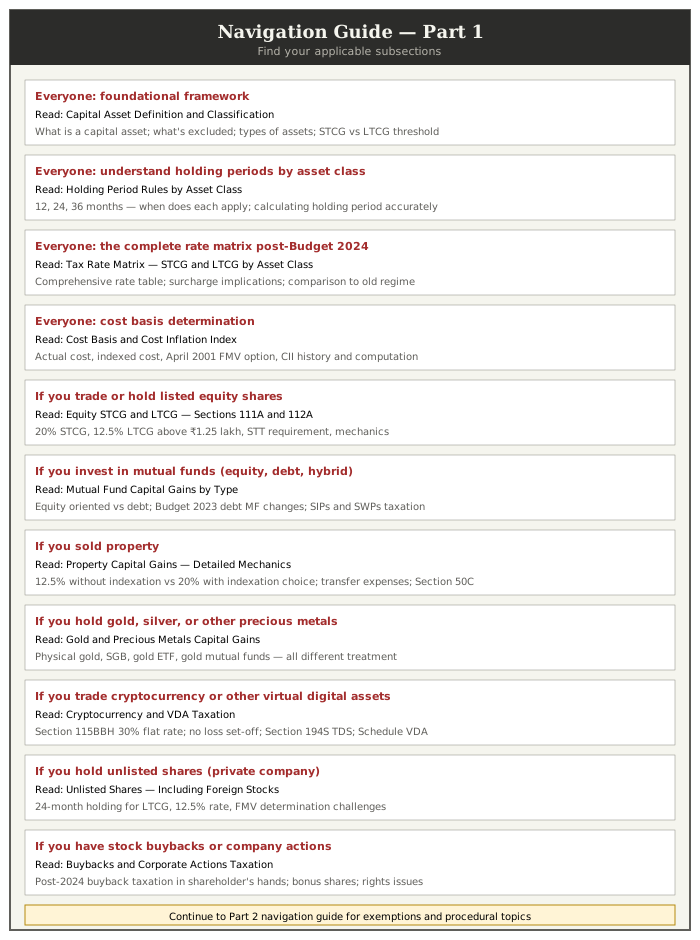
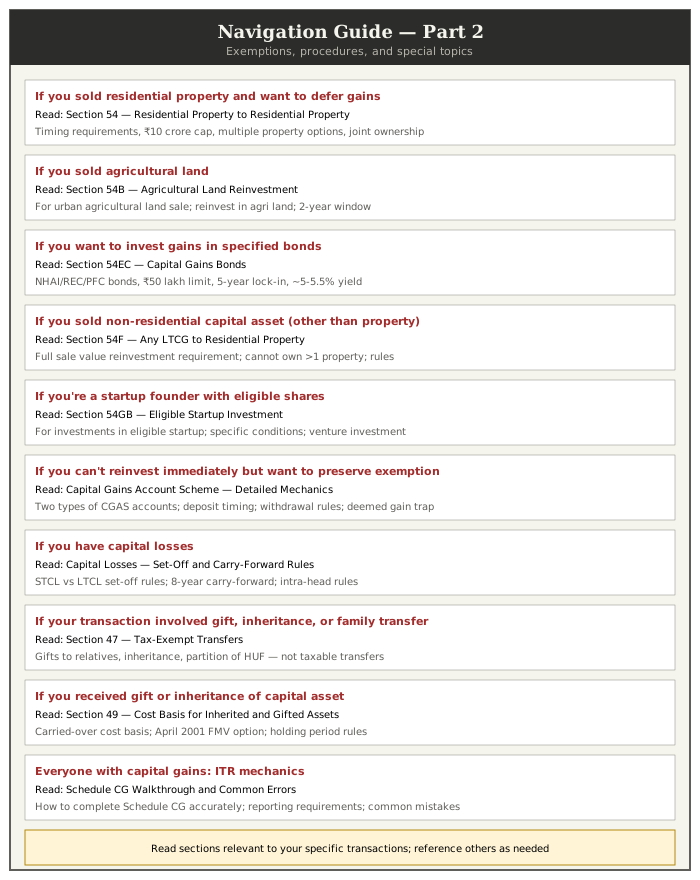
Navigation guide — which subsections apply to your situation
Capital Asset Definition and Classification
The starting point for any capital gains analysis: identifying whether you have a capital asset, and what type.
Section 2(14) — Capital Asset Definition.
A "capital asset" is any property held by an assessee — whether or not connected with business or profession. The definition is broad:
- Tangible assets: real estate, jewelry, vehicles
- Intangible assets: goodwill, copyrights, patents
- Financial assets: shares, bonds, mutual fund units
- Negotiable instruments
What's EXCLUDED from "capital asset" definition.
These items are NOT capital assets — sale generates business income, not capital gains:
- Stock-in-trade or inventory held for business
- Consumable stores or raw materials
- Personal effects (clothes, furniture, etc.) — exception: jewelry, archaeological, etc., ARE capital assets
- Rural agricultural land (Lesson 14 covered this in detail)
- Specific government bonds
- Gold deposit bonds issued under specific schemes
Personal effects vs personal capital assets.
Personal use items are generally excluded but with important exceptions:
Excluded (not capital assets):
- Wearing apparel
- Furniture for personal use
- Furniture, clothes, etc. of family members
Included (ARE capital assets):
- Jewelry (precious stones, gold, silver ornaments)
- Archaeological collections
- Drawings, paintings, sculptures
- Any work of art
This distinction matters: selling clothes generates no tax; selling family gold creates capital gains.
| Category | Examples |
|---|---|
| Short-Term Capital Asset | Held for less than the specified period (12/24/36 months by class) |
| Long-Term Capital Asset | Held for more than the specified period |
| Listed equity share / equity mutual fund | LTCG if held more than 12 months |
| Other capital assets | LTCG if held more than 24 months (post-Budget 2024) |
| Immovable property (land/building) | LTCG if held more than 24 months |
| Unlisted shares | LTCG if held more than 24 months |
| Debt mutual funds (special rule) | Always taxed at slab rates regardless of holding |
The fundamental tax structure.
Short-Term Capital Gains (STCG):
- Generally taxed at slab rates (with exception for listed equity at 20% under 111A)
- No special exemptions like Section 54
Long-Term Capital Gains (LTCG):
- Taxed at concessional rates (12.5% post-Budget 2024)
- Eligible for various reinvestment exemptions (Section 54 family)
- Indexation benefit available in some cases
Sections 2(14), 2(29A), 2(42A) of Income Tax Act 1961.
Holding Period Rules by Asset Class
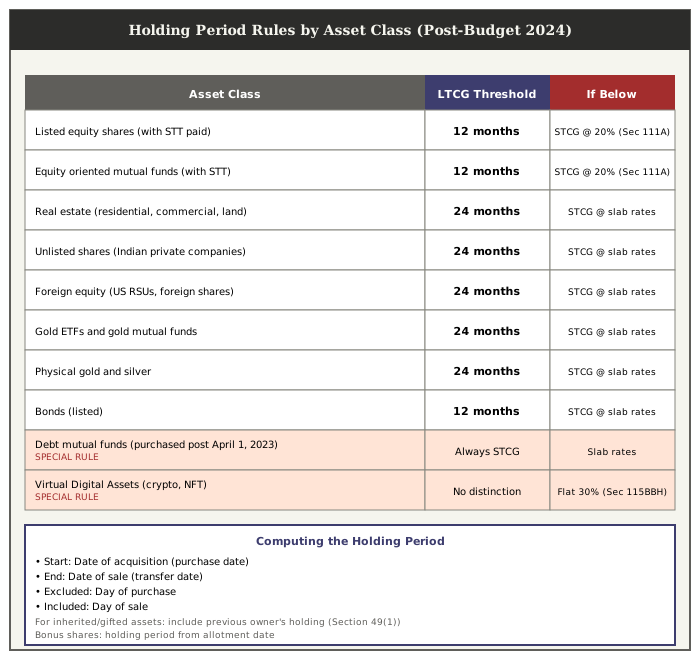
The holding period determines whether your gain is short-term or long-term. Budget 2024 simplified this significantly but classes still differ.
Tax Rate Matrix — STCG and LTCG by Asset Class
The complete picture of capital gains tax rates post-Budget 2024.
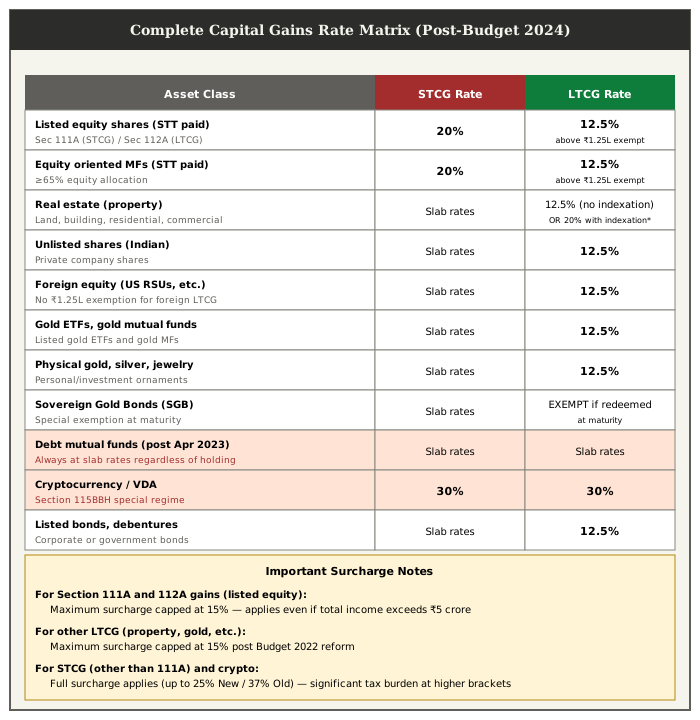
The Budget 2024 simplification.
Before Budget 2024, capital gains rates varied widely across asset classes (10%, 15%, 20%, 20% with indexation). Budget 2024 simplified to essentially two rates: 12.5% LTCG and 20% STCG for listed equity, with slab rates for non-listed STCG.
Section 87A rebate interaction.
Critical clarification (introduced in Lesson 5 and reiterated here): The Section 87A rebate is NOT available against special-rate capital gains.
A filer with ₹10 lakh of LTCG on listed equity in New Regime: LTCG ₹10 lakh, less ₹1.25 lakh exemption = ₹8.75 lakh Tax at 12.5%: ₹1,09,375 Even though total income is within ₹12 lakh, Section 87A rebate doesn't apply to this tax Plus 4% cess: ~₹1,13,750 final tax This is a common surprise for filers expecting rebate coverage.
Sections 45, 111A, 112, 112A, 115BBH of Income Tax Act 1961; Budget 2024 amendments; Budget 2022 surcharge cap.
Cost Basis and Cost Inflation Index
The cost basis you use determines the gain. Understanding cost basis options can save substantial tax.
Three components of cost basis.
For any capital asset, your cost basis = Cost of Acquisition + Cost of Improvement + Transfer-Related Expenses.
Cost of Acquisition. The actual price you paid for the asset, plus directly attributable acquisition costs (broker fees, stamp duty paid at purchase, registration fees).
Cost of Improvement. Capital expenditures that improved the asset (renovations to property, major upgrades to equipment). NOT routine maintenance or repairs.
Transfer Expenses. Costs directly related to the sale (brokerage at sale, legal fees, advertising costs, stamp duty paid for transfer).
Bought apartment in 2015 for ₹50 lakh; paid ₹2 lakh stamp duty + ₹50,000 registration + ₹50,000 broker fee. Renovated kitchen in 2020 spending ₹8 lakh. Sold in 2025 for ₹1.2 crore; paid ₹1.2 lakh broker commission + ₹20,000 legal fees. Cost basis: ₹50,00,000 + ₹2,00,000 + ₹50,000 + ₹50,000 + ₹8,00,000 = ₹61,00,000 Net sale consideration: ₹1,20,00,000 - ₹1,20,000 - ₹20,000 = ₹1,18,60,000 Capital gain: ₹1,18,60,000 - ₹61,00,000 = ₹57,60,000 (LTCG)
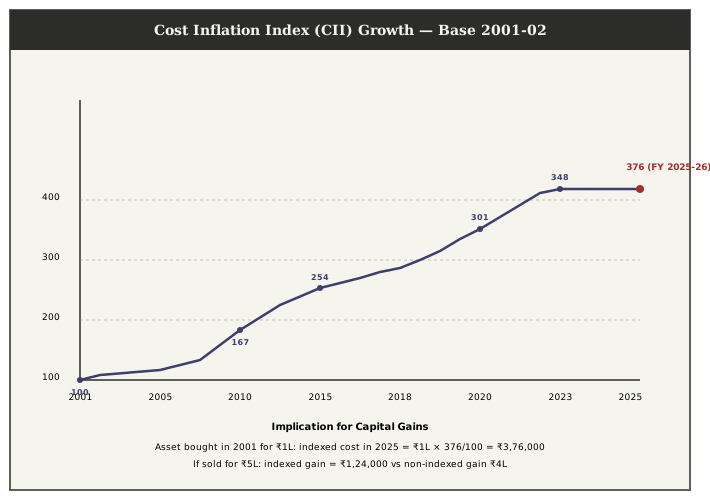
Cost Inflation Index (CII).
When indexation applies (e.g., property acquired before July 23, 2024 with the 20% option), the cost is adjusted for inflation using CII.
Formula: Indexed Cost = Original Cost × (CII of Year of Sale) / (CII of Year of Acquisition)
| Financial Year | CII Value |
|---|---|
| 2001-02 (base year) | 100 |
| 2005-06 | 117 |
| 2010-11 | 167 |
| 2014-15 | 240 |
| 2015-16 | 254 |
| 2017-18 | 272 |
| 2018-19 | 280 |
| 2019-20 | 289 |
| 2020-21 | 301 |
| 2021-22 | 317 |
| 2022-23 | 331 |
| 2023-24 | 348 |
| 2024-25 | 363 |
| 2025-26 | 376 |
Property bought 2015 for ₹50 lakh. Sold 2025 for ₹1.5 crore. CII 2015-16 = 254; CII 2025-26 = 376 Indexed cost = ₹50,00,000 × 376/254 = ₹74,01,575 Gain with indexation: ₹1.5 crore - ₹74,01,575 = ₹75,98,425 Tax at 20% (with indexation): ₹15,19,685 Gain without indexation: ₹1.5 crore - ₹50 lakh = ₹1 crore Tax at 12.5% (without indexation): ₹12,50,000 Without indexation wins by ₹2,69,685. Choose the 12.5% option.
When indexation wins.
- Less than 8-10 years holding: 12.5% without indexation usually wins
- 10-15+ years holding: indexation may win depending on actual appreciation vs inflation
- Older properties with substantial appreciation: depends on specific math
The April 2001 FMV option.
For assets acquired BEFORE April 1, 2001, you can use the FMV as of April 1, 2001 as cost basis instead of actual cost. Critical for inherited or very old properties.
Example. Family property acquired 1985 for ₹2 lakh. FMV April 1, 2001 was ₹15 lakh. Sold 2025 for ₹2 crore. Cost option 1: ₹2 lakh (actual) Cost option 2: ₹15 lakh (April 2001 FMV) Choosing ₹15 lakh: indexed cost = ₹15L × 376/100 = ₹56.4 lakh; gain = ₹1.43 crore at 20% = ₹28.7 lakh Choosing ₹2 lakh (without indexation): gain = ₹1.98 crore at 12.5% = ₹24.75 lakh Choosing ₹15 lakh (without indexation): gain = ₹1.85 crore at 12.5% = ₹23.1 lakh Lowest tax: ₹15 lakh FMV with 12.5% rate = ₹23.1 lakh.
Sections 48, 55(2)(b), 55(3) of Income Tax Act 1961; CBDT CII notifications.
Equity STCG and LTCG — Sections 111A and 112A
The specific regime for listed equity shares and equity-oriented mutual funds.
Section 111A — Short-Term Capital Gains on Listed Equity.
Applies to STCG on:
- Listed equity shares
- Units of equity-oriented mutual funds
- Units of business trusts (REITs, InvITs)
Conditions:
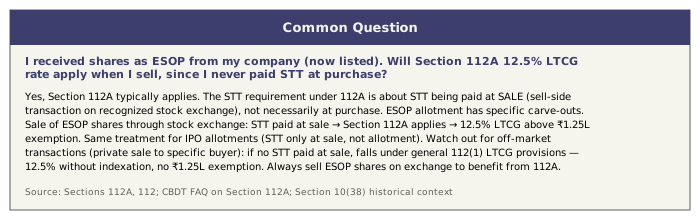
- Securities Transaction Tax (STT) must have been paid
- Asset held for less than 12 months
Rate: 20% (post-Budget 2024; was 15% before)
Section 112A — Long-Term Capital Gains on Listed Equity.
Applies to LTCG on same assets when held over 12 months.
Rate: 12.5% (post-Budget 2024; was 10% before)
The ₹1.25 lakh exemption.
A unique feature of Section 112A: the first ₹1.25 lakh of long-term capital gains per year is exempt from tax.
Aggregation across all equity assets. The exemption is across all your equity LTCG combined, not per stock or per mutual fund.
If you have ₹50,000 LTCG from Reliance shares + ₹40,000 from HDFC Bank + ₹60,000 from equity MF = total ₹1.5 lakh LTCG.
Tax computation: ₹1.5 lakh - ₹1.25 lakh = ₹25,000 taxable. Tax at 12.5% = ₹3,125.
STT requirement.
For Section 111A/112A to apply, STT must have been paid:
- Buy and sell both on exchange (typical retail trades): STT paid both ends, qualifies
- Buy on exchange, sell off-market: only buy STT, may not qualify
- Pre-listing acquisition (IPO allotment): STT typically only on sale; qualifies
Worked example with the exemption.
Active investor has the following in FY 2025-26:
| Stock/Fund | Holding | Purchase | Sale | Gain |
|---|---|---|---|---|
| Reliance | 14 months | ₹2,00,000 | ₹2,80,000 | ₹80,000 (LTCG) |
| HDFC Bank | 18 months | ₹1,50,000 | ₹2,10,000 | ₹60,000 (LTCG) |
| ICICI Bank | 8 months | ₹1,00,000 | ₹1,30,000 | ₹30,000 (STCG) |
| Equity MF | 20 months | ₹3,00,000 | ₹3,60,000 | ₹60,000 (LTCG) |
LTCG total: ₹80K + ₹60K + ₹60K = ₹2,00,000 LTCG taxable: ₹2,00,000 - ₹1,25,000 exemption = ₹75,000 Tax on LTCG: ₹75,000 × 12.5% = ₹9,375 STCG total: ₹30,000 Tax on STCG: ₹30,000 × 20% = ₹6,000 Total capital gains tax: ₹15,375 + cess 4% = ₹15,990
If you have unrealized long-term gains in equity, consider selling shares to realize gains up to ₹1.25 lakh per year (tax-free), then immediately rebuying. Example: You hold ₹5 lakh worth of Infosys with ₹3 lakh unrealized LTCG. Sell shares to realize ₹1.25 lakh LTCG → exempt Immediately rebuy same shares (new cost basis) Pay only small brokerage and STT costs Future sale will have lower remaining gain Over multiple years, this systematically harvests the ₹1.25 lakh annual exemption.
Sections 111A, 112A of Income Tax Act 1961; Budget 2024 amendments increasing rates and exemption from ₹1 lakh to ₹1.25 lakh.
Mutual Fund Capital Gains by Type
Mutual fund taxation depends critically on the underlying composition. Different fund types face very different tax treatment.
Classification of mutual funds for tax purposes.
Equity-oriented funds. At least 65% allocation to Indian listed equity shares throughout the year. Examples:
- Diversified equity funds
- Large-cap, mid-cap, small-cap funds
- ELSS (tax-saving) funds
- Sectoral and thematic funds (if 65%+ equity)
- Most equity index funds
Debt funds. Less than 35% equity allocation. Examples:
- Liquid funds, ultra-short term funds
- Short-term, medium-term, long-term debt funds
- Gilt funds (government securities)
- Corporate bond funds
- Credit risk funds
Hybrid funds. Mixed equity-debt allocation.
- Aggressive hybrid (65%+ equity): taxed as equity
- Conservative hybrid (less than 65% equity): taxed as debt
- Balanced advantage funds: classification depends on actual allocation
International funds. Funds primarily investing abroad. Classified as debt funds for Indian tax purposes regardless of underlying assets (because underlying isn't Indian equity).
Fund of funds (FoF). Depends on FoF type:
- FoF investing in equity MFs: usually classified as equity if 65%+ in domestic equity MFs
- FoF investing in international MFs: classified as debt
- FoF investing in commodity/gold: classified per underlying
| Fund Type | STCG (held less than 12 mo equity / 24 mo other) | LTCG |
|---|---|---|
| Equity-oriented MF | 20% (Sec 111A) | 12.5% above ₹1.25L exemption (Sec 112A) |
| Debt MF (purchased pre Apr 2023) | Slab rates | 20% with indexation (or 12.5% without post-Budget 2024) |
| Debt MF (purchased post Apr 2023) | Slab rates | Slab rates always (NO LTCG) |
| Hybrid (equity classified) | 20% | 12.5% above ₹1.25L |
| Hybrid (debt classified) | Slab rates | Slab rates (if post Apr 2023) |
| International MF | Slab rates | Slab rates (if post Apr 2023) |
| Gold MF | Slab rates | 12.5% |
The Budget 2023 debt MF revolution.
Before April 1, 2023: Debt MFs held over 36 months qualified for 20% LTCG with indexation — very tax-efficient.
After April 1, 2023: Debt MF gains are ALWAYS taxed at slab rates (treated like FD interest). NO LTCG benefit, NO indexation.
This was a major change affecting debt fund investing strategies.
Practical impact. A debt fund investor in 30% bracket:
- Pre-2023 rules: held 36+ months, 20% with indexation → effective tax often 0-5%
- Post-2023 rules: 30% slab rate regardless of holding
Debt funds lost much of their tax advantage. Many investors shifted to:
- Equity funds (long-term)
- Direct fixed deposits (similar tax, no MF expense ratio)
- Tax-free bonds (where available)
Grandfathering of pre-April 2023 debt MF investments.
Investments made before April 1, 2023 in debt MFs retain old tax treatment. So if you bought debt MF on March 31, 2023 and sell in 2026 (3 years held), you still get 20% LTCG with indexation.
SIPs and SWPs — taxation mechanics.
SIP (Systematic Investment Plan). Each instalment is a separate purchase for tax purposes.
SWP (Systematic Withdrawal Plan). Each withdrawal is partial redemption.
- Pro-rata cost basis applied to each withdrawal
- Treated as STCG or LTCG based on each unit's holding period
Investor starts SIP of ₹10,000/month in equity MF on April 1, 2024. Continues through March 31, 2025 (12 SIPs total). Decides to redeem ₹1,50,000 on April 15, 2025. For each redeemed unit, holding period is from purchase date to April 15, 2025: April 2024 SIP: held 12+ months → LTCG May 2024 SIP: held 11.5 months → STCG June 2024 onwards: STCG If FIFO is applied, earliest units redeemed first. Mix of LTCG and STCG applies.
Sections 2(42A), 50AA, 111A, 112A of Income Tax Act 1961; Budget 2023 debt MF amendments.
Property Capital Gains — Detailed Mechanics
While Lesson 13 covered the framework, here we add deeper detail on specific computational mechanics.
The 12.5% vs 20% indexation choice — detailed analysis.
For property acquired BEFORE July 23, 2024, the choice exists. Decision factors:
Holding period.
- Less than 8 years: 12.5% without indexation usually wins
- 8-12 years: depends on specifics
- 12+ years: indexation often wins
Cost vs sale ratio.
- High appreciation relative to inflation: 12.5% without indexation wins
- Modest appreciation tracking inflation: indexation wins
- Below inflation: indexation can yield loss
Mathematical comparison framework.
For property bought for cost C in year Y, sold for sale value S in 2025-26: Tax without indexation = 12.5% × (S - C) Tax with indexation = 20% × (S - C × 376/CII_Y) Set equal to find break-even: 12.5(S-C) = 20(S - C×376/CII_Y) Solving: indexation wins when (S/C) is less than approximately 1.65 × (376/CII_Y)
Practical implication. For property bought in 2015 (CII 254): Breakeven ratio = 1.65 × 376/254 = 2.44 If S/C less than 2.44 (property less than 2.44× original cost), indexation wins If S/C more than 2.44 (property over 2.44× original cost), 12.5% without indexation wins
Stamp duty value (Section 50C) trap.
If actual sale price is less than stamp duty value (circle rate), the higher value is deemed for capital gains.
Safe harbor. If actual sale price is within 10% of stamp duty value (residential property), actual price prevails.
Example. Sale agreement for ₹80 lakh; stamp duty value ₹95 lakh. Difference: ₹15 lakh (18.75%) Exceeds 10% safe harbor Deemed sale value: ₹95 lakh for capital gains Tax on phantom gain you didn't receive
Property co-owned 50-50 between spouses, sold for ₹2 crore: Each spouse's share: ₹1 crore Each computes capital gains separately on their ₹1 crore Each can independently use Section 54/54EC/54F Effective doubling of available exemptions This significantly increases tax planning flexibility for couples.
Multiple property exit strategies.
If you own multiple investment properties:
- Stagger sales across years to spread capital gains
- Use Section 54 against highest-gain property (one residential reinvestment)
- Use Section 54EC bonds for ₹50L exemption on another
- Time sales near year-end to maximize Capital Gains Account use
Sections 45, 48, 50C, 54 of Income Tax Act 1961; Budget 2024 amendments.
Gold and Precious Metals Capital Gains
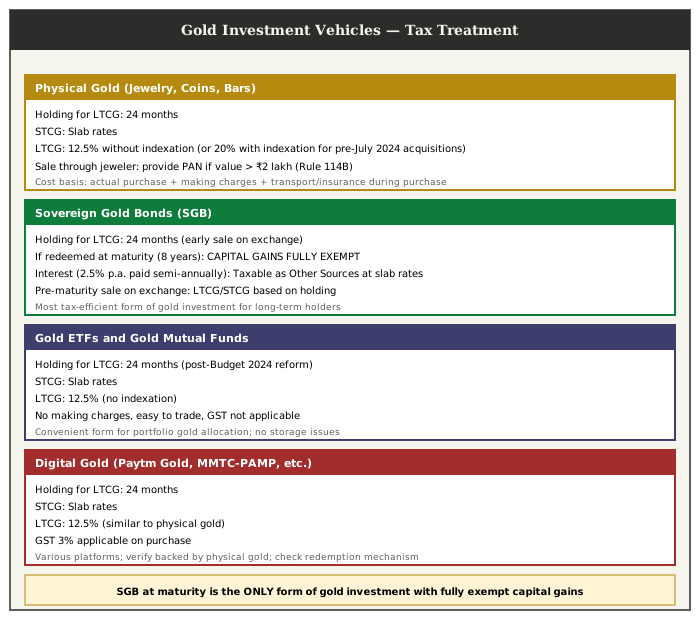
Different forms of gold investment face different tax treatment.
Sovereign Gold Bonds — the tax sweet spot.
SGB advantages:
- 2.5% annual interest (taxable, but adds to gold returns)
- LTCG fully exempt if held to maturity (8 years)
- No making charges
- No storage costs
- Government backing eliminates counterparty risk
For long-term gold investors, SGB is dramatically more tax-efficient than physical gold or ETFs.
Family gold and jewelry — practical considerations.
Family ornaments often have unclear cost basis:
- Inherited jewelry: previous owner's cost (or April 2001 FMV if before 2001)
- Family heirlooms: track best available historical evidence
- Wedding gifts received: gift documentation if available
For old family gold, the April 2001 FMV option is often beneficial. Calculate at FMV of 2001 (use government gold price data for that period), then apply indexation or 12.5% flat to current sale value.
Practical FMV reference. Gold price April 1, 2001 was approximately ₹4,300 per 10 grams. Use this to establish FMV for old family gold.
Sections 2(14), 45, 47(viic) of Income Tax Act 1961; CBDT SGB taxation guidance.
Cryptocurrency and VDA Taxation
The most punitive tax regime for any asset class in Indian tax law.
Section 115BBH — VDA Special Regime.
Introduced by Finance Act 2022, applies from FY 2022-23 onwards:
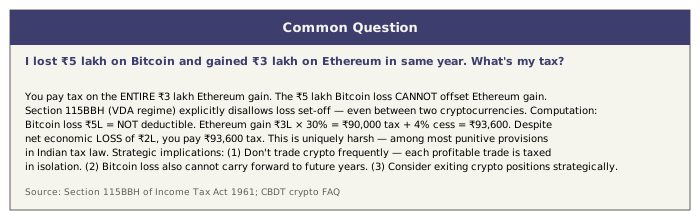
- Income from transfer of VDA: 30% flat rate
- No deductions allowed except cost of acquisition
- No set-off of losses against other income
- Losses on VDA cannot be carried forward against any income
- Losses on one VDA cannot offset gains on another VDA
What is a Virtual Digital Asset (VDA)?
The definition is broad and includes:
- Cryptocurrencies (Bitcoin, Ethereum, etc.)
- Non-fungible tokens (NFTs)
- Other digital assets specified by CBDT
The harsh restrictions.
The cumulative effect of Section 115BBH creates a uniquely burdensome regime:
No expense deductions. Trading fees, software subscriptions, platform charges — none deductible against VDA gains. Only the original cost of acquiring that specific VDA is deductible.
If you lose ₹2 lakh on Bitcoin and gain ₹2 lakh on Ethereum: Loss: NOT deductible Gain: ₹2 lakh taxed at 30% = ₹60,000 Despite net zero economic position, tax of ₹60,000 applies.
No carry-forward of losses. A VDA loss in year 1 cannot offset gains in year 2. Each year stands alone.
No regime concessions. Cannot apply Section 87A rebate to VDA tax. Cannot use New Regime lower slab rates (since flat 30% applies regardless).
Section 194S — TDS on VDA transfers.
1% TDS on VDA transactions through Indian exchanges:
- Exchange deducts 1% on sale proceeds
- Counts toward your final tax liability
- Excess refundable at filing
For foreign exchange trades, this TDS doesn't apply directly, but Indian resident is still liable for 30% Section 115BBH tax.
Schedule VDA in ITR.
Mandatory disclosure of VDA transactions:
- Each transaction reported separately
- Date, amount, type of VDA
- Cost basis and sale value
- TDS amount
An active crypto trader making ₹10 lakh net gain on ₹50 lakh of trading volume: 30% tax on ₹10 lakh = ₹3,00,000 Plus 4% cess: ₹12,000 Plus surcharge if total income exceeds threshold Total: ₹3,12,000+ on ₹10 lakh net gain (31%+ effective) Compare to equity trader with same situation: STCG at 20% = ₹2 lakh, with surcharge cap at 15% — far lower burden.
Strategic implications.
The regime is designed to discourage VDA trading. For most retail traders, the economics are challenging:
- Cannot offset losses against gains
- High tax even on small profits
- Compliance burden of detailed transaction tracking
Some Indian traders shifted to:
- Foreign exchanges (still 30% Indian tax, but additional complexity)
- Long-term holding strategies (still 30%, but less frequent tax events)
- Exiting crypto investing entirely
Schedule FA disclosure for foreign exchange crypto.
For Indians using foreign crypto exchanges (Coinbase, Binance.US, etc.):
- Schedule FA disclosure required as ROR (foreign asset)
- Plus Section 115BBH 30% tax on gains
- Plus Schedule VDA disclosure
- Triple-layered compliance
Sections 115BBH, 194S, 2(47A) of Income Tax Act 1961; Finance Act 2022.
Buybacks and Corporate Actions Taxation
Recent reforms have significantly changed corporate action taxation.
Stock buybacks — pre-October 2024 vs post-October 2024.
Pre-October 2024. Company paid buyback tax at 20% on the buyback distribution amount. Shareholder received tax-free buyback proceeds.
Post-October 2024. Buyback tax abolished. Buyback consideration treated as deemed dividend in shareholder's hands. Tax at shareholder's slab rates.
Impact analysis. For high-bracket shareholders:
- Pre-October 2024: 20% company-level tax → shareholder receives net
- Post-October 2024: 30%+ shareholder tax on full consideration
This is a substantial tax increase for buybacks of high-bracket shareholders.
Bonus shares.
When you receive bonus shares:
- Not taxable at receipt
- Cost basis of bonus shares: ZERO
- Holding period from allotment date of bonus shares
- Original shares retain original cost basis
When you sell bonus shares later:
- Sale value is full capital gain (since cost basis is zero)
- Holding period determines short-term or long-term
Rights issue.
When you exercise rights:
- Pay the rights subscription price
- New shares acquired with that subscription price as cost basis
- Holding period from rights allotment date
If you sell rights entitlement without subscribing:
- Sale proceeds taxable as short-term capital gain
- Original shares cost basis unchanged
Share split (stock split).
When stock splits (e.g., 1:5 split):
- No tax event
- Cost basis adjusts proportionally (1 share at ₹500 becomes 5 shares at ₹100)
- Holding period unchanged from original purchase
Merger and demerger.
For shareholders of company being acquired/merged:
- Generally no tax at merger (Section 47(vii) if conditions met)
- Cost basis of new shares = cost basis of old shares
- Holding period combines old + new
For demerger:
- Original cost basis allocated between original company and demerged entity
- Allocation per Section 49(2C) and prescribed method
Buyback strategy for shareholders.
Post-October 2024, shareholders should:
- Evaluate whether to participate in buyback or hold
- Holding may shift tax to LTCG (lower) vs buyback dividend (slab)
- Consider total tax position annually
Sections 47, 49(2C), 56(2)(x), 115QA (repealed) of Income Tax Act 1961; Budget 2024 buyback amendments.
Section 54 — Residential Property to Residential Property
The most commonly used capital gains exemption for individuals.
The core exemption.
When you sell a residential house property held long-term and reinvest the capital gain in another residential property, the gain is exempt from tax (up to ₹10 crore cap).
Eligibility conditions.
- Asset sold: residential house property
- Asset held: long-term (more than 24 months)
- Filer: Individual or HUF (companies, firms cannot use)
- New asset: residential house property in India
Reinvestment timeline.
The new property must be:
- Purchased within 1 year BEFORE sale of original property, OR
- Purchased within 2 years AFTER sale of original property, OR
- Constructed within 3 years AFTER sale of original property
The "1 year before" provision is unusual — most exemption sections only allow post-sale reinvestment. Section 54 uniquely allows pre-sale purchase to qualify.
The amount of exemption.
Exemption = Lower of:
- Capital gain on original property, OR
- Amount invested in new property
If you invest more than the capital gain, only the gain amount is exempt; excess investment doesn't enhance exemption.
If you invest less than the capital gain, only the invested portion is exempt; balance gain is taxable.
Filer sells residential property for ₹2 crore. Indexed cost: ₹50 lakh. LTCG: ₹1.5 crore. Scenario A: Buys new house for ₹1.8 crore. Investment ≥ capital gain Exemption = full ₹1.5 crore (entire gain) Tax: ZERO Scenario B: Buys new house for ₹1 crore. Investment less than capital gain Exemption = ₹1 crore (amount invested) Taxable gain: ₹50 lakh × 12.5% = ₹6.25 lakh tax Scenario C: Buys new house for ₹2.5 crore. Investment exceeds capital gain Exemption capped at ₹1.5 crore (the gain) Tax: ZERO Note: ₹10 crore investment cap discussed below
The Budget 2023 ₹10 crore cap.
Maximum investment qualifying for Section 54 exemption is ₹10 crore. Investments beyond this don't enhance exemption.
If LTCG is ₹15 crore and you invest ₹15 crore in new property:
- Pre-Budget 2023: Full ₹15 crore exempt
- Post-Budget 2023: Only ₹10 crore exempt; ₹5 crore taxable
This affects ultra-high-value property transactions.
Multiple new houses option.
Budget 2019 added: if capital gain doesn't exceed ₹2 crore, you can invest in TWO new houses (instead of one). Available only once in lifetime.
So filer with ₹1.5 crore LTCG can buy two houses totaling ₹1.5 crore+ and still get full exemption.
Lock-in period for new property.
New property must be held for 3 years from acquisition/construction. If sold earlier:
- Exemption clawed back
- Cost basis of new property reduced by exemption amount
- Effectively, original gain becomes taxable in year of sale of new property
Construction option mechanics.
If you opt for construction (3-year window):
- Pay builder progressively per agreement
- Construction must complete within 3 years
- Possession date matters for the 3-year rule
- Delays beyond 3 years may risk exemption
Common implementation challenges.
Challenge 1: Timing the sale and purchase. Most filers face: you want to sell first to fund purchase, but reinvestment timeline may not align. Solution: Capital Gains Account Scheme (covered next).
Challenge 2: Construction delays. Builder delays beyond 3 years can risk exemption. Document delays with builder; in some cases, tax tribunals have allowed exemption with documented developer-caused delays.
Challenge 3: Multiple sale-purchase coordination. If selling property A and buying property B, with property B's payment schedule spread over months, coordinate carefully.
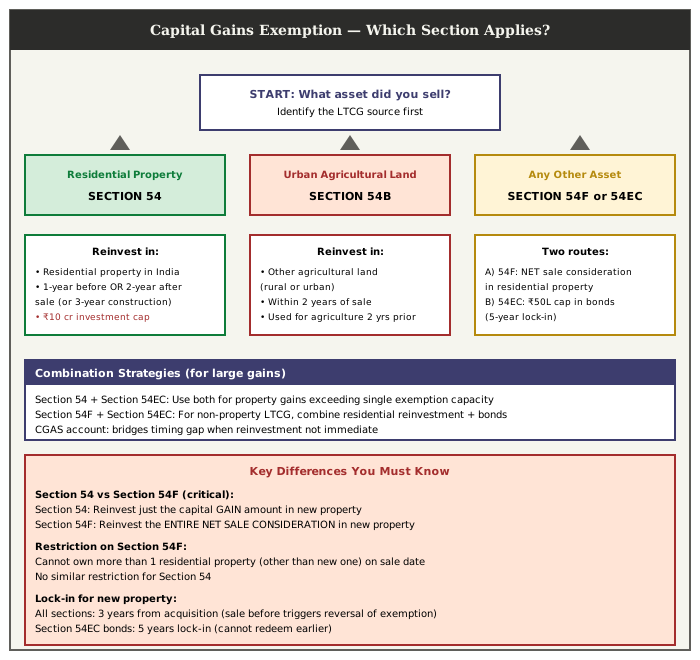
Section 54 of Income Tax Act 1961; Budget 2019 (two-house option); Budget 2023 (₹10 crore cap).
Section 54B — Agricultural Land Reinvestment
A specialized exemption for sale of urban agricultural land.
The exemption.
When urban agricultural land is sold (which triggers capital gains because it's a capital asset under Section 2(14)), reinvestment in other agricultural land defers the gain.
Eligibility conditions.
- Asset sold: agricultural land (must have been agricultural)
- Land must have been used for agricultural purposes by you or your parent in 2 years preceding sale
- Filer: individual or HUF
- New asset: agricultural land (rural or urban)
Reinvestment timeline.
Within 2 years after sale of original land
No 3-year construction window (since you're buying land, not building)
Exemption amount.
Lower of:
- Capital gain on original agricultural land, OR
- Cost of new agricultural land
Lock-in.
New agricultural land must be held for 3 years. Sale within 3 years triggers reversal.
Farmer sells urban agricultural land for ₹1 crore (cost basis ₹20 lakh): LTCG: ₹80 lakh Tax without exemption: ₹80 lakh × 12.5% = ₹10 lakh If reinvests ₹80 lakh in rural agricultural land: Full exemption under Section 54B Tax: ZERO If reinvests ₹50 lakh: Exemption: ₹50 lakh Taxable gain: ₹30 lakh × 12.5% = ₹3.75 lakh
Why this section matters less than expected.
Most agricultural land in India is RURAL (no capital gains tax to begin with). Section 54B applies only to URBAN agricultural land — which is comparatively rare. So this section's practical application is limited.
Section 54B of Income Tax Act 1961.
Section 54EC — Capital Gains Bonds
The most flexible exemption — works for any LTCG, not just property.
The exemption.
LTCG from any long-term capital asset can be exempt by investing in specified bonds.
Eligibility conditions.
- Asset sold: any long-term capital asset (immovable property primarily; broader after some amendments)
- Investment: specified bonds (NHAI, REC, PFC, or other notified)
- Timeline: within 6 months of sale
Investment limit.
Maximum ₹50 lakh per financial year aggregate (across all qualifying transactions).
If you have multiple gains in same FY:
- Aggregate exemption capped at ₹50 lakh
- Cannot exceed ₹50 lakh even from multiple separate transactions
| Feature | Detail |
|---|---|
| Issuers | NHAI (National Highways Authority of India), REC (Rural Electrification Corp), PFC (Power Finance Corp), and other notified |
| Maturity | 5 years (cannot be redeemed earlier) |
| Interest | Approximately 5-5.5% per annum (taxable) |
| Lock-in | 5 years from issue date |
| Liquidity | None during lock-in |
Sale of commercial property: ₹3 crore proceeds, ₹1 crore cost. LTCG: ₹2 crore. Option A: Pay tax in full. Tax: ₹2 crore × 12.5% = ₹25 lakh Plus surcharge and cess Option B: Invest ₹50 lakh in 54EC bonds. Exempt portion: ₹50 lakh Taxable gain: ₹1.5 crore × 12.5% = ₹18.75 lakh Net tax saved by exemption: ₹6.25 lakh BUT capital locked for 5 years at 5% return Option C: Section 54F (if eligible) + 54EC combination. Reinvest portion in residential property (Section 54F) Plus ₹50 lakh in 54EC bonds Combined exemption can cover entire ₹2 crore gain
The 5% bond yield is lower than typical FD rates. But: Tax saved upfront (e.g., ₹6.25 lakh on ₹50 lakh investment in above example) Effective yield = bond interest + tax saved on opportunity cost Often equivalent to 8-10% effective return when tax saving included
Drawbacks.
- 5-year lock-in (no liquidity)
- Below-market bond yield
- Capital tied up
When to use 54EC.
Most appropriate when:
- You have substantial LTCG you want to defer
- You don't want to invest in real estate
- You can spare ₹50 lakh for 5 years
- You don't need the funds for other purposes
For large LTCG (₹3 crore+): Section 54: reinvest in residential property (one house, up to ₹10 crore) Section 54EC: ₹50 lakh in bonds Combined: substantial deferral possible
Section 54EC of Income Tax Act 1961; CBDT notifications on eligible bonds.
Section 54F — Any LTCG to Residential Property
For LTCG on assets OTHER than residential property, Section 54F provides exemption through residential property reinvestment.
The exemption.
LTCG on any long-term capital asset (except residential property) is exempt if you reinvest the NET SALE CONSIDERATION (not just gain) in a residential property.
Critical distinction from Section 54.
| Aspect | Section 54 | Section 54F |
|---|---|---|
| Asset sold | Residential property | Any non-residential capital asset |
| Reinvestment required | Capital gain amount | Net sale consideration |
| Conditions on existing property | None | Cannot own more than 1 other property |
Net sale consideration. Sale value minus transfer expenses. NOT the same as capital gain.
You sell unlisted shares for ₹50 lakh. Cost basis ₹10 lakh. LTCG: ₹40 lakh. Section 54 thinking (wrong here). Reinvest ₹40 lakh in property → exemption. Section 54F reality (correct here). Must reinvest ENTIRE ₹50 lakh (sale value, less transfer expenses) to fully exempt the ₹40 lakh gain. If you only invest ₹40 lakh in new property: Proportionate exemption: ₹40L × (₹40L / ₹50L) = ₹32 lakh exempt Taxable: ₹8 lakh × 12.5% = ₹1 lakh So Section 54F requires more cash outlay than Section 54 for the same gain.
Restriction on existing residential properties.
To claim Section 54F:
- You can own at most ONE residential property (other than the new one) on the date of sale
- Cannot purchase additional residential property (other than the new one) within 1 year before sale or 2 years after sale
- Cannot construct additional residential property within 3 years after sale
This restriction makes Section 54F unsuitable for filers with multiple residential properties.
Timing requirements (same as Section 54).
- Purchase: 1 year before or 2 years after sale
- Construction: 3 years after sale
Common use cases.
Use Case 1: Selling shares to fund home purchase. Filer sells equity portfolio worth ₹1.5 crore (LTCG ₹80 lakh). Reinvests ₹1.5 crore in new residential property. Owns no other residential property. Section 54F fully exempts ₹80 lakh gain.
Use Case 2: Selling gold for property. Family sells inherited gold worth ₹2 crore. Reinvests in property purchase. Section 54F exemption possible if conditions met.
Use Case 3: Selling business assets to retire to a home. Retiring business owner sells business equipment worth ₹1 crore (capital gain ₹70 lakh). Buys retirement home worth ₹1 crore. Section 54F exempts the entire ₹70 lakh.
Section 54F can be combined with 54EC bonds: 54F for property reinvestment 54EC for ₹50 lakh in bonds Together can fully exempt large gains
Section 54F of Income Tax Act 1961.
Section 54GB — Eligible Startup Investment
A specialized exemption for filers investing in eligible startups.
The exemption.
LTCG on sale of residential property exempt if invested in subscription of equity shares of an eligible startup which then uses the funds for new plant and machinery.
Eligibility conditions.
- Asset sold: residential property
- Filer: individual or HUF
- Investment: equity shares of eligible startup (subscription, not secondary purchase)
- Startup must be eligible per Section 80-IAC criteria
- Startup must use proceeds for new plant and machinery within 1 year
Complex multi-step process.
- Sell property
- Subscribe to eligible startup shares
- Startup acquires new plant/machinery
- All within specified timelines
- Lock-in periods apply
Why it's not commonly used.
The conditions are specific and the investment path complex:
- Must invest in startup (specific definition)
- Startup must use funds in specified manner
- Multiple parties involved
- Substantial documentation
In practice, most filers use Section 54 (general property reinvestment) or 54F (any LTCG to residential).
Section 54GB of Income Tax Act 1961.
Capital Gains Account Scheme — Detailed Mechanics
The bridge between sale and reinvestment when timing doesn't align.
The problem CGAS solves.
You sell property in October 2025. You haven't bought new property yet. ITR filing deadline is July 31, 2026. You won't claim Section 54 exemption when filing because you haven't reinvested. But you might invest later (within 2 years).
CGAS allows you to "park" the capital gain in a designated bank account, claim the Section 54/54F exemption now, and reinvest later within the deadline.
Where to open CGAS account.
At authorized public sector banks (SBI, Canara, etc.) — not all branches offer this. Verify before approaching.
Two account types.
Type A — Savings Account.
- Interest: similar to regular savings rate (~3-4%)
- Withdrawals: anytime for property purchase
- Flexibility: high
Type B — Term Deposit Account.
- Interest: higher fixed deposit rate
- Withdrawals: per fixed deposit terms
- Flexibility: lower
Most filers use Type A for accessibility.
Deposit timeline.
You must deposit the unutilized capital gain in CGAS BEFORE the due date of filing your ITR for the year of sale.
For sale in FY 2025-26:
- ITR due date: July 31, 2026 (non-audit)
- CGAS deposit deadline: July 31, 2026
Claim mechanics.
While filing ITR for year of sale:
- Show capital gain
- Show amount deposited in CGAS
- Claim exemption under Section 54/54F treating CGAS deposit as deemed investment
Withdrawal for property purchase.
When you actually purchase property:
- Withdraw from CGAS via designated form
- Bank requires evidence of property purchase
- Funds released to seller or for purchase
The deemed gain trap.
If you don't utilize CGAS funds within deadline (2 years for purchase, 3 years for construction from original sale date):
- Unutilized amount becomes deemed capital gain in the year following deadline expiry
- Taxed at applicable rate (12.5% for LTCG on property)
- Penalty for missed deadline
Sale of property: October 15, 2025. LTCG: ₹1 crore. Filed ITR for FY 2025-26 by July 31, 2026: Showed LTCG: ₹1 crore Deposited in CGAS: ₹1 crore (before July 31, 2026) Claimed Section 54 exemption: ₹1 crore Tax in FY 2025-26: ZERO on this transaction Scenario A: Purchase in March 2027 (within 2 years from October 2025 sale). Withdraw ₹1 crore from CGAS Buy property for ₹1 crore Section 54 exemption finalized No tax payable Scenario B: No purchase by October 2027 (2-year deadline missed). Unutilized CGAS: ₹1 crore Deemed LTCG in FY 2027-28: ₹1 crore Tax at 12.5%: ₹12.5 lakh + interest under Section 234B/234C Costly miss
Strategic considerations.
- Open CGAS account at major PSU bank
- Use Type A for flexibility
- Set calendar reminders for 2-year deadline
- If construction route chosen, monitor builder progress carefully
Section 54(2), 54F(4) of Income Tax Act 1961; Capital Gains Account Scheme 1988.
Capital Losses — Set-Off and Carry-Forward Rules
How to use capital losses to reduce tax liability.
Intra-head set-off rules.
Within the same year:
Short-term capital loss (STCL):
- Can offset both STCG and LTCG (any type)
- Maximum flexibility
Long-term capital loss (LTCL):
- Can offset ONLY LTCG (not STCG)
- Less flexible
In FY 2025-26: STCL on equity: ₹50,000 LTCG on property: ₹3,00,000 STCG on equity: ₹1,00,000 Set-off: STCL ₹50K can offset either STCG or LTCG Optimal: offset against STCG (taxed at 20%) for ₹50K → STCG reduces to ₹50K LTCG remains ₹3,00,000 Tax: STCG ₹50K × 20% = ₹10,000 LTCG ₹3,00,000 × 12.5% (property rate) = ₹37,500
Inter-head set-off.
Capital losses CANNOT offset other heads of income (salary, business income, etc.). They can only offset capital gains.
This is a significant restriction — investment losses don't reduce your tax on salary.
Carry-forward rules.
If losses cannot be fully utilized in current year:
- Short-term capital loss: Carry forward 8 assessment years against any future capital gains (STCG or LTCG).
- Long-term capital loss: Carry forward 8 assessment years against ONLY future LTCG.
Carry-forward conditions.
- Must be reported in ITR of loss year
- Must file ITR within original due date (not belated)
- Cannot retrospectively claim if missed in original filing
In FY 2024-25, you had STCL of ₹2,00,000 (unused) that you reported in ITR by July 31, 2025. In FY 2025-26, you have: STCG: ₹1,50,000 LTCG: ₹3,00,000 Set-off: Carry-forward STCL ₹2,00,000 offsets STCG ₹1,50,000 + LTCG ₹50,000 STCG: ZERO LTCG: ₹2,50,000 taxable
Specific limitations for VDA losses.
Cryptocurrency/VDA losses CANNOT be:
- Set off against gains from other VDAs in same year
- Set off against any other income
- Carried forward to future years
Each VDA gain stands alone for 30% taxation.
Speculative business losses (intraday equity trading).
- Intraday equity trading is speculative business income (covered in Lesson 12)
- Speculative losses can only offset speculative gains
- Carry forward only 4 years
- Cannot offset other business income
Practical loss harvesting strategy.
Before year-end:
- Review your portfolio for unrealized losses
- Selectively sell loss positions to realize losses
- Use losses to offset realized gains
- Reduces current year tax
- Different from US wash sale rules — Indian law allows rebuy
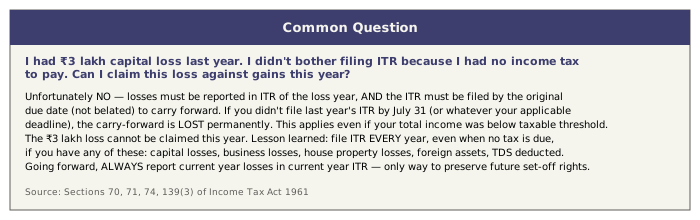
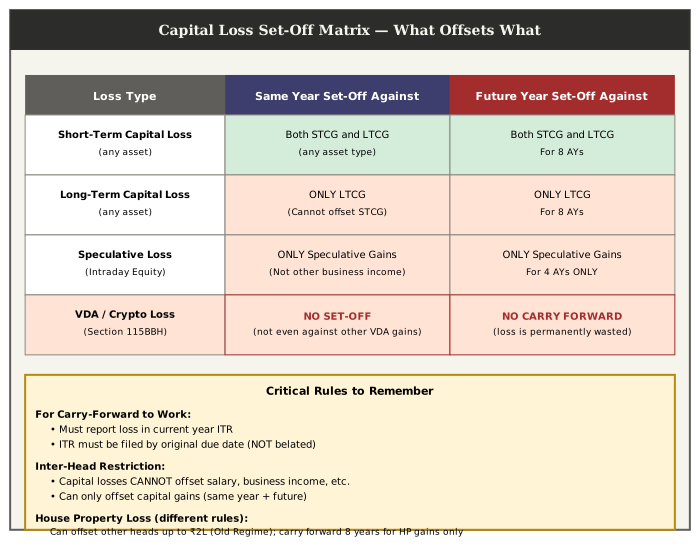
Sections 70, 71, 74 of Income Tax Act 1961; Section 115BBH for VDA loss restrictions.
Section 47 — Tax-Exempt Transfers
Certain transfers are not treated as taxable transfers for capital gains purposes.
Why this matters.
Without Section 47, every change in ownership would trigger capital gains tax. Section 47 carves out specific situations as non-taxable transfers.
Major exempt transfers.
- Section 47(i) — HUF property division. Partition of HUF property among coparceners: not a taxable transfer.
- Section 47(iii) — Gifts to relatives. Gifts of capital assets to specified relatives: not taxable transfer for the giver. Cost basis carries to receiver.
- Section 47(iv) — Transfer to spouse. Transfer of capital asset to spouse: not taxable transfer for giver.
- Section 47(v) — Transfers involving company restructuring. Specific transfers in amalgamation, demerger, conversion of partnership to LLP/company.
- Section 47(vii) — Amalgamation. Shareholder of amalgamating company receives shares of amalgamated company: not a taxable transfer if conditions met.
- Section 47(viia) — Demerger. Shareholder receives shares of demerged company: not taxable if conditions met.
- Section 47(viic) — Sovereign Gold Bond. Redemption of SGB at maturity: not a taxable transfer.
- Section 47(xiii), 47(xiiib) — Firm to company/LLP conversion. Conversion under specified conditions: not taxable transfer.
- Section 47(x) — Bonus shares. Issue of bonus shares: not a taxable transfer for shareholder.
Practical examples.
Father gifts apartment to son For father: Section 47(iii) — not a taxable transfer For son: receives apartment with father's cost basis When son sells later: capital gains using father's cost Holding period includes father's holding
HUF holds family property Karta decides partition among coparceners Each coparcener receives their share Section 47(i) — not a taxable transfer Each coparcener's cost basis: their share of HUF's cost
Company issues 1:1 bonus shares Shareholder receives equal number of new shares No tax at receipt Cost basis of bonus shares: ZERO When sold later, full sale value is gain
The deeper principle.
These transfers preserve economic continuity:
- HUF partition: family wealth simply allocated
- Gift to relative: same family, no economic gain
- Amalgamation: same economic interest, different corporate vehicle
- Bonus shares: same economic ownership, different share count
Section 47 prevents tax on transactions that don't represent real economic exits.
Section 47 of Income Tax Act 1961 (multiple sub-clauses).
Section 49 — Cost Basis for Inherited and Gifted Assets
For assets received without paying (gifts, inheritance), Section 49 establishes cost basis.
Section 49(1) — The carried-over cost basis rule.
When you receive a capital asset by:
- Inheritance (under will or intestate succession)
- Gift
- Partition of HUF
- Under conditions of Section 47 transfers
Your cost basis = previous owner's actual cost.
Holding period addition.
For determining short-term vs long-term:
- Your holding period includes previous owner's holding period
- Often makes inherited asset automatically long-term
Section 55(2)(b) — April 2001 FMV option.
For assets acquired by previous owner BEFORE April 1, 2001:
- You can use FMV as of April 1, 2001 as cost basis
- Or actual cost (whichever you prefer)
This is significant because old assets often have very low actual cost but substantial 2001 FMV.
Grandfather bought property in 1970 for ₹50,000. He died in 2015; your father inherited. Father died in 2024; you inherited. You sell in 2025 for ₹1.5 crore. Cost basis options: Option 1: ₹50,000 (grandfather's actual cost) Option 2: FMV April 1, 2001 (say, ₹10 lakh) Holding period: Grandfather (1970-2015) + Father (2015-2024) + You (2024-2025) = Combined long-term holding. Computation with Option 1 (actual cost). Indexed cost (FY 2001-02 to FY 2025-26): ₹50,000 × 376/100 = ₹1,88,000 Gain with indexation: ₹1.5cr - ₹1.88L = ₹1,48,12,000 Tax at 20%: ₹29,62,400 Computation with Option 2 (April 2001 FMV). Indexed cost: ₹10,00,000 × 376/100 = ₹37,60,000 Gain with indexation: ₹1.5cr - ₹37.6L = ₹1,12,40,000 Tax at 20%: ₹22,48,000 Without indexation (post-Budget 2024 12.5% option). Using cost ₹10 lakh: Gain ₹1.4 crore × 12.5% = ₹17,50,000 Using cost ₹50,000: Gain ₹1,49,50,000 × 12.5% = ₹18,68,750 Best option: April 2001 FMV with 12.5% rate = ₹17,50,000 (lowest tax). The ₹10 lakh April 2001 FMV saves substantial tax vs the ₹50,000 actual cost.
For improvements made by previous owner.
If grandfather/father made improvements before transfer to you:
- Their improvement costs add to your cost basis
- Indexed from year of improvement (if applicable)
Special rule for shares acquired through ESOPs that were transferred.
If you received shares through ESOP, then transferred them to spouse, the spouse's cost basis = your exercise FMV (the perquisite value at which you were taxed). NOT your strike price.
Sections 49, 55(2)(b) of Income Tax Act 1961.
Schedule CG Walkthrough and Common Errors
The Schedule CG of ITR is where capital gains are computed and reported. Filling it correctly is crucial.
Schedule CG structure.
The schedule has separate sections for:
- A: Short-term capital gains
- B: Long-term capital gains
- Sub-sections by asset type
Each requires:
- Date of acquisition
- Date of transfer
- Full value of consideration
- Cost of acquisition (with indexation if applicable)
- Cost of improvement
- Expenditure on transfer
- Capital gain/loss
- Deductions claimed under Section 54 family
- Net taxable capital gain
Common error 1: Wrong holding period classification.
Filers often misclassify gains:
- Equity held 11 months: STCG (not LTCG)
- Property held 23 months: STCG (not LTCG)
- Foreign equity held 23 months: STCG (not LTCG)
Always verify holding period against specific asset class threshold.
Common error 2: Missing transfer expenses.
Filers often forget to deduct:
- Brokerage paid at sale
- Legal/registration costs at sale
- Stamp duty paid for transfer
- Advertising costs
These reduce taxable gain. Maintain receipts.
Common error 3: Forgetting indexation choice.
For property acquired before July 23, 2024, you can choose 20% with indexation or 12.5% without. Common error: defaulting to one without comparing both. Calculate both and choose lower.
Common error 4: Missing ₹1.25 lakh equity exemption.
For equity LTCG under Section 112A, the ₹1.25 lakh exemption is per filer per year. Common error: applying it per asset or per fund. The exemption is aggregated.
Common error 5: Wrong Section claimed.
Section 54 vs 54F confusion:
- Section 54: Property to property
- Section 54F: Other assets to property
Wrong section choice can lead to denial of exemption during scrutiny.
Common error 6: Capital Gains Account Scheme miss.
Filers who plan to reinvest but haven't yet by ITR filing date often forget to deposit in CGAS. Without CGAS deposit before due date, exemption claim is invalid.
Common error 7: Loss reporting omissions.
Filers often don't report losses thinking "I don't have to." But to carry forward, losses MUST be reported in ITR of loss year — by original due date.
Common error 8: Wrong cost basis for inherited assets.
For inherited assets:
- Use previous owner's cost (Section 49(1))
- Consider April 2001 FMV option for older assets
- Include previous owner's holding for period calculation
Common error: using fair market value at date of inheritance as cost basis. WRONG.
Common error 9: VDA reporting in wrong section.
Crypto/VDA gains:
- Use Schedule VDA (separate from Schedule CG)
- Apply Section 115BBH 30% rate
- Don't aggregate with other capital gains
Common error 10: Foreign asset capital gains miss Schedule FA.
If you have foreign equity capital gains:
- Report gain in Schedule CG
- ALSO disclose foreign assets in Schedule FA
- Both required; one without the other is incomplete
Form 16/26AS reconciliation.
For listed equity transactions:
- Form 26AS Part E shows STT-paid transactions
- Aggregate matches your trading
- Discrepancies indicate missing transactions or reporting errors
Documentation maintenance.
For every capital gains transaction, maintain:
- Purchase contract/agreement
- Sale agreement/contract
- Bank statements showing payments
- Brokerage notes
- Stamp duty/registration receipts
- Cost of improvement evidence
- Transfer expense receipts
Retain for 7+ years (general statute of limitations is 6 years for scrutiny).
ITR instructions; Schedule CG technical specifications; CBDT capital gains compliance guidance.
End of lesson — Additional common questions
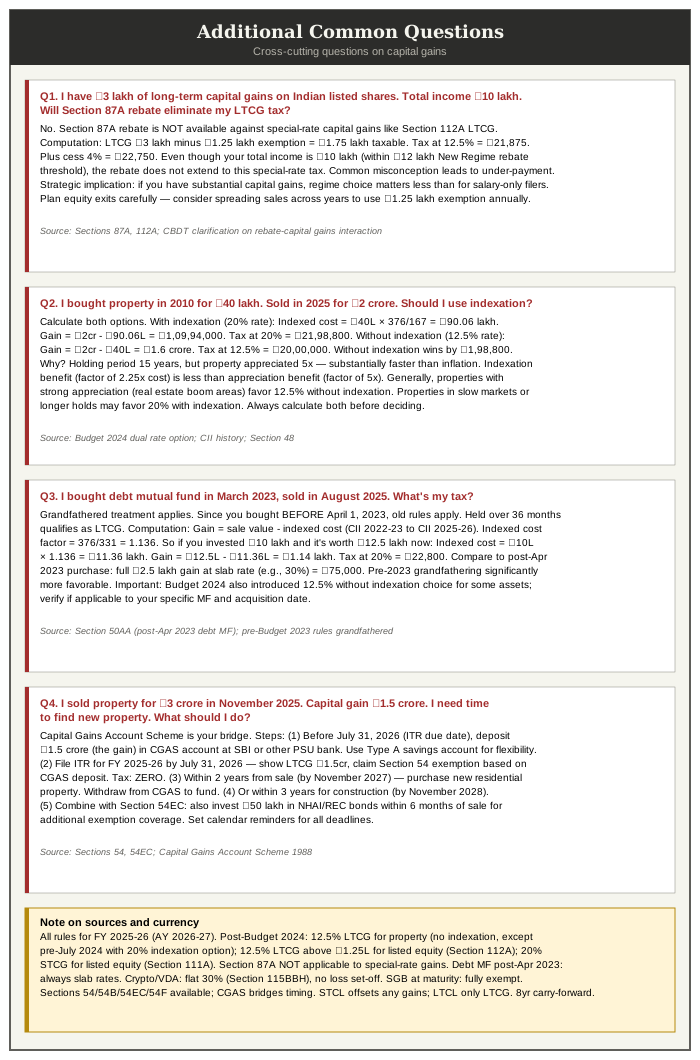
Key Takeaways
- Budget 2024 unified most LTCG at 12.5% and STCG on listed equity at 20%; Section 87A rebate is NOT available against any special-rate capital gains
- Section 112A provides a ₹1.25 lakh annual LTCG exemption on listed equity — aggregate across all equity assets, not per stock
- Debt mutual funds purchased after April 1, 2023 are always taxed at slab rates with no LTCG benefit; pre-April 2023 investments retain old treatment
- VDA (cryptocurrency) gains are taxed at 30% flat; losses cannot be set off against any income including other VDA gains, and cannot be carried forward
- Section 54, 54B, 54EC, 54F, and 54GB each serve a specific reinvestment scenario — match the section to your transaction type to avoid scrutiny denial
- CGAS allows claiming Section 54/54F exemption at filing even before reinvestment — but deposit must happen before the ITR due date
- STCL can offset both STCG and LTCG; LTCL can only offset LTCG; both carry forward 8 years only if reported in ITR by original due date
- For inherited assets, cost basis is the previous owner's cost; the April 2001 FMV option is often beneficial for assets held since before 2001
Quiz — 6 Questions
Answer one at a timeWhat is the STCG tax rate on listed equity shares under Section 111A after Budget 2024?