IT Notices, Scrutiny, and Appeals
Faceless assessment regime under Faceless Assessment Scheme 2019; Section 143(1) routine CPC intimation with demand response options; Section 143(2) scrutiny assessment — limited vs complete, process and documentation; Section 142(1) pre-assessment inquiry best practices; Section 148 income escaping assessment with 3-year and 10-year lookback limits; Section 156 demand notice with stay options and coercive recovery; appeals hierarchy from CIT(A) to ITAT to High Court to Supreme Court; Section 154 rectification for apparent mistakes; Section 270A under-reporting and misreporting penalties at 50% and 200%; Schedule FA foreign asset penalty at ₹10 lakh per asset per year; Vivad se Vishwas dispute resolution schemes; and professional fee ranges from ₹2,000 to ₹5 lakh+
- Identify the type and significance of each income tax notice — Section 143(1) intimation, 143(2) scrutiny, 142(1) inquiry, 148 reassessment, and 156 demand — and know the required response and timeline for each
- Navigate the faceless assessment regime: understand how digital submissions work, response timelines, and how to organize documentation for scrutiny
- Trace the four-level appeals hierarchy from CIT(A) through ITAT, High Court, and Supreme Court — including fee ranges, typical timelines, and 20% pre-deposit requirements for stay
- Apply Section 154 rectification for apparent mistakes and distinguish it from Section 264 revision and full appeals — including the 4-year time limit
- Calculate penalty exposure under Section 270A (50% for under-reporting, 200% for misreporting) and Section 271FA (₹10 lakh per foreign asset per year) and identify immunity conditions under Section 270AA
- Evaluate whether to engage a CA, tax lawyer, or self-handle based on notice type, financial stakes, and complexity — referencing typical fee ranges for each service level
IT Notices, Scrutiny, and Appeals
Filing your ITR isn't the end of the tax journey — it's often the beginning of a multi-year compliance dialogue with the Income Tax Department. Even perfectly filed returns sometimes generate notices. Notices range from routine intimations confirming your filing to scrutiny notices demanding detailed documentation to reassessment notices alleging income escaped assessment. How you respond — accurately, timely, and with appropriate documentation — determines whether the matter closes quickly or escalates into multi-year disputes with penalty exposure.
Most tax filers panic when they receive a notice. This response is often counterproductive. The vast majority of notices are routine — automated intimations about TDS mismatches, minor calculation differences, or requests for missing information. Genuine scrutiny notices affect a small percentage of filers and follow specific processes. Knowing what each notice means, the required response, applicable time limits, and escalation paths transforms a stressful experience into a manageable process.
This lesson covers the post-filing tax compliance ecosystem: types of notices and their meanings, the faceless assessment regime that now governs most tax disputes, the appeals hierarchy from Commissioner (Appeals) to Supreme Court, penalty provisions, and the practical considerations of when to handle matters yourself versus engaging a chartered accountant or tax lawyer. Understanding these mechanics is critical — wrong response or missed deadline can convert a small issue into substantial liability with penalty up to 200% of the tax involved.
A reminder: this lesson uses Income Tax Act 1961 references applicable to FY 2025-26 income filed as AY 2026-27.
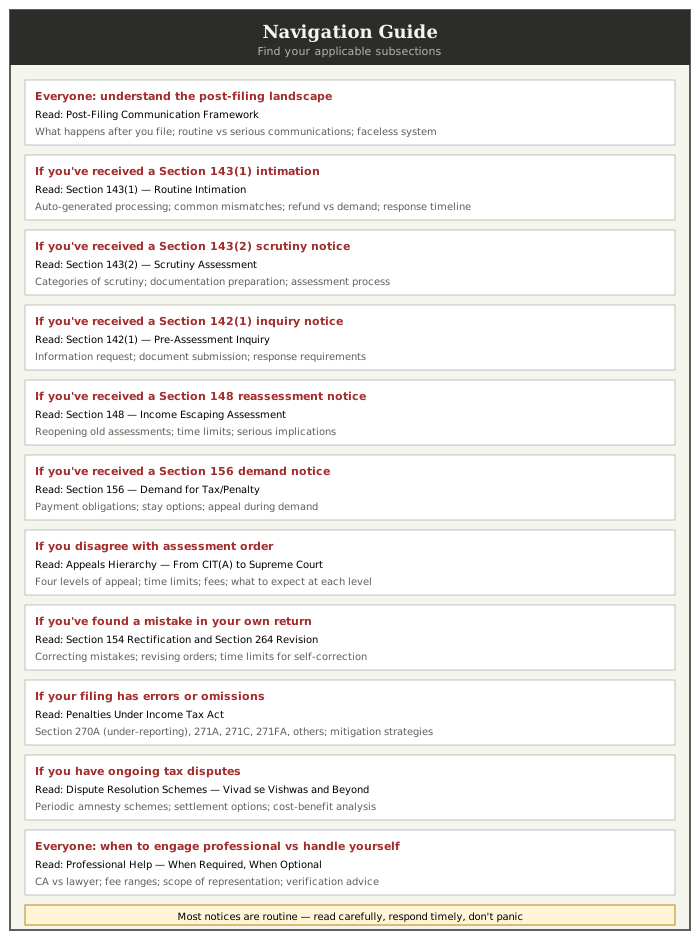
Navigation guide — which subsections apply to your situation
Post-Filing Communication Framework
Understanding how Income Tax Department communicates and when each type of communication occurs.
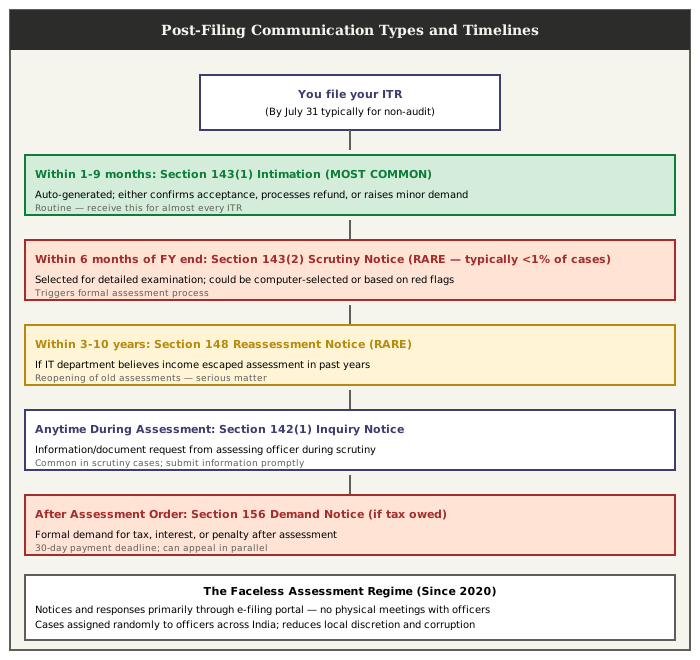
The faceless assessment revolution.
Since 2020, most assessments and scrutiny happen "faceless" — through the e-filing portal:
- No physical visits to IT offices
- Cases assigned to random officers across India
- All communication digital
- Specific time-bound responses required
This system reduces corruption opportunities and standardizes treatment. But it requires comfort with digital communication and prompt response to portal notifications.
Where notices arrive.
- E-filing portal (incometax.gov.in) under "Pending Actions"
- Registered email address (as per ITR)
- Registered mobile number (SMS for major notices)
- In some cases, postal communication
Common reasons for "automatic" notices.
- TDS mismatch (Form 26AS vs ITR reported)
- AIS discrepancy (high-value transactions not in ITR)
- Mathematical errors detected by CPC
- Missing income heads (e.g., interest declared in Form 26AS not in ITR)
- Section 80C / 80D claims without proof matching declarations to employer
Income Tax Act 1961 various sections; Faceless Assessment Scheme 2019; CBDT procedural circulars.
Section 143(1) — Routine Intimation
The most common post-filing communication.
What it is.
Section 143(1) intimation is the CPC (Central Processing Centre) Bangalore's automated processing of your ITR. It:
- Confirms your filed ITR
- Computes tax as per CPC's interpretation
- Either matches your computation (refund due or no balance) OR shows discrepancy
Three possible outcomes.
Outcome 1: Refund due.
- Your computation matches CPC
- TDS/advance tax > final tax liability
- Refund processed (typically within weeks of intimation)
- Direct credit to bank account on file
Outcome 2: No demand, no refund.
- Tax filed = tax actually due
- Intimation closes the matter
- No action required from you
Outcome 3: Demand for payment.
- CPC computation > your filed tax
- Difference owed plus interest
- 30-day response window
- Either pay or contest
Common reasons for demand under 143(1).
| Reason | Description |
|---|---|
| TDS not matched | TDS in Form 26AS doesn't match TDS claimed in ITR |
| Interest income missed | Bank/post office interest in 26AS not in ITR |
| Capital gains underreported | Brokerage data shows gain not declared |
| Deduction excess | 80C/80D claims exceed limit or not properly supported |
| Filing form mismatch | Wrong ITR form for income type |
| Mathematical errors | Calculation mistakes in ITR |
Response options for 143(1) demand.
- If you agree with demand: Pay through challan; file response on portal acknowledging.
- If you disagree: File rectification under Section 154 within 4 years.
- If demand is large and disputed: Can file appeal to CIT(A) — covered later.
Timeline. 143(1) intimations can issue up to 9 months after end of FY of filing. So for ITR filed July 2026 (FY 2025-26), intimation typically by December 2026 or so. Sometimes later.
Section 143(1) of Income Tax Act 1961.
Section 143(2) — Scrutiny Assessment
The serious assessment scrutiny — less common but more consequential.
What triggers Section 143(2).
- Computer-Assisted Scrutiny Selection (CASS) — risk-based selection by computer
- Compulsory scrutiny categories (specific high-risk situations)
- Investigation Wing referrals
- Information from various sources (CBI, ED, GST, etc.)
Categories of scrutiny.
Limited Scrutiny. Examines only specific issues identified (e.g., "verify capital gains on property sale").
- Notice specifies the scope
- Faster process
- More common
Complete Scrutiny. Detailed examination of entire return.
- All income, deductions, claims examined
- Lengthier process (3-6 months typically)
- More demanding documentation
Time limit to issue notice.
Section 143(2) notice must be issued within 3 months from end of FY in which return was furnished. For ITR filed in July 2026 (FY 2026-27): notice must be issued by June 30, 2027.
The scrutiny process.
- Step 1: Receipt of 143(2) notice. Specifies issues to be examined or that complete scrutiny is being done.
- Step 2: Section 142(1) notices. Subsequent notices asking for specific documents/information.
- Step 3: Document submission. Through e-filing portal under faceless system.
- Step 4: Show cause notice (if any). If officer proposes additions, you get chance to respond.
- Step 5: Assessment order (Section 143(3)). Final order accepting or modifying your filed income.
- Step 6: Demand notice (Section 156). If additional tax demanded.
Typical timeline. 12-18 months from 143(2) notice to final assessment order.
Preparing for scrutiny.
When you receive 143(2):
- Don't panic — many scrutinies result in no addition
- Read notice carefully — identify specific issues raised
- Gather documentation for those issues
- Consider engaging CA (especially for complex cases)
- Respond within prescribed timeline (usually 30 days for each notice)
Documentation to maintain (in case of scrutiny).
For 6+ years after assessment year:
- Bank statements
- Investment proofs
- Property documents
- Salary slips and Form 16
- Brokerage statements
- All deduction supporting documents (rent receipts, insurance, etc.)
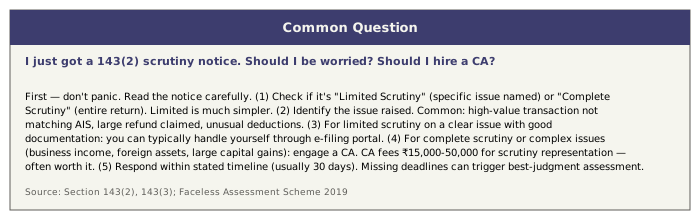
Sections 143(2), 143(3), 142(1) of Income Tax Act 1961; Faceless Assessment Scheme.
Section 142(1) — Pre-Assessment Inquiry
The information request notice issued during assessment proceedings.
What it asks.
Section 142(1) typically asks for specific documents, information, or explanations:
- Bank statements for specific period
- Source of investment funds
- Explanation of specific income/expense items
- Documentation of claimed deductions
- Cost of acquisition documentation
Response timeline.
Generally 15-30 days specified in the notice. Extensions possible by request but not guaranteed.
Best practices for response.
- Submit through e-filing portal (faceless system)
- Provide exactly what's asked — don't volunteer extra information
- PDF format preferred
- Organize logically (separate folders by topic)
- Cover letter summarizing submissions
- Maintain records of what was submitted
Common mistakes.
- Submitting late (triggers adverse inferences)
- Submitting irrelevant documents
- Verbal explanations without supporting documents
- Inconsistent information across submissions
- Not maintaining copy of what was submitted
Section 142(1) of Income Tax Act 1961.
Section 148 — Income Escaping Assessment
The most serious tax notice — reopening of past assessments.
What it means.
Section 148 notice means the IT department believes income chargeable to tax escaped assessment for a past year. They want to reassess.
Time limits.
Under amended provisions:
- 3 years from end of relevant AY (if income escaping ≤ ₹50 lakh)
- 10 years from end of relevant AY (if income escaping > ₹50 lakh)
So for FY 2015-16 (AY 2016-17), notice can issue up to 10 years later for substantial escaping — i.e., up to FY 2026-27.
Prerequisite for Section 148.
Officer must have:
- Information suggesting income escaped assessment
- Conducted inquiry under Section 148A
- Issued show-cause notice giving you opportunity to respond
- Reasoned order finding income did escape
Recent amendments have made the process more procedural — old "vague reasons to believe" has been replaced with specific information requirements.
What triggers Section 148.
- High-value transactions in AIS not matched in ITR
- Information from foreign jurisdictions (CRS, FATCA)
- Investigation Wing reports
- GST data mismatches
- Property registration showing income source not declared
- Bank account discoveries
Response process.
- Step 1. Receive notice; understand the alleged escaping income.
- Step 2. Engage CA + lawyer for substantial cases.
- Step 3. Submit response within prescribed time (usually 30 days).
- Step 4. May include: explanation of why income wasn't taxable, documentation supporting filed position, requests for inspection of officer's information.
- Step 5. Assessment proceedings as for normal scrutiny.
- Step 6. Assessment order; if adverse, appeal options.
Penalty exposure.
Under Section 270A:
- Under-reporting: 50% of tax on under-reported income
- Misreporting: 200% of tax on misreported income
For substantial Section 148 cases, penalty exposure often exceeds the original tax.
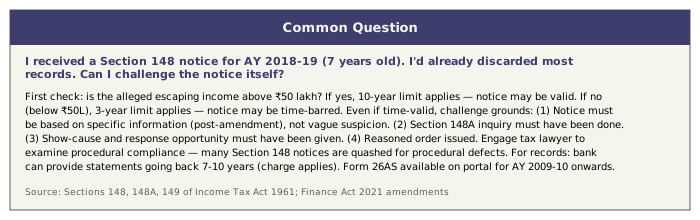
Sections 147, 148, 148A, 149 of Income Tax Act 1961; Finance Act 2021 amendments.
Section 156 — Demand for Tax/Penalty
The formal demand notice following an assessment.
What it demands.
Section 156 demand notice issued after assessment order specifies:
- Total tax demanded
- Interest under Sections 234A, 234B, 234C, 220(2)
- Penalty (if levied)
- Mode of payment
- 30-day payment deadline
Payment options.
| Option | Description |
|---|---|
| Pay full demand | Resolves matter; can still appeal |
| Apply for stay | Request extension or instalments |
| Partial payment | 20% deposit while appealing typically required |
| Appeal with no payment | Risks recovery action against assets |
Stay during appeal.
Filing appeal alone doesn't stay demand. Separate stay application needed:
- To same officer who passed order
- Or to CIT(A) if appeal filed there
- Or to higher authorities
Typical conditions for stay:
- 20% pre-deposit of disputed amount
- Bank guarantee for balance
- Genuine hardship demonstrated
Coercive recovery.
If you don't pay or get stay:
- Bank account attachment
- Asset attachment
- Recovery from third parties (employers, debtors)
- Property auction (extreme cases)
These actions can occur 60+ days after demand notice.
Section 220 interest.
Failure to pay demand within 30 days attracts interest under Section 220(2):
- 1% per month or part thereof
- From date of demand till payment
So delayed payment can become substantial.
Section 156, 220 of Income Tax Act 1961.
Appeals Hierarchy — From CIT(A) to Supreme Court
The four-level appeal structure for tax disputes.
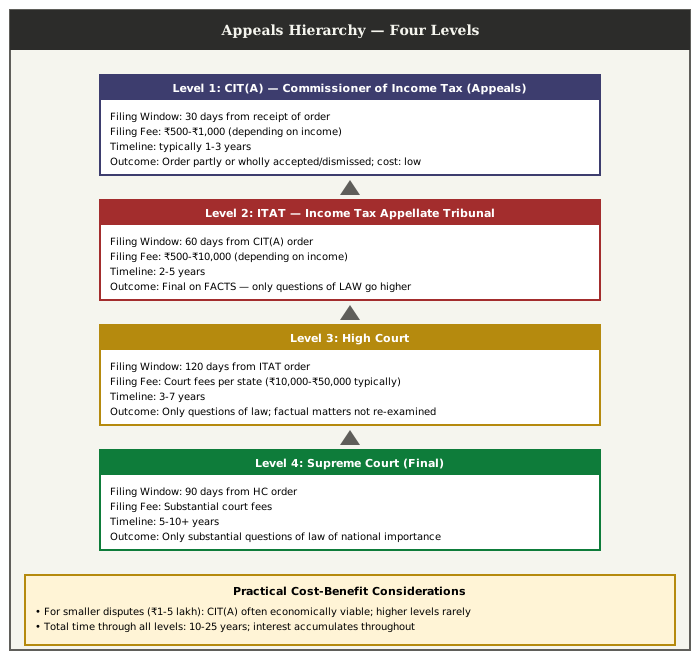
Practical appeal considerations.
When to appeal.
- Genuine factual or legal dispute
- Substantial financial impact
- Reasonable chance of success
- Capable of carrying the case for multiple years
When not to appeal.
- Procedural minor errors (use rectification instead)
- Small amounts where legal costs exceed benefit
- Weak factual position
- Clear settled law against you
Vivad se Vishwas option (when available).
Periodically, government offers amnesty schemes allowing settlement of pending appeals:
- Pay disputed tax (typically without interest/penalty)
- Cases closed
- Limited windows when schemes are open
For ongoing appeals, evaluate amnesty when offered.
Sections 246A, 253, 260A, 261 of Income Tax Act 1961; CBDT appeals procedures.
Section 154 Rectification and Section 264 Revision
For correcting mistakes without full appeals.
Section 154 — Rectification.
For correcting "mistake apparent from the record":
- Mathematical errors
- Clerical mistakes
- Wrong sections cited
- TDS not credited despite being in 26AS
- Income tax computation errors
Process.
- File rectification request through e-filing portal
- Specify the mistake clearly
- Provide supporting evidence
- Time limit: 4 years from assessment year
Common rectification uses.
- 143(1) intimation showing higher demand than actual
- Missing TDS credits
- Wrong year of credit for refunds
- Mathematical errors in CPC processing
Section 264 — Revision by Commissioner.
For broader corrections beyond just "apparent mistakes":
- Discretionary remedy
- Filed with Principal Commissioner/Commissioner
- Within 1 year from order
- Limited grounds — usually used when appeal time has lapsed
Section 263 — Revision against you.
Important caveat: Section 263 allows Commissioner to revise orders that are "erroneous and prejudicial to revenue" — potentially against you. So revision isn't always favorable.
Sections 154, 263, 264 of Income Tax Act 1961.
Penalties Under Income Tax Act
The various penalty provisions for non-compliance.
Section 270A — Under-reporting and misreporting of income.
The most important penalty provision (replaced older Section 271(1)(c) from FY 2016-17).
| Type | Penalty |
|---|---|
| Under-reporting of income | 50% of tax payable on under-reported income |
| Misreporting (more serious — false claims, suppression) | 200% of tax payable on misreported income |
What constitutes misreporting:
- Misrepresentation of facts
- Failure to record receipts/transactions
- Claim of false deduction
- Failure to disclose investments/transactions
Common penalty sections.
| Section | Penalty | Application |
|---|---|---|
| 270A | 50%/200% | Under-reporting/misreporting income |
| 271A | ₹25,000 | Failure to maintain books of account |
| 271B | 0.5% of turnover (max ₹1,50,000) | Failure to get accounts audited |
| 271C | Amount equal to tax not deducted | TDS non-deduction |
| 271D | Amount equal to loan accepted | Cash loans over ₹20,000 |
| 271E | Amount equal to repayment | Cash repayment over ₹20,000 |
| 271FA | ₹5,000-₹10,000/day | Failure to furnish Statement of Financial Transactions |
| 271FAA | ₹50,000 | False AIS reporting |
| 271H | ₹10,000-₹1 lakh | Failure to file TDS returns |
| 271J | ₹10,000 per error | Wrong CA/Cost Accountant report |
Schedule FA — Special penalty.
For failure to disclose foreign assets in Schedule FA:
- ₹10 lakh per asset per year of non-disclosure
- Under Section 271FA of Income Tax Act
- Plus Black Money Act penalties (separate)
This is the most punitive penalty provision in Indian tax law — far harsher than the underlying tax on the income.
Penalty mitigation.
Under Section 270AA, immunity from penalty available if:
- Tax and interest as per assessment order paid within prescribed time
- No appeal filed against the assessment order
- Application made for immunity
- Officer satisfied no misreporting involved
Sections 270A, 271A-271J, 270AA of Income Tax Act 1961.
Dispute Resolution Schemes — Vivad se Vishwas and Beyond
Periodic amnesty programs to clear pending disputes.
Vivad se Vishwas Scheme (VSV) — Pattern.
Government periodically introduces amnesty schemes:
- 2020: VSV 2020 — settled disputes at varying terms
- 2024: VSV 2024 — second iteration
Typical VSV terms.
- Pay disputed tax amount
- Waiver of interest, penalty
- Case withdrawn at appeal stage
- Time-bound application window
Cost-benefit analysis for filers with pending disputes.
Consider VSV when:
- Pending appeal has weak grounds
- Interest/penalty accumulating
- Want to close uncertainty
- Cash available to pay tax
Consider continuing appeal when:
- Strong legal position
- Substantial amount where interest savings worth wait
- Procedural defects in original order
- Favorable judicial precedents emerging
When are VSV schemes likely?
Government introduces when pending tax disputes are high (currently substantial backlog at all levels). Periodic announcement typically in budget or budget-adjacent context.
Direct Tax Vivad se Vishwas Act 2024 and earlier schemes; Finance Act provisions.
Professional Help — When Required, When Optional
Practical guidance on when to engage professionals.
When self-handling is usually sufficient.
- 143(1) intimation with simple TDS/income mismatch
- Limited scrutiny on single clear issue with good documentation
- Rectification under Section 154 for obvious errors
- Routine refund claims
- Small demand amounts (₹10,000-₹50,000)
When CA engagement is recommended.
- Complete scrutiny under 143(2)
- Multiple income heads involved
- Capital gains computations questioned
- Business or professional income matters
- Foreign assets/income matters
- Substantial financial implications (₹5+ lakh)
When tax lawyer is needed.
- Section 148 reassessment (especially for old years)
- Appeals to High Court and Supreme Court
- Complex legal interpretation cases
- Cases involving criminal prosecution possibility
- Substantial Black Money Act implications
Typical fee ranges.
| Service | Fee Range |
|---|---|
| 143(1) rectification | ₹2,000 - ₹5,000 |
| Limited scrutiny representation | ₹10,000 - ₹30,000 |
| Complete scrutiny representation | ₹25,000 - ₹1,00,000 |
| CIT(A) appeal | ₹25,000 - ₹2,00,000 |
| ITAT appeal | ₹50,000 - ₹5,00,000 |
| High Court matter | ₹2,00,000 - ₹20,00,000 |
| Supreme Court matter | ₹5,00,000+ |
Fees vary based on complexity, location, professional reputation.
Choosing a CA or lawyer.
- Experience in similar matters
- Reputation with peer references
- Communication style (responsive, clear)
- Fee structure (lump sum vs hourly clear)
- Professional standing (membership in ICAI, Bar Council)
ICAI directory; Bar Council records; general professional practice.
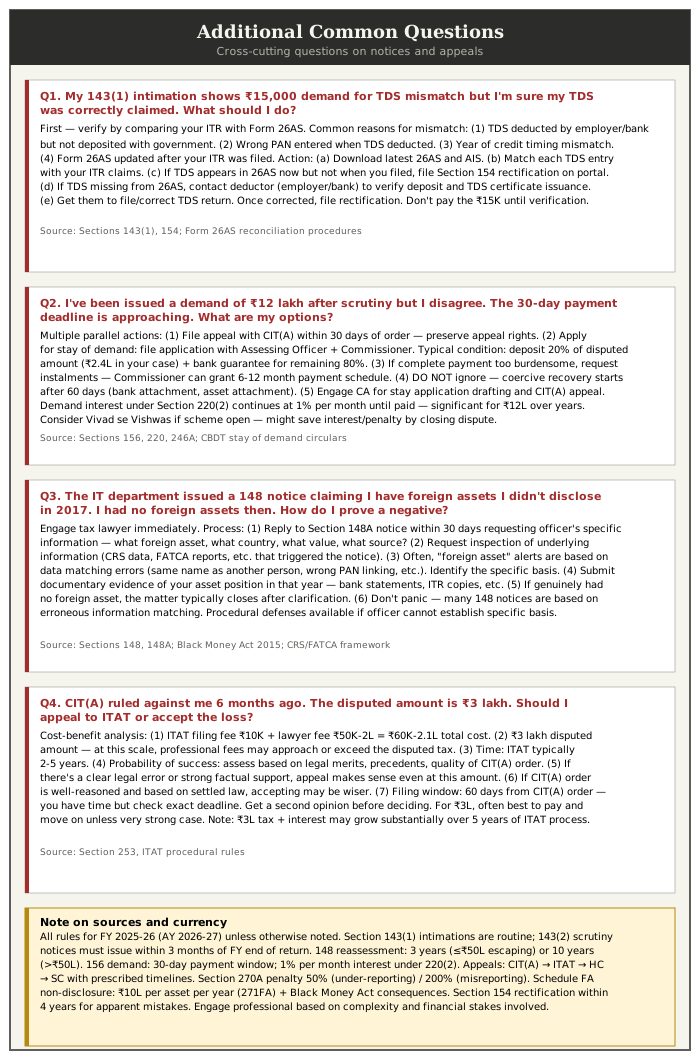
End of lesson — Additional common questions
Key Takeaways
- Most notices are routine 143(1) intimations from CPC Bangalore — respond within 30 days, pay or file rectification under Section 154
- Section 143(2) scrutiny must be issued within 3 months from end of FY of filing — faceless system handles all communication digitally
- Section 148 reassessment can reach back 3 years (income ≤ ₹50 lakh) or 10 years (income > ₹50 lakh) — requires officer to have specific information and follow Section 148A inquiry process
- Filing an appeal does not stay demand — apply separately for stay; typically 20% pre-deposit required while appeal is pending
- Penalty under Section 270A: 50% of tax for under-reporting, 200% for misreporting — Schedule FA failure carries ₹10 lakh per foreign asset per year
- Section 154 rectification available for 4 years for 'mistakes apparent from the record' — faster and cheaper than appeals for clear errors
- Evaluate Vivad se Vishwas when offered — pay disputed tax, waive interest and penalty — particularly for appeals with weak grounds or when uncertainty cost is high
Quiz — 5 Questions
Answer one at a timeWhich notice is the CPC Bangalore's automated processing of your ITR — the most common post-filing communication?