State & Professional Taxes
Constitutional division of taxing powers; professional tax state-by-state with Article 276 cap and Section 16(iii) deduction; stamp duty rates with Section 80C interaction and capital gains cost basis treatment; municipal property tax computation and Section 23 deductibility for let-out properties; state agricultural income tax in Kerala, Assam, and others; GST for individuals including consumer impact, RCM, and registration thresholds; TCS on foreign tours, LRS remittances, and motor vehicles under Section 206C; vehicle road tax lifetime vs annual systems with EV concessions; multi-state filer considerations; and how stamp duty, property tax, and professional tax interact with central income tax
- Identify the constitutional division of taxing powers between Union, State, and municipal governments and explain why multiple parallel tax systems exist
- Apply professional tax rules state-by-state, including the Article 276 cap, which states levy PT, and the Section 16(iii) deduction from salary income
- Compute stamp duty impact on Section 80C deduction and future capital gains cost basis — and document all transaction costs at purchase
- Determine when municipal property tax is deductible from house property income under Section 23 and when it is not
- Identify which states levy agricultural income tax and how it interacts with the central Section 10(1) exemption
- Explain GST obligations for individuals — when registration is required, when RCM applies, and why salaried employees and investors never register
- Compute TCS on foreign tour packages, LRS remittances, and motor vehicle purchases, and claim TCS credit in the ITR
- Understand vehicle road tax systems across states, EV concessions, and the income tax treatment of vehicle taxes for personal vs business use
State & Professional Taxes
Indian taxation isn't just central income tax. Every working professional and property owner faces a layered set of state, municipal, and transaction-based taxes that aren't part of the central income tax framework but significantly affect overall tax burden. A salaried professional in Mumbai pays central income tax plus Maharashtra professional tax plus property tax (if homeowner) plus stamp duty on transactions plus GST on services consumed. These often add 1-3% to effective tax burden — sometimes more for property-heavy lifestyles.
This lesson covers the parallel tax systems that operate alongside central income tax. Some are minor annoyances (professional tax of ₹2,400/year); others are substantial (stamp duty of 5-7% on property purchase). The interplay between these systems is also important — stamp duty paid on property purchase becomes part of cost basis for future capital gains, GST paid on services may interact with input tax credit for self-employed filers, and state-level agricultural income tax can affect overall planning for those with substantial farm income.
Most lessons in this curriculum focus on what's filed with the central Income Tax Department. This lesson focuses on what's filed (or paid) with state governments, municipal corporations, and registration authorities. While these don't go in your ITR, they affect your financial life and require their own compliance.
A reminder: this lesson uses Income Tax Act 1961 references applicable to FY 2025-26 income filed as AY 2026-27, alongside state-specific tax laws and GST Act 2017.
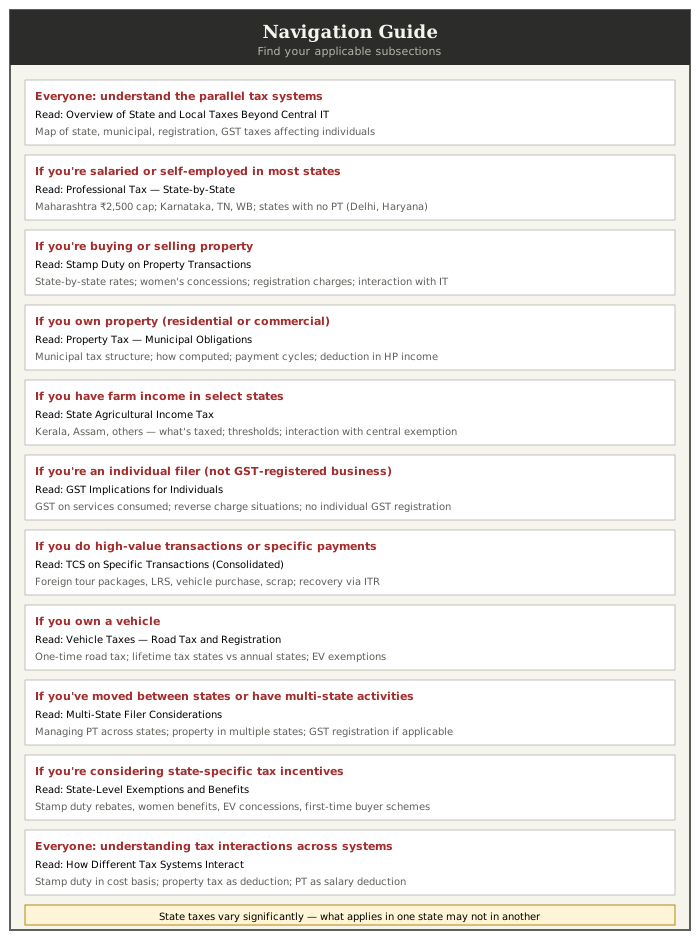
Navigation guide — which subsections apply to your situation
Overview of State and Local Taxes Beyond Central IT
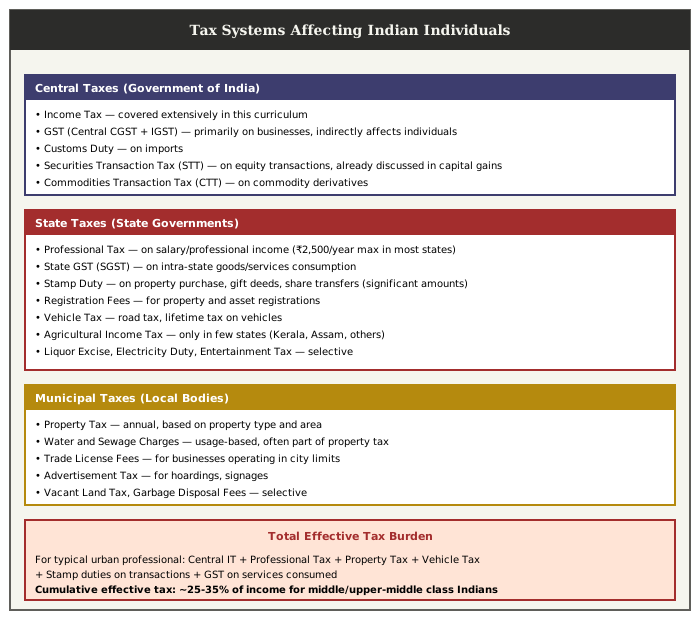
Indian taxation operates on three constitutional levels: central, state, and municipal. Each has its own taxing powers under the Constitution.
Constitutional framework.
Under the Constitution of India (Schedule VII):
- Union List: Central government taxing powers (income tax, customs, central excise)
- State List: State government taxing powers (stamp duty, professional tax, agricultural income tax, vehicle tax)
- Concurrent List: Both can tax (some areas)
This division is why we have multiple parallel tax systems.
The GST reform. The 2017 GST regime subsumed many state taxes (Sales Tax/VAT, Entry Tax, Octroi, Service Tax, etc.) into a unified GST framework. CGST goes to centre, SGST to states, IGST split between them. But several state taxes remain outside GST: stamp duty, professional tax, vehicle tax, property tax, electricity duty, alcohol/petroleum.
Constitution of India Schedule VII; GST Act 2017; various state tax statutes.
Professional Tax — State-by-State
The most common state tax affecting working professionals across India.
What is Professional Tax (PT).
A state-level tax levied on professions, trades, callings, and employments. Despite the name, it's not just for "professionals" — it's collected from anyone earning income through profession, trade, or employment in a state.
Constitutional cap.
Article 276 of the Constitution caps Professional Tax at ₹2,500 per year per person across all states. So even in states with PT, no one pays more than ₹2,500/year.
State-by-state status.
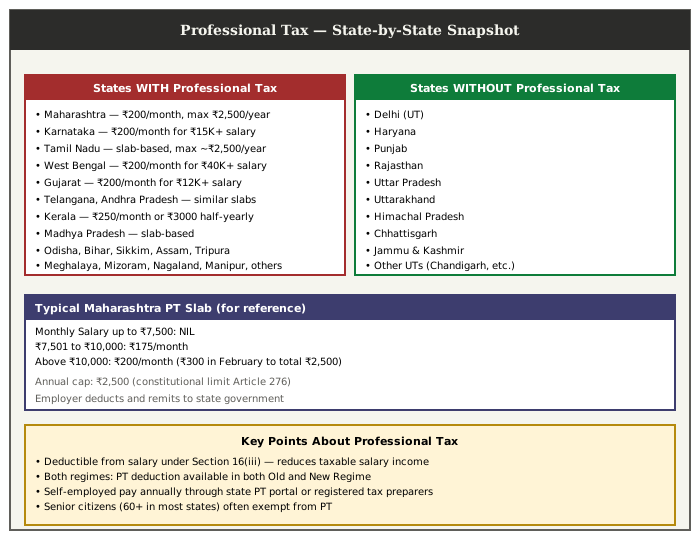
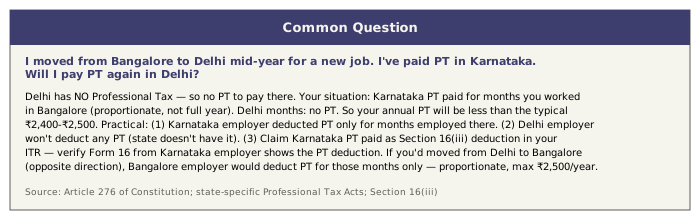
Article 276 of Constitution of India; state Professional Tax Acts (Maharashtra Profession Tax Act 1975, Karnataka Tax on Professions Trades Callings and Employments Act 1976, etc.); Section 16(iii) of Income Tax Act 1961.
Stamp Duty on Property Transactions
Among the largest single tax payments most Indians ever make.
What is stamp duty.
A state-level tax on legal documents transferring assets — property, shares, business interests. The duty makes the document legally enforceable. Documents without proper stamp duty cannot be used as evidence in court.
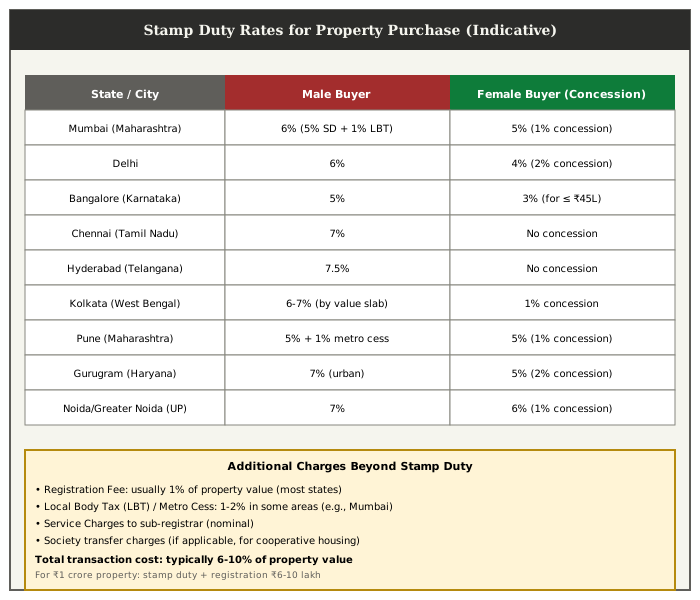
State-by-state rates.
Stamp duty varies dramatically by state. Approximate rates as of FY 2025-26:
Stamp duty interaction with income tax.
- Becomes part of cost basis for future capital gains computation
- Section 80C deduction available in year of purchase (within ₹1.5 lakh limit, Old Regime)
- Not deductible separately under any other section
Buy ₹1 crore property in Mumbai paying 6% stamp duty (₹6 lakh) + 1% registration (₹1 lakh) = ₹7 lakh total transaction cost. For income tax purposes: Section 80C: ₹1.5 lakh (within overall limit) — saves tax in current year
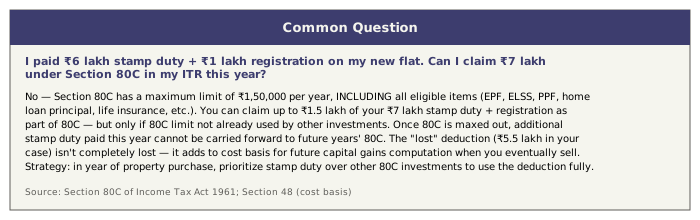
Cost basis for future capital gains: ₹1,07,00,000 (purchase price + stamp duty + registration) When you sell later for ₹2 crore: Capital gain: ₹2 crore - ₹1.07 crore = ₹93 lakh (instead of ₹1 crore) LTCG tax saved: ₹7 lakh × 12.5% = ₹87,500 So stamp duty effectively reduces future capital gains. Document all transaction costs carefully.
State Stamp Acts (Maharashtra Stamp Act 1958, Karnataka Stamp Act 1957, etc.); Indian Stamp Act 1899; Section 80C, 48 of Income Tax Act 1961.
Property Tax — Municipal Obligations
Annual tax levied by municipal corporations on properties.
Computation basis varies by city.
Major systems:
- Unit Area System (UAS). Tax = Unit value × Property area × Use factor × Age factor × Occupancy factor × Structure factor. Used in Delhi, Mumbai (post-2010), Bangalore.
- Annual Rental Value (ARV). Tax = Notional annual rent × Tax rate. Used in some older municipal regimes.
- Capital Value System (CVS). Tax = Property's capital value × Tax rate. Used in Mumbai (current), Kolkata, others.
Typical property tax burden.
For a 1,000 sq ft apartment:
- Mumbai: ₹15,000 - ₹50,000 annually (depending on area)
- Bangalore: ₹3,000 - ₹15,000 annually
- Delhi: ₹4,000 - ₹20,000 annually
- Smaller towns: ₹2,000 - ₹10,000 annually
Income tax interaction.
For let-out and deemed let-out properties (covered in Lesson 13):
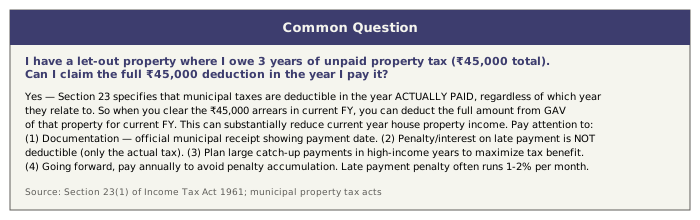
- Municipal taxes PAID by owner are deductible from Gross Annual Value
- Must be actually paid (not accrued) during the year
- Reduces Net Annual Value before 30% standard deduction
For self-occupied properties:
- Property tax is NOT separately deductible
- (Since GAV is nil, there's no income to deduct from)
Let-out property: Annual rent received: ₹5,00,000 Property tax paid: ₹15,000 Net Annual Value: ₹4,85,000 Less 30% standard deduction: ₹1,45,500 Less home loan interest: ₹2,00,000 Net house property income: ₹1,39,500 taxable Without property tax payment: NAV would be ₹5,00,000; HP income ₹50,000 higher → ₹50,000 × 30% tax bracket = ₹15,000 more tax. Paying property tax saves you the deduction.
Section 23 of Income Tax Act 1961; municipal property tax laws (BMC Act for Mumbai, BBMP Act for Bangalore, MCD Act for Delhi, etc.).
State Agricultural Income Tax
While central law exempts agricultural income, some states tax it separately.
States with agricultural income tax (selective list).
| State | Agricultural Income Tax Status |
|---|---|
| Kerala | Yes — Kerala Agricultural Income Tax Act 1991 |
| Assam | Yes — Assam Agricultural Income Tax Act 1939 |
| Tamil Nadu | Yes — TN Agricultural Income Tax Act 1955 (limited applicability) |
| West Bengal | Yes — WB Agricultural Income Tax Act 1944 |
| Karnataka | Yes — Karnataka Agricultural Income Tax Act 1957 |
| Most other states | NO state agricultural income tax |
Kerala — most active. Kerala actively taxes plantation income (rubber, coffee, tea estates).
Computation pattern.
Each state has its own slabs, deductions, and rates. Typically:
- Basic exemption threshold (around ₹2-5 lakh)
- Progressive rates from 10-40%
- Specific deductions for cultivation expenses
- Returns filed with state agriculture/tax department
Interaction with central exemption.
Important: Central exemption of agricultural income (Section 10(1)) doesn't prevent states from taxing the same income. Indian constitutional framework allows both.
For a Kerala plantation owner with substantial agricultural income:
- Central tax: NIL (Section 10(1))
- State tax: per Kerala Agricultural Income Tax Act
This is a state-level burden affecting wealthy plantation owners primarily.
Partial integration interaction.
For central income tax (Lesson 14 covered):
- Agricultural income exempt but used for partial integration with non-agricultural income
- This is for CENTRAL tax rate determination
- State agricultural income tax is separate and additional
State Agricultural Income Tax Acts (Kerala, Assam, etc.); Section 10(1) of central Income Tax Act 1961.
GST Implications for Individuals
Most individuals aren't GST-registered, but GST affects daily life.
Where individuals encounter GST.
As consumers.
- GST included in price of goods/services
- Restaurant bills, shopping, healthcare premiums, professional fees
- Service charges
- All consumer transactions
Typical GST rates.
- Essential goods: 0% or 5%
- Standard items: 12-18%
- Luxury items, services: 28%
- Special rates: alcohol/petroleum (state taxes, outside GST)
Reverse Charge Mechanism (RCM) for individuals.
In specific cases, the recipient (individual) must pay GST instead of the supplier:
| Service Received | RCM Applicability for Individual |
|---|---|
| Legal services from advocate | If individual is GST registered |
| Service from unregistered supplier | Generally for businesses, not individuals |
| Imported services | Yes — individual must pay GST under RCM |
Most individuals don't face RCM. Those affected are typically GST-registered professionals/businesses.
No GST registration for pure individuals.
- Salaried employees: NEVER need GST registration
- Investors: NEVER need GST registration (capital gains aren't supply of goods/services)
- Pure rental income from residential property: GST exempt
- Pure rental income from commercial property: GST registration if rent > ₹20 lakh annually
When individuals need GST registration.
- Operating a business with turnover > ₹40 lakh (₹20 lakh for services)
- Commercial property rentals > ₹20 lakh/year
- E-commerce operations
- Inter-state supply of goods (any turnover)
This is covered in Lesson 12 (self-employed taxation) in more detail.
GST Act 2017; CGST Rules; CBIC notifications.
TCS on Specific Transactions (Consolidated)
Tax Collected at Source on various transactions, covered piecemeal across earlier lessons.
Major TCS provisions affecting individuals.
| Transaction | Section | Rate | Threshold |
|---|---|---|---|
| Foreign tour packages (from Indian operator) | 206C(1G) | 5% | Any value |
| LRS remittances — education (own funds) | 206C(1G) | 5% | Above ₹10 lakh |
| LRS remittances — education (loan) | 206C(1G) | 0.5% | Above ₹7 lakh |
| LRS remittances — medical | 206C(1G) | 5% | Above ₹7 lakh |
| LRS remittances — other purposes | 206C(1G) | 20% | Above ₹10 lakh |
| Sale of motor vehicle | 206C(1F) | 1% | Value > ₹10 lakh |
| Sale of scrap | 206C(1) | 1% | Any value |
How TCS works mechanically.
- You make the transaction (e.g., book foreign tour)
- Service provider/seller adds TCS to your bill
- They deposit TCS to government
- They issue TCS certificate (Form 27D)
- TCS appears in your Form 26AS
- You claim TCS as credit in your ITR
- If TCS exceeds your tax liability: refund
Booking ₹15 lakh foreign tour package. TCS at 5%: ₹75,000 collected Total bill: ₹15,75,000 TCS deposited by tour operator Form 27D issued to you At ITR time: ₹75,000 claimed as TCS credit If your total tax liability for year is ₹2 lakh: net tax to pay = ₹1,25,000 If your total tax liability is ₹50,000: ₹25,000 refund
Cash flow consideration.
TCS doesn't increase your final tax — but it does affect cash flow:
- Money tied up with government
- Recoverable through ITR
- Average wait: 6-12 months for refund
Section 206C of Income Tax Act 1961; Finance Act 2020/2023 amendments.
Vehicle Taxes — Road Tax and Registration
State-level taxes on vehicle ownership.
Two systems.
Lifetime tax states (most south Indian states).
- One-time payment at registration
- Karnataka, Tamil Nadu, Kerala, Maharashtra (newer rules), others
- Rate: 8-20% of vehicle ex-showroom price (depending on type, fuel, state)
- No annual payment
Annual tax states.
- Paid every year
- UP, Delhi (older registrations), some others
- Lower per-year amount but recurring
Typical road tax burden.
For ₹10 lakh car:
| State | Approximate Lifetime Tax |
|---|---|
| Karnataka | ₹1,30,000 - ₹1,80,000 (13-18%) |
| Maharashtra | ₹1,10,000 - ₹1,40,000 (11-14%) |
| Tamil Nadu | ₹1,30,000 - ₹1,80,000 |
| Delhi | ₹40,000 - ₹80,000 (per year) |
| UP | ₹70,000 - ₹1,00,000 (one-time) |
EV concessions.
Most states offer significant concessions for electric vehicles:
- Delhi: 100% road tax exemption for EVs
- Maharashtra: significant rebates
- Kerala, Karnataka, Tamil Nadu: various concessions
- Aimed at promoting EV adoption
Income tax interaction.
Vehicle taxes are NOT deductible in personal income tax (unlike business vehicles where they may be).
For business vehicles:
- Road tax deductible as business expense
- Insurance premium deductible
- Depreciation per Section 32 (15% for general vehicles, 30% for commercial taxis)
State Motor Vehicle Acts; state-specific road tax rules.
Multi-State Filer Considerations
Special considerations for those operating across multiple states.
Property in multiple states.
If you own property in multiple states:
- Each property generates HP income for central ITR
- State-specific property tax in each state
- State-specific stamp duty when purchased
- Maintenance/local compliance per state
Important: For central ITR, all property income aggregates regardless of state. State property tax paid for each property is deductible per Section 23 (for let-out properties).
Income earned across states.
If you work or earn in multiple states:
- Central income tax: single ITR, aggregates all income
- Professional tax: each employer (in PT state) deducts proportionately
- No state income tax (India doesn't have state-level personal income tax — unlike US)
GST registration across states.
For GST-registered businesses operating in multiple states:
- Separate GST registration per state
- IGST for inter-state supplies
- CGST + SGST for intra-state supplies
- Complex compliance — usually requires CA
Practical for typical individuals.
Most individuals don't face multi-state tax complexity beyond:
- Professional tax (only in PT states)
- Property tax (only for states where property owned)
- Vehicle tax (registration state)
Various state tax laws; CGST/SGST framework.
State-Level Exemptions and Benefits
States offer various tax-related incentives.
Common state-level benefits.
Stamp duty concessions.
- Women buyers: 1-2% reduction (most states)
- First-time buyers under affordable housing: rebates
- Senior citizens: some states (rare)
- Self-occupied vs investment: varies
Property tax rebates.
- Early payment rebate (5-10% if paid before due date)
- Senior citizen rebate (some municipalities)
- Single woman homeowner rebate (select cities)
EV incentives.
- Road tax exemption (most states)
- Registration fee waiver
- Direct purchase subsidies (state-specific schemes)
Affordable housing schemes (state-specific).
- PMAY (Pradhan Mantri Awas Yojana) — central + state
- State-specific subsidy schemes
- Interest subvention (CLSS)
State-level tax notifications; PMAY guidelines.
How Different Tax Systems Interact
The interactions across tax systems often matter more than individual tax burdens.
Property purchase tax interactions.
When you buy property worth ₹1 crore:
Direct taxes paid:
- Stamp duty: ₹5-7 lakh (state)
- Registration: ₹1 lakh (state)
- GST on under-construction: 5-12% (central) — only if applicable
Income tax interactions:
- Section 80C: up to ₹1.5 lakh from stamp duty (Old Regime)
- Cost basis for future capital gains: includes stamp duty + registration
Ongoing tax obligations:
- Property tax: ₹15,000+/year (municipal)
- Income tax on rental (if let out)
- Wealth tax: abolished
Property bought 2015 for ₹50 lakh + stamp duty ₹3 lakh + registration ₹50,000 = ₹53.5 lakh total cost. Sold 2025 for ₹1.5 crore. Cost basis for capital gains: ₹53.5 lakh (not ₹50 lakh) Indexation (if applicable): use full ₹53.5 lakh as base Lower capital gain → lower tax This is why documentation of ALL transaction costs at purchase is critical for sale 10+ years later.
Salary income interaction.
Salaried filer in Maharashtra:
- Central income tax (slab rates)
- Professional tax ₹2,500/year
- Both PT and central IT computed on same gross salary
- PT deducted before computing taxable salary (Section 16(iii))
So PT ₹2,500 reduces taxable salary by ₹2,500 → tax saved at marginal rate (e.g., ₹750 at 30%). Net effective burden of PT: ₹2,500 - ₹750 = ₹1,750.
Various central and state laws; CBDT clarifications on cost basis treatment.
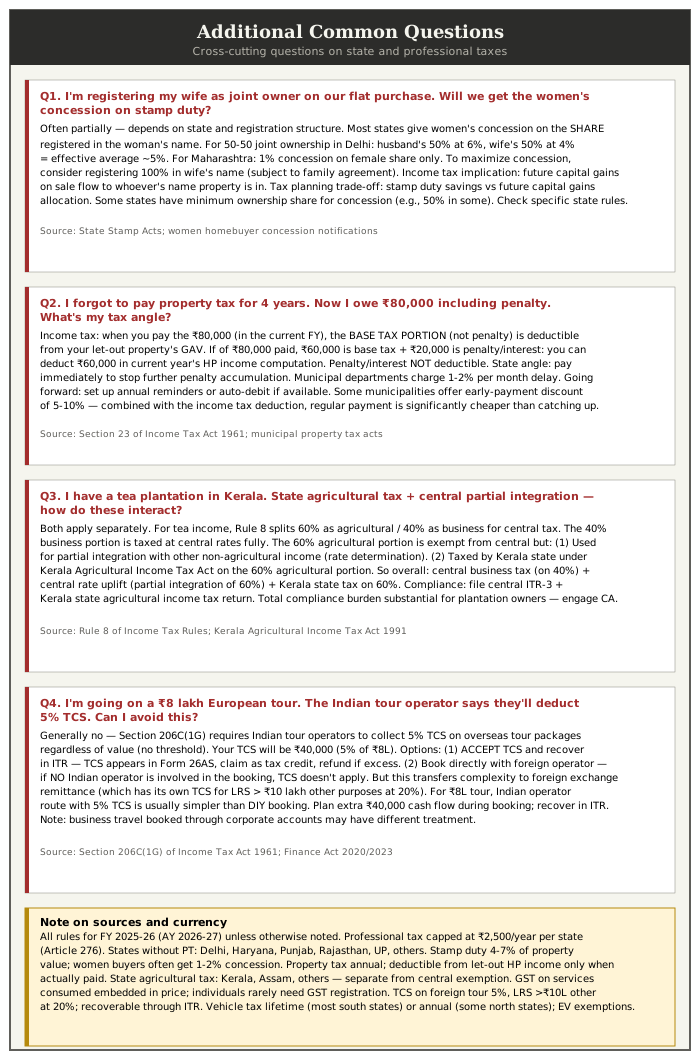
End of lesson — Additional common questions
Key Takeaways
- Article 276 caps Professional Tax at ₹2,500/year across all states; Section 16(iii) allows PT deduction from salary, so net effective burden is lower than the gross PT paid
- Stamp duty paid on property purchase forms part of cost basis for future capital gains under Section 48 — document all transaction costs at purchase, not just the property price
- Section 80C deduction is available on stamp duty in the year of purchase (within the ₹1.5 lakh limit under Old Regime) — this is not a separate 80C category but part of the overall limit
- Municipal property tax is deductible from Gross Annual Value only for let-out properties under Section 23, and only if actually paid during the year — not for self-occupied properties
- Central income tax exemption on agricultural income (Section 10(1)) does NOT prevent state-level agricultural income tax; Kerala, Assam, Tamil Nadu, West Bengal, and Karnataka levy their own agricultural income tax
- Salaried employees and pure investors never need GST registration; commercial property rentals above ₹20 lakh/year and businesses above threshold do
- TCS on foreign tour packages is 5% and LRS remittances for other purposes is 20% above ₹10 lakh — these are fully creditable against your final tax liability and result in a refund if TCS exceeds your tax
- India has no state-level personal income tax (unlike the US); multi-state earners file one central ITR aggregating all income, paying professional tax only in states that levy it
Quiz — 5 Questions
Answer one at a timeWhat is the maximum Professional Tax any state can levy per person per year under Article 276 of the Constitution?