Senior Citizens and Retirees
Senior citizen and super senior citizen tax categories, New Regime vs Old Regime analysis for retirees, Section 80TTB ₹50,000 interest deduction, pension income taxation (uncommuted, commuted, family pension, NPS annuity), retirement corpus withdrawals, SCSS and PMVVY government schemes, Section 207(2) advance tax exemption, Form 15H, enhanced 80D and 80DDB healthcare deductions, reverse mortgage under Section 10(43), and estate planning considerations
- Determine when New Regime is more advantageous for retirees than Old Regime using the worked examples at ₹10 lakh and ₹18 lakh income, and identify what deductions make Old Regime competitive
- Apply the taxation rules for uncommuted pension, commuted pension (government vs non-government), family pension, EPFO pension, and NPS annuity under Old and New Regimes
- Use Section 80TTB's ₹50,000 deduction on all deposit interest, understand its TDS interaction, and determine Form 15H eligibility to prevent TDS deduction on FD income throughout the year
- Identify the tax treatment of EPF, PPF, NPS Tier-1, Superannuation Fund, gratuity, and leave encashment withdrawals at retirement
- Apply Section 207(2) to determine advance tax exemption eligibility — distinguishing between income types that qualify (rental, capital gains, interest) versus those that disqualify (business income, F&O trading)
- Apply enhanced Section 80D limits and Section 80DDB specified disease deductions, understand reverse mortgage exemption under Section 10(43), and identify estate planning strategies using HUF, joint ownership, and gifting
Senior Citizens and Retirees
Senior citizens face a different tax landscape than working-age filers. Higher basic exemption thresholds, specific deduction increases for interest income, exemption from advance tax (with conditions), and the special tax treatment of retirement-related income — all combine to create a meaningfully different filing experience.
The Budget 2025 changes have also reshaped this landscape. The New Regime's ₹12 lakh tax-free threshold (₹12.75 lakh for salaried/pensioners with standard deduction) often makes the regime decision straightforward for retirees living on pensions and interest income. Old Regime advantages around 80TTB, higher basic exemption, and standard deduction become less compelling when New Regime offers zero tax on much higher income.
This lesson covers the rules specific to senior citizens (60+) and super senior citizens (80+), the major retirement income streams and their taxation, government schemes designed for seniors, and tax planning considerations particular to later life stages.
A note on terminology: this lesson uses Income Tax Act 1961 references applicable to FY 2025-26 income filed as AY 2026-27. The Income Tax Act 2025 (effective April 2026) preserves these provisions with renumbering.
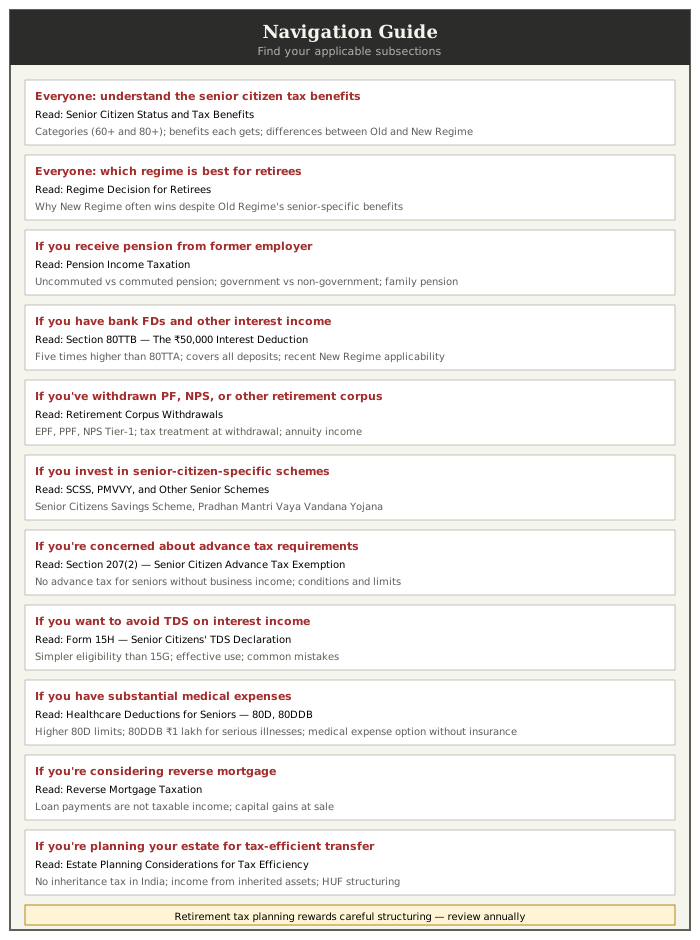
Navigation guide — which subsections apply to your situation
Senior Citizen Status and Tax Benefits
Indian tax law recognizes two categories of senior citizens, each with distinct benefits.
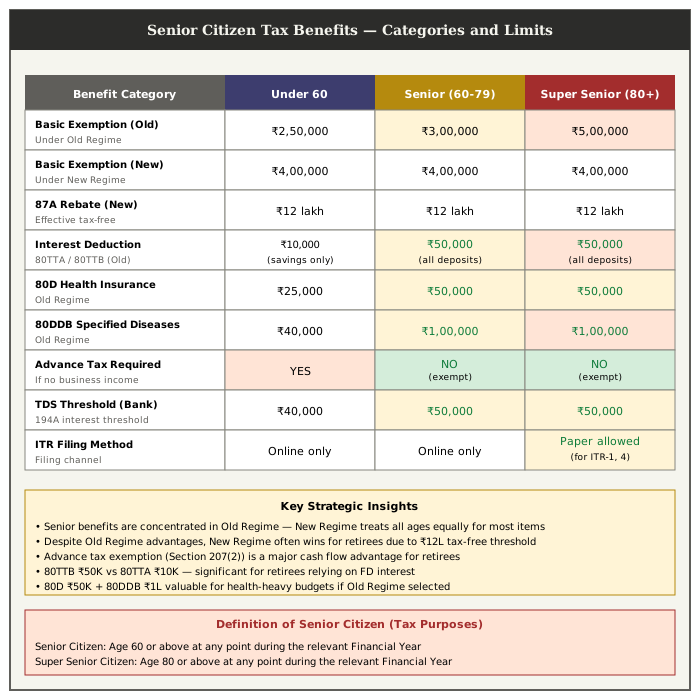
Section 80TTB, 207(2), 80D, 80DDB of Income Tax Act 1961; CBDT senior citizen provisions; First Schedule of Finance Act 2025.
Regime Decision for Retirees
For most retirees, the regime decision is straightforward — but counterintuitively, the answer is usually New Regime, not Old.
Why retirees often benefit from New Regime.
Old Regime computation: Income: ₹10,00,000 Standard deduction (pensioner): ₹50,000 80TTB interest deduction: ₹50,000 80D health insurance (parents may not need): ₹0 (assume) Taxable: ₹9,00,000 Tax: ₹12,500 + ₹80,000 = ₹92,500 Plus 4% cess: ₹3,700 Total: ₹96,200 New Regime computation: Income: ₹10,00,000 Standard deduction: ₹75,000 Taxable: ₹9,25,000 Tax: ₹0 (up to ₹4L) + ₹20,000 (₹4-8L) + ₹12,500 (₹8-9.25L) = ₹32,500 Section 87A rebate: ₹32,500 (full rebate as income ≤ ₹12L) Total: ₹0 New Regime saves ₹96,200.
Old Regime computation (with full senior deductions): Income: ₹18,00,000 Standard deduction: ₹50,000 80TTB: ₹50,000 80D parents: ₹50,000 (parents 60+) 80D self (₹50K if 60+): ₹50,000 Total deductions: ₹2,00,000 Taxable: ₹16,00,000 Tax: ₹12,500 + ₹1,00,000 + ₹1,80,000 = ₹2,92,500 Plus cess: ₹11,700 Total: ₹3,04,200 New Regime computation: Income: ₹18,00,000 Standard deduction: ₹75,000 Taxable: ₹17,25,000 Tax: ₹0 + ₹20K + ₹40K + ₹60K + ₹25,000 (₹16-17.25L at 20%) = ₹1,45,000 No rebate (above ₹12L threshold) Plus cess: ₹5,800 Total: ₹1,50,800 New Regime saves ₹1,53,400.
When does Old Regime win for retirees?
Old Regime becomes competitive only with substantial additional deductions:
- 80DDB ₹1 lakh (specified disease treatment)
- 80U ₹75K-1.25L if filer has disability
- Home loan interest under Section 24(b)
- Substantial 80G donations
Even with these, the breakeven is usually above ₹20 lakh income.
Section 115BAC of Income Tax Act 1961; comparative analysis.
Pension Income Taxation
Pensions form the primary income source for most retirees. Tax treatment varies by type and pension provider.
Uncommuted pension (monthly payments).
- Always fully taxable as salary income (Section 17(1)(ii))
- TDS deducted by pension disbursing authority (bank or institution)
- Salary head — gets standard deduction (₹75K New / ₹50K Old)
- Treated identically to active employment salary
Commuted pension (lump sum at retirement).
- Government employees: Fully exempt under Section 10(10A)(i).
- Non-government employees receiving gratuity: 1/3 of commuted pension exempt.
- Non-government employees not receiving gratuity: 1/2 of commuted pension exempt.
Non-government retiree commutes ₹6 lakh of pension (lump sum). Also received gratuity. Exempt: 1/3 × ₹6L = ₹2,00,000 Taxable as salary: ₹4,00,000
Family pension (after employee's death).
Family pension is paid to surviving family members and has different tax treatment:
- Taxable under "Income from Other Sources" (NOT Salaries)
- Old Regime exemption: 1/3 of family pension OR ₹15,000 (whichever lower)
- New Regime exemption (Budget 2024+): ₹25,000
Widow receives ₹4 lakh family pension annually. Old Regime exemption: lower of (1/3 × ₹4L = ₹1,33,333) or ₹15,000 → ₹15,000 Old Regime taxable: ₹3,85,000 New Regime exemption: ₹25,000 New Regime taxable: ₹3,75,000
EPFO Pension (Employees' Pension Scheme).
For salaried employees covered under EPS:
- Monthly pension from EPFO after age 58 (early withdrawal options after 50)
- Treated as pension income (Salary head)
- Subject to standard deduction
- Modest amounts typically (capped at limited monthly figure)
National Pension System (NPS) annuity.
After NPS Tier-1 retirement at 60:
- 60% lump sum (tax-free)
- Mandatory 40% used to buy annuity from insurance company
- Annuity payments are taxable as "Salary" (pension)
- Subject to standard deduction in computation
Sections 17, 10(10A), 57 of Income Tax Act 1961; CBDT pension taxation guidance.
Section 80TTB — The ₹50,000 Interest Deduction
The single most valuable senior-specific deduction in the Old Regime.
The deduction.
- ₹50,000 deduction on interest income from ALL deposits
- Available only to senior citizens (60+) and super senior citizens
- Covers savings accounts, FDs, RDs, post office deposits, co-operative bank deposits
- Old Regime only (mostly — see note below)
Comparison to Section 80TTA (for under-60).
- 80TTA: ₹10,000 only on savings account interest
- 80TTB: ₹50,000 on ALL deposit interest types
- Senior citizens cannot claim 80TTA in addition — 80TTB replaces it
Why this matters for retirees. With FD interest at 7-8% rates, a retiree with ₹6 lakh in FDs earning ₹45,000-₹50,000 annual interest has effectively zero tax on interest under Old Regime via 80TTB. Without 80TTB (under-60 with same income), only ₹10,000 of savings interest exempt — taxable interest much higher.
Recent interpretation regarding New Regime. Initial reading of Section 115BAC suggests 80TTB is not available in New Regime. However, some interpretations and CBDT guidance suggest it may survive under specific conditions. Conservative approach: treat as Old Regime deduction only.
TDS interaction. Banks deduct 10% TDS on interest above ₹50,000 (senior citizens) or ₹40,000 (under 60). If your total interest is, say, ₹52,000, TDS is deducted on the excess, but you claim 80TTB ₹50K when filing — refund of excess TDS.
Form 15H to avoid TDS upfront. If your total tax liability is nil (often true for retirees in New Regime up to ₹12L), file Form 15H with each bank to avoid TDS deduction.
Section 80TTB of Income Tax Act 1961.
Retirement Corpus Withdrawals
When you actually access your retirement savings, tax treatment varies by source.
EPF withdrawal at retirement.
- Fully tax-free if continuous service of 5+ years
- TDS deducted at 10% if withdrawal exceeds ₹50,000 and PF account not transferred
- No tax liability beyond TDS adjustment
PPF maturity withdrawal.
- Fully tax-free regardless of service length
- E-E-E status (exempt at investment, accumulation, and withdrawal)
- 15-year lock-in (extensions in 5-year blocks)
NPS Tier-1 at age 60.
Mandatory split:
- 60% lump sum withdrawal: Fully tax-free
- 40% annuity purchase: No tax at purchase; annuity income taxable
Premature exit from NPS (before age 60).
- 20% lump sum: Tax-free
- 80% annuity: No tax at purchase; annuity taxable
- Higher annuity portion reflects penalty for early exit
Superannuation Fund withdrawal.
- 1/3 commuted lump sum: Tax-free (similar to commuted pension rules)
- Balance used for pension purchase: Pension income taxable
Approved Gratuity (already covered).
- Government: Fully exempt
- Non-government: Lower of actual / ₹20 lakh lifetime cap / formula amount
Leave encashment at retirement (covered).
- Government: Fully exempt
- Non-government: Lower of actual / ₹25 lakh lifetime cap / formula amount
Sections 10(11), 10(12), 10(10A) of Income Tax Act 1961; CBDT retirement corpus guidelines.
SCSS, PMVVY, and Other Senior Schemes
The government offers specific schemes designed for senior citizens with both income and tax benefits.
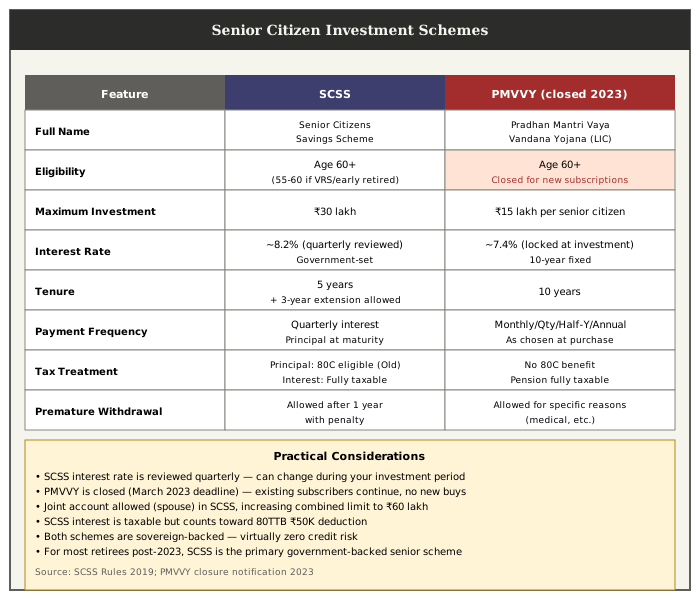
Other senior-relevant schemes.
Mahila Samman Savings Certificate. For women including senior citizen women — 2-year tenure, ~7.5% interest, ₹2 lakh investment limit. No specific senior advantage but available to senior women.
Post Office Monthly Income Scheme (POMIS). Open to all, 5-year tenure, ~7.4% interest, monthly payouts. Useful for retirees seeking steady cash flow. ₹9 lakh single / ₹15 lakh joint limit.
RBI Floating Rate Savings Bonds. 7-year tenure, interest rate floats with NSC rate + 0.35%. Currently around 8.05%. ₹1,000 minimum, no maximum. Good for retirees willing to lock for 7 years.
Senior Citizens Savings Scheme Rules 2019; CBDT guidance on senior schemes.
Section 207(2) — Senior Citizen Advance Tax Exemption
A significant cash flow benefit that's often overlooked.
The exemption. Resident individuals aged 60 or above are NOT required to pay advance tax IF they do not have income from business or profession.
Without 207(2). A 65-year-old retiree with ₹50 lakh in FDs earning ₹3.5 lakh interest would need to: Estimate annual tax: approximately ₹40,000-60,000 (depending on regime) Pay quarterly: ₹6,000-9,000 by June 15, etc. Manage cash flow around quarterly payments With 207(2). Same retiree: No quarterly payments required Pay full tax as self-assessment by July 31 next year All ₹3.5 lakh interest stays in retiree's account until then Earns additional interest on what would have gone to government
What disqualifies you from 207(2).
Having income from business or profession:
- Running a proprietary business
- Freelancing/consulting (PGBP income)
- F&O trading (treated as PGBP)
- Partner in a partnership firm receiving remuneration
Mere capital gains, rental income, interest, dividends — these do NOT count as business income. Most retirees with these income types qualify for 207(2).
Important: Section 234A still applies. Advance tax exemption doesn't mean late filing exemption. File ITR by deadline. Section 234A interest applies if filed late even for exempt seniors.
Section 207(2) of Income Tax Act 1961.
Form 15H — Senior Citizens' TDS Declaration
For most retirees, Form 15H is the practical tool to avoid TDS deduction on FD interest.
Eligibility.
- Resident individual aged 60 or above
- Estimated total tax liability for the year = NIL
Why eligibility is broader than 15G.
- 15G (under 60): Total income must be below ₹2.5L basic exemption. With New Regime's effective ₹12L threshold, 15G eligibility expands significantly.
- 15H (60+): Estimated tax = nil. With higher exemptions (₹3L Old, ₹4L New) + 80TTB ₹50K + 87A rebate, many retirees with substantial FD income qualify.
Retiree with ₹6 lakh total income (mostly FD interest): New Regime: ₹6L - ₹4L exemption = ₹2L taxable; tax = ₹10,000; 87A rebate eliminates this; nil tax → 15H eligible. Old Regime: ₹6L - ₹3L exemption (60+) - ₹50K 80TTB = ₹2.5L taxable; tax ~₹0 after 87A rebate; nil tax → 15H eligible.
Process.
- Visit each bank where you have FDs at start of FY.
- Fill Form 15H (single page declaration).
- Submit to bank manager — they note it in your account.
- Bank does NOT deduct TDS during the FY.
- Renew next April for the next FY.
Don't file 15H if you might owe tax. If your tax liability turns out to be more than nil, you've made a false declaration. Penalty under Section 277, including potential prosecution.
Verification. Some banks accept Form 15H only if your total interest is also below threshold (more conservative approach).
Section 197A of Income Tax Act 1961; Form 15H under Rule 29C.
Healthcare Deductions for Seniors — 80D, 80DDB
Two valuable deductions for managing healthcare costs in retirement (Old Regime only).
Section 80D enhanced limits.
For senior citizens (60+):
- Self + Spouse: ₹50,000 (vs ₹25,000 for under 60)
- Parents 60+: Additional ₹50,000
- Maximum combined: ₹1,00,000
Special: Medical expenses for very senior parents WITHOUT health insurance.
Section 80D allows ₹50,000 deduction for actual medical expenses incurred for senior citizen parents (or self if you're a senior) who do NOT have health insurance. Useful for parents whose health insurance lapsed or who never had coverage due to pre-existing conditions.
Conditions:
- Senior citizen (60+)
- No health insurance for that senior
- Medical expenses paid through banking channels (not cash)
- Receipts retained
Section 80DDB — Specified Diseases.
Critical for retirees facing serious illness. Deduction for actual expenditure on medical treatment of:
- Self
- Spouse, children
- Parents (dependent)
- Siblings (dependent)
Specified diseases include:
- Cancer (malignant)
- Chronic renal failure
- Hematological disorders (hemophilia, thalassemia)
- Neurological diseases (Parkinson's, dementia of advanced stage, etc.)
- AIDS
- Other notified diseases
Deduction limits:
- Patient under 60: Up to ₹40,000
- Patient 60+: Up to ₹1,00,000
Documentation.
- Form 10-I prescription from specialist
- Original medical bills, pharmacy receipts
- Treatment records
Both 80D and 80DDB — Old Regime only.
Sections 80D and 80DDB of Income Tax Act 1961; CBDT notification on specified diseases.
Reverse Mortgage Taxation
Reverse mortgage allows senior citizens to convert home equity to income while staying in their home.
How it works.
- Senior citizen mortgages own home to bank
- Bank pays out periodic amounts (monthly/quarterly/lump sum)
- No EMIs during senior's lifetime
- At senior's death (or sale), bank recovers loan from sale proceeds
Tax treatment.
Loan disbursements (payments to senior): NOT taxable.
Under Section 10(43), payments received under reverse mortgage scheme are explicitly excluded from income. This is a critical exemption — without it, periodic payments would be taxable.
Capital gains at eventual sale.
When the property is sold (typically after senior's death), capital gains arise. Treated as LTCG (assuming property held over 24 months) at 12.5%. Tax falls on the estate/heirs, not the senior.
Practical scenarios.
Senior 70, owns home worth ₹1 crore. Takes reverse mortgage for ₹30 lakh over 15 years. Receives ₹16,667/month. Lives until 85. Total received: ₹30 lakh (assume) Tax during life: Zero on these payments At 85, property sale by heirs: capital gains based on actual sale price vs cost basis Heirs pay tax on gains; reverse mortgage loan settled from sale proceeds
Section 10(43) of Income Tax Act 1961; National Housing Bank reverse mortgage guidelines.
Estate Planning Considerations for Tax Efficiency
India does not have an inheritance tax or estate duty (abolished in 1985). But thoughtful estate planning still provides tax benefits.
Key points.
No tax on inheritance itself. Whether you inherit ₹10 lakh or ₹100 crore, no tax at the time of inheritance (Section 56(2) excludes inheritance from "gift" tax).
Income from inherited assets IS taxable. Once you own inherited assets, income from them (rent, interest, dividends, capital gains on sale) is taxable as your income.
Cost basis is carried over. When you sell inherited assets, capital gains are computed using the previous owner's cost basis (Section 49(1)). Holding period also includes the previous owner's period.
For pre-April 2001 assets. You can use Fair Market Value as of April 1, 2001 instead of original cost — often beneficial for property inherited from grandparents.
Will vs intestate succession.
- Will: Distribute as you wish; explicit clarity
- No will (intestate): Distribution per personal law (Hindu Succession Act, etc.)
- Tax treatment same in both cases (no inheritance tax)
HUF as a tax planning vehicle.
- Hindu Undivided Family (HUF) can be created by HUF karta
- Family ancestral property + gifts received as HUF flow to HUF
- HUF has its own PAN, own basic exemption, own tax rates
- HUF income taxed separately from individual income — splits income across entities
- Useful for families with substantial ancestral property/business
Joint ownership for income splitting.
- Property owned 50-50 by spouses split income/expenses 50-50
- Each gets their own basic exemption, 80C limit, etc.
- Effective for couples where one is in higher bracket
Section 80C investments in family member names.
- Sukanya Samriddhi for daughter under 10
- PPF in spouse's name (counts toward your 80C if you contributed)
- Long-term wealth accumulation in next generation's name
Gift of money to family members.
- Gifts to specified relatives (spouse, children, parents, siblings, etc.) are exempt from tax
- BUT clubbing provisions (Section 64) apply for income from gifted assets to spouse or minor child
- Adult children: gifts are clean — income belongs to child
- Strategic for transferring wealth to adult children with lower brackets
Sections 49(1), 56(2), 64 of Income Tax Act 1961; Hindu Succession Act 1956; HUF taxation provisions.
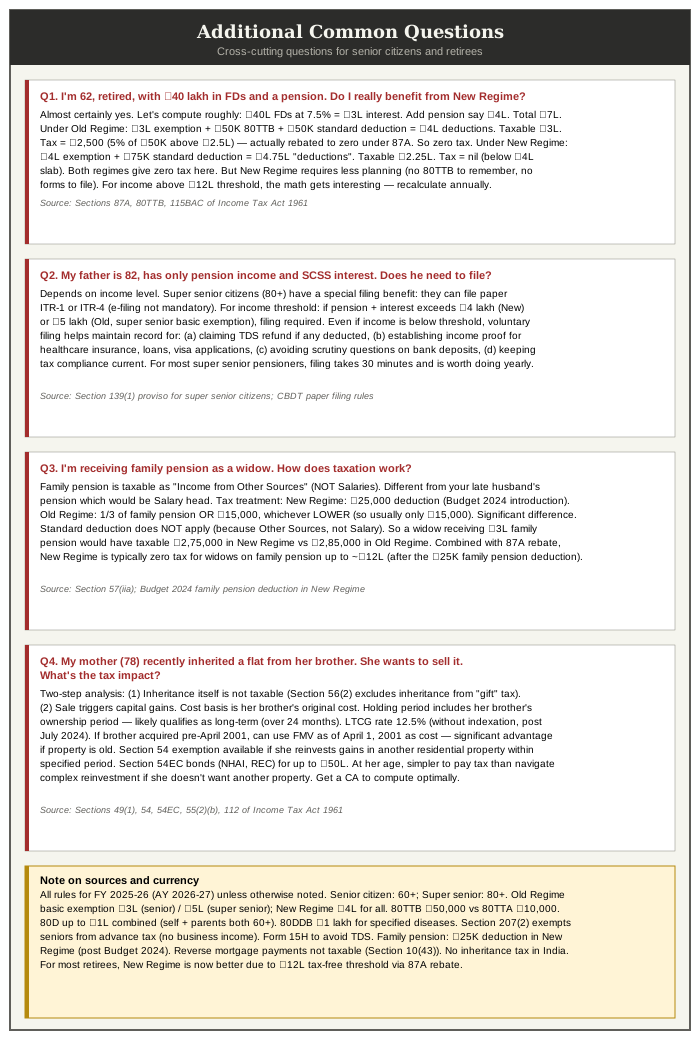
End of lesson — Additional common questions
Key Takeaways
- Senior citizens (60+) have ₹3 lakh basic exemption under Old Regime; New Regime's 87A rebate makes income tax-free up to ₹12 lakh for most retirees — typically making New Regime the better choice even without deductions
- Section 80TTB allows senior citizens ₹50,000 deduction on ALL deposit interest (savings, FDs, RDs, post office) in Old Regime — replacing and far exceeding the ₹10,000 80TTA limit available to under-60 filers
- Uncommuted pension is always fully taxable as salary; commuted pension is 100% exempt for government employees, 1/3rd exempt for non-government with gratuity, and 1/2 exempt for non-government without gratuity
- Family pension is taxed under 'Income from Other Sources' — Old Regime exemption is the lower of 1/3 of family pension or ₹15,000; New Regime (Budget 2024+) allows ₹25,000 exemption
- Section 207(2) exempts resident senior citizens aged 60+ from advance tax — provided they have no business or profession income; rental income, capital gains, interest, and dividends do not disqualify
- Form 15H allows senior citizens with nil tax liability to avoid TDS on FD interest throughout the year; must be submitted to each bank at the start of each financial year and renewed annually
- Section 80D enhanced limits for seniors are ₹50,000 for self/spouse (vs ₹25,000 for under-60) and ₹50,000 additional for senior parents; 80DDB allows up to ₹1 lakh deduction for specified disease treatment when patient is 60+
- Reverse mortgage payments to senior citizens are fully exempt from tax under Section 10(43); India has no inheritance tax — estate planning value comes from HUF structuring, joint ownership, and gifts to adult children
Quiz — 5 Questions
Answer one at a timeA 68-year-old retired engineer earns rental income, FD interest, and long-term capital gains. Which, if any, of these income types disqualifies him from the Section 207(2) advance tax exemption?