LLP and Partnership Firm Partners
Two-level partnership taxation framework, Section 40(b) partner remuneration limits with Finance Act 2024 updates, 12% cap on interest on partner capital, Section 10(2A) profit share exemption, Section 194T new TDS on partner payments, LLP versus partnership structural and compliance differences, admission and retirement goodwill tax treatment under Section 9B, dissolution and tax-neutral conversion, firm-level loss carry-forward, and ITR-5 and ITR-3 filing obligations
- Explain the two-level partnership taxation structure and demonstrate why profit share distributions do not create double taxation
- Compute maximum deductible partner remuneration under Section 40(b) using Finance Act 2024 limits, distinguishing the updated ₹6 lakh threshold from prior rules
- Apply the 12% simple interest cap on partner capital interest, compute deductible and disallowed amounts, and trace tax treatment in both firm and partner hands
- Identify partner income categories taxable as PGBP versus exempt under Section 10(2A), and complete Schedule EI disclosure in ITR-3
- Implement Section 194T TDS compliance for partnership and LLP payments effective FY 2025-26, distinguishing covered from excluded payment types
- Compare LLP and traditional partnership firm across liability, compliance, audit thresholds, and annual MCA filing requirements
- Calculate capital gains tax consequences of partner admission, retirement, dissolution, and tax-neutral conversion under Sections 47(xiii) and 47(xiiib)
- Apply Section 78(2) restrictions on firm loss carry-forward after constitution changes and select correct ITR forms for firm and individual partners
LLP and Partnership Firm Partners
Partnerships have long been a common business structure in India, especially for professional firms (law, accountancy, consulting), small businesses, and family-run enterprises. The introduction of Limited Liability Partnerships (LLPs) in 2008 created a hybrid structure combining partnership flexibility with corporate-like limited liability.
Both structures share important tax characteristics: they are treated as separate entities for taxation but income flowing to partners has unique treatment that differs significantly from both salary and dividend taxation.
The Finance Act 2024 introduced a substantial change effective FY 2025-26 — Section 194T, requiring firms to deduct TDS on remuneration, interest, and commission paid to partners. This is a major compliance change that affects every active partnership and LLP. Previously, partner payments were largely outside the TDS framework; now firms must establish withholding mechanisms and partners must track these credits.
This lesson covers the tax framework for partnerships and LLPs from both the firm's and partner's perspectives: how firm income is computed, what's deductible (Section 40(b) salary/interest limits), how profit share flows tax-free to partners (Section 10(2A)), the new Section 194T TDS mechanism, and the practical implications for various partnership life events — admission, retirement, dissolution.
A reminder: this lesson uses Income Tax Act 1961 references applicable to FY 2025-26 income filed as AY 2026-27.
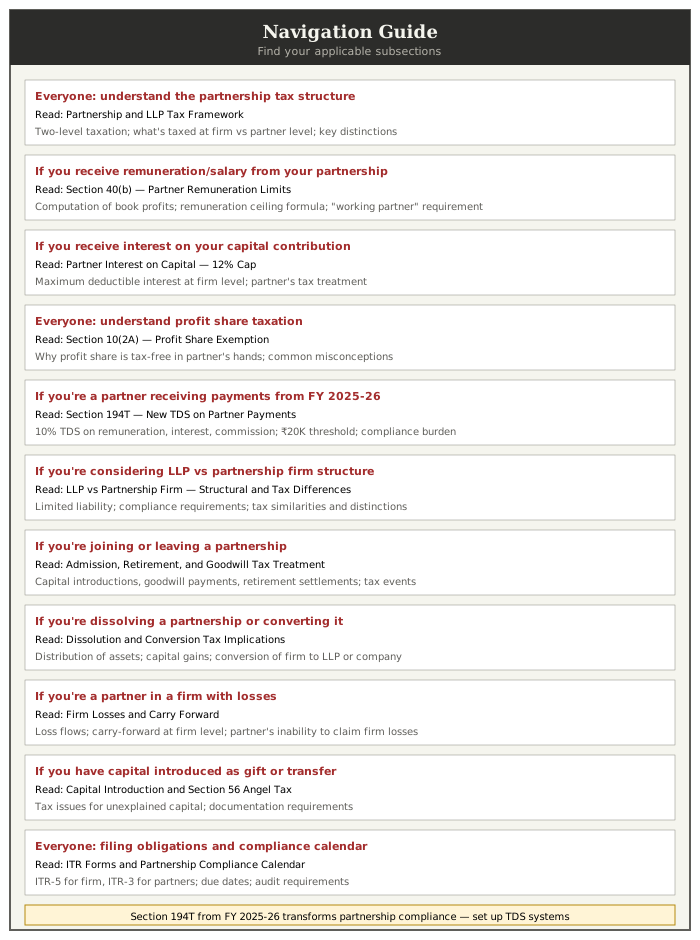
Navigation guide — which subsections apply to your situation
Partnership and LLP Tax Framework
Partnerships and LLPs are taxed at TWO levels — but in a way that prevents double taxation of the same income.
The two-level structure.
Level 1: Firm-level taxation.
The partnership or LLP files its own ITR (ITR-5) and pays tax on its taxable income at 30% + surcharge + cess. Before computing taxable income, the firm can deduct:
- Salary/remuneration to working partners (within Section 40(b) limits)
- Interest on partner capital (up to 12% simple interest)
- All normal business expenses
Level 2: Partner-level taxation.
Each partner reports in their personal ITR:
- Salary/remuneration received from firm: taxable as PGBP (NOT salary head despite the name)
- Interest on capital: taxable as PGBP (NOT other sources)
- Profit share from firm: TAX-FREE under Section 10(2A)
Why this works without double taxation.
The firm pays tax on its income AFTER deducting partner remuneration and interest. So the firm's "after-tax profit" already excludes amounts taxed to partners. When the firm distributes this after-tax profit as partner's share, it's already been taxed once at firm level — taxing it again in partner's hands would be double taxation.
Worked example. Firm with two partners (A and B, equal partners). Business revenue ₹50 lakh; business expenses ₹20 lakh; salary to A and B ₹6 lakh each; interest on capital to A and B ₹2 lakh each. Firm's tax computation: Revenue: ₹50,00,000 Less business expenses: ₹20,00,000 Less partner salaries (within Section 40(b) limits): ₹12,00,000 Less partner interest (within 12% cap): ₹4,00,000 Firm's taxable income: ₹14,00,000 Firm's tax @ 30%: ₹4,20,000 Plus cess 4%: ₹16,800 Firm pays: ₹4,36,800 After-tax profit available for distribution: ₹14,00,000 − ₹4,36,800 = ₹9,63,200 This is distributed equally to A and B = ₹4,81,600 each. Partner A's tax (similarly for B): Salary from firm: ₹6,00,000 (taxable as PGBP) Interest on capital: ₹2,00,000 (taxable as PGBP) Profit share: ₹4,81,600 (TAX-FREE under Section 10(2A)) Partner A's total taxable income from firm: ₹8,00,000 Tax on this at slab rates (assuming no other income, New Regime): ₹20,000 Total tax on firm's ₹14 lakh "business profit": Firm: ₹4,36,800 Partner A: ₹20,000 Partner B: ₹20,000 Total: ₹4,76,800
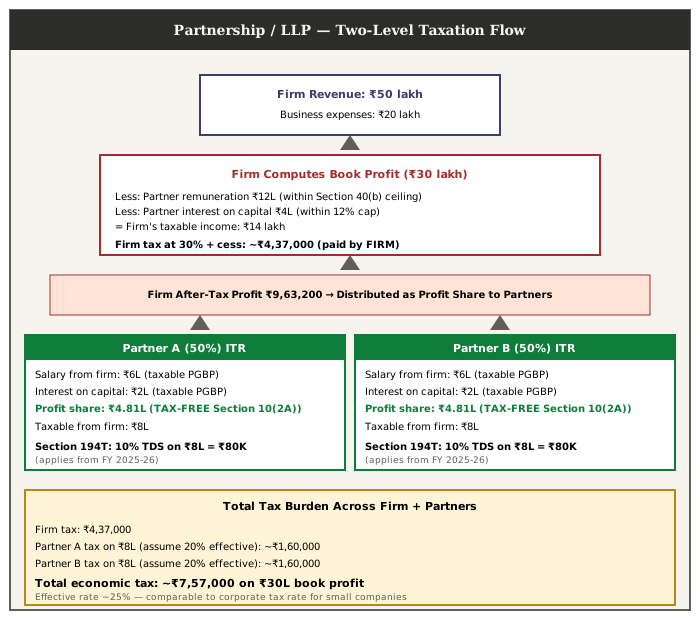
Sections 28-44DB, 184, 40(b), 10(2A) of Income Tax Act 1961.
Section 40(b) — Partner Remuneration Limits
Not all remuneration paid to partners is deductible at firm level. Section 40(b) imposes specific limits.
Two key conditions for deduction.
Condition 1 — Working Partner. Remuneration is deductible only when paid to a "working partner" — one who is actively engaged in the conduct of business or profession of the firm. Sleeping partners (passive investors) don't qualify for deductible remuneration.
Condition 2 — Partnership Deed. Remuneration must be authorized by the partnership deed. Verbal agreements, retrospective resolutions don't qualify.
The remuneration ceiling formula.
Total deductible remuneration to all partners cannot exceed:
| Type of Firm | First ₹3 lakh of Book Profit | Above ₹3 lakh of Book Profit |
|---|---|---|
| Professional firm | ₹1,50,000 or 90% (whichever higher) | 60% of book profit |
| Other firms | ₹1,50,000 or 90% (whichever higher) | 60% of book profit |
Note: Budget 2024 changes (effective FY 2024-25 onwards).
The remuneration limits were updated by Finance Act 2024:
- First ₹6 lakh of book profit: ₹3,00,000 or 90% (whichever higher)
- Above ₹6 lakh: 60% of book profit
This is a meaningful enhancement from the older ₹3 lakh thresholds. Effective for FY 2024-25 and onwards.
Computing "book profit."
Book profit = Net profit per accounts (before remuneration to partners) + Adjustments per Section 40(b) Explanation
Adjustments include:
- Add back: depreciation if not as per Section 32
- Add back: any partner remuneration already deducted
- Subtract: interest on capital to partners (within 12% limit)
In simpler terms: book profit is what the firm earned BEFORE paying partners (other than capital interest).
Worked example with new limits. Firm's book profit (before partner remuneration): ₹40 lakh. Maximum deductible remuneration: First ₹6 lakh: ₹3 lakh or 90% (= ₹5,40,000) → higher = ₹5,40,000 Above ₹6 lakh: ₹40L − ₹6L = ₹34L × 60% = ₹20,40,000 Total ceiling: ₹5,40,000 + ₹20,40,000 = ₹25,80,000 If actual remuneration paid is ₹30 lakh: Deductible: ₹25,80,000 Disallowed (added back to firm income): ₹4,20,000 If actual remuneration paid is ₹20 lakh: Deductible: ₹20,00,000 (the full amount, since within ceiling)
Strategic implications.
The ceiling creates incentive to pay partners no more than the limit. Excess remuneration is taxed twice — once at firm level (disallowance) and once at partner level (partner's income). Tax-inefficient.
Section 40(b), Explanation 4 to Section 40(b) of Income Tax Act 1961; Finance Act 2024 amendments to remuneration limits.
Partner Interest on Capital — 12% Cap
Interest paid by the firm on partner's capital contribution is deductible at the firm level, subject to a cap.
The rule. Interest at simple interest rate up to 12% per annum is deductible. Excess is disallowed at firm level.
Conditions for deduction.
- Partnership deed must authorize the interest payment
- Rate must be specified in the deed
- Cannot exceed 12% per annum
- Computed as simple interest (not compounded)
Worked example. Partner A contributed ₹20 lakh capital. Deed allows 10% interest. Permitted rate (lower of 10% deed rate or 12% statutory cap): 10% Annual interest: ₹20L × 10% = ₹2,00,000 Deductible at firm level: ₹2,00,000 Taxable to A as PGBP: ₹2,00,000 If deed had specified 15% interest: Permitted rate: 12% (statutory cap) Annual interest as per deed: ₹3,00,000 Deductible at firm level: ₹2,40,000 (12% of ₹20L) Disallowed: ₹60,000 (added back to firm income) Taxable to A as PGBP: ₹3,00,000 (full amount received) Excess interest creates double taxation — firm pays tax on the disallowed portion AND partner pays tax on the full amount received.
Capital fluctuations during year. Interest is computed on partner's actual capital balance, which may vary. Use opening balance + (movements × time apportioned).
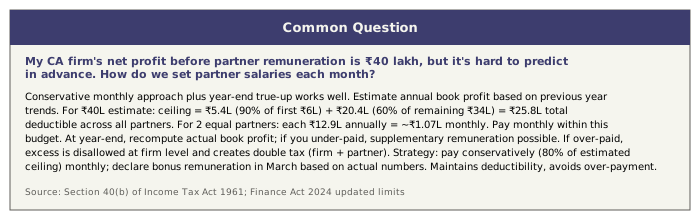
Section 40(b)(iv) of Income Tax Act 1961.
Section 194T — New TDS on Partner Payments
The Finance Act 2024 introduced Section 194T, making partner payments subject to TDS for the first time. Effective from FY 2025-26.
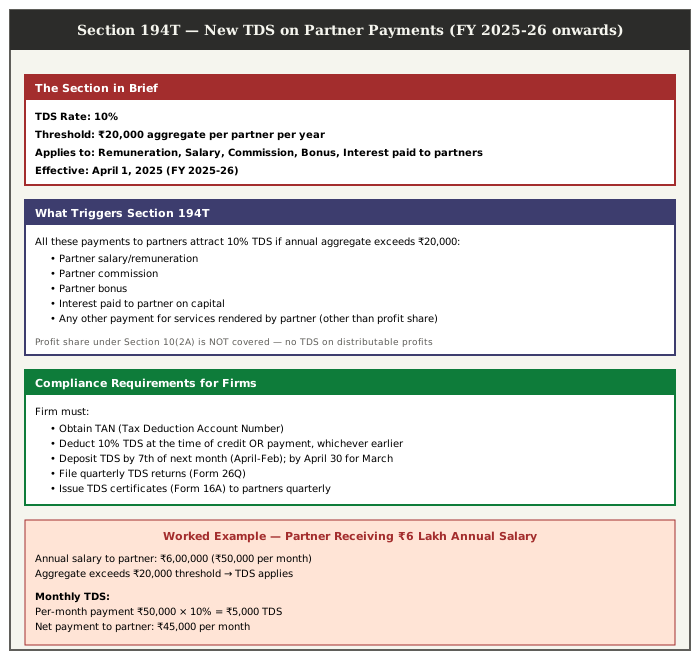
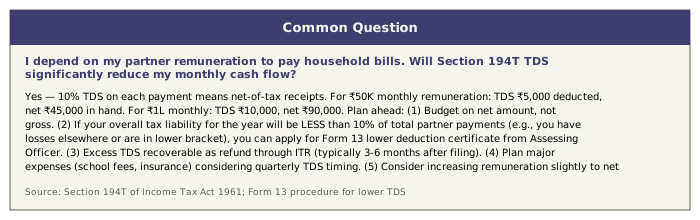
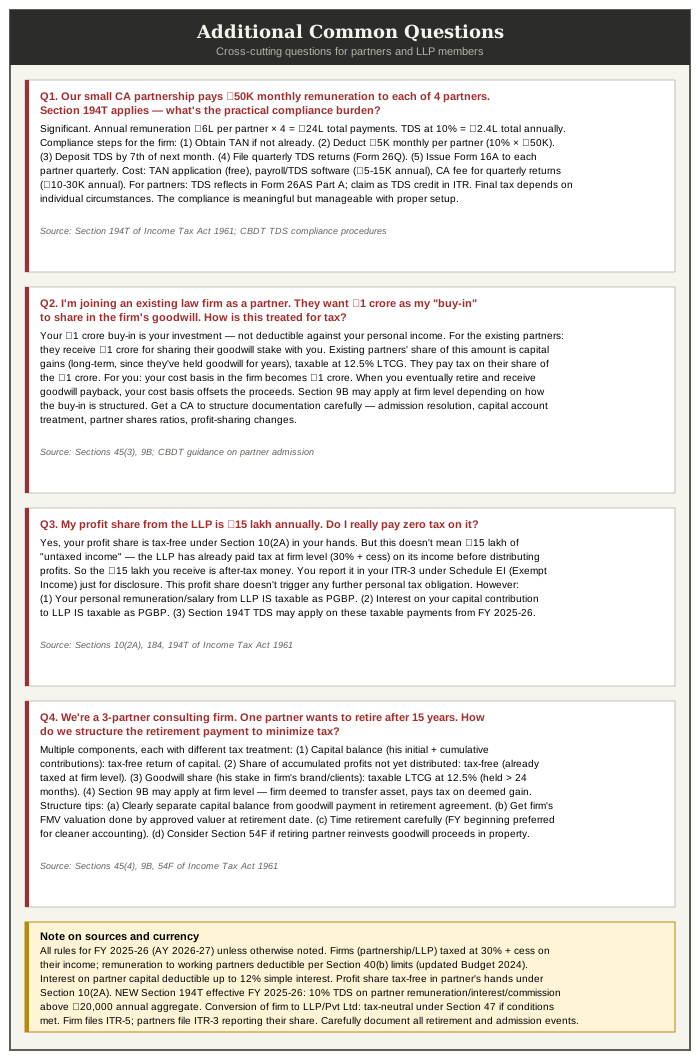
Compliance burden for small partnerships.
Section 194T introduces meaningful compliance burden:
- Small partnerships that never had TDS obligations now need to deduct, deposit, and report
- Need TAN number (separate from PAN)
- Quarterly TDS returns required
- TDS certificate generation required
Small partnerships paying ₹30K-40K monthly to each of 2-3 partners now face this entire compliance framework.
Partner's perspective.
Partner sees ₹5,000 deducted from each ₹50,000 monthly payment. This is similar to salary TDS deducted by employer:
- TDS shows in Form 26AS Part A
- Claimed as TDS credit when filing ITR
- Final tax depends on partner's total income
- Refund if TDS exceeds actual tax liability
Why this was introduced.
The government cited:
- Tracking partner payments for tax compliance
- Bringing partnership payments into the formal TDS ecosystem
- Reducing tax evasion through informal partner payments
Practical adaptations.
Many small partnerships are exploring:
- Outsourcing TDS compliance to consultants
- Reducing partner salary frequency (e.g., quarterly instead of monthly)
- Restructuring payment categories where possible
But these adaptations have limits — the substantive law requires TDS on essentially all partner payments.
Section 194T does NOT cover.
- Profit share (Section 10(2A) distribution) — already tax-free
- Reimbursement of expenses partner incurred for firm
- Loans from firm to partner (separate provisions)
Section 194T of Income Tax Act 1961 (introduced by Finance Act 2024); CBDT TDS compliance procedures.
LLP vs Partnership Firm — Structural and Tax Differences
Two distinct entity types with substantially similar tax treatment but different structural features.
| Aspect | Partnership Firm | LLP |
|---|---|---|
| Governing Law | Indian Partnership Act 1932 | Limited Liability Partnership Act 2008 |
| Liability | Unlimited (partners liable personally) | Limited to capital contribution |
| Number of Partners | Min 2, Max 50 (or 20 for non-banking) | Min 2, No maximum |
| Tax Rate (Firm) | 30% + surcharge + cess | 30% + surcharge + cess |
| Section 40(b) — Remuneration | Applies | Applies |
| Section 10(2A) — Profit Share | Applies | Applies |
| Section 194T (FY 2025-26) | Applies | Applies |
| Audit | If turnover > ₹1cr | If turnover > ₹40 lakh (LLP Act) |
| Filing Requirement | ITR-5 | ITR-5 + Form 8 + Form 11 (LLP-specific) |
| ROC Compliance | None | Annual MCA filing required |
| Public Disclosure | None | Financials publicly viewable |
| Conversion to Pvt Ltd | Possible (with tax issues) | Possible (Section 47(xiii)) — tax-neutral if conditions met |
Tax similarities dominate. From a pure tax perspective, partnerships and LLPs are nearly identical:
- Both treated as separate taxable entities
- Both file ITR-5
- Both subject to same firm-level tax rates
- Both partners treated under Section 40(b), 10(2A), 194T identically
Where LLP differs.
LLP Act compliance. LLPs must file annual statements with the Registrar of Companies (RoC). This includes:
- Form 8 (Statement of Account and Solvency) — by October 30
- Form 11 (Annual Return) — by May 30
Failure to file attracts late fees that can grow rapidly. Common reason for LLP closure or strike-off.
Audit threshold. LLP Act requires audit when turnover crosses ₹40 lakh OR contribution crosses ₹25 lakh. Income tax audit applies on different thresholds.
Why choose LLP over Partnership Firm.
- Limited liability protection
- Easier conversion to Pvt Ltd later
- Better credibility with banks, vendors
- No upper limit on number of partners
Why choose Partnership Firm over LLP.
- Simpler compliance (no RoC filings)
- Lower cost of setup
- More familiar structure for family businesses
- Privacy (no public disclosure of financials)
Partnership Act 1932; LLP Act 2008; Sections 184, 40(b), 10(2A), 194T of Income Tax Act 1961.
Admission, Retirement, and Goodwill Tax Treatment
Partnership changes create specific tax events.
Admission of a new partner.
When a new partner is admitted:
- Existing partners may share part of their goodwill/equity with the new partner
- New partner brings capital contribution
Tax treatment:
- For existing partners: any consideration received from new partner for sharing in goodwill is taxable as capital gain on sale of intangible asset
- For new partner: capital contribution is not income (it's their personal investment)
Worked example. Three-partner firm has goodwill valued at ₹3 crore (built over years). Original partners have ₹1 crore each. New (fourth) partner admitted, paying ₹50 lakh as goodwill share + ₹20 lakh capital contribution. For existing partners: ₹50 lakh divided among them based on their existing ratios. This is capital gain (long-term, since goodwill held > 24 months for them). For new partner: ₹70 lakh total investment (₹50 lakh goodwill + ₹20 lakh capital). No income tax on payment.
Retirement of a partner.
When a partner retires:
- They receive their capital balance back
- Plus their share of unrealized gains/goodwill (if any)
- May receive premium for retiring earlier (effectively selling their share)
Tax treatment of retirement payment:
- Retirement amount = (Capital balance) + (Share of accumulated profits) + (Goodwill share)
- Capital balance: NOT taxable (it's return of capital)
- Share of accumulated profits: NOT taxable (already taxed at firm level previously)
- Goodwill payment: TAXABLE as capital gains (long-term if firm owned > 24 months by retiring partner)
Specific provision — Section 9B. When firm pays consideration to retiring partner for transfer of capital asset including goodwill, the firm is deemed to have sold the asset to the partner at FMV. Firm pays tax on the deemed gain.
Dual taxation concern. Section 9B can create dual taxation — firm pays tax on deemed transfer, and partner pays tax on receipt of goodwill. Strategy: structure retirement carefully to avoid Section 9B triggers, or accept the dual taxation as cost of clean exit.
Death of a partner.
Special continuity provisions:
- Firm doesn't dissolve automatically (in most modern partnership deeds)
- Legal heirs may be admitted to firm or receive payout
- Tax treatment of payout depends on what's being distributed
Sections 45(3), 45(4), 9B of Income Tax Act 1961; Partnership Act 1932 admission and retirement provisions.
Dissolution and Conversion Tax Implications
When the partnership ends or transforms, specific tax events arise.
Dissolution.
When a partnership dissolves:
- All partnership assets are deemed sold at FMV (Section 45(4))
- Firm pays capital gains tax on the deemed sale
- Partners receive cash/assets per their shares
Worked example. Firm with two equal partners, balance sheet: Land: ₹10 lakh (cost), FMV ₹2 crore Building: ₹5 lakh (cost), FMV ₹50 lakh Other assets: ₹15 lakh Capital: A and B ₹15 lakh each Reserves: nil Upon dissolution and asset distribution: Deemed sale at FMV: ₹2.55 crore Cost: ₹30 lakh Capital gain: ₹2.25 crore (long-term) Tax on firm: ₹2.25 crore × 12.5% (LTCG without indexation) = ₹28.13 lakh Each partner receives: ₹(2.55 crore - 28.13 lakh) / 2 = ₹1.13 crore approximately Partner's tax: No further tax (since firm already paid)
Conversion of Partnership Firm to LLP.
Under Section 47(xiiib), if conditions met:
- No tax event (cost basis carried over)
- Continued profit share calculation
- LLP succeeds to all firm assets, liabilities, accumulated losses
Conditions:
- All firm assets and liabilities transferred to LLP
- All firm partners become LLP partners
- No payment to partners other than capital + profit share
- Capital + profit share ratios preserved for 5 years post-conversion
- Aggregate profit-sharing ratios of partners do not differ from those in the firm
- Total assets, total liabilities of LLP same as firm immediately after conversion
If any condition is violated, the conversion becomes taxable retroactively.
Conversion of Partnership/LLP to Private Limited Company.
Section 47(xiii) provides similar tax-neutral conversion if conditions met:
- All firm/LLP assets and liabilities become company's
- All partners become shareholders
- Partner profit-share ratio matches shareholder ratio
- Aggregate profit-sharing ratios preserved for 5 years
- All partners' capital becomes company's paid-up capital
Strategic use: Tech startups often start as LLP (lower compliance) then convert to Pvt Ltd before fundraising rounds.
Sections 45(3), 45(4), 47(xiii), 47(xiiib), 9B of Income Tax Act 1961.
Firm Losses and Carry Forward
A partnership firm's losses are carried forward at the firm level, not the partner level.
The key principle. Unlike profit share (which flows tax-free to partners), losses do NOT flow to partners. Partners cannot claim firm's losses against their personal income.
Firm-level loss carry-forward.
- Business loss: Carry forward 8 years (Section 72)
- Speculative loss: Carry forward 4 years
- House property loss: Carry forward 8 years
- Capital loss: Carry forward 8 years
Why this matters.
If a firm has losses, partners don't get any immediate tax benefit. The loss sits at firm level waiting for future profits. If the firm doesn't recover, the loss is wasted.
Compare to sole proprietorship. A sole proprietor's losses flow directly to their personal return and can offset other income heads. This is a meaningful disadvantage of partnership structure for early-stage loss-making businesses.
Strategy for new partnerships expected to have losses.
Consider sole proprietorship + spouse business arrangement instead of formal partnership in early years. Or accept that early losses won't be immediately tax-deductible.
Section 78(2) — Special restriction.
If there's a change in the constitution of the firm (admission/retirement of partner), the firm can only carry forward losses to the extent of:
- Continuing partners' share at the time of loss
- If a partner contributing 50% to the loss leaves, only 50% of the loss can be carried forward by the new firm (which lacks that partner)
This is a meaningful compliance issue when partners enter/exit firms with carried-forward losses.
Sections 72, 73, 78 of Income Tax Act 1961.
Capital Introduction and Section 56 Angel Tax
When new partners join, they typically contribute capital. Specific tax issues arise.
Capital contribution from new partners.
Normal capital contribution is not income (it's their personal investment). But if the contribution is unexplained or suspicious, tax issues arise:
Section 68 — Unexplained cash credits. If the firm's books show capital from a partner but the partner cannot explain the source, the amount is treated as unexplained income of the FIRM. Taxed at 60% + surcharge + cess. Heavy tax for failure to explain source.
Section 56(2)(viib) "Angel Tax" for Companies. Companies receiving share consideration above FMV face angel tax. This provision does NOT apply to partnerships or LLPs directly.
Section 9B — Reconstitution Taxation. When a firm is reconstituted (partner admitted, retired, etc.) and there is transfer of capital asset:
- Capital asset deemed transferred to outgoing partner / firm
- Capital gains tax at firm level
Documentation requirements for partner capital.
- Source of funds from partner: bank statements, ITR, salary slips
- Mode of contribution: bank transfer preferred over cash
- Resolution recording the capital contribution
- Updated capital account in firm's books
Foreign partner capital.
- Subject to FEMA regulations
- RBI permission may be needed
- Documentation for foreign source of funds
- TDS implications under Section 195 if remuneration paid to non-resident partner
Sections 68, 9B of Income Tax Act 1961; FEMA regulations for foreign partner contributions.
ITR Forms and Partnership Compliance Calendar
Specific forms and timelines for partnership compliance.
ITR forms.
ITR-5: Filed by the Firm/LLP.
- Reports firm-level income, deductions, tax
- Lists partner shares
- Due date: July 31 (non-audit) or October 31 (audit) or November 30 (transfer pricing)
ITR-3: Filed by Individual Partners.
- Reports partner's salary, interest, profit share from firm
- Reports any other personal income
- Due date: Same as firm (depending on audit status)
Compliance calendar.
| Activity | Frequency | Due Date |
|---|---|---|
| TDS deduction (Section 194T from FY 2025-26) | On payment/credit | At time of transaction |
| TDS deposit | Monthly | By 7th of next month (Apr-Feb); April 30 for March |
| TDS return (Form 26Q) | Quarterly | July 31, October 31, January 31, May 31 |
| GST returns (if registered) | Monthly/Quarterly | As per GST schedule |
| Annual GST return (GSTR-9) | Annually | December 31 |
| ITR filing (firm and partners) | Annually | July 31/October 31 |
| Tax audit report | Annually | September 30 (one month before ITR) |
| Form 8 (LLP only) | Annually | October 30 |
| Form 11 (LLP only) | Annually | May 30 |
CBDT compliance calendar; LLP Act compliance requirements; ITR instructions.
Key Takeaways
- Partnership and LLP taxation operates at two levels — firm pays 30% + cess on income, then distributes after-tax profit to partners tax-free under Section 10(2A); partner salary and interest are taxable as PGBP but profit share is fully exempt
- Section 40(b) Finance Act 2024 limits: first ₹6 lakh of book profit allows ₹3,00,000 or 90% (whichever higher); above ₹6 lakh allows 60% — an upgrade from the prior ₹3 lakh threshold; excess remuneration is disallowed at firm level and still taxed in partner's hands
- Partner interest on capital is deductible only up to 12% simple interest per annum; interest above the cap is disallowed at firm level yet taxed to the partner — creating double taxation on the excess
- Section 194T (effective FY 2025-26) requires TDS on all partner salary, interest, and commission payments; profit share distributions under Section 10(2A) are excluded from TDS; small partnerships now need TAN numbers and quarterly TDS returns
- LLP and partnership firm have identical income tax treatment but differ structurally: LLP provides limited liability, has no cap on partners, requires Form 8 and Form 11 MCA filings, and has a lower audit threshold of ₹40 lakh turnover
- Section 9B deems retirement or dissolution transfers to occur at FMV, triggering firm-level capital gains tax; tax-neutral conversion to LLP (Section 47(xiiib)) or Pvt Ltd (Section 47(xiii)) requires strict conditions including 5-year ratio preservation
- Firm losses stay at firm level — partners cannot offset them against personal income; Section 78(2) restricts carry-forward to continuing partners' share when constitution changes through admission or retirement
Quiz — 5 Questions
Answer one at a timeUnder Section 40(b) as amended by Finance Act 2024, what is the maximum total deductible partner remuneration for a firm with book profit of ₹40 lakh?