NRIs and Foreign Income
NRI and ROR resident tax framework for India-sourced income, NRO vs NRE vs FCNR account tax treatment, 20% Section 195 TDS on NRI property sales with Form 13 lower deduction certificate, RNOR window strategic planning, Schedule FA seven sub-schedules with Black Money Act penalties, DTAA credit method and Form 67 procedure, Section 89A foreign retirement account relief, 24-month foreign equity LTCG rules, LRS remittances with TCS rates, FEMA compliance, and active US stock trader obligations including W-8BEN, US estate tax, fractional shares, and US-India tax year reconciliation
- Apply the residency status framework to determine which income is taxable in India for NRIs versus ROR and RNOR residents, distinguishing India-sourced income under the Section 9 deemed accrual rule
- Calculate NRI property sale TDS obligations under Section 195 at 20% on long-term capital gain, apply for a Form 13 lower deduction certificate, and plan reinvestment exemptions under Sections 54, 54EC, and 54F
- Identify the RNOR window and execute strategic liquidation, distribution, and repatriation of foreign assets before ROR status triggers global income taxation
- Complete Schedule FA disclosure across all seven sub-schedules (A1–A7) and quantify Black Money Act penalty exposure of ₹10 lakh per asset per year for non-disclosure
- File Form 67 to claim foreign tax credit under the DTAA credit method, ensuring submission before the ITR due date with documentary support
- Apply Section 89A withdrawal-basis relief for foreign retirement accounts in notified countries, and plan distribution timing around the RNOR window
- Compute capital gains on foreign equity using the 24-month LTCG threshold and INR conversion at transaction-date RBI reference rates, distinguishing treatment from Indian listed shares
- Classify trading activity as investor or trader for US stock trading, file W-8BEN to obtain the 15% DTAA dividend withholding rate, and implement the annual compliance checklist including Schedule FA and Form 67
NRIs and Foreign Income
India has one of the largest diasporas in the world — over 30 million people of Indian origin living abroad. Many maintain financial connections with India: property, bank deposits, investments, family obligations. At the same time, India's economic integration has meant resident Indians increasingly hold foreign assets — US stock from work, properties bought abroad, foreign retirement accounts from overseas stints, cryptocurrency on international exchanges.
Both situations create complex tax obligations. NRIs face Indian tax on their India-sourced income with specific rules around property sales, deposit interest, and capital gains. Resident Indians with foreign assets face Schedule FA disclosure requirements where non-compliance triggers Black Money Act penalties up to ₹10 lakh per asset PER YEAR. The intersection of Indian tax law, foreign tax law, DTAA treaties, and FEMA regulations creates the most technically demanding area of Indian taxation.
This lesson covers both directions: how NRIs are taxed on Indian income, and how residents are taxed on foreign income. We cover DTAA mechanics, the Form 67 process for claiming foreign tax credit, the mandatory Schedule FA disclosure regime, special rules for NRO vs NRE accounts, the 20% TDS rule for NRI property sales, and the substantial penalties under the Black Money Act for failure to disclose foreign assets.
A reminder: this lesson uses Income Tax Act 1961 references applicable to FY 2025-26 income filed as AY 2026-27, alongside the Black Money (Undisclosed Foreign Income and Assets) and Imposition of Tax Act, 2015.
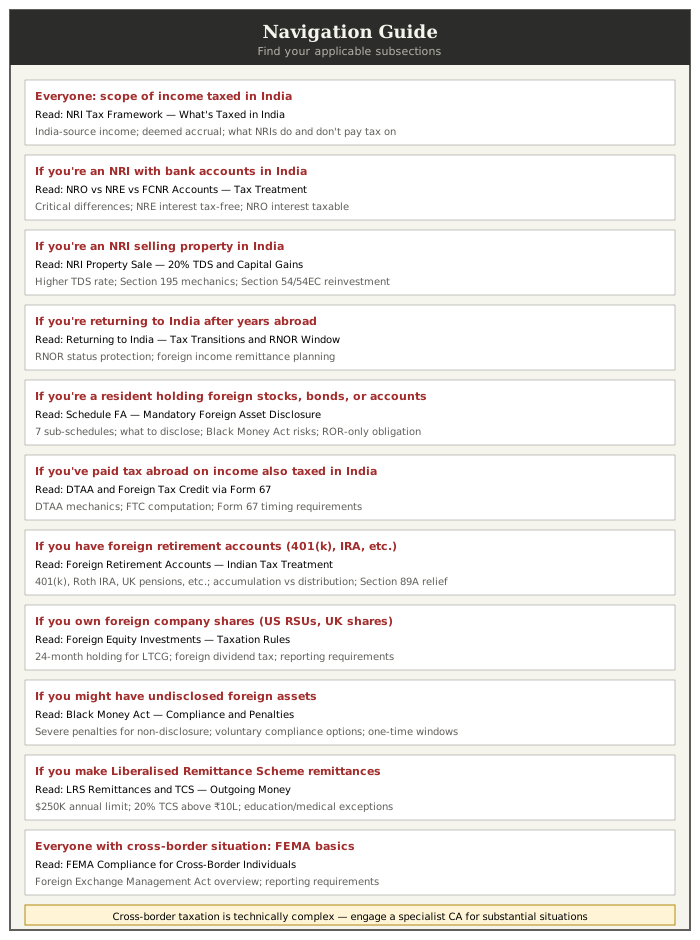
Navigation guide — which subsections apply to your situation
NRI Tax Framework — What's Taxed in India
The fundamental rule: NRIs (Non-Resident Indians) are taxed in India only on India-sourced income. Foreign-source income is not taxed in India for NRIs.
The principle.
| Residential Status | Income Taxed in India |
|---|---|
| Resident and Ordinarily Resident (ROR) | Global income (Indian + Foreign) |
| Resident but Not Ordinarily Resident (RNOR) | Indian income + foreign business income controlled from India + foreign professional income earned during stay in India |
| Non-Resident (NR/NRI) | Only Indian-sourced income |
What constitutes Indian-sourced income for NRIs.
| Income Source | Indian-Sourced? |
|---|---|
| Salary for services performed in India | YES (regardless of where paid) |
| Salary for services performed abroad, paid by Indian employer | YES (deemed accrued in India) |
| Salary for services performed abroad, paid by foreign employer | NO |
| Rental income from property in India | YES |
| Interest from Indian bank deposits (except NRE/FCNR) | YES |
| Interest from NRE/FCNR deposits | NO (specifically exempt) |
| Dividends from Indian companies | YES |
| Capital gains on Indian shares, property, MFs | YES |
| Business income from Indian business | YES |
| Foreign salary, foreign interest, foreign dividends | NO |
Deemed accrual rule (Section 9). Even if income is paid abroad, if it accrues from a connection in India, it's deemed to accrue in India. Examples:
- Salary for services rendered in India, even if paid into a foreign bank
- Interest from money borrowed for an Indian business
- Royalty from a patent used in India
- Fee for technical services rendered for an Indian business
NRI basic exemption and slab rates.
NRIs follow the same slab structure as residents:
- Old Regime: Basic exemption ₹2.5 lakh (no senior citizen relief — that's resident-only)
- New Regime: Basic exemption ₹4 lakh
Section 87A rebate availability for NRIs.
Section 87A rebate (₹60K under New Regime, ₹12.5K under Old Regime) is available ONLY to RESIDENTS. NRIs do not get this rebate. Significant tax difference for NRIs vs residents with similar Indian income.
NRI with ₹10 lakh rental income from property in Bangalore. No other Indian income. NRI tax (New Regime): Income: ₹10,00,000 Less 30% standard deduction on rental: ₹3,00,000 Taxable: ₹7,00,000 Tax: ₹0 (₹0-4L) + ₹15,000 (₹4-7L at 5%) = ₹15,000 Plus cess: ₹600 Total: ₹15,600 A resident with same situation would have ₹15,000 tax fully rebated under Section 87A → ZERO tax. NRI pays ₹15,600.
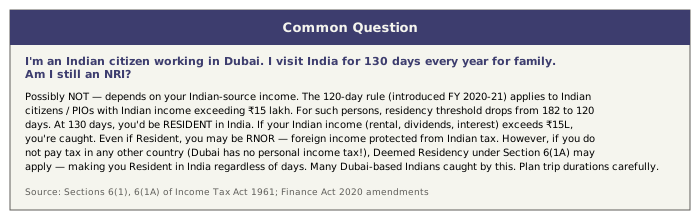
Sections 5, 6, 9, 87A of Income Tax Act 1961.
NRO vs NRE vs FCNR Accounts — Tax Treatment
Three types of bank accounts for NRIs with very different tax treatment.
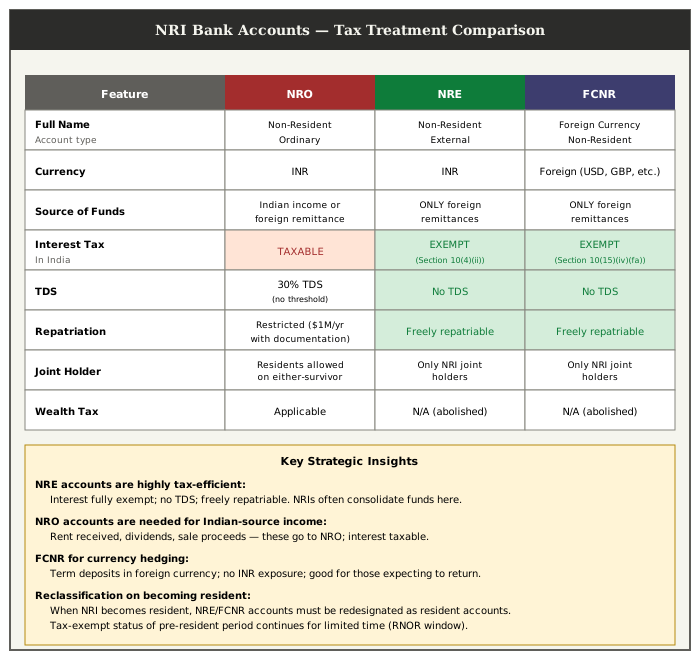
The major NRE advantage. Interest on NRE deposits is fully exempt from Indian tax under Section 10(4)(ii). For an NRI maintaining ₹50 lakh in NRE FD at 7% interest = ₹3.5 lakh annual interest — completely tax-free in India.
Compare with NRO: same ₹50 lakh at 7% = ₹3.5 lakh interest, taxed at 30% TDS + slab rates. Substantial difference for NRIs choosing where to park funds.
The catch: NRE accounts can only be funded from foreign remittances. Indian income (rent, dividends) cannot go to NRE; it must go to NRO.
Sections 10(4)(ii), 10(15)(iv)(fa) of Income Tax Act 1961; FEMA NRI account regulations.
NRI Property Sale — 20% TDS and Capital Gains
When an NRI sells property in India, specific TDS and capital gains rules apply.
The TDS at higher rate.
When an NRI sells property, the buyer must deduct TDS under Section 195 at:
- 20% on long-term capital gain
- Slab rates (up to 30%) on short-term capital gain
This is vastly different from resident-seller TDS under Section 194-IA (which is 1% of sale value regardless of gain).
Why this matters.
Resident seller: 1% TDS on ₹1 crore sale = ₹1 lakh. Recovered when filing ITR if actual tax is lower.
NRI seller: 20% TDS on capital gain. If gain is ₹50 lakh, TDS = ₹10 lakh withheld. This is much more significant cash flow impact.
Mechanics of the TDS.
- Step 1. NRI seller provides buyer with computation of capital gain.
- Step 2. Buyer deducts 20% TDS on the gain (or Form 13 lower deduction certificate amount).
- Step 3. Buyer obtains TAN (if doesn't already have).
- Step 4. Buyer deposits TDS via Form 27Q (different from Form 26QB used for resident sellers).
- Step 5. Buyer issues TDS certificate (Form 16A) to NRI seller.
- Step 6. NRI files ITR to compute final tax and claim refund of excess TDS.
The Form 13 lower deduction certificate.
If the seller can show that actual capital gains tax will be lower than 20% of sale value (e.g., long-held property with substantial cost), they can apply to Assessing Officer for a Form 13 lower deduction certificate. Once issued, buyer deducts at the lower specified rate.
NRI selling Bangalore property for ₹2 crore. Bought 2005 for ₹30 lakh. CII 2005-06 = 117; CII 2025-26 = 376. Cost computation: Indexed cost: ₹30L × 376/117 = ₹96.41 lakh Capital gain (with indexation, pre-July 2024 option): ₹2 crore - ₹96.41 lakh = ₹1.035 crore Tax at 20% with indexation: ₹20.7 lakh Without indexation (12.5% rate, Budget 2024 alternative): Capital gain (no indexation): ₹2 crore - ₹30 lakh = ₹1.7 crore Tax at 12.5%: ₹21.25 lakh Indexation wins (₹20.7 lakh vs ₹21.25 lakh). TDS without lower deduction certificate. Buyer deducts 20% of capital gain = ₹20.7 lakh (matches actual tax) But buyer needs to know cost basis — uncomfortable for buyers TDS as percentage of sale value (default approach). Many buyers, unsure of NRI's basis, withhold 20% of sale value = ₹40 lakh NRI files ITR to claim refund of excess ₹19.3 lakh Cash flow problem: NRI has ₹40 lakh tied up for months
Strategic options for NRIs.
- Apply for Form 13 lower deduction certificate before sale
- Negotiate with buyer to deduct on gain (not sale value) with documentation
- Plan capital gains exemption (Sections 54, 54EC, 54F) before the sale
Reinvestment exemptions for NRIs.
NRIs can use the same exemptions as residents:
- Section 54: Buy new residential property in India (NOT abroad)
- Section 54EC: Invest up to ₹50 lakh in specified bonds
- Section 54F: Reinvest entire net sale consideration in residential property
Section 195; Form 27Q; CBDT NRI property sale procedures.
Returning to India — Tax Transitions and RNOR Window
Returning NRIs face significant tax transitions. Smart planning during the RNOR window can save substantial tax.
Returning NRI residency timeline.
When you return to India, you typically move through three stages:
- Stage 1: Non-Resident (NR). Year of return — depends on days in India. If you spent less than 182 days in India in the return year, still NR for that year.
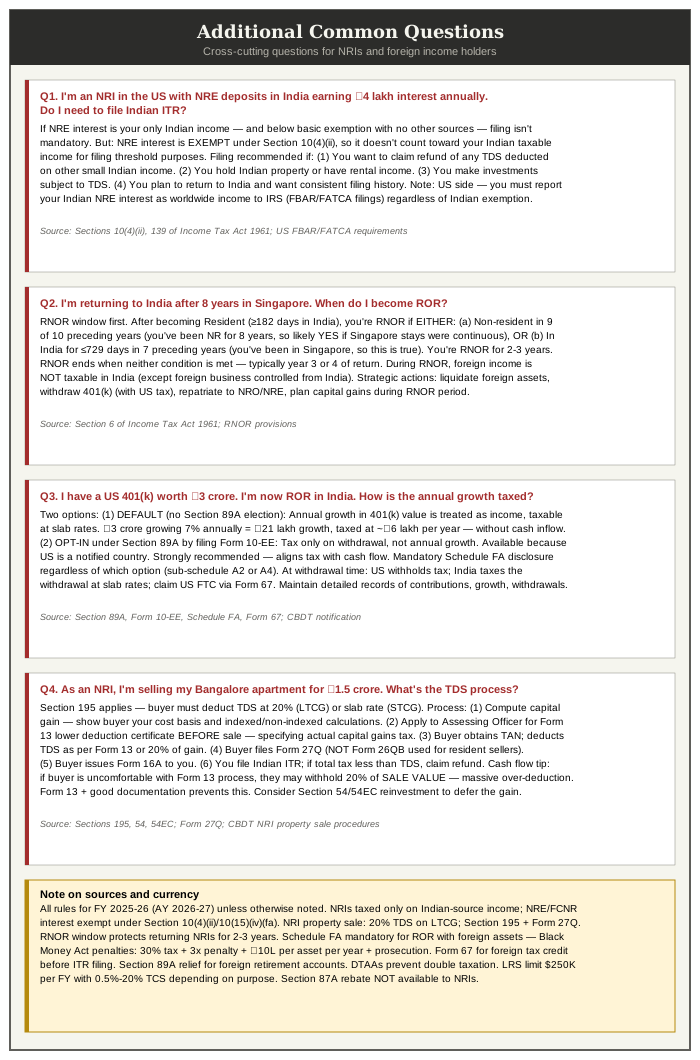
- Stage 2: Resident but Not Ordinarily Resident (RNOR). After becoming Resident (≥182 days), you may qualify for RNOR if: Non-resident in 9 out of 10 preceding years, OR In India for 729 days or less in preceding 7 years. The RNOR window is typically 2-3 years for someone returning after long abroad period.
- Stage 3: Resident and Ordinarily Resident (ROR). After RNOR window ends, becomes ROR — global income taxable in India.
The RNOR advantage.
During RNOR period, foreign income is largely NOT taxed in India:
- Foreign salary, interest, dividends, rental, capital gains: NOT taxable
- Foreign business income controlled from India: TAXABLE
- Foreign professional income earned during India stay: TAXABLE
Strategic actions during RNOR window.
- Action 1: Liquidate foreign assets to convert capital gains. Selling US stocks, foreign property, foreign mutual funds during RNOR avoids Indian capital gains tax. Same sale during ROR phase would attract Indian tax.
- Action 2: Distribute foreign retirement accounts strategically. Withdrawing from 401(k), IRA during RNOR may avoid Indian tax (subject to specific rules covered next).
- Action 3: Repatriate funds before ROR status. Bring funds to India during RNOR; declare in Schedule FA from ROR year onwards.
- Action 4: Income recognition timing. If you can defer foreign income to RNOR years and accelerate Indian income, this optimization can save substantial tax.
Foreign assets at ROR transition.
When you become ROR:
- Schedule FA disclosure becomes mandatory
- Black Money Act applies if foreign assets undisclosed
- Foreign income becomes globally taxable
Many returning NRIs forget to update bank account status (NRE/FCNR must be converted to resident accounts). Continuing as "NRI" while actually resident triggers tax and FEMA violations.
Section 6 of Income Tax Act 1961; FEMA Master Direction on NRI Banking.
Schedule FA — Mandatory Foreign Asset Disclosure
The most consequential disclosure obligation for residents with foreign assets.
Who must file Schedule FA.
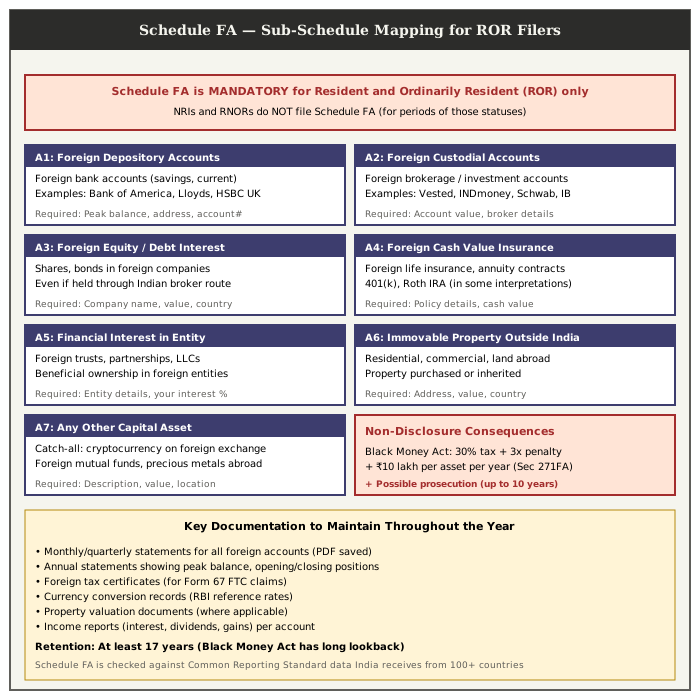
Only Residents and Ordinarily Resident (ROR) individuals must disclose foreign assets in Schedule FA. NRIs, RNORs, and even residents who recently moved to ROR status are not required to file Schedule FA for periods they weren't ROR.
What's covered.
Schedule FA has 7 sub-schedules (A1 through A7) covering:
- A1: Foreign Depository Accounts (foreign bank accounts)
- A2: Foreign Custodial Accounts (foreign brokerage accounts)
- A3: Foreign Equity and Debt Interest (shares, bonds in foreign companies)
- A4: Foreign Cash Value Insurance / Annuity Contracts
- A5: Financial Interest in any Entity (foreign trusts, partnerships)
- A6: Immovable Property Held Outside India
- A7: Any other Capital Asset Held Outside India
Information required for each asset.
- Country, jurisdiction
- Name of entity (bank/company/etc.)
- Address
- Account/folio/identification number
- Period of holding during the year
- Total investment (peak balance during the year)
- Income earned during the year
- Tax paid in foreign country
The peak balance challenge.
For each foreign account, Schedule FA asks for "peak balance" during the year — the highest balance at any point. This requires careful record-keeping. Banks may charge for historical statements.
Black Money Act penalties for non-disclosure.
The Black Money Act, 2015 was specifically designed for unreported foreign assets:
- Income from undisclosed foreign asset: TAXED AT 30%
- Penalty: 3 TIMES the tax (90% effective tax rate)
- Plus: prosecution with up to 10 years rigorous imprisonment
- ALSO: penalty for failure to disclose in Schedule FA — ₹10 lakh per asset per year
The penalties stack. For someone with a ₹50 lakh foreign account undisclosed for 5 years:
- Tax + penalty on income: substantial
- Schedule FA penalty: ₹10L × 5 years = ₹50 lakh
- Possible prosecution
Practical implications.
The Schedule FA penalty is the most striking — it applies regardless of whether tax was correctly paid on the foreign income. Even if all your foreign income is included in your ITR (no tax evasion), missing Schedule FA disclosure attracts ₹10 lakh penalty per asset per year.
What to disclose.
Common items:
- US 401(k), IRA accounts: Yes, A2/A4
- Foreign brokerage accounts (Charles Schwab, Fidelity, etc.): Yes, A2
- Foreign bank accounts: Yes, A1
- Foreign stock holdings (US RSUs not sold): Yes, A3
- Foreign property: Yes, A6
- Cryptocurrency on foreign exchanges: Yes, A7
- Foreign trust/partnership interest: Yes, A5
Exemptions.
- Foreign assets received as bequest from non-resident relative: still need disclosure
- Foreign assets held by NRI/RNOR period: no disclosure required for those periods
Section 139(1) Schedule FA of Income Tax Act 1961; Black Money (Undisclosed Foreign Income and Assets) and Imposition of Tax Act, 2015.
DTAA and Foreign Tax Credit via Form 67
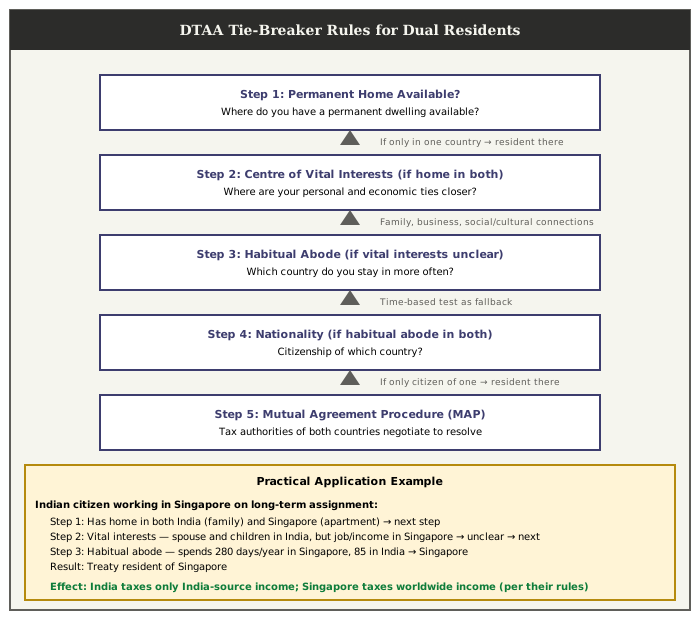
Double Taxation Avoidance Agreements (DTAAs) prevent double taxation of the same income in two countries.
How DTAAs work.
India has DTAAs with 95+ countries. Each treaty specifies:
- Which country has primary taxation rights for various income types
- Maximum withholding rates the other country can charge
- Mechanism for relief from double taxation
Two main methods of relief.
Method 1: Exemption Method. Source country taxes; resident country exempts the same income. Less common in Indian DTAAs.
Method 2: Credit Method. Both countries tax, but resident country gives credit for tax paid in source country. Most common Indian approach.
Resident Indian receives dividend from US company. US withholds 15% TDS (per India-US DTAA). US dividend gross: ₹10,00,000 US tax withheld: ₹1,50,000 Net received: ₹8,50,000 In India: Dividend included in income at full ₹10 lakh. Indian tax on dividend (assume 30% slab): ₹3,00,000. Foreign Tax Credit claim: Lower of (US tax paid ₹1,50,000) or (Indian tax on this dividend ₹3,00,000) = ₹1,50,000 Final Indian tax on dividend: ₹3,00,000 - ₹1,50,000 = ₹1,50,000 Total combined tax: ₹1,50,000 (US) + ₹1,50,000 (India) = ₹3,00,000. Same as Indian tax on ₹10 lakh — no double tax.
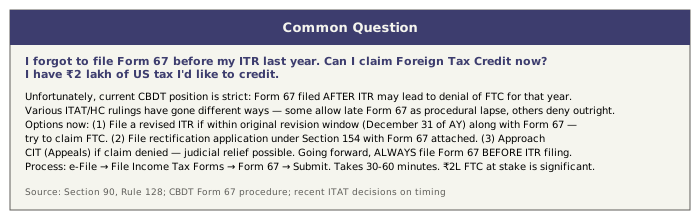
Form 67 — Mandatory for Foreign Tax Credit.
To claim FTC, you must file Form 67 online:
- Filed BEFORE filing your ITR
- Specifies: country, type of income, foreign tax paid, FTC claimed
- Backed by documentation: foreign tax certificates, foreign country returns
Critical: Timing.
Form 67 must be filed on or before the due date of filing ITR. Late Form 67 = FTC denied even if otherwise eligible.
Documents to maintain.
- Foreign tax returns
- Foreign tax certificates (e.g., US Form W-2, 1099)
- Foreign tax payment proofs
- Currency conversion records
- Computation of foreign tax credit
DTAA-specific rates (common examples).
| Country | Dividend WHT (DTAA) | Interest WHT (DTAA) |
|---|---|---|
| USA | 15-25% | 15% |
| UK | 10-15% | 15% |
| Singapore | 10-15% | 15% |
| UAE | 10% | 12.5% |
| Mauritius | 5-15% | 7.5% |
For Indian residents, these are the rates the source country can charge before India taxes the income and credits the foreign withholding.
Section 90 of Income Tax Act 1961; DTAA treaties with respective countries; CBDT Form 67 procedures.
Foreign Retirement Accounts — Indian Tax Treatment
For Indians who worked abroad, foreign retirement accounts pose complex Indian tax questions.
Common situations.
US 401(k) and IRA.
- Tax-deferred US accounts
- Contributions in employment years
- Distributions at retirement (post-59.5 in US)
UK pensions, Australian superannuation, etc.
- Similar tax-deferred structures
- Different country-specific rules
Indian tax treatment — the principle.
For ROR Indians, the tax treatment hinges on whether they accept "accrual" or "withdrawal" basis:
Accrual basis (default Indian approach):
- Annual growth in account taxable each year
- Even before withdrawal
- Creates substantial tax burden without cash flow
Withdrawal basis (preferred for taxpayer):
- Tax only when actually withdrawn
- Aligns tax with cash flow
Section 89A relief (Budget 2021).
Section 89A allows residents to opt for taxation on withdrawal basis for "specified retirement accounts" in "notified countries." This is a significant relief.
Conditions:
- Account must be in a notified country (US, UK, Canada specifically notified)
- Account must be a "specified retirement account"
- Taxpayer must opt in by Form 10-EE
- Withdrawal includes both periodic and lump sum distributions
Without Section 89A: Annual growth in 401(k) is treated as income (controversial but tax department's general view). With 89A: Wait until withdrawal, tax then.
Returning NRI has US 401(k) worth $300,000 (₹2.5 crore). Annual growth: $30,000 (₹25 lakh). Without Section 89A: ₹25 lakh added to Indian income annually Tax at slab rates: ~₹7.5 lakh annually No cash inflow → cash flow burden With Section 89A: No annual tax during accrual Only tax at withdrawal time Better cash flow alignment
Strategic withdrawal during RNOR window.
If retiree withdraws from 401(k) during RNOR window:
- US: standard US tax applies on distribution
- India: RNOR doesn't tax foreign-source income → no Indian tax
- Net result: pay only US tax (around 10-37% federal + state)
Same withdrawal in ROR phase would attract Indian tax (with credit for US tax via DTAA). Often higher combined burden.
Documentation.
- Annual statements from foreign retirement account
- Currency conversion at year-end (peak balance)
- US tax returns showing 401(k) reporting
- Withdrawal records when made
Section 89A of Income Tax Act 1961; CBDT notification specifying countries.
Foreign Equity Investments — Taxation Rules
Indians holding foreign stocks face specific tax rules.
Holding period and rates.
Foreign equity is treated like Indian unlisted shares for tax purposes:
- LTCG threshold: 24 months holding
- LTCG rate: 12.5% without indexation (post-Budget 2024)
- STCG: Slab rates
Compare with Indian equity.
| Asset Type | LTCG Threshold | LTCG Rate |
|---|---|---|
| Indian listed shares | 12 months | 12.5% above ₹1.25 lakh exemption |
| Foreign listed shares | 24 months | 12.5% (no exemption) |
| Unlisted shares (Indian) | 24 months | 12.5% |
So foreign listed shares (US stocks, UK shares) require LONGER holding for LTCG and don't get the ₹1.25 lakh annual exemption that Indian listed shares enjoy.
Dividend from foreign shares.
- Indian tax at slab rates (Other Sources head)
- Plus foreign country withholding (per DTAA)
- Foreign Tax Credit via Form 67
Indian resident receives US RSUs from employer (Indian subsidiary of US parent). At RSU vesting: Perquisite (as salary): FMV of vested shares at vest date Indian employer (subsidiary) deducts TDS At sale (say, 2 years after vesting): Capital gain in INR: (USD sale price × INR rate) - (USD cost basis × INR rate at vest) LTCG at 12.5% (held 24 months) US may withhold tax on gain (15% per India-US DTAA for capital gains in some cases; varies) Indian tax with US FTC credit via Form 67
Currency conversion issues.
For each transaction, convert USD to INR at the appropriate rate:
- For vesting: RBI reference rate on vesting date
- For sale: RBI reference rate on sale date
- For dividend: RBI rate on dividend date
These rates affect gain computation significantly. Documenting source of rates is essential.
Schedule FA disclosure.
All foreign shares must be disclosed in Schedule FA (sub-schedule A3) every year you hold them as ROR — not just in years of buying/selling.
Sections 45, 47, 49, 112 of Income Tax Act 1961; Schedule FA instructions.
Black Money Act — Compliance and Penalties
The Black Money Act, 2015 dramatically changed compliance for Indians with foreign assets.
The Act's purpose.
Designed to address concerns about Indians holding undisclosed wealth abroad. Imposes severe consequences for non-disclosure of foreign income and assets.
Coverage.
The Black Money Act applies to:
- Indian residents (broadly defined to include ROR and certain RNOR situations)
- Foreign income not previously disclosed
- Foreign assets not previously disclosed
Penalties under Black Money Act.
Tax on undisclosed foreign income/asset. 30% — same rate as Indian income tax for high earners.
Penalty for non-disclosure. 3 times the tax — effectively 90% of the asset value as penalty.
Combined: Up to 120% of asset value can be lost to Indian government if foreign asset is detected.
Plus separate Schedule FA penalty. ₹10 lakh per asset per year of non-disclosure under Section 271FA of Income Tax Act.
Plus possible prosecution. Up to 10 years rigorous imprisonment.
One-time compliance window (2015). When the Act was introduced, a 3-month compliance window allowed disclosure with 30% tax + 30% penalty (60% total). The window closed September 30, 2015.
Subsequent voluntary disclosure scheme (2016). Income Declaration Scheme (IDS) allowed disclosure of undisclosed Indian income at 45% (30% tax + 7.5% Krishi Kalyan cess + 7.5% Pradhan Mantri Garib Kalyan cess). Closed September 30, 2016.
Current voluntary compliance.
No general voluntary compliance window currently open. Disclosing now means:
- 30% tax on income
- 3× penalty (90%)
- Schedule FA penalties for past years
- Prosecution risk
Practical advice for those with old undisclosed assets.
This is a difficult situation requiring specialized legal counsel. Options to consider:
- Option 1: Voluntary disclosure now. Pay tax + penalty + Schedule FA fees. Limit prosecution exposure through cooperation. Cost: heavy but bounded.
- Option 2: Continued non-disclosure. Risk: discovery through foreign country information exchange. India has Tax Information Exchange Agreements (TIEAs) with many countries. Increasing CRS (Common Reporting Standard) automatic data sharing.
- Option 3: Liquidate before becoming ROR (for those still RNOR). If you're still RNOR, foreign assets aren't in your Indian tax scope. Strategic liquidation and bringing funds onshore can be done now.
Black Money (Undisclosed Foreign Income and Assets) and Imposition of Tax Act, 2015; Section 271FA of Income Tax Act 1961.
LRS Remittances and TCS — Outgoing Money
When you send money abroad, specific tax rules apply.
Liberalised Remittance Scheme (LRS).
RBI scheme allowing resident individuals to remit up to $250,000 per FY abroad for permitted purposes:
- Education
- Medical treatment
- Maintenance of close relatives
- Travel (private visits, business, etc.)
- Gift remittances
- Capital account transactions (foreign investments, foreign property)
TCS rates on LRS remittances.
| Purpose | Threshold | TCS Rate |
|---|---|---|
| Foreign education funded by loan | Above ₹7 lakh | 0.5% |
| Foreign education funded by own | Above ₹10 lakh | 5% |
| Foreign medical treatment | Above ₹7 lakh | 5% |
| Foreign tour packages from Indian operator | Any amount | 5% |
| Other (investment, gifts, etc.) | Above ₹10 lakh | 20% |
The 20% TCS impact.
Most non-education, non-medical LRS remittances above ₹10 lakh face 20% TCS — significant withholding. Recovered when filing ITR if actual tax liability is lower.
Practical implications.
Sending $50,000 to your son's US bank for general expenses. INR equivalent: ~₹42 lakh TCS 20% above ₹10 lakh threshold: 20% × ₹32 lakh = ₹6.4 lakh withheld You pay bank ₹42L + ₹6.4L = ₹48.4 lakh Claim refund of ₹6.4 lakh through ITR
Sending money for son's tuition fees ($25K paid to US university). INR equivalent: ~₹21 lakh If from education loan: 0.5% above ₹7L = 0.5% × ₹14L = ₹7,000 TCS If from own funds: 5% above ₹10L = 5% × ₹11L = ₹55,000 TCS
Documentation requirements.
Banks require:
- LRS purpose declaration form
- Tax compliance certificate
- Source of funds documentation
- KYC documents
- PAN
Aggregation across the year. TCS is computed cumulatively. Multiple smaller remittances totaling over the threshold trigger TCS on the excess.
Section 206C(1G) of Income Tax Act 1961; RBI LRS Master Direction.
FEMA Compliance for Cross-Border Individuals
Beyond tax law, the Foreign Exchange Management Act (FEMA) governs cross-border financial activities.
Key FEMA principles.
For residents.
- Cannot maintain foreign currency accounts in India (except specific permitted categories)
- LRS limit of $250K per year for permitted outward remittances
- Indian source income from abroad requires reporting
For non-residents.
- Can maintain NRO/NRE/FCNR accounts in India
- Restrictions on Indian property purchase (residential allowed; agricultural restricted)
- Income from Indian sources can be repatriated subject to limits
Repatriation rules.
| Item | NRI Repatriation |
|---|---|
| NRE balance | Freely repatriable |
| FCNR balance | Freely repatriable |
| NRO balance | Up to $1 million per FY with documentation |
| Sale of inherited property | Up to $1 million per FY |
| Sale of personally bought Indian property (NRI) | Within investment value; balance via NRO route |
Returning NRIs and FEMA.
When you return to India:
- Notify banks within 7 days of return
- Convert NRE/FCNR accounts to resident accounts
- Foreign assets can continue to be held under specific provisions
Penalties for FEMA violations.
- Penalty up to 3 times the amount involved
- Imprisonment for repeat offenders
- Compounding option for cooperative violators
Reporting requirements.
Various forms based on transactions:
- Form ECB/EFM for foreign borrowings
- Form 15CA/CB for cross-border payments
- Annual Performance Reports for foreign investments
Foreign Exchange Management Act 1999; RBI Master Directions.
Active Foreign Stock Traders — Special Considerations
A growing population of Indian residents actively trades US stocks through platforms like INDmoney, Vested, Groww International, and Interactive Brokers. The basic tax framework covered earlier in this lesson applies, but active traders face specific issues that don't affect occasional foreign equity holders. This subsection covers what dedicated US stock traders need to know beyond the general foreign equity rules.
Trader vs Investor Classification
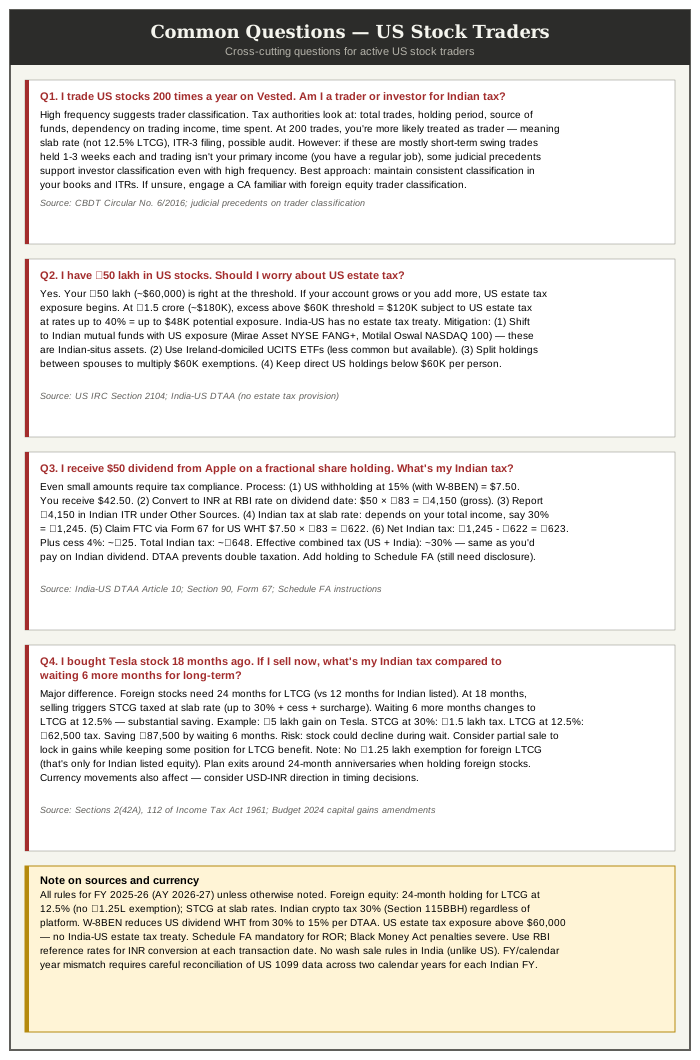
The fundamental question for any active stock trader: are you treated as an "investor" (capital gains) or "trader" (business income)? This distinction applies to foreign stocks the same as Indian stocks.
Why the classification matters.
| Aspect | Investor (Capital Gains) | Trader (Business Income) |
|---|---|---|
| Long-term tax | 12.5% LTCG (after 24 months) | Slab rates (no LTCG benefit) |
| Short-term tax | Slab rates | Slab rates |
| Losses | Can offset capital gains only | Can offset other business income |
| Audit threshold | Not relevant | ₹1 crore turnover triggers audit |
| ITR Form | ITR-2 | ITR-3 |
| Expenses | Not deductible | Deductible (subscription fees, software, etc.) |
Tests applied by tax authorities.
There's no clear legal threshold. CBDT Circular No. 6/2016 guidance and judicial precedents indicate factors:
- Frequency and volume of trades
- Holding period (very short = trader; longer = investor)
- Magnitude (trading is primary income source vs secondary)
- Source of funds (own capital vs borrowed for trading)
- Treatment in your books/records (declared as trading or investment)
- Whether you're substantially active during market hours
Practical classification thresholds.
Tax authorities generally consider you a trader if:
- Most positions held for hours/days (not months)
- 100+ trades per year
- Substantial portion of income from trading
- Active monitoring during market hours
- Trading is your declared business activity
You're more likely treated as investor if:
- Buy-and-hold for months or years
- Fewer than 20-30 trades per year
- Trading is supplementary to other income
- Hold long-term positions through market cycles
Self-classification advantage.
How you initially declare matters. If you consistently file as investor (ITR-2 with capital gains), tax authorities tend to accept that classification unless trading pattern is obviously commercial. If you start declaring as business income (ITR-3), you can't easily revert without scrutiny questions.
Strategic implication.
For most casual-to-moderate Indian US stock traders, declaring as investor is preferable:
- LTCG at 12.5% (vs slab rate up to 30% + surcharge)
- Simpler ITR-2 filing
- No audit obligation
- Even if you trade 50-80 times a year, investor classification usually holds
CBDT Circular No. 6/2016 on equity income classification; Section 28 and 45 of Income Tax Act 1961; various ITAT and HC decisions on trader vs investor classification.
Currency Conversion Mechanics
Active US stock traders face hundreds of transactions per year, each requiring rupee conversion for Indian tax computation.
Which exchange rate to use.
For each transaction, the relevant rate is RBI's reference rate on the transaction date:
- Buy transaction: RBI rate on the buy date
- Sell transaction: RBI rate on the sell date
- Dividend: RBI rate on dividend payment date
- Withholding tax: RBI rate on date tax was withheld
RBI reference rates source.
- RBI publishes daily reference rates for USD, GBP, EUR, JPY at: rbi.org.in → Forex Markets → FX Reference Rates
- Daily 1:30 PM rate is typically used
- For currencies without daily RBI reference rates (most exotic currencies), use the closest available rate or convert via USD as intermediate.
Practical workflow for active traders.
Approach 1: Use platform-provided INR values. Many India-targeted platforms (Vested, INDmoney) provide INR-converted values in statements. Easier but verify the exchange rate methodology matches RBI reference rate. Document the source.
Approach 2: Manual conversion using RBI rates. For each transaction, manually convert USD amounts. More work but verifiable in case of scrutiny.
Approach 3: Hybrid — Year-end reconciliation. Use platform INR values during the year for record-keeping. At year-end, run reconciliation against RBI rates for accuracy on material transactions (especially large ones).
Buy 100 shares of AAPL on March 15, 2025 at $180. RBI rate March 15: ₹83.45. Indian rupee cost: $180 × ₹83.45 × 100 = ₹15,02,100 Sell 100 shares on October 20, 2026 at $230. RBI rate October 20: ₹84.20. Indian rupee sale value: $230 × ₹84.20 × 100 = ₹19,36,600 Holding period: 19 months (less than 24 months) → STCG Capital gain: ₹19,36,600 - ₹15,02,100 = ₹4,34,500 Tax at slab rate: depends on total income (typically 20-30% bracket) Note the FX effect. Same trade in USD terms: $50 × 100 = $5,000 gain. But INR gain is ₹4,34,500 due to currency appreciation. The rupee gain reflects both stock appreciation AND USD strengthening against INR. Both are taxable in India. Conversely, if rupee strengthened. If RBI rate on sell date was ₹81 (rupee stronger): INR sale: $230 × ₹81 × 100 = ₹18,63,000 Capital gain: ₹18,63,000 - ₹15,02,100 = ₹3,60,900 Smaller INR gain despite same USD profit. The currency effect can swing gains by 5-15% annually.
RBI Master Direction on foreign exchange; CBDT guidance on currency conversion for tax purposes.
W-8BEN Form — Reducing US Dividend Withholding
A critical compliance item that many Indian US stock traders overlook.
What is W-8BEN.
A US tax form (Form W-8BEN: Certificate of Foreign Status of Beneficial Owner for United States Tax Withholding and Reporting) that establishes you are a non-US person and claims DTAA benefits.
The default vs treaty rate.
| Without W-8BEN filed | With W-8BEN filed |
|---|---|
| US WHT on dividends: 30% | US WHT on dividends: 15% (per India-US DTAA) |
| US WHT on interest: 30% | US WHT on interest: 15% |
| US WHT on capital gains: usually 0% | US WHT on capital gains: usually 0% |
The 15% saving.
A trader receiving $1,000 (~₹83,000) in US dividends:
- Without W-8BEN: $300 withheld; receives $700
- With W-8BEN: $150 withheld; receives $850
- Difference: $150 per $1,000 of dividends. Significant for serious dividend-focused investors.
How to file W-8BEN.
Most India-targeted platforms (Vested, INDmoney, Groww International) handle W-8BEN as part of account opening. Verify:
- Your account profile shows W-8BEN filed
- Recent dividend payments show 15% WHT (not 30%)
- Get copy of W-8BEN for records
Renewal.
W-8BEN expires after 3 years from filing. Brokers typically prompt for renewal. Failure to renew reverts you to 30% WHT.
For Interactive Brokers and other US brokers directly.
- Download W-8BEN from IRS website
- Fill identity, country (India), DTAA claim
- Submit to broker
- Get acknowledgment
IRS Form W-8BEN; India-US Double Taxation Avoidance Agreement Article 10 (Dividends), Article 11 (Interest).
US Estate Tax — Critical for Substantial Holdings
A serious risk that most Indian US stock traders are unaware of, with potentially catastrophic financial consequences.
The rule.
The US imposes estate tax on US-situs assets of non-US persons (including Indians) at progressive rates up to 40%. The threshold is just $60,000.
US-situs assets include:
- Shares of US-incorporated companies (Apple, Microsoft, Tesla, etc.)
- US real estate
- US bonds (mostly)
- US bank deposits (mostly exempt)
Compare to US citizens/residents. US persons get $13 million+ exemption (2024). Non-US persons get just $60,000.
The danger.
An Indian trader with $200,000 in US stocks (~₹1.66 crore) holds:
- Assets above $60,000 threshold by $140,000
- On death: US estate tax applies on the excess
- Rate: starts at 18% climbing to 40%
- Could lose $30,000-$50,000 (~₹25-40 lakh) to US estate tax
No DTAA protection.
Critical: India-US treaty does NOT have an estate tax treaty component. India abolished estate tax in 1985, so India has no estate tax to begin with. US treats Indian residents as fully exposed to US estate tax on US-situs assets above $60,000.
Practical implications.
- Assets exceeding $60,000 face US estate tax exposure
- Heirs would deal with both Indian succession and US estate tax filing
- IRS Form 706-NA must be filed within 9 months of death
Mitigation strategies.
- Strategy 1: Keep holdings below $60,000. Limit US stock holdings to under $60,000 per person. For families, split holdings between spouses to multiply exemptions.
- Strategy 2: Invest through Indian mutual funds with US exposure. Indian MFs investing in US stocks (Mirae Asset NYSE FANG+, Motilal Oswal NASDAQ 100, etc.) are Indian-situs assets — not subject to US estate tax. You hold MF units in India, not US stocks directly.
- Strategy 3: Use ETFs domiciled in Ireland (UCITS). Ireland-domiciled ETFs (rather than US-domiciled) avoid US estate tax exposure while still providing US market exposure. Less common for retail Indians but feasible through some platforms.
- Strategy 4: Joint accounts with rights of survivorship. Not straightforward — US estate tax may still apply on death of either holder. Get specialized US tax advice.
- Strategy 5: Use US partnership structures or trusts. Sophisticated planning; requires US estate planning attorney.
Reality check.
For Indian retail investors with $5,000-$50,000 in US stocks, US estate tax isn't a practical concern. But anyone with substantial US holdings ($100,000+) should consciously plan or accept this risk.
US Internal Revenue Code Section 2104 (US-situs assets for estate tax); India-US DTAA (no estate tax component); IRS Publication 559.
Fractional Shares and Schedule FA Reporting
Many India-targeted platforms offer fractional share trading. This creates reporting complications.
The issue.
Indian residents using Vested, INDmoney, etc. often hold:
- 0.5 shares of Tesla
- 1.7 shares of Berkshire Hathaway
- 0.05 shares of Berkshire Hathaway A class
These fractional positions are economic interests in shares but not full shares. How to report in Schedule FA?
The conservative approach.
Disclose each holding as foreign equity interest in Schedule FA sub-schedule A3:
- Name of company
- Country (USA)
- Address (often the company HQ)
- Period of holding
- Peak value during the year (computed at peak NAV)
- Closing value
- Income earned (dividends)
For aggregating small holdings.
Some commentators suggest aggregating very small fractional positions by company. So if you hold 0.5 + 0.5 + 0.5 of Tesla bought across 3 transactions, report as 1.5 Tesla shares overall.
Conservative practice: report each underlying position separately.
Form 16A from platforms.
India-targeted platforms typically provide:
- Annual transaction statement
- Capital gains summary in INR
- Schedule FA-ready disclosure summary
Use these as starting point but verify against your records.
Schedule FA instructions; platform documentation; CBDT general disclosure principles.
Crypto on Foreign Exchanges
Indians trading cryptocurrency on US-based exchanges (Coinbase, Kraken, Binance.US) face a unique multi-layered tax situation.
Three layers of complexity.
- Layer 1: Section 115BBH — Indian crypto tax. All crypto gains taxable at flat 30% in India. No deductions for losses, no offset against other income, no slab rate benefits.
- Layer 2: 1% TDS under Section 194S. Crypto transactions through Indian exchanges face 1% TDS. Foreign exchanges may not deduct this — but the Indian resident is still liable to report and pay tax.
- Layer 3: Schedule FA disclosure. Crypto held on foreign exchanges = foreign asset → Schedule FA sub-schedule A7 disclosure mandatory.
Practical scenarios.
Indian resident has $5,000 worth of Bitcoin on Coinbase. Schedule FA disclosure: REQUIRED Any sale/exchange/conversion: 30% Indian tax on gain (Section 115BBH) No deduction for transaction fees Losses cannot offset other gains
Indian resident transfers crypto from Coinbase to Indian exchange (CoinDCX). Transfer between own wallets: not a taxable event (no sale) But Section 194S 1% TDS may apply when sold on Indian exchange Schedule FA disclosure still required for the period held on foreign exchange
Indian resident uses crypto on foreign exchange to buy other crypto (BTC to ETH). Treated as sale of BTC + purchase of ETH 30% Indian tax on BTC gain New cost basis established for ETH Both ends potentially Schedule FA disclosable
Currency conversion for crypto.
Crypto values fluctuate constantly. Conservative approach:
- Use exchange rate at time of transaction
- For year-end Schedule FA, use peak value during year in INR (converted at peak date)
- Maintain detailed transaction logs
Section 115BBH, 194S of Income Tax Act 1961; Schedule FA instructions; CBDT crypto taxation circulars.
Tax Loss Harvesting — Different Rules
US tax planning allows specific identification of lots for tax loss harvesting. Indian tax treatment differs.
US approach.
In the US, when you sell some shares, you can specify which "lots" you're selling (first-in-first-out, last-in-first-out, highest cost basis first, etc.). This allows tax loss harvesting — selling losing lots while keeping winning lots.
Indian approach.
Indian tax law uses FIFO (First-In-First-Out) for capital gains computation by default. All shares of the same company are typically treated as one block (with sub-lots for tax tracking).
Implications.
If you own 100 AAPL shares bought across multiple dates at different prices:
- Selling 30 shares: Indian tax treatment uses earliest-acquired shares first
- Cannot pick "highest cost lots" to maximize losses
- Less flexibility than US treatment
Wash sale rules.
The US has "wash sale" rules: if you sell at a loss and rebuy within 30 days, the loss is disallowed (deferred). India has NO equivalent wash sale rules for foreign stocks. You can sell at a loss and immediately rebuy to harvest the loss for Indian tax purposes.
Strategic implication.
Indian residents trading US stocks can:
- Sell losing positions before year-end to realize loss
- Immediately rebuy to maintain exposure
- Claim the loss against other capital gains (or carry forward)
This is technically allowed in India but creates US tax compliance burden (US needs the wash sale tracking even though India doesn't).
Section 45-55 of Income Tax Act 1961; US Internal Revenue Code Section 1091 (wash sales).
Reconciling US and Indian Tax Years
The fundamental calendar mismatch creates reconciliation work.
The year mismatch.
- US tax year: January 1 to December 31
- Indian financial year: April 1 to March 31
The reconciliation problem.
US brokers send Form 1099 (similar to Indian Form 16A) for the calendar year. Indian ITR requires Indian FY data. So a US tax year ends in December but Indian FY 2025-26 covers April 2025 to March 2026 — overlap of two calendar years.
The reconciliation approach.
For each Indian FY (e.g., FY 2025-26):
- Capture all transactions from April 1, 2025 to March 31, 2026
- This spans Jan-Mar 2026 portion + April-Dec 2025 portion of US 1099 data
- Combine partial US 1099s (calendar year 2025 covers April-Dec 2025 part; 2026 calendar 1099 covers Jan-Mar 2026 part)
Filing Indian ITR for FY 2025-26 (AY 2026-27): Need: All US stock transactions April 1, 2025 to March 31, 2026. Sources: US Form 1099 for calendar year 2025: Includes April-Dec 2025 transactions (relevant) + Jan-Mar 2025 transactions (NOT relevant) US Form 1099 for calendar year 2026: Will include Jan-Dec 2026 (only Jan-Mar 2026 relevant) Reconciliation: Extract relevant periods from both 1099s for Indian FY 2025-26 ITR.
Foreign Tax Credit timing.
For Form 67 (FTC claim), declare foreign tax paid in the Indian FY:
- Dividends received Jan-Mar 2026: 15% US WHT in that period claimable in FY 2025-26
- Even though same tax appears on US 1099 for calendar 2026
- This requires careful tracking.
Documentation.
Maintain:
- Monthly transaction statements (saved as PDF)
- Year-end consolidated statements from broker
- US Form 1099 each year
- Currency conversion records
- W-8BEN and renewal records
Indian Section 90; CBDT Form 67 procedures; US IRS Form 1099 documentation.
Practical Toolkit for Active US Stock Traders
Annual compliance checklist.
April-May (start of Indian FY).
- Renew W-8BEN if approaching 3-year expiry
- Document Schedule FA opening balances
- Plan year's tax loss harvesting if applicable
- Setup tax reconciliation worksheet
Quarterly.
- Pay advance tax on estimated foreign income (Section 207-208)
- Reconcile platform statements with bank/broker records
At year-end (March 31).
- Take screenshot of all holdings with INR-converted values
- Note peak values during the year (for Schedule FA)
- Identify loss-harvesting opportunities before March 31
Filing season (April-July).
- Get US 1099 data for the FY (combining two calendar years)
- Compute foreign tax credit per transaction
- File Form 67 BEFORE ITR filing
- Complete Schedule FA accurately
- File ITR-2 (investor) or ITR-3 (trader)
Tools and platforms.
- Vested, INDmoney, Groww International: India-targeted, easier compliance, fewer features
- Interactive Brokers, Charles Schwab: Direct US access, more features, more manual work
- Tax-specific tools: Quicko, Cleartax provide foreign stock-aware ITR filing
- Spreadsheet templates: Many CA blogs publish free templates for US stock reconciliation
When to engage a specialist.
Consider specialized cross-border CA if:
- Over $100K in US holdings
- Active trader (100+ trades/year)
- Holdings across multiple platforms
- Complex situations (RSUs + own buys, multiple currencies, derivatives)
- Family ownership across India-US (common for tech families)
Cost: ₹15,000-₹75,000 annually for active trader filing — usually worth it given complexity.
Key Takeaways
- NRIs are taxed in India only on India-sourced income; Section 87A rebate is unavailable to NRIs — a meaningful difference versus residents with similar income levels
- NRE account interest is fully exempt under Section 10(4)(ii); NRO interest is taxed at slab rates plus 30% TDS; routing Indian income correctly between accounts is critical
- When an NRI sells Indian property, the buyer must deduct TDS under Section 195 at 20% on long-term capital gain — vastly higher than the 1% of sale value required for resident sellers
- The RNOR window (typically 2-3 years after return) is a strategic opportunity: liquidate foreign assets, distribute retirement accounts, and repatriate funds before ROR status triggers global income taxation
- Schedule FA disclosure is mandatory for every ROR resident with foreign assets; the Black Money Act imposes ₹10 lakh per asset per year for non-disclosure even when all foreign income is correctly reported
- Form 67 must be filed on or before the ITR due date — late filing means the foreign tax credit is automatically denied regardless of eligibility
- Section 89A allows withdrawal-basis (not accrual-basis) taxation for foreign retirement accounts in notified countries; strategic withdrawals during the RNOR window can eliminate Indian tax entirely
- Foreign equity requires 24 months for LTCG versus 12 months for Indian listed shares; no ₹1.25 lakh annual exemption applies to foreign stock gains
- W-8BEN filing reduces US dividend withholding from 30% to 15% per India-US DTAA; verify the form is on file with every platform and renew before the 3-year expiry
- US estate tax applies to Indian residents holding more than $60,000 in US-situs assets at progressive rates up to 40%; India-US DTAA provides no estate tax protection
Quiz — 5 Questions
Answer one at a timeWhich of the following statements about Section 87A rebate is correct for Non-Resident Indians?