Farmers and Agricultural Income
Constitutional basis for agricultural income exemption, Section 2(1A) definition and scope, partial integration mechanics, plantation income rules for tea/coffee/rubber, rural versus urban land sale distinctions, compulsory acquisition exemption under Section 10(37), ITR form selection, and government scheme tax treatment for farmers
- Identify the three categories of agricultural income under Section 2(1A) and distinguish what activities qualify versus those classified as business income
- Apply the two-condition test for partial integration and understand how agricultural income increases the effective tax rate on non-agricultural income
- Calculate the agricultural and business portions of income for tea, coffee, and rubber plantations using Rules 8, 7B, and 7A respectively
- Determine whether a sale of agricultural land triggers capital gains tax based on the rural-urban proximity test under Section 2(14)
- Apply Section 10(37) exemption conditions for compulsory acquisition of urban agricultural land
- Select the correct ITR form for farmers based on their mix of agricultural, business, and other income
Farmers and Agricultural Income
Agricultural income occupies a unique constitutional position in Indian tax law. Article 246 of the Constitution gives the central government no power to tax agricultural income — that authority belongs to the states. As a result, Section 10(1) of the Income Tax Act exempts agricultural income from central income tax entirely.
This creates a counterintuitive situation. Pure agricultural income is fully tax-free at the central level. But the moment you have any non-agricultural income, the agricultural income — while still exempt — affects the tax rate applied to your non-agricultural income through a mechanism called "partial integration." A farmer with ₹5 lakh agricultural income and ₹6 lakh salary pays MORE tax than someone with just ₹6 lakh salary, even though the agricultural income itself isn't taxed.
Beyond the integration mechanics, this lesson covers what actually counts as agricultural income (narrower than commonly understood), the special rules for tea, coffee, and rubber plantations (where part is agricultural and part is business), capital gains on sale of agricultural land (urban vs rural matters enormously), and the practical compliance questions farmers face when they have any non-agricultural income alongside their farming.
A reminder: this lesson uses Income Tax Act 1961 references applicable to FY 2025-26 income filed as AY 2026-27.
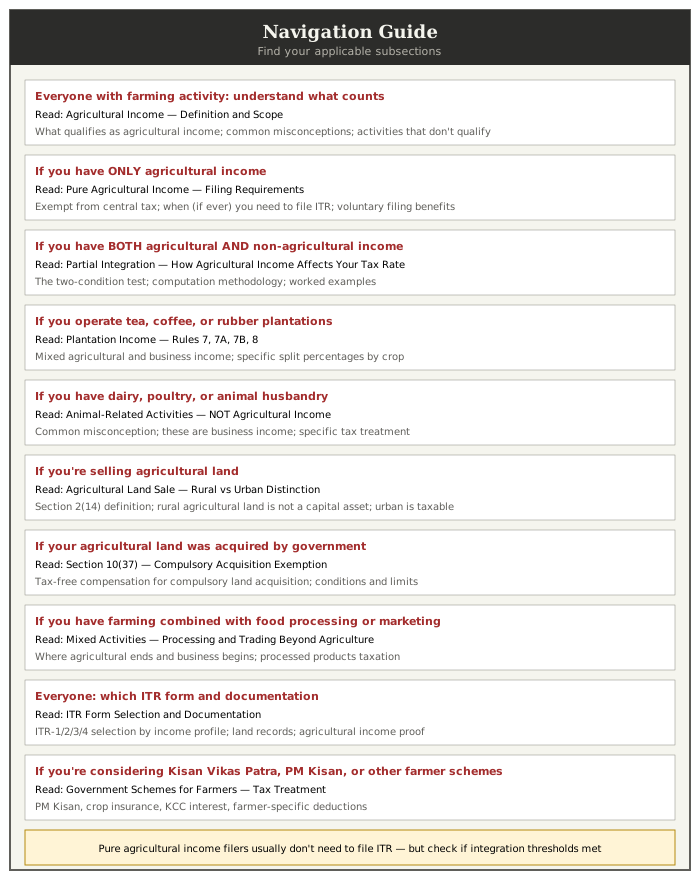
Navigation guide — which subsections apply to your situation
Agricultural Income — Definition and Scope
Section 2(1A) defines agricultural income narrowly. Many activities that seem agricultural don't qualify.
The three categories of agricultural income.
Category 1 — Rent or revenue from agricultural land.
Rent received from leasing out agricultural land for farming, or revenue from agricultural land used for agricultural purposes. The land must be:
- Situated in India
- Used for agricultural purposes
- Either rented out for agriculture or operated by the owner
Category 2 — Income from agricultural operations.
This is the most common form — income from cultivating land. Specifically:
- Basic operations on the land (cultivation of soil, tilling, sowing, planting)
- Subsequent operations on crops (weeding, harvesting, irrigation)
- Sale of the agricultural produce in raw form
The Supreme Court's CIT v. Raja Benoy Kumar Sahas Roy judgment established that agricultural income requires both basic and subsequent operations on land. Simply purchasing crops to sell is NOT agricultural income.
Category 3 — Income from farm buildings.
Income from buildings on or near agricultural land used as dwelling for cultivators, storage of agricultural produce, or operations connected with farming. The building must be:
- In the immediate vicinity of agricultural land
- Used by the cultivator or rent receiver
- For farming-related purposes
Critical clarification: what is NOT agricultural income.
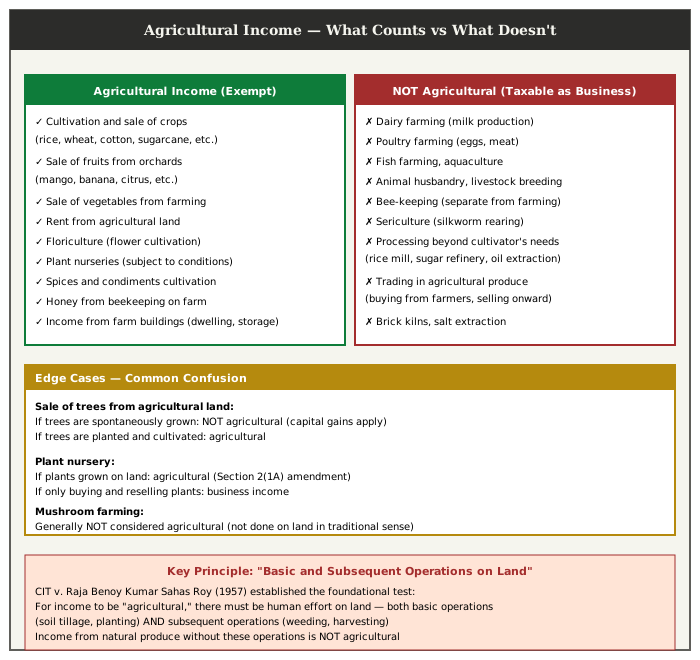
The classic confusion. Dairy involves keeping animals on land but doesn't involve cultivation of soil for crops. Animals consume agricultural products (fodder) but their products (milk) come from the animals, not directly from the land. Income from selling milk is therefore business income, subject to normal tax rates. If you grow fodder yourself and use it to feed your own dairy animals, the fodder cultivation portion is agricultural (notional value), while milk sale is business. In practice, separating these is complex; most dairy operators treat all dairy income as business.
Section 2(1A) of Income Tax Act 1961; CIT v. Raja Benoy Kumar Sahas Roy 1957 SC; CBDT clarifications.
Pure Agricultural Income — Filing Requirements
If your entire income is agricultural and you have no non-agricultural income, your tax situation is straightforward.
Filing requirement.
Pure agricultural income is exempt from central income tax under Section 10(1). If your total income is below the basic exemption limit (₹2.5 lakh Old / ₹4 lakh New), you generally don't need to file ITR.
But filing is mandatory in certain situations even with pure agricultural income:
- Deposited ₹1 crore+ in current accounts during the year
- Foreign travel expenses ₹2 lakh+ for self or others
- Electricity consumption ₹1 lakh+ in a year
- Foreign assets held or income
- TDS deducted on any income
Voluntary filing benefits.
Even if not mandatory, voluntary ITR filing helps farmers:
- Establishes income proof for bank loans, especially Kisan Credit Card limits
- Required for visa applications (for foreign travel/education)
- Useful for insurance claims, government scheme applications
- Maintains tax compliance history
- Helps in claiming agricultural land sale exemptions later
Documentation to maintain.
Even though agricultural income isn't taxed, scrutiny notices may demand proof:
- Land ownership records (7/12 extract, patta, mutation records)
- Sale receipts from APMCs, traders, processors
- Records of agricultural expenses (seeds, fertilizers, labour)
- Bank statements showing agricultural income receipts
- Crop records, farming details
**Section 56(2)(x) gift rules don't override.** Gifts of agricultural land or agricultural produce from non-relatives above ₹50,000 may still be taxable as "Income from Other Sources" even though normal agricultural income is exempt.
Sections 10(1), 139, 56(2)(x) of Income Tax Act 1961.
Partial Integration — How Agricultural Income Affects Your Tax Rate
The most consequential rule for farmers with non-agricultural income. Even though agricultural income remains exempt, it affects the rate at which non-agricultural income is taxed.
The two-condition test.
Partial integration applies ONLY if BOTH conditions are met:
- Non-agricultural income exceeds basic exemption limit
- Agricultural income exceeds ₹5,000
If either condition fails, no integration — agricultural income is fully ignored.
The mechanism.
Instead of taxing only non-agricultural income at slab rates, the system:
- Computes tax on (Agricultural + Non-agricultural income) at slab rates — call this "A"
- Computes tax on (Agricultural income + Basic Exemption) at slab rates — call this "B"
- Actual tax = A − B
This effectively pushes your non-agricultural income into higher slabs (because agricultural income "uses up" the lower slabs first).
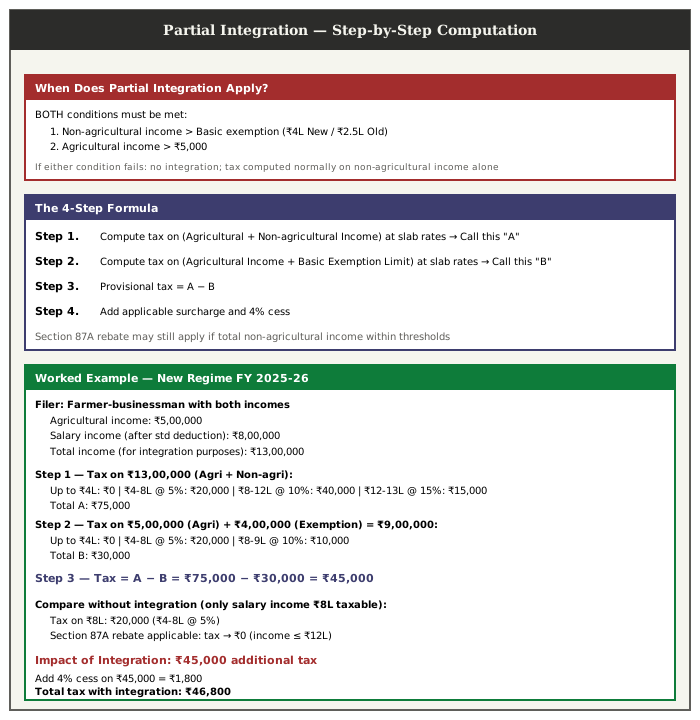
A person with ₹8 lakh salary + ₹5 lakh agricultural income pays MORE tax than a person with just ₹8 lakh salary. Even though agricultural income is "exempt," it pushes the salary into higher slabs through integration.
In the worked example, without agricultural income, the ₹8 lakh salary would have zero tax due to Section 87A rebate. With agricultural income triggering integration, the rebate may not fully apply because the integration computation creates tax liability. The rebate applies if total income (non-agri) is within ₹12 lakh. So in our example, with ₹8L non-agri salary income within ₹12L threshold, rebate could apply to the ₹45K tax, potentially reducing it to zero. CBDT rebate-integration interaction has been clarified in various circulars — verify with current guidance for your specific situation.
Old Regime computation differs slightly.
- Basic exemption: ₹2.5L instead of ₹4L
- Rates step up faster (20% at ₹5L, 30% at ₹10L)
- Generally results in higher integration impact
Section 10(1) read with Finance Act 2025; Schedule I to Finance Act for slab rates; CBDT circulars on integration.
Plantation Income — Rules 7, 7A, 7B, 8
Tea, coffee, and rubber plantations have a unique tax treatment. The income is partly agricultural (cultivation) and partly business (processing for sale).
Why special rules exist. A tea plantation grows leaves (agricultural) AND processes them into sellable tea (business). Drawing a clean line between agricultural and business components is impractical, so the law specifies fixed percentages.
Rule 8 — Tea income.
| Component | Treatment |
|---|---|
| Agricultural portion | 60% (exempt) |
| Business portion | 40% (taxable as business income) |
A tea estate with ₹1 crore total profit: ₹60 lakh treated as agricultural income (exempt, but counts for integration) ₹40 lakh treated as business income (fully taxable)
Rule 7B — Coffee income.
| Coffee Type | Agricultural | Business |
|---|---|---|
| Grown and cured | 75% | 25% |
| Grown, cured, roasted, and ground | 60% | 40% |
The deeper the processing, the more business income recognized (because processing is the non-agricultural value-add).
Rule 7A — Rubber income.
| Component | Treatment |
|---|---|
| Agricultural portion | 65% (exempt) |
| Business portion | 35% (taxable) |
Rule 7 — General principle.
For any other agricultural produce processed before sale, the principle is: separate the agricultural component (which would be the value the cultivator would have received without further processing) from the business processing margin.
In practice, Rule 7 leaves room for interpretation. Tax authorities and assessees often dispute the split. Plantation companies with tea/coffee/rubber benefit from the certainty of fixed percentages.
Practical implications.
For a tea estate company:
- Maintain separate books for cultivation and processing
- Compute agricultural and business income per Rule 8
- File ITR-3 or ITR-5/6 (depending on entity)
- Plantation labor laws may also affect employment-related deductions
Other plantation crops not covered by specific rules.
Cardamom, cinnamon, sugarcane (when processed by cultivator), arecanut, etc. — these don't have fixed percentage rules. Income is determined based on the specific situation:
- If only grown and sold raw: agricultural
- If processed to packaged products: depends on extent of processing
- For sugarcane specifically: if cultivator only grows and sells to sugar mill, agricultural. If cultivator owns the mill, the income from the mill is business income (separated from agricultural value of sugarcane).
Rules 7, 7A, 7B, 8 of Income Tax Rules 1962; Section 2(1A) of Income Tax Act 1961.
Animal-Related Activities — NOT Agricultural Income
The most common misconception among rural filers — believing dairy, poultry, fisheries are agricultural. They're business income, with regular tax treatment.
Dairy farming.
Income from milk production, cattle keeping, buffalo farms — all classified as business income. Tax treatment:
- Income subject to normal slab rates
- Standard business deductions (feed costs, veterinary care, equipment, labor)
- Depreciation on dairy assets (cattle, sheds, equipment)
- Section 44AD presumptive applicable if turnover ≤ ₹2-3 crore
- No special exemption for dairy income
If you grow fodder on your land for your dairy cattle: The fodder cultivation itself is agricultural (notional value) The dairy operation is business Reasonable allocation of cost may be needed In practice, most dairy operators treat all income as business and don't separate the fodder cultivation portion.
Poultry farming.
Income from egg layers, broilers, hatcheries — all business income. Similar treatment as dairy:
- Slab rates
- Business deductions
- Presumptive scheme applicable
- Depreciation on poultry sheds, equipment
Fish farming and aquaculture.
Pond fish farming, prawn farming, fishery business — all business income. Note:
- Sea fishing operations: business
- Government licenses, costs, capital expenditure all relevant
- Income tax + GST may apply depending on scale
Apiary (beekeeping).
Two scenarios:
- Beekeeping incidental to flower/orchard farming on your land: agricultural (honey is product of land's flora)
- Commercial beekeeping operation not linked to specific agricultural land: business
The judicial treatment has varied; consult a CA for substantial beekeeping income.
Sericulture (silkworm rearing).
Silk production is generally business income, not agricultural. The cultivation of mulberry plants to feed silkworms is the agricultural part; the rearing and reeling of silk is business.
Section 2(1A) of Income Tax Act 1961; judicial precedents on dairy and poultry treatment; CBDT circulars.
Agricultural Land Sale — Rural vs Urban Distinction
A critical distinction with major tax consequences. Sale of agricultural land may or may not trigger capital gains tax depending on whether the land is "rural" or "urban."
Section 2(14) — Definition of Capital Asset.
Capital asset specifically EXCLUDES "agricultural land in India" — but with conditions. The exclusion applies if the agricultural land is RURAL.
What makes agricultural land "urban" (hence taxable on sale)?
Land within specified distances of municipal limits is urban:
- Within municipal limits OR cantonment area: urban
- Within 2 km of municipalities with population 10,000-1 lakh: urban
- Within 6 km of municipalities with population 1-10 lakh: urban
- Within 8 km of municipalities with population over 10 lakh: urban
What is "rural agricultural land"?
Land BEYOND the above distances from urban centers — and actually used for agricultural operations.
| Land Type | Sale Tax Treatment |
|---|---|
| Rural agricultural land | NOT a capital asset → No capital gains tax |
| Urban agricultural land | Capital asset → Capital gains tax applies |
Farmer sells two plots: 1. 10 acres of farmland 25 km from a city (population 2 lakh) for ₹50 lakh — bought 1990 for ₹2 lakh. 2. 5 acres of farmland 1 km from a town (population 50,000) for ₹80 lakh — bought 1995 for ₹3 lakh. Plot 1 (Rural). No capital gains tax. ₹50 lakh proceeds tax-free. Plot 2 (Urban). Capital asset. Capital gains tax applies: Long-term (held over 24 months) LTCG: ₹80 lakh - indexed cost of ₹3 lakh (or actual ₹3 lakh) Tax at 12.5% without indexation OR 20% with indexation (filer's choice)
Why this matters strategically.
Farmers selling rural agricultural land — even at substantial gain — face no income tax. This makes rural farmland a tax-favored asset class. However:
- Stamp duty applies to all property sales
- State agricultural tax may apply in some states
- Future use of proceeds (investing in non-agricultural assets) creates future tax obligations on income
Common misclassification disputes.
The proximity test creates frequent disputes:
- Distance measured by road or aerial? Generally aerial (per CBDT clarifications)
- What if village expanded into municipal limits between purchase and sale? Status at sale time matters
- What if land used for non-agricultural activity but legally still agricultural? May still be capital asset if not actually agricultural
Section 2(14) of Income Tax Act 1961; Section 45; various CBDT clarifications.
Section 10(37) — Compulsory Acquisition Exemption
When agricultural land is compulsorily acquired by the government, Section 10(37) provides exemption.
Conditions for exemption.
- Land must be agricultural
- Land must be in urban area (otherwise no capital gains anyway)
- Acquisition by Central or State government or local authority
- By compulsory acquisition (not voluntary sale to government)
- Compensation must be received as result of such acquisition
- Owned and used for agricultural purposes during 2 years immediately before acquisition (by individual or HUF)
What's exempted.
The entire capital gain from compulsory acquisition is exempt. Both the gain on land AND interest on enhanced compensation (received later) are exempt.
Government acquires agricultural land worth ₹2 crore for a highway project. The farmer had owned the land for 20 years, original cost ₹5 lakh. Without Section 10(37): Long-term capital gain of approximately ₹1.95 crore, tax at 12.5% = ₹24+ lakh. With Section 10(37): Entire gain exempt. Tax: ZERO.
Strategic considerations.
- Section 10(37) applies only to AGRICULTURAL urban land
- If land was non-agricultural at time of acquisition, no Section 10(37)
- Document agricultural use of land carefully (cropping records, sale receipts)
- Section 54B (reinvestment in other agricultural land) is another option for non-Section 10(37) cases
Section 10(37) of Income Tax Act 1961.
Mixed Activities — Processing and Trading Beyond Agriculture
When farming activities extend beyond raw cultivation, tax treatment becomes complex.
The principle. Agricultural income covers cultivation and the minimal processing needed for the cultivator to make the produce marketable. Beyond that minimum, processing becomes business income.
Minimum processing — still agricultural.
These are part of agricultural income because cultivators have always done them:
- Threshing rice/wheat
- Drying grains
- Winnowing
- Removing husks from coconuts
- Curing tobacco (in cultivator's hands)
- Initial cleaning, sorting
These transform the produce into a different product or substantially enhance value:
- Rice cultivator running a rice mill: cultivation = agricultural; milling = business
- Sugarcane cultivator running sugar mill: cultivation = agricultural; sugar production = business
- Oilseeds cultivator with oil press: cultivation = agricultural; oil extraction = business
- Spice cultivator processing and packaging branded products: cultivation = agricultural; packaging/branding = business
The Rule 7 principle. When you can't easily separate agricultural and business components, Rule 7 of Income Tax Rules provides a framework: identify the market value of the agricultural produce at the stage where the cultivator typically sells (raw form) — that's the agricultural income. Excess of total sale value over this represents the business processing margin.
Sugarcane grower sells: Raw sugarcane to mill: ₹50 per kg (market rate for raw cane) If he runs his own sugar mill, produces sugar and sells at ₹200 per kg If he processes his own cane: Agricultural value: ₹50 per kg × quantity (notional, but follows market rate) Business value: ₹150 per kg × quantity (processing margin) The agricultural portion qualifies for exemption (and integration); the business portion is fully taxable.
Section 2(1A); Rule 7 of Income Tax Rules; various judicial decisions on processing.
ITR Form Selection and Documentation
Which ITR form to use depends on the mix of income sources.
ITR-1 (Sahaj). Use only if:
- Agricultural income ≤ ₹5,000 (incidental, doesn't trigger integration)
- Other income from salary, one house property, other sources only
- Total income up to ₹50 lakh
ITR-2. Use if:
- Agricultural income > ₹5,000
- Capital gains income
- More than one house property
- Foreign income or assets
- No business or professional income
ITR-3. Use if:
- Business or professional income (including plantations)
- Income from partnership firms
- Agricultural income alongside business
ITR-4 (Sugam). Use if:
- Presumptive business/professional income
- Agricultural income up to ₹5,000
- Income up to ₹50 lakh
- One house property
For a pure farmer with substantial agricultural income (above ₹5,000) but no other income source, ITR-2 is typically used for voluntary filing.
Documentation to maintain.
Land records.
- 7/12 extract (Maharashtra), Patta (TN), RoR (KA), Khatauni (UP) — state-specific land records
- Mutation records showing current ownership
- Sale deed for purchase of land
Agricultural operations.
- Crop sowing records
- Harvest records
- Input purchase invoices (seeds, fertilizers, pesticides)
- Labor wage payments
- Equipment hire receipts
Sales records.
- APMC (Agricultural Produce Market Committee) receipts
- Direct sale receipts to traders, processors
- Mandi sales records
- Online platform receipts (e.g., e-NAM)
Bank records.
- Separate bank account for agricultural income preferred
- Kisan Credit Card account statements
- Cheque deposit receipts from buyers
Filing tips for farmers.
- Maintain digital records via apps like Kisan Suvidha or state agriculture portals
- Use Kisan Credit Card transactions to establish income trail
- Keep records for at least 6 years after AY (general statute of limitations)
- For mixed farming + business, maintain separate records
CBDT instructions on ITR forms; state-level land record systems.
Government Schemes for Farmers — Tax Treatment
Several government schemes specifically support farmers. Their tax treatment varies.
PM-KISAN (Pradhan Mantri Kisan Samman Nidhi).
Income support of ₹6,000 per year (₹2,000 every 4 months) to eligible farmers.
- Tax treatment: Exempt (treated as government grant for agriculturists)
- Not considered agricultural income; not business income
- No reporting requirement in ITR
Kisan Credit Card (KCC).
Subsidized credit for farmers.
- Interest paid: deductible if loan used for farming
- Interest subvention: not taxable as separate income
- Loan principal: not taxable
- Default/waiver of loan: may have tax implications (debt forgiveness)
Crop Insurance (PMFBY).
Crop insurance claims received for crop damage:
- Generally not taxable (substitution for crop income, which is itself exempt)
- Premium paid by farmer: generally not deductible (covers agricultural income, which is exempt)
- Premium subsidy from government: not taxable
Soil Health Card Scheme.
Government scheme providing soil testing — no direct tax implication.
Crop loan waivers.
State and central government periodically waive farmer loans. Tax treatment is ambiguous:
- Loan waiver could theoretically be income (debt forgiveness)
- In practice, government waivers for agricultural loans are typically not pursued for taxation
- No direct exemption in Act, but no enforcement either
- Document waiver letters from government/banks
FPO (Farmer Producer Organisation) income.
If farmers organize through FPO:
- FPO is typically a producer company (separate entity)
- FPO files its own ITR (ITR-6)
- Distribution to farmer members may be agricultural (if for produce) or business (if other)
- Individual farmers' share of agricultural produce sold via FPO retains agricultural character
PM-KISAN scheme guidelines; CBDT notifications on farmer schemes; PMFBY scheme rules.
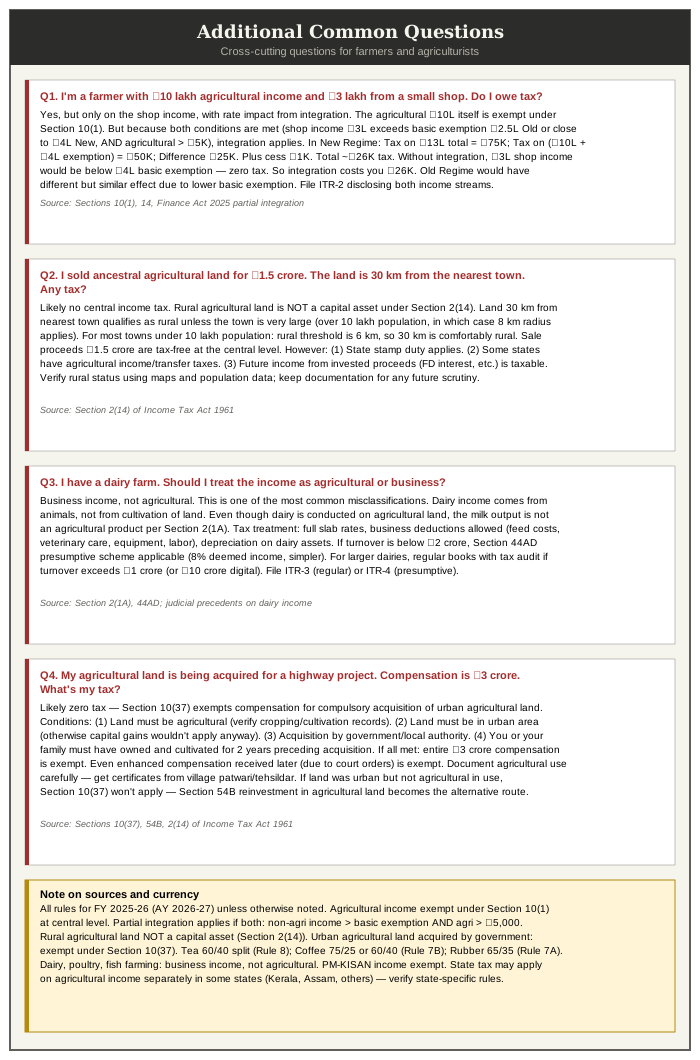
End of lesson — Additional common questions
Key Takeaways
- Agricultural income is exempt from central tax under Section 10(1), but if non-agricultural income exceeds the basic exemption AND agricultural income exceeds ₹5,000, partial integration applies and effectively raises the tax rate on non-agricultural income
- Tea income splits 60% agricultural / 40% business (Rule 8); coffee grown and cured splits 75/25, further processed splits 60/40 (Rule 7B); rubber splits 65/35 (Rule 7A)
- Rural agricultural land (beyond specified distances from urban centers) is not a capital asset — its sale triggers no capital gains tax regardless of profit; urban agricultural land is taxable on sale
- Section 10(37) fully exempts capital gains when urban agricultural land is compulsorily acquired by government, provided the individual or HUF owned and used it for agriculture for 2 years before acquisition
- Dairy, poultry, fish farming, and sericulture are business income, not agricultural — even though they occur on or near agricultural land
- PM-KISAN receipts are exempt and don't need to be reported in ITR; crop insurance claims are generally not taxable; loan waivers have ambiguous but typically unenforced tax treatment
- File ITR-2 when agricultural income exceeds ₹5,000 with no business income; ITR-3 when plantation or other business income is present alongside agricultural income
Quiz — 5 Questions
Answer one at a timePartial integration of agricultural income applies only if BOTH conditions are met. Which pair correctly states those conditions?