Self-employed and Presumptive Taxpayers
Regular vs presumptive choice under Sections 44AD, 44ADA, and 44AE; tax audit thresholds under Section 44AB; deductible expenses and depreciation for regular books; F&O and intraday trading as business income; GST and income tax interaction; and year-round self-employment compliance calendar
- Distinguish business from profession under Indian tax law and match each to the correct presumptive scheme, ITR form, and audit threshold
- Apply Section 44AD — 8% (6% digital) deemed income rate, ₹2-3 crore turnover limit, and the 5-year lock-in consequence of opting out
- Apply Section 44ADA — 50% deemed income on specified professional receipts up to ₹50 lakh (₹75 lakh if digital), with no lock-in
- Calculate Section 44AE transport presumptive income — ₹1,000 per ton for heavy vehicles, ₹7,500 per month for others — within the 10-vehicle cap
- Determine when Section 44AB tax audit is mandatory — standard and digital thresholds, and the presumptive non-compliance trigger
- Compute F&O and intraday trading turnover using the absolute value method, and identify the applicable business income treatment
- Reconcile GST and income tax turnover, handle ITC adjustments in expense deductions, and manage year-round compliance obligations
Self-employed and Presumptive Taxpayers
Self-employed filers face a different tax landscape than salaried employees. No employer deducts TDS based on declarations. Income varies month to month. Business expenses become deductible. The choice between regular books and presumptive taxation creates strategic decisions with multi-year consequences.
This lesson covers everything a self-employed filer needs: the regular vs presumptive choice, threshold rules, audit requirements, deductible expenses, depreciation, the interaction with GST, and the specific quirks of common self-employment categories — freelance consultants, doctors with private practice, F&O traders treated as business filers, small shopkeepers and retailers.
For most small self-employed filers, presumptive taxation under Sections 44AD or 44ADA dramatically simplifies compliance. But the rules have nuances — the 5-year lock-in for Section 44AD, what counts as "specified profession" under 44ADA, what happens when turnover crosses thresholds. Get the choice wrong and you face years of compliance burden or unwanted scrutiny.
A note on terminology: this lesson uses Income Tax Act 1961 references applicable to FY 2025-26 income filed as AY 2026-27.
Navigation guide — which subsections apply to your situation
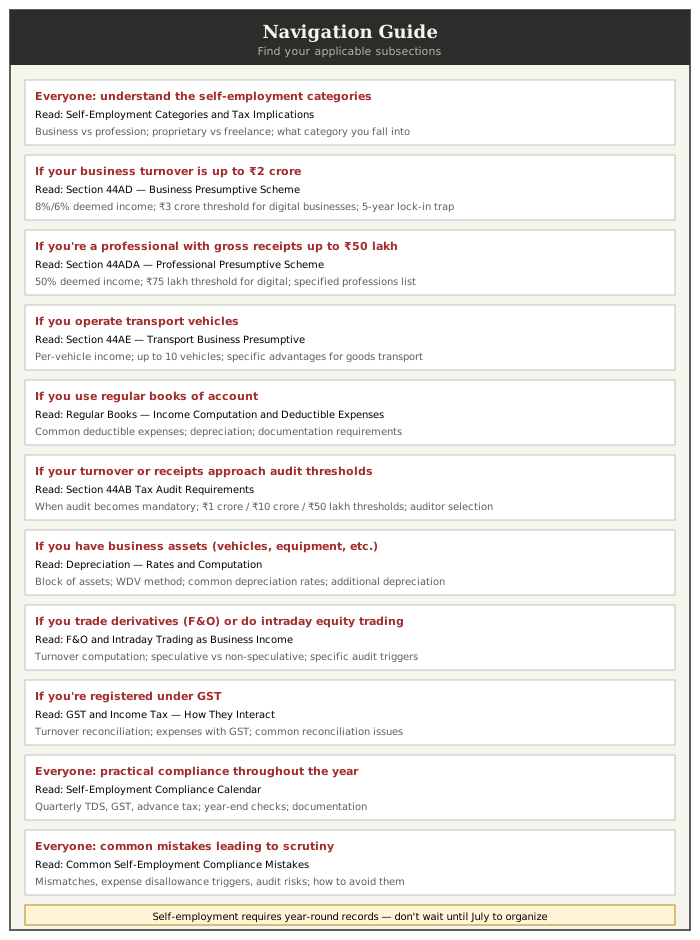
Self-Employment Categories and Tax Implications
Indian tax law distinguishes between "business" and "profession" — and within these, between presumptive and regular taxpayers. The category determines your ITR form, audit obligations, and deduction options.
Business vs Profession.
Business is any trade, commerce, manufacture, or adventure in the nature of trade. Examples:
- Retail shops, wholesalers
- Manufacturing units
- Online sellers (e-commerce)
- Restaurants, food businesses
- Trading (stock market, F&O, commodities)
- Service businesses (cleaning, delivery, etc.)
- Real estate dealing
Profession is occupations requiring specialized knowledge or skill, listed under specified categories. Examples:
- Legal practitioners (advocates, lawyers)
- Medical practitioners (doctors, surgeons, dentists)
- Engineering (consultants, architects)
- Accountancy (CAs, CSs, cost accountants)
- Technical consultancy
- Interior decoration
- Information technology professionals (notified)
- Authorized representatives
- Film artists
- Notified professions under Section 44AA
Why the distinction matters.
| Aspect | Business | Profession |
|---|---|---|
| Presumptive Section | 44AD | 44ADA |
| Turnover/Receipts Limit | ₹2-3 crore | ₹50-75 lakh |
| Deemed Income | 8% (6% digital) | 50% |
| Lock-in Rule | 5 years if opt out | No lock-in |
| Audit Threshold | ₹1 crore (₹10 cr if digital) | ₹50 lakh |
| ITR Form | ITR-3 or ITR-4 | ITR-3 or ITR-4 |
Proprietary business or proprietorship. An unincorporated business owned by one person. Most freelancers, shopkeepers, and small business operators run proprietorships. Income flows directly to the proprietor's personal ITR (no separate entity tax).
Partnership firms and LLPs. Separate entities with their own ITR (ITR-5). Individual partners file ITR-3 to report partnership income (covered in Lesson 16).
Sections 28-44DB of Income Tax Act 1961; CBDT notification on specified professions.
Section 44AD — Business Presumptive Scheme
For small business owners, Section 44AD offers dramatic simplification — no books of account, no expense documentation, and a presumed income percentage.
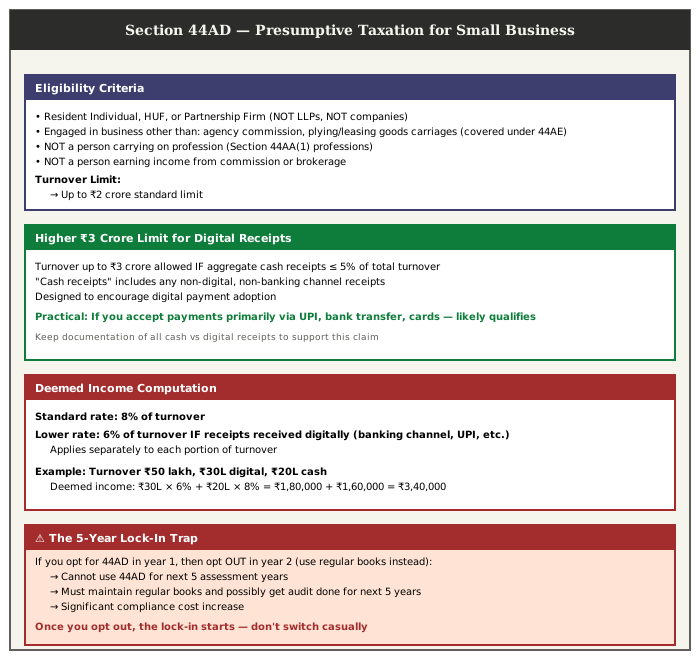
What you get with 44AD.
- No need to maintain books of account
- No need to track individual expenses
- No tax audit (within turnover threshold)
- Use simpler ITR-4 form
- Significantly reduced compliance burden
What you give up with 44AD.
- Cannot claim actual expenses if they exceed 8% (cash) or 6% (digital) of turnover
- Limited deductions beyond presumptive percentage
- Stuck with deemed income even if actual loss
Actual profit margin is around or above 8% (6% digital) of turnover Compliance simplicity matters more than maximizing deductions Annual turnover comfortably within ₹2-3 crore limit Stable business with predictable income
Actual profit margin is below presumptive percentage High expenses, depreciation needs Loss years (presumptive doesn't allow loss declaration) Multi-year tax planning with carry-forward
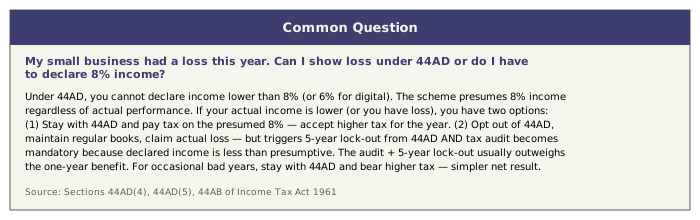
Section 44AD of Income Tax Act 1961; CBDT presumptive taxation provisions.
Section 44ADA — Professional Presumptive Scheme
For professionals, Section 44ADA offers presumptive taxation at 50% of gross receipts — significantly simpler than maintaining detailed books.
Eligibility.
- Resident individuals or partnership firms (NOT LLPs)
- Carrying on profession specified under Section 44AA(1)
- Gross receipts up to ₹50 lakh standard, or ₹75 lakh if digital ≥95%
Specified professions under Section 44AA(1).
Legal, medical, engineering, architectural, accountancy, technical consultancy, interior decoration, and other notified professions. Key included professions:
- Doctors, surgeons, dentists, physiotherapists
- Lawyers, advocates
- Chartered Accountants, Company Secretaries
- Architects, engineers (private practice)
- Interior designers
- Authorized representatives (tax consultants)
- Film artists (actors, directors, music directors, etc.)
- Information Technology professionals (notified 2007)
What's NOT a "specified profession" under 44ADA.
- Consulting in unrelated areas (general business consulting)
- Trading/business activities (covered under 44AD)
- Commission/brokerage income
- Insurance agents
- Real estate brokers
For these, regular business income computation applies.
Computation. Deemed income = 50% of gross receipts.
Deemed income: ₹20 lakh Tax computed on ₹20 lakh under chosen regime No need to track individual expenses No books of account required
No 5-year lock-in. Unlike 44AD, Section 44ADA has NO lock-in. You can opt in/out of 44ADA freely each year. This makes it more flexible than the business presumptive scheme.
Tax audit requirement. Tax audit required if you opt out of 44ADA and declare income less than 50% AND your gross receipts exceed basic exemption limit (the latter is almost always true for professionals).
CA in private practice with gross receipts ₹25 lakh: Office rent ₹2,40,000 Staff salary ₹3,60,000 Other expenses ₹1,50,000 Total expenses: ₹7,50,000 Actual income: ₹17,50,000 (70% of receipts) Under 44ADA: Deemed income = ₹12,50,000 (50%) Under regular books: Actual income = ₹17,50,000 44ADA gives a ₹5 lakh tax benefit by deeming lower income. Worth maintaining the simplicity.
If actual expenses exceed 50% of receipts (low margin business), regular books would show lower income. But many professionals have margins above 50%, making 44ADA advantageous.
Section 44ADA of Income Tax Act 1961; CBDT notification on specified professions.
Section 44AE — Transport Business Presumptive
For owners of goods transport vehicles, Section 44AE provides per-vehicle income computation.
Eligibility.
- Individuals, HUF, Partnership Firms, LLPs (most entity types)
- Engaged in plying, hiring, or leasing goods carriages
- Own NOT MORE THAN 10 goods vehicles at any time during the year
Deemed income computation.
| Vehicle Type | Deemed Income |
|---|---|
| Heavy Goods Vehicle (>12 metric tonnes) | ₹1,000 per ton of gross vehicle weight per month per vehicle |
| Other Vehicles | ₹7,500 per month per vehicle |
3 heavy vehicles, 15 tonnes each: 3 × 15 × ₹1,000 × 12 = ₹5,40,000 2 light commercial vehicles: 2 × ₹7,500 × 12 = ₹1,80,000 Total deemed income: ₹7,20,000
No tax audit required if within 10-vehicle limit. If you exceed 10 vehicles, you cannot use 44AE — must use regular books with audit if turnover exceeds threshold.
Section 44AE of Income Tax Act 1961.
Regular Books — Income Computation and Deductible Expenses
If you don't use presumptive (either by choice or because thresholds exceed), regular books of account are required.
Books of account requirements.
Under Section 44AA, the following must maintain books:
- Professionals with gross receipts > ₹1.5 lakh in any of preceding 3 years
- Businesses with income > ₹1.2 lakh OR turnover > ₹10 lakh in any of preceding 3 years (lower thresholds for newly opting out of 44AD)
Basic books required.
- Cash book
- Journal
- Ledger
- Copies of bills/invoices issued
- Receipts for expenses
For larger businesses (turnover > ₹25 lakh).
- Day book
- General ledger
- Bank statements
- Stock register (for those dealing in goods)
Common deductible business expenses.
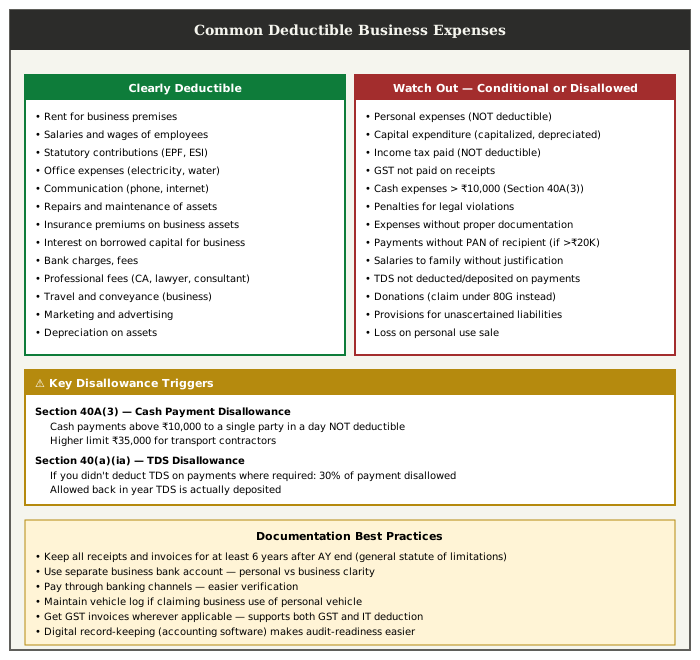
Sections 28-44DB, 40A(3), 40(a)(ia) of Income Tax Act 1961.
Section 44AB Tax Audit Requirements
Tax audit becomes mandatory when business or professional thresholds are crossed.
Standard audit thresholds.
| Category | Standard Threshold | Higher Threshold (Digital ≥95%) |
|---|---|---|
| Business turnover | ₹1 crore | ₹10 crore |
| Professional gross receipts | ₹50 lakh | (no higher limit) |
The higher ₹10 crore business threshold applies when:
- Aggregate cash receipts ≤ 5% of total receipts
- Aggregate cash payments ≤ 5% of total payments
This is intended to reward digital adoption.
Audit triggered by presumptive non-compliance.
If you use Section 44AD/44ADA and declare income LESS than the presumptive percentage, tax audit becomes mandatory regardless of turnover. So a freelancer with ₹30 lakh receipts who claims actual income of ₹10 lakh (less than 50% presumptive) needs audit.
What audit involves.
Auditor selection. Must be a Chartered Accountant in independent practice. Cannot be an employee, related party, or anyone with financial interest in the assessee.
Audit reports.
- Form 3CA / 3CB (Audit Report)
- Form 3CD (Statement of Particulars)
Audit report due date. Must be filed BEFORE ITR due date for audit cases — typically by October 31 (one month before ITR due date of November 30 for audit assessees).
Practical cost. Audit fees typically range:
- Small business/profession: ₹15,000 - ₹30,000
- Medium business: ₹30,000 - ₹75,000
- Large business: ₹75,000+
Why audit matters beyond compliance.
- Auditor signs off on key tax positions
- Audit report reduces scrutiny risk significantly
- Banks often require audited financials for business loans
- Establishes professionalism for vendor/client relationships
Under Section 271B: Penalty equal to 0.5% of turnover or ₹1,50,000, whichever is lower. Significant penalty for missed audit obligation.
Sections 44AB, 44AD(5), 271B of Income Tax Act 1961; ICAI audit guidance.
Depreciation — Rates and Computation
Depreciation is the allowance for wear and tear of business assets — significant deduction for capital-intensive businesses.
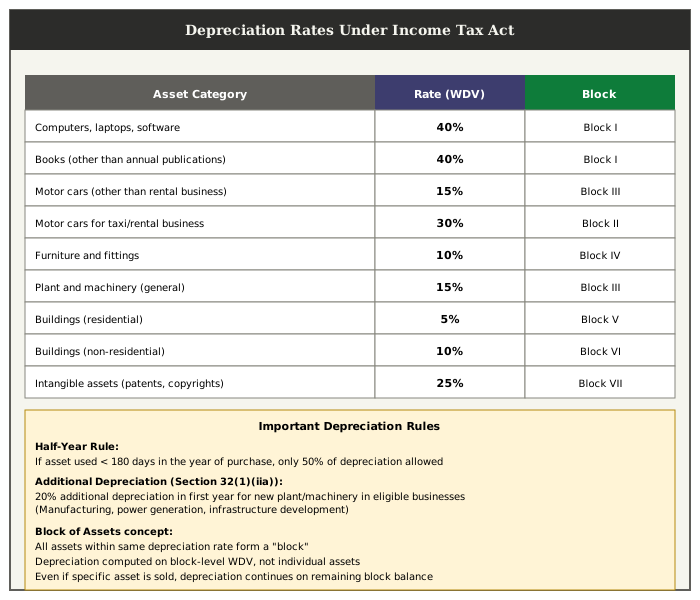
Depreciation under presumptive scheme. When using 44AD or 44ADA, depreciation is deemed already factored into the presumptive rate. You cannot claim depreciation separately. But this also affects WDV — the asset value is reduced for future years even though no actual depreciation claimed.
Sections 32, 32(1)(iia) of Income Tax Act 1961; Appendix I (depreciation rates) to Income Tax Rules.
F&O and Intraday Trading as Business Income
A growing category of self-employment — traders treated as business filers.
F&O (Futures and Options).
- Always treated as Non-Speculative Business Income
- File ITR-3 (presumptive 44AD doesn't apply)
- Can claim trading-related expenses (terminal charges, internet, etc.)
- Losses can offset other business income (except speculative)
Intraday equity trading.
- Always treated as Speculative Business Income
- File ITR-3
- Specific rule: losses only against speculative gains
- Carry forward only 4 years (vs 8 for other business losses)
Turnover computation for F&O (critical for audit threshold).
For F&O, "turnover" has a specific definition:
- Options: Sum of (absolute profit/loss per contract) + (premium on options sold)
- Futures: Sum of (absolute profit/loss per contract)
So if you have one profitable F&O trade of ₹1 lakh and one losing trade of ₹50,000, turnover = ₹1.5 lakh (sum of absolutes), not ₹50,000 net.
Tax audit for F&O traders.
If F&O turnover (computed as above) exceeds:
- ₹1 crore (standard) or ₹10 crore (digital): Audit required
- Or if claiming loss/income less than presumptive (8% of turnover): Audit required for declaring loss
Active F&O traders often hit audit thresholds quickly due to turnover computation Audit cost (~₹15-30K) + compliance time Consider taxable income vs audit cost trade-off
Common F&O compliance mistakes.
- Computing turnover incorrectly (using net P&L)
- Not maintaining trade-wise records
- Treating F&O as capital gains (it's business)
- Claiming losses without filing audit when required
Section 43(5) of Income Tax Act 1961; CBDT Circular No. 6/2016 on equity trading classification.
GST and Income Tax — How They Interact
For self-employed filers above GST threshold, the two taxes interact in several ways.
GST registration threshold.
- Standard: ₹40 lakh turnover (₹20 lakh for service providers and certain states)
- Lower limits for specific categories
Key interactions.
Turnover reconciliation.
- GST turnover (per GSTR returns) should match income tax turnover
- Significant differences trigger scrutiny in both regimes
- AIS pulls data from GST returns — reconcile carefully
GST on expenses.
- Input tax credit (ITC) under GST reduces GST liability
- For income tax, expense is the NET cost (after ITC claimed)
- If ITC not claimed (or not eligible), full expense including GST is deductible
If you claim ITC: GST liability reduces by ₹9,000; expense for IT = ₹50,000 If you don't claim ITC: expense for IT = ₹59,000
TDS on GST component.
TDS deducted on basic amount, not GST component. E.g., professional fee invoice ₹50,000 + ₹9,000 GST = ₹59,000. TDS at 10% = ₹5,000 (on basic ₹50K), not ₹5,900.
GST and presumptive scheme.
- Section 44AD turnover: includes/excludes GST? Generally INCLUSIVE per most interpretations
- Section 44ADA gross receipts: INCLUSIVE of GST
- Verify with CA — interpretations have varied
GST audit (separate from IT audit).
- GST audit applicable for GST turnover > ₹2 crore
- Different from IT audit thresholds
- Requires different forms (GSTR-9C)
GST Act and rules; CBDT circulars on GST-IT interaction; AIS guidance.
Self-Employment Compliance Calendar
Self-employed filers face year-round compliance — not just July filing.
Monthly.
- TDS deduction on payments (if applicable) by 7th of next month
- GST returns (GSTR-1, GSTR-3B) — by 11th and 20th respectively for monthly filers
- TCS payment (if applicable)
- Salary TDS payment for employees
Quarterly.
- Advance tax instalments: June 15, September 15, December 15, March 15
- Quarterly TDS returns: Q1 (July 31), Q2 (October 31), Q3 (January 31), Q4 (May 31)
- Quarterly GST returns for composition scheme filers
Annually.
- Annual GST return (GSTR-9): December 31 following FY
- Income tax return: July 31 (non-audit), October 31 (audit), November 30 (TP report)
- Tax audit report (Form 3CA/3CB-3CD): One month before ITR
- Financial statements preparation
Year-end (March).
- Inventory verification (if applicable)
- Bad debt write-offs
- Accruals and provisions
- Capital expenditure decisions for depreciation
- Self-assessment tax payment
Missing quarterly advance tax → 234C interest Missing TDS deductions on payments → 30% expense disallowance Missing GST returns → late fees, ITC blocked Late tax audit → ₹1.5 lakh penalty Late ITR → carry forward losses denied
CBDT compliance calendar; GST Act compliance requirements.
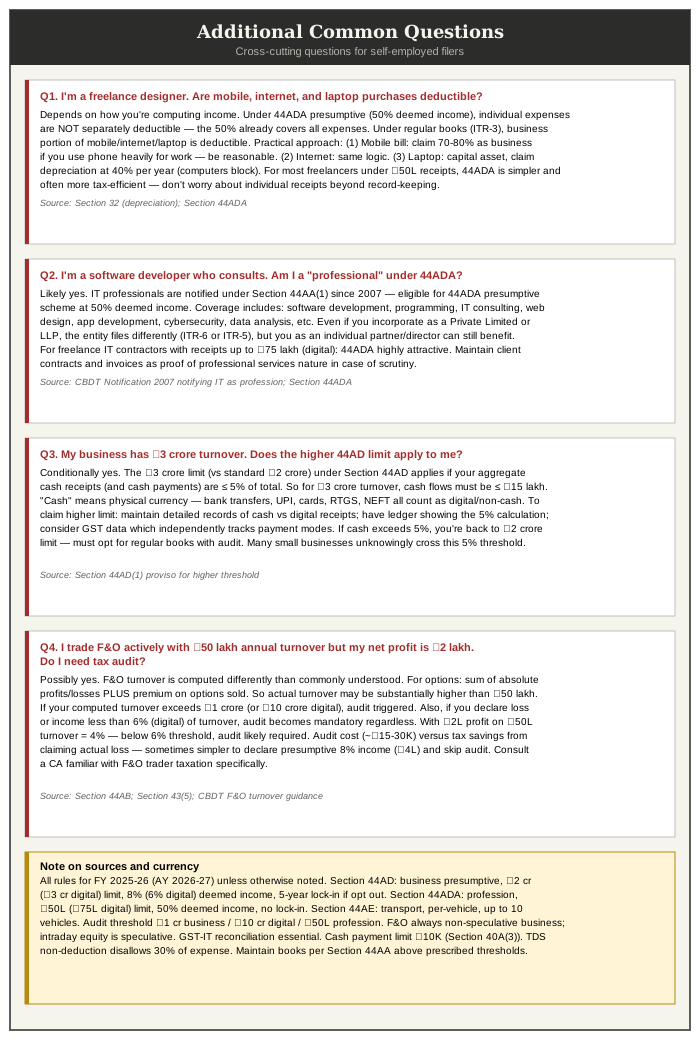
End of lesson — Additional common questions
Key Takeaways
- Business filers use Section 44AD (8% deemed income up to ₹2-3 crore) — professionals use Section 44ADA (50% deemed income up to ₹50-75 lakh) — each with different lock-in rules
- Section 44AD has a 5-year lock-in: once you opt out and declare income below 8%, you cannot return to 44AD for 5 years — choose carefully
- Section 44ADA has no lock-in — professionals can switch freely each year between presumptive and regular books
- Tax audit triggers two ways: exceeding turnover thresholds, or declaring income below the presumptive percentage under 44AD/44ADA
- F&O is always Non-Speculative Business Income (file ITR-3) — turnover is the sum of absolute profits and losses, not net P&L
- GST and income tax turnovers must reconcile — expense deductions use net cost after ITC, and TDS applies only to the basic invoice amount
- Self-employed filers have year-round compliance: monthly TDS/GST, quarterly advance tax, and annual audit/ITR deadlines
Quiz — 4 Questions
Answer one at a timeA freelance doctor with gross receipts ₹35 lakh under Section 44ADA has actual expenses of ₹20 lakh. What is the deemed income under 44ADA?