Salaried Employees in Depth
Salary structure and CTC breakdown, HRA and LTA exemptions, ESOP and RSU two-stage taxation, retirement contributions and terminal benefits, Section 89(1) relief for arrears, Form 12BB declarations, and year-round tax planning
- Compute HRA exemption using the three-part formula for metro and non-metro cities and identify what documentation is required
- Apply the LTA four-year block rules, carry-forward entitlements, and covered travel costs
- Understand the two-stage taxation of ESOPs and RSUs, the startup deferral under Section 80-IAC, and cash flow management strategies
- Identify the three-stage tax treatment of EPF, VPF, NPS Tier-1, and Superannuation contributions and the ₹7.5 lakh aggregate employer cap
- Calculate gratuity, leave encashment, and commuted pension exemptions for government and non-government employees
- Handle multiple employer scenarios, compute Section 89(1) relief for arrears, and manage Form 12BB declarations to employer
Salaried Employees in Depth
For most Indian taxpayers, salary is the dominant — often only — source of income.
This lesson covers everything a salaried filer needs to know that wasn't fully addressed in earlier lessons: the structure of a typical salary package, optimization opportunities within and outside the New Regime, taxation of equity compensation (ESOPs and RSUs that have become common for tech employees and senior professionals), what happens at retirement (gratuity, leave encashment, commuted pension), and tax planning techniques like Section 89(1) relief for arrears.
The Budget 2025 changes have shifted the salaried tax landscape significantly. The ₹12.75 lakh tax-free threshold under the New Regime means most salaried filers earning up to that amount pay zero tax — but those above it face decisions about regime, HRA optimization, and structuring that materially affect take-home.
We also cover the practical mechanics that don't appear in tax law textbooks but matter in practice: Form 12BB declaration to employer, handling multiple Form 16s when switching jobs mid-year, and the cascade of TDS, advance tax, and self-assessment for salary-dominant filers.
This lesson builds on Lessons 3 (Head 1 — Salaries), 4 (Chapter VI-A deductions), 5 (regime choice), and 7 (TDS) — all of which touched on salary topics. Here we go deeper.
A reminder on terminology: this lesson uses Income Tax Act 1961 references applicable to FY 2025-26 income filed as AY 2026-27.
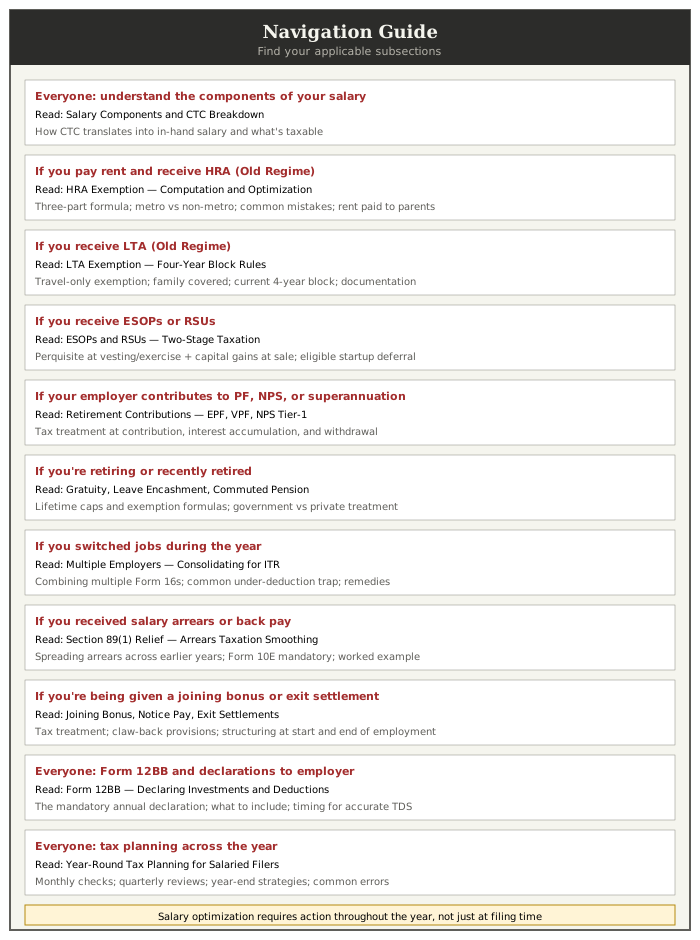
Navigation guide — which subsections apply to your situation
Salary Components and CTC Breakdown
Understanding your salary structure is the first step. Most filers receive an offer in "CTC" (Cost to Company) form but actual take-home is significantly less. Different components have different tax treatment.
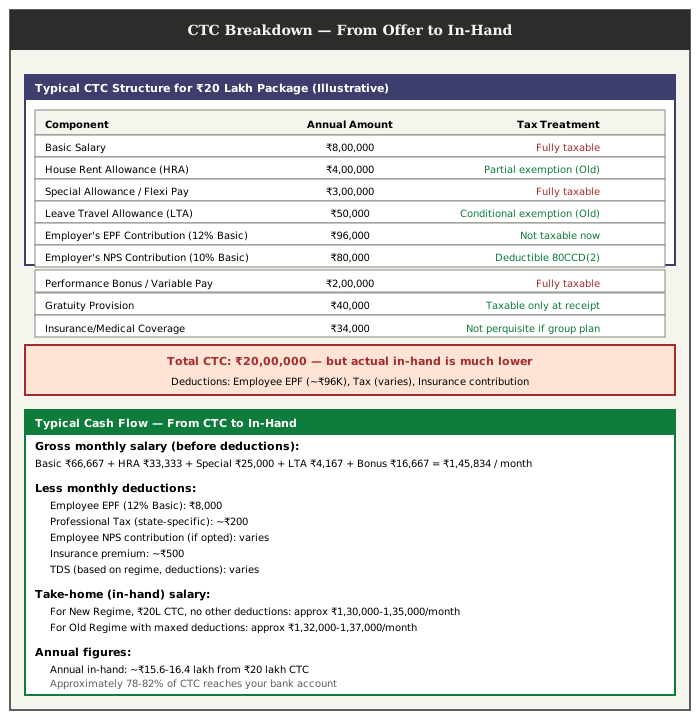
CTC includes employer contributions (EPF, NPS, gratuity, insurance) — these don't go to your bank account Variable pay is conditional on performance — may not pay out fully Stock options often shown at expected value, not guaranteed Insurance premium contribution is employer's cost, doesn't increase your salary
Section 17 of Income Tax Act 1961; Rule 2A through 2C of Income Tax Rules.
HRA Exemption — Computation and Optimization
HRA exemption is the most valuable allowance for salaried filers in Old Regime — but the rules are nuanced.
The three-part formula. Exemption is the LEAST of:
- Actual HRA received
- 50% of basic salary (40% for non-metro cities)
- Actual rent paid minus 10% of basic salary
Mumbai, Delhi, Kolkata, Chennai All other cities (including Bangalore, Hyderabad, Pune, Ahmedabad, etc.) are treated as non-metro for HRA — even though commonly considered "tier 1" metros in other contexts.
Filer details: Basic salary: ₹6,00,000 HRA received: ₹3,00,000 Rent paid: ₹2,40,000 (₹20,000/month) City: Bangalore Computation: 1. Actual HRA received: ₹3,00,000 2. 40% of basic (non-metro): ₹2,40,000 3. Rent paid minus 10% of basic: ₹2,40,000 - ₹60,000 = ₹1,80,000 Exemption: Least of three = ₹1,80,000 Taxable HRA: ₹3,00,000 - ₹1,80,000 = ₹1,20,000
Same filer with: Basic salary: ₹6,00,000 HRA received: ₹3,00,000 Rent paid: ₹3,00,000 (₹25,000/month) City: Mumbai Computation: 1. Actual HRA received: ₹3,00,000 2. 50% of basic (metro): ₹3,00,000 3. Rent paid minus 10% of basic: ₹3,00,000 - ₹60,000 = ₹2,40,000 Exemption: Least of three = ₹2,40,000 Taxable HRA: ₹3,00,000 - ₹2,40,000 = ₹60,000 Metro city gets ₹60,000 more exemption due to higher rent and 50% threshold.
Rent agreement (mandatory for monthly rent ≥ ₹50,000) Rent receipts (signed by landlord) Landlord's PAN required if annual rent exceeds ₹1 lakh Landlord's Aadhaar number if PAN unavailable (declaration)
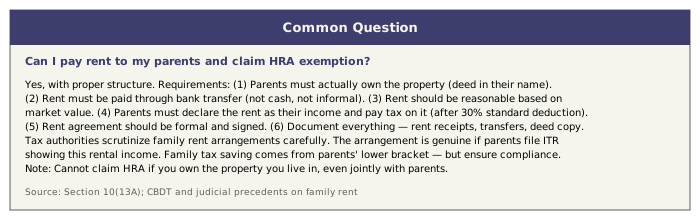
NOT available. This is a major regime decision factor. For filers paying substantial rent in metros, lost HRA exemption can be ₹2-4 lakh — significantly affecting the regime choice.
Section 10(13A) of Income Tax Act 1961; Rule 2A of Income Tax Rules.
LTA Exemption — Four-Year Block Rules
Leave Travel Allowance exemption covers domestic travel costs but with specific rules and limitations.
The exemption.
- Available for travel within India only (not international)
- Two journeys allowed in a block of four calendar years
- Current LTA block: 2022-2025 (next: 2026-2029)
- Covers self, spouse, dependent children (max 2), dependent parents/siblings
- Travel costs only — accommodation, food, sightseeing NOT covered
Mode of travel and limits.
- Air travel: Economy class fare of national carrier (Air India) by shortest route
- Rail: AC First Class fare by shortest route
- Other public transport: Actual fare or first class/deluxe equivalent
- Own car: First class rail equivalent from starting point to destination
Air tickets, train tickets, bus tickets Boarding passes Travel itinerary Hotel bills (not deductible but useful for proof of travel) Travel insurance receipts
Carry-forward rule. If you don't claim LTA in a block, you can carry forward ONE journey to the first year of the next block. Maximum total in a block: 2 journeys (1 from previous + 1 in current).
Claiming international travel — not allowed Claiming hotel/food costs — only travel covered Claiming for non-family members Missing documentation
LTA in New Regime: NOT available.
Section 10(5) of Income Tax Act 1961; Rule 2B of Income Tax Rules.
ESOPs and RSUs — Two-Stage Taxation
Equity compensation has become standard at tech companies and senior levels across industries. The taxation is more complex than salary.
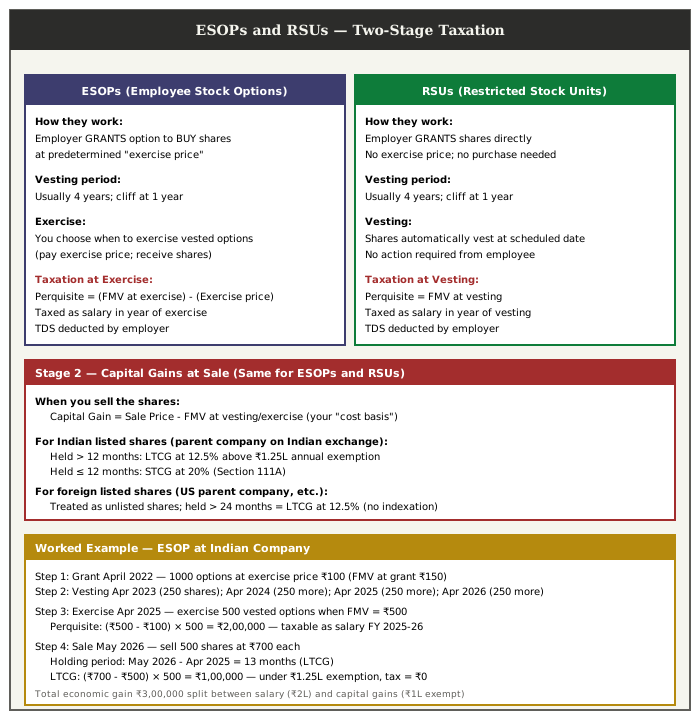
Both ESOPs and RSUs trigger tax obligations even before you've actually sold the shares — you may face a TDS deduction on perquisite value but have no cash inflow yet. This creates cash flow issues.
Strategies for managing ESOP/RSU tax burden.
- Sell-to-cover. Many companies offer to sell some shares immediately to cover the TDS. Net effect: you end up with fewer shares but no cash outflow.
- Same-day sale (for cash flow). Exercise and sell immediately. You realize both perquisite (taxed as salary) and capital gains (zero gain if sold immediately at exercise price). Avoids cash flow strain.
- Long-term hold. If shares likely to appreciate, hold for over 12 months (Indian shares) or 24 months (foreign) for LTCG treatment.
If you receive ESOPs from a DPIIT-recognized startup (Section 80-IAC eligible), the perquisite tax can be deferred: TDS at exercise: deferred Tax payable: earliest of (a) 5 years from end of FY of exercise, (b) sale of shares, (c) leaving employment This deferral helps startup employees who otherwise face large tax bills before liquidity events.
Perquisite still applies (employer in India deducts TDS) Shares held in foreign demat account Sale gains: taxable in India (worldwide income for ROR) Foreign tax may apply too — claim DTAA credit Schedule FA disclosure mandatory for ROR with foreign shares
Section 17(2)(vi) of Income Tax Act 1961 (ESOP perquisite); Section 192(1C) (startup deferral); CBDT ESOP guidance.
Retirement Contributions — EPF, VPF, NPS Tier-1
Employee retirement contributions have specific tax treatment at three stages: contribution, accumulation, and withdrawal.
Employees' Provident Fund (EPF) — mandatory for most salaried employees.
| Stage | Tax Treatment |
|---|---|
| Employee contribution (12% Basic) | Eligible for Section 80C deduction (Old Regime only) |
| Employer contribution (12% Basic) | Tax-free at contribution (within limits) |
| Interest accumulation | Tax-free up to ₹2.5 lakh annual contribution; above that, interest taxable |
| Withdrawal after 5 years | Tax-free |
| Withdrawal before 5 years | Taxable (with TDS at 10% above ₹50K) |
Voluntary Provident Fund (VPF). Same as EPF — voluntary contributions above 12% mandatory. Counts toward 80C limit. Same withdrawal rules.
National Pension System (NPS) Tier-1.
| Stage | Tax Treatment |
|---|---|
| Employee contribution | 80CCD(1) within 80C cap + 80CCD(1B) additional ₹50K (Old Regime) |
| Employer contribution (up to 14%) | 80CCD(2) — fully deductible (both regimes) |
| Interest/returns | Tax-free during accumulation |
| Lump sum withdrawal at 60 (max 60% of corpus) | Tax-free |
| Annuity purchase (min 40% of corpus) | Annuity income taxable as salary/pension |
Superannuation Fund. Some employers maintain superannuation funds (separate from EPF). Tax treatment:
- Employer contribution: tax-free up to ₹1.5 lakh per year
- Employee contribution: eligible for 80C
- Interest accumulation: tax-free
- Withdrawal at retirement: 1/3rd tax-free (commuted portion)
Under Section 17(2)(vii), if total employer contribution to EPF, NPS, and Superannuation Fund exceeds ₹7.5 lakh per year, the excess is taxable as perquisite. Affects high earners with substantial employer retirement benefits.
Sections 17(2)(vii), 10(11), 10(12), 80CCD of Income Tax Act 1961.
Gratuity, Leave Encashment, Commuted Pension
At retirement, three terminal benefits have specific exemption rules.
Gratuity exemption.
Government employees. Fully exempt — no limit.
Non-government, covered by Payment of Gratuity Act. Exemption is least of:
- Actual gratuity received
- ₹20 lakh (lifetime cap)
- 15 days' last drawn salary × completed years of service
Non-government, not covered by Payment of Gratuity Act. Exemption is least of:
- Actual gratuity received
- ₹20 lakh (lifetime cap)
- Half-month's average salary (last 10 months) × completed years of service
Leave Encashment at retirement.
Government employees. Fully exempt.
Non-government. Exemption is least of:
- Actual amount received
- ₹25 lakh (lifetime cap — increased Budget 2023)
- 10 months' average salary
- Cash equivalent of 30 days × completed years of service
Commuted Pension (lump sum at retirement).
- Government employees. Fully exempt.
- Non-government employees who received gratuity. 1/3rd of commuted pension exempt.
- Non-government employees who did not receive gratuity. 1/2 of commuted pension exempt.
Uncommuted pension (regular monthly). Always fully taxable as salary.
Voluntary Retirement Scheme (VRS). Compensation up to ₹5 lakh exempt under Section 10(10C) subject to conditions.
Sections 10(10), 10(10AA), 10(10A), 10(10C) of Income Tax Act 1961.
Multiple Employers — Consolidating for ITR
Job changes during a financial year create specific tax complications.
Both employers compute TDS independently: Each thinks you're in a lower tax bracket (since they only see their share) Combined income may put you in a higher bracket Total TDS deducted is less than actual tax liability
Filer earns: Employer A: ₹8 lakh (April-September) → Employer A's full-year projection = ₹8L × 2 = ₹16L Employer B: ₹10 lakh (October-March) → Employer B's full-year projection = ₹10L × 2 = ₹20L Actual total annual income: ₹18 lakh Employer A deducted TDS based on ₹16L → low TDS rate. Employer B did the same. Combined TDS may be less than tax on ₹18 lakh, creating self-assessment tax obligation.
Two strategies.
- Strategy 1 — Inform new employer of previous salary. Provide Form 12B to new employer with details of previous employment income. New employer can compute TDS based on combined annual income.
- Strategy 2 — Pay self-assessment tax at year-end. Accept higher tax at year-end, pay before filing. Simpler but means cash flow burden in July.
Form 12B. Declaration to new employer of prior employment income and TDS. Optional but recommended.
Combining Form 16s. When filing:
- Receive Form 16 from each employer for their respective period
- ITR has multiple employer entries — add each
- Standard deduction (₹50K Old / ₹75K New) claimed ONCE only (not per employer)
- Tax computed on combined income
Section 192(2) of Income Tax Act 1961; CBDT Form 12B procedure.
Section 89(1) Relief — Arrears Taxation Smoothing
When you receive salary arrears (back-dated increases), they're taxed in the year received — even though they relate to earlier years. Section 89(1) provides relief to prevent disproportionate tax.
Without relief, ₹3 lakh arrears received in a year when you're in 30% bracket = ₹90,000 extra tax. If those arrears related to earlier years when you were in 20% bracket = ₹60,000 tax in those years. Relief lets you pay the lower amount.
Must be filed online BEFORE filing your ITR. Failure to file Form 10E = relief denied even if computation correct.
Computation methodology.
- Compute tax with arrears in current year.
- Compute tax in current year WITHOUT arrears.
- Difference = Tax attributable to arrears in current year (let's call this A).
- Identify which earlier years arrears related to.
- For each earlier year, compute what tax would have been if arrears had been received in that year.
- Sum of additional tax across those years = Tax attributable to arrears spread over years (let's call this B).
- Relief = A − B (if positive).
In FY 2025-26, filer receives ₹3 lakh arrears relating to FY 2023-24 (₹1L), FY 2024-25 (₹1L), and FY 2025-26 (₹1L). Current year (FY 2025-26) tax with arrears: ₹2,50,000 Current year tax without arrears: ₹1,75,000 Additional tax in current year (A): ₹75,000 Recomputing for FY 2023-24: Adding ₹1L would have increased tax by ₹20,000 (assuming 20% bracket then). Recomputing for FY 2024-25: Adding ₹1L would have increased tax by ₹20,000. Plus ₹1L attributable to FY 2025-26 itself: tax at 30% = ₹30,000. Sum (B): ₹70,000. Section 89(1) relief: ₹75,000 − ₹70,000 = ₹5,000. Final tax after relief: ₹2,45,000.
Section 89(1) of Income Tax Act 1961; Rule 21A; Form 10E filing procedure.
Joining Bonus, Notice Pay, Exit Settlements
Transitions in employment have specific tax treatment.
Joining bonus / Sign-on bonus.
- Taxable as salary in the year received
- TDS deducted by employer
- If you leave within a year and have to refund the bonus, you can deduct it from salary income in the year of refund
- Document clearly with Form 16 amendments
Notice pay recovery (employer deducts from your last salary if you leave without notice).
- Recovery is NOT eligible for deduction from salary
- This has been clarified by courts and CBDT — you pay tax on full salary, even amount recovered as notice pay
- Practical impact: paying tax on income you didn't fully receive
Notice pay paid by you (instead of serving notice).
- Not deductible from salary income
- If you paid it from already-received salary, no remedy
- Same principle as employer deduction
Severance and exit settlement.
- Compensation for termination, golden handshake, etc.
- Taxable as "Profits in Lieu of Salary" under Section 17(3)
- Limited exemption under Section 10(10C) if from approved VRS (up to ₹5 lakh)
- Most severance fully taxable
Garden leave salary.
- Salary paid during notice period when you're not working
- Fully taxable as salary
- Standard TDS applies
Sections 17, 10(10C) of Income Tax Act 1961; CBDT clarifications on notice pay.
Form 12BB — Declaring Investments and Deductions
Form 12BB is the mandatory annual declaration you submit to your employer specifying expected investments and deductions, so they can compute accurate TDS.
What goes in Form 12BB.
- Part A — Personal details. Name, PAN, financial year
- Part B — Allowance details for exemption. HRA: rent paid, landlord PAN, address. LTA: travel details (block period)
- Part C — Section 24(b) interest on housing loan. Lender name, address. Amount of interest
- Part D — Deductions under Chapter VI-A. 80C: investments planned (PPF, ELSS, LIC, etc.) with amounts. 80D: health insurance premium. 80E: education loan interest. 80G: donations. Other Section 80 items
Submit by April/May at start of FY for employer's first computation Updates allowed during the year as situations change Most employers freeze declarations by January 15-31 for Q4 TDS calculation Final proofs typically requested by February
Over-declaration → low TDS → potential 234B/234C interest if you can't justify at year-end Under-declaration → high TDS → cash flow strain; recoverable via ITR refund
Practical workflow.
- April-May: declare expected investments
- December: review and revise based on actual investments
- February: submit final proofs (rent receipts, LIC premium receipts, etc.)
- April (next year): Form 16 issued reflecting final TDS
Section 192(2D), Rule 26C, Form 12BB of Income Tax Rules.
Year-Round Tax Planning for Salaried Filers
Tax planning isn't just for March. Specific actions throughout the year maximize benefits.
April-May (Start of FY).
- Submit Form 12BB to employer with planned investments
- Verify PAN-Aadhaar linkage active
- Decide regime preliminarily based on previous year experience
- Start any new SIPs (ELSS for 80C, PPF deposits)
- Review prior year's ITR for lessons learned
June (Q1 advance tax).
- If non-salary income expected (capital gains, rental, etc.), assess advance tax need
- Pay first installment by June 15 if applicable
July-August.
- File ITR for previous FY (deadline July 31)
- E-verify within 30 days
- Check refund status periodically
September (Q2 advance tax).
- Mid-year tax position review
- Pay second installment by September 15
October-November.
- Plan year-end gifts/donations (Section 80G)
- Review HRA situation; ensure rent receipts complete
- Plan LTA travel if eligible (block ending Dec 2025)
December (Q3 advance tax).
- Pay third installment by December 15
- Last chance for revised return of previous AY (Dec 31 deadline)
- Year-end gift/donation timing
January.
- Provide final investment proofs to employer
- ELSS investments — ensure done before March 31 for current FY benefit
- 80D health insurance renewals before March 31
February.
- Top up PPF deposits (75% interest till March; full year if before April)
- Final 80C planning — ELSS, NSC, LIC, etc.
March (Q4 advance tax).
- Pay 100% cumulative advance tax by March 15
- Complete all 80C investments by March 31
- Verify pension fund contributions
- Last-minute tax-saving investments (be cautious; check returns vs tax saved)
General tax planning best practices; CBDT timelines.
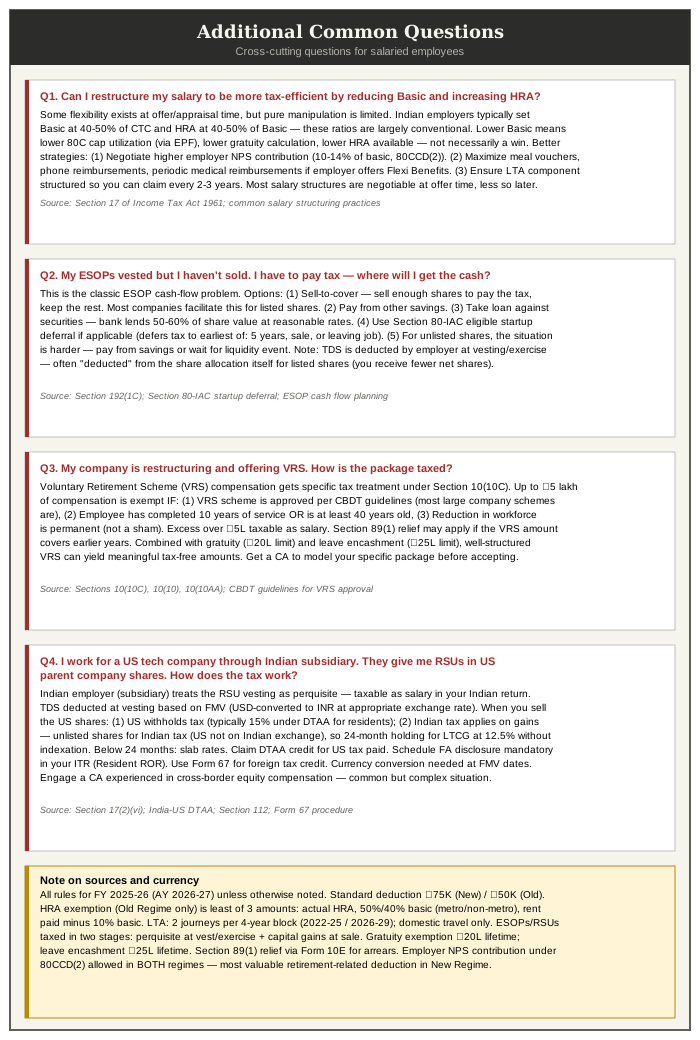
End of lesson — Additional common questions
Key Takeaways
- HRA exemption is the LEAST of: actual HRA received, 50% of basic (metro) or 40% (non-metro), and rent paid minus 10% of basic — HRA is not available under New Regime
- LTA covers two journeys in a four-year block (current block 2022-2025), domestic travel only, with one carry-forward allowed to the next block's first year
- ESOPs and RSUs trigger perquisite tax at exercise (before sale), creating cash flow issues; DPIIT-recognized startups under Section 80-IAC qualify for five-year deferral
- Employer contributions to EPF, NPS, and Superannuation Fund exceeding ₹7.5 lakh per year become taxable as perquisite under Section 17(2)(vii)
- Gratuity cap is ₹20 lakh; leave encashment cap is ₹25 lakh; commuted pension — 1/3rd exempt for non-government employees who received gratuity, 1/2 otherwise
- Section 89(1) relief prevents excess tax on arrears received in higher-bracket years — Form 10E must be filed online before ITR or relief is denied
- Multiple employer job changes create under-deduction risk; use Form 12B with new employer or budget for self-assessment tax at year-end
- Form 12BB is the mandatory employer declaration covering HRA, LTA, housing loan interest, and all Chapter VI-A deductions
Quiz — 5 Questions
Answer one at a timeWhich of the following cities is treated as a metro city for HRA exemption purposes?