Major Life Changes
Marriage, divorce, birth of a child, death in family, job loss, disability, relocation, adoption, single parenting, and caring for elderly — the tax dimensions of every major life event, from Section 64 spousal income clubbing through legal heir filing, severance taxation, and Section 80U/80DD/80DDB disability deductions
- Apply Section 64(1) spousal income clubbing rules to determine when asset transfers trigger clubbing, identify strategies for legitimate tax planning between spouses, and compute joint ownership deductions for home loans
- Determine tax treatment of recurring and lump-sum alimony, analyze capital gains cost basis for assets received in divorce settlement, and apply custody-related child deduction rules under Sections 80C and 80D
- Claim Sukanya Samriddhi Yojana, Section 80C tuition fees, Section 10(32) minor child exemption, and NPS Vatsalya deductions for child-related tax planning
- Execute legal heir registration on the income tax portal, file the deceased's final ITR, claim TDS credits from Form 26AS, and apply cost basis carry-over rules under Section 49(1)
- Compute severance package tax treatment across notice pay, gratuity under Section 10(10), leave encashment under Section 10(10AA), and VRS compensation under Section 10(10C)
- Apply Sections 80U, 80DD, and 80DDB to maximize disability-related deductions up to ₹2.75 lakh combined, and identify documentation requirements for each certificate
- Implement post-life-event document updates across PAN-Aadhaar, bank KYC, insurance nominees, and statutory EPF/PPF/NPS nomination changes to prevent missed notices and refunds
Major Life Changes
Life events trigger specific tax consequences that filers often don't anticipate. Marriage doesn't just change your relationship status — it changes your tax planning options, clubbing rules for gifts between spouses, joint ownership opportunities, and HRA implications if you move. Divorce involves complex tax treatment of alimony, asset distributions, and ongoing financial obligations. Birth of a child opens new deduction routes (Sukanya Samriddhi, tuition under 80C, hospital expenses under 80D). Death in family requires legal heirs to navigate inheritance documentation, claim TDS deducted in the deceased person's name, and transition assets while managing the tax positions.
Beyond personal events, career and lifestyle shifts also have tax dimensions: job loss creating gaps in TDS coverage, relocation changing professional tax obligations, becoming disabled or caring for someone with disability opening Section 80U/80DD deductions, adoption creating dependent status questions.
This lesson covers the tax dimensions of major life changes that filers face throughout adulthood. While not every change requires complex planning, awareness of the tax angles helps you make better decisions at these transition points.
A reminder: this lesson uses Income Tax Act 1961 references applicable to FY 2025-26 income filed as AY 2026-27.
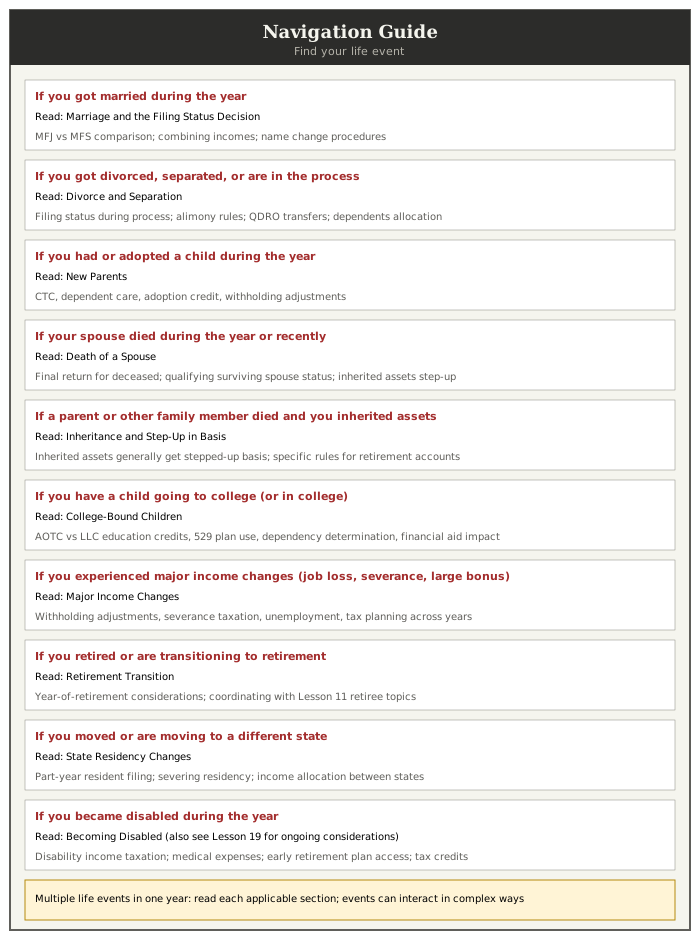
Navigation guide — which subsections apply to your situation
Marriage — Tax Implications and Planning
Marriage doesn't create joint tax filing in India (unlike some countries) — each spouse continues filing individually. But marriage opens several tax planning opportunities and creates some pitfalls.
Gifts between spouses — exempt under Section 56.
Gifts between spouses are exempt from tax. You can transfer any amount of money or assets to your spouse without tax. However, the clubbing rule (covered below) means income from gifted assets is taxed in the giver's hands.
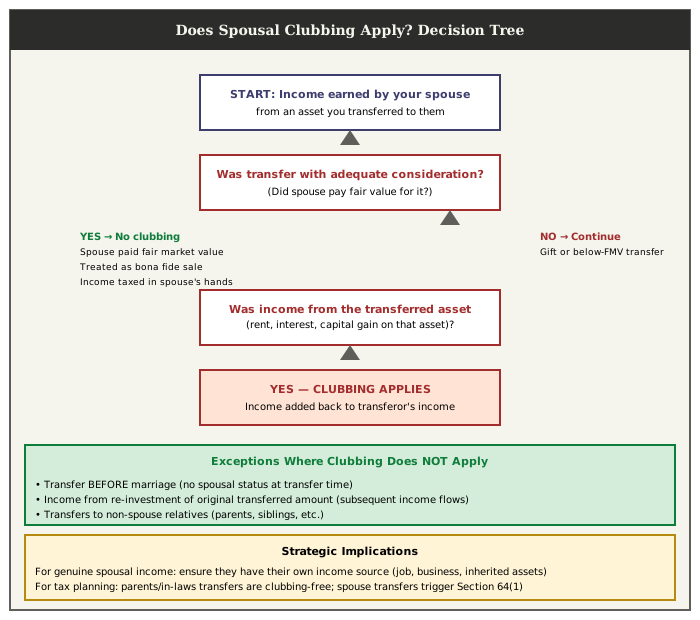
Section 64(1) — Spousal income clubbing.
If you transfer assets to your spouse WITHOUT adequate consideration, income from those assets is clubbed with your income for tax purposes. Examples:
Triggers clubbing:
- Husband gives ₹50 lakh to wife who invests in FDs → FD interest clubbed with husband's income
- Wife transfers stock to husband → dividend and gains clubbed with wife's income
Doesn't trigger clubbing:
- Each spouse independently earns and invests their own income
- Gift before marriage (no clubbing applies)
- Gifts to non-spouse relatives (parents, siblings — no clubbing)
Practical implication.
The straightforward "give wife money for tax planning" strategy doesn't work due to clubbing. Better approaches:
- Wife earns own income → no clubbing
- Reinvest spouse-gifted amounts after some time — original clubbing continues but reinvestment income usually isn't clubbed (specific judicial interpretation)
- Gift to spouse's PPF/SSY account where investment growth isn't her income directly
Joint property ownership.
When buying property as a couple:
- Register as joint owners (typically 50-50)
- Each contributes to EMIs from own income
- Each claims 50% of home loan interest, principal, etc.
- This doubles available deductions vs single owner
Critical: Each spouse must actually contribute. If only one spouse pays everything but property is jointly registered, the non-contributing spouse's share could be treated as gift, with clubbing of rental income/gains back to the contributing spouse.
HRA changes after marriage.
If you move into your spouse's house after marriage:
- You no longer pay rent → cannot claim HRA exemption
- Unless you continue paying rent and have documentation
If your spouse owns the house and charges you rent:
- HRA exemption available for you
- BUT spouse's rental income becomes taxable
- Net family tax often higher than original arrangement
Combined regime decision.
Marriage doesn't change individual regime choice — each spouse independently selects Old or New Regime. But couples can plan together:
- One spouse maximizes deductions in Old Regime
- Other goes for New Regime simplicity
- Coordinate large investments and expenses
Sections 56(2)(x), 64(1), 24(b), 80C of Income Tax Act 1961.
Divorce — Asset Distribution and Alimony Taxation
Divorce raises complex tax questions, with limited specific tax provisions in Indian law.
Alimony — recurring vs one-time.
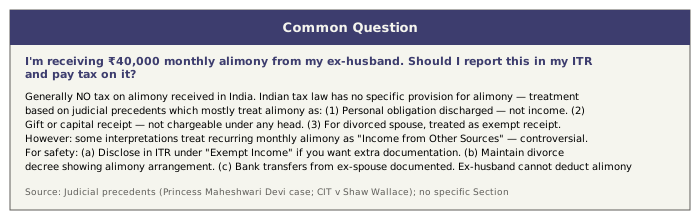
Recurring alimony (monthly maintenance).
- Generally treated as gift or capital receipt, not income
- NOT taxable in recipient's hands (per various judicial precedents)
- NOT deductible for payer (treated as personal expenditure)
- Some judicial precedents treat as "income from other sources" — controversial area
- Best practice: get tax opinion based on specific structure
Lump sum alimony.
- Generally treated as capital receipt
- NOT taxable in recipient's hands
- NOT deductible for payer
- Settlement document should clearly characterize as alimony, not gift
No specific section of Income Tax Act addresses alimony; treatment based on judicial precedents (CIT v. Shaw Wallace & Co., Princess Maheshwari Devi case, etc.).
Asset distribution at divorce.
When marital assets are divided as part of divorce:
- Generally treated as gift between former spouses
- Section 56(2)(x) exempts gifts from "spouse" — but does "former spouse" qualify?
- Most interpretations treat divorce-related transfers as exempt
- Document carefully in divorce settlement
For specific assets transferred:
- Property: cost basis transferred to recipient; future capital gains based on original cost
- Shares/Mutual Funds: similar carry-over basis
- FDs/Bank deposits: simple transfer, no tax event
Tax filing during/after divorce.
While married but separated:
- Continue filing as individual (no joint filing in India anyway)
- Each spouse files own return
- Communication about shared assets/income important
After divorce:
- Each former spouse files independently
- Clubbing under Section 64 may continue for assets transferred during marriage
- Update PAN, Aadhaar with new address/name (if changed)
Custody and dependent claims.
If you have children:
- Section 80C tuition fees: claim for any of your children regardless of custody
- Section 80D health insurance: covers dependent children
- HRA: if you set up new household for children, claim normally
- Deductions for child expenses are based on actual payment, not custody
Common scenarios.
Scenario 1: Wife receives ₹1 crore lump sum alimony + house. ₹1 crore: NOT taxable as income House: NOT taxable at receipt; capital gains apply when she sells it Cost basis: previous owner's cost (or April 2001 FMV if applicable)
Scenario 2: Husband pays ₹50,000/month maintenance to wife. ₹50,000/month: NOT taxable to wife NOT deductible to husband Documented in court order
Scenario 3: Divorce settlement transfers business interest. Transfer of shares/ownership: complex; specialized tax advice needed Cost basis carries over
Sections 56(2)(x), 64; CIT v. Shaw Wallace & Co. (alimony characterization); various ITAT decisions.
Birth and Raising Children — Deductions and Planning
Children create specific tax deduction opportunities under various sections.
Sukanya Samriddhi Yojana (SSY) — Daughter-specific.
For families with daughters under 10 years old:
- Account opened with banks/post office in daughter's name
- Up to ₹1.5 lakh annual contribution (within 80C limit)
- ~8.2% interest, government-backed (rate revised quarterly)
- 21-year tenure with restrictions
- E-E-E status: contribution deductible, interest tax-free, withdrawal tax-free
- Eligible 80C deduction in Old Regime
Strategy: Open SSY for daughter immediately after birth. Maximum power of compounding over 21 years. Combined parental contributions for two daughters: up to ₹3 lakh/year deduction.
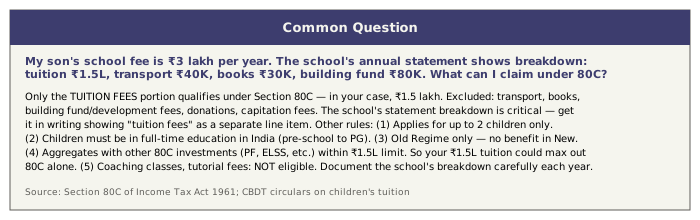
Children's tuition fees — Section 80C.
Tuition fees for full-time education at school, college, or university in India:
- Up to ₹1.5 lakh combined for up to 2 children (within overall 80C limit)
- Old Regime only
- Covers actual fees, not capitation/donation
- Includes pre-school, kindergarten, but not coaching classes
Documentation: Annual fee receipts, ensure they show "tuition fees" specifically (not development fees, transport, etc.).
Hospital and medical expenses for childbirth.
Section 80D coverage:
- Health insurance premium for self + family (including children): up to ₹25,000 (under 60)
- Preventive health check-up: up to ₹5,000 within 80D limit
- Maternity insurance premium qualifies for 80D deduction
For self-paid hospital expenses (no insurance):
- 80D limited to insurance premium; doesn't cover direct hospital bills
- 80DDB only for specified diseases (childbirth not listed)
- Generally, hospital bills not directly deductible
Strategy: Maintain family floater health insurance covering pregnancy/maternity. Pay premium before fiscal year-end for 80D claim. Coverage typically waits 2-4 years before maternity benefits — plan early in family planning timeline.
Section 10(32) — Minor child income exemption.
If your minor child earns income from your gifts (clubbing case):
- ₹1,500 per child per year exempt under Section 10(32)
- Maximum 2 children
- Net clubbed amount added to higher-income parent
Childcare and dependent benefits.
India doesn't have a specific childcare deduction (unlike US). Childcare expenses are not directly deductible.
National Pension System for child — NPS Vatsalya.
Recent scheme (introduced 2024): parents can open NPS account for minor children.
- Contribution by parent eligible for 80CCD(1B) ₹50,000 deduction
- E-E-E status similar to regular NPS
- Useful for long-term retirement planning for child
Sections 80C, 80CCD(1B), 80D, 10(32) of Income Tax Act 1961; CBDT children's tax benefits guidance.
Death in Family — Legal Heir Filing and Inheritance
When a family member passes away, specific tax obligations arise.
Filing the deceased's final return.
For the year of death:
- Income earned till date of death needs to be reported
- Legal heir files the return on behalf of deceased
- Get Legal Heir Certificate from court (or use other proof: succession certificate, probated will, etc.)
Procedure on incometax.gov.in:
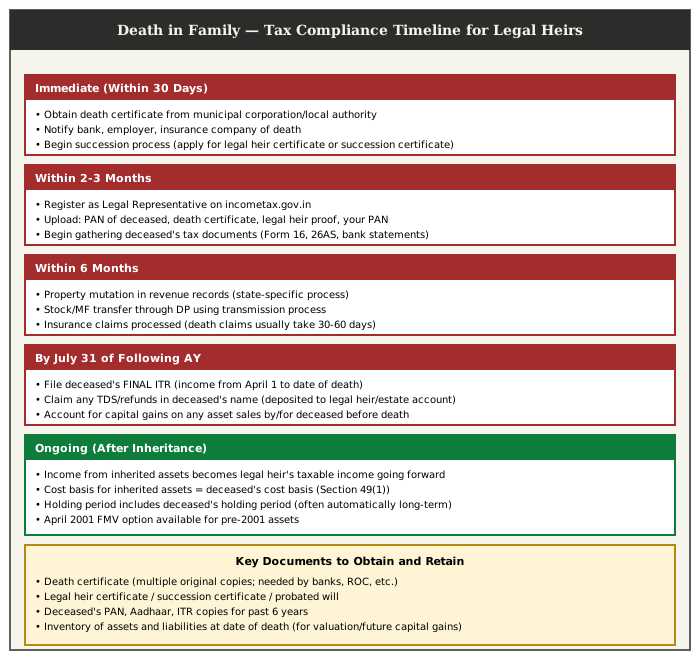
- Register as Legal Representative on the portal
- Upload: PAN of deceased, death certificate, legal heir proof, your PAN
- After approval, can file ITR on behalf of deceased
- Refund/Demand goes to estate/legal heirs
Inheritance — not taxable.
India has no inheritance tax. Whether you inherit ₹10 lakh or ₹100 crore, no tax at the time of inheritance.
But you become responsible for:
- Future income from inherited assets (taxable as your income)
- Cost basis carry-over for capital assets (deceased's original cost becomes yours)
- Stamp duty on property transfer (state-specific)
Inheritance of specific assets.
Bank accounts:
- Joint account with rights of survivorship: passes to joint holder
- Nominee account: passes to nominee (but legal heirs may have claim)
- Without nominee: requires legal heir/succession certificate to transfer
Real estate:
- Will determines distribution; if no will, personal succession law applies
- Mutation in revenue records (state-level)
- Future rental/sale income belongs to inheritor
Shares and mutual funds:
- Demat account joint holder: easy transfer
- Without joint holder: legal heir/succession process
- DPs (depository participants) require specific documentation
Insurance policies:
- Nominee receives proceeds
- Death benefit typically tax-free for life insurance
- Pension annuity policies: continuing payments may be taxable to nominee
EPF, PPF, NPS:
- Nominee/legal heir receives accumulated amount
- Generally tax-free at receipt
- Future investment of received amounts is taxable as legal heir's income
TDS on deceased's name.
If TDS was deducted on income paid to the deceased:
- Appears in deceased's Form 26AS
- Legal heir claims TDS as part of deceased's final ITR
- Refund credited to estate/legal heir account
Common timeline.
| Time After Death | Action |
|---|---|
| Immediately | Death certificate, will/succession start |
| Within 1-2 months | Bank account update, insurance claim |
| Within 6 months | Property mutation, stock transfer |
| Within 12 months | File deceased's final ITR; close PAN if needed |
| Long-term | Manage inherited income, future filings as inheritor |
Sections 159, 168, 49(1) of Income Tax Act 1961; Indian Succession Act 1925.
Job Loss and Career Transitions
Career disruptions create specific tax planning challenges.
Mid-year job loss scenario.
If you lose job mid-year:
- TDS already deducted by previous employer reflects assumption of full-year employment
- Likely too much TDS deducted for your actual earnings
- File ITR to claim refund
Multiple-employer scenario.
If you have brief unemployment then new job:
- Each employer deducts TDS independently (no coordination)
- Each thinks you're at different bracket
- Reconcile during ITR filing
Severance package taxation.
| Component | Tax Treatment |
|---|---|
| Notice pay in lieu (paid by employer) | Salary (fully taxable) |
| Gratuity (if eligible) | Section 10(10) exempt up to limits |
| Leave encashment | Section 10(10AA) exempt up to limits |
| Severance compensation | Fully taxable salary unless qualifies as VRS |
| Outplacement support | Benefit to employee; may be perquisite |
VRS compensation under Section 10(10C).
If severance qualifies as Voluntary Retirement Scheme:
- Up to ₹5 lakh exempt
- Specific conditions on the scheme
- Not all severance qualifies
Career break planning.
If taking voluntary career break:
- Manage previous year's PF/NPS contributions
- Maintain health insurance (employer-funded ones lapse)
- File ITR for the year of resignation
- Track foreign assets if working overseas
Self-employment after job.
Transitioning to freelancing:
- Move from Salary head to PGBP
- Section 44AD/44ADA presumptive options
- Quarterly advance tax now applies (Section 207)
- Get Section 80-IAC eligible startup if starting own venture
Returning to employment after break.
Re-entering workforce:
- New TDS may not account for previous year's work
- Provide Form 12B for past employment income
- Year-end ITR reconciles all positions
Sections 10(10), 10(10AA), 10(10C), 192 of Income Tax Act 1961.
Disability — Sections 80U, 80DD, and Other Deductions
Significant tax benefits for filers with disabilities or supporting disabled dependents.
Section 80U — For the disabled person themselves.
If you have a disability:
- Disability (40-79%): ₹75,000 deduction
- Severe disability (80%+): ₹1,25,000 deduction
- Old Regime only
Specified disabilities under the Persons with Disabilities Act:
- Blindness, low vision
- Hearing impairment
- Locomotor disability
- Mental retardation, mental illness
- Other notified disabilities
Documentation: Certificate from notified medical authority (government hospital civil surgeon, etc.).
Section 80DD — For disabled dependent.
If you support a disabled dependent (parents, spouse, children, siblings):
- Disability (40-79%): ₹75,000 deduction
- Severe disability (80%+): ₹1,25,000 deduction
- Old Regime only
- Dependent must be wholly or mainly dependent on you. Not necessarily living with you.
Specific provisions:
- Money set aside for the disabled dependent's care (deposit in LIC scheme, etc.) qualifies
- Annual expenditure on dependent's training, medical treatment qualifies
Section 80DDB — Specified diseases.
For medical treatment of specified diseases (you or dependent):
- Under 60: up to ₹40,000
- Senior 60+: up to ₹1,00,000
Specified diseases:
- Cancer (malignant)
- Chronic renal failure
- Hematological disorders
- Neurological diseases
- AIDS
Documentation: Form 10-I prescription from specialist + treatment records.
Combined deduction potential.
Family with disabled dependent + serious illness:
- 80DD: ₹1.25 lakh (severe disability)
- 80DDB: ₹1 lakh (senior parent with cancer)
- 80D: ₹50,000 (health insurance for parents)
- Total: ₹2.75 lakh additional Old Regime deductions
Sections 80U, 80DD, 80DDB of Income Tax Act 1961.
Relocation — Tax Aspects of Moving
Moving cities for work has tax dimensions beyond just changing addresses.
Professional tax changes.
Professional tax is state-imposed:
- Mumbai/Maharashtra: up to ₹2,500/year
- Bangalore/Karnataka: up to ₹2,400/year
- Delhi: no professional tax
- Tamil Nadu: up to ₹2,500/year
When moving between states with different professional tax regimes:
- Inform new employer of state change
- Get certificate of clearance from previous state (if applicable)
- Adjust withholding for new state
HRA changes after relocation.
If you relocate from a metro to non-metro (or vice versa):
- Metro (Mumbai, Delhi, Kolkata, Chennai): 50% of basic for HRA exemption
- Non-metro (everywhere else, including Bangalore, Hyderabad): 40% of basic
- May affect HRA exemption substantially
Bank account and PAN-Aadhaar updates.
- Update address with bank (KYC)
- Update Aadhaar address (UIDAI portal)
- Update employer for TDS purposes
- Update bank for IT communications
- PAN address auto-updates if Aadhaar is updated and linked
Tax notice receipts.
Outdated address can mean missing important IT Department notices:
- Section 143(1) intimations
- Scrutiny notices under 143(2)
- Defective return notices (139(9))
- Refund delivery
State-level Professional Tax Acts; CBDT communications procedures; UIDAI Aadhaar address update procedures.
Adoption — Tax Considerations
Adoption creates a legal parent-child relationship with associated tax implications.
Equivalence with biological children.
Under Indian tax law, adopted children are treated equivalently to biological children for most tax purposes:
- 80C tuition fees: claimable for adopted children
- 80D health insurance: covers adopted dependent
- Sukanya Samriddhi for adopted daughter (under 10): eligible
- Section 10(32) minor child income exemption: applies
Documentation needed.
- Legal adoption deed (registered)
- Birth certificate showing adoptive parents (sometimes amended)
- Adoption agency certificate (if applicable)
Single parent adoption.
Single individuals adopting:
- Same tax benefits as in two-parent adoption
- All deductions applicable
- Section 80C, 80D, etc. all available for the child
Inheritance considerations.
- Adopted child has rights similar to biological child under personal law
- For Hindu Succession Act: equal share with biological children
- Estate planning should explicitly include adopted children
Sections 80C, 80D, 10(32) of Income Tax Act 1961; Hindu Adoption and Maintenance Act 1956.
Single Parenting Tax Considerations
Single parents face specific challenges in maintaining family finances and tax planning.
Single deductions vs. dual-income family.
A two-parent family can potentially claim:
- ₹1.5 lakh 80C deduction each (combined ₹3 lakh)
- ₹2 lakh home loan interest each (combined ₹4 lakh)
- ₹50,000 NPS 80CCD(1B) each (combined ₹1 lakh)
- HRA each (if both employed and renting)
Single parent claims only one set:
- ₹1.5 lakh 80C
- ₹2 lakh home loan interest
- ₹50,000 NPS 80CCD(1B)
- HRA
This is one reason single parents often pay more tax on equivalent household income.
Maximizing children-related deductions.
Single parent fully entitled to:
- All 80C tuition for children
- 80D for children's health insurance
- Sukanya Samriddhi for daughters
- NPS Vatsalya for children
- Section 10(32) minor child clubbing exemption
Working with the alimony.
If receiving alimony:
- Alimony not taxable (no Indian tax)
- Combined with own income for budgeting
If paying alimony (you're paying it):
- Not deductible
- Document carefully for legal compliance
Tax planning for single parents.
- Maintain own ITR filing record
- Maximize all available deductions
- Use HRA, 80C, 80D to full extent
- Health insurance for children (employer plus separate cover)
- Plan emergency fund (3-6 months expenses)
Sections 80C, 80D, 56(2)(x) of Income Tax Act 1961.
Caring for Elderly — Deductions and Planning
Supporting elderly parents creates specific tax planning opportunities.
Section 80D enhanced limits for parents.
| Parent's Age | 80D Limit (in addition to self ₹25K) |
|---|---|
| Below 60 | ₹25,000 |
| 60 and above | ₹50,000 |
Maximum combined 80D for self + parents: ₹50,000 (under 60) + ₹50,000 (parents 60+) = ₹1,00,000 (Old Regime only).
Section 80DDB for parents' serious illness.
If parent has specified disease:
- Under 60: deduction ₹40,000
- 60+: deduction ₹1,00,000
- Documented Form 10-I prescription required
- Actual medical expense receipts
Documentation maintained:
- Parent's PAN
- Hospital bills, pharmacy receipts
- Doctor's certificates
- Form 10-I
- Bank transfers (don't use cash for substantial expenses)
Hospital insurance for parents.
Many filers buy separate health insurance for parents:
- Different policy than family floater
- Senior citizen plans (PSU insurers, etc.)
- Premium fully eligible under 80D parents' limit
Reverse mortgage for parents.
If parents own their home and want monthly income:
- Reverse mortgage from bank
- Payments to parents: NOT taxable (Section 10(43))
- Significant retirement income source
Estate planning interaction.
When supporting elderly:
- Their assets eventually pass to you
- Cost basis carries over
- Tax planning consideration for future capital gains
Living arrangements.
If parents live with you:
- HRA continues if you rent (parents living with you doesn't change rental status)
- If you own the house, no HRA (regardless of parents' presence)
If you rent place for parents:
- Section 80GG available if you don't receive HRA
- Otherwise, rent paid for parents is personal expense (not deductible)
Sections 80D, 80DDB, 80GG, 10(43) of Income Tax Act 1961.
Document Updates After Life Events
Major life changes require specific document and account updates.
Identity documents.
- PAN: Auto-updates from Aadhaar link
- Aadhaar: Update address through UIDAI Self Service Portal
- Passport: Renew if address changed
- Voter ID: Update through Election Commission portal
Income tax updates.
- ITR for transition year
- Update employer with new address
- Update bank account if relocated
- Email/mobile for IT communications
Bank and investment accounts.
- Address change in savings/current accounts
- Nominee updates after major events
- Joint holder changes if relevant
- Demat account name/address updates
Insurance.
- Update beneficiary after marriage/divorce
- Add children to family floater
- Update health insurance coverage
- Life insurance beneficiary if applicable
Will and succession planning.
- Update will after marriage/divorce
- Include new children
- Address property changes
- Consider HUF formation/changes
Statutory filings.
- EPF nominee updates
- PPF nominee updates
- NPS nominee updates
- Demat account updates
UIDAI Master Direction; ITR forms; insurance regulations; Hindu Succession Act for succession planning.
Key Takeaways
- Section 64(1) clubbing prevents simple gift-based tax planning between spouses — gifts to spouse create income tax in the giver's hands, not the receiver's; joint property ownership with both spouses contributing EMIs is the legitimate alternative that doubles available deductions
- Alimony treatment under Indian tax law relies on judicial precedents rather than specific legislation — both recurring and lump sum alimony are generally NOT taxable to the recipient and NOT deductible for the payer; divorce asset transfers are generally exempt under Section 56 principles
- Birth of a child opens Sukanya Samriddhi Yojana (up to ₹1.5 lakh within 80C, E-E-E), Section 80C tuition fees for up to 2 children, 80D maternity insurance premium, and NPS Vatsalya (₹50,000 under 80CCD(1B)); minor child income from gifted assets is clubbed to the higher-income parent with only ₹1,500/child exempt under Section 10(32)
- Death in family requires legal heir registration on incometax.gov.in, filing the deceased's final ITR reporting income till date of death, claiming TDS from Form 26AS, and applying cost basis carry-over for capital assets — India has no inheritance tax, but stamp duty applies on property transfer
- Severance package tax varies by component — notice pay is fully taxable; gratuity is exempt under Section 10(10); leave encashment under Section 10(10AA); VRS compensation up to ₹5 lakh exempt under Section 10(10C); only qualifying VRS schemes get this exemption
- Sections 80U (self), 80DD (disabled dependent), and 80DDB (specified diseases) together can create up to ₹2.75 lakh in additional Old Regime deductions; all three require specific documentation — disability certificate from notified authority, Form 10-I prescription from specialist
- Major life events require systematic document updates: PAN-Aadhaar linkage auto-updates PAN address; all other changes (bank KYC, employer TDS, insurance nominees, EPF/PPF/NPS nominations) require proactive action; outdated addresses can cause missed Section 143(1) intimations and scrutiny notices
Quiz — 5 Questions
Answer one at a timeUnder Section 64(1), if a husband gifts ₹50 lakh to his wife and she invests in bank FDs earning ₹3 lakh interest annually, how is the FD interest taxed?