Real Estate Owners and Rental Income
Property income tax framework, self-occupied and let-out property computation, Budget 2025 two-property benefit, home loan deductions stack across regimes, pre-construction interest 5-year spread, joint ownership planning, post-Budget 2024 capital gains regime, Sections 54/54EC/54F exemptions, TDS on property transactions, and inherited property cost basis rules
- Compute income from self-occupied and let-out property using the GAV/NAV framework and identify the Budget 2025 two-property SOP benefit
- Calculate home loan deductions across Sections 24(b), 80C, 80EE, and 80EEA and apply the pre-construction interest 5-year spread rule
- Identify when the 12.5% (without indexation) vs 20% (with indexation) capital gains rate favors the taxpayer for property sold after Budget 2024
- Apply Sections 54, 54EC, and 54F in combination to compute capital gains exemption on property sale
- Understand Section 194-IA TDS mechanics as a property buyer and fulfill the 26QB filing requirement
- Determine cost basis for inherited and gifted property using Section 49(1) and the April 2001 FMV option under Section 55(2)(b)
Real Estate Owners and Rental Income
Real estate occupies a unique place in Indian tax planning. It's an asset most middle-class families aspire to own, often involves the largest single financial transaction of someone's life, and creates tax obligations that span purchase, ownership, rental, sale, and inheritance. The rules are nuanced — multiple sections interact, recent Budget changes have shifted the landscape, and small structural decisions at purchase can have decade-long consequences.
This lesson covers the full lifecycle of real estate ownership from a tax perspective. Computing rental income properly (with the 30% standard deduction many filers miss), maximizing home loan interest deductions, understanding the Budget 2025 expansion to two self-occupied properties, navigating the post-Budget 2024 capital gains regime (12.5% without indexation vs 20% with indexation for older property), and using Sections 54, 54EC, and 54F to defer or exempt capital gains on sale.
We also cover the practical mechanics that trip up most filers: joint ownership planning, the cost basis rules for inherited and gifted property, the cascade of TDS obligations when buying or selling, and how the choice of regime affects home loan deductions differently for self-occupied vs let-out properties.
A note on terminology: this lesson uses Income Tax Act 1961 references applicable to FY 2025-26 income filed as AY 2026-27.
Navigation guide — which subsections apply to your situation
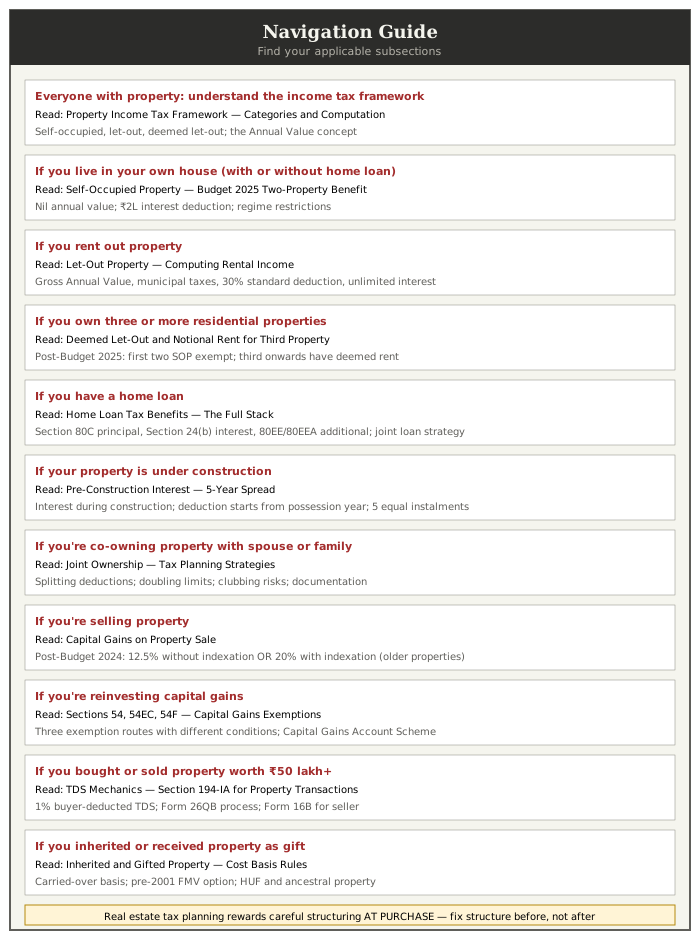
Property Income Tax Framework — Categories and Computation
Indian tax law treats different property situations differently. Understanding the categories is foundational.
The four categories of property for tax purposes.
- Self-Occupied Property (SOP). Property used by the owner for their own residence. After Budget 2025, up to TWO such properties can be claimed with nil annual value.
- Let-Out Property (LOP). Property actually rented out. Rental income forms the taxable base.
- Deemed Let-Out Property (DLOP). Third or subsequent residential properties not actually let out — taxed as if let out at notional fair rent. Applies post-Budget 2025 for third+ properties.
- Property used for own business. Not taxed under House Property head — falls under PGBP.
The Annual Value concept. All property income computation starts with "Annual Value":
- For SOP: Annual Value = NIL (after Budget 2025, for up to two properties)
- For LOP: Higher of actual rent OR expected reasonable rent
- For DLOP: Expected reasonable rent (notional)
From this Annual Value, deductions are taken to arrive at taxable income from house property.
The standard computation framework.
Sections 22-27 of Income Tax Act 1961; Budget 2025 amendments.
Self-Occupied Property — Budget 2025 Two-Property Benefit
This is the most significant recent change for property owners. Until Budget 2025, only ONE property could be claimed as self-occupied with nil annual value. Now TWO are allowed.
The expanded benefit.
As per the Union Budget 2025, the government has changed the rules related to taxation of self-occupied house properties. Earlier, only one house could have nil annual value. But now, starting from April 1, 2025, a taxpayer can show their annual value as nil for two self-occupied properties (without meeting any specific condition). However, if someone owns more than two houses, the third and additional houses will still be taxed based on notional rent.
What this means practically.
| Property Count | Pre-Budget 2025 Treatment | Post-Budget 2025 Treatment |
|---|---|---|
| 1 property | Nil annual value | Nil annual value |
| 2 properties | 1 at nil, 1 at deemed rent | BOTH at nil |
| 3 properties | 1 at nil, 2 at deemed rent | 2 at nil, 1 at deemed rent |
| 4 properties | 1 at nil, 3 at deemed rent | 2 at nil, 2 at deemed rent |
Real-world scenarios benefiting from this change.
- Family with house in hometown + apartment near workplace: Both now exempt
- Spouse living separately for work + family home: Both exempt as long as both are self-occupied
- Investment property where owner stays occasionally + primary home: Both can be claimed
- Inherited ancestral home + own purchased home: Both exempt
Choosing which properties to claim as SOP.
When you own 3+ properties, you choose which 2 to declare as SOP. Strategy: pick the two with:
- Highest expected/notional rent → maximizes deemed rent avoided
- Highest municipal tax base → less municipal tax against deemed income
- Largest property where notional rent would be substantial
Home Loan Interest Deduction for SOP.
| Regime | Maximum Deduction | Notes |
|---|---|---|
| Old Regime | ₹2,00,000 per year | Aggregate across all SOPs |
| New Regime | ZERO | No interest deduction on SOP |
Even though you can claim two SOPs with nil annual value in New Regime, you cannot claim the home loan interest deduction on those properties. This is a significant disadvantage for filers with substantial home loans on self-occupied property.
Loss from SOP. In Old Regime, when interest on SOP loans exceeds the deduction limit or generates a notional loss, this loss can be set off against other heads of income up to ₹2 lakh per year. Any excess carried forward for 8 years against future house property income.
Section 23 of Income Tax Act 1961 (amended Budget 2025); Section 24(b).
Let-Out Property — Computing Rental Income
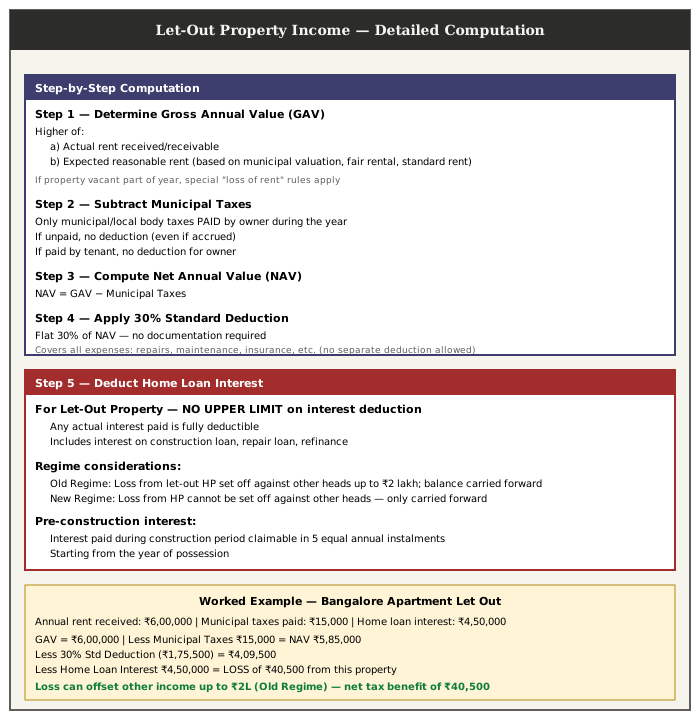
When you actually rent out property, specific computation rules apply.
Deemed Let-Out and Notional Rent for Third+ Property
For filers with three or more residential properties, the third and subsequent properties are taxed at notional (deemed) rent — even if not actually rented out.
The deemed rent concept. The tax law assumes you could have earned rent on the property if you'd chosen to rent it out. This notional rent becomes the basis for taxation.
Computing the deemed rent. The "expected reasonable rent" is the higher of:
- Municipal valuation
- Fair rental value (what similar properties in the area would fetch)
- Subject to standard rent if applicable (rent control jurisdictions)
In practice, most tax filers refer to the municipal valuation as the simplest defensible benchmark.
Computation for deemed let-out property. Same framework as actual let-out:
- Deemed Annual Value (notional rent)
- Less: Municipal Taxes paid
- Less: 30% Standard Deduction on NAV
- Less: Home Loan Interest (unlimited for DLOP, just like LOP)
Filer owns 4 residential properties: 1. Primary residence in Bangalore (SOP) 2. Apartment in Mumbai used during work visits (SOP) 3. Inherited family house in Pune (vacant) 4. Investment flat in Hyderabad (vacant) Pre-Budget 2025: 1 SOP + 3 DLOP — three properties had deemed rent. Post-Budget 2025: 2 SOPs + 2 DLOP — only Pune and Hyderabad have deemed rent. This is a meaningful relief for filers with multiple properties used personally.
Choosing which to declare as SOP among multiple. Strategy: declare as SOP the two properties with the highest notional rent. If Bangalore notional rent = ₹6L, Mumbai = ₹8L, Pune = ₹3L, Hyderabad = ₹4L — declare Bangalore and Mumbai as SOP (saves tax on ₹14L deemed income vs ₹7L if you chose Pune+Hyderabad).
Vacancy claim for DLOP. If a deemed let-out property is genuinely vacant due to: tenant leaving, repair/renovation requiring vacant possession, or property between tenants, you can claim "vacancy deduction" — reducing the notional rent proportionally.
Sections 22, 23(4), 23(5) of Income Tax Act 1961; Budget 2025 amendments.
Home Loan Tax Benefits — The Full Stack
Home loan deductions stack across multiple sections — but only some are available in each regime.
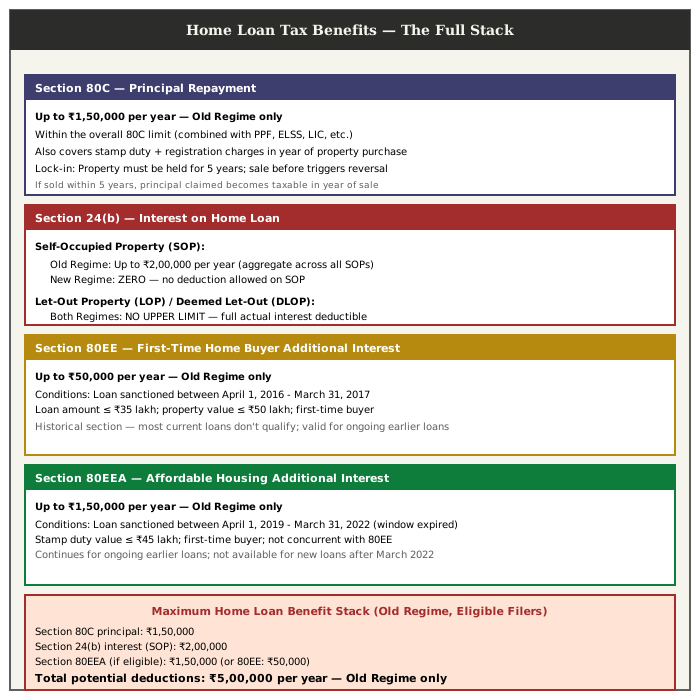
For filers with substantial home loan obligations on self-occupied property, the Old Regime offers ₹2 lakh interest deduction + ₹1.5 lakh principal in 80C + potentially ₹1.5 lakh under 80EEA — total ₹5 lakh deductions. The New Regime offers ZERO interest deduction on SOP. For a filer paying ₹3.5 lakh annual interest, this can swing the regime decision substantially.
Let-out property differs. Interest on let-out property is deductible without limit in BOTH regimes (against rental income, with loss-setoff restrictions in New Regime). So home loans on rented-out properties are less affected by regime choice.
Joint loan strategy. When property and loan are joint between spouses:
- Each can independently claim Section 80C up to ₹1.5L for their share of principal
- Each can independently claim Section 24(b) up to ₹2L for their share of interest (SOP)
- Effectively doubles available deductions to ₹3L principal + ₹4L interest
For this to work:
- Property must be co-owned (registered jointly)
- Both must be co-borrowers on the loan
- Both must contribute to EMIs from their own income
- Each claims proportionate to their share (usually 50-50 or per ownership ratio)
Sections 24(b), 80C, 80EE, 80EEA of Income Tax Act 1961.
Pre-Construction Interest — 5-Year Spread
Interest paid during the construction period (before getting possession) is treated specially.
The rule. Interest paid from loan disbursement until the end of the financial year before possession is "pre-construction interest." This accumulated interest is deductible in 5 equal annual instalments starting from the year of possession.
Property purchase via under-construction agreement: Loan disbursed: April 2022 Construction completed: October 2025 Possession taken: November 2025 Total interest paid during construction (April 2022 to March 2025): ₹4,50,000 Pre-construction interest treatment. Pre-construction period: FY 2022-23 + FY 2023-24 + FY 2024-25 = 3 years Total pre-construction interest: ₹4,50,000 Deductible over 5 instalments of ₹90,000 each, starting FY 2025-26 (year of possession) For FY 2025-26 (Old Regime, SOP): Current year interest (Nov 2025 to Mar 2026): ₹75,000 Pre-construction interest 1st instalment: ₹90,000 Total Section 24(b) claim: ₹1,65,000 (within ₹2L SOP limit) For FY 2026-27 to FY 2029-30: Continue claiming ₹90,000 pre-construction instalment + current year interest Total claim subject to ₹2 lakh SOP ceiling (or unlimited if let out)
Pre-construction interest is claimable in 5 equal instalments regardless of the period over which it accrued. Whether construction took 6 months or 6 years, the accumulated pre-construction interest splits into 5 equal portions.
Section 24(b) of Income Tax Act 1961; CBDT guidance on pre-construction interest.
Joint Ownership — Tax Planning Strategies
Joint ownership of property creates significant tax planning opportunities.
The core principle. When property is jointly owned by individuals, each co-owner is taxed on their proportionate share of income (and gets proportionate share of deductions).
Most common: spouse joint ownership. If property registered 50-50 between spouses and both contribute to EMIs:
- Rental income split 50-50, taxed in each spouse's return
- Each claims 50% of municipal taxes, standard deduction, interest
- Each claims their proportionate share of 80C principal
Doubling deduction limits through joint ownership.
| Deduction | Single Owner | Joint Owners (Both Eligible) |
|---|---|---|
| Section 80C (principal) | ₹1,50,000 | Up to ₹3,00,000 combined |
| Section 24(b) (interest, SOP) | ₹2,00,000 | Up to ₹4,00,000 combined |
| Section 80EEA (if applicable) | ₹1,50,000 | Up to ₹3,00,000 combined |
For a couple with substantial home loan EMIs, joint ownership can mean an additional ₹3-5 lakh of annual deductions claimed across both returns.
Critical conditions for joint claim.
- Property must be co-owned — registered in both names with specified ownership ratio.
- Both must be co-borrowers on the loan — not just one.
- Each must contribute to EMI from their own income/funds.
- Each claims proportionate to ownership share — not arbitrary split.
Documentation requirements.
- Sale deed showing co-ownership
- Loan sanction letter showing both as co-borrowers
- Bank statements showing EMI contributions from both
- For HRA in same arrangement: not allowed since you own the property
Under Section 64(1), income from assets transferred to spouse without adequate consideration is clubbed with the transferor's income. If one spouse pays for the property but registers in joint name without genuine financial contribution from the other spouse, the rental income/capital gains can be clubbed with the contributor's income. Genuine financial contribution from each spouse is essential.
Parent-child joint ownership. When property is jointly owned with parents or adult children:
- Each gets their share of income/deductions
- No clubbing issues (unlike minor children)
- Useful for estate planning + current tax efficiency
Working couple buys ₹1.5 crore apartment with ₹1.2 crore loan, ₹30 lakh down payment. Registered 50-50 between spouses Both are co-borrowers; both contribute to EMI from their salaries Annual interest ₹10 lakh, annual principal ₹4 lakh In Old Regime: Husband claims: ₹2L (Section 24(b)) + ₹1.5L (Section 80C, capped) = ₹3.5L Wife claims: ₹2L (Section 24(b)) + ₹1.5L (Section 80C, capped) = ₹3.5L Combined deduction: ₹7 lakh vs single owner: ₹3.5L combined deduction. Joint structure doubles the benefit.
Sections 26, 64, 24(b), 80C of Income Tax Act 1961.
Capital Gains on Property Sale
Selling property triggers capital gains tax. Post-Budget 2024 changes have significantly altered the landscape.
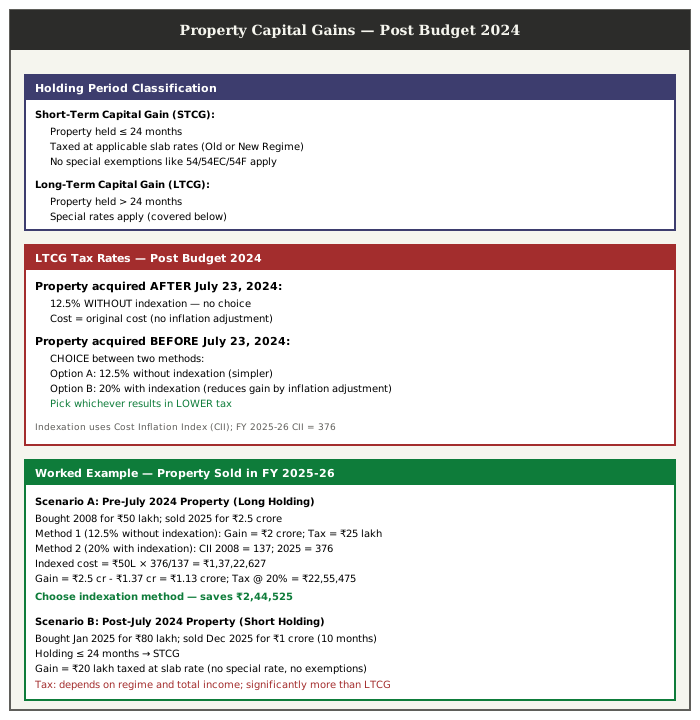
The choice between 12.5% and 20% with indexation.
This was a significant Budget 2024 reform. Initially Budget 2024 proposed only 12.5% without indexation (no choice). After public outcry, the government added the option to use 20% with indexation for properties acquired before July 23, 2024.
When 12.5% without indexation wins.
- Property held for short long-term periods (24-60 months)
- Property where prices appreciated faster than inflation
- Simpler computation
When 20% with indexation wins.
- Property held for very long periods (10+ years)
- Property where appreciation roughly tracks or lags inflation
- Substantial inflationary period gives meaningful indexation benefit
Computing capital gain. Capital Gain = Sale Consideration − Indexed Cost (if applicable) − Cost of Improvement (indexed) − Transfer Expenses (brokerage, legal fees)
Stamp duty value vs actual sale. If sale price is less than stamp duty value (circle rate), the higher of the two is used as sale consideration. This prevents underreporting. Limited tolerance (10% in some cases) before this rule kicks in.
Sections 45, 48, 50C, 112 of Income Tax Act 1961; Budget 2024 amendments; CII notifications.
Sections 54, 54EC, 54F — Capital Gains Exemptions
Three routes to exempt or defer property capital gains tax through reinvestment.
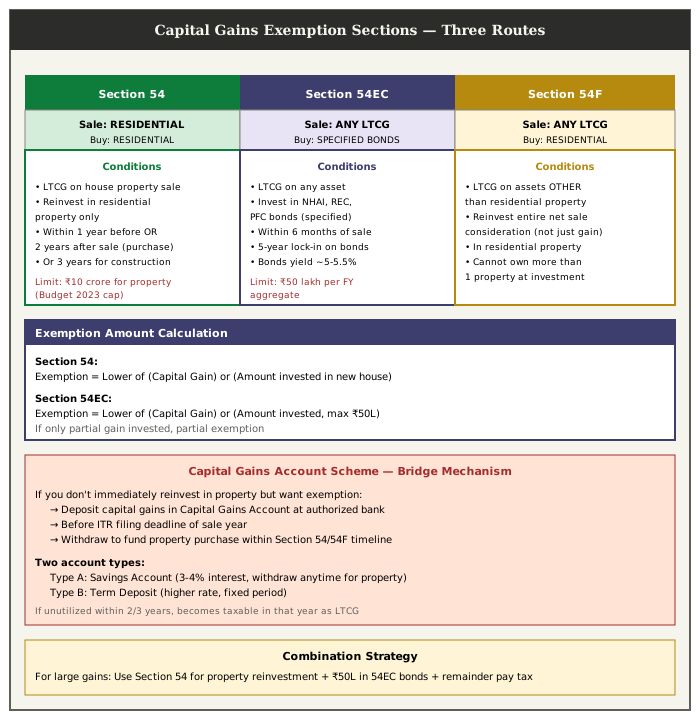
Filer sells residential property in June 2025 with: Sale value: ₹3 crore Indexed cost: ₹1 crore LTCG: ₹2 crore Strategy. Use Section 54: Buy new residential property worth ₹1.5 crore → ₹1.5 crore of LTCG exempt Use Section 54EC: Invest ₹50 lakh in NHAI/REC bonds → ₹50 lakh more LTCG exempt Total exempt: ₹2 crore (the entire gain) Tax payable: ZERO If only ₹1 crore in new property and no bonds: Section 54 exempts ₹1 crore Remaining ₹1 crore taxed at 12.5% (without indexation, post-July 2024 rule) = ₹12.5 lakh The combination saves ₹12.5 lakh.
Section 54 ₹10 crore cap (Budget 2023). Maximum investment under Section 54 that can be claimed for exemption is ₹10 crore. Earlier no cap existed. Affects ultra-high-value property transactions.
Section 54F nuance. Requires investing the entire NET SALE CONSIDERATION (not just gain) in new property. So if you sell shares worth ₹2 crore with ₹50 lakh gain, you need to invest ₹2 crore in residential property, not just ₹50 lakh. Significant difference from Section 54.
Sections 54, 54EC, 54F, 54G of Income Tax Act 1961; Budget 2023 amendments capping Section 54 at ₹10 crore.
TDS Mechanics — Section 194-IA for Property Transactions
Already covered in Lesson 7 — here's the property-specific detail.
Section 194-IA — TDS on Property Purchase.
| Aspect | Detail |
|---|---|
| Trigger | Property sale value ≥ ₹50 lakh |
| Rate | 1% of total sale consideration |
| Deductor | Property buyer |
| Form | Form 26QB (challan + return combined) |
| Deadline | Within 30 days of month of payment |
| Certificate to seller | Form 16B (downloaded from TRACES after filing 26QB) |
Key clarifications.
- TDS on entire sale value, not just gain. Even if seller has loss, 1% TDS applies. Seller claims refund of excess at filing.
- Multiple buyers/sellers. When property has joint owners, TDS applies separately. Each buyer-seller pair files separate 26QB for their proportionate transaction value.
- Stamp duty value rule. If sale price is below stamp duty value, TDS is on the higher of two. Prevents underreporting.
- No PAN of seller. TDS rate becomes 20% (instead of 1%) if seller's PAN is not furnished.
Process for buyer.
- Pay seller 99% of sale value at registration. Withhold 1%.
- Visit incometax.gov.in → e-Pay Tax → Form 26QB.
- Fill PAN of both parties, property details, payment dates, TDS amount.
- Pay through net banking.
- Within 10-15 days, download Form 16B from TRACES.
- Provide Form 16B to seller.
Section 194-IB for tenant TDS (rent). Already covered Lesson 7. Individual tenants paying ₹50K+/month rent must deduct 5% TDS at year-end via Form 26QC.
Sections 194-IA, 194-IB of Income Tax Act 1961; Form 26QB and 26QC procedures.
Inherited and Gifted Property — Cost Basis Rules
When property comes to you through inheritance or gift, specific rules govern your future tax treatment.
Cost basis rule (Section 49(1)). For inherited or gifted property:
- Your cost basis = previous owner's actual cost
- Your holding period = your holding + previous owner's holding (for determining long-term/short-term)
- This is the "carried over basis" principle. The previous owner's gain doesn't get taxed at inheritance/gift, but you bear the burden when you sell.
Pre-April 2001 acquisitions (Section 55(2)(b)). For property acquired by the previous owner before April 1, 2001:
- You can use FMV (Fair Market Value) as of April 1, 2001 as cost basis INSTEAD of actual cost
- Often more favorable, especially for old properties
Mother bought property in 1985 for ₹2 lakh. FMV on April 1, 2001 was ₹15 lakh. She gifted to you in 2020. You sell in 2025 for ₹1 crore. Cost option 1: ₹2 lakh (actual 1985 cost) Cost option 2: ₹15 lakh (FMV April 1, 2001) You choose ₹15 lakh as cost basis — substantially reduces gain. Then apply indexation from 2001 (or use 12.5% without indexation, whichever is lower).
HUF and ancestral property. Ancestral property (passed down through generations) traditionally belonged to HUF. Income from HUF property is taxed in HUF's hands, not individual coparceners. HUF has its own:
- PAN
- Basic exemption (₹2.5L Old / ₹4L New)
- Tax rates (slab-based, similar to individuals)
For families with substantial ancestral property, HUF structuring splits income across entity and individuals — useful tax planning vehicle.
Inheritance not taxable; income from inherited assets is.
Receiving inheritance: zero tax (no inheritance tax in India).
Income from inherited property: taxable as your income going forward.
Gift from non-relative: taxable above ₹50,000. While gifts from specified relatives (parents, siblings, etc.) are tax-free, gifts from non-relatives are taxable as "Income from Other Sources" if aggregate exceeds ₹50,000 in a year.
For property specifically:
- Property gifted by relative: tax-free
- Property gifted by non-relative: stamp duty value taxable as income (if exceeds ₹50,000)
Inline question on inherited property capital gains computation.
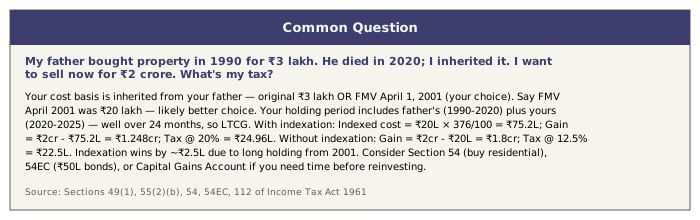
Sections 47, 49(1), 55(2)(b), 56(2)(x) of Income Tax Act 1961.
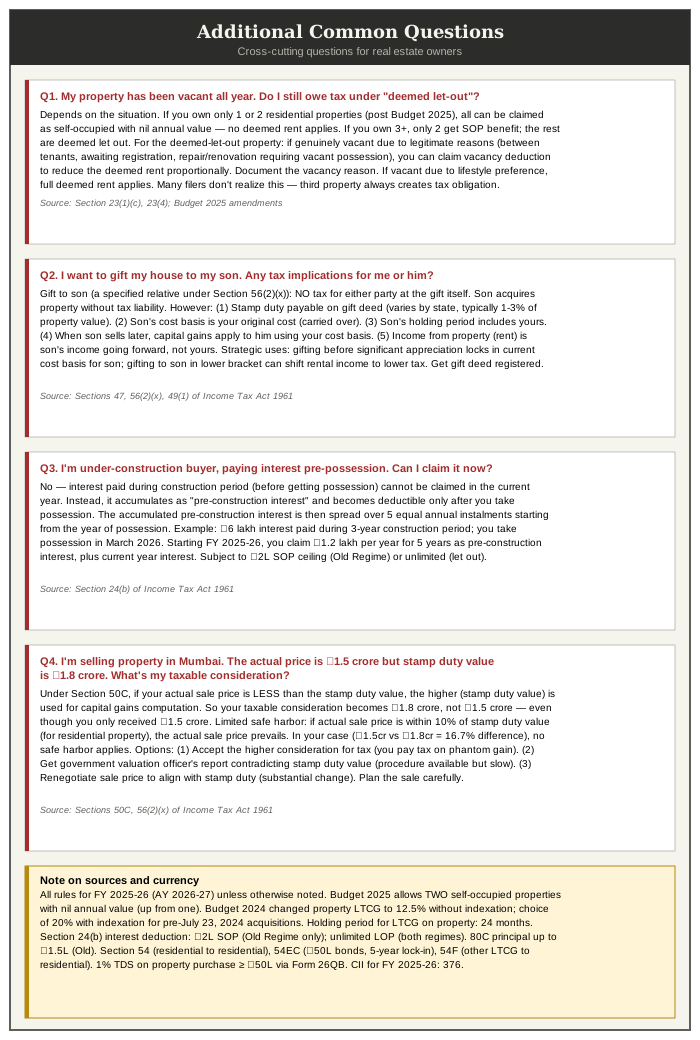
End of lesson — Additional common questions
Key Takeaways
- Budget 2025 expanded the nil annual value benefit to TWO self-occupied properties; third and subsequent residential properties are taxed at notional (deemed) rent under Sections 23(4) and 23(5)
- Home loan interest deduction on SOP is up to ₹2 lakh per year in Old Regime and ZERO in New Regime — this difference is the primary driver of home-loan-heavy filers choosing the Old Regime
- Pre-construction interest (accumulated from loan disbursement to the year before possession) is deductible in 5 equal annual instalments starting from the year of possession, regardless of construction duration
- Joint co-ownership with co-borrowership effectively doubles deduction limits: up to ₹3 lakh total principal (80C) and ₹4 lakh total interest (24b) across both owners
- Post-Budget 2024, property owners can choose between 12.5% without indexation OR 20% with indexation for LTCG — the indexation option is available only for properties acquired before July 23, 2024
- Sections 54 (residential reinvestment, capped at ₹10 crore), 54EC (bonds up to ₹50 lakh), and 54F (non-residential asset sale + full proceeds into residential) can be used in combination to fully eliminate capital gains tax
- Section 194-IA requires the property buyer to deduct 1% TDS on purchases ≥ ₹50 lakh via Form 26QB within 30 days; rate rises to 20% if seller's PAN is not furnished
- For inherited or gifted property, cost basis carries over from the previous owner (Section 49(1)); for pre-April 2001 acquisitions, FMV as of April 1, 2001 can substitute as the cost basis under Section 55(2)(b)
Quiz — 5 Questions
Answer one at a timePost-Budget 2025, what is the maximum number of self-occupied residential properties a taxpayer can claim with nil annual value?