Disabilities and Caregivers
Section 80U fixed deductions for disabled individuals, Section 80DD caregiver deductions for disabled dependents with the dual-option claim structure, Section 80DDB expense-based deductions for specified diseases under Rule 11DD, Form 10-IA and Form 10-I certification requirements with UDID card system, LIC Jeevan Aadhar and Niramaya Health Insurance specialized schemes, estate planning with discretionary trusts and will provisions for disabled dependents, long-term care corpus calculation methodology, and stacking strategy for maximum Old Regime tax benefit
- Compute Section 80U deductions for a resident individual with documented disability, distinguishing the ₹75,000 tier (40–79%) from the ₹1,25,000 tier (80%+) and confirming Old Regime applicability
- Apply Section 80DD to support claims by caregivers for disabled dependents, explain the two-option claim structure (expenditure vs. approved scheme deposit), and identify when the 80U vs. 80DD mutual exclusion applies
- Identify qualifying diseases under Rule 11DD for Section 80DDB, compute the net deductible amount after insurance reimbursement, and specify Form 10-I requirements by disease category
- Navigate the medical certification process for Form 10-IA, identify authorized issuing authorities for each disability type, and apply UDID card as the master disability credential
- Evaluate LIC Jeevan Aadhar and Niramaya Health Insurance as specialized financial instruments for disability planning, tracing premium payments to Section 80DD and 80D deductions
- Construct an estate plan for a disabled dependent using discretionary trust, HUF structuring, and will provisions, identifying common pitfalls of verbal commitments and direct asset ownership
- Calculate the long-term care corpus required for a disabled dependent using inflation-adjusted expense projections and discounted present value methodology
- Design a stacking strategy combining 80U, 80DD, 80DDB, and 80D deductions, assess the regime decision impact, and establish a documentation system for multi-year claims
Disabilities and Caregivers
Indian tax law provides specific support for filers with disabilities and those caring for disabled dependents. While Lesson 18 introduced Sections 80U, 80DD, and 80DDB, this lesson goes deeper into the practical mechanics: which disabilities qualify, how to obtain the necessary certificates, the documentation that survives scrutiny, the specialized insurance schemes (LIC Jeevan Aadhar, Niramaya), and the tax planning considerations specific to families dealing with long-term disability or chronic illness.
These deductions matter substantially for affected families. A family with one severely disabled dependent and elderly parents managing serious illness can claim ₹1.25 lakh (80DD) + ₹1 lakh (80DDB for senior parent) + ₹50,000 (80D parents) + ₹25,000 (80D self) = ₹3 lakh in disability/health-related deductions under Old Regime. For middle-income filers, this can represent meaningful tax savings — potentially ₹60,000-₹90,000 per year. Beyond tax savings, the framework recognizes the financial reality that families bear substantial direct costs for disabled members.
This lesson also addresses estate planning considerations specific to disability — how to set up financial arrangements for disabled dependents who may outlive their parents, the role of trust structures, and special-purpose insurance plans designed for this population.
A reminder: this lesson uses Income Tax Act 1961 references applicable to FY 2025-26 income filed as AY 2026-27.
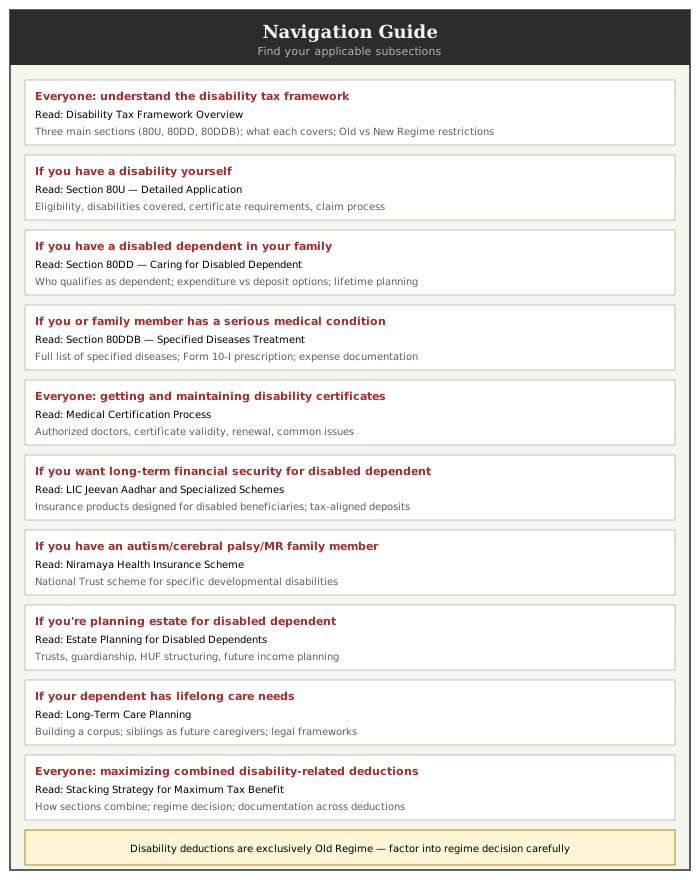
Navigation guide — which subsections apply to your situation
Disability Tax Framework Overview
Indian tax law provides three main deduction sections addressing disability and serious illness, all under Chapter VI-A (Old Regime only).
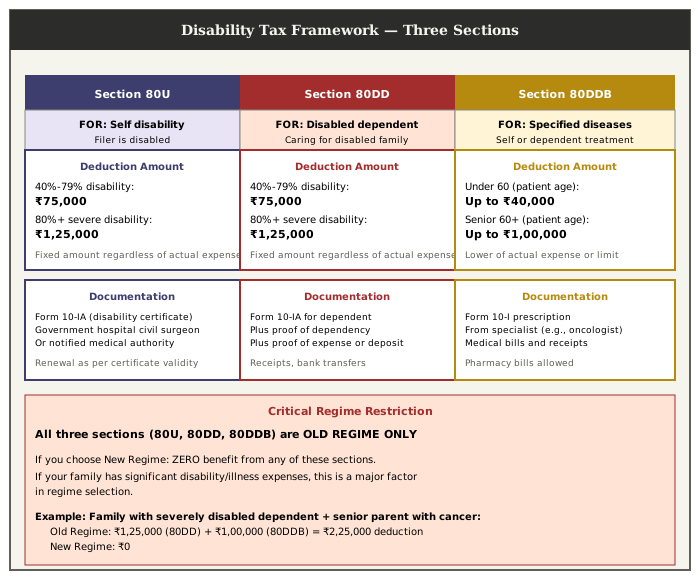
Sections 80U, 80DD, 80DDB of Income Tax Act 1961.
Section 80U — Detailed Application
When the taxpayer themselves has a disability, Section 80U provides a fixed deduction.
Eligibility.
- Resident individual
- Certified disability of 40% or more
- Disability must be one of those listed in Rights of Persons with Disabilities Act, 2016
- Old Regime only
Disabilities covered.
Section 80U covers disabilities defined under the Rights of Persons with Disabilities Act:
Physical disabilities:
- Locomotor disability (including amputation, polio)
- Cerebral palsy
- Muscular dystrophy
- Acid attack victims
- Blindness, low vision
- Hearing impairment, deaf-blindness
Intellectual disabilities:
- Intellectual disability (mental retardation)
- Specific learning disabilities (dyslexia, etc.)
- Autism spectrum disorder
Mental illness:
- Mental illness (schizophrenia, etc.)
Neurological conditions:
- Multiple sclerosis
- Parkinson's disease
Blood disorders:
- Hemophilia
- Thalassemia
- Sickle cell disease
Multiple disabilities:
- Combination of two or more of the above
Severity thresholds.
Two-tier deduction structure:
| Disability Level | Deduction |
|---|---|
| 40% to 79% (Person with disability) | ₹75,000 |
| 80% and above (Person with severe disability) | ₹1,25,000 |
Fixed amount, not based on expense.
Unlike 80DDB which is based on actual expense, 80U provides a fixed amount regardless of:
- Whether you spent more or less on disability-related needs
- Whether you have any expense in that specific year
- Your income level
The rationale: society recognizes additional living costs for disabled persons, so flat deduction acknowledges this.
Certification process.
To claim 80U, you need a certificate from authorized medical authority:
Authorized authorities:
- Civil Surgeon at a government hospital
- Notified specialist (varies by disability type)
- Specific medical boards for certain conditions
Form 10-IA — The disability certificate.
The certificate (Form 10-IA) must include:
- Name and identifying details of person with disability
- Specific disability and percentage
- Period for which certificate is valid
- Doctor's name, qualification, registration number
- Issuing authority signature and stamp
Validity periods.
- For permanent disabilities: lifetime certificate
- For potentially recoverable conditions: 1-5 years validity
- Renewal required upon expiry
Common issues with certification.
Issue 1: Wrong issuing authority. Some filers obtain certificates from private clinics — not acceptable. Only notified authorities.
Issue 2: Incomplete information. Certificate must specify percentage of disability; statement of "disability present" without percentage is insufficient.
Issue 3: Expired certificate. Renewal often delayed; tax department doesn't accept expired certificates.
Issue 4: Self-perceived vs medically certified. Some filers think their condition qualifies but don't get medical certification. Tax department requires the certificate.
Get certificate from a government hospital with proper diagnosis. Even though it may take more effort than a private doctor, the certificate is acceptable to tax authorities.
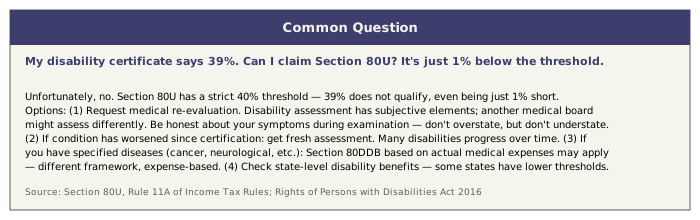
Section 80U of Income Tax Act 1961; Rights of Persons with Disabilities Act 2016; Rule 11A of Income Tax Rules.
Section 80DD — Caring for Disabled Dependent
For filers supporting a disabled dependent, Section 80DD provides similar deductions.
Who qualifies as "dependent."
For Section 80DD:
- Spouse (regardless of independent income)
- Children (including adopted)
- Parents
- Brothers and sisters
- Members of HUF (if filer is karta)
The dependent must:
- Be wholly or mainly dependent on you for support
- Not have claimed Section 80U for themselves
- Have certified disability of 40% or more
Deduction amounts.
Same structure as 80U:
- 40% to 79% disability: ₹75,000
- 80% and above (severe): ₹1,25,000
Two ways to use the deduction.
Section 80DD provides flexibility — you can claim the deduction for either:
Option 1: Expenditure for medical treatment, training, rehabilitation.
- Actual money spent on dependent's medical care, therapy, special education, rehabilitation
- Documentation of actual expense not required (though recommended)
- Claim full deduction regardless of actual expense (similar to 80U)
Option 2: Money set aside in approved schemes for dependent's care.
- Deposit in approved insurance scheme (LIC Jeevan Aadhar, similar products)
- Amount deposited any time during the year
- Maximum claim equal to deduction limit
Tax mechanism explanation.
The deduction amount (₹75,000 or ₹1,25,000) is fixed. Whether you spend that much or not, you claim the fixed amount. The "expense vs deposit" choice is mainly for documentation purposes — both options qualify.
Cannot also claim 80U for same person. If dependent claims 80U themselves (their own ITR), you cannot claim 80DD for them. Choose: either dependent files own return with 80U, or supporting family member claims 80DD.
For dependents who can't file their own returns (severely disabled, intellectually disabled, etc.), 80DD by the caregiver makes more sense.
Documentation needed.
- Form 10-IA disability certificate for dependent
- Proof of dependency (medical records, financial support evidence)
- For deposit option: proof of deposit in approved scheme
- For expense option: bills, receipts (optional but recommended)
Approved scheme deposits.
Section 80DD recognizes deposits in specific schemes like:
- LIC Jeevan Aadhar
- LIC Jeevan Vishwas
- Similar products from other insurers
These schemes provide future financial support to disabled dependent. Detailed in next subsection.
Common scenarios.
Son cannot work, fully dependent. Father claims 80DD ₹1,25,000. Father can either spend on son's therapy/care OR deposit in LIC Jeevan Aadhar.
Lives with brother who supports her. Brother can claim 80DD ₹75,000 if she's dependent. Document financial support pattern.
60% disability initially, deteriorating. Son claims 80DD ₹75,000 initially. Re-certification shows 85% — claim increases to ₹1,25,000.
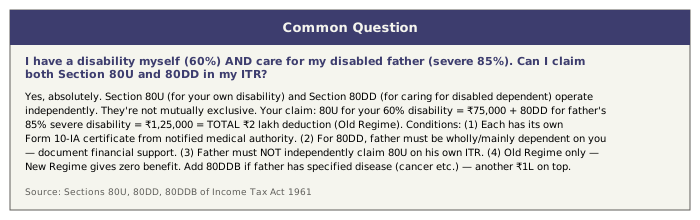
Section 80DD of Income Tax Act 1961; Rule 11A.
Section 80DDB — Specified Diseases Treatment
For actual medical expenses on serious illnesses, Section 80DDB provides expense-based deduction.
Key difference from 80U/80DD.
While 80U and 80DD give fixed deduction regardless of expense, 80DDB gives lower of:
- Actual medical expense incurred, OR
- The maximum limit (₹40,000 or ₹1,00,000)
So you need to track and document actual expenses.
Specified diseases under Rule 11DD.
The complete list under Section 80DDB:
Cancer (malignant):
- All forms of malignant cancer
- Documented by oncologist
Neurological diseases:
- Dementia (advanced stage)
- Ataxia
- Chorea
- Hemiballismus
- Parkinson's disease
- Aphasia
- Motor neuron disease
- Dystonia musculorum deformans
Chronic renal failure.
- Documented by nephrologist
- Includes those on dialysis or post-transplant
Hematological disorders:
- Hemophilia
- Thalassemia
AIDS.
- Confirmed by approved diagnostic test
- Documented by infectious disease specialist
Plus other notified diseases over time.
Eligibility for the deduction.
You can claim 80DDB for medical treatment of:
- Yourself
- Spouse
- Dependent children
- Dependent parents
- Dependent brothers and sisters
Deduction limits based on patient's age (not filer's age).
| Patient Age | Maximum Deduction |
|---|---|
| Below 60 | Up to ₹40,000 |
| 60 and above | Up to ₹1,00,000 |
The deduction is lower of:
- Actual medical expenditure, OR
- The age-based limit
Form 10-I prescription.
Critical document — without it, deduction is denied.
Form 10-I must be issued by:
- For cancer: an oncologist with DM/MBBS+MD/MD(Medicine)
- For chronic renal failure: a nephrologist (DM Nephrology) or a urologist
- For neurological diseases: a neurologist (DM Neurology) or MBBS+MD(Medicine)
- For hematological disorders: a haematologist (DM)
- For AIDS: appropriate specialist
The prescription must:
- Name the patient
- Specify the disease
- Be issued before the medical expense (or as soon as practical)
- Include doctor's qualification, registration number
Form 10-I from a private clinic specialist works only if the specialist's qualifications meet the rule requirements. Government hospital specialists often easier to navigate.
Insurance reimbursement reduction.
If insurance company reimburses any part of the medical expense, your deduction reduces by reimbursed amount.
Spent ₹80,000 on cancer treatment. Insurance reimbursed ₹50,000. Deductible amount: ₹30,000 (the unreimbursed portion). Sub-limit: Up to ₹1 lakh for senior patient. So ₹30,000 is fully claimable (within the ₹1L limit for senior).
Practical claim process.
- Get Form 10-I from specialist
- Maintain detailed medical bills (hospital, doctor consultations, pharmacy, diagnostic tests)
- Document insurance reimbursements
- Compute net medical expense (after reimbursement)
- Claim lower of actual expense or limit
- Include in 80DDB during ITR filing
Section 80DDB of Income Tax Act 1961; Rule 11DD specifying diseases.
Medical Certification Process
The certification process is often the most challenging part of claiming disability deductions.
Where to get disability certificate (Form 10-IA).
Government hospitals.
- Civil Surgeon (Senior Medical Officer) at District Hospital
- Mostly free or nominal fee
- Detailed evaluation including specialist input
- Most reliable for tax purposes
Notified specialist boards.
- For specific conditions, separate boards exist
- Mental disability board (NIMHANS Bangalore, NIMHIR Mumbai, etc.)
- Cancer registries for chronic conditions
- Specialist hospitals (AIIMS, etc.)
Private hospitals with notified specialists.
- Some private hospitals have authorized specialists
- Verify the doctor's notification status
- Generally more expensive but quicker
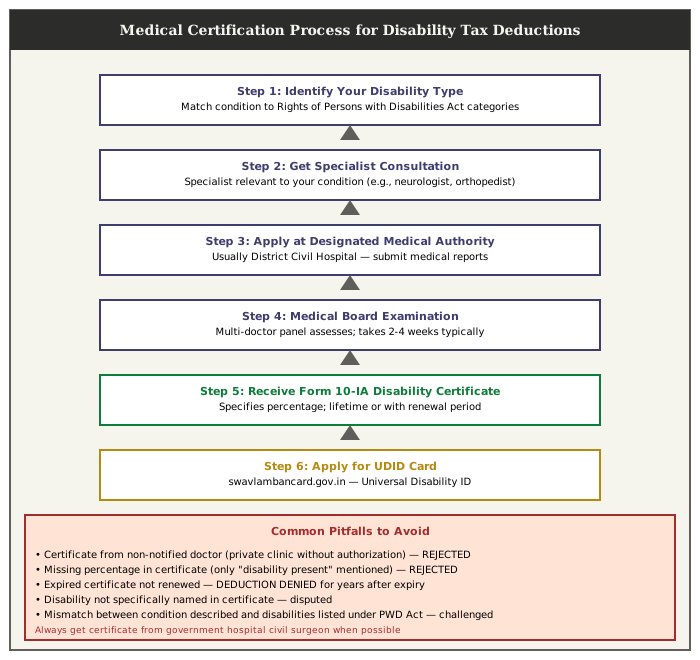
Step-by-step certification process.
Step 1: Identify your disability category.
- Physical, intellectual, mental illness, neurological, etc.
- Refer to Rights of Persons with Disabilities Act
- Match condition to recognized category
Step 2: Get specialist consultation.
- Specialist relevant to your disability
- They assess and document the condition
- Specialist provides medical opinion
Step 3: Apply for disability certificate.
- At designated medical authority (usually District Hospital)
- Submit medical reports
- Medical board examines
- Certificate issued specifying percentage
Step 4: Aadhaar-link the certificate.
- Most disability certificates now linked to UDID (Unique Disability ID)
- UDID card is the master credential
- Apply at swavlambancard.gov.in
UDID card.
Universal Disability Identity (UDID) card:
- Single permanent identification for disability
- Issued by Department of Empowerment of Persons with Disabilities
- Universally accepted for benefits/concessions
- Includes Form 10-IA equivalent information
Validity and renewal.
For permanent disabilities (e.g., congenital, severe physical):
- Lifetime certificate
- No renewal needed
For progressive or potentially treatable conditions:
- Validity may be 1-5 years
- Renewal requires re-evaluation
- Tax department checks validity for each AY claimed
Common certification issues.
Issue 1: Wrong percentage assessment.
Sometimes initial percentage assessment is conservative. Re-evaluation may be needed if condition has deteriorated or if initial assessment seemed too low.
Issue 2: Certificate from non-notified doctor.
Tax department rejects certificates from doctors not on the notified list. Always verify before getting certificate.
Issue 3: Expired certificate.
Common — busy taxpayers forget renewal dates. Tax department denies deduction without valid certificate.
Issue 4: Disability not specifically named.
Some certificates say "disability" without specifying type/percentage. Insufficient.
Rule 11A of Income Tax Rules; Persons with Disabilities Act 2016; UDID portal regulations.
LIC Jeevan Aadhar and Specialized Schemes
Insurance products specifically designed for families with disabled dependents.
LIC Jeevan Aadhar — Overview.
A specialized policy from LIC providing financial security for disabled dependents. The unique feature: payouts continue regardless of the proposer's death.
Key features.
- Proposer is parent/guardian of disabled dependent
- Premium paying term: up to 35 years
- Maturity benefit: lump sum to the disabled beneficiary
- Death benefit: ensures continued financial support
- Acts as deposit qualifying for Section 80DD deduction (₹1,25,000 limit for severe disability)
How it works for tax purposes.
During payment period:
- Annual premiums paid by proposer
- Qualifies as "deposit in approved scheme" under Section 80DD
- Claim ₹75,000 or ₹1,25,000 deduction (based on dependent's severity)
At maturity or death of proposer:
- Lump sum paid to disabled beneficiary
- Beneficiary's financial security ensured
- Lump sum largely tax-free to beneficiary
Why families value this.
Many disabled adults will outlive their parents. Parents worry: who will care for them financially? LIC Jeevan Aadhar addresses this:
- Guaranteed corpus for dependent
- Survives even if proposer dies young
- Combined with tax deduction during payment
Other similar schemes.
ICICI Pru Smart Kid - Special Need. Similar structure for disabled children.
Family insurance for medical conditions. Some insurers provide policies covering specific medical conditions affecting dependents.
Long-term care insurance. Less common in India; available through some private insurers.
Comparison with regular investments.
If you save ₹1.25 lakh annually for 25 years at 8% return: ~₹92 lakh corpus.
If you use LIC Jeevan Aadhar with same premiums:
- Earlier years: tax savings of ₹37,500 per year (30% bracket × ₹1.25L)
- Total tax saved over 25 years: ~₹9 lakh
- Maturity value: depends on plan but typically ₹80-100 lakh
The tax savings give a slight edge to insurance-based approach + provides life insurance protection.
Section 80DD; LIC product brochures; IRDAI approved insurance products.
Niramaya Health Insurance Scheme
A specialized health insurance scheme by National Trust for specific developmental disabilities.
Background.
National Trust for the Welfare of Persons with Autism, Cerebral Palsy, Mental Retardation, and Multiple Disabilities Act, 1999 created the National Trust. Niramaya is its health insurance scheme.
Coverage.
For people with:
- Autism
- Cerebral palsy
- Mental retardation (intellectual disability)
- Multiple disabilities (combination of above)
Benefits.
- Health insurance coverage for the beneficiary
- Premium covers most medical needs
- Includes therapy, rehabilitation, mental health care
- Coverage continues regardless of family financial circumstances
Premium and conditions.
- Premium per year: nominal (typically ₹250-₹500 for low-income; varies)
- Income-tested or available to all
- Documentation: disability certificate
- Renewable annually
Tax implications.
Premium paid by family: qualifies under Section 80D as health insurance for dependent. Section 80D limits apply (₹25,000 for general; senior with disability scenarios may apply higher limits).
Why this matters.
Many private insurers exclude or restrict coverage for these conditions. Niramaya provides accessible coverage specifically for this population. The financial protection is meaningful for families.
Where to apply.
Apply through:
- Authorized organizations affiliated with National Trust
- District-level disability welfare offices
- National Trust website
National Trust Act 1999; Niramaya scheme regulations; National Trust portal.
Estate Planning for Disabled Dependents
Specific considerations when planning for the long-term financial security of disabled family members.
The core challenge.
If you support a disabled dependent and they will outlive you, who manages their finances? How do you ensure they have continued income? Estate planning for disabled dependents addresses these questions.
Key planning instruments.
Trusts.
A discretionary trust can hold assets for the disabled person's benefit:
- Trustees manage the assets
- Distributions made for beneficiary's needs
- Beneficiary doesn't have direct ownership (good if they cannot manage finances)
- Trust is taxable entity in India — files separate ITR
Setup of trust:
- Trust deed identifying beneficiary, trustees, terms
- Stamp duty applicable
- Tax registration of trust as separate entity
HUF structuring.
If family is Hindu Undivided Family:
- HUF can hold property for benefit of disabled member
- HUF tax planning advantages remain
- Membership rules for disabled member based on personal law
Insurance-based planning.
- LIC Jeevan Aadhar (covered above)
- Annuity products providing lifetime payments
- Life insurance with the disabled person as beneficiary
Legal guardianship vs financial trustee.
For severely disabled adults:
- Legal guardian: handles personal affairs
- Financial trustee/conservator: handles money matters
- Both may be different people
Will provisions.
In your will, specifically address:
- Who will be financial guardian for disabled child
- Assets earmarked for disabled person
- Backup guardians if primary unable
- Discretionary vs fixed distribution
Succession planning timeline.
| Time | Action |
|---|---|
| Now | Will, trust, insurance setup |
| 5 years | Review and update; assess investments |
| At parent's death | Trustees assume control; beneficiary protected |
| Lifetime of beneficiary | Continuous distributions; tax compliance |
Sibling planning.
If non-disabled siblings will support disabled sibling:
- Document expectations in writing
- Establish trust structure to formalize support
- Insurance/trust accumulates for the future obligation
- Avoids family conflict over distribution
Common pitfalls.
Pitfall 1: No documentation. Verbal commitments to support disabled sibling rarely survive death or family disputes.
Pitfall 2: Direct ownership in disabled person's name. If beneficiary cannot manage finances, direct ownership creates problems (banks may freeze accounts, finances may be mishandled).
Pitfall 3: Inadequate corpus. ₹10-50 lakh seems substantial but for 30-40 years of support, may be inadequate.
Pitfall 4: Tax-inefficient structure. Without planning, distributions may face higher taxation than necessary.
Indian Trusts Act 1882; Hindu Succession Act 1956; Persons with Disabilities Act 2016.
Long-Term Care Planning
Planning for the lifetime financial needs of a disabled dependent.
Computing the corpus needed.
Step 1: Estimate annual expenses for the dependent.
- Medical/therapy costs
- Daily care expenses
- Special needs (equipment, assistance)
- Standard living expenses
- Buffer for unexpected costs
Step 2: Estimate expected lifespan and care duration.
- Use medical/life expectancy estimates
- Consider improving conditions or stable disabilities
Step 3: Inflation adjustment.
- Costs grow 5-8% annually
- Therapy/medical costs often grow faster
Step 4: Discount rate (investment return).
- Conservative 7-9% return assumption
- Stay liquid for unexpected needs
Step 5: Required corpus = Future expense stream discounted to present value.
Example calculation.
Disabled dependent, age 25:
- Current annual expenses: ₹4 lakh
- Expected life: 40 more years (until 65)
- Inflation: 7%
- Investment return: 9%
Year 1: ₹4 lakh Year 10: ₹4L × 1.07^9 = ₹7.36 lakh Year 25: ₹4L × 1.07^24 = ₹20.34 lakh Year 40: ₹4L × 1.07^39 = ₹55.16 lakh Total nominal expenses over 40 years: ~₹8 crore Present value at 9% discount: ~₹2.5-3 crore
So family needs to build ~₹3 crore corpus over their working years to provide for this dependent's lifetime needs.
Investment strategy.
Long-term (parents in 30s-40s):
- Equity-heavy investments (60-70%)
- ELSS for 80C + 80DD deposit
- LIC Jeevan Aadhar for guaranteed maturity
- PPF for stability
Mid-term (parents in 50s):
- Reduce equity exposure
- Increase fixed income
- Start liquid funds for accessibility
At/after retirement:
- Conservative allocation
- Monthly income generation
- Trust structure operational
Annual review framework.
- Update expense estimates
- Recalculate required corpus
- Adjust investment mix
- Review insurance adequacy
- Update will and trust documents
General financial planning principles; insurance product structures; trust law.
Stacking Strategy for Maximum Tax Benefit
How to combine multiple disability-related deductions for maximum benefit.
Possible stacking scenarios.
80DD: ₹1,25,000 (severe disability) - claim by working parent 80D: ₹25,000 health insurance for family (covers dependent) 80D: ₹50,000 for senior parent health insurance (if applicable) Section 80GG (if renting): up to ₹60,000 Total potential: ₹2.6 lakh
80U: ₹1,25,000 (self severe disability) 80D: ₹25,000 self health 80D: ₹50,000 parent health 80DDB: ₹1,00,000 (parent cancer treatment) Total: ₹3.0 lakh
80DD: ₹1,25,000 (claimed by one spouse) 80U: cannot claim - dependent doesn't file own return 80D: ₹25,000 family 80D: ₹50,000 each spouse's parents (if 60+) 80DDB: depends on diseases Total potential: ₹3.0-4.5 lakh
Regime decision implications.
For families with substantial disability-related deductions:
- Old Regime allows all these deductions
- New Regime denies all of them
A family with ₹3 lakh of disability-related deductions:
- Old Regime: Tax saved at 30% bracket = ₹90,000 (substantial)
- New Regime: ₹0 saved
For middle-to-higher income families, this is a strong reason to stay with Old Regime.
Documentation across deductions.
Maintain coordinated documentation:
- Family medical file with all certificates
- Annual updates and renewals tracked
- Receipts categorized by section claimed
- Bank statements showing all medical expenditures
Annual planning.
At year-start (April):
- Review all certificates and validity
- Plan renewals before expiry
- Estimate annual medical expenses
- Choose regime considering deductions
Quarterly:
- Track medical expenses
- Insurance renewals
- 80D health insurance premiums
- Form 10-I prescriptions for ongoing conditions
Year-end (March):
- Pay any pending insurance premiums
- Final medical expense compilation
- Tax document organization
Combined principles from Sections 80U, 80DD, 80DDB, 80D of Income Tax Act 1961; CBDT compliance guidance.
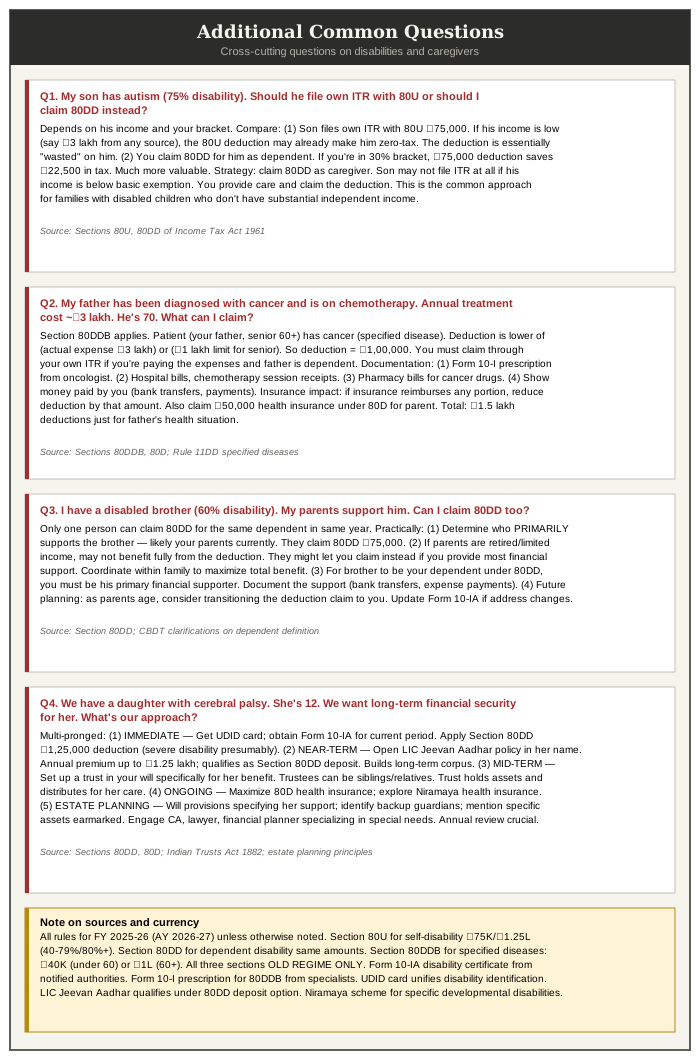
End of lesson — Additional common questions
Key Takeaways
- Section 80U provides a fixed deduction of ₹75,000 (40–79% disability) or ₹1,25,000 (80%+) to resident individuals with a certified disability under the Rights of Persons with Disabilities Act — the amount is fixed regardless of actual expense and is available only under Old Regime; Form 10-IA from an authorized government authority is mandatory
- Section 80DD provides the same fixed deduction amounts as 80U but is claimed by the caregiver for a disabled dependent — 80U and 80DD are mutually exclusive for the same person: either the dependent files their own return claiming 80U, or the caregiver claims 80DD; for dependents unable to file, 80DD is the default choice
- Section 80DDB differs fundamentally by covering actual medical expenses on specified serious diseases under Rule 11DD (cancer, neurological diseases, chronic renal failure, hemophilia, thalassemia, AIDS) — deduction is the lower of actual expense or the age-based limit (₹40,000 below 60; ₹1,00,000 for 60+); insurance reimbursements directly reduce the deductible amount; Form 10-I from a qualified disease-specific specialist is required
- Medical certification requires Form 10-IA from a government civil surgeon or notified specialist — certificates from unauthorized private clinics are rejected; the UDID (Universal Disability ID) card at swavlambancard.gov.in serves as the master disability credential; permanent disabilities get lifetime certificates while progressive conditions require periodic renewal and tax department validates for each AY claimed
- LIC Jeevan Aadhar qualifies as a deposit under Section 80DD — annual premiums paid by parent/guardian trigger the full 80DD deduction; the lump sum payable on maturity or proposer's death goes to the disabled beneficiary largely tax-free; Niramaya scheme from the National Trust covers autism, cerebral palsy, intellectual disability, and multiple disabilities with nominal annual premiums qualifying under Section 80D
- Estate planning for disabled dependents should use a discretionary trust (beneficiary avoids direct asset ownership), formalize sibling support commitments in writing to survive death or family disputes, and build adequate corpus — a 25-year-old dependent needing ₹4 lakh annually requires approximately ₹2.5–3 crore corpus assuming 7% inflation and 9% return over 40 years
- Disability-related deductions can be stacked substantially: 80DD (₹1,25,000) + 80U (₹1,25,000 for self-disability) + 80D (₹75,000) + 80DDB (₹1,00,000) can reach ₹3–4.5 lakh under Old Regime — at the 30% bracket this represents ₹90,000–₹1.35 lakh annual tax savings, making Old Regime strongly preferable over New Regime for this population
Quiz — 5 Questions
Answer one at a timeA resident individual has a certified locomotor disability assessed at 65%. Under Section 80U, what is the deduction available for AY 2026-27 under Old Regime?